PHOTOS: Pontifical Mass at the Throne – 13 Oct 2017 – @MadisonDiocese

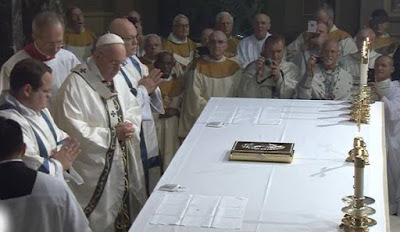
On Friday 13 October, we had a Pontifical Mass at the Throne with the Extraordinary Ordinary of Madison, His Excellency Most Reverend Robert C. Morlino at the little church of St. Mary in Pine Bluff where Fr. Richard Heilman is pastor.

Here are some images from the Mass.  NB: Some of you readers helped to buy the vestments!   HERE

IMG_2898

Out Lady of Fatima has been in the church during the anniversary months.

IMG_2904

IMG_2908

The size of the sanctuary required us to find a Roman solution for the sacred ministers.  We seated them on the steps of the altar, which worked well.  We’ve done this before.

IMG_2923

We are getting good enough at these Masses that we were able to proceed with about 20 minutes of practice of a few rough spots.  The priests, who rotate through roles when we have these Masses, are pretty familiar now with the sacred action.

IMG_2931 IMG_2933 IMG_2939 IMG_2953 IMG_2954 IMG_2957  IMG_2958

There were people standing along the sides and in the back, and we put more chairs in the narthex.

IMG_2967

Turning the housling cloths.  At this parish, even for the Novus Ordo Masses, everyone uses the rail and I don’t believe anyone receives in the hand anymore.

IMG_2982 IMG_2991 (2)

IMG_3005

Fr. Heilman was one of the Deacons at the Throne.

IMG_3014

Posted in "How To..." - Practical Notes, Liturgy Science Theatre 3000 | Tagged , , , ,
18 Comments

WDTPRS 19th Sunday after Pentecost: SECRET – saving and healing

NADAL_19_post_pent_smToday’s Secret for the 19th Sunday after Pentecost was in ancient versions of the Gelasian Sacramentary, such as the 8th c. Gellonensis.  I don’t think it survived the scissors of the Consilium, wielded by Fr. Bugnini’s liturgical experts.

SECRET (1962MR):

Haec munera quaesumus, Domine, quæ oculis tuae maiestatis offerimus, salutaria nobis esse concede.

In prayers which stress propitiation we will often have looking words or imagery.  For example, we get orations with the gentle imperative respice, from respicio (“look upon, have regard”).  We also put things and ourselves in God’s sight, “in conspectus tuo” and, as today, we offer things to the “eyes of your majesty”.   I think this is both a “courtly” form of address, but it also resonates of the Biblical, as in Ps 32 (33):18: “Behold the eyes of the Lord are on them that fear him: and on them that hope in his mercy.”  We know from many other WDTPRS articles that maiestas can be a form of address for God, as in “Your Majesty”, but it also refers to a divine characteristic, His glory, in this case tied to His mercy.

SUPER LITERAL TRANSLATION:

We beseech You, O Lord, grant that these gifts which we are offering in the sight of Your majesty, are for us saving things.

SMOOTHER:

Grant, we beseech You, O Lord, that these gifts which we offer,  under Your merciful gaze, may be for our salvation.

St. Andrew Bible Missal (1962):

O Lord, we ask that these gifts which we offer in the presence of your majesty may be availing unto our salvation.

In the Introit, we begin with Salus, (“salvation, health”).  In the Collect we beg to be freed not only in mind, but also in body.  The Epistle, from Ephesians, we hear the Apostle pray for the renewal of the mind and the new man.  The Church sings in the Offertory “salvum me faciet… Thy right hand will save me.”

The Secret also has salutaria, “saving/healthful things” and in the Postcommunion the priest intones, “medicinalis operatio… the working of healing grace”.

Another common theme in the Mass formulary is that of observance of the commandments.

In the Introit the Psalmist sings “Attend, O my people, to my law.”  In the Collect we pray to seek what is of God (“quae tuae sunt”).  The Communion explicitly speaks about God’s mandata, His commandments “to be kept most diligently”.  The Postcommunion links the medicinalis operatio with keeping God’s laws (“inhaerere mandatis”).

The “medicinal” imagery today may stem from the ancient Roman church where this Sunday’s Mass was celebrated: The Basilica of Sts. Cosmas and Damian, whose feast day since the earliest day has been celebrated in the autumn – in ancient times as today on the fifth day before the Kalends of October (27 Sept).  Remember, this Sunday can “slide around” in the calendar depending on when Easter fell.  St. Cosmas and Damian, you will recall, were brothers and physicians who were martyred during the reign of the Emperor Diocletian in 283.  They were venerated in Rome, having not only a Basilica at the Roman Forum dedicated to their memory, but their names are in the Roman Canon.

Posted in WDTPRS | Tagged
1 Comment

New Book about Galileo!

I’m pretty excited about this book and I haven’t even gotten into it yet!

I’ve read a lot about Galileo over the years.  This looks good.  I like that “in context” part.  The book doesn’t just deal with issues, but about the personalities and competing interests of the day.

Galileo Revisited: The Galileo Affair in Context by Paschal Scotti

US HERE – UK HERE

Inevitably people who attack the Church will bring up Galileo.  When the issue of Faith and Science comes up, Galileo’s name is soon to follow. However, they usually have no idea what really happened with him.

Posted in The Campus Telephone Pole | Tagged
23 Comments

Urgent Prayer Request

May I ask a prayer from the readership?  I am ailing and I must MC a Pontifical Mass this evening.  First, something is wrong with my neck on the right side.  When I move, it hurts like crazy.  Second, I’ve come down with a cold, which makes the neck thing really fun.  I have no energy and a lot of pain.

Please ask, on this most portentous anniversary, the Mother of God and Queen of Priests to intervene for me and lift both of these problems.

Thanks in advance.


Posted in SESSIUNCULA |
20 Comments

D. Madison 13 OCT – Pontifical Mass for 100th anniv of Miracle of the Sun – AND YOUR MASSES

Fatima_miracle_of_the_sunOn 13 October, special Masses will be celebrated on the occasion of the 100th anniversary of the Miracle of the Sun during the final apparition of Our Lady at Fatima.

Use the combox to post about YOUR Masses! 

In Madison, His Excellency Most Rev. Robert C. Morlino, the Extraordinary Ordinary, will celebrate a Pontifical Mass at the Throne at 6 PM at St. Mary’s, Pine Bluff.

Fr. Richard Heilman is pastor of St. Mary’s and the Mass is celebrated there at his request with the assistance of the Tridentine Mass Society of the Diocese of Madison.

We hope to be able also to LIVE STREAM this Mass over the interwebs!  The equipment is in and working.

The Mass will be a 2nd Class Votive Mass of the Immaculate Heart of Mary in accord with Rubricae Generales of the 1962 Missale Romanum 342 & 370-372.

I am sure that in many places special Masses are being organized.

OCTOBER POSTER

Posted in ACTION ITEM!, Events, Liturgy Science Theatre 3000, Our Solitary Boast | Tagged , , , ,
31 Comments

Card. Sarah: Holy See has last word on liturgical translations

New Say The Red - Do The Black / New Translation coffee mugPeople ran around with their hair on fire a while back when Pope Francis changed the process by which translations of the liturgical texts are prepared.  He gave a greater role to bishops conferences.

I read today at the National Catholic Register that Robert Card. Sarah, Prefect of the Congregation for Divine Worship and Discipline of the Sacraments, confirms that the Holy See retains the last word on the translations.

Of course.  It can’t be any other way.

Ed Pentin, the best English-language Vaticanista now, reports:

Cardinal Robert Sarah has weighed in on Magnum Principium, Pope Francis’ motu proprio on liturgical translations, reassuring the faithful that the Vatican will continue to safeguard any changes or new liturgical translations to ensure they remain faithful to the original Latin.

In an article in the French Catholic journal L’Homme Nouveauthe prefect of the Congregation for Divine Worship and the Discipline of the Sacraments (CDW) confirmed that the motu proprio’s change to Canon 838 — which shifts some responsibility for translating liturgical texts away from the Vatican to local bishops — will still require the Vatican to give approval to any such changes or translations.

The article, officially dated Oct. 1 — the day on which Magnum Principium (The Great Principle) came into effect — bolsters the guidance issued with the motu proprio by Archbishop Arthur Roche, secretary of the CDW. Archbishop Roche stressed that the Vatican’s role in confirming texts remains an “authoritative act” presupposing “fidelity” to the original Latin.

Cardinal Sarah’s statements on the matter contradict those who see the motu proprio as a gateway to more liberal vernacular interpretations of liturgical texts, inconsistent with their Latin original.

The Holy Father, who signed Magnum Principium Sept. 3, authorized changes to Canon 838 that decentralized the translation process, giving local bishops responsibility for translating liturgical texts, while retaining the Vatican’s authority to approve or reject a proposed translation.

The CDW will no longer instruct bishops to make proposed amendments, but retains authority to confirm or veto the results at the end of the process. [I effect, however, I’ll bet that there will be unofficial instruction to make changes.]

Among other consequences, this means that the Vatican commission Vox Clara, which was established by Pope John Paul II in 2002 to help the CDW vet English translations, will no longer be needed.  [I don’t see why it couldn’t still be useful as a liaison, especially now.]


[…]Liturgiam Authenticam

In his article, Cardinal Sarah begins by reasserting that the “authoritative text” concerning liturgical translations remains Liturgiam Authenticam, the 2001 instruction issued by the CDW, that aimed to ensure “insofar as possible” that texts must be translated from the original Latin “integrally and in the most exact manner.”

For this reason, he continues, the faithful translations carried out and approved by bishops’ conferences “must conform in every way to the norms of this instruction.”


[…]

Read the rest there.

Posted in Liturgy Science Theatre 3000, New Translation, WDTPRS | Tagged , , ,
7 Comments

A Dominican Thomist examines the claim that “Amoris laetitia” is “Thomistic”

Aquinas_AmorisThis is really important.

I’ve been waiting for a Dominican well-versed in Thomas to examine the claim that Amoris laetitia is a “Thomistic” document and/or that it makes good use of the Angelic Doctor’s words.

At LifeSite find an examination by Father Thomas Crean, O.P., who has serious credentials.

I think what he wrote settles the issue.

I suggest that you print it out.


Posted in SESSIUNCULA | Tagged , ,
29 Comments

25th Anniversary of the release of the Catechism of the Catholic Church

Today is the 25th anniversary of the release of the Catechism of the Catholic Church.  St. John Paul II approved the provisional text in June 1992 and it was promulgated on 11 October 1992, which is also the anniversary of the opening of the Second Vatican Council.  Hence, today is also the feast of Pope St. John XXIII who opened that Council with a speech known today as Gaudet Mater Ecclesia.

In that speech, the most important thing Pope John said was:

The manner in which sacred doctrine is spread, this having been established, it becomes clear how much is expected from the Council in regard to doctrine. That is, the Twenty-first Ecumenical Council, which will draw upon the effective and important wealth of juridical, liturgical, apostolic, and administrative experiences, wishes to transmit the doctrine, pure and integral, without any attenuation or distortion, which throughout twenty centuries, notwithstanding difficulties and contrasts, has become the common patrimony of men. It is a patrimony not well received by all, but always a rich treasure available to men of good will.

Our duty is not only to guard this precious treasure, as if we were concerned only with antiquity, but to dedicate ourselves with an earnest will and without fear to that work which our era demands of us, pursuing thus the path which the Church has followed for twenty centuries. […]
… But from the renewed, serene, and tranquil adherence to all the teaching of the Church in its entirety and preciseness, as it still shines forth in the Acts of the Council of Trent and First Vatican Council, the Christian, Catholic, and apostolic spirit of the whole world expects a step forward toward a doctrinal penetration and a formation of consciousness in faithful and perfect conformity to the authentic doctrine, which, however, should be studied and expounded through the methods of research and through the literary forms of modern thought. The substance of the ancient doctrine of the deposit of faith [NB] or the truths which are contained in our time-honored teaching is one thing, the manner in which these truths are set forth – in the same meaning and understanding – is another. [NB… that last bit is often left out of translations!] And it is the latter that must be taken into great consideration with patience if necessary, everything being measured in the forms and proportions of a magisterium which is predominantly pastoral in character.

Does that sound like what is going on today?

“adherence to all the teaching of the Church in its entirety and preciseness”

“a formation of consciousness in faithful and perfect conformity to the authentic doctrine”

I have a PODCAzT about John XXIII’s speech.  HERE

This anniversary prompts me, once again, to urge that you dear readers begin to form small study groups.   Let’s call them “base communities”.

In self-enrichment and in self-defense, begin to study the Catechism of the Catholic Church together.

Read, review, study the Catechism of the Catholic Church.

US HERE – UK HERE (There are many editions.  Look around.)

I am a huge fan of Kindles (US HERE – UK HERE), but you should also have the BOOK, the material volume which you can hold in your hand and write in.  Get the book, which you can flip around in and hold spots in with a couple fingers as you cross check.

Read it.  Pick it up. Read portions every day.

St. John Paul II called the CCC, “a sure reference point”.

Finally, I have a personal anecdote about the CCC.

First, some strong Latin students were asked to contribute to the first Latin version of the CCC.  I was one of them (Matrimony).  It was a strange process.  The provisional text of the Catechism was composed mainly in French. The Italian text was prepared from the French, but Italian became the bases of the Latin version.  Imagine the difficulties that could arise when translating quotations, etc.   Keep in mind that the 1992 text was provisional.  It was eventually revised.  There were quite a few errors of citations, etc.  The text was given to my school, the Patristic Institute Augustinianum, for double-checking and verification and correction.  When that process was completed, the president of the Institute, who knew I worked in the Palazzo Sant’Uffizio across the road from the Augustininianum, asked me to deliver the finished text to the Cardinal Prefect.  And so, I carried the final version of the corrected, official LATIN text wrapped up in brown paper, up to Card. Ratzinger’s office and put it into his hands.  St. Pope John Paul II would promulgate that official Latin text in 1997 on the Feast of the Assumption.

Posted in Linking Back, Our Catholic Identity | Tagged , ,
14 Comments

ASK FATHER: Confirmation at an SSPX chapel?

009_TmsmConfirmation2016From a reader…

QUAERITUR:

Thanks for all that you do on this blog. It’s been a real blessing for me and my family over the years. My question concerns confirmation. I live in a diocese where the bishop has established a “policy” of not confirming children until they are 15. The pastor of my FSSP parish has been very reluctant to fight this. My impression is that we are barely tolerated in the diocese so I understand his position, but I nevertheless need to get my children confirmed. I have a 13 year old and an 11 year old that very much want to be confirmed this year. They know their catechism. If the diocese won’t confirm them because of their “policy” (which seems to contravene the canon law right of the faithful to receive the sacraments), would I sin by having recourse to the local SSPX chapel for confirmation? I’m not sure what else to do. Recourse to Rome seems unlikely to bear fruit these days, and waiting until 15 is unacceptable.

Pope St. Pius X, of blessed and hallowed memory (Lord, raise up holy clergy and hierarchy like unto him!) did many good things for the Church. However, his decision to move the age of First Holy Communion back to the age of reason, while arguably laudable, displaced the Sacrament of Confirmation. Valiant attempts have been made to put the Sacraments of Initiation back into their traditional order (Baptism, Confirmation, Holy Communion), but in many places these attempts have been met with fierce resistance from various quarters But, perhaps that is tangential to this immediate and pressing question.

Parents are the primary educators of their children. We are constantly reminded of this by Holy Mother Church. Pastors of souls have the obligation of ensuring that their flock are well-prepared, properly disposed, and ready to receive the sacraments. The Latin Rite Bishops in these USA mandated by decree on 21 August 2001, that the proper age for confirmation is “between the age of discretion and about sixteen years of age, within the limits determined by the diocesan bishop and with regard for the legitimate exceptions given in canon 891.”

So, the Bishops punted.

Rather than opting for a younger age, or an older age, the Bishops mandated somewhere between 7 and 16. Quite a wide berth. However, local bishops have the right to make additional specifications.

If one disagrees with one’s Bishop, who makes a decision about something which is within his purview to decide, what can one do?

St. Ignatius of Antioch has some advice:

“Your submission to your bishop, who is in the place of Jesus Christ, shows me that you are not living as men usually do but in the manner of Jesus himself, who died for us that you might escape death by belief in his death. Thus one thing is necessary, and you already observe it, that you do nothing without your bishop; indeed, be subject to the clergy as well, seeing in them the apostles of Jesus Christ our hope, for if we live in him we shall be found in him.”

In your case, I would write a letter to the bishop and plead for an exception to his decision. Offer to meet with him, not in a hostile way, but as a devoted child to a pastoral father.

If the bishop rejects the letter, rejects the offer to meet with him, stands firm on his decision (which, again, is his decision to make), one may still disagree with him.  However, in this antinomian age, obedience to our legitimately appointed shepherds in those things legitimately deputed to them, as difficult as it may often be, can be  a way of loving submission to Our God.

Mind you, obedience in those arenas where a bishop does not have legitimate authority is an entirely different kettle of fish.

I would not go to a chapel of the SSPX until they are fully reintegrated in a manifest way.

That said, I have on occasion also answered questions about going outside of one’s diocese for confirmation.  Can. 886 of the Code of Canon Law for the Latin Church states,

“A bishop in his own diocese may lawfully administer the sacrament of confirmation even to the faithful who are not his subjects, unless there is an express prohibition by their own Ordinary.”

For example, last November here in Madison, the Bishop conferred the sacrament on many young people, some of whom were brought by their parents from many states away.  We will have confirmations again in December, I believe, and I expect the same will happen to a greater or lesser degree.  Of course, there was in the case of each confirmand a written verification with the pastor of his or her parish.  These things are not done in the dark, sneaking around.

Some people who find that their local bishop is not cooperative, could discover that the bishop of the neighboring diocese may be friendly and helpful.

Posted in "How To..." - Practical Notes, ACTION ITEM!, Liturgy Science Theatre 3000, SSPX | Tagged , ,
21 Comments

“What is happening to our world?”

fatima_hellThe other day Archbishop Salvatore Cordileone of San Francisco consecrated the archdiocese entrusted to his care to the Immaculate Heart of Mary.

Many bishops are doing the same with their dioceses.  I have a growing list HERE.

In his sermon, Archbp. Cordileone spoke in strong, clear terms.  HERE Among his remarks, I find these of special note.  He starts out with recounting the vision the children at Fatima had of Hell.  Then…

[…]

What is happening to our world? In so many different ways, what was once unthinkable has become routine. The century since the Fatima apparitions now ending has mocked God, but God will not be mocked: not because He delights in wreaking vengeance on us, but because turning our backs on God only bounces back to us, leading to our own self-destruction.

[…]

For 100 years we ignored the message of Fatima; or, perhaps, it is not so much the message we ignored, for we are well aware of the warnings and the history that resulted. Rather, it is the requests we ignored. But we cannot afford to do so any longer. We have to pay attention. We have to do what she told the waiters at Cana: do whatever he tells you. And what does Christ tell us to do? He reveals this in the requests our Lady made at Fatima. It is now time to heed those requests. We might not have the power to change world history, but we can change what happens in our own families and communities if we heed the message. This next century can be radically different from the last one, but only if we heed the message and respond to the requests.

Which means that what we are doing today cannot be relegated to being simply a moving event and pleasant memory in the history of our Archdiocese. Far from being something we check off on a to-do list, what we are about today is nothing less than a call to arms: to spiritual arms. We are living in a time and place of intense spiritual battle, and only in taking up spiritual arms will we alleviate the spiritual disease that is at the root of so much of the physical and mental suffering in the world today. It is time to leave the sensational aside, and respond to the requests of our Lady at Fatima.

[…]

We need to attend to the requests of Our Lady.


Posted in "How To..." - Practical Notes, Our Solitary Boast | Tagged , ,
4 Comments