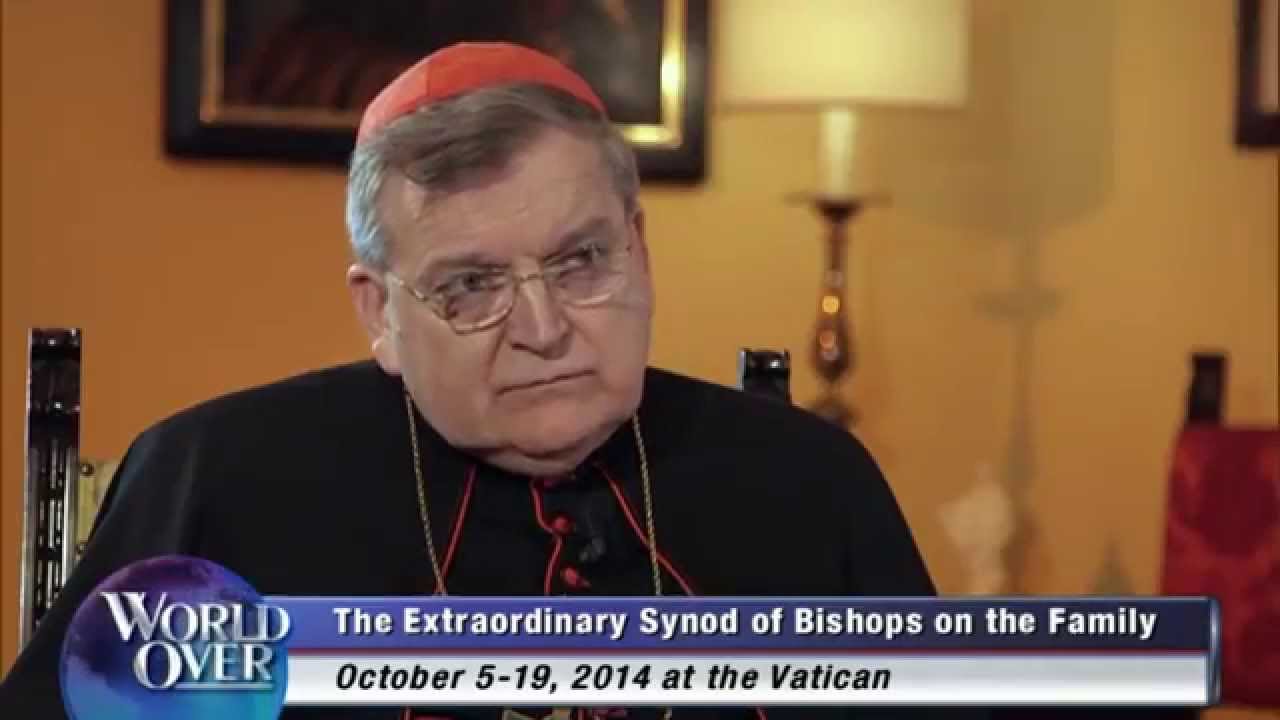
Did no one know that when the MSM got hold of the ‘Relatio’, people were going to go bananas?

We continue to watch the spin and the spinning of the spin after yesterday’s Synod… what can we call it?…. debacle.  Yes, debacle.  The release of the Relatio post disceptationem, an unprecedented mid-point summary document, was a debacle.   It has provoked “wonder”, which is old Church code for “shock, scandal provoking confusion”.

It was telling that, during yesterday’s presser, for the presentation of the Relatio, the chair of the Synod, Card. Erdö, tossed a question about the now infamous homosexuality paragraphs over to Archbp. Bruno Forte (whom some suggest might wind up as Prefect of a Franciscan CDF… if it isn’t Archbp. Fernandez), saying: “the one who wrote the passage ought to know what it means”.

The Holy See Press Office spun the Relatio this way:

Declaration of the Director of the Holy See Press Office on behalf of the General Secretariat of the Synod

The General Secretariat of the Synod, in response to reactions and discussions following the publication of the Relatio post disceptationem, and the fact that often a value has been attributed to the document that does not correspond to its nature, [Is that so?] reiterates that it is a working document, which summarises the interventions and debate of the first week, and is now being offered for discussion by the members of the Synod gathered in the Small Groups, in accordance with the Regulations of the Synod.
The work of the Small Groups will be presented to the Assembly in the General Congregation next Thursday morning.

A good example of spin – and the massive damage inflicted by the release of the Relatio – is found at CNN, which has a few slanted points:

Under conservative assault, Vatican backtracks on gay comments

Rome (CNN) — Under furious assault from conservative Catholics, [Furious assault?] the Vatican backtracked Tuesday on its surprisingly positive assessment of gays and same-sex relationships.
In a report Monday, the Vatican had said that gays and lesbians have “gifts to offer” the Christian community and acknowledged that same-sex couples can give “precious support” to one other.
The statement, an interim report from a closely watched meeting of Catholic clergy here, was widely praised by liberals. It is believed to be the first time the Vatican has said anything positive about gay relationships. [And yet it isn’t supposed to be an official document, a final document.  It’s just a working document.  Right?]
[…]

And that, even with its ominous language about conservatives and their furious assaults, is somewhat more responsible than what you will see at some other outlets, especially the even more openly pro-homosexual sites.

Again, my great worry is not so much what the Synod is talking about, but the expectations that are being raised because of gaffs, errors, bad decisions, weird language and, it must be said, the machinations of some within the Church.

So, let’s accept that the Relatio is just a “working document”.  Fine.

Did nobody in the Synod office or in the Press Office know that when the MSM got hold of it, people were going to go bananas?

Of course they knew that chaos would occur and that certain paragraphs would be read with strong reactions.  Of course they did.

Therefore, someone wanted the chaos.  Someone wanted those now infamous paragraphs to hit the press and then be spun into all sorts of false conclusions and false expectation.  They wanted to bump the needle, move the paradigm in a certain direction.  This seems like a classic exercise in creeping incrementalism.  They know that they are not going to get their way, or get everything that they want… this time.  But they toss things out, create the chaos, and then, even as they back away from it and do some clean up, they have managed to moved the paradigm a degree or two toward their goal.  That’s how they work.

Conservatives, by the way, don’t do this well.  They tend not to work together well and they tend to want everything right away.  It would be great were faithful Catholics able to work together better.  Meanwhile, the catholic Left is having a conga line dance, with noisemakers and little hats.

Anyway, a bright spot today occurred during the presser.  Card. Napier of South Africa said that he was surprised that the Relatio was released and that he clearly disagreed with some elements in the document.  He also is worried about the false expectations that are being created.

UPDATE:

The moderation queue ON.

Meanwhile, TIME magazine – predictably – and purposely – misrepresented the facts.  HERE

The Bishops Are Catching Up To Pope Francis on Gay Rights [How many things are wrong with that.  First, “the bishops” aren’t doing anything. Second, what has Francis really said?  Third, “Gays” don’t have rights, other than basic human rights.]

Mercy must be the way forward for the Catholic Church.  [Which means, I think, you can stick anything where ever you want and eventually people will be forced to call it “good”.]

Stunning news came from Rome today where the bishops [some few bishops] gathered for Pope Francis’s Synod on the Family issued a report suggesting that the Church should create a more inclusive space for gay Catholics to participate in the life of the Church.  [They already have it.]

In the [unofficial draft] document, the bishops [no… the writer of the draft] said without reservation [is that so?] that gay Catholics have “gifts and qualities to offer to the Christian community.” From that, they ask: “are we capable of welcoming these people, guaranteeing to them a fraternal space in our communities?”

This is a stunning language change from the Catholic Church on the question of homosexuality. [Is it?  Really?  Did the document say that it’s okay to have homosexual sex?] Since the Congregation for the Doctrine of the Faith declared in 1975 that “homosexual acts [ACTS!] are intrinsically disordered” Rome has been clear on where it stands on the issue of homosexuality and same-sex unions. As recently as January 2013, Pope Benedict — while affirming the dignity of the LGBT community — suggested that gay marriage threatens the world’s “justice and peace.” [And he was right, as we are seeing today more and more.]

The Church’s shift on LGBT issues began shortly after Pope Francis’s election in March 2013. In July of last year, Francis famously said, “[i]f someone is gay and he searches for the Lord and has good will, who am I to judge?” [Hang on!  That comment had a context. HERE]

But today’s document produced by the [tiny number of] bishops [in reality, the one’s who wrote it… it wasn’t a collaboration that all the bishop members of the Synod voted to approve] shows that Pope Francis’s personal vision [HUH?  No.] is slowly becoming the vision of the universal Church. [This babble is the personal vision of the writer.  Enough of this rubbish.]

[…]

This is the sort of trash that people are going to read about this Synod.

Posted in Biased Media Coverage, Liberals, Our Catholic Identity, Sin That Cries To Heaven, The Coming Storm, The Drill, The future and our choices, What are they REALLY saying? | Tagged , , ,
75 Comments

“The truly bizarre document that the Vatican released Monday”

Have you been following the reports of Robert Royal about the Synod of Bishops?

Here’s today’s:

Synod Day 8 – A Bizarre Document and Process Print

I have been in Rome, by my rough count, 100 times during my adult life. Some visits had to do with secular matters of culture or politics, most with questions related to the Catholic Church. But I think I can say without the slightest doubt that yesterday was the strangest day I’ve ever passed in the Eternal City.  [This is what I have heard too.  I’ll head over next week, after the close of the Synod, and will get more of the mood.  It is sure to linger.]

By now, almost everyone interested in Catholic matters knows about what can only be called the truly bizarre document that the Vatican released Monday: the relatio summing up the first week of work by the Extraordinary Synod on the Family. I was at the press conference after the release and it, too, was a very strange thing indeed. More on that below. But before you despair – I can tell you that there were some questions from utterly astonished old Vatican reporters in that room and journalists walking around in shock outside for hours after – things are both bad and maybe also not so entirely bad as they might first seem.

First, the bad. For reasons that may only be know to certain figures involved – or to the God who searches the human heart – a document coming from the Vatican now has passages like these:

50. Homosexuals have gifts and qualities to offer to the Christian community: are we capable of welcoming these people, guaranteeing to them a fraternal space in our communities? Often they wish to encounter a Church that offers them a welcoming home. Are our communities capable of providing that, accepting and valuing their sexual orientation, without compromising Catholic doctrine on the family and matrimony? [Homosexuals do NOT have ”gifts and qualities” for the Church simply because they are homosexuals. They have gifts because they are human beings, not because they want to have sex with people of the same sex.  I made this point yesterday.]
51. The question of homosexuality leads to a serious reflection on how to elaborate realistic paths of affective growth and human and evangelical maturity integrating the sexual dimension: it appears therefore as an important educative challenge. The Church furthermore affirms that unions between people of the same sex cannot be considered on the same footing as matrimony between man and woman. Nor is it acceptable that pressure be brought to bear on pastors or that international bodies make financial aid dependent on the introduction of regulations inspired by gender ideology.
52. Without denying the moral problems connected to homosexual unions it has to be noted that there are cases in which mutual aid to the point of sacrifice constitutes a precious support in the life of the partners. Furthermore, the Church pays special attention to the children who live with couples of the same sex, emphasizing that the needs and rights of the little ones must always be given priority.  [?!?]

If you find your head spinning at the language italicized above, you aren’t the only one. Several of the journalists in the room put very carefully worded questions to the four members of the press conference panel, trying to elicit clarifications. I’m sorry to say that with the exception of Cardinal Erdö, every one of them engaged in a level of spin unworthy of a Church that seeks to proclaim the truth about the Good News of our redemption by Jesus Christ.

I won’t mention the names of respondents out of respect for the nakedness of our fathers. But let me suggest some of the dynamic in the room. One female reporter for RAI Radio, the Italian state-run broadcast services, asked pointedly in response to the last section above about the rights of children, whether they don’t have a right to be raised by a male father and a female mother (an argument that in Europe, especially in France, has been very prominent)? The reply from an exalted cleric was to enter a thicket of platitudes about parental rights to educate a child, which no one objects to or has ever objected to, insofar as they were intelligible. But the fundamental question of having a real mother and a real father went entirely untouched – by a prince of the Church talking about a burning current question.

Similarly, an American journalist [Michael Voris!] raised a question about the absurd phrase in section 50: “Homosexuals have gifts and qualities to offer to the Christian community.” In one way, of course, this is true, since all people have gifts and qualities. The journalist wanted to know, however, whether the Synod fathers were saying that homosexuals have gifts to offer precisely because of their homosexuality? That seemed to be implied.

Sadly, more inconsequential commentary followed. [From Bruno Forte… who, under this Pope, will probably be the next Prefect of CDF if Müller is exiled.] The Synod has been talking a great deal about its respect for the intelligence of the Catholic laity. [Is that why they put a media quarantine around the Synod?] But no Catholic layperson of any intelligence left the press conference yesterday thinking that this subject – and several others – was anything other than more confused than ever and perhaps inclining towards things gay activists have been seeking that cannot be squared with the Gospel.

You can find in the three sections quoted above some nods towards Catholic teaching, of course, but the rest of the summary – which a reliable source close to the process confirmed to me reflected what the bishops actually discussed, even as they “took for granted” Catholic teaching – reads like some hapless running after the small number of people who are pursuing a disordered sex life [The tail isn’t wagging the dog.  The tip of the tail is.] who might still have some vestigial interest in the Church. John Allen has brilliantly formulated this as “lifestyle ecumenism,” a sequel to the ecclesial ecumenism of Vatican II.

There were also more questions, of course, about Communion for divorced and remarried Catholics, and how that might be squared with Jesus’ own words. And again, there were words, many words spoken that continued to try the impossible task to square the circle. No statement that has come out of the Vatican – including the scholarly gyrations of Cardinal Kasper – has come close to making this work. And Cardinal Erdö boldly, for this panel, said certain questions present an either/or: either you give Communion or you don’t.

But here’s a slight counterweight to these otherwise alarming developments.

I spoke over dinner yesterday evening with someone involved in the whole process. That person must remain anonymous, of course, and his opinions may or may not be dispositive. But it may just be that the bishops themselves have been surprised by this document. [The release seems to have been carried out in a very strange way.  Also, the media cordon has prevented differing sides from being reported with any serious weight.] A Synod relatio usually is issued only at the end of the event, and is presented to the pope as the working results of the group he’s asked to advise him. The process is clearly different this time out. There’s still almost an entire week ahead, with small language groups meeting the next few days and the whole group of participants coming together again only on Thursday.

But even if those behind the scenes assure us that the bishops are aware of how they are being misperceived [Ooohhh… I doubt that.] and that the final document or the overall process or something somehow is different than what it seems (and I have to say that the person who told me this has my full confidence) the Church has now dug itself into a deep hole. And why, pray tell, issue such a poorly crafted, deeply flawed, and basically misleading text?

The relatio concludes:

58. The reflections put forward, the fruit of the Synodal dialog that took place in great freedom [Is that so?] and a spirit of reciprocal listening, are intended to raise questions and indicate perspectives that will have to be matured and made clearer by the reflection of the local Churches in the year that separates us from the Ordinary General Assembly of the Synod of bishops planned for October 2015. These are not decisions that have been made nor simply points of view. All the same the collegial path of the bishops and the involvement of all God’s people under the guidance of the Holy Spirit will lead us to find roads of truth and mercy for all. This is the wish that from the beginning of our work Pope Francis has extended to us, inviting us to the courage of the faith and the humble and honest welcome of the truth in charity.

Nice sentiments, but the only thing the world takes away from this – people back home tell me National Public Radio and other outlets are really going to town – is that the Church is cozying up to gays. [The Synod of the MEDIA is what worries me.] That the tone and perhaps the teaching seem to be changing. That divorced and remarried Catholics will soon be able to receive Communion by a process no one can actually explain without sounding like he’s babbling. But it will happen.

The reality may prove to be something different, but that’s the message the Synod has now sent, whether it intended to or not. We’ll see before too long whether that message now can ever be fixed.

We will have some rocky days ahead, my friends.

Posted in Liberals, Pray For A Miracle, Sin That Cries To Heaven, The Coming Storm, The Drill, The future and our choices | Tagged , , ,
94 Comments

ASK FATHER: Are there different ways to get an annulment faster?

From a reader…

QUAERITUR:

Is the process for the Petrine privilege quicker than the annulment process? Is it easier to get? Thanks.

Again with the “getting.”

Let’s get those annulments and let’s get them fast!  Right?  After all, my friend Ellen’s best friend’s cousin’s hairdresser knew a guy who had a third cousin who “got an annulment” in four months because she paid a deacon on the sly. But my other friend Matt’s father’s neighbor had a plantar’s wart burned off by this guy named Lou who was treated really badly by the receptionist at the local tribunal and so he left the Church because his annulment was taking 37 years!  When is the Church finally going to be merciful?  We have to get annulments!

Let’s avoid the language of consumerism when we talk about canonical processes.
Let’s remain sober.

Marriage is brought about by an act of consent between a man and a woman capable of doing so.

A declaration of nullity (often called, imprecisely, an “annulment”) is sometimes the conclusion of a thorough, careful, just and timely review of the facts presented to an ecclesiastical court (tribunal) about a putative marriage.

A declaration of nullity states that, after prudently assessing the facts, the Judges (usually one to three at the first grade of trial and three at the second grade of trial (four judges minimum) arrived at the moral certitude needed to declare that the act of consent which appeared to initiate this putative marriage was invalidly placed, and the marriage did not truly exist in the first place.

It has nothing to do with sacramentality.  It has nothing to do with the legitimacy of children. It has nothing to do with divorce. It has nothing to do with whether one party or the other is a nice person or a real [___].

A “lack of form” case is often the solution to a situation where at least one of the parties in the putative marriage was Catholic, and the marriage took place outside of the Catholic Church, without a priest or deacon (a witness authorized by the Church) present, and without a dispensation. It is a simple declaration: Caia was Catholic, Caia attempted marriage to Sempronius without observing the Catholic form of marriage, Caia wasn’t really married to Sempronius.  Easy peasy.

On the other hand, a Pauline Privilege case is based on 1 Corinthians 7:10-15.  It allows the local bishop to dissolve the bond of a natural marriage.  It’s not an “annulment”. Nothing is declared null.  The Church dissolves a valid marriage bond between two unbaptized persons, one of whom is now baptized or seeking to be baptized, and wishes to enter into a new marriage in the Church.

A Petrine Privilege (Privilege of the Faith) case can only be invoked by the Pope himself.

In these Petrine Privilege cases, the Pope dissolves the bond of a natural marriage.  Again, it’s not a declaration of nullity, but a dissolution between a baptized person and an unbaptized person, in order to permit a subsequent marriage in the Church.

Both Petrine Privilege and Pauline Privilege cases have specific set parameters. They are privileges, not rights.

The bishop or pope is not under any obligation to grant the privilege.

The person requesting the privilege cannot have been the main reason that the marriage has broken up. They both take time. They both require evidence. Neither are “shortcut annulments”.

Everyone must understand some important things about tribunals.

All the processes require educated and trained canonists.  They can be either clergy or lay. They require administrative support and other staff. There are mailings, supplies, programs, ongoing education, not to mention salaries, healthcare, office space, heat, lights, etc.  Nearly every diocese in the world – even those which charge a fee for the process – looses money on their tribunals. But the benefit of a good tribunal by far outweighs the loss of money.   It is worth the economic loss because of the value of protecting the sacredness of the marriage bond.  It is worth the loss to stand strong on and with the Gospel, with the Lord Himself, in favor the permanence of marriage.  The cost of the tribunal is worth it to protect the rights of the parties involved.

Posted in "How To..." - Practical Notes, ASK FATHER Question Box, One Man & One Woman, Our Catholic Identity | Tagged , ,
23 Comments

Jihadist magazine shows black flag flying from St. Peter’s Obelisk

Meanwhile, even as – as some people claim – there are within the Church those who wish to bring her down. There are – as is patently clear to anyone with a brain – there are outside the Church those who wish to bring her down.

Rather, chop off her head.

I saw this at Tempi (Italian HERE):

La bandiera nera sventola sull’Obelisco di San Pietro: la rivista dello Stato islamico festeggia la “crociata fallita”

The black flag waves over the Obelisk of St. Peter: the magazine of the Islamic State celebrates the “failed crusade”

The “crociata” in this case refers to the present loose coalition doing stuff – sort of – to bits and pieces of ISIS, Islamic State, whatever the evil movement of militant Islam is called right now.

Didn’t the leader of this movement say something about going to Rome?

Yes, I remember that correctly. HERE

Rome will be conquered next, says leader of ‘Islamic State’
Muslims have been called to flock to the ‘Islamic State’ to gather for a battle against non-believers throughout the world

Abu Bakr al-Baghdadi, the self-proclaimed leader of the ‘Islamic State’ stretching across Iraq and Syria, has vowed to lead the conquest of Rome as he called on Muslims to immigrate to his new land to fight under its banner around the globe.
Baghdadi, who holds a PhD in Islamic studies, said Muslims were being targetted and killed from China to Indonesia. Speaking as the first Caliph, or commander of the Islamic faithful since the dissolution of the Ottoman empire, he called on Muslims to rally to his pan-Islamic state.

“Those who can immigrate to the Islamic State should immigrate, as immigration to the house of Islam is a duty,” he said in an audio recording released on a website used by the group formerly known as the Islamic State of Iraq and al-Sham.
“Rush O Muslims to your state. It is your state. Syria is not for Syrians and Iraq is not for Iraqis. The land is for the Muslims, all Muslims.

Is this really really really haaaaard for people to grasp?

Sts. Nunilo and Alodia, pray for us!  (Feast 22 October)

Posted in The Coming Storm, The Drill, The future and our choices, The Religion of Peace | Tagged , , , ,
28 Comments

Of annulments and Christmas trees

From the often amusing Eye of the Tiber:

Cardinal Kasper Adds Three Sacraments

Vatican City––Citing the need for the Church to “update herself with modern times,” Cardinal Walter Kasper declared that the Church has now added three Sacraments to the original seven instituted by Christ. In an interview with America, Kasper explained his decision: “Christ challenged the Pharisees to look deeper than the Mosaic Law, and he challenges us to the same. The original seven sacraments were sufficient for their time, but times have changed, and the Church owes the world a greater number of spiritual life rafts.”

Continuing his interview, Kasper added: “We need a paradigm change and we must – as the good Samaritan did – consider the situation also from the perspective of those who are suffering and asking for help. Christ’s sacraments just aren’t doing the job, and so it is our duty as a Church to reach out in other ways.”

Most of all, His Eminence pushed for the Church to adapt to the Metric system: “The number 7 is a prime number; it can’t be divided by anything. And when you multiply it by anything you always get some weird number like 23 or 49. The Church needs to leave behind the Imperial system of Sacraments and join the rest of Europe in the Metric system.”

Pointing out the complexity of modern life as compared to earlier times in human history, Kasper affirmed that “Life is not just black or white or yellow or green or blue or red or purple; there are, in fact, exactly ten nuances. Not seven.”

Kasper’s new list of Sacraments is as follows:

1. Baptism

2. Confirmation

3. Eucharist

4. Reconciliation

5. Marriage

6. Holy Orders

7. Anointing of the Sick

8. Annulment

9. That YouTube video of that Lifehouse song with that Jesus skit

10. Christmas trees

I think he forgot the Church Tax.

Posted in Lighter fare |
14 Comments

Synods are messy. The media quarantine isn’t helping.

One of the reasons why the “Synod of the Media” has been so successful in spinning the Synod is because of the media gag that the head of the Synod of Bishops, Lorenzo Card. Baldisseri, imposed.  For this extraordinary meeting of the Synod, the interventions, or speeches, of the participants weren’t made public through the Vatican website or L’Osservatore Romano.  So much for being in the “information age”.

Some people have observed to me that they found this move “inexplicable”, “unimaginable”, etc.

No.  It is not inexplicable.  When you want to control the message so that you can advance a particular agenda, you try to control the public flow of facts.  Rather, you control which facts become public and which don’t.

In any event, I saw a preview of a fuller interview to come out tomorrow in Il Foglio with Card. Burke.  He isn’t pleased that only one side of what’s going on in the Synod is being reported.

Q: What are you seeing beyond the media cordon which surrounds the Synod.

BURKE: There is emerging of worrisome trend because some are advancing the possibility of adopting a practice that distances itself from the truth of the Faith. Even if it ought to be evident that one cannot go in this direction, many are encouraging, for example, dangerous openings open-minded ideas on the question of communion being given to the divorced and remarried. I don’t see how it’s possible to reconcile the irreformable concept of the indissolubility of marriage with the possibility of admitting to communion those who live in an irregular situation. This places directly into discussion that which our Lord said when he taught that whoever divorces his wife and marries another commits adultery.

[…]

I don’t know how the briefing was conceived but it seems to me that something isn’t working well if the information is being manipulated in a way so as to underscore only one proposal instead of reporting faithfully the various positions that have been brought up. This bothers me a great deal because a significant number of bishops do not accept the ideas of openings [“aperture”] but few know this. They speak only about the necessity that the Church open itself to petitions from the world brought up in February by Cardinal Kasper.

The whole interview comes out tomorrow.

So, a media quarantine is placed around the Synod and the interventions, or speeches.

Suddenly, as the large sessions and cease and the small groups, which draft proposals for a larger document to be given to the Pope start to meet, suddenly there emerges a mid-point report, the relatio post disceptationem.  The unofficial translation is HERE.

Meanwhile, Radio Vaticana reported that the President of the Polish Bishop’s Conference has rejected the Relatio post disceptationem. I found a link HERE.

Sorry, I had to rely on Google for this version . Some words didn’t come through, but I’ll bet there are Polish speakers out there who can help:

Archbishop Gadecki: Document synod of bishops for many unacceptable

In an interview with Vatican Radio chairman of the Polish Episcopate did not hesitate to say that this document departs from the teaching of John Paul II, and even that can be seen in the traces [antyma??e?skiej] ideology. According to Archbishop Gadecki, this text also highlights the lack of a clear vision for the synodal assembly.

[…]

Hey… that old teaching of St. John Paul II? That’s obsolete by now. Familiaris consortio is… what… already 33 years old?

This Synod isn’t looking orderly and peaceful.

But… Synods are not smooth and orderly. Synods are messy.

If you want a smooth and orderly Synod, then take a cue from the old Supreme Soviet meetings, where every clapped at the same time at the same lines.

But first impose a media cordon.

Ironically, my own media cordon is now imposed. The moderation queue is ON.

Posted in Liberals, One Man & One Woman, Our Catholic Identity | Tagged , , ,
40 Comments

Be wary of news reports about the what the Synod is up to

We must be wary about the “Synod of the Media”.

There is a Synod of Bishops that takes place and there is the way the MSM and also Catholic (especial catholic) media spins the Synod.

As the bishops split up in to smaller groups, there comes a status report called the Relatio post disceptationem  (Latin disceptatio is “a dispute, disputation, debate, discussion, disquisition”).

The Relatio p. d. is getting mixed reviews.  Liberals are experiences frissons of glee, which doesn’t usually bode well for truth.

Nicole Winfield of AP has this piece about the newly released mid-point report, after the first week of everyone yakking in the Synod hall.

Note some of the language in this piece.  Nota bene, this is written for a low-information audience, but the language is still pretty misleading.

Bishops [which?] clearly took into account the views of Pope Francis, [of course they would – he’s the Pope] whose “Who am I to judge?” comment about gays signaled a new tone of welcome for the church. [Is there a clear connection between what the bishops considered and what Francis said on the airplane?  Not really.] Their report also reflected the views of ordinary Catholics who, in responses to Vatican questionnaires in the run-up to the synod, rejected church teaching on birth control and homosexuality as outdated and irrelevant. [They did, did they?]

The bishops [which?] said gays had “gifts and qualities” to offer and asked rhetorically if the church was ready to provide them a welcoming place, “accepting and valuing their sexual orientation without compromising Catholic doctrine on the family and matrimony.”

Maybe some bishops do hold that.  Others don’t.  But here we have a vague “bishops”, implying greater unanimity than there is.

Be careful in your reading of news about the Synod.

For example, if the Synod makes a statement about the “gifts and qualities” of homosexuals, keep in mind that homosexuals do NOT have “gifts and qualities” for the Church simply because they are homosexuals.

Of course homosexuals have “gifts and talents!”  But they have them as human beings, not as homosexuals.  They must not be turned into some subset that can then claim rights as homosexuals.  They are no better or worse than any other human being and each of them have the obligation to respect nature and God’s law.

Homosexuals are not special.

Catholics do not object to homosexuals participating in the life of the Church.  We object to the suggestion that homosexual acts are normal, acceptable, good, proper… take your pick.  They aren’t.  They are objective sinful and gravely disordered.  The people with the inclinations toward them are obliged to struggle against them just ever other person on earth is obliged to struggle against inclinations, to battle against and resist the world, the flesh and the devil.

Vatican Radio‘s coverage is a little more careful, distinguishing between the “Synod Fathers” and “the report”.  But not much.

That said, am I happy with what we are hearing come forth from the Synod?  No.  Then again, we are hardly getting a good picture, are we. The spectacularly bad decision to close off information from the public has only exacerbated the pre-Synod confusion.

Posted in Biased Media Coverage, Sin That Cries To Heaven, The Drill | Tagged ,
76 Comments

Pope Francis, Communion, and the outskirts of Buenos Aires

You might have a look at something that Sandro Magister posted today, which could give us an insight into what Pope Francis is thinking. HERE

Here is a sample:

[…]

he sociology of religion would have much to say in this regard. Until the middle of the 20th century, in Catholic parishes, the ban on communion for those who were in a position of irregular marriage did not raise any problems, because it remained practically invisible. Even where Mass attendance was high, in fact, very few received communion every Sunday. Frequent communion was only for those who also went to confession frequently. There was evidence of this in the twofold precept that the Church issued for the faithful as a whole: to confess “once a year” and to receive communion “at least during the Easter season.”

Abstention from communion was therefore not a visible stigma of punishment or marginalization. The main motivation that kept most of the faithful from frequent communion was their great respect for the Eucharist, which could be approached only after adequate preparation, and always with fear and trembling.

All of this changed during the years of Vatican Council II and the post-council. In brief, confessions plummeted while communion became a mass phenomenon. Now everyone or almost everyone receives it, always. Because in the meantime the general understanding of the sacrament of the Eucharist has changed. The real presence of the body and blood of Jesus in the consecrated bread and wine has declined to a symbolic presence. Communion has become like the sign of peace, a gesture of friendship, of sharing, of fraternity, “the same old story: everyone else is going, so I’ll go too,” as Pope Benedict XVI said, who tried to restore the authentic sense of the Eucharist by among other things having the faithful kneel and giving the host on the tongue.

In such a context, it was inevitable that the ban on communion would be perceived among the divorced and remarried as the public denial of a “right” of everyone to the sacrament. The protests were and are on the part of a few, because most of the divorced and remarried are far from religious practice, while among the practicing there is no lack of those who understand and respect the discipline of the Church. But within this very narrow spectrum of cases there has emerged, starting in the 1990’s and mainly in a few German-speaking dioceses, a campaign for changing the discipline of the Catholic Church in the area of marriage, which has reached its peak with the pontificate of Pope Francis, with his clear agreement.

The synod’s concentration on the question of the divorced and remarried also risks losing sight of much more macroscopic situations of crisis in Catholic marriage.

Shortly before the synod, for example, there appeared in Italian bookstores a report on the pastoral activity set up by then-cardinal Jorge Mario Bergoglio on the outskirts of Buenos Aires:

P. De Robertis, “Le pecore di Bergoglio. Le periferie di Buenos Aires svelano chi è Francesco”, Editrice Missionaria Italiana, Bologna, 2014.

From this one learns that most couples, on the order of 80-85 percent, are not married but simply cohabit, while among spouses “the majority of marriages are invalid, because the people marry when they are immature”, but then don’t even try to get a declaration of nullity from the diocesan tribunals.

It is the “curas villeros,” the priests Bergoglio sent to the outskirts, who provide this information and proudly state that they give everyone communion no matter what, “without raising barricades.”

The outskirts of Buenos Aires are not an isolated case in Latin America. And they give evidence not of a success but if anything of an absence or failure of pastoral care for marriage. On other continents Christian marriage is in the grips of challenges no less grave, from polygamy to forced marriages, from “gender” theory to homosexual “marriages.”

In the face of such a challenge this synod and the next will decide if the appropriate response will be that of opening a loophole for divorce or of restoring to indissoluble Catholic marriage all of its alternative and revolutionary power and beauty.

[…]

He continues with some observations by Card. Ruini, who generally has his head screwed on in the right direction.

Comment moderation is ON.

Posted in Francis, One Man & One Woman, Our Catholic Identity | Tagged , ,
42 Comments

Play by Play: Card. Burke’s video interview recap!

Ed Peters, canonist extraordinaire, has a useful recap of Card. Burke’s video interview with Raymond Arroyo of EWTN.   Peters points to the minute and second mark of certain of the Cardinal’s comments and then adds his own helpful commentary.

This is the video interview that has sent a few of the catholic Left to swoon upon their feinting couches, others to beat the air vainly as so many windmills, others to erupt in spittle-flecked nutties.

Some notes on Cdl. Burke’s EWTN interview

by Dr. Edward Peters

There are too many important passages in Raymond Cdl. Burke’s recent 29 minute interview with EWTN to quote and comment upon here. The entire interview should be seen by those wanting to understand better what is happening in and around the Extraordinary Synod on the Family. Even so, a few parts warrant underscoring.

At approx. 11:45, Burke talks about helping couples in irregular unions (Catholics civilly remarried after divorce) to “lead a chaste life”. Burke is referring to the brother-sister relationship long recognized by moralists and canonists as a viable way for such couples to stay together (say, for the sake of children), cease taking for themselves the prerogatives of the married, and access holy Communion.

At approx. 12:45, I wish Burke had been allowed to respond to Cdl. Kasper’s astounding claim that sacramental Confession is possible for someone who does not express firm purpose of amendment. Instead the discussion went down another interesting path. Oh well. [Ditto.  I caught that too.]

At approx. 15:58, Burke rejects with the bluntness it deserved Kasper’s claim that the annulment process itself is nothing more than Catholic divorce. The 1944 address of Pius XII mentioned by Burke is available in English at Canon Law Digest III: 612-622 or in Italian here.

At approx. 17:08, Burke makes a subtle but vital point that is of divine law that the Church ha[s] a process for assessing (among other things) the validity of marriage. It must be understood that, whatever else it is, marriage is, by Christ’s decision, a relationship rooted in contract (though this contract is raised to the level of sacrament between the baptized, c. 1055) and therefore the ecclesial society needs a legal process to assess the binding character of those contracts apparently entered into by its members. While the Church can, and does, make use of both judicial and administrative procedures to attain justice (annulment cases being among those matters treated judicially, c. 1671), the notion of hearing marriage nullity cases “administratively” has become code for deciding such cases “pastorally” or “mercifully” or in some way or another that is not “legal” in nature. [Exactly!] Burke’s comment is an urgent call not to abandon the idea that some legal process be employed to satisfy certain aspects of divine law.

At approx. 18:50, Burke makes an important observation on the “complexity” of the annulment process, namely, that the process is, for the most part, only as a complex as are the situations that the process is meant to assess. If life (including its legal aspects) were simple, then living life (and settling its legal questions) would also be simple. He makes the same point at approx. 19:30, calling for more people to be trained in canon law.

At approx. 21:10, Burke concedes the oddity of the pope’s naming a commission to revise tribunal procedures before it was even settled that tribunal procedures needed to be revised, [Yes.  That was strange, to say the least.] let alone agreed in regard to the manner in which they should be revised. For my part I too was surprised to learn that such a commission had been appointed so quickly, and then struck by, among other things, how few of the members seem to have extensive first instance experience or come from nations wherein tribunals function on significant scales. [As in, for example, these USA, where tribunals are being cleaned up?]

At approx. 21:20, Burke says he would make very few and very small changes to the current annulment process. “Very few” because, as I and others have argued, the tribunal process already is a bare-bones legal process, that is, almost nothing that tribunals do is not directly required by natural law for the achievement of justice. Things like citation of parties, use of witnesses, settled grounds for investigation, moral certitude of decision, and so on—to eliminate any of these aspects of an annulment case would be to deprive the process of something required by natural law itself for justice. “Very small” because Burke strongly supports, among other things, maintaining mandatory second instance review of affirmative sentences (c. 1682). Now, this is one of the few points on which reasonable Catholic minds can differ with Burke (and still make sense while doing so). [That could be an interesting debate.  But that would require clear thinking and terms.]

All informed discussants recognize that mandatory review of trial court sentences is not required by divine law for the attainment of justice, so in that regard it is a matter left to human genius for decision. Precisely because it is a matter for human determination, I am comfortable leaving the continuation or abandonment of mandatory second instance to the wisdom of ecclesiastical authority. Personally, I prefer its abrogation—but I grant that my experience in tribunal work colors my view: I served in tribunals where qualified first instance judges took their duties seriously [ehem… not all tribunals are equal] and (I’d like to think as a result thereof) second instance courts rarely failed to ratify first instance decisions. Too, perhaps one incentive to the good work being done in first instance is knowing that second instance is going to examine it. Removing mandatory review is a risky way to test that hypothesis.

In any event, Burke in his office regularly sees tribunal cases from around the world: he might therefore appreciate second instance as being a much more important practical, if admittedly optional, check on faulty first instance processes or decisions and, as a prudential matter, favor retention of second instance on those grounds. If that’s the case, well, let’s just say that Burke’s prudential judgment on such things is worth considerably more than mine.

At approx. 22:30, I wish the discussion on the “nature of the Synod” had turned first to the incredibly bad ecclesiology that allows such nonsense as “Synod 2014 is like a new Vatican Council II” even to be uttered. [Yes.  That was ridiculous.] How does such nonsense get said at all? Compare Canons 336-341 on ecumenical councils (subjects of “supreme and full power over the universal Church”) with Canons 342-348 on synod (groups of bishops that foster unity and advise). Good grief.

At approx. 26:20, Burke makes the kind of comment that resonates with every good lawyer: when asked how he felt about being removed from the Congregation of Bishops, Burke replies that No one has a right to be on such a body. Brilliant, go right to the heart of the law (cc. 331, 360-361, and ap. con. Pastor bonus) and defend the pope’s authority over his own dicastery. [But WAIT!  I thought the Synod of the Media had already decided that everyone who defends traditional practice is actually attacking the Pope!] Whether Burke’s is a voice that Pope Francis wants to hear is entirely the pope’s call to make. Opinions may differ on the wisdom of such a removal, but it is not for this group or that, for the media, or for any one else to impose their preferences in such matters on the pope. [The Pope can remove a Cardinal from a Congregation if he doesn’t think that he can work easily with him. If a Pope doesn’t like the aftershave which Lou Card. Gehrig habitually wears, that could be reason enough.]

Burke the lawyer upholds that papal authority.

When I posted about the video interview it had 589 views.

More now!

Haven’t seen it?   What are you waiting for?

YouTube thumbnailYouTube icon

As I post it has 10546 views.

Click to PRE-ORDER

Buy in USA HERE
Buy in UK HERE

The book is available for KINDLE (USA) for much less than the paperback. HERE
Don’t have a Kindle yet.  What on earth are you waiting for?  USA HERE (for one type, a Paperwhite, you can surf to others) and UK HERE

Posted in One Man & One Woman, Our Catholic Identity, The Drill | Tagged , , , , , , , , ,
22 Comments

Synod’s “Relatio” drafting committee. Notice anything odd?

Pope Francis made an interesting move.  He added a few prelates to the group assigned to write the final Relatio (summary and suggestions to be submitted to the Pope).

At this point in the Synod, after all the little speeches, the members break into smaller groups, usually by language, to draft their proposed contributions in few of a final document to be drafted by a sub-committee.

The papal appointees to the drafting group are:

  • Cardinal Gianfranco Ravasi, president of the Vatican’s Pontifical Council for Culture.
  • Cardinal Donald W. Wuerl, archbishop of Washington, D.C.
  • Archbishop Victor Manuel Fernandez, rector of the Pontifical Catholic University of Argentina and one of the pope’s top theological advisors.
  • Archbishop Carlos Aguiar Retes of Mexico, president of CELAM, the Latin American bishops’ council.
  • Archbishop Peter Kang U-Il of South Korea.
  • Father Adolfo Nicolás Pachón of Spain, superior general of the Jesuit order.

No Africans.

Some people will say that the committee is comprised of members who lean one way or another.   That isn’t what surprised me.

No Africans are on the drafting committee, and yet is it clear that the state of the the family in Africa is considered pretty important.

I guess it isn’t as important as the state of the family in the wealthy West and Northern Hemisphere.

Isn’t that interesting?

Posted in The Drill | Tagged
31 Comments