Hell’s Bible (aka NY Times) Editor: “We don’t get religion. We don’t get the role of religion in people’s lives.”

Via Ave Maria Radio:

TOP NYT EDITOR CONFESSES: WE DON’T UNDERSTAND RELIGION AT ALL  [Well knock me down with a feather!]

In an interview with WNYC’s “Fresh Air” The New York Times executive editor Dean Baquet admits his newspaper knows nothing about religion or the role it plays in people’s lives.

I want to make sure that we are much more creative about beats out in the country so that we understand that anger and disconnectedness that people feel. And I think I use religion as an example because I was raised Catholic in New Orleans. I think that the New York-based and Washington-based too probably, media powerhouses don’t quite get religion. We have a fabulous religion writer, but she’s all alone. We don’t get religion. We don’t get the role of religion in people’s lives. And I think we can do much, much better. And I think there are things that we can be more creative about to understand the country.

This admission will come as no surprise to anyone who’s ever attended a church service once in his or her life and read basically anything the NYT has published about religion. The newspaper has a long-running history of really bad screw-ups. For example, the newspaper of record apparently thought Christians think Christ’s body is still buried.

Read more at TheFederalist.com…

Posted in Biased Media Coverage, Liberals, The Last Acceptable Prejudice | Tagged ,
22 Comments

ACTION ITEM! NEW PROJECT – SATURNOS FOR CLERICS!

action-item-buttonBy now most of you know about the Biretta for Seminarians Project.

You – seminarians and lay people – contact John Hastreiter in church goods at Leaflet Missal in St. Paul – 651-209-1951 Ext-331.  Seminarians: give name, address, HAT SIZE and John will put you on the list. Lay people or clergy: Contact John and pay for one or more birettas and John takes care of the shipping, etc.

In light of recent events, and in consultation with Mr. Hastreiter, here is a new project for your consideration.

saturno 02

SATURNOS FOR CLERICS PROJECT

The Project will work along the same lines as the Biretta Project.

Clerics (priests and deacons – bishops buy your own!), contact Mr. Hastreiter with your information – check your hat size before you call.

Here is a video about how to measure for your HAT SIZE: HERE.  It is important to double-check especially if you have gained or lost a lot of weight or hair.

“Saturno” is, of course, an Italian nickname for the broad-rimmed Roman clerical hat.  Romans also call the hat a “padella… frying pan”.  Otherwise it is a “cappello Romano”.  “Saturno” is fun and pretty much everyone knows it.

Mr. Hastreiter informs me that there are a couple options for your saturno.  There are different kinds of Roman hats: woven straw for hot weather (they come in white for when you wear your white cassock), felt (like most normal hats, and pressed fur (often rabbit – warmer – rather shiny as in the photo, above).

My initial thought about this is that the Project should be mainly for deacons and priests rather than for seminarians.  I don’t think that seminarians should be excluded.  That said, it could be that getting a saturno and having it around at the sem is NOT going to do you a lot of good… depending on the faculty and what you do with it.  Be prudent, men, and deny yourself some good things for the sake of the greater goal: ordination.  That said, seminarians aren’t excluded.

¡Hagan lío!  Let the New Evangelization Thrive!

PS: We also need a Spanish Biretta and a Jijin For Fr. Z Project.

Posted in ¡Hagan lío!, ACTION ITEM!, Lighter fare, Mail from priests, New Evangelization, Priests and Priesthood, Seminarians and Seminaries | Tagged , , , ,
13 Comments

Liturgical challenge: “If we say, ‘I shall attend this Mass because it will be good for me,’ it will be of no avail.”

Today at the ever helpful Crisis there is a piece by Anthony Esolen (who is being persecuted by Providence College – HERE) with thoughts on disposition and sacred worship stemming from the thought of Dietrich von Hildebrand in his work Liturgy and Personality, which is out in a new edition.

I warmly recommend both… Esolen and von Hildebrand.

If you have never read anything by Dietrich von Hildebrand… whew… are you in for a treat.  It is a hard treat, mind you.

US HERE – UK HERE

Under immediately discussion is disposition for participation in sacred liturgical worship.  This could be helpful – and a real challenge – for a lot of readers.

Sample:

In other words, the liturgy sweeps us out of ourselves. We do not set about this transformation directly, says Hildebrand. That would be a contradiction. We cannot forget ourselves while assiduously gauging the measure of our spiritual progress. We do not participate in the liturgy for the experience: the ravishment comes “in an entirely gratuitous manner.” The proper attitude of the man being transformed by the liturgy “is like that of love which is entirely directed towards its object, a love which in its very essence is a pure response-to-value, which comes into existence only as a response to the value of the beloved.” Had Dante said, “I think I shall fall in love with this girl Beatrice, because she will enable me to write great poetry,” he would have been but one of the great crowd of poetic poseurs, and could never have written his Commedia. Hildebrand insists upon the necessity of love. If we say, “I shall attend this Mass because it will be good for me,” it will be of no avail. It would be like trying to win the love of a woman by gazing into a mirror.

I am determined now to reread Liturgy and Personality.

Mind you, the title of this blog post is meant to provoke.  There are many levels of benefits that flow from different levels of participation on our sacred liturgical worship.  Should we be satisfied with the lesser, when the greater is possible?

Hence, there is also a great challenge on the table for PRIESTS AND BISHOPS.  Consider ars celebrandi and the knock on effect it MUST have for the congregation.  Consider the rite itself!   What choices about liturgical worship are going to foster the greater rather than the mere lowest common denominator?  The easy path.  The utilitarian.

Fathers… read and ponder.  It’s on us.

Posted in "How To..." - Practical Notes, Hard-Identity Catholicism, Liturgy Science Theatre 3000 | Tagged , ,
12 Comments

ASK FATHER: Baptizing with the name “Lucifer”.

UPDATE:  Reading comments, I was suddenly minded of the moment in Michael O’Brien’s book Voyage to Alpha Centauri (UK LINK HERE) when the dupes perform the Satanic dance.

Have you read it?

infant baptism

“You named me WHAT?!?”

From a priest…

QUAERITUR:

I recently encountered a situation in ministry that previously was the stuff of theory or anecdote only.

A parent has given his still unbaptized toddler the middle name “Lucifer.” The parent claims that even though Lucifer fell, he was still “God’s favorite” angel and that the name was chosen for that and no sinister occult reason. Based on a previous priest’s alleged refusal to approve the child’s baptism the parent had the impression he must legally change the middle name in order to baptize (something he is not willing to do). I told the parent that I would consider baptism but (a) I would not baptize using the name Lucifer; (b) that he would need to choose a saint’s name in place of Lucifer; and (c) I can only strongly encourage him to cease using the middle name with the child if he is seriously making a decision for Christ and Christ’s reign on behalf of his child.

A further testament to the poverty of modern catechesis and, more importantly, modern Catholic culture! Can anyone imagine our great-grandparents reaction to  a name so deeply associated with Satan?

Lucifer means, simply and plainly, the bearer of light. Today, the Church celebrates the martyrdom of the great St. Lucy, Lúcia in Latin, and the root of her name is the Latin lux, lucis, “light”.  There’s nothing wrong with that.  In some ancient texts, Christ Himself is referred to as “lucifer… bringer of light”, that is, the one who brings us the illumination which is truth and wisdom, guiding us to the way to eternal life.  There is a hymn of St. Hilary, Lucis largitor splendide, which calls Christ, “tu verus mundi lucifer,” and St. Ambrose’s Aeterne rerum conditor speaks of the morning start as “lucifer“.

There was even a St. Lucifer, bishop of Cagliari, during the Arian controversies.  The founding bishop of Siena was also named Lucifer.

Of course the most prominent contemporary use of lucifer describes the paschal candle, and by analogy Christ, during the Easter Proclamation, in the Latin Exsultet.

Yet, by the time of Dante, Lucifer had begun to be understood as a sort of proper name for Satan, because of his former status as a light-bearing angel.

If someone were to ask to have a child named Lucifer because of a strong devotion to St. Lucifer of Cagliari, or out of interest in the Lord Jesus Christ’s status as the Morning Star who never sets, a prudent pastor would gently urge an alteration of the name, because of the sensibilities of the community and the common association of that name with evil.

Here, however, we have something even worse. The parents know that Lucifer is generally seen as a name of the devil, and they still want to give it to their son.

Let us not have any misplaced sentimentality towards the Evil One.  His pride and unchangeable decision to reject God eternally taints his person and reputation to a degree that all good Christians should shudder in horror at the mention of his name.

Can. 855 of the Code of Canon Law requires that a baptismal name be chosen not be “foreign to Christian sentiment.”

Life is not, thanks be to God, a Rolling Stones song.  Having sympathy for the devil is foreign to Christian sentiment.  Hence, to choose a name out in that sympathy is likewise foreign to Christian sentiment.  It is prudent, reasonable and smart in our present cultural context – especially since we are not in either Cagliari or Siena of yesteryear – to decline to use the name “Lucifer” for a child’s baptism.

And, take note, the Extraordinary Form rite of baptism retains all those powerful exorcisms precisely to unchain the domination of the very enemy under discussion.  That’s even smarter.

Posted in "How To..." - Practical Notes, ASK FATHER Question Box, Our Catholic Identity | Tagged ,
28 Comments

ASK FATHER: Rose vestment on weekdays after Gaudete Sunday?

IMG_8372From a reader…

QUAERITUR:

Can rose Vestments be worn on the Féria days of the 3rd week of Advent in both Extraordinary Form and Novus Ordo?

I haven’t seen an indication of that for the Novus Ordo in the Novus Ordo Ordo.

For the Extraordinary Form, the Usus Antiquior, I direct your attention to the Ordo put out by the great men at St. John Cantius in Chicago.

During the weekdays following Gaudete we find Lucy (red) and Ember Days (violet).  However, on Monday (which has the option of O.L. of Guadalupe) and Thursday (Advent Feria) I see an indication for rose or violet, rose listed first.

So, this Ordo says “yes”.  Angelus Press didn’t send me one this year.

As far as the Novus Ordo is concerned, perhaps the principle of “mutual enrichment” might apply.  Also, given that rubrics were always considered withing the realm of moral theology, there is also the new interpretive principle developing in an ongoing walking together of mercy these days: struggle with it for a while and then just go ahead and do it.


Posted in ¡Hagan lío!, "How To..." - Practical Notes, ASK FATHER Question Box, Liturgy Science Theatre 3000 | Tagged , ,
6 Comments

What are your Advent and Christmas customs?

First, I’ll remind you, please, when shopping via Amazon, use my search box on the sidebar.  I’ll get a small percentage of each item you get.  I have no way of seeing who buys what, by the way.  Get your shopping done now so you don’t have to fret as Christmas draws nearer.  Keep those last spiritually and liturgically heavy days unburdened by that stuff.

However, there are other things to prepare as well.   Do you have certain personal or family customs for Christmas time?

Perhaps you readers could use this entry to share some ideas about how to make Advent and Christmas a fruitful time for yourselves and families.

Do you have an Advent calendar?

Are there any other things you do, or don’t do, for Advent?  Remember, it is a time of penance, too.

Do you listen to Christmas music before Christmas or wait until after?

When do you put up your tree and when do you decorate it?

Do you eat fish on Christmas Eve?  Pork hocks and lentils after Christmas?  Goose?

Do you bake cookies?

Do you have stockings at the mantle or a creche?

Does the youngest child put the star or angel on the tree?

What happens in your parishes?  Are there food and clothing and toy drives?

Maybe some discussion here can help other people think, in advance, about Christmas, which is fast approaching.

I’m just askin’.


Posted in I'm just askin'..., Our Catholic Identity | Tagged ,
50 Comments

ASK FATHER: Holy ICE! Holy Water freezing in the stoop.

IMG_0422From a reader…

QUAERITUR:

I have included some pictures as a visual aid for my question.

Today I went to confession at a church well over 100 years old. As such, the entrance ways are quite cold in the winter, especially right now since we’re in an Arctic Polar Vortex. As you can see below, the holy water in the stoup is a holy Popsicle. I had some blessed salt in my purse so I added a few granules to melt a small amount to bless myself with (also pictured below). It worked quite well.

This is not an uncommon problem. We had a funeral when the temperatures were reaching the -40°C mark (without the wind chill) and the holy water kept freezing outside.

This got me thinking; what are the requirements for holy water? Since salt naturally helps to prevent (or at least slow down) the freezing of water, and since exercised salt is already added to holy water that’s made according to the Roman Ritual, is there anything that prohibits adding a substantial amount of exorcised salt to holy water or using salt water to prevent freezing?

Interesting question.

I only have ever use and only will ever use the older, traditional blessing for Holy Water in the Rituale Romanum. Period.

In the traditional blessing, salt is exorcised and blessed. After the water is also given the same treatment, the salt is added to the water with the invocation of the Trinity in a three-fold pouring in crosses.

There is no specified amount for the salt.

There have been times when I have added quite a bit of salt to retard any algae growth if I knew it was going to sit for a while or be stored. There have been times that I have had to clean a salty crust from stoops, left as the water evaporated. No harm no foul.

Perhaps you might suggest to Father to use the older rite and add quite a bit of salt.

Holy water brings actual graces to those who are disposed to receive them.

There can be both spiritual and corporal effects from the use of Holy Water.  Use of Holy Water in making the sign of the Cross effects the forgiveness of venial sins.  One should use it consciously, perhaps also saying an act of contrition.  Holy Water helps us resist temptations that can come from the Devil, the Enemy of the soul.  Demons hate Holy Water.  The blessing of Holy Water refers to how it puts devils to flight.  Holy Water can aid our intellect and will.

We use Holy Water in the Asperges and Vidi Aquam at Mass.  We use it in blessing objects. We use it at funerals.  We use it, in fact, all the time… or we should.

There are various kinds of waters which we bless and use as Catholics.   Today I was chatting with a priest about my coming on the Vigil of Epiphay to bless a large quantity of “Epiphany Water” which will then be distributed to the large men’s group which will be in attendance.

Let’s use these spiritual aids.  It is so easy to incorporate their use in our daily lives.  Why not?


Posted in "How To..." - Practical Notes, ASK FATHER Question Box | Tagged
14 Comments

New Dean of the Roman Rota appointed

16_12_12_LOssRom_01UPDATE:

Note that Msgr. Maurice Monier was appointed PRO-Dean. That means that Pinto is not necessarily retired. As a matter of fact it looks like Pinto is staying in place, according to a well-placed friend. So, BOTH Pinto and Monier will be wheeling in that chair at the circular table.

On the other hand, Catholic Hierarchy lists him as Dean Emeritus.

16_12_12_CathHier_01

____ Originally Published on: Dec 12, 2016 @ 11:32

A while back Msgr. Vito Pinto – then-Dean of the Roman Rota – made disparaging remarks about the Four Cardinals of the Five Dubia on Amoris laetitia.  At the time I observed that Pinto was 75 (aka retirement age).

Today I observe at L’Osservatore Romano that a new pro-Dean of the Rota has been appointed: Msgr. Maurice Monier of the Diocese of Le Puy-en-Velay.

It is tempting to conclude that the timing of the appointment has something to do with Pinto’s explosive gaffe in his talk. However, I’m pretty sure that that is not what happened. It was time for Pinto to be retired anyway. Pintos exploded after all.

Posted in Lighter fare | Tagged
9 Comments

Pope Francis pummels traditional priests, seminarians, laity … again. What can we learn from that?

UPDATE 14 Dec 2016:

Jan Bentz of LifeSite has a follow up piece.

___  Originally Published on: Dec 12, 2016 ___

Over the last few years, Our Holy Father Pope Francis has said some pretty awful things about priests.  He doesn’t limit himself to priests.  Remember how he pummeled the Cardinals and Bishops of the Roman Curia as a Christmas gift a couple years ago?  HERE  Everyone is a target: women religious, theologians, canonists, you name ’em.

The other day, during his daily Mass fervorino he recounted an anecdote – actually, a bit of gossip – in a rather – well, there isn’t any other way to take it – insulting manner about a seminarian getting some clerical gear.  He heaped ridicule on this seminarian and on pretty much anyone who respects and uses outward traditional garb or, I suppose, anything else that is traditional.  I am reminded of his mocking of an altar boy who was standing with his hands folded together carefully… as altar boys ought.  I am reminded of his scoffing at a spiritual bouquet which people presented to him.

I honestly don’t know what His Holiness is trying to accomplish with these harsh gestures and words.  It could be that – while they deal with things that are not his cup of tea – he says them before their possible impact is considered.

BUT … Don’t we all do that?  I know that I do, sometimes.  And I regret it afterward.  I suspect that Pope Francis does too.

Let’s see his words posted at the site of Vatican Radio:

“About rigidity and worldliness, it was some time ago that an elderly monsignor of the curia came to me, who works, a normal man, a good man, in love with Jesus – and he told me that he had gone to buy a couple of shirts at Euroclero [the clerical clothing store] and saw a young fellow – he thinks he had not more than 25 years, or a young priest or about to become a priest – before the mirror, with a cape, large, wide, velvet, with a silver chain. He then took the Saturno [wide-brimmed clerical headgear], he put it on and looked himself over. A rigid and worldly one. And that priest – he is wise, that monsignor, very wise – was able to overcome the pain, with a line of healthy humor and added: ‘And it is said that the Church does not allow women priests!’. Thus, does the work that the priest does when he becomes a functionary ends in the ridiculous, always.”

It’s sort of an inversion of the parable of the publican and the pharisee, no?  “Thank God I’m not like him!”, only the fancy and the lowly are reversed.

I must ask: How many times has Pope Francis inveighed against the perils of gossip in the Church?  Gossip in “the terrorism of words” according to Vatican Radio.  “Gossip is rotten,” he told a crowd gathered in St. Peter’s Square back in 2014. “At the beginning, it seems to be something enjoyable and fun, like a piece of candy.  But at the end, it fills the heart with bitterness and also poisons us.”  You can find other examples.

Also, a subtle point, this is probably not going to be appreciated by women who think that they can be, or want to be, priests.  THIS is what the Pope thinks of you: You just want to play dress up – hah! hah! – aren’t you ridiculous?

A couple comments and explanations about this are in order.  First, the cape described is called a cappa.  It is not the cappa magna of the bishop.  It is a black, ankle or slightly higher length, cloak. It sometimes has a velvet collar (mine does not), that fastens at the throat with clasps and a chain.  Sometimes they have fabric “frogs” as a closure.

The use of these accouterments means, in itself, precisely nothing.

It is superficial to judge the heart and mind of a person by these fleeting glimpses.  After all, who even knows if that seminarian or priest actually bought what he tried on?  And who knows why he might have bought it?  Any priest who lives in a cold climate – as I do – and who has to go to the cemetery for burials or who goes from the rectory to the church when it’s -10° and blowing knows how useful this cloak is.  Moreover, the flat hat, or as the Roman’s call them, “saturno” (after the planet – also called “frying pans”), is quite practical.  It keeps the rain and snow from going down your neck and it will shade over a book as well.

However puzzling and, frankly, derogatory the public recitation of that anecdote was to a large number of people, my main concern reaches beyond the itsy bitsy, teensy weensy feelings of traditional Roman Catholics, who by now are thoroughly inured by decades of abuse and neglect  from the priests and bishops who should be giving them pastoral care.

Let’s consider for a moment… this:

QUAERITUR: Would we Latins be out of line in mocking our Eastern Catholic or Orthodox brothers?

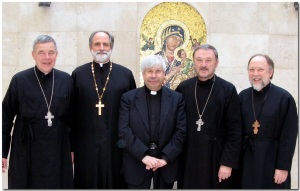
An Orthodox married priest explains why he wears his attire to Walmart.

eastern priest walmart

Just look at the strange hat, will you?  Maybe it’s a bad thing?

Lots of Eastern priests wear silver and gold chains with cross and icons.  Are they doing something bad? Look at these guys, with their black robes and their silver chains.

Some of these have three things.  And these hats are even stranger!

Heck… Eastern Catholics and Orthodox don’t just wear hats, they wear crowns!

Look at all that fancy finery!  Are they just functionaries?  Are they ridiculous?  Perhaps it should be sold and the money given to the poor.

As for the saturno…

Benedict XVI saturno

Why did THE POPE wear it?  Why, to be ridiculous, of course.

(The real answer is that the sun was really hot.)

St. John Paul used a saturno when it was hot.

John Paul II saturno

John Paul II saturno May 1980 Ouagadougou

Let’s get serious for the last part of this post.

I’ve known clerics who are really into the outward trappings of traditional Catholicism.  Really into them.  Some – few – of them are, well, a bit vain.  Others, however, are perfectly normal, sane, hard working men who pour themselves out like rivers to their flocks.  They find the garb good and useful and they put it to good use.  In time people see what priests are all about even if they wear – gasp – a cappa when they go out into the cold.  And… lots… dare I say… most?  the vast majority?… want their priests to look like priests.  No?  Am I wrong about that?

So.  What’s the take away from this for me, for the priests and the seminarians who are reading this.  What can I learn from this beating that the Vicar of Christ doled out to every cleric who owns a cloak and a hat, who does not despise traditional things enough?

  • First, be careful how you talk about people based solely on appearances or glances of something that you can’t possibly grasp from a distance.  Check your tongues!  How often would we – would I – have avoided sinning had we – had I – simply kept our mouths shut.
  • Next, remember that the Church has two lungs, West and East.   The Holy Father would never in a million years mock Easterners for their traditional style of dress and for their high liturgical style.  But he regularly mocks Westerners.  What of it?  We Latins also have our traditional style of dress and our own high liturgical style that matches the East step for step.  We have nothing to apologize for in wanting it and using it with good intentions.
  • Also, too much of a good thing is too much.  If you are a young priest or a seminarian, and you are really into these things, examine your motives and consciences.  I’m not saying give them up.  On the contrary!  I’m saying that if you are too attached to them, to the exclusion of prudence, etc., make some changes.

action-item-buttonMoreover, remember that we have going here at this blog a long-term project to get birettas for seminarians.  HERE

John Hastreiter at Leaflet Missal in St. Paul is collecting names and hat sizes of seminarians who don’t have a biretta and putting them on a “biretta wanted list”.  Then you, dear readers, can contact John, buy a biretta, and he will send it to a man on the list!

Contact John in church goods at Leaflet Missal in St. Paul – 651-209-1951 Ext-331.  If he is away, leave a voicemail with your phone number and he will call you back ASAP.

Let’s encourage these men!  Call John and buy a biretta for a seminarian.  It’s as easy as that.

Lastly, we priests – most of us anyway – are not precious tender snowflakes who need affirmation and hugs and puppies and coloring books.  I won’t say that we need a drubbing all the time, but we can take it when its handed out.


Posted in ¡Hagan lío!, ACTION ITEM!, Hard-Identity Catholicism, Liturgy Science Theatre 3000, Mail from priests, Our Catholic Identity, Priests and Priesthood, Seminarians and Seminaries | Tagged , , ,
68 Comments

Knights of Columbus bankroll Crux. Do @KofC also hold @Crux editorial positions?

I saw a piece at Crux today which left me disappointed.  The piece in question is an opinion hit-job by Austen Ivereigh against anyone who dares to suggest that there are problems with Chapter 8 of Amoris laetitia.

Ivereigh is a “contributing editor” at Crux.  His position is de facto an editorial position.

On Crux’s webpage we read:

We’re an independent Catholic news site, operated in partnership with the Knights of Columbus….

They are partners.

Is this the sort of product that the Knights of Columbus want?

If this is the sort of thing that the Knights of Columbus aim for as partners, then I must review my hitherto positive view of the Knights of Columbus.

Posted in Green Inkers, I'm just askin'..., Liberals | Tagged ,
25 Comments