
From a reader…
QUAERITUR:
I am wondering if there are limits to the trope-ability of the Kyrie. Today I attended a parish that my husband and I usually avoid — although it is probably our territorial parish — because of questionable liturgical practices that leave us on edge during Mass (priest holding hands with the altar girls behind the altar during the Our Father, for instance). Today, in between the standard parts of the Kyrie, the choir/a cantor inserted lines in the spirit of: “For all the times we have failed to be open-hearted and welcoming….”
I understood that tropes were supposed to enhance understanding of the theology of the Mass. This seemed to narrow our cry for mercy to a single issue. Is this licit or am I overly critical?
First, we might get into the idea of the Kyrie and tropes.
The Greek acclamation Kyrie eleison probably entered the Roman liturgy from the East by the 6th century and was firmly established by the time of St. Gregory the Great. Hence, it is one of the oldest elements of the Roman Rite. Its troping, however, took off in the medieval period. From about the 9th c. onward, musicians began inserting short texts, “tropes”, into established chants. In the Kyrie, the inserted phrases often identified Christ under particular titles or described His saving work, while the underlying Kyrie eleison remained intact. “Trope” comes from Greek tropos, meaning “a turn, direction, manner, or way” from trepein “to turn.”. In ancient rhetoric, a trope became a “turn” of expression, that is, a figurative use of language. In medieval liturgy, the term was applied to a textual or musical addition that “turned” or expanded an established chant by inserting explanatory or devotional phrases. Hence, a Kyrie trope is an added phrase attached to the fixed acclamation Kyrie eleison, usually elaborating who Christ is or what He has done.
Such troped Kyries became extremely elaborate in some medieval uses and were associated with named chant settings. After the Council of Trent, the reform of the Roman Missal greatly reduced them, favoring a more stable liturgical text. The Novus Ordo’s 3rd Form of the Penitential Act is a bit of archeologizing, a return to an older practice. One might ask if the true good of the people, as the Council Fathers required, was considered. But I digress. Anyway, brief Christological invocations are joined to Kyrie eleison.
So, yes, in the Novus Ordo, the Kyrie can be “troped,” but there are limits. Checking the USCCB’s GIRM, in Penitential Act Form C, the invocations are supposed to be addressed to Christ and to proclaim His saving work. USCCB liturgical guidance explicitly says they should not become a shortened examination of conscience.
So, something like, “Lord Jesus, you came to call sinners: Lord, have mercy” sort of works, but, “For all the times we have failed to be welcoming (to undocumented cultural enrichers who want to take our country and kill us…)” does not. The second example turns the Kyrie into a list of communal faults rather than an invocation of Christ. Another one that wouldn’t work would be “Lord Jesus, for using the A/C against Laudato si,…”. However, something like, “Lord Jesus, you endured the Cross and tomb so that we might be saved”, would fit the bill.
So the short answer is: yes, tropes are permitted, but they should be Christological invocations, not improvised mini-examinations of conscience and certainly not for virtue signaling and woke stuff.
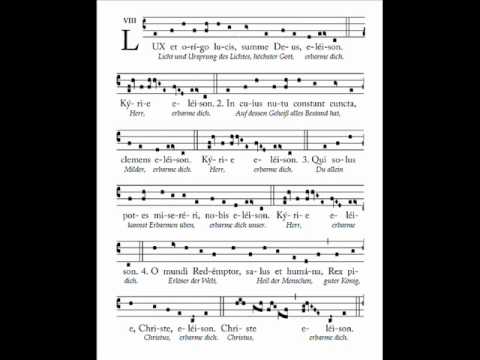
Finally, here is an example of the troped-Kyrie in Gregorian chant, Mass Lux et Origo.















In school Masses, years ago, children were invited to compose those tropes, and inevitably they were about our sins, rather than about Christ.
Sometimes almost as bad as,
“For the times we have been mean to the kittens, Lord have mercy.”
Also, I believe the tropes or invocations are limited to three.
Does Mr. Stockerman have all 18 Masses with troped Kyries, somewhere?
An interesting “trope” is the song 1985 “Kyrie” by the band Mister Mister . It went to #1. Band member John Lang wrote the song as an explicitly Christian one.
Other records of people wanting more than society is giving them Gregorian Chant by Spanish monks went to #3 in the US in 1994
JP II’s words set to multiple languages charted in the 1999 release “Abba Pater”
Placido Domingo in 2009 with his son put JP II’s words to music
Sorry, this is so late. It has been a long week. Just to amplify what Father said…
As far as troping is concerned, when I was working on a Ph.D. in musicology, I took an entire semester pro-seminar in Medieval music by a chant expert studying the use of the terms, tonus, modus, and tropus in chant music from the Greeks to the Renaissance.
Fr. Z is correct that troped chant began in the 9th-century, involving sequences, chants, etc. The chant structure was composed of long, extended melismatic melodies (florid chant) and extensive troping (both words and music). The rhythm was free (without precise rhythm, because rhythmic theory would develop about a century later), which lent itself to the florid style. This was, primarily (although by no means only), associated with the St. Martial abbey at Limoge in central France. By the 12th-century, the Cistercian reform drastically reduced both the amount of chant (especially sequences) and trope content. Beginning at the end of the 12th-century and lasting into the 14th-century, the school at Notre Dame produced largely syllabic chant and introduced rhythmic theory in a precise way, leading to the rise of polyphony. There was very little troping of an extensive, free flowing, variety. Troping did continue into the early Renaissance, but by the time of the Notre Dame school, the practice was dwindling, to be almost completely suppressed by Trent.
If you want to do computer analysis of chant tropes, an excellent online database exists: the Corpus Troporum Database:
https://openhumanitiesdata.metajnl.com/articles/10.5334/johd.318
Troping was almost exclusively didactic, clarifying a term or amplifying a situation in the chant. I am not aware of any troping of a corporate (Forgive us for this sin…) penitential variety at that time (of course, I don’t know all of the tropes, but the Database, above, should be able to bring up any, if they exist). If one were in a penitential mood, there were always the penitential psalms. One must remember that chant was the exclusive domain of clergy (or schola) during this period and the laity, who went to Mass, very seldomly and in monasteries even less, would have been exposed to chant, such that they would recognize troping. Corporate acts of penance would become “popular” in the early 1200’s leading to the flagellate movement in the 1260’s, although this had little effect on the music.
The modern situation the commenter describes, where a priest inserts a trope in the Kyrie, seems to be required, if the Kyrie is part of the Penitential Rite:
GIRM no. 52
52. After the Penitential Act, the Kyrie, eleison (Lord, have mercy), is always begun, unless it has already been part of the Penitential Act. Since it is a chant by which the faithful acclaim the Lord and implore his mercy, it is usually executed by everyone, that is to say, with the people and the choir or cantor taking part in it.
Each acclamation is usually pronounced twice, though it is not to be excluded that it be repeated several times, by reason of the character of the various languages, as well as of the artistry of the music or of other circumstances. When the Kyrie is sung as a part of the Penitential Act, a “trope” precedes each acclamation.
Clarification, as Father noted, is provided by the USCCB:
Penitential Act (Third Form: Kyrie with tropes) contains only one set of
invocations for the Kyrie. The rubrics allow that “other invocations” could also be used, using the
text provided as a model (no. 6). Such invocations
are always addressed to Christ. They are not to be
an abbreviated form of an examination of
conscience, but rather invocations of praise for the
salvific work of Christ. The U.S. Adaptations to the
Order of Mass, pending confirmation by the Holy
Liturgy of the Eucharist, provide seven additional formulae for the
Penitential Act.
There are eight sample texts and all of them speak directly to Christ:
Lord Jesus, you came to gather the nations into the peace of God’s kingdom: Lord, have mercy.
Lord Jesus, you come in word and sacrament to strengthen us in holiness: Christ, have mercy.
Lord Jesus, you will come in glory with salvation for your people: Lord, have mercy.
Lord Jesus, you are mighty God and Prince of peace: Lord, have mercy.
Lord Jesus, you are the Son of God and Son of Mary: Christ, have mercy: The people: Christ, have mercy.
Lord Jesus, you are Word made flesh and splendor of the Father: Lord, have mercy
Lord Jesus, you came to reconcile us to one another and to the Father: Lord, have mercy. Lord Jesus, you heal the wounds of sin and division: Christ, have mercy.
Lord Jesus, you intercede for us with your Father: Lord, have mercy.
Lord Jesus, you raise the dead to life in the Spirit: Lord, have mercy
Lord Jesus, you bring pardon and peace to the sinner: Christ, have mercy:
Lord Jesus, you bring light to those in darkness: Lord, have mercy.
Lord Jesus, you raise us to new life: Lord, have mercy.
Lord Jesus, you forgive us our sins: Christ, have mercy
Lord Jesus, you feed us with your body and blood: Lord, have mercy.
Lord Jesus, you have shown us the way to the Father: Lord, have mercy.
Lord Jesus, you have given us the consolation of the truth: Christ, have mercy
Lord Jesus, you are the Good Shepherd, leading us into everlasting life: Lord, have mercy.
Lord Jesus, you healed the sick: Lord, have mercy.
Lord Jesus, you forgave sinners: Christ, have mercy:
Lord Jesus, you gave yourself to heal us and bring us strength: Lord, have mercy
So, as Father says, a trope involving corporate sin is not permitted in modern practice and (I’d have to do some research), probably not in ancient practice, as well.
A very extensive summary of Medieval trope practice may be found in Richard Hopin’s, Medieval Music. If you go to the internet archive and search for it, you may either check it out, or do a word search (upper left-hand corner) of the word, “trope,” to bring up most of his discussion of the three classes of tropes. My seminar professor was his son-in-law.
The Chicken