Do not speak to me, He says, of the difficulties you will face, for “I am with you!”

[B]ecause he had enjoined on them great things, to raise their courage He reassures them that He will be with then always, “even to the end of the world.”  Now do you see the relation of His glory to His previous condescension?  His own proper power is again restored.  What He had said previously was spoken during the time of His humiliation.  He promised to be not only with these disciples but also with all who would subsequently believe after them.  Jesus speaks to all believers as if to one body.  Do not speak to me, He says, of the difficulties you will face, for “I am with you,” as the one who makes all things easy.  Remember that this is also said repeatedly to the prophets in the Old Testament.  Recall Jeremiah objecting that He is too young and Moses and Ezekiel shrinking from the prophet’s office.  “I am with you” is spoken to all these people.

St. John Chrysostom (+407)
The Gospel of Matthew, Homily 90.2

Posted in Patristiblogging, Patristic Rosary Project | Tagged ,
1 Comment

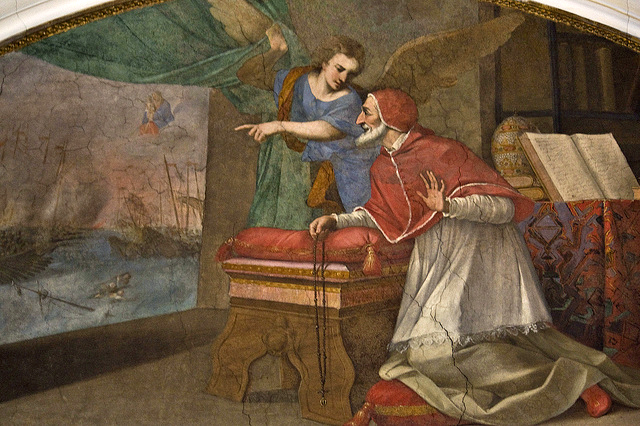
“O God, who deigned to choose blessed Pius to be Pontifex Maximus in order to smash the enemies of your Church to bits”

Today is the ninth day before Pentecost.  Hence, today is the Feast of the Ascension of the Lord.  Notice that today is THURSDAY.

However, in the traditional Roman calendar, used with the 1962 Missale Romanum, today is the feast of St. Pope Pius V (+1572).

I made a PODCAzT about him some years ago, and about his famous document Quo primum.

084 09-04-30 St. Pius V and Quo primum

A friend sent me a list of some of the accomplishments of St. Pius, who reigned for only a bit more than 6 years, but in tumultuous times.

1) began his pontificate by giving large alms to the poor (he did not just talked about them)
2) as Pope, continued the life of penance and virtue he had lived as a mendicant friar
3) made two meditations during the day ON BEENDED KNEES in the presence of the Bl. Sacrament
4) visited hospitals and sat by the bedside of the sick
5) washed the feet of the (non-Muslim) poor and embraced the lepers
6) always opposed Protestantism and the Turks (Islam)
7) excommunicated Elizabeth I (England)
8) instituted the Feast of the Holy Rosary
9) reformed the curia and the Church, leaving, after he died, “the memory of a rare virtue and an unfailing and inflexible integrity”

Let’s pause for a moment to drill into the collect for this saint, who I am sure doesn’t mind at all being bumped off the day by Our Lord’s feast.

Deus, qui, ad conterendos Ecclesiae tuae hostes et ad divinum cultum reparandum, beatum Pium Pontificem maximum eligere dignatus es: fac nos ipsius defendi praesidiis et ita tuis inhaerere obsequiis; ut, omnium hostium superatis insidiis, perpetua pace laetemur.

Contero is, “to grind, bruise, pound, to crumble, separate into small pieces”.  That word alone is a hint that this is a great prayer.  Obsequium, in the plural here, is a little tricky to get into English just right.  First, it has to do with God: it’s with tuis.  It has to do with how God is indulgent, toward us.  I want to say “cleave to your indulgences”, but that sounds like the use of the indulgences the Church grants from the treasury of the merits of Christ and the saints.  So, we have to put it another way.

Slavishly Literal Attempt:

O God, who deigned to choose blessed Pius to be Pontifex Maximus in order to smash the enemies of your Church to bits and to renew the divine worship, cause us to be defended by his protections and to cleave with obedience to what you will in such way that, once the plots of all our enemies are overcome, we may rejoice in perpetual peace.

This is martial and bold.  This is exactly the attitude we need more of in the Church right now!

We are in a constant state of war with the world, flesh and the Devil.  And the Devil uses human agents (his catch-farts) in his deadly design.  The Church is best from within and from without, by enemies internal and external.

What do you think Pius would say today about the state of the Church?  The teachings of the Council his closed are nearly abandoned in some parts, our sacred worship is in shambles, there is heresy and indifference, the Church’s external enemies, such as Islam, are rising with little or no guidance or outcry.

Sometimes, friends, the appropriate tools is the sword, so that we can return in peace to the plow.

Note especially the point about “renewal of worship”.  I contend that nothing will change for the better in the Church until we undertake a serious revitalization of our sacred liturgical worship of God.

St. Pius V, pray for us.

And while we are at it…

Sts. Nunilo and Alodia, pray for us.
St. Lawrence of Brindisi, pray for us.

Posted in Liturgy Science Theatre 3000, Saints: Stories & Symbols | Tagged
14 Comments

5 May – MADISON: Ascension Thursday – Pontifical Mass at the Throne

On Ascension Thursday, 5 May, at 7 PM, His Excellency Most Rev. Robert C. Morlino (aka The Extraordinary Ordinary) will celebrate Holy Mass in the traditional Roman Rite “at the Throne” at St. Mary’s Church in Pine Bluff, WI. All are welcome.

The music:

Antiphon at the Entrance of the Bishop: Sacerdos et Pontifex, mode I
Ordinary of the Mass:
KSBA: Missa Simplex a 3, Aristotle A. Esguerra (sung by the students and friends of the Holy Family Homeschoolers)
Gloria: I
Credo III
Proper: Gregorian of the day (sung by the Knights of Divine Mercy Schola)
Antiphon after the Last Gospel: Regina Caeli, simple tone
Hymn at the Recession: “Come, Holy Ghost”

Posted in Events, Liturgy Science Theatre 3000 | Tagged
4 Comments

Ascension Thursday Feet

There are many images of the Lord’s Ascension to heaven.

The ones I like the most are the medieval depictions which show the Apostles, often with Mary, looking up and all you see above are a pair of lordly Feet.

The Ascension of Christ, historiated initial ‘C’, Italy, 15C (State Library of Victoria, RARES 096 IL I)

From the site Ignatius Insight, providing an excerpt from “The Ascension: The Beginning of a New Nearness,” from Joseph Ratzinger’s Images of Hope: Meditations on Major Feasts (Ignatius Press, 2006 – UK HERE).  My emphases and comments:

You are surely familiar with all those precious, naïve images in which only the feet of Jesus are visible, sticking out of the cloud, at the heads of the apostles. The cloud, for its part, is a dark circle on the perimeter; on the inside, however, blazing light. It occurs to me that precisely in the apparent naïveté of this representation something very deep comes into view. All we see of Christ in the time of history are his feet and the cloud. His feet—what are they?

We are reminded, first of all, of a peculiar sentence from the Resurrection account in Matthew’s Gospel, where it is said that the women held onto the feet of the Risen Lord and worshipped him. As the Risen One, he towers over earthly proportions. We can still only touch his feet; and we touch them in adoration. Here we could reflect that we come as worshippers, following his trail, close to his footsteps. Praying, we go to him; praying, we touch him, even if in this world, so to speak, always only from below, only from afar, always only on the trail of his earthly steps. At the same time it becomes clear that we do not find the footprints of Christ when we look only below, when we measure only footprints and want to subsume faith in the obvious. The Lord is movement toward above, and only in moving ourselves, in looking up and ascending, do we recognize him.

When we read the Church Fathers something important is added. The correct ascent of man occurs precisely where he learns, in humbly turning toward his neighbor, to bow very deeply, down to his feet, down to the gesture of the washing of feet. It is precisely humility, which can bow low, that carries man upward. This is the dynamic of ascent that the feast of the Ascension wants to teach us.

Historiated initial in Ranworth Antiphoner (c.1460-1480), fol 98, Image 448

Posted in Lighter fare, Liturgy Science Theatre 3000 | Tagged ,
2 Comments

WDTPRS Ascension – Our humanity, “raised beyond the heights of archangels”

On my planet, this coming Sunday is the 7th Sunday after Easter, Ascension Thursday having fallen on Thursday.

In most places Ascension Thursday has been transferred to Sunday, but not with malice.  The notion the bishops had was to expose more people to the mystery of the Lord’s Ascension.  That may indeed occur, but in my opinion the transfer may reinforce an impression that these great feasts, important for our Catholic identity, aren’t compelling enough to inspire the planning and sacrifices required to go to Mass during the week.

Meanwhile, the Ascension of Our Lord, one of the great mysteries of the life of Christ, has been celebrated on the fortieth day after Easter (i.e., a Thursday) since the 4th century.

Enough said.

For Ascension Thursday Sunday – in the Novus Ordo – there are two Collects from which the priest celebrant may freely choose. The first prayer is a new composition for the Novus Ordo, and thus it is not found in pre-Conciliar editions of the Missale Romanum.  The second option, added in the 2002, 3rd edition is fairly ancient, but is less interesting.  We will look at the first Collect:

Fac nos, omnipotens Deus, sanctis exsultare gaudiis, et pia gratiarum actione laetari, quia Christi Filii tui ascensio est nostra provectio, et quo processit gloria capitis, eo spes vocatur et corporis.

The main source for this prayer is undoubtedly St Leo the Great’s (d 461) Sermon 73, 4:

Quia igitur Christi ascensio, nostra provectio est, et quo praecessit gloria capitis, eo spes uocatur et corporis, dignis, dilectissimi, exultemus gaudiis et pia gratiarum actione laetemur.

The phrase gratias agere means “to give thanks”.  In Latin, “Thank you!” is “Grátias tibi ágo!, literally, “I give thanks to you.”  The link with Greek eucharistia (“thanksgiving”) is apparent.  In liturgical contexts actio is often the liturgical “action” itself, the act of liturgical worship, even the core of the Mass, the Eucharistic Prayer.  Provectio is “an advancement, promotion”.

LITERAL RENDERING:

Cause us, Almighty God, to exult in holy joys, and to be glad in devout thanksgiving, because the ascension of Christ Your Son is our advancement, and the hope of the Body is being called to that place from whence comes forth the glory of the Head.

I capitalize Body and Head, because Leo is working with the ecclesiological image of Christ as Head of us, His Body the Church.  I defend “from whence” – which some think a redundant tautology).

CURRENT ICEL (2011):

Gladden us with holy joys, almighty God, and make us rejoice with devout thanksgiving, for the Ascension of Christ your Son is our exaltation, and, where the Head has gone before in glory, the Body is called to follow in hope.

Since our Collect is basically St. Leo let’s quote him some more.  On 1 June 444, in that same Sermon 73, 4, he preached to his Roman flock:

“Truly it was a great and indescribable source of rejoicing when, in the sight of the heavenly multitudes, the nature of our human race ascended over the dignity of all heavenly creatures, to pass the angelic orders and to be raised beyond the heights of archangels. In its ascension it did not stop at any other height until this same nature was received at the seat of the eternal Father, to be associated on the throne of the glory of that One to whose nature it was joined in the Son.”

The same Pope Leo (channeling his inner St. Augustine – s. 325, 1) says in Sermon 74, 3, preached on 17 May 445:

“[Our Catholic] Faith, reinforced by the Ascension of the Lord and strengthened by the gift of the Holy Spirit, has not been terrified by chains, by prison, by exile, by hunger, by fire, by the mangling of wild beasts, nor by sharp suffering from the cruelty of persecutors.  Throughout the world, not only men but also women, not just immature boys but also tender virgins, have struggled on behalf of this Faith even to the shedding of their blood.  This Faith has cast out demons, driven away sicknesses, and raised the dead.”

We know with holy and Catholic Faith that what was not assumed, was not redeemed (St Gregory of Nazianzus (+389/90).

Our humanity, body and soul, was taken by the Son into an unbreakable bond with His divinity. When Christ rose from the tomb, our humanity rose.  When Christ ascended to heaven, so also did we ascend.  In Christ Jesus, our humanity now sits at the Father’s right hand.  His Ascension then is our great hope now.  Our hope is already fulfilled, but not yet in its fullness.

This hope informs our trials in this life.

Posted in EASTER, Liturgy Science Theatre 3000, WDTPRS | Tagged , , , ,
5 Comments

4 May: St. Monica, widow

In the older, traditional Roman calendar today is the feast of the mother of St. Augustine, St. Monnica, widow.  She died in Ostia (Rome’s port) in 387, when she and her family were heading back to North Africa after Augustine’s conversion and baptism by St. Ambrose.  She caught a fever during a blockade of the port.

(Yes, you can spell her name “Monnica”, more consistent with her Punic origins.)

In the chapel of The Cupboard Under The Stairs I have a first-class relic of this marvelous woman.

20130504-094844.jpg

In the post-Conciliar calendar, her feast was moved to be next to that of her son.

As she lay dying in Ostia near Rome, Monnica told Augustine (conf. 9):

“Lay this body anywhere, let not the care for it trouble you at all. This only I ask, that you will remember me at the Lord’s altar, wherever you be.”

Read about St. Augustine

She was buried there in Ostia. Her body was later moved to the Church of St. Augustine in Rome across the street from where I lived for many years.

May she pray for us, for widows and for parents of children who have drifted from the Church.

Be sure to pray for the departed. Pray for them! Don’t just remember them. Don’t just think well of them. Don’t just, as the case may be, resent or be angry at them. Pray for them!

Prayer for the dead is a spiritual work of mercy.

Also, I’ll remind you of a newish book on Augustine:

REVIEW: The book on Augustine which Pope Benedict would have wanted to write.

Also, if you want a really interesting book on the Doctor of Grace, check out Serge Lancel‘s volume.  UK HERE

BTW… read about how here original epitaph inscription was found by some kids.  HERE

Posted in Saints: Stories & Symbols | Tagged , ,
6 Comments

13 yr old 8th grader uses $2 bill – school freaks out, police called, threats and ignorance ensue

From time to time we hear about the idiocies that public schools perpetrate.

Here’s another which caught my eye in the wake of controversy about changing the $10 or $20 bills.

From Joe For America:

SCHOOL CALLS POLICE ON GIRL USING 2 DOLLAR BILL TO BUY HER CHICKEN NUGGETS! IT GETS WORSE!


When 13-year-old eighth grader, Danesiah Neal, tried to spend a 2 Dollar Bill at lunch at Christa McAuliffe Middle School, she was detained and threatened with a felony!

It gets worse! The 2 Dollar Bill investigation had to go all the way to the bank to get solved!

I am beyond disbelief at the STUPIDITY at this Texas school, and with the Fort Bend police who carried on with the blatant ignorance that had to be involved! (Besides the fact that it was only $2)

“I went to the lunch line and they said my 2 Dollar Bill was fake,” Danesiah told Ted Oberg Investigates. “They gave it to the police. Then they sent me to the police office. A police officer said I could be in big trouble.”

Not just big trouble. Third-degree felony trouble.

School officials called Daneisha’s grandmother, Sharon Kay Joseph.

“She’s never in trouble, so I was nervous going in there,” she recalled to ABC13.

The officials asked, “‘Did you give Danesiah a 2 Dollar Bill for lunch?’ He told me it was fake,” she said.

Then the Fort Bend ISD police investigated the 2 Dollar Bill with the vigor of an episode of Dragnet, even though at that school 82-percent of kids are poor enough to get free or reduced price lunch.

The alleged theft of $2 worth of chicken tenders led a campus officer — average salary $45,000 a year — to the convenience store that gave grandma the 2 Dollar Bill.  [Didn’t the Obama administration outlaw food that was appetizing?]

Next stop — and these are just the facts — the cop went to a bank to examine the 2 Dollar Bill.

[…]

Really?  I’m surprised they didn’t call the Secret Service.


Posted in You must be joking! | Tagged
38 Comments

Your Good News

It has been a while since we’ve all seen what your own good news is.

So, what is your good news?

Posted in SESSIUNCULA |
29 Comments

Happy Star Wars Day

This isn’t really my thing, but I am ecumenical.  I mean, if Pope Francis can send a Message for the end of Ramadan, then I can send my message for Star Wars Day.

So… to all of you a hearty…

“May The Fourth” be with you!


Posted in Lighter fare | Tagged
11 Comments

Sam Gregg: False mercy and emotivism

At Catholic World Report, we find an article by Sam Gregg of Acton Institute.

Here is a sample from his article…

Three Counterfeits of Mercy

[…]

Mercy as Sentimentalism

Like everyone else, Christians are influenced by the social climate in which they live. It’s no exaggeration to say that those of us who live in the West are immersed in cultures in which sentimentalism, as opposed to reasoned discourse, is a distinguishing characteristic. Whether it’s people who begin arguments with the expression “I just feel that,” or those who endlessly invoke hard-cases (euthanasia advocates are masters of this black art) to justify what’s clearly wrong, the trend is clear: reason is out and emotivism is in.

That phenomenon includes large segments of Catholic life and opinion. Consider, for instance, those clergy whose pastoral manner is more akin to that of a secular therapist than a priest and whose preaching is difficult to distinguish from the ruminations of Oprah.

In such an atmosphere, it’s not surprising that mercy is increasingly understood by some Christians as a basis for painting those who highlight reason’s requirements as rigorists or judgmental. That attitude periodically surfaced at the 2014 and 2015 Synods on the Family. Those who politely reminded Synod participants, for instance, that Christianity has always taught that there are moral absolutes which identify certain free choices as always evil were often portrayed as hard-hearted or lacking mercy—invariably by bishops presiding over taxpayer-funded, hyper-bureaucratized, and empty churches which now primarily function as tame auxiliaries of Western European welfare states.

Whoever would have thought that those who referenced the moral law and its inner logic inscribed, as St Paul tells us, on man’s very nature and confirmed by the Decalogue forcibly re-emphasized by Christ would accused of “throwing stones” and labelled as “Pharisees”? There’s nothing merciful, however, about trying to marginalize the truths knowable through revelation and reason in the name of mercy. Nor is there anything compassionate about pretending that mercy allows Christ’s moral teaching to be put aside in difficult cases. Christ Himself never did so.

Likewise, mercy isn’t realized by ignoring the truth that any free choice for moral evil involves doing serious harm to what John Paul’s 1993 encyclical Veritatis Splendor calls the “fundamental goods” (VS 48, 50) that lie at the core of the Christian moral life. Indeed, in the absence of the absolutes prohibiting such choices, coherent moral reasoning becomes impossible. Everyone is subsequently left adrift in a sea of emotivism.

[…]

Okay… how do you all feel about this?

Posted in The Drill, The future and our choices | Tagged ,
16 Comments