ASK FATHER: Could the Congregation for the Doctrine of the Faith issue a binding interpretation of #AmorisLaetitia

From a reader…

QUAERITUR:

As a recent convert and a lawyer (but definitely not a canon lawyer), in view of Pope Francis’ recent endorsement of the broad view of AL, can the Congregation for the Doctrine of the Faith issue a binding interpretation of AL.

Sure.  The Congregation can do this.  We have the famous case of the explanation of Ordinatio sacerdotalis.

However, just as in the case of Ordinatio sacerdotalis, the Holy Father would have to sign off on such a document and order its publication.

Even were the CDF to draft such a thing (itself hard to do without the knowledge of the Pope), is it likely that Francis would approve it?

When it comes to documents, Francis holds all the cards.  Congregations are merely extensions of his own office.  He delegates his authority to group A his task about subject A, to B his task about B, etc.

Posted in "How To..." - Practical Notes, ASK FATHER Question Box, The Drill | Tagged ,
12 Comments

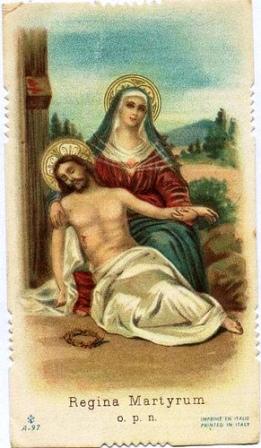
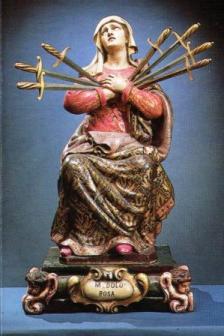
15 Sept: Seven Sorrows of Mary, Mater Dolorosa, Queen of Martyrs

15 Sept: Seven Sorrows of Mary, Mater Dolorosa, Queen of MartyrsToday is the Seven Sorrows of the Blessed Virgin Mary.  Can you name them?

Here the entry from the Roman Martyrology:

Memoria beatae Mariae Virginis perdolentis, quae, iuxta crucem Iesu adstans, Filii salutiferae passioni intime fideliterque sociata est et nova exstitit Eva, ut, quemadmodum primae mulieris inoboedientia ad mortem contulit, ita mira eius oboedientia ad vitam conferret.

In the older, pre-Conciliar Missale Romanum we find this wonderful Collect for today’s Holy Mass.

COLLECT (1962MR):
Deus, in cuius passione,
secundum Simeonis prophetiam
dulcissimam animam gloriosae Virginis Matris Mariae
doloris gladius pertransivit:
concede propitius;
ut qui dolores eius venerando recolimus,
passionis tuae effectum felicem consequamur.

LITERAL VERSION:
O God, at whose Passion,
according to Simeon’s prophecy,
the most sweet soul of the glorious Virgin, Mary our Mother,
was pierced by a sword of sorrow:
mercifully grant
that we who observe her sorrows by veneration
may attain to the happy result of Your Passion
.

15 Sept: Seven Sorrows of Mary, Mater Dolorosa, Queen of MartyrsAlso, in the old Communion Antiphon we have a connection between the great sorrow of Mary at the Cross and how she merits to be called Queen of Martyrs:

ANTIPHONA AD COMMUNIONEM:
Felices sensus beatae Mariae Virginis,
qui sine morte meruerunt martyrii palmam
sub Cruce Domini
.

Sensus is an incredibly complicated word. It means, among other things, the faculties of sensing and perceiving, but also of the sentiments of the heart and mind. In a collective “sense” sensus stands for “the common feelings of humanity, the moral sense”. Sensus is also our disposition of mind or humor and inclination. It signifies understanding of the thinking faculty, in the sphere of reason.

LITERAL VERSION:
Blissful the sentiments of the Blessed Virgin Mary,
which beneath the Cross of the Lord,
without death merited the martyr’s palm
.

This antiphon underscores how the totality of Mary’s being, “magnified” by God at every point of her life, was united with her Son as He endured the sufferings of the Cross.

This feast reminds us that there is a path to holiness through the sufferings and sorrows we endure.  We must learn to unite them to the sufferings of our Lord.  Mary teaches us to do this.  The martyrs teach us to do this.

Here is something that I wrote for the best Catholic weekly in the UK, the Catholic Herald in my column “Omnium Gatherum”:

September brings lovely Marian feasts, including – in the traditional Roman calendar – Our Lady of the Good Shepherd (3 Sept), Nativity of Mary (8), Name of Mary (12), Seven Sorrows of Mary or Our Lady of Sorrows (15), Our Lady of Ransom (24).

The feast of the Our Lady of Sorrows was instituted in Cologne in 1413 as a response to the Protestant Hussites (the ones that put the sword gashes on the face of Our Lady of Czestochowa in Poland). Pope St Pius X assigned her feast to 15 September 15 so she could remain close to the Cross and the Feast of its Exaltation on 14 September.

Our Lady’s Seven Sorrows are 1) The Prophecy of Holy Simeon, 2) The Flight of the Holy Family into Egypt, 3) The Loss of the Child Jesus in the Temple, 4) The Encounter of Jesus with His Blessed Mother as He Carries the Cross, 5) The Crucifixion and Death of our Lord Jesus Christ and Mary at the foot of the Cross, 6) The Descent from the Cross, and Jesus in the Arms of His Most Blessed Mother, 7) The Burial of our Lord, and the Loneliness of the Blessed Virgin.

Speaking of seven, Our Lady revealed to St Bridget (d 1373) a devotion we can use to obtain seven graces if we meditate on her sorrows and recite seven Hail Mary’s. These graces are (in her voice) 1) I will grant peace to their families, 2) They will be enlightened about the divine mysteries, 3) I will console them in their pains and I will accompany them in their work, 4) I will give them as much as they ask for as long as it does not oppose the adorable will of my divine Son or the sanctification of their souls, 5) I will defend them in their spiritual battles with the infernal enemy and I will protect them at every instant of their lives, 6) I will visibly help them at the moment of their death, they will see the face of their Mother, 7) I have obtained from my divine Son, that those who propagate this devotion to my tears and sorrows, will be taken directly from this earthly life to eternal happiness since all their sins will be forgiven and my Son and I will be their eternal consolation and joy.

Our beautiful devotions enrich our lives.

Posted in Liturgy Science Theatre 3000, Our Solitary Boast | Tagged , , ,
9 Comments

Benedict XVI: last Pope of old era or first of the next?

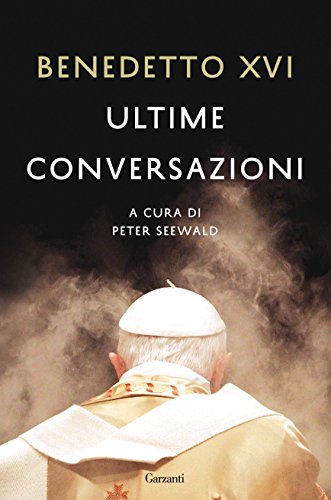
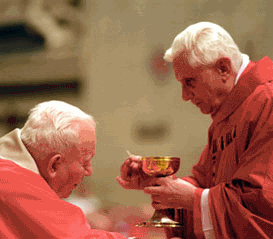
popebenedictpopejohnpaulcommunionI’m reading the Italian edition of Pope Benedict’s book-long interview with German journalist Peter Seewald.  I’m jumping around a bit and I ran across an interesting section.  Here is my on the fly translation from the Italian (not from the German original):

SEEWALD: Do you see yourself as the last Pope of the old world or the first of the new?

BENEDICT: I would say both.

SEEWALD: As a bridge, a kind of connecting element between the two worlds?

BENEDICT: I don’t belong to the old world anymore, but the new one in reality hasn’t yet begun.

SEEWALD: The election of Pope Francis is perhaps an exterior sign of a epochal turning point?  With his does a new era begin definitively?

BENEDICT: The temporal divisions were always decisive a posteriori: only in a second time is it established that here began the Middle Ages or there began the modern era.  Only a posteriori is it seen how movements developed.  For this reason I won’t hazard a like affirmation now.  Nevertheless, it is evident that the Church has been abandoning more and more the old traditional structures of European life and, hence, changes appearance and lives new forms.  It’s clear above all that the dechristianization of Europe progresses, that the Christian element is vanishing more and more from the fabric of society.  Consequently, the Church must find a new form of presence, must change its way of presenting itself.  There are epochal upheavals underway, but one doesn’t yet know to what point it can be said with precision that one or the other begins.

SEEWALD: You know the prophecy of Malachy, that in the Middle Ages compiled a list of future pontiffs, foreseeing also the end of the world, or at least the end of the Church.  According to such a list the papacy would terminate with your pontificate. And if you were effectively the last to represent the figure of the Pope as we have known up to now?

BENEDICT: Anything is possible.  This prophecy was probably born in circles around Philip Neri.  In that time Protestants sustained that the papacy was finished, and he wanted only to demonstrate, with a very long list of Popes, that, instead, that was not the case.  It is not for this reason, however, that one must conclude that it will in fact end.  Rather, that his list wasn’t long enough!

Seewald deftly worked up to the Malachy question, didn’t he?

In any event, I found Benedict’s answer quite interesting.  He wouldn’t be pinned down, but he suspects that he a kind of liminal figure, if not a bridge.  Bridge has additional connotations, of course, when talking about the papacy.

I was interested to read his diagnosis of the Church and of Europe, especially in light of his earlier thoughts about the identity of Europe, the Christian Catholic dimension which made Europe Europe.  He seems resigned to the fact that Europe is gone.  Indeed, he seems resigned to the fact that what the Church was, in Europe, is gone.

As I read this, however, a little bell chimed in my head way back in my memory palace.  I went hunting to find where it was ringing.

I think I found it in the prophecies of Garabandal.  Conchita seems to have received a message that

“After His Holiness Paul VI, there will be only two more popes before the end of the present period (el fin de los tiempos) which is not the end of the world. The Blessed Virgin told me so, but I do not know what that means.”

So, if we count the Pope everyone forgets to remember, John Paul I of the 33 days, then John Paul II was the last Pope before “el fin de los tiempos”.  Not being a native speaker of the Spanish of tiny villages of Northern Spain in the 60’s and 70’s before TV homogenized everything, I want to be a little cautious about what “el fin de los tiempos” means.  I think that Spanish handles possessives a little differently than Italian does, and because Italian dominates my ear, I tread carefully.  Spanish speakers of Spanish might help me out here, but I have a strong inclination to render “fin del los tiempos” as “the end of an era”, not just “the end of times”, in some apocalyptic sense.

If I am right, and I welcome some Spanish Spanish speakers to jump in, this “fin del los tiempos” sounds rather like what Benedict says to Seewald.

A couple more thoughts.

First, Benedict’s name-sake, St. Joseph, was also a liminal figure, standing astride the two covenants, old and new.  He, too, was a “humble laborer”, and, in the pages of Scripture at least, pretty quiet, but decisive when he was directed from above.  He tried to keep his family safe.

Second, another liminal figure would be St. John the Baptist.  I can’t help but think of Benedict’s great attachment to the work of St. Augustine, who has a profound explanation of the figure of the Baptist in relation to Christ, as the forerunner to the Word.  Augustine’s exploration of Voice and Word is amazing.

Third, St. Benedict himself is a liminal figure in late antiquity, standing between the classical age and the medieval period.  His influence in the development of Christendom and Europe itself was foundational.

Furthermore, Summorum Pontificum remains of immense importance.  Is some ways it may be the most important contribution of the pontificate because it concerns the starting point and the ending point of all initiatives … all successful initiatives … in the Church, worship, liturgical worship, of God.  The knock-on effects are slowly accumulating.  But of these things I have written extensively elsewhere.

In any event, I found this passage in the new book to be interesting.

PRE-ORDER NOW!
Benedict XVI: last Pope of old era or first of the next?
US Hardcover – HERE
UK Hardcover – HERE
US Paperback – HERE 
UK Paperback  – not yet

Posted in Benedict XVI, Francis, Pope of Christian Unity, SUMMORUM PONTIFICUM | Tagged , , ,
29 Comments

Canonist Ed Peters on Pope Francis’ “Argentinian Letter”

Distinguished canonist Ed Peters (who also comments here) has posted on his fine blog In The Light Of The Law some thoughts about Pope Francis’ latest move, the letter to the Argentinian bishop about a draft document that seems to attempt to apply Amoris laetitia chapter 8.

First, On the Buenos Aires directive:

On the Buenos Aires directive
September 13, 2016

Canon 915, the modern (yet resting on ancient roots) norm that prohibits ministers of holy Communion from giving that sacrament to Catholics who “obstinately persevere in manifest grave sin” does not expressly name divorced Catholics living in their second (or third, or fourth, or fifth…) ‘marriages’ as examples of persons ineligible for holy Communion, but they have long been the ‘go-to’ example of those covered by the canon. Even its harshest critics generally conceded that Canon 915 applies to divorced-and-remarried Catholics—the emotional hardships associated with such cases being, in some critics’ minds, a good argument for abandoning the norm.

Now, in his unequivocal endorsement (“There are no other interpretations possible” [!]) of a leaked draft of some Argentine bishops’ plan for implementing his document Amoris laetitia, [NB] Pope Francis has neither ‘abrogated’ Canon 915 nor ‘interpreted’ it out of existence (both being the sort of technical operations the pope shows little interest in). Nevertheless, his action will likely make it harder for Catholic ministers, who remain bound by canon law even in stressful cases, to observe Canon 915 at the practical level.  [That is, isn’t it.  Priests who are faithful and obedient to the law will be between a hard spot and that other thing.  If they obey the law, they will be accused of being against the Pope.]

Basically, the Argentine draft (assuming it is still a ‘draft’) directs ministers of holy Communion (chiefly parish priests) to work through concrete cases impacting access to at least three sacraments (Matrimony, Penance, and the Eucharist), guided not by the Church’s accumulated pastoral wisdom as summed up in norms like Canon 915 (which seem not even not to be mentioned!), but instead by a line of endlessly malleable considerations phrased in verbiage redolent of the 1970s. [Rem acu!] If some pastors after the publication Amoris were already being told by irate parishioners that ‘Pope Francis says you have to give me Communion’, [Yes, that happened.] what might they expect in the wake of his sweeping approval of this Argentine interpretation of Amoris? [We’ll know soon.]

Fundamentally the Argentine draft stumbles, I suggest, in the same way as does Amoris, namely, in thinking that an individual’s subjective, albeit sincere, conclusions about his or her eligibility for Communion per Canon 916 trumps the Church’s authority, nay her obligation, to withhold the sacrament in the face of certain objective, externally verifiable conditions per Canon 915. …

[…]

Read the rest there.

Also, Dr. Peters comments on Jeff Mirus’ piece.  Mirus argues contra aliquos who say that by his letter Francis has lapsed into heresy.  Thus, Peters:

May I demur re Mirus this once?

Pretty much everything Dr. Jeff Mirus writes is worth reading, but his latest column, correctly defending Pope Francis against charges of heresy based on his endorsement of the Buenos Aires Directive, overstates the argument in one small, technical regard and, I think, misses a larger, more important point in another. I basically agree with everything Mirus wrote, except as follows.

1. Mirus writes: “It is impossible to prove that advocacy of any disciplinary approach indicates heresy in the mind of the advocate.” That is not correct. A classic example pointed to a man whose refusal to abide by disciplinary norms such as genuflecting before the tabernacle might show a wordless, but clearly heretical, denial of the Real Presence. This is a small, technical point, perhaps, but it reminds us all to be wary of universal assertions. My second concern is larger.

2. Most of Mirus’ column is spent trying to show how the objectively grave sin of remarriage after divorce (with all necessary caveats & conditions included) might in a specific case be rendered subjectively venial at least for one partner. As holy Communion may be (and perhaps even should be, assuming sorrow for sin, CCC 1393) taken by one in venial sin, Mirus argues that some divorced-and-remarried Catholics should feel free to approach for holy Communion. Now, everything Mirus says so far is at least arguably, and much of it is actually, true.

[NB] But it misses the crucial point: One’s approaching for holy Communion is a matter of personal conscience chiefly guided by Canon 916 (which Mirus does not cite, but would have cited had he adverted to it); but distribution of Communion by a minister is a matter of objective status chiefly under Canon 915, which Mirus does not cite, but should have considered.

As has been explained many times, [NB] in certain cases ministers of holy Communion are bound not by the would-be recipient’s assessment of conscience, but by the demands of canon law responding to one’s external, objective status. [external, objective] Long story made short, Catholics who have entered marriages subsequent to mere divorce are objectively disqualified from being given holy Communion (CCC 1650, 2384), whatever might be their subjectively reduced culpability for their state. This is a crucial point: two canons (and the values behind two canons) come into play every time a minister and recipient meet over the Host. Yes, Amoris seems to miss this point and the Buenos Aires Directive clearly misses it. Still.  [So, many people in irregular situations are going to be told by the less than faithful (or well-informed) dissidents that they can go to Communion regardless of their objective status.  On the other hand, faithful priests will be in an awkward situation.  When they try to apply the law (which they are obliged to do, which they promised to do) they will be accused of being [FILL IN BLANK].  Two parishes, side by side, will communicate diametrically opposed messages.  Hey… what’s new?]

To be sure, more goes into these cases than what I just outlined, but this should suffice to show that, even if Mirus’ theory of venial sin for some divorced-and-remarried Catholics is correct, it does not answer the question about their being admitted to holy Communion.

Thanks to Ed Peters.  He has no combox over there.  Comment here, but remember that he works hard on his posts at his blog.  You should check it out often.

Posted in 1983 CIC can. 915, Canon Law, One Man & One Woman, The Drill | Tagged , ,
28 Comments

ASK FATHER: Parish prayer effort to beg protection from Islamic terror. Wherein Fr. Z rants.

ASK FATHER: Parish prayer effort to beg protection from Islamic terror. Wherein Fr. Z rants.From a reader…

QUAERITUR:

I will appreciate your help in leading me to a prayer to protect us from terrorism (specifically Muslim, if possible) that can be recited by our parish weekly during these threatening times. I do this at the behest of my Pastor.

Your pastor is wise to seek to do something like this.  We are living in increasingly dangerous times.

Today I had lunch with a priest who remarked that the Church is really good and reacting and reforming, but not very good at foreseeing and avoiding.  Why wait to tackle a problem before it turns into disaster?  A stick in time saves nine applies also to the fabric of the Church.

The Rosary was used at the Battle of Lepanto!  Can you think of something better than that?

But wait!  There’s more.

I was recently reminded of the 1889 encyclical about St. Joseph, Quaquam pluries of Pope Leo XIII (will we see his like again, I wonder).  In that encyclical Leo asked that a prayer be added at the end of the recitation of the Holy Rosary especially during the month of October (dedicated in a special way to the Rosary).  The prayer was indulgenced then and it is still indulgenced now.  It is in the Handbook of Indulgences.  It would be said after the Salve Regina and the usual concluding prayer of the Rosary.  Of course it could be used after any Marian devotion (it seems appropriate to use it in conjunction with a Marian devotion).  It could be used by itself as well.

Prayer

To you, O blessed Joseph, do we come in our tribulation, and having implored the help of your most holy Spouse, we confidently invoke your patronage also.

Through that charity which bound you to the Immaculate Virgin Mother of God and through the paternal love with which you embraced the Child Jesus, we humbly beg you graciously to regard the inheritance which Jesus Christ has purchased by his Blood, and with your power and strength to aid us in our necessities.

O most watchful guardian of the Holy Family, defend the chosen children of Jesus Christ;  O most loving father, ward off from us every contagion of error and corrupting influence;  O our most mighty protector, be kind to us and from heaven assist us in our struggle with the power of darkness.

As once you rescued the Child Jesus from deadly peril, so now protect God’s Holy Church from the snares of the enemy and from all adversity; shield, too, each one of us by your constant protection, so that, supported by your example and your aid, we may be able to live piously, to die in holiness, and to obtain eternal happiness in heaven.

AMEN.

So, perhaps you might have in the parish a Rosary after morning Mass and a Rosary in the evening as a scheduled event, and include the prayer to St. Joseph.  Father could hear confessions for the time of the devotion (and after).

Also, don’t forget that one of the historic reasons for the institute of the Forty Hours Devotion was the threat of Islam!

“But Father! But Father!”, some of you panty-waists are grizzling, “This is horrible.  Pray against terrorists?  They are simply misunderstood!   After all, Vatican II says that we all pray to the same God… and … you know.  We are brothers and sisters and we must never suggest anything so triumphalistic and retrograde! They are a ‘menace”?  NO! YOU are the menace with your throwback fear mongering!  You are a deplorable xenophobic islamophobe!  You probably support Donald Trump because you HATE VATICAN II!

I’ll pray for you after I sorrowfully watch the video of a thug in a hood shouting in Arabic as he saws your head off on the street outside your parish church… no, wait… your faith community’s worship space. Even though you are seriously screwed up right now, there is hope for you. I’ll pray that, at the end, you gave courageous witness to the Catholic Faith and to Christ.  And, if you are beatified, I’ll pray to you, asking you to intercede for our nation and to beg that God be appeased.  Until then, please just shut up.

Back to Forty Hours.   If the Rosary is something that you can have in the parish everyday, Forty Hours is a special event, very intense, which you can have once a year.

The mighty St. Charles Borromeo (shall we see his like again, I wonder) wrote to Pope Paul III asking for indulgences for his institution of Forty Hours. Paul III responded:

“Since … Our beloved son the Vicar General of the Archbishop of Milan at the prayer of the inhabitants of the said city, in order to appease the anger of God provoked by the offences of Christians, and in order to bring to nought the efforts and machinations of the Turks who are pressing forward to the destruction of Christendom, amongst other pious practices, has established a round of prayers and supplications to be offered both by day and night by all the faithful of Christ, before our Lord’s Most Sacred Body, in all the churches of the said city, in such a manner that these prayers and supplications are made by the faithful themselves relieving each other in relays for forty hours continuously in each church in succession, according to the order determined by the Vicar . . . We, approving in our Lord so pious an institution, and confirming the same by Our authority, grant and remit”, etc.

It is time to bring this devotion back and to do it right!  Forty Hours Devotion means 40 hours.  I would like to see this done as it used to be: on a rotating basis, parish to parish, throughout dioceses, on a fixed, annual schedule so that it is predictable.  It would also like to see used the Clementine Instruction and in the Extraordinary Form.

There are many devotions and prayers already written and used by our forebears for centuries.

They must be REVIVED!

So many people today ought not to be receiving Holy Communion.  They perhaps go to Communion anyway when they are at Mass because they feel pressure as everyone goes forward.  At all these devotions, stand alone and without Holy Mass, everyone participates equally with no need to go forward.  They can pray and participate in the life of the parish and be devout and join the personal problems and petitions to the prayers being offered.  People would return to Church on Sundays for Vespers and Benediction.  Old hand missals often included the prayers for Vespers along with the prayers for Mass.

WE NEED THESE DEVOTIONS!

I’ve often contemplated the signs of the times and wondered if the wrath of God will be averted through our prayers and mortifications.  Once there were many communities of sisters who did reparation for the sins people committed.  Once there were many many more Masses being offered.  Once there were many more devotional practices and, as a Church, we talked about sacrifice and expiation, the anger of God at sins and our need to beg for mercy.

Before it is too late, this must be RESTORED!

Once upon a time, Popes vigorously moved the entire Church – which still had a strong identity – to common action in prayer.  I wish that our bishops, at least, would give us collective guidance that doesn’t amount to nice thoughts about kitties, sunshine, and birthday cakes on this real threat and on a range of other issues.

ASK FATHER: Parish prayer effort to beg protection from Islamic terror. Wherein Fr. Z rants.

Click!


Posted in "How To..." - Practical Notes, ASK FATHER Question Box, The Coming Storm, The future and our choices, The Religion of Peace, Urgent Prayer Requests, Wherein Fr. Z Rants | Tagged , , , , , ,
16 Comments

ASK FATHER: Pope Francis said Fr. Hamel is a martyr. Is he now “Blessed Jacque Hamel”?

Fr-Hamel12-540x300From a reader…

QUAERITUR:

I saw today that Pope Francis confirmed that Fr. Hamel is a “martyr.” Does this mean we can now refer to him as St. or Blessed or Venerable Fr. Hamel?

I strongly suspect that Fr. Jacques Hamel, recently killed in his church at Mass by an Islamic murderer in N. France, is a martyr.  The murderer was pledged to ISIS.

However, just as the Church has procedures when promulgating laws and teaching definitively, so too the Church has procedures when determining if a slain Catholic was martyred.   “Martyr” is also a technical term for someone who was killed precisely for hatred of Christ, the Faith, or some aspect of the Faith that is integral to it.

Now the back story.  Pope Francis celebrated his daily Mass at Santa Marta for Fr. Hamel today.  HERE  He also gave quite a good sermon.  English language reportage HERE.

To the congregation gathered at Santa Marta and which included Archbishop Dominque Lebrun of Rouen, along with 80 other pilgrims from the diocese, Pope Francis said that “to kill in the name of God is satanic”. [Pope Francis does not shirk from talking about the Enemy.  That’s good.]

Reflecting on the many martyrs that are part of the history of the Catholic Church, Pope Francis said: “this is a story that repeats itself in the Church, and today, he said, there are more Christian martyrs than there were at beginning of Christianity”  [Francis used the word “martyr”.]

Today – he continued – there are Christians “who are murdered, tortured, imprisoned, have their throats slit because they do not deny Jesus Christ”.

This history, the Pope said – continues with our Father Jacques: he is part of this chain of martyrs.

“Father Jacques Hamel was slain as he celebrated the sacrifice of Christ’s crucifixion. A good man, a meek man, a man who always tried to build peace was murdered (…). This is the satanic thread of persecution” he said.  [There’s the s word again.]

And, Pope Francis continued: “What a pleasure it would be if all religious confessions would say: ‘to kill in the name of God is satanic'”. [He’s on a roll!]

Pope Francis concluded his homily holding up Fr Hamel and his example of courage and said we must pray to him to grant us meekness, brotherhood, peace and the courage to tell the truth: “to kill in the name of God is satanic”.

On the altar, a simple photograph of Fr Hamel who was slain by two Islamist fanatics while celebrating Mass in the Church of Saint-Etienne-du-Rouvray on 26 July 2016.

The liturgy was broadcast live by the Vatican Television Station.

The Roman Pontiff has the highest authority in the Church after Christ Himself. He is Christ’s Vicar. He is the chief teacher and the lawgiver. However, the Pope must exercise his office in a prudent, responsible way lest confusion be sown. If he is sloppy about law and doctrine, people can become confused. “Did he teach X or not?” “Did he change the law about Y or not?” Confusion and doubts harm the whole fabric of the Church. Therefore, even Popes, for the sake of the good ordering of the life of the Church, have to follow the procedures which they (in the persons of their predecessors) have lain down.

Popes have established the Congregation for Saints to study the cases of those who have been killed, possibly as martyrs. They study all the evidence, carefully gathered and verified, in what is very like a court case. Once they make a determination that the person was martyred, they submit their decision to the Holy Father who can confirm it or not. If he confirms it, then he can either announce the decision in a public ceremony for the martyr or allow a delegate to make the announcement in the local church where the person was.

The point is that Pope Francis and his predecessors have an official procedure for these matters. If the Pope wants to change that procedure he’ll make it clear that that is what he is doing. Until then, Francis can call Fr. Hamel a martyr every day until the parenthesis of his pontificate closes, but he will not be officially recognized as a martyr until he makes that clear in the right way.

Meanwhile, it really does seem that Fr. Hamel is a martyr, doesn’t it. It wouldn’t surprise me at all were Francis to accelerate the process.

Play video

BTW… Francis wore red vestments for the Mass because it is the Feast of the Exaltation of the Cross, not because Fr. Hamel is being honored liturgically as a martyr.

Posted in "How To..." - Practical Notes, ASK FATHER Question Box, Francis, Modern Martyrs, Saints: Stories & Symbols |
33 Comments

Would the young Joseph Ratzinger – or I – have had the same reaction if….

As I often write, we are our rites.

In the new interview book with Peter Seewald, Benedict XVI was asked how the son of a Bavarian policeman became a priest. I have a measure of sympathy with Benedict’s answer. I, too, am the son of a cop and I, too, was first moved by Catholic liturgical worship.

Would the young Joseph Ratzinger - or I - have had the same reaction if....BTW… the English won’t be available until November, but it is available to readers in these USA in ITALIAN on Kindle. UK HERE (UK get a Kindle HERE – US get a Kindle HERE)

Benedict wrote:

It was in order to enter more and more into the liturgy. To recognize that that the liturgy was truly the central point and to try to comprehend it, together with the whole historical development undergirding it. . . .Because of this, then, I became generally interested in religious questions. It was the world in which I felt myself at ease.

I wonder if young Joseph Ratzinger would have had the same reaction to…

Play video

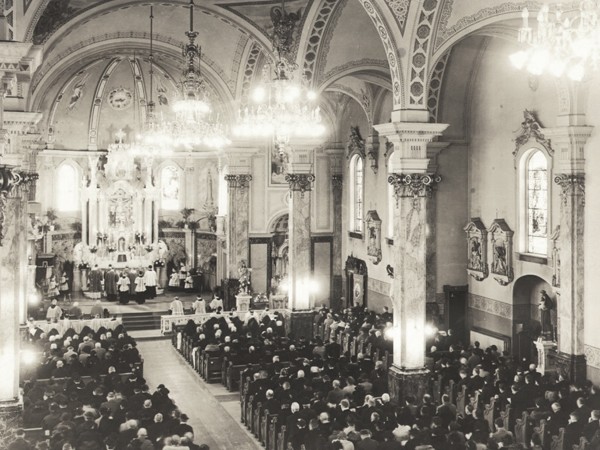
And in an ugly church?

What I first experienced the first time I walked into a Catholic Church was …

Would the young Joseph Ratzinger - or I - have had the same reaction if....

Now, as it appears after its decoration in the 1980’s.

st agnes church st paul

There was never an ironing-board altar in there.

And what you hear inside …

Play video

No, wait…. that’s the High School choir!

Here is the Gloria from Haydn’s Paukenmesse, also called the “Mass in Time of War”. This is a recording from St. Agnes Church, by the Twin Cities Catholic Chorale. I am in the choir in this recording.

Play video

This is the sort of thing you hear on 30 Sundays of the Year.

Would I have entered into communion in the Catholic Church had my first experience of Catholicism been in some dreadful municipal airport with My Little Pony music and dopey preaching by Father (now Bishop) Fatty McButterpants that wouldn’t have dented my rejected Lutheran catechism? I can’t say for sure, but God brought me to St. Agnes and not to the “Engendering Togetherness Community of Welcome” and “On Eagle’s Wings.” I had been a musician for a while by the time I walked into that church, and a good one. I had Latin and Greek by then. Like I say, I don’t know for sure what a church service with “Joy Is Like The Rain” would have done for me… or “Gather Us In”, but I suspect things would have turned out differently.

We are our rites.  How we pray shapes what we believe.  What we believe shapes how we pray.

I wonder how many priestly vocations have been annihilated by crappy music, ugly churches, and bad preaching from feckless and dissident priests.

At St. Agnes, during the 33 years that Msgr. Schuler was pastor, there were 30 First Masses.

Not. Rocket. Science.

PRE-ORDER NOW!
Would the young Joseph Ratzinger - or I - have had the same reaction if....
US Hardcover – HERE
UK Hardcover – HERE
US Paperback – HERE 
UK Paperback  – not yet
Posted in "How To..." - Practical Notes, Benedict XVI, Hard-Identity Catholicism, Liturgy Science Theatre 3000, Mail from priests, Priests and Priesthood, Seminarians and Seminaries, The future and our choices, Turn Towards The Lord | Tagged , , , ,
23 Comments

Did Pope Francis really write that letter?

UPDATE:

I have found a “news story” (but not really) at the site of Vatican Radio by Philippa Hitchen saying something about the letter. HERE

Also, in today’s L’Osservatore Romano of 12-13 September there is an unsigned piece on p. 7 which makes reference to the letter. HERE

Does this entirely put the question to bed?

Probably.  Unsigned articles in L’Osservatore are usually quasi-demi-semi-hemi official.  This is not quite as good as a response directly from the Holy See Press Office, but I think we have to go with it.  Yes, the Pope really wrote that letter.

And, yes, the Pope really endorsed the Argentinian document which opens the door to the divorced and remarried who do not use the brother and sister option to both the Sacrament of Penance and, hence, to reception of Communion.

Pope Francis, in his letter to the Argentinian bishop, the seeming chairman of the bishops who composed the document, confirms that the document “nella sua pienezza… in its entirety” shows “il senso del capitolo VIII dell’esortazione apostolica … the intent of chapter VIII of the Apostolic Exhortation”.

Here is the deal.   Again, we do NOT  have here the doors thrown open to official approval of Communion for anyone in any circumstance whatsoever.  This is not carte blanche.

As a matter of fact, if we want to be fair to what has been written (rather clumsily and unclearly), were someone, some couple, to read and take seriously – with the help of a good, faithful priest – what Amoris said, and what the Argentinian thing said, not many people would be able to discern that they can honestly receive Communion.

I’ll also repeat that, those who are rightly disposed toward the Church’s teaching and laws will work with all of this in continuity with the Church’s entire body of teaching, in obedience and fidelity.  Those who are not inclined to obedience and fidelity will continue to do whatever the heck they want, no matter what any Pope writes.

However, it seems to me that the way that this has all been handled, and the way this all will surely be reported, will open the door to abuses, abuses which I – for one – cannot fathom that any Pope would intend!

More on this later.

____ ORIGINAL Published on: Sep 12, 2016 @ 11:03

A complicated game is being played between those who defend the Church’s doctrine about matrimony and Communion, and the Kasperites who want to overturn the Church’s concerning doctrine matrimony and Communion for the divorced and remarried.

This game is being played in the Gray Zone.

First, it is important that we do NOT have a spittle-flecked nutty about what’s happening, or appears to be happening.  Spittle-flecked nutties don’t do us any good and, frankly, they are the right of the Left.  There is surely a lot that we simply do not know.

We have an alleged papal letter which appears to communicate Pope Francis’ approval of the content of a document of a region of bishops in Argentina. That document has some dodgy things in it, including a really bad section – 6.   The Pope is alleged to have written to a bishop in Argentina saying that that Argentinian regional document is in keeping with the Post-Synodal Apostolic Exhortation Amoris laetitia, that the regional document accurately interprets Amoris laetitia.  Section 6 of the regional document from Argentina effectively says that the divorced and remarried who are still together for whatever reason and who are not abstaining from sexual relations CAN be admitted to Communion.

Yes, I wrote “alleged”. The “Vatican” hasn’t acknowledged that it is real. The Press Office was asked about the letter, but no response was given. So, we can’t affirm that the letter is from the Pope or whether someone in the shadows made it up as part of a campaign of disinformation.

The Francis Forgery?

Why is the Holy See Press Office unavailable for comment?

Why should we believe that the Pope wrote this?  Because it appeared on InfoCatolica (which speaks for whom)?  Ditto LifeSite.

Isn’t there a Holy See Press Office and Social Communications dicastery?

We do not have all the facts in this matter.

The problem is section 6 of the Argentinian document. One could throw mud at other sections of the Argentinian document, but 6 is the bad one.  To wit (trans. at LifeSite):

6) In other, more complex circumstances, and when it is not possible to obtain a declaration of nullity, the aforementioned option may not, in fact, be feasible. Nonetheless, it is equally possible to undertake a journey of discernment. If one arrives at the recognition that, in a particular case, there are limitations that diminish responsibility and culpability (cf. 301-302), particularly when a person judges that he would fall into a subsequent fault by damaging the children of the new union, Amoris Laetitia opens up the possibility of access to the sacraments of Reconciliation and the Eucharist (cf. notes 336 and 351). These in turn dispose the person to continue maturing and growing with the aid of grace.

Did Pope Francis really write that letter?BTW… the Argentinian document has been removed from where I saw it first at InfoCatolica… removed “for revision”. It is available at LifeSite.
Note also that in the alleged papal letter the writer does not explicitly condone anything.  Read it carefully (without the spittle-flecks).

I will repeat what I wrote before. Nothing that has come out – authentic or not, real or forgery – changes anything. The Pope has not changed anything. Church doctrine and law are not changed through letters to individual bishops in reaction to local documents that have no real authority.  Has anything been promulgated in the proper way?

If the Pope wants to change something, or try to change something, he must do it explicitly with the proper form and promulgation.  Private letters and off-the-cuff remarks on airplanes don’t change law or doctrine.

The moderation queue is really ON this time!

Posted in Hard-Identity Catholicism, I'm just askin'..., One Man & One Woman, The Drill | Tagged , , ,
83 Comments

Benedict XVI’s Regensburg Address: 10 years later

Benedict XVI's Regensburg Address: 10 years laterHas it been 10 years already?   Job 7:6!  John Allen at Crux reminded me of the anniversary.

Ten years ago Benedict XVI delivered his famous Regensburg Address which sparked huge controversy over his inclusion of the example of Islam and their view of Allah in regard to reason and will.

You will want to review the essay by Sam Gregg of ACTON INSTITUTE about the Regensburg Address.  HERE

Here is a slice of Gregg’s article:

One of the basic theses presented by Benedict at Regensburg was that how we understand God’s nature has implications for whether we can judge particular human choices and actions to be unreasonable. Thus, if reason is simply not part of Islam’s conception of the Divinity’s nature, then Allah can command his followers to make unreasonable choices, and all his followers can do is submit to a Divine Will that operates beyond the categories of reason.

Most commentators on the Regensburg Address did not, however, observe that the Pope declined to proceed to engage in a detailed analysis of why and how such a conception of God may have affected Islamic theology and Islamic practice. Nor did he explore the mindset of those Muslims who invoke Allah to justify jihadist violence. Instead, Benedict immediately pivoted to discussing the place of reason in Christianity and Western culture more generally. In fact, in the speech’s very last paragraph, Benedict called upon his audience “to rediscover” the “great logos”: “this breadth of reason” which, he maintained, orthodox Christianity has always regarded as a prominent feature of God’s nature. The pope’s use of the word “rediscover” indicated that something had been lost and that much of the West and the Christian world had themselves fallen into the grip of other forms of un-reason. Irrationality can, after all, manifest itself in expressions other than mindless violence.

That irrationality is loose and ravaging much of the West—especially in those institutions which are supposed to be temples of reason, i.e., universities—is hard to deny. Take, for instance, those presently trying to turn Western educational institutions into one gigantic “safe space.” [cf. precious snowflakes] In this cocoon, those who maintain, for instance, that gender theory fails basic tests of logic, or that the welfare state has negative cultural effects, or that not all forms of inequality are in fact unjust (to name just some propositions which many today consider offensive), are regularly designated as “haters” or some word to which the suffix “phobe” is attached. [cf. democrats and their candidates]

You also want to read about Benedict XVI’s amazing Regensburg Address with the help of James Schall.

US HERE – UK HERE

Benedict XVI's Regensburg Address: 10 years later

Here is the audio of the talk.

Play video

I haven’t been able to find a full video of the Address. Odd.

With Italian voice over:

Play video

Another with Italian voice over, but decent video.

Play video

Posted in Benedict XVI, The Drill, The Religion of Peace | Tagged , , , , ,
10 Comments

Would Millard Fillmore’s VP pick be preferable to Tim Kaine?

Taylor Fillmore posterAs I have often said and written, I would vote for the corpse of Millard Filmore (the last Whig President and an anti-Catholic No Nothing) to keep Hillary Clinton out of the White House. And now, with Tim Kaine (can. 915 NOW!) on the dem ticket, I would extend my preference for Fillmore’s cadaver also to Fillmore’s VP’s cadaver… except that Fillmore didn’t have one, that is, he didn’t have a VP.

Fillmore ascended (descended?) to the presidency upon the untimely death of Zachary Taylor (+1850) from a nasty gastric malady after eating, they say, iced milk and raw fruit. (Be wary of milkshakes!) There was a theory that he was assassinated with arsenic or some such. As a matter of fact, in 1991 they would dig him up, Taylor, that is, to test his remains for arsenic.  They determined that it wasn’t arsenic.  It was probably the gastroenteritis that got him after all. Gastroenteritis got him with the help of his doctors, of course.  They bled and blistered him and gave him massive doses of an emetic to induce vomiting called ipecac (I’ll bet that’s as nasty as it sounds), opium, quinine and calomel (aka mercury chloride) which was used as both a laxative and a horticultural fungicide. What could go wrong?

Yes… that paragraph, with its emetics and laxatives and gastric problems, the bitterness of the quinine and the delirium of opiates, surely sets the tone for what follows.

And now to Tim Caine, or, No. 2 (on the ticket).

Spotted at The Stream:

Catholic Church Will Change on Marriage, Kaine Tells Radical LGBT Group

WASHINGTON (AP) — Democratic vice presidential nominee Tim Kaine is predicting that the Roman Catholic Church may eventually change its opposition to gay marriage. [Can’t be done.]

Kaine is a Roman Catholic [catholic] as well as a U.S. senator from Virginia and a former governor of that state. He told the Human Rights Campaign during its national dinner Saturday in Washington that he had changed his mind about gay marriage and that his church may follow suit one day.  [Quisling.]

[Watch this!  You may need to squint in the sight of his theological brilliance.] “I think it’s going to change because my church also teaches me about a creator who, in the first chapter of Genesis, surveyed the entire world, including mankind, and said, ‘It is very good,’” Kaine said. He then recalled Pope Francis’ remark that “who am I to judge?” in reference to gay priests.  [This is little better than word salad.  Wasn’t it in Genesis that we read that God created man male and female?  Genesis 1 says:  “And God created man to his own image: to the image of God he created him: male and female he created them. And God blessed them, saying: Increase and multiply”,  Right?  God seems to have had a reason for the two sexes thing: increase and multiply.  What’s the old phrase?  God created Adam and Eve, not Adam and Steve.  No “increase and multiply” that way.  Kaine seems to have fallen into the trap that God made people homosexual and that the homosexuality is one of the things God said was good.]

“I want to add: Who am I to challenge God for the beautiful diversity of the human family? I think we’re supposed to celebrate it, not challenge it,” Kaine said.  [As an aside: Kaine was educated by Jesuits.  I’m just sayin’.]

While he pledged to fight for increased rights for lesbian, gay, bisexual, transgender and queer Americans, Kaine admitted that he had opposed gay marriage until 2005.  [What a guy.]

“For a long time while I was battling for LGBT equality, I believed that marriage was something different,” he said. Virginia’s lieutenant governor when state lawmakers pushed for a constitutional amendment to keep marriage between one man and one woman, he recalled speaking to amendment supporters who said they hoped LGBT people would feel so unwelcome that they would move out of Virginia.

“When I heard the proponents describe their motivations, it became clearer to me where I should stand on this,” he said.  [THAT’s a reason to change your mind about sodomy?]

[…]

Brilliant.

At the urging of Daniel Webster, Fillmore the Whig appointed the only Whig Supreme Court Justice: Benjamin Robbins Curtis.  If you are not a Whig, you might not have know that.  Don’t infer from this that I am a Whig, which would be Kaine/Jesuit/Fishwrap reasoning (= fallacious).  Here’s another interesting factoid.  Curtis, the first on the SCOTUS bench to have a degree from a law school, was one of only two Justices who dissented from SCOTUS Dred Scott v Sanford in 1857.  He was so put off by that decision that he resigned from the Court.

Fillmore’s pick for SCOTUS turned out to be not too bad!

Speaking of the SCOTUS and really bad decisions, I am convinced in my marrow that Hillary Clinton, if given the chance, would appoint disastrous Justices who will set the compass of the SCOTUS for a generation and more to the accelerated ruin of these USA.

Fillmore’s corpse would surely choose better Justices than either Hillary or Kaine.

And, in answer to the question I facetiously posed, Fillmore’s VP choice would also probably be better than Hillary’s.

Again…  I’m all in!

FILLMORE CORPSE
AND
[….]
2016!  

Posted in I'm just askin'..., Liberals, Lighter fare, Sin That Cries To Heaven, The Coming Storm, The future and our choices | Tagged , , , ,
42 Comments