EXSULTET: WDTPRS and audio

The EXSULTET is one of the most spectacular moments of all the Church’s liturgical life.

When it is sung well in Latin the Church is in her glory!

I have fond memories of singing the Exsultet. The first time, I was a deacon on retreat at a monastery in central Italy, where the largest community of Benedictine nuns in Italy sing every word of their office and Mass in Gregorian chant in their 12th c. abbey. Another time, I was asked by my bishop (of an ancient Roman Suburbicarian diocese) to sing the Exsultet in Latin. We started outside in the deep night in the square before an enormous fire. It took over 10 minutes to get everyone inside, with long pauses between each “Lumen Christi!” The candle was the size of a Scottish caber. Though there was still much movement and exuberance I started singing, and when they heard the rarely use Latin and chant the great crowd quieted. As I sang about the “red-glowing flame” being “divided into parts” I could see a thousand candles and hear the fire still crackling outside as it cast flickering glows through the main door.

Most precious, however, are the times I sang the Exsultet in my home parish.

Here is my rendering of the 1970 Missale Romanum version of the Exsultet. Alas, there is no space to give you the Latin also. The Exsultet is also called the Praeconium Paschale. Paschale is an adjective of a Latinized Hebrew word pascha, for the Passover meal of the lamb. The sure and certain Lewis & Short Dictionary says the adjective praeconius, a, um is “of or belonging to a praeco or public crier” while the substantive praeconium is “a crying out in public; a proclaiming, spreading abroad, publishing.” In a Christian context this of course also infers the Good News! A praeconium is simultaneously a profession of faith and a call to faith extended to all who hear.

The Exsultet is a poem, elements of which go back to St. Ambrose (+397). It is to be sung by a deacon (or priest or cantor) during the Easter Vigil as a hymn of praise to God for the light of the Paschal Candle. The text became part of the Roman liturgy around the 9th century. The text is theologically packed. It contains a summary of Easter’s mystery. Christ is risen: we too can rise in Him. This was prepared for from the fall of man, directed by a loving Father, and awaits only the end of the world, although our baptismal character allows us to live the reality now: Already, but not yet!

There is an introductory invitation to “Exult!” (whence its name) given to three different groups: the angels, the Church on earth, and the whole Church together. There follows an account of works of God in the Paschal Mystery and the history of salvation. It begins with a dialog just like a Preface during Holy Mass.

Like a Eucharistic Prayer the Exsultet is a remembrance (anamnesis) which makes the past mysteries present to us. The singer deacon begs the congregation to pray for him as he tells the story of our family history of salvation with all the foreshadowing and “types” of our redemption. So great is God’s ability to turn evil to good that the deacon dares to call Adam’s fall our “happy fault… felix culpa” since because of it we were sent the gift of our Savior. You hear of the work of bees and the shattering of chains of sin. All evil is driven away.

The constant refrain is that this is a blessed night when heavenly and earthly realities merge together and become one.

Finally, there is a humble petition that God the Father will accept our Paschal candle, our evening sacrifice of praise, and make it into one of the lights of the heavens.

This poem/hymn/prayer is too much to grasp all at once. But year by year we have the chance to hear it renewed in the heart of the Church’s greatest night. The mysteries within it do not change, but we do. Each year we are a little different. We can hear it each year with new insight and understanding.

Consider the setting.

For forty days we have done penance. We participated at the anniversary of Holy Mass and the Priesthood on Holy Thursday with the mandatum and the procession to the altar of repose, Christ in agony in Gethsemane. On Good Friday, the day with no Mass, after our humble prostration before the Crucified Lord we stood for the singing of the Passion. Now we are in a dark church. The fire was kindled and the “Light of Christ” was thrice announced. The faithful have little candles sparked to life from the single flame of the Paschal candle, the “Christ candle”, now lighted as the symbol of His resurrection. The candle is incensed and then:


2002 Missale Romanum

Exult now O ye angelic throngs of the heavens:
Exult O ye divine mysteries:
and let the saving trumpet resound for the victory of so great a King.
Let the earthly realm also be joyful, made radiant by such flashings like lightning:
and, made bright with the splendor of the eternal King,
let it perceive that it has dismissed the entire world’s gloom.
Let Mother Church rejoice as well,
adorned with the blazes of so great a light:
and let this royal hall ring with the great voices of the peoples.
Wherefore, most beloved brothers and sisters,
you here present to such a wondrous brightness of this holy light,
I beseech you, together with me
invoke the mercy of Almighty God.
Let Him who deigned to gather me in among the number of the Levites,
by no merits of mine,
while pouring forth the glory of His own light
enable me to bring to fullness the praise of this waxen candle.

Deacon: The Lord be with you!
Response: And with your spirit!
D: Raise your hearts on high!
R: We now have them present to the Lord!
D: Let us then give thanks to the Lord our God!
R: This is worthy and just!
Truly it is worthy and just
to resound forth with the whole of the heart, disposition of mind,
and by the ministry of the voice,
the invisible God the Father Almighty,
and His Only-begotten Son
our Lord Jesus Christ,
Who, on our behalf, resolved Adam’s debt to the Eternal Father
and cleansed with dutiful bloodshed the bond of the ancient crime.
For these are the Paschal holy days,
in which that true Lamb is slain,
by Whose Blood the doorposts of the faithful are consecrated.
This is the night
in which first of all You caused our forefathers,
the children of Israel brought forth from Egypt,
to pass dry shod through the Red Sea.
This is the night
which purged the darkness of sins by the illumination of the pillar.
This is the night
which today restores to grace and unites in sanctity throughout the world Christ’s believers,
separated from the vices of the world and the darkness of sins.
This is the night
in which, once the chains of death were undone,
Christ the victor arose from the nether realm.
For it would have profited us nothing to have been born,
unless it had been fitting for us to be redeemed.
O wondrous condescension of Your dutiful concern for us!
O inestimable affection of sacrificial love:
You delivered up Your Son that You might redeem the slave!
O truly needful sin of Adam,
that was blotted out by the death of Christ!
O happy fault,
that merited to have such and so great a Redeemer!
O truly blessed night,
that alone deserved to know the time and hour
in which Christ rose again from the nether world!
This is the night about which it was written:
And night shall be made as bright as day:
and night is as my brightness for me.
Therefore the sanctification of this night puts to flight all wickedness, cleanses sins,
and restores innocence to the fallen and gladness to the sorrowful.
It drives away hatreds, procures concord, and makes dominions bend.
Therefore, in this night of grace,
accept, O Holy Father, the evening sacrifice of this praise,
which Holy Church renders to You
in the solemn offering of this waxen candle
by the hands of Your ministers from the work of bees.
We are knowing now the proclamations of this column,
which glowing fire kindles in honor of God.
Which fire, although it is divided into parts,
is knowing no loss from its light being lent out.
For it is nourished by the melting streams of wax,
which the mother bee produced for the substance of this precious torch.
O truly blessed night,
in which heavenly things are joined to those of earth,
the divine to the human!
Therefore, we beseech You, O Lord,
that this waxen candle, consecrated in honor of Your name,
may continue unfailing to dispel the darkness of this night.
And once it is accepted as a placating sacrifice,
may it be mingled with the heavenly lights.
Let the morning star meet with its flame:
that very star, I say, which knows no setting:
Christ Your Son, who, having returned from the nether realm,
broke serene like the dawn upon the human race,
and now lives and reigns forever and ever.
Posted in "How To..." - Practical Notes, Classic Posts, Linking Back, Liturgy Science Theatre 3000 |
15 Comments

Thorn of the Crown bleeds with Good Friday and Annunciation fall together

God is great.

Apropos my post about Lady Day and Good Friday falling together, which won’t happen again for over a hundred years.

From CNS:

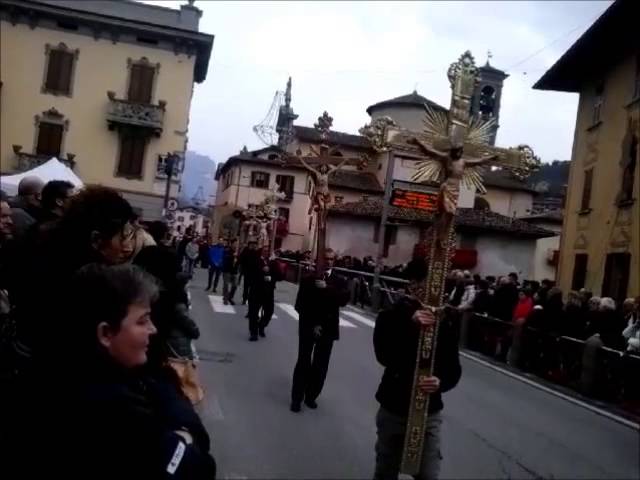
.- A single thorn held to have been taken from Christ’s crown of thorns that traditionally ‘bleeds’ each time that Good Friday falls on March 25, has done so again this year.

Bishop Raffaele Calabro, Bishop Emeritus of Andria in Italy’s Apulia region, confirmed today that the thorn has bled.

“The miracle has started, the wonder is underway,” Bishop Calabro stated.

The thorn has been kept in a reliquary in Andria’s cathedral since 1308.

A commission who observed the miracle confirmed the formation of three spherical formations or “gems” on the thorn and that “on the base of the thorn is the residue of the preceding miracle of 2005, renewing.”

The last time the miracle of the bleeding thorn took place was in 2005, and it is not expected to do so again until 2157. The occurrence has been recorded since 1633.

Bishop Calabro thanked God “for what he is doing, as the miracle is a gift from the love of God and is a sign of his love for this community.”

YouTube thumbnailYouTube icon

I am reminded of what I once heard an old bishop say: “Meno chiacchiere – più processioni”.

YouTube thumbnailYouTube icon

Posted in Just Too Cool | Tagged , ,
1 Comment

Why aren’t feminists angry at Francis for his foot washing changes?

Pope-Francis-SmilingToday I muse about why catholic feminists (an oxymoron – emphasis on moron –  I know, but bear with me) are not vexed by Pope Francis and his dramatically public choice to wash the feet of non-Christians.

Think this through for them.

What the Lord did at the Last Supper was wash the feet of His Apostles. Not just any of His disciples. Not everyone in the street. What He did, He did for the sake of apostolic ministry.

catholic feminists have always wanted hierarchs to include women in the foot washing, but they understood – if not by reason, by emotion – that the Lord’s gesture was about apostolic ministry and therefore priesthood. They wanted to be included because they want women to be priests.

Then comes Francis.

For decades catholic feminists have been pushing for women to be included in the foot washing rite, because they wanted women to be ordained.  Little did they think that Francis would reason, “Well, if women, why not non-Christians?”

Francis blows the connection of apostolic ministry and foot washing out the window.

For Francis, washing feet is a gesture of kindness to everyone. It is not about apostolic ministry, it is about religious tolerance, welcome, mercy, [fill in a natural virtue]. It isn’t connected to the Faith. If non-Christians are included, then this isn’t an exclusively Christian deal.

And it certainly isn’t about ordination … of anybody.

So, I ask again, “Why aren’t catholic feminists having a fit that Francis washes the feet of non-Christians?”

That Francis, in addition to washing the feet of women, washes the feet of non-Christians he has, single-handedly, taken the feminist power of this symbolism off the table.

Or, perhaps that was exactly what he wanted to do….

By washing the feet of non-Christians, he enervated the catholic feminist agenda. The foot washing rite is no longer symbolically significant in their battle for the ordination of women.  The fact that the Pope authorized the inclusion of women in the foot washing robs feminist catholics of a primary symbol in their decades long struggle for ordination.

How many times is it again that Francis has said that women can’t be ordained?

Moderation queue is ON. I won’t even think of letting your comments through if you didn’t read more than the title and then think it through.

Posted in Francis, Priests and Priesthood, The Drill | Tagged , , , ,
Comments Off on Why aren’t feminists angry at Francis for his foot washing changes?

A Tenebrae excerpt: “O my people! lament, like a virgin”

The Lamentations of Fr. Z include verses on the loss of the singing of Tenebrae, whole and entire in its proper language.

The ordering of the psalms is not particularly profound, but the antiphons and responsories are simply incomparable in the liturgical year.

To give you a sample, here is a snippet of Matins for Holy Saturday sung by the monks of Le Barroux.

You are hearing the 3rd Lesson, Lamentation, from the Prophet Jeremiah followed by the Responsory.  The Lamentation is sung in a special tone, not the usual prophecy tone.  In the Responsory, tune your ears for the word “uluate“,  howl.

The text in English

Reading 3
Lam 5:1-11
1 Remember, O Lord, what is come upon us: consider and behold our reproach.
2 Our inheritance is turned to aliens: our houses to strangers.
3 We are become orphans without a father: our mothers are as widows.
4 We have drunk our water for money: we have bought our wood.
5 We were dragged by the necks, we were weary and no rest was given us.
6 We have given our hand to Egypt, and to the Assyrians, that we might be satisfied with bread.
7 Our fathers have sinned, and are not: and we have borne their iniquities.
8 Servants have ruled over us: there was none to redeem us out of their hand.
9 We fetched our bread at the peril of our lives, because of the sword in the desert.
10 Our skin was burnt as an oven, by reason of the violence of the famine.
11 They oppressed the women in Sion, and the virgins in the cities of Juda.
Jerusalem! Jerusalem! Return unto the Lord thy God.

R. O my people! lament, like a virgin girded with sack-cloth for the husband of her youth, howl, ye shepherds, in sack-cloth and ashes
* For the day of the Lord is at hand, and it is great and very terrible.
V. Gird yourselves, ye Priests, and howl, ye ministers of the altar: cast up ashes upon you.
R. For the day of the Lord is at hand, and it is great and very terrible.
Gloria omittitur
R. O my people! lament, like a virgin, girded with sack-cloth for the husband of her youth, howl, ye shepherds, in sack-cloth and ashes * For the day of the Lord is at hand, and it is great and very terrible.

A chant for our times and for our nation and for our Church.

Lectio 3
Incipit Oratio Ieremíæ Prophetæ
Lam 5:1-11
1 Recordare, Domine, quid acciderit nobis; intuere et respice opprobrium nostrum.
2 Hereditas nostra versa est ad alienos, domus nostrae ad extraneos.
3 Pupilli facti sumus absque patre, matres nostrae quasi viduae.
4 Aquam nostram pecunia bibimus; ligna nostra pretio comparavimus.
5 Cervicibus nostris minabamur, lassis non dabatur requies.
6 Ægypto dedimus manum et Assyriis, ut saturaremur pane.
7 Patres nostri peccaverunt, et non sunt: et nos iniquitates eorum portavimus.
8 Servi dominati sunt nostri: non fuit qui redimeret de manu eorum.
9 In animabus nostris afferebamus panem nobis, a facie gladii in deserto.
10 Pellis nostra quasi clibanus exusta est, a facie tempestatum famis.
11 Mulieres in Sion humiliaverunt, et virgines in civitatibus Iuda.
Ierusalem, Ierusalem, convertere ad Dominum Deum tuum.

R. Plange quasi virgo plebs mea: ululate pastores in cinere et cilicio:
* Quia venit dies Domini magna, et amara valde.
V. Accingite vos sacerdotes, et plangite ministri altaris, aspergite vos cinere.
R. Quia venit dies Domini magna, et amara valde.
Gloria omittitur
R. Plange quasi virgo plebs mea: ululate pastores in cinere et cilicio: * Quia venit dies Domini magna, et amara valde.

Posted in "How To..." - Practical Notes, Hard-Identity Catholicism, LENTCAzT, Liturgy Science Theatre 3000, PODCAzT | Tagged ,
4 Comments

Lady Day and Good Friday – Of the Angels’ ‘Ave’ and the ‘Consummatum est’.

Today, 25 March 2016, is simultaneously the Feast of the Annunciation and Good Friday.  Liturgically we celebrate the Annunciation later.

In ancient times there was a tradition that Christ died on the 8th day before the Kalends of April: 25 March.  The idea that Christ died gave up the ghost on the day He took our flesh is certainly as beautiful as it is fitting.

How poignant it would have been also for Mary.

Mary said “Yes.” on the day of the Annunciation.  “Fiat” was her prayer.  That day the Incarnation took place as the Son took our humanity into an indestructible bond with His divinity.  Christ’s life began in the private darkness of the womb.  Soon after Salvation was born into the light of the world.

Mary said “Yes.” on the day of her Son’s death.  “Fiat” was her prayer.  That day the Incarnation was temporarily broken, as His human soul and body were sundered.  Christ’s life ended in the public darkness of the biblical tenebrae.  Soon after Salvation was accomplished with a burst of light at the Resurrection.

Good Friday rarely falls on Annunciation, Lady Day.  Lately it occurred in 1910, 1921, 1932, 2005, and today.  It’ll be a long time before the next time: 2157.

It also occurred in the year 1608. That day, the poet John Donne, one of the Metaphysical Poets, penned a magnificent poem.  He contrasts the two experiences of our Lady.

Upon the Annunciation and Passion Falling upon One Day.  1608

Tamely, frail body, abstain today; today
My soul eats twice, Christ hither and away.
She sees Him man, so like God made in this,
That of them both a circle emblem is,
Whose first and last concur; this doubtful day
Of feast or fast, Christ came and went away;
She sees Him nothing twice at once, who’s all;
She sees a Cedar plant itself and fall,
Her Maker put to making, and the head
Of life at once not yet alive yet dead;
She sees at once the virgin mother stay
Reclused at home, public at Golgotha;
Sad and rejoiced she’s seen at once, and seen
At almost fifty and at scarce fifteen;
At once a Son is promised her, and gone;
Gabriel gives Christ to her, He her to John;
Not fully a mother, she’s in orbity,
At once receiver and the legacy;
All this, and all between, this day hath shown,
The abridgement of Christ’s story, which makes one
(As in plain maps, the furthest west is east)
Of the Angels’ Ave and Consummatum est.
How well the Church, God’s court of faculties,
Deals in some times and seldom joining these!
As by the self-fixed Pole we never do
Direct our course, but the next star thereto,
Which shows where the other is and which we say
(Because it strays not far) doth never stray,
So God by His Church, nearest to Him, we know
And stand firm, if we by her motion go;
His Spirit, as His fiery pillar doth
Lead, and His Church, as cloud, to one end both.
This Church, by letting these days join, hath shown
Death and conception in mankind is one:
Or ‘twas in Him the same humility
That He would be a man and leave to be:
Or as creation He had made, as God,
With the last judgment but one period,
His imitating Spouse would join in one
Manhood’s extremes: He shall come, He is gone:
Or as though the least of His pains, deeds, or words,
Would busy a life, she all this day affords;
This treasure then, in gross, my soul uplay,
And in my life retail it every day.

Another poet, George Herbert wrote a poem in Latin reflecting on our life through Christ’s death:

In Natales et Pascha Concurrentes

Cum tu, Christe, cadis, nascor ; mentemque ligavit
Una meam membris horula, teque cruci.
O me disparibus natum cum numine fatis !
Cur mihi das vitam, quam tibi, Christe, negas ?
Quin moriar tecum : vitam, quam negligis ipse,
Accipe; ni talem des, tibi qualis erat.
Hoc mihi legatum tristi si funere praestes,
Christe, duplex fiet mors tua vita mihi :
Atque ubi per te sanctificer natalibus ipsis,
In vitam, et nervos Pascha coaeva fluet.

Christina Rossetti has this:

Good Friday
Christina Rossetti

Am I a stone, and not a sheep,
  That I can stand, O Christ, beneath Thy cross,
To number drop by drop Thy blood’s slow loss,
   And yet not weep?

Not so those women loved
   Who with exceeding grief lamented Thee;
Not so fallen Peter weeping bitterly;
   Not so the thief was moved;

Not so the Sun and Moon
   Which hid their faces in a starless sky,
A horror of great darkness at broad noon –
   I, only I.

Yet give not o’er,
   But seek Thy sheep, true Shepherd of the flock;
Greater than Moses, turn and look once more
   And smite a rock.

Posted in Poetry | Tagged , , , ,
18 Comments

25 March 1991: Archbp. Marcel Lefebvre – R.I.P.

On this day in 1991 Archbishop Marcel Lefebvre died.

Lefebvre was a great churchman, an astoundingly effective missionary.

I learned of Lefebvre’s death in an interesting way. I was that morning opening up our office (the Pontifical Commission “Ecclesia Dei“) because I was the first to arrive.  As I was switching on lights and machines, there the doorbell rang.   Thinking it was our secretary, who might not have the key handy, I opened the door to find… then-Card. Ratzinger.  He gave me the news that Lefebvre had died. He had just received a phone call about his death and stopped at our office on his way in to the Congregation.  I got on the phone to our own Cardinal right away.

Here are shots of Lefebvre’s memorial card, which I have kept these years.  I have it in a plastic holder, usually also with a short list of names of bishops for whom I say a Memorare after every Mass I say.

Lefebvre needs prayers.  He died excommunicated, poor man.

In your charity, you might pray for him too.

20130325-165100.jpg

20130325-165104.jpg

Posted in Linking Back | Tagged
29 Comments

Good Friday 3 April AD 33 – Lunar and Solar Eclipses as Christ died on the Cross

The fellow who made the video about the Star of Bethlehem (a compelling argument, I might add), also did some research about what happened in the heavens on Good Friday.

Let’s break it down.

Passover begins on the 14th day of the Jewish lunar month of Nisan. Moreover, Passover begins at twilight, dividing 14 Nisan and 15 Nissan. The Gospels say the Lord was crucified on Preparation Day, a Friday.  14 Nisan 14 fell on a Friday Preparation Day, twice: 7 April AD 30 and 3 April AD 33.  Daniel in 444 BC prophesied (Daniel 9:21–26) that the Anointed one would be cut off in 476 years after the decree to rebuild Jerusalem: AD 33.

The Bible records that, at the time of the crucifixion and death of the Lord, there were signs, including a “blood moon” or lunar eclipse.

Only one Passover lunar eclipse was visible from Jerusalem while Pilate was in office. It occurred on 3 April 33.

On 3 April the Moon rose already in eclipse.  It rose the color of blood.  That means that the eclipse began before it rose, in the constellation of the Virgin (at the time of Christ’s birth there was a New Moon, in the constellation of the Virgin).

The eclipse started at 3 pm when Christ was breathing His last.

But remember that a lunar eclipse is a syzygy!

If there is an eclipse in one direction there is an eclipse in the other direction too.

If you were standing on the Moon during that syzygy of 3 April 33, you would see a total eclipse of the Sun.

The blotted Sun would be in the heart of the constellation of the Ram (cf. “the Lamb who was slain”).

You can try this out for yourselves.  Go to the online astronomy aid Starry Night.  HERE

Move your location to Jerusalem and then plug in the time of about 7 pm and date 3 April 33 and adjust your view to ESE.  You will see the Moon has just risen and there is a label for your Earth’s shadow.  The Moon had risen at about 6:30 pm in the totality of the eclipse. HERE

15_04_03_eclipse_Crucifixion_01

Click

With the daylight turned off, and the horizon removed, and then looking at an angle down through the Earth below the horizon, at 3 pm, you see the Moon and Earth’s shadow converging in Virgo.

15_04_03_eclipse_Crucifixion_02

Then you can switch to the view from the Moon!

You must adjust your view a little and turn yourself right with a few clicks.  But you will find it.  In the screenshot, below, you can see where Earth and Sun are in Aries. Since the Earth would be larger in the Moon’s sky than in this screenshot, the Sun would be in total eclipse.  Adjust for UTC + 3 hours to the right time in Jerusalem from 1500 to 1800. HERE

15_04_03_eclipse_Crucifixion_03

Click

In read around the question a little more, I find that, using different date calculators, there are some problems of the day of the week.  Also, there are arguments for dating the Crucifixion to 1 April 33.  If that is the case, then the phenomena described above occur on Easter Sunday.  Much hinges on which calendar the Lord and His disciples were using for their own Passover meal, if the last Supper was a Passover meal (Joseph Ratzinger argued that it was a related sacrificial meal but not a seder.)

Definitive?  Not quite.  But it is not to be discounted that God, from all Eternity knowing exactly what would happen, set the heaven’s in motion in so precise a way that its signs would help us to understand the mysteries taking place, which were in other ways foreshadowed.   In the sacraments (a term interchangable with “mystery” in many contexts), visible signs help us to understand that insensible graces and transformations are taking place.  If in the signs of the sacraments, why not too signs in the heavens?

Posted in Just Too Cool, Linking Back | Tagged , , ,
8 Comments

Washing Feet – observations

I refer the readership to some lucid and sober comments about the pedilavium, the foot washing, that can occur as an option in both uses of the Roman Rite.

Fr John Hunwicke makes some keen and, for liberals sobering, observations. I expunged his emphases and added my own emphases and comments:

PEDILAVIUM or FOOT WASHING: such a wealth of different meanings

The meaning of this rite, in the intention of the current Sovereign Pontiff, has been changed. I persist, against all the traddy shock-horror, in considering this No Big Deal. [This is a good approach, provided the Church’s laws are still being obey… which they are not in many places.] Firstly, a bit of History.

(1) The sense the Pedilavium appears (not invariably but) most commonly to have had in the pre-modern period was of humble service done by a superior (Bishop, Abbot) before his own subjects, and in the intimacy of their own close fellowship. Among the feet which Father Abbot washed were those of the young monk whom, perhaps, he had needed yesterday to discipline. His Lordship the Bishop did the same for a presbyter with whom … forfend the thought! … he may have had a less than cordial relationship. Perhaps an equivalent would be Papa Bergoglio washing the feet of curial cardinals including those who had disagreed with him in Synod or during their weekly audiences!  [Now that would be a gesture that would mean something, especially after the way he lambasted the Curia for Christmas a year and more back.  In any event, take note of the gesture’s element of condescension.]

[NB] The Lord did not, as people sometimes carelessly assert, “wash the feet of his disciples”, who were many; He washed the feet of a much more limited group, the Twelve. He did not wash the feet of the people who flocked to hear Him teach in the fields or on the Mountain or beside the Lake or in the village square, or even the feet of the Seventy He sent forth or of the women who ministered to Him; when He washed the feet of the Twelve, it was behind the closed doors of an exclusive Meeting arranged in almost 007-style secrecy. And the implication of S Peter’s words was that this had not been the Lord’s regular custom.  [Take note of the gesture’s element of exclusivity.  The Lord washed the feet of the elite Twelve, the “chosen”, and out of public view.]

It has been plausibly suggested that we might discern sacerdotal undertones when a bishop washes the feet of his presbyters; Anglicans will recall that Bubbles Stancliff, a liturgical dilettante who was bishop of Salisbury and who appears to have believed this, introduced the ceremony into Anglican ordination rites. [On the other hand, it is a fact that the High Priest washed the feet of his first sacerdotes.]

[This is good…] Washing the feet of a person with whom one has no relationship, no daily fellowship whether for better or for worse, empties the rite of this, historically (I think) its first, meaning. Unless a different meaning is devised, it becomes an empty, formalistic, ritual. [Interesting, no?]

(2) A second meaning of some historic pedilavium ceremonies was both the humility and the generosity of the great and the grand towards their social inferiors. Holy Condescension. This is the meaning which the rite had when it was used by sovereigns and by some bishops. Food, clothing, money would often be distributed. In the twentieth century, British monarchs restored the rite in this sense, but did not revive the actual footwashing. Specially minted pieces of archaic coinage are distributed. True, the Lord High Almoner still girds himself with a towel, but that is only because this is the sort of thing which the English, a strange race, deem to be ‘tradition’.

Meanings (1) and (2) both rest upon presuppositions of status and hierarchy. These are concepts now rather out of vogue. [Unless you are a liberal.  Remember: they are the morally superior elitists par excellence.] Perhaps this is why the Holy Father has dreamed up a new and completely different understanding of the rite … inculturating it, so to speak, into post-modernity.

(3) This different and new meaning Papa Bergoglio now wishes to attach to the rite is the boundless love and Mercy of God to all, and not least to those on the peripheries of Society. This removes any overlaps with meanings (1) and (2) (and it is very far from what the closed and exclusive intimacy of the Last Supper suggests that the Lord had in mind). But, [PAY ATTENTION!] as long as we all understand that this new meaning has nothing whatsoever to do with S John’s Last Supper narrative or the Church’s ancient liturgical tradition, it seems to me a perfectly reasonable Acted Parable for an innovative Roman Pontiff to introduce and to encourage. No harm in a bit of imagination!!  [So, perhaps the pedilavium should be developed into an entirely separate Holy Thursday rite, outside of Mass, especially the Holy Thursday Mass.]

Since the Pedilavium is, in historical terms, a very recent and completely optional importation into the Liturgy of a ceremony which (where it was done at all) used to be extra-liturgical and took varying forms, I cannot see why any Roman Pontiff, or, for that matter, any junior curate, should not be entitled to juggle around with it, and to give it whatever new meaning or meanings he chooses to suit his own specific social context. [Yep.  As long as it isn’t during Holy Thursday Mass.] (Whether Maundy Thursday, a congested Day on which liturgically quite a lot already happens, is the most apt time for such performances, I very much doubt. Here, I have a constructive suggestion to make: see, below, my penultimate paragraph.)

[…]

Read the rest over there.  It gets good.

Intriguing.

So… remove it entirely from Mass and then … let a hundred flowers blossom!  Let a hundred schools of thought… make up stuff.

Meanwhile, this ludicrous scene was spotted on Facebook and sent to me.

16_03_24_footwashing_madness_01

I don’t know what this is, but it isn’t the liturgy of the Catholic Church.

Posted in "How To..." - Practical Notes, Liturgy Science Theatre 3000, The Drill | Tagged , , , ,
17 Comments

UPDATE: Pontifical Red Vestments from @Gammarelli for @MadisonTMS

One of my favorite portrait artists is Giovanni Battista Moroni (+1579).  Not one was he Catholic, in a serious sense, he was both in Trent when the Council was being held and was influenced by it.

One of Moroni’s more famous paintings is The Tailor, which hands in the National Gallery in London.

Moroni Tailor

It is interesting for its details, of course, but it is significant because it portrays a tradesman rather than a member of a noble family, etc.

It is also a kind of logo for Ditta Gammarelli in Rome, ecclesiastical tailors.  They use it on their bags, etc.

Right now the Tridentine Mass Society of Madison – 501(c)(3) – , of which I am President, has a fundraiser going on to buy vestments.  We need Pontifical vestments because we have a wonderful bishop who pontificates in the traditional rite.  We can use them also for Solemn Masses.  I have a full description HERE.

Your donations are tax deductible.

The great guys at Gammarelli have been kind enough to send photos as they cut the fabric for vestments.  I thought this was particularly good.   They are cutting for the cope.

16_03_25_Gammarelli_cutting_cope

Please help with this fundraising project!  (Don’t worry, we have more coming.)

HERE


Posted in Liturgy Science Theatre 3000, SUMMORUM PONTIFICUM, The Campus Telephone Pole | Tagged ,
Comments Off on UPDATE: Pontifical Red Vestments from @Gammarelli for @MadisonTMS

POLLS: Holy Thursday Foot Washing – What happened where you are?

This year for the first time it is licit that women’s feet be washing during the entirely optional “Mandatum” in the Mass of the Lord’s Supper, Holy Thursday.


NB: Before this year, those who were doing so, did so in violation of the law.

What happened where you went to Holy Thursday’s Mass, assuming, of course, that you went?  Otherwise, if you did not go, perhaps you know what happened by word of mouth or by reading the bulletin, etc.

Chose your best answer – depending on the Form of Mass you attended – and add a comment in the combox, below.

Anyone can vote. Registered and approved participants can also comment.

The 2016 Holy Thursday EXTRAORDINARY Form Mass I attended ...

View Results

The 2016 Holy Thursday ORDINARY FORM (NOVUS ORDO) Mass I attended ...

View Results

Posted in Liberals, Liturgy Science Theatre 3000, POLLS | Tagged , , ,
72 Comments