Congratulations Archdiocese of St. Paul and Minneapolis: New Archbp. HEBDA

My native place has finally received an official appointment of its next Archbishop.

He has already been there for a while, the former Coadjutor of Newark, Archbishop Bernard Hebda.

He had been the Adminstrator. He is staying as Archbishop.

This is good news for the Twin Cities and beyond.

Posted in SESSIUNCULA | Tagged ,
9 Comments

TENEBRAE 2016: Photos

I recently posted about

Today I received photos from a favorite place of mine, Wyoming Catholic College.  Prof. Peter Kwasniewski writes:

Last night we held our fifth consecutive Tenebrae service at Wyoming Catholic College. (We always sing, in full, the traditional Tenebrae for Holy Thursday on Wednesday night. It lasts for about 2 1/2 hours. The faithful sing all the Psalms and antiphons with the Schola.)

Not only is Tenebrae itself hauntingly beautiful, but it is apparently attractive as well. Each year, our schola of singers has grown (it was twice as large in 2016 as it was in 2012), and the congregation of the faithful has grown, too (it was easily four times as many as the first time we did it). Students, faculty, parishioners and local families all come out for it now.

The Church’s tradition gives us such tremendous resources. If only we would use them, we would be doing the new evangelization in earnest.

Here are a couple photos.

Tenebrae 2016 (1)

And at the end, perhaps just before the last Miserere or just after the “earthquake”.

Tenebrae 2015 (2)

Some people will ask what that big candelabra is called.  In English we refer to it as a “hearse”.  In Rome, however, it is called a “Barabbas”.  My friend Gregory DiPippo of NLM quipped: “In a similar vein, I decreed that the “parvum sustentaculum” which was introduced into the Easter vigil in the Pius XII Horror Week should be called the Caiphas.”

As you can tell, he isn’t a fan of the 1955 reform!

Posted in Liturgy Science Theatre 3000 | Tagged , , , ,
8 Comments

Blog down for a while… why?

UPDATE 24 March:

There was another attack today.

____

There was a DNS attack on the blog today.

There were 383 pages of log entries from one IP address making multiple queries per second.

Just so you know… the devil and his agents hate this blog.

Fr. Z’s Litany for the Conversion of Internet Thugs (2.0)

A wry work in progress.

Litany for the conversion of internet thugs (2.0).
(For private use only, when truly irritated, and when the alternative is foul language.)

Lord, have mercy.
Christ, have mercy.
Lord, have mercy.
Christ, graciously hear us.
God, the Father of Heaven, have mercy on us.
God, the Son, Redeemer of the World, have mercy on us.
God, the Holy Ghost, have mercy on us.
Holy Trinity, one God, have mercy on us.

Lest internet thugs be eternally tormented by all the fiends of hell, convert them, O Lord.
Lest they pass eternity in utter despair, convert them, O Lord.
Lest they come to be damned for the harm they cause, convert them, O Lord.
Lest they roast forever in the deepest cinders of hell, convert them, O Lord.
Lest they suffer the unceasing pain of loss, convert them, O Lord.

Lest devils endlessly increase their physical agony, convert them, O Lord.
Lest devils twist their bowels and boil their blood in hell, convert them, O Lord.
Lest devils use them as toys and tools, convert them, O Lord.
Lest devils forever gnaw upon their skulls, convert them, O Lord.

Lest the innocent be harmed by the sins of thugs, convert them, O Lord.
Lest the innocent yield to thugs in weakness, convert them, O Lord.
Lest the innocent be drawn into thuggish traps, convert them, O Lord.

From faceless Facebook admin drones, spare us O Lord.
From tweeting Twitter idiots, spare us O Lord.
From loony Wikipedia liars, spare us O Lord.
From from heart-hardened spammers, spare us O Lord.
From liberal nut-case smear-blogging hacks, spare us O Lord.
From thread-dominating combox trolls, spare us, O Lord.
From sophomoric drive-by commentators, spare us, O Lord.

From server memory resource difficulties, spare us O Lord.
From rss feed problems, spare us O Lord.
From DOS attacks, spare us O Lord.
From power outages and surges, spare us O Lord.
From viruses, trojan horses, and all manner of snares, Lord save us.
From wasting our time, Lord save us.
From our own stupidity, Lord save us.

St. Michael, defend us.
St. Gabriel, defend us.
Holy Guardian Angels, defend us.
St. Isidore of Seville, defend us.
St. Francis de Sales, defend us.
St. Maximilian Kolbe, defend us.
All ye angels and saints….. GRRRRR.

Lamb of God, who takest away the sins of the world, spare us, O Lord.
Lamb of God, who takest away the sins of the world, graciously hear us, O Lord,
Lamb of God who takest away the sins of the world, have mercy on us.

V. Christ, Jesus who died for our sins.
R. Please return, and return swiftly.

Let us pray.
Almighty and merciful God,
who according to Thy ineffable plan
hast called us into existence to do Thy will
amid the vicissitudes and contagion of this world
grant, we beseech Thee,
both protection for Thy servants who use the tools of this digital age
and confusion for evil-doers who abuse their neighbors and Thy gifts.
Through Christ our Lord.   Amen.
____

I need some serious consolation!

*sniff*

Go HERE

Posted in SESSIUNCULA |
25 Comments

24 March: Bl. Oscar Romero, martyr

There is a piece at Vatican Radio that this Holy Thursday, 24 March, will be the “feast day” of Bl. Oscar Romero, the Salvadoran Archbishop who was murdered while celebrating Mass in 1980. It seems to be the Church’s day of prayer for missionary martyrs.

It’s not his feast day where I am, in the sense that anything liturgical can be done in his honor.

And it wouldn’t be even if it weren’t Holy Thursday.

I’m all for prayer to true martyrs whom the Church has recognized as such. We can also invoke the prayers of the countless martyrs whose names are know only to God.

However, the liturgical cult of a Blessed, only beatified, as many martyrs are, is generally only extended to the diocese where that Blessed lived and died and also, perhaps, to their religious orders and some other places closely associated with the Blessed, such as a native country or diocese, etc.

Canonization, not beatification, opens the way to being on the universal Church’s calendar, not just a local calendar.  Sometimes the Church allows for much wider observance and cult of mere Blesseds, depending on their popularity.

So, for the whole Church, even were tomorrow not Holy Thursday, which bumps every other consideration off the calendar because our focus ought to be on the Institution of the Eucharist and the Priesthood and the beginning of the Lord’s Passion (and not on political agendas or other sidelines), we don’t celebrate Bl. Oscar Romero liturgically.

In years to come, unless he is canonized if you are in El Salvador, then you might have permission to remember him liturgically, but if you aren’t, then you probably won’t.

The moderation queue is ON.

Posted in "How To..." - Practical Notes, Liturgy Science Theatre 3000, Saints: Stories & Symbols | Tagged
7 Comments

ASK FATHER: How long do I have to fulfill my Easter Duty?

From a reader…

QUAERITUR:

One of the precepts of the Church states we are to receive Holy Communion at Easter. I always wondered if that meant Easter Mass or during the Easter season. My 1962 Missal say Easter (period) but I have seen it stated elsewhere as the Easter season.

Thanks for your consideration and have a great Holy Week!

Easter Duty is the obligation to receive Holy Communion at least at Easter time.  This “time” used to vary according to the country. Communion was to be received at one’s parish, if possible. Otherwise, the parish was to be informed.  Old parish registers had a column for notations about Easter Duty.  Also, I have used confessionals that still had a small slot through which a penitent could slide a card for the priest to sign about Easter Duty.  Easter Duty, while mainly focused on Communion, usually and reasonably also included one’s annual confession at the the same time.

In the 1983 Code for the Latin Church, the law for the Easter Duty (can. 920) says that it must be fulfilled during the Easter season “unless it is fulfilled for a just cause at another time during the year.”

The 1917 Code specified that the period for the fulfillment of this duty ran from Palm Sunday to the 2nd Sunday of Easter.  As mentioned before, the “time” varied by place. In Great Britain, it was between Ash Wednesday and Low Sunday, but in Westminster the 4th Sunday of Lent to Trinity Sunday; in Ireland, Ash Wednesday and the Octave of Ss. Peter and Paul, etc.   The current Code does not specify what the Easter season is for purposes of this precept, and so it seems to run from Holy Saturday through to Pentecost.

However, an indult once given for these United States permitted the fulfillment of this obligation anytime between the 1st Sunday of Lent and Trinity Sunday, inclusive. It has not been revoked and so – I supposed – may still be in force.  That said, the time from the beginning of Lent through Pentecost is pretty long.

So…

GO TO CONFESSION!

And remember: It is NOT obligatory to go to Communion just because you go to Mass.


Posted in "How To..." - Practical Notes, ASK FATHER Question Box, Liturgy Science Theatre 3000 | Tagged , ,
5 Comments

Wherein Fr. Z reviews and rants on important points about VALID baptism

infant baptismBecause Easter is a special time for baptizing, I hereunder assemble some observations from past ASK FATHER Question Box responses about baptism and validity.

INITIAL RANT: 

Bishops would do well to quiz priests, and seminarians before ordination as deacons, about how to baptize.  Some might find this insulting, but given how important this is… who cares?  I have heard some pretty crazy things in my email.  Some men trained in certain place and certain years – this includes especially permanent deacons, by the way – cannot be assumed to know how to baptize properly.

I mean … how hard is it, guys, to do it right?  To do it in such a way that there can be no doubt in the minds of those watching that it was valid?  How hard is it?  For all love, if priests and deacons can’t do these basic things right, say the black and do the red, they should be sent to some… I dunno… “re-education” camp. No air-conditioning.  No screens on the windows.  Perhaps they should stay in camps on the model of Sheriff Arpaio’s in Maricopa County until they can demonstrate that they know the words and actions.

QUAERITUR: What if the water doesn’t flow on the head?

I put this to the CDF and received a response that the baptism is not valid.  Other great writers have established that if they water does not flow on the head, the validity is doubtful and it should be repeated conditionally.   Say there is an emergency, an accident, and only a leg can be reached: after the rescue, the person should be baptized conditionally.  Bottom line: water must contact the head!

QUAERITUR: What if the water flows only on the hair of the head but not the skin?

If it runs on the hair of the head, the baptism is valid.

QUAERITUR: Does the water have to be poured, only poured?

No.  Pouring, sprinkling and immersion or a combination of the three are possible for validity.  However, the water must contact – say it together – the head.

Immersion: The water has to have contact with at least the back or base of – WHAT? – the head.   Concerning babies and immersion, dipping, of just the “backside”.  FAIL.


12_11_23_sac-baptism-headQUAERITUR
: Can the priest change the words used?

Sacraments have both matter and form.  The matter of baptism is water (not something else) in contact with at least the head.   The form is the speaking of the formula: “I baptize you in the name of the Father, and of the Son, and of the Holy Spirit.”  In my opinion it is best to do this in Latin, though approved translations are allowed.  The form is absolutely essential. In no circumstance can it be altered. These words must be pronounced simultaneously with action of making the water contact the head.  Not before.  Not after.  A good practice is to pour the water thrice, with the Names of the Persons of the Trinity, or continuously as the whole form is pronounced.  That way there is no question about validity.

QUAERITUR: What about sponsors, godparents?

Having a godparent is important for baptism for liceity but not for validity.  I am writing here about validity. I’ll leave godparent stuff for another post.

BONUS RANT:

It is a constant source of amazement to me just how hard some priests find it to follow the book!  Just do the red and say the black!

Well… I guess I do understand.

Priests are generally good-hearted men, even if some are dumb or have wacky ideas.

Sometimes priests err because they want to make the rite more “meaningful”.  Sometimes they endure real pressure from poorly catechized lay people.  Yes, it is good that they come to the church for these milestone moments.  However, because their identity is tenuous at best, they want “meaningful” stuff put into the rite where it doesn’t belong.  Priests sometimes cave in.    Believe me, I understand the pressure.  A bunch of people got really mad at me once because I wouldn’t interject goofy things they made up and wanted as part of the rite of baptism.  Yes… there is pressure.

Some priests think they are doing something “more authentic” because they read somewhere that in the ancient Church baptism was by immersion.   Liberal writers and workshops have fed them the line that if it is “pristine” then it must automatically be better.  This is redolent of the false archeologizing Pius XII warned about in Mystici Corporis Christi and which the Church condemned when pushed by the infamous Synod of Pistoia.  Just because something was done in the ancient Church, that doesn’t mean that it is better than what we do now.  We’ve learned a few things along the way, after all, and therefore changed our practices.

So here is a message for priests about baptism, particularly by immersion:

If you are too dumb to do immersion properly, just don’t do it.

Otherwise, next time throw yourself into the immersion pool, preferably wearing a millstone.

Posted in "How To..." - Practical Notes, ASK FATHER Question Box, Wherein Fr. Z Rants | Tagged , ,
21 Comments

National Catholic Prayer Breakfast confirms a big guest speaker in addition to Card. Sarah!

NCPBThis year on 17 May the 12th National Catholic Prayer Breakfast will be held in Washington DC.

The keynote speaker is the great Robert Card. Sarah, Prefect of the Congregation for Divine Worship.

A special guest speaker has also been confirmed today, Speaker of the House, Paul Ryan (R-WI).

Early bird pricing for tickets expires on 31 March 2016.

Registration is open.

HERE

Posted in Events, Just Too Cool, Our Catholic Identity, The Campus Telephone Pole | Tagged , , ,
1 Comment

ASK FATHER: Priest only baptizes babies by full immersion and without clothes (… on the baby)

baptismFrom a reader…

My daughter and son-in-law (a Lutheran, and a good man finding his way home) are taking classes in preparation for the baptism our granddaughter who will be born in April. She has been told that all baptisms are done during Mass with no exceptions. Not her preference but she’s fine with that. They also have been told that all babies will be baptized by total immersion in the baptismal font (large pool) in the narthex. The babies (in the past as many as 12 or more at a time) will be completely disrobed. My daughter and her husband were taken aback by this and they do not feel at all comfortable placing their newborn in this situation. I’ve told them that while I believe it is certainly licit, I’ve never seen this done before. I believe it to be part of the Orthodox tradition but I do not understand it to be a Roman Catholic tradition, at least in this country. So for me this situation does beg the question, why? Why the pastor would think this necessary, even against the wishes of the parents? Your comments and suggestions please Father.

P.S. Went to confession today!  Thank you for your constant reminder of God’s Mercy encountered in this sacrament. Would that all priests be as vigilant in this regard.

Naked baptism, and baptism by immersion are certainly valid, but not required. I question the authority of the pastor to impose either on the faithful.  I think a discussion is in order with the pastor about possible options. If he’s unwilling to bend, a call to the diocesan chancery (after Holy Week, thank you) might produce some reasonable alternatives.

Once again, the question arises: Why are certain persons in the Church (generally of a liberal stripe) intent on making certain options mandatory (e.g., doing baptisms a certain way) while, at the same time, they seem eager to turn certain mandatory obligations into mere options (e.g., claiming that it’s still an option to stand during the Canon while it’s clearly not permitted any longer)?

Thanks for the mention of confession.  Everyone…

GO TO CONFESSION!

Posted in "How To..." - Practical Notes, ASK FATHER Question Box, Liberals, Liturgy Science Theatre 3000 | Tagged ,
41 Comments

Combox decorum: a metaphor

Friends, just because you have some anonymity in these interwebs, that doesn’t give you free reign to be all crabby, and, you know, go at each other with knives in the combox.

YouTube thumbnailYouTube icon

It’s the Star Trek fight music that does it.

Posted in Lighter fare | Tagged
4 Comments

Wednesday of Holy Week: The Whole Megillah

megillat estherDuring Holy Week, in the traditional Roman Rite we read or sing all four Gospel accounts of the Passion of the Lord.

Tomorrow, Spy Wednesday, we read or sing the whole Passion according to Luke.  Mass can get a little long, even on the weekdays of Holy Week.

This year our Wednesday of Holy Week, 23 March, coincides with the beginning of the Jewish holiday Purim, which celebrates how God, through Esther and her adoptive father Mordechai, saved the lives of the Jewish people from the hateful Hamman and the King during the Persian captivity.

One of the customs of Purim is to read or sing the whole scroll of the Book of Esther, which is called “the whole megillah (megillat – scroll)”.  There are several “megillah books”, but Esther is probably the most associated with the word.   During the singing of the whole megillah, when the name of the evil Hamman is pronounced, the people often shout and make noise with noisemakers to blot out his name, a kind of damnatio memoriae.  There are some interesting Youtube videos of the singing of Esther that have this blotting out of “Hamman”.   For example, HERE, at synagogue in Tampa, they really get into it.  Check out about 1:30.

By the way, don’t be puzzled by the seemingly cheerful raucous music that introduce some of these Megillah Esther videos.  Purim is a time of serious partying.   There is a lot of dressing up in costumes and feasting.

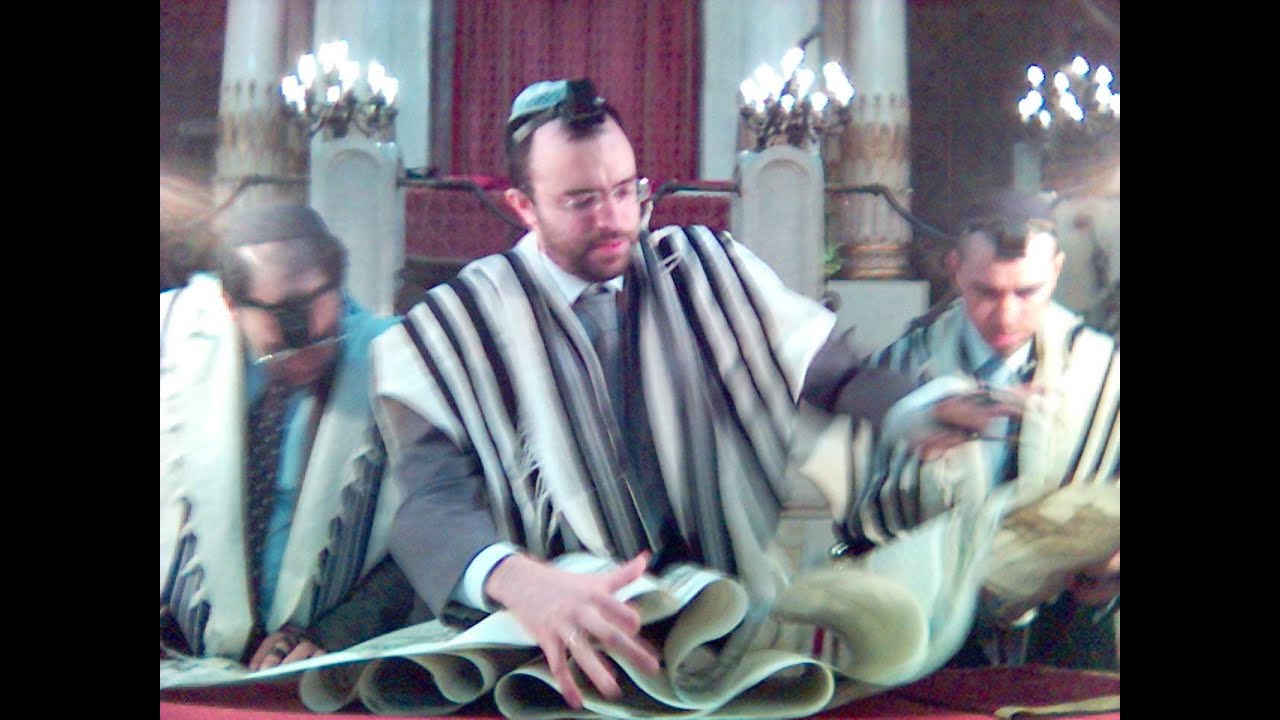
Here is a singing of Esther from the Synagogue in Rome (Hebrew with an Italian accent).  Chapter 3 starts at 12:35 or so and right after is a mention of the hated Hamman.

YouTube thumbnailYouTube icon

Posted in Hard-Identity Catholicism | Tagged , , , ,
8 Comments