Welcome Aboard New Registrants!

To participate in the combox here, you must be registered and approved (by me).

Since the blog is under constant attack by spammers and nefarious ne’er-do-wells, I use the “about you” field in particular to screen registrations.

Welcome aboard recent registrants!

Benedicite
sbhamilton
grzechy
JamesF-J
toddbrown
Lesterrobyndumm
leftycbd
hartmtown
Herrgottswinkel
brschirf
rkvidt
Manducat in the hat
Aj09op
douglass49shaw
Byzshawn
Evergreen
aliceinstpaul
Cb1987
dlzsoon
Michael Glowacki
suellen1954
mcrw
keiling
uncletomcobley

I, for one, do not weep that there are dozens of comments under a post here, rather than hundreds. You have seen what vile fever swaps comboxes become at the Fishwrap and other catholic sites. I’d rather have fewer and better comments, than the soul-annihilating feculence in evidence from the liberal dissidents and heretics. I can’t screen every possible comment here for charity, but I try to keep an eye on things.

Posted in SESSIUNCULA |
Comments Off on Welcome Aboard New Registrants!

UPDATE: English translation of Memoirs of Louis Bouyer

The English translation of The Memoirs of Louis Bouyer: From Youth and Conversion to Vatican II, the Liturgical Reform, and After has finally been produced.  UK click HERE

Soon after it was put on sale, it because unavailable.  Apparently the supply chain was goofed up.  Happily it is now available again.

If you tried to order it, and were unsuccessful, try again!

This is an important first hand account of what happened in the liturgical “reform” sparked by Vatican II.

15_08_18_Bouyer

Click to buy!

For Amazon UK click HERE

Posted in Liturgy Science Theatre 3000, The Campus Telephone Pole | Tagged , ,
1 Comment

You are the periphery which can revitalize the Church!

Some time ago, I wrote HERE:

If there is a malaise in the Church today, if there is an interior decay (and there is), then [as Pope Francis says] we should look to peripheries for that which can help to revitalize our identity, get us strong and healthy again.  We need what the periphery has to offer.

Traditional Catholics whose “legitimate aspirations” have been drawn to the traditional forms of our sacred liturgical worship, and who stick closely to traditional expressions of doctrine, are a periphery.   They have even been made into a periphery by the Church’s own appointed pastors.

It’s time to start listening to this periphery.

I drive at this point in some other posts as well.

I read at One Peter Five an interview of Bp. Athanasius Schneider with the Spanish-Language website, Adelante La Fe (Advance the Faith).  In the interview we find this:

Adelante la Fe: Can Your Excellence give some words of encouragement to those priests who, for being faithful to Church Tradition, are isolated and pushed into the background in their dioceses and not given temples where they can officiate Holy Mass in the Extraordinary Form, as well as to those faithful who are deprived of Traditional Holy Mass?

Mons. Schneider: I would like to say to these priests, seminarians, young people and families: “It is an honor and a privilege to be faithful to the Divine truth and to the spiritual and liturgical traditions of our forefathers and of the saints and being therefore marginalized by those who currently occupy administrative power in the Church. This your fidelity and courage constitute the real power in the Church. You are the real ecclesiastical periphery, which with God’s power renews the Church. Living the true tradition of dogma, liturgy and holiness is a manifestation of the democracy of the Saints, because tradition is the democracy of the Saints. With Saint Athanasius I would like to tell you these words: Those in the Church who oppose, humiliate and marginalize you, have occupied the churches, while during this time you are outside; it is a fact that they have the premises – but you have the Apostolic Faith. They claim that they represent the Church, but in reality, they are the ones who are expelling themselves from it and going astray (cf. Letter to his flock)”.

Beautifully expressed.

He is right.

Be the Maquis!

Posted in Be The Maquis, Francis, Hard-Identity Catholicism, Linking Back, Our Catholic Identity | Tagged , , ,
5 Comments

ASK FATHER: “I went to confession at a SSPX parish for several years.”

penance_confession_stepsFrom a reader…

QUAERITUR:

After I became Catholic, some friends introduced me to tradition and I began to attend a SSPX parish with them. I went to confession at this SSPX parish for several years. I have heard that the validity of SSPX confessions is dubious at best. Do I need to go and reconfess those sins?

First, the SSPX might have a chapel, but they don’t have a parish.  Parishes are officially established by proper authority.  The SSPX doesn’t have authority to establish parishes.

Next, the 1983 Code of Canon Law says that:

Can. 966 §1 For the valid absolution of sins, it is required that, in addition to the power of order, the minister has the faculty to exercise that power in respect of the faithful to whom he gives absolution.
§2 A priest can be given this faculty either by the law itself, or by a concession issued by the competent authority in accordance with can. 969.

From this we see that priests must have permission of the Church to absolve sins.  The Church, by the way, gets to determine how the sacraments are administered.

The business about “the law itself” giving the faculty to absolve validly pertains, for example, to situations of danger of death.  Consider the situation of a priest who is (for any reason at all) no longer in active ministry and, therefore, no longer has any faculties to function as a priest.  If a person is in danger of dying, that ex-priest would in that circumstance automatically have the faculty to absolve validly, even if there were another, active priest in good standing there present also.

Under normal circumstances, however, if a priest does not have the faculty to receive sacramental confessions, for whatever reason, the absolution is invalid.

So, say you are a penitent who has been going to a priest who does not have faculties (such as all priests of the SSPX).

If you later realize that the priest who heard your confession and gave you absolution did not have the faculty to absolve from sin, yes, I think that – for the sake of ease of mind if nothing else – you should reconfess those sins. If it has been a long time and you don’t have a clear memory of those confessions, explain the situation to the priest confessor and confess those sins in general terms.

You did this in good faith, and in clear ignorance of the fact that the SSPX priest to whom you confessed did not have the authority to absolve. Doing something out of ignorance is not subjectively sinful.

Priests who know they do not have faculty to hear confessions, and yet continue to illicitly and invalidly absolve… that’s a different, serious matter.

Frankly, I long for reconciliation of these good men.  I think they will be good confessors.

By the way… a “confessor” is a priest who has faculties to receive sacramental confessions. It may be that, for some reason, a priest might be given faculties to say Mass but not to preach or hear confessions. Rare… but… it can be done.

What about the “common error” angle?  That is, because of error on the part of the penitent about the priest’s situation, his lack of faculties, then the absolution was valid.

No.

I think that the individual’s sins are probably forgiven, not because of common error or some mysterious faculty that results from the ignorance of the penitent, but rather because of the intent of the penitent.  The penitent, hopefully, makes the equivalent of a perfect act of contrition (sorrow for sins because of the love of God), and so his sins are hopefully forgiven.

Lest SSPX apologists say “See! See!  Even Fr. Z agrees that a confession to an SSPX priest results in the forgiveness of sins, so therefore it’s alright to go to them!”

Ummm… no.  It is not alright.  You don’t know what happens or happened, common error or not.

Your soul is too precious to risk.

One of the reasons why Christ and Holy Church have worked things out the way they are is so that penitents don’t have to doubt that their sins are forgiven.

Let’s treat the Sacrament with reverence.

Anyway, for that reason, namely, the intention of the confessee, I don’t think it’s absolutely necessary for him to re-confess the sins specifically, but prudence requires mentioning the matter to a real confessor.

So… GO TO CONFESSION!

Go to true confessors – priests with faculties.

UPDATE 21 August.

Here is an example of the sort of feedback I get in my email on this topic.

I would like to point out the INCORRECT statement regarding Confessions by SSPX priests. These confessions ARE valid as these priests ARE also validly ordained and ARE given the faculty to forgive sins. I certainly would NOT go to a vatican 2 priest because I believe they have NOT got the proper faculty to forgive sins.

I respond, …

For I say unto thee, thou are Seonag, and on this Seonag I will build my Church, and whatsoever beliefs thou hast, evenso they go against objective reality, I shalt confirm and whomsoever thou shalt dislike for whatever reason, from him I shall withhold faculties, for in fain, I came to announce: I am the way, the subjective feeling, and the light.

We have a real challenge, friends, and so do the priests of the SSPX!

Let’s all work together to get at the truth.  I long for the reconciliation of the SSPX.  Only drilling for and embracing the truth will help us on that path.

Posted in "How To..." - Practical Notes, ASK FATHER Question Box, Four Last Things, GO TO CONFESSION, Liturgy Science Theatre 3000, SSPX | Tagged , , ,
19 Comments

ASK FATHER: “Glass goblet” for the Precious Blood

From a reader…

bernini_crocifissioneQUAERITUR:

On vacation I attended a mass where the precious blood was offered in a glass goblet, a man in a suit and tie (deacon?) gave the homily and the congregation stood after receiving (that bit shocked me). I’m a just nobody. Should I write to someone anyway? Do you have advice so that if I write it’ll be more likely to be read? BTW I think highly of the Bishop of this diocese.

Clearly there is some liturgical abuse going on here.

Even if the man who preached was a deacon, he should have been appropriately attired (alb, stole, and dalmatic if he was the deacon of the Mass; alb and stole or cassock, surplice, and stole if he was merely the preacher).

In addition, the Precious Blood deserves precious vessels, not glass goblets.

The question is a good one: “As a visitor, what are my responsibilities?”

One indeed has the right to object to serious liturgical abuse, but how to avoid having one’s legitimate complaints merely go into some circular file to be destroyed at some later date without having any effect?

Tough question.

Sometimes complaints against a priest have long-lasting effect. Other times complaints disappear. The cynical among us will probably point out that complaints, however frivolous, against a priest of patently orthodox repute tend to have longer life than complaints against their more heterodox confreres… right?… and attribute this disparity to the tenor of, if not the bishop himself, at least the staff with which he surrounds himself. The cynical are, in many cases, spot on correct.

Yet, this inquirer thinks highly of the bishop of this diocese. Perhaps he will listen. Nothing ventured, nothing gained.

In a politely worded letter, simply point out the liturgical abuse as well as the great respect for His Excellency.  It might get a fair read.

Remember what Holy Church tells in Redemptionis Sacramentum 

6. Complaints Regarding Abuses in Liturgical Matters

[183.] In an altogether particular manner, let everyone do all that is in their power to ensure that the Most Holy Sacrament of the Eucharist will be protected from any and every irreverence or distortion and that all abuses be thoroughly corrected. This is a most serious duty incumbent upon each and every one, and all are bound to carry it out without any favouritism.

[184.] Any Catholic, whether Priest or Deacon or lay member of Christ’s faithful, has the right to lodge a complaint regarding a liturgical abuse to the diocesan Bishop or the competent Ordinary equivalent to him in law, or to the Apostolic See on account of the primacy of the Roman Pontiff. It is fitting, however, insofar as possible, that the report or complaint be submitted first to the diocesan Bishop. This is naturally to be done in truth and charity.

Posted in "How To..." - Practical Notes, ASK FATHER Question Box, Liturgy Science Theatre 3000 | Tagged ,
26 Comments

ASK FATHER: Priests who do not believe in the Real Presence

Mass_ConsecrationFrom a reader…

It is my understanding that the priest’s intention to consecrate is necessary for transubstantiation to take place. I know that there are Catholic priests out there that do not believe in the Real Presence. If the celebrating priest does not believe he CAN confect the Eucharist, is it possible that he therefore doesn’t INTEND to consecrate, even if he says the correct formula? How can he intend what, to him, is impossible?

Second question:
If a priest intends to consecrate the loaf of bread back in the rectory during the mass, does it happen? I’m wondering if a priest who lost his faith or had malice in his heart towards God for some reason, could he consecrate a whole pita bread factory (assuming that is valid matter) out of malice for the Eucharist?

“I know that there are Catholic priests out there that do not believe in the Real Presence…”

Responding to this sort of speculation is difficult. This line of inquiry is usually unhelpful. Speculative curiosity about hypothetic situations can lead to meditation and contemplative prayer, but it can also lead to a idleness and gossip that is antithetical to the Christian life.

Yes, there may be priests who do not believe in the Real Presence. Yes, of the 400,000 + ordained men currently alive, there are probably some who are horrific sinners of dissipate faith, dissolute life, and dispassionate evil. We should pray for them.

Imagine the horrors of hell.   Then multiply that a hundred fold for a priest who goes to hell.

Imagine, particularly, the pain experienced by a priest who loses faith in the Blessed Sacrament and then dies.

After death, he no longer has need of faith. He has knowledge. He knows, in a manner more full and more acute than the holiest of mystics alive today knows, the reality and profundity of the Eucharist which he once held in his hands.  Now he is for all eternity shut off from the blissful sight of that marvelous gift.

How he must scream in agony.

We should pray for all priests, but especially for priests who have doubts or who have lost their faith and lost their way.

There are multiple stories of perfidious priests and the Eucharist. There is the sad tale of Father Charles Chiniquy, who clashed with the bishop of Chicago in the 1850’s and ended up being suspended and excommunicated for his intransigence. (It’s not good to die excommunicated.) He became a fanatical Protestant who wrote books against the Catholic Church and created horrible lies about the Church’s supposed involvement in the assassination of Lincoln. He, according to some rumors, upon receiving notice of his excommunication, walked out in the street in Chicago and saw a passing bread truck and pronounced the words of consecration over it. The story, as it is told, is full of holes. Other versions of this faux legend surface every few years but there is no proof that it happened.

Were it to happen, woe betide the priest who did it. Suffice it to say that were something like this to happen, the priest would be in a world of eternal hurt in the afterlife.

Happier are the stories of priests who doubted the reality of the Eucharist but became convinced because of an interior or exterior Eucharistic miracle. Consider the miracle of Lanciano, where are kept to this day a monstrance holding the remnants of a Host which was shown to be real flesh and a chalice containing globules of coagulated blood, some thirteen centuries after the miracle took place.

The Holy Spirit is with the Church until the end of time, guiding Her and guarding Her from error. Despite the sinfulness of priests and their perfidious actions (along with the perfidy of laity as well!), Holy Church will continue to provide the real sacraments to the world. That is all we really need to know.

Posted in "How To..." - Practical Notes, ASK FATHER Question Box, Liturgy Science Theatre 3000, Mail from priests | Tagged , ,
29 Comments

Wyoming Catholic College – Missae Solemnes!

There was a fine event at one of my favorite places in these USA, Wyoming Catholic College, located in the burgeoning metropolis of Lander, WY.

As you may recall, WCC is the only school around where students can’t have a cellphone but can have gun.

They have Horsemanship Instructors on the faculty.

They are fortunate enough to have Prof. Nancy Llewellyn there for Latin!

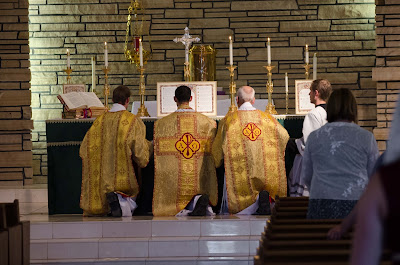
Prof. Peter Kwasniewski has a piece at NLM with photos of Solemn Masses recently celebrated at Holy Rosary parish in WCC, which serves as the chapel of the college.  They had a visiting priest around, which made it possible to have the Missa Solemnis.  If I ever get there again, I hope we might be able to do the same.

Check out the photos.

Here is a sample:

Wyoming Catholic College has great curriculum as well as fine programs during the summer.  My one brief visit left me deeply impressed with the students.

Finally, check out this book by Peter Kwasniewski:

Resurgent in the Midst of Crisis: Sacred Liturgy, the Traditional Latin Mass, and Renewal in the Church  UK link HERE

He also has A Missal for Young Catholics

Also, I recently received another book – from one of you readers – with an intro by PK.  It was briefly out of print.  It must have sold like wildfire.  It is now available again.

Finally in English… The Memoirs of Louis Bouyer: From Youth and Conversion to Vatican II, the Liturgical Reform, and After

15_08_18_Bouyer


I have this on my table in my short, priority stack.

Posted in Brick by Brick, Just Too Cool, SUMMORUM PONTIFICUM | Tagged , ,
9 Comments

Catholic Colleges and Big Business Abortion – Planned Parenthood

I direct the readership’s attention to The Cardinal Newman Society‘s report A More Scandalous Relationship: Catholic Colleges and Planned Parenthood

The CNS has a feed on my side bar.  Watch it daily.

Also, at Crisis see the article on Catholic Colleges and Planned Parenthood: New Proof of Collusion


Posted in Emanations from Penumbras | Tagged , ,
9 Comments

What to do if – when – there are no hosts for Mass?

Premium Quality Cast Iron Corn Grinder For Wheat Grains

Did you see this?

I want you to get your heads into a mental place where, in an economic collapse or some other kind of catastrophic situation, wheat flour and wine are scarce.

Sometimes when I write in a dystopian way about SHTF situations I mention that it would not be a bad idea to stockpile hosts and wine.

Remember: Things always happen to someone else, until they happen to you.

From CNA:

Shortages in Venezuela mean priests are running out of Hosts

Caracas, Venezuela, Aug 15, 2015 / 03:33 pm (CNA/EWTN News).- Venezuela’s ongoing economic crisis has hit the Church in a unique way: the production of Hosts fell 60 percent during the past month, affecting three states in the South American country.

Giovanni Luisio Mass, prior of the Order of Poor Knights of Christ of the Temple of Jerusalem, explained to local media that the shortage of unleavened wheat flour needed to make Hosts has been acute for a month now.

According to Caracol TV, the monthly production of Hosts has dropped from 80,000 to 30,000. This drop, Mass indicated, has affected every parish in three Venezuelan states. He added that they can only send 1,500 Hosts to the parishes in the north of the country, because there is no longer enough flour to make the 8,000 they have always needed.

Several parishes, along with the local communities, have organized to search for the wheat flour needed for the Hosts.

Venezuela is dealing with shortages including food, toilet paper, medicines, auto parts, chocolate, oil, and clothes irons. [If the democrats make any more gains for their agenda, this will be our future.] According to the Central Bank of Venezuela, food prices went up 92 percent last year, and during the last ten years inflation has risen 1,250 percent.

According to the Colombian newspaper El Tiempo, since 2003 the Venezuelan government has imposed price controls on 165 products, including cooking oil, soap, milk, flour, cereals, toilet paper , cleaning products, detergent, diapers, toothpaste, and sugar. The local currency has plummeted in value.

As a result, price-controlled commodities are affordable, but disappear from shelves in no time, often to be resold on the black market at market rates. And the good that are not price-controlled, are unafforable because of the devalued currency.

The government has also instituted policies to control sales, such as distributing tickets for the purpose of taking turns at the supermarkets, and placing digital fingerprint readers in the stores to prevent people from exceeding the allotted amount of products they could buy. [Perhaps signs or implanted chips in the forehead or hand?]

According to the BBC, every day Venezuelans have to form long lines at the supermarkets, but often they do not find the products they need and have to get in another line.

On average, a Venezuelan spends five hours a week shopping. The BBC quoted the Venezuelan polling company Datanálisis that said that in 80 percent of the supermarkets there is a shortage of basic goods. Consequently the black market, where the price is four times higher, has grown, and 65 percent of the people in lines outside the supermarkets are people who will resell what they buy.

Will we be out on the edges of fields picking up the pe’ah?  Will we be gleaning just to make Mass hosts?

It would be worth it.

Not to be flippant, such a scenario could help us reduce the number of people who go to Holy Communion thoughtlessly or in the state of sin.

As I write, I have in my mind’s eye the painting of The Gleaners by Jean-François Millet at the Musée d’Orsay in Paris. It’s realistic details and the size of the painting drive home the plight of the poor workers, toiling to salvage what is left on the edge of the fields. In the background, you see abundance harvested. There is also the ominous figure of a foreman on horseback.

SO001003My home parish in St. Paul has maintained – to my knowledge – the practice of making their own hosts!  Ladies would gather in the rectory basement and fire up the host irons.  It was rather wonderful to use hosts made right there. I like to back communities of nuns who make hosts (like this one HERE), but this could be a good back up option:

  • a grinder for unmilled wheat,
  • sealed cans of flour
  • and host irons.

These parish made hosts tend to be affected quite a bit by ambient humidity and aridity.  You have to be careful with particles.  A ciborium will often have quite a few fragments at the bottom.  Father has to watch carefully while distributing and also keep an eye on the paten, which must be used with great attention.

But… in the face of hosts or no hosts….  easy decision.

Posted in "How To..." - Practical Notes, Global Killer Asteroid Questions, Liturgy Science Theatre 3000, Semper Paratus, Si vis pacem para bellum!, TEOTWAWKI, The Coming Storm, The future and our choices | Tagged , , , ,
46 Comments

ASK FATHER: Latin Instituted Acolytes in Eastern liturgies

From a reader…

QUAERITUR:

I have two Questions concerning the liturgical role of instituted acolytes in the Eastern Rites:

1) May a man who has been instituted as an acolyte according to the ordinary form of the Roman Rite vest and act as a subdeacon in an Eastern Rite Liturgy?

2) Would an instituted acolyte be considered as already having been ordained as a subdeacon in the Eastern Rite Churches or would he have to be ordained a subdeacon in the Eastern Rite before he could function as a subdeacon in the Divine Liturgy?

I asked a priest friend about this, who in turn did some consultation.  Team work!

This is what I received:

I consulted a knowledgeable Eastern friend of mine, Adam DeVille. Adam says, “Usually, yes, though there is nothing formal about this and it would likely depend almost entirely on the discretion of the pastor/main celebrant. Likely, however, he would not in fact vest as a subdeacon (with an orarion or “stole”) but as a simple acolyte (sticharion/dalmatic and no orarion), but even here there would be some variation – Greeks regularly dress up 6-year-old altar boys in the same two vestments as ordained adult subdeacons!
Since 1972, in the Ordinary Form of the Roman Rite, acolytes are no longer ordained, but rather “instituted.” Therefore, a Latin man, who has been instituted as an acolyte, who then transfers to an Eastern ritual Church and seeks holy orders, would have to be ordained in that ritual Church to the minor orders.

If a Latin man had received ordination to the minor orders, in one of the religious communities entrusted to the Ecclesia Dei commission, for example, he would not have to be re-ordained in those orders in the Eastern Church.

All these, and many more questions are answered in a forthcoming book, The Oxford Handbook of Sacramental Theology, particularly the chapter on the Sacrament of Orders by Adam DeVille.

Posted in "How To..." - Practical Notes, ASK FATHER Question Box, Both Lungs, Liturgy Science Theatre 3000, Seminarians and Seminaries | Tagged , , , ,
4 Comments