
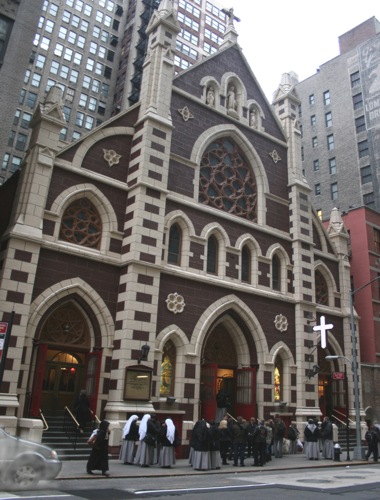
Holy Innocents, Manhattan
Remember my post “Dear Traditionalists,…” ? I meant what I wrote then and I still mean it now. In part, I wrote:
Do you want this? Do you? Or, when you don’t get what you want handed to you, are you going to whine about it and then blame others?
The legislation is in place. The young priests and seminarians are dying to get into this stuff. Give them something to do.
[…]
Pope Benedict gave you, boys and girls, over the course of his 8 years, a beautiful new bicycle! He gave you a direction, some encouragement, a snow cone, and a running push. Now, take off the damn training wheels and RIDE THE BIKE!
That, for the laity and priests who want to get involved.
There is another component, of course.
Those who want the traditional forms are often forced to go begging cap in hand and are made to feel – by bishops and priests FOR SHAME! – as if they were red-headed step-children.
I have been sent part of a transcript of a sermon given in New York City by Fr. J. Wylie at a favorite church of mine, Holy Innocents in the Garment District. Holy Innocents has been a great success story. However, a recommendation was made by a committee that it, along with Fr. Rutler’s parish St. Michael’s in Hell’s Kitchen, should be closed.
Fr. Wylie has some hard words, imbued with charity and priestly concern, to those who desire the traditional Roman Rite as well as to the priests and bishops who have, for decades, abused the same through neglect or outright persecution. And you know who you are.
I hand it over to Fr. Wylie:
Dear friends – and mark well that I speak to you now from the prophetic heart of my sacerdotal paternity – Dom Prosper Gueranger has something important to say also about threes. Hear it well:
“[T]he sacraments, being visible signs, are an additional bond of unity between the members of the Church: we say additional, because these members have the two other strong links of union – submission to Peter and to the pastors sent by him and profession of the same faith. The Holy Ghost tells us, in the sacred Volume, that a threefold chord is not easily broken [Eccles. Iv 12]. Now we have such a one, and it keeps us in the glorious unity of the Church: hierarchy, dogma, and sacraments, all contribute to make us one Body. Everywhere, from north to south, and from east to west, the sacraments testify to the fraternity that exists amongst us; by them we know each other, no matter in what part of the globe we may be, and by the same we are known by heretics and infidels. These divine sacraments are the same in every country, how much soever the liturgical formulae of their administration may differ; they are the same in the graces they produce, they are the same in the signs whereby grace is produced – in a word, they are the same in all the essentials” (pp. 228-9).
…
Dom Gueranger writes these words for us under his entry for precisely this Fourth Sunday after Easter, when in this parish, as I understand, you will meet to discuss a path forward for the precarious existence of your own worshipping community. Will this be the path Christ charts or will we make of ourselves instruments of the evil one for division and derision? The test of this, as in all things, is charity. Deus caritas est; et ubi caritas est vera, Deus ibi est. Where there is a breakdown of charity, there also is the spirit of the antichrist. I urge you, therefore, to be obedient and to be charitable with your legitimate superiors in all this, as well as with each other. Be firm and clear, also, and just; however, let charity always be the litmus test of whom it is you serve.
Allow me to say, first of all, that it has been my great privilege to serve this community during my term in New York. I have benefitted and learned so much from you and from your piety and fidelity, vivacity and zeal. [I echo what Father is saying here…] I refer to all of you, now – you know who you are, I hope, from the love that I bear for you. Some I know better than others, through service at the altar – your acolytes and MCs; others I have loved with my voice and through my ears (like the organists and choir); others yet through my eyes, such as those who keep the church so beautiful, restored and adorned with flowers; others yet I bear with love, such as those who source and restore such magnificent vestments; many of you are known to me in the intimacy of the confessional or through the rich friendship of spiritual direction: upon all of you I gaze from this pulpit with a father’s love and admiration. Yet I must make my own the words of our Blessed Lord when I tell you that my heart breaks with pity to behold those who seem to be as though sheep without a shepherd. [Do I hear an “Amen!”?]
Allow me to explain. When I first came to New York, I marveled at the freedom traditional Catholics had always enjoyed in New York. When the Mass of the Ages seemed everywhere in the world effectively to have been banned, here in New York it found a home. “What freedom!” I thought, “What magnanimity from the pastors of the Church here in this place!” Now, however, with the benefit of time and deeper understanding, I see the superficiality of this first appreciation. Indeed, such a conclusion would be more befitting the 1980s and 1990s when Catholic laypeople were organizing such masses here and there on an ad hoc basis. First at St. Agnes, I believe, and then elsewhere, “homes” were found for such communities … and this indeed did give for their members here a happier prospect than in many parts of the world. But in a post-Summorum Pontificum Church, after Pope Benedict courageously proclaimed that the extraordinary form of the liturgy pertains equally to the fulness of the Roman rite, this approach cannot any more, I think, be characterised as true magnanimity.
As I said: during the dark days of prohibition, New York seemed to be a happy place to be for you because of the indult-masses at places like St. Agnes, but in the fresh juridical freedom Summorum Pontificum brings, New York has become, in my view, a less felicitous place for traditional Catholics: because nothing is structured, nothing acknowledged. Who takes responsibility for you pastorally?
Pastores dabo vobis, the Lord promises Jeremiah: I will give you shepherds! Fundamentally – and this is something about which I urge you to think well and pray much about – as a priest, I have to say: I worry about the situation of traditional Catholics in the Archdiocese. Yes, the archdiocese ‘permits’ a traditional mass here or there — but responsibility for the matter continues to rest upon the initiative and resourcefulness of the laity, who with enormous difficulty have to source priests hither and thither as though we were seemingly still living in Reformation England or Cromwellian Ireland. Isn’t it high time for the Church to take pastoral responsibility also for these sheep? Do they not deserve a shepherd? a parish? or at least some sense of juridical security? What happens to you when the parish you are harbouring in closes its doors? [Do I hear an “Amen!”?]
What will become of the priestly vocations aplenty I see in these numerous young men of such quality as we have in abundance serving here at Holy Innocents, St. Agnes and elsewhere – remaining as they do at the mercy (and sometimes, caprice) of ‘landlords’ who, for one reason or another, ‘permit’ their presence in their parishes? Doors everywere seem closing to them. Our Saviour has closed its doors to them. St. Agnes, for its part, guards its doors vigilantly to make sure they don’t enter the building 5 minutes too early or don’t overstay their welcome by 5 minutes more. Now, it seems, the doors of Holy Innocents will be closed to them, too. Taken together, this is, in my view, a clear instance of exclusion: an injustice which you should bring to the attention of your shepherd, I think. You are fully-fledged members of the baptised Faithful, for heaven’s sake: why are you scurrying about like ecclesiastical scavengers, hoping for a scrap or two to fall from the table for your very existence? [OORAH!] The precariousness of your community cannot hinge on a church building being available to you as though you were a mere sodality or guild. The days of renting space in hotels and the like must surely be over. You are not schismatics! Are you schismatics? [we are treated as if we are, while true schismatics and heretics get away with everything, and are even rewarded in some places.]
Whatever happens to Holy Innocents – and this will be the decision of your chief-shepherd here, who will base his decision on more information than any of us has at his or her disposal – you need to assert that you belong to the Church as fully as any other community. You have found a home here, largely through your own hard work and perseverence: no good shepherd could dispossess you of your home without providing safety and good pasture elsewhere. Parishioners of a Novus ordo parish closure might easily find another ‘home’ nearby; but what of you? You have a right to find the Mass (and not only on Sundays); and not only the Mass, but the other sacraments and rites of the Church. Closing this parish is more akin to closing a linguistic parish or a Oriental rite parish. What becomes of you?
No longer, I say, should you think of yourselves as squatters in the mighty edifice of Holy Church, nor should you find yourselves turned out like squatters. Shepherds must needs make difficult decisions, such as the erection or suppression of parishes – that is their onerous duty and in this they must have our obedience, charity and prayer: but never should they throw open the sheep-fold and allow the uncertain dispersion of their sheep into a world full of wolves. Charity, of course, is a two-way street.
Look. This sermon describes a situation that exists not only in New York City. It can be applied to many places without singling out Gotham.
I say again:
- Do not give up.
- Make your desires known in charity but clearly.
- Put aside minor differences and band together.
- Excel in works of mercy.
- Be willing to work and sacrifice and give of time and talent and treasure.
Step up. Don’t whine. Think it through. Set goals. Make it happen. You can do it.




 My friend Fr. Gerald Murray has a fine piece at
 Fishwrap



 OrdainedButStillbeingFormedDiakonos on “Sometimes the scalpel is the honey.” Wherein Fr. Z rants about “the parable of the wheat and tares”.: “I’m finally reading the Divine Comedy. I’m through the Inferno and halfway in the Purgatorio. I often wonder if someone…”




























