I saw a great tweet with the hashtag #10YrsOnMars and a very cool picture from a collection of images from the surface of Mars! They were taken by the intrepid Mars rovers. HERE
Here’s one.

Poor little Spirit. RIP.

I saw a great tweet with the hashtag #10YrsOnMars and a very cool picture from a collection of images from the surface of Mars! They were taken by the intrepid Mars rovers. HERE
Here’s one.
Poor little Spirit. RIP.
The Benedictine monks in Norcia, Italy make excellent beer. Would that we could get it here!
Now it seems that some Trappists in these USA are trying their hand at the production of this material proof of God’s love.
From the Boston Globe… alas, I can’t read the article. Maybe one of you can?
My friend Fr. Gerry Murray of the Archdiocese of New York was recently on FNC. He spoke about Pres. Obama’s HHS Mandate. He did a great job explaining some key points and had a few good one liners.
You might review this for the sake of your own discussions on the topic.
http://www.youtube.com/watch?v=B6l_8LBUQZ0&feature=player_embedded
Fr. Z kudos to Fr. Murray!
 From a reader:
My __ year old father and his woman friend would like to get married but not go through the government with a marriage lisence. Are there any patriotic priests who would help them? I found protestant pastors but as they are Catholic they would appreciate the sanctity of a Catholic church….dad is a widower and she is a widow both had long happy marriages.
Patriotic?!?
The Church teaches that marriage is not just an agreement between two people, but is a public covenant. The Church has long cooperated with civil governments with regards to marriage, since marriage between one man and one woman is something that is to be valued both by the Church and the State.
In some places, the State has moved to distance itself from the Church and has ceased that cooperation. In France and Mexico, for example, the State does not recognize marriages celebrated in the Church as having any civil effect. In the United Kingdom, the State did not recognize Catholic marriages until 1836. The faithful in these places would need to exchange matrimonial consent twice – once for civil effect, and once in the Church truly to marry each other.
For now, these United States and the Catholic Church are still cooperating in the sphere of marriage, though as state after state changes the definition of marriage to include agreements that are NOT marriage, the time may come soon when that cooperation will have to cease. But… for now … the state authorizes priests and deacons to act in two capacities at a wedding. First, they act in their religious role as official witnesses of the Church to the exchange of matrimonial consent. Second, they act as agents of the State officiating at a wedding of two persons.
That said, the Church reserves the right to permit the celebration of “secret marriages” or “clandestine marriages”, that is to say, marriages that are not recognized by the State in certain circumstances. Canons 1130 – 1133 of the Latin Code (and can. 840 of the Eastern Code) provide the parameters.
A secret marriage can only be permitted by the local ordinary (i.e., the diocesan bishop, vicar general, or an episcopal vicar), the parties involved must observe secrecy (only the priest, the couple, and two witnesses should be present at the wedding), and the marriage is recorded only in a special register in the secret archives of the diocesan curia.
“But Father! But Father!”, you are probably saying by now, “Why would anyone enter into a clansted… clantstine… secret marriage? You surely hate Vatican II.”
Some reasons for secret marriages would include situations where the state law on marriage is unjust or contrary to natural law (e.g., in places where it was once illegal for a man and woman of different races to marry, or a free person to marry a slave, etc.). For example, when in its fourth term the Obama Administration makes it illegal to marry a Catholic, we will have more clandestine marriages. The local ordinary will have to see if the reasons for a marriage without a state license are justifiable.
These days there are two reasons normally given for wanting a secret marriage. First, one or both parties are undocumented immigrants and, next, one or both parties are senior citizens and concerned that marriage would affect a pension payment.
There may, possibly – but only possibly – be some justification for granting permission in the first situation, especially if there are children involved. I am not convinced that our current immigration laws in these USA are that unjust. In the second case, I do not see a justification for permitting a secret marriage. The terms of the pension are normally clear. To marry without a civil license merely to circumvent the pension contract is pretty dodgy.
The Church should be very careful in permitting secret marriages, because doing so puts the priest or deacon who officiates at such a wedding in danger of civil prosecution. A priest or deacon who officiated at such a wedding without permission of the local ordinary would acting illicitly, and be subject to civil and ecclesiastical penalties. It would also cast aspersion on the character of the other priests who are obeying both the civil and ecclesiastical law.
I read at BBC, that my favorite Chinese film director, Zhang Yimou, has been fined for having too many children.
China fines Zhang Yimou $1.2m over one-child policy breach
China has fined popular film director Zhang Yimou more than one million dollars for violating the country’s one-child policy.
The director, who said he has three children, has 30 days to pay 7.5m yuan ($1.2m, £729,000), state media say.
Mr Zhang, known for directing the Beijing Olympics opening ceremony in 2008, in December apologised for violating the strict policy.
China introduced the policy in the 1970s to curb population growth.
The policy until recently limited most urban couples to a single child. Rural families were allowed to have two children if their first-born was a girl.
But last year, China said it would relax the policy – families will be allowed two children if one parent is an only child.
[…]
China is now facing a large imbalance between the sexes. Girl children are aborted in favor of males. When populations have lots of men without mates and enough to do… bad things result. As I understand, there is a black market in women kidnapped and brought into China.
In any event, check out a couple movies by Zhang Yimou.
A great movie! To Live
A great Wuxia movie. Hero
Touching. You might tear up. The Road Home

A great look at the lot of children. Not One Less
Japan… Nanjing…

Gong Li was in several of his flicks. Raise The Red Lantern

For your Brick by Brick file, I was sent a link to an entry at Catholic San Francisco about a new liturgical institute established by Archbishop Salvatore Cordileone.
Archbishop explains goal of new liturgical institute
On the eve of the feast of the Epiphany, more than 200 sacred music lovers from around the archdiocese and beyond filled the parish hall of St. Sebastian Church in Greenbrae and practiced Gregorian chant with Archbishop Salvatore J. Cordileone in preparation for afternoon vespers.
The event, organized by St. Sebastian pastor Father Mark Taheny and a group of parish volunteers, served as the archbishop’s launch point for publicly introducing the new Benedict XVI Institute for Sacred Music and Divine Worship at St. Patrick’s Seminary & University in Menlo Park and its director, Benedictine Father Samuel Weber.
Archbishop Cordileone explained to the assembly that he created the institute to “reclaim the sense of the sacred” in liturgical expression at the parish level and to offer a deeper sense of formation to lay ministers such as lectors, music directors, extraordinary ministers of holy Communion [may advice is elimination of most of them] and those who bring Communion to the sick. The institute’s program – still in development while it seeks funding – will offer liturgical education courses toward certification at St. Patrick’s, at parishes and online.
[…]
Music is at the heart of the institute, the archbishop said as he introduced Father Weber, founder of the Institute for Sacred Music in St. Louis and a highly regarded scholar, composer and practitioner of chant in the English-speaking world.
“We want to reclaim sacred music which is so much at the heart of our celebration of the Mass,” said the archbishop who puts Gregorian chant at the first place of the Mass. [Just like the Second Vatican Council.] “It doesn’t replace other forms of music, but those forms must be in harmony with the sacred traditions of chant.”
[…]
For more information about the Benedict XVI Institute for Sacred Music and Divine Worship, and to participate in an important survey that may help shape the program, visit www.benedictinstitute.org.
Fr. Z kudos to Archbp. Cordileone!
I also call back to your minds the musical institute set up by James MacMillan in England and the sacred art institute in Florence and, now, in New York City.
Benedict XVI’s liturgical vision, his “Marshall Plan”, is still best, most viable path to follow.
It is no less important and “valid” today than it was before March 2013.
No initiative of renewal of the Church or any dimension of the Church’s life will get any traction without a renewal of our sacred liturgy. For this renewal to take place, we had better continue in the direction Papa Ratzinger set out for us.
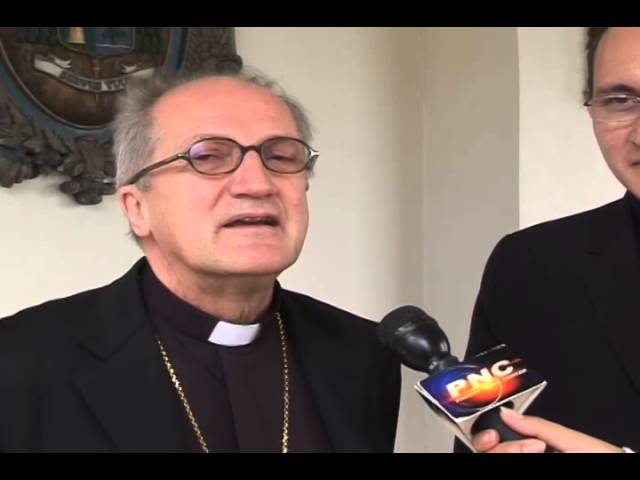
I was sent a link to a video with some of an interview by Bishop Enrico dal Covolo, who is presently rector of my old school, the Pontifical Lateran University. dal Covolo, an SDB (aka Socio di Bertone aka Salesian) has done some work on the Fathers of the Church.
In any event, before last Christmas dal Covolo went to Guam to visit one of the many global spin offs of the aforementioned Lateran. Inter alia, in the interview (btw the newsie calls him “dal Covólo. Fail. It’s “dal Cóvolo”) he made some comments about the differences between Pope Francis and Pope Benedict.
The video includes and English translation voice-over, so I can’t hear the actual Italian original, but:
“I believe that the… Pope Francis is a figure of discontinuity with the previous …ahhh pontificate, but a very very good discontinuity because he’s pushing the Church, he’s exorcising the Church from all its fears that he had in the past. … I agree totally with these changes that Pope Francis is doing because they correspond precisely to the challenges that we face today.”
Et tu, Brute?
You don’t use a word like “discontinuity” in this way unless you intend to dump on Benedict.
The irony in this is that were you to check the word “clericalism” in an illustrated dictionary, dal Covolo’s picture would grace the entry.
Benedict XVI raised dal Covolo up with his own hand to the episcopate and rectorate of the Lateran. Also, I suspect that dal Covolo – a patrologist more than a patristicist – was one of the ghost writers behind Benedict’s Wednesday General Audience address in his series on the Fathers of the Church. Benedict treated dal Covolo very well indeed.

UPDATE:
I see that Rorate has something on this. The poster over there accuses dal Covolo of ingratitude. Yah, that too.
 From a reader:
A confessor I go to has recently made it his practice to whisper the words of absolution while I am saying the Act of Contrition. The first time he did this I did not catch it and after he dismissed me I asked him whether or not I had in fact been absolved. He said yes and he had said the words of absolution during my Act of Contrition. Now that I know he does it this way (I can hear him whispering but don’t understand the words) I am not so put off by it, but I was wondering whether or not there is any ruling on whether a penitent needs actually to hear and understand the words of absolution for them to be effective?
No, it is not necessary for validity that you hear the form of absolution. It is not necessary that you understand the words.
It is necessary that you confess your sins (the matter) and that the validly ordained priest with faculties says the proper words (the form).
Some priests (and this priest too) often begin to recite in a low voice or whisper the formula of absolution as soon as he has heard part of the act of contrition which expresses attrition (“I dread the loss of heaven and the pains of hell”). This is not rare.
Leaving aside the issue of validity, Father should probably say the sacramental form (“Ego te absolvo… I absolve you…”) at the end more of the formula, clearly, when the penitent has finished the act of contrition. In this way the penitent does not leave with any doubts about what happened. That’s important.
If in the confessional you are in doubt about whether the priest has absolved you, by all means respectfully ask the priest before you get out of the confessional.
Remember point #15 of Fr. Z’s 20 Tips For Making A Good Confession.
And, everyone, GO TO CONFESSION!
A depressing bit of news from not-too-Catholic-friendly RNS:
Roman Catholics decline in England, Wales
CANTERBURY, England (RNS) The number of Roman Catholic adherents in England and Wales fell by more than 90,000 in 2012, despite a wave of immigrants from Poland and other Eastern European countries with historically Catholic backgrounds.
Prominent Catholics say the recent wave of sex abuse scandals involving priests and children is responsible for the decline. [Prominent Catholics? Uh huh. I wonder which flavor koolaid they drink. Anyone wanna guess?]
[…]
Read the rest there. There is even some ol’ fashioned class warfare worked in.
I wonder if the real reason there are declining numbers is that people don’t hear much clear Catholicism, hard-identity Catholicism from the Church’s pastors.

Coat of Arms by D Burkart









A Daily Prayer for Priests


They find you a pro-life agent in your area who commits to giving a portion of the fee to a pro-life group!

PLEASE subscribe via PayPal if it is useful. Zelle and Wise are better, but PayPal is convenient.
A monthly subscription donation means I have steady income I can plan on. I put you my list of benefactors for whom I pray and for whom I often say Holy Mass.
In view of the rapidly changing challenges I now face, I would like to add more $10/month subscribers. Will you please help?
For a one time donation...



Help Monks in Wyoming (coffee – UPDATED LINK) and Norcia (beer) and the wonderful "Soap Sisters" of Summit, NJ!


Please follow me on Twitter!










Visits tracked by Statcounter
since Sat., 25 Nov. 2006:

