Overdue: catechesis concerning “pro multis”

I found this important entry over at the blog of His Hermeueticalness, the great Fr. Finigan:

Over three years ago, I reported on a letter of the congregation for the Doctrine of the Faith, dated 17 October 2006, concerning the words pro multis ("for many") in the words for the consecration of the the chalice at Mass.

The letter states that there is no doubt about the validity of Masses in which the phrase "pro multis" is translated "for all" and that it is a dogma of faith that Christ died on the Cross for all men and women. However, it notes several arguments in favour of an accurate translation of "pro multis" and concludes that the phrase should be properly translated in the future.

The other day, a priest friend pointed out to me that there was a timespan included in the letter:

The Bishops’ Conferences of those countries where the formula "for all" or its equivalent is currently in use are therefore requested to undertake the necessary catechesis for the faithful on this matter in the next one or two years to prepare them for the introduction of a precise vernacular translation of the formula pro multis (e.g, "for many", "per molti", etc.) in the next translation of the Roman Missal that the Bishops and the Holy See will approve for use in their country.

Did you notice any catechesis on this matter in your country in the one or two years to October 2008? We are, of course, still waiting for the next translation of the Roman Missal into English, and are likely to be waiting for some time to come.

Is it is now time to start saying "for many"? There wasn’t any significant delay or insuperable problem when we were peremptorily told to say "for all" instead of "for all men."


Fr. Finigan does us a great service in bringing this point back to our minds.

Therefore, you priests who are reading this… don’t wait for conferences to make a move.  Start your catechesis.

Therefore, you bishops whe are reading this… don’t wait for conferences to make a move.  Start your catechesis.

Therefore, conferences of bishops…  what’s going on?  Should be be left to the abovementioned.

Posted in New Translation, PRO MULTIS | Tagged
19 Comments

The Calgary Communion Show Down

I have pretty much spoken my piece about the issue of attempts to deny the Catholic people their rites in the matter of how to receive Holy Communion, especially when a restriction is placed again Holy Communion on the tongue.

Also, you know that the Holy See’s Congregation for Divine Worship has been sending notes to people assuring them that, yes, Redemptionis Sacramentum 92 is still in force… really… no, really!

Now as I get off an airplane I find in my email inbox copies of correspondence and notes from faithful which scorch my laptop’s screen about a dust up in Calgary, Alberta.

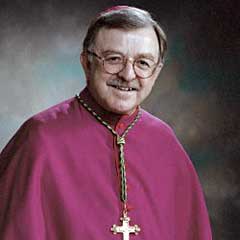
Apparently, the local bishop, His Excellency Most. Rev.Frederick Henry is having a fight with the local presence of the FSSP over the distribution of Communion on the tongue.   The bishop issued "norms" for the Diocese of Calgary which forbid Communion on the tongue because of H1N1.  The FSSP and the people frequenting their Masses are not conforming to his wishes.

Bishop Henry issued the directive to cease distribution of Communion on the tongue following the recommendation from the Medical Officer of Health, whom I assume is a government official.

When Bishop learned that at the FSSP parish people were still receiving Holy Communion on the tongue, he ordered that they not celebrate Mass at all.  He suspended the Extraordinary Form Masses.

He also wrote in one piece of correspondence that

"the current pandemic circumstances do not warrant the non-reception of the Body and Blood of the Lord in favour of a spiritual communion."

Get that?   The Bishop won’t allow non – reception of Holy Communion.   So, you must receive only in the hand, and, apparently, you must receive.

I am not sure how that works if you think you are in the state of mortal sin because you are so angry about being bullied, but… I digress.

At a certain point someone pointed out to His Excellency that a bishop cannot forbid Communion on the tongue.  The text of the e-mail ran like this.  Sadly, the person who wrote this was a bit confused, but the substance of the note is not thereby lessened.

    To: Bishop F.B. Henry

    Your excellency,

    The Congregation for the Doctrine of the Faith (CDF), [sic … It was the CDW… Worship, not Faith… but go on…] on 24 July 2009, stated that it is not licit to deny reception of communion on the tongue, despite the current threat of H1N1. Attached is a scan of the CDF’s letter on this matter.

    Through Jesus, Mary, and Joseph,
    ……

His Excellency the Bishop of Calgary wrote back this extraordinary form of response.  I am not making this up.

    From: Bishop F.B. Henry
    Date: Mon, Nov 30, 2009 at 12:22 PM
    Subject: RE: Calgary’s Saint Anthony Parish: forbidden to have Mass if communion in the hand is not offered?
    To: …

   I am well aware of what the congregation decided but quite frankly, it is not their call. It is mine

So… this is not the Congregation’s call.

Interesting.

Pretty bold, if you ask me.

The way I understand it, the Holy Father is the Supreme Legislator in the Church.  He has delegated his authority to govern matters liturgical, the "discipline of the sacraments" to the Congregation for Divine Worship and Discipline of the Sacraments.  After the Holy Father, this Congregation is the highest authority when it comes to Latin Rite worship and discipline of the sacraments.  A local priest in a parish, or bishop in a diocese might be able to set aside something from the territorial conference of bishops, but they cannot ignore what a Congregation does.   When the Congregation determines something, it is no longer anyone else’s call (except the Holy Father).

Redemptionis Sacramentum is a juridical document of the CDWDS which had the approval of the Roman Pontiff.   The same Congregation has reaffirmed with specific reference to H1N1 what RS said.

Posted in The Drill | Tagged , , , , , , ,
105 Comments

Turn by turn: Benedict XVI ad orientem versus

The Holy Father celebrated Holy Mass with members of the Pontifical Theological Commission.

Mass was in the Pauline Chapel in the Apostolic Palace.

Mass was ad orientem, at an altar which can be used from either side.

Since this was for the theological commission, perhaps the Holy Father was also saying something theological by a choice he knew would be widely discussed.

What do you think?

No matter what, it is nice to see the Roman Pontiff celebrating ad orientem versus.

Brick by brick, friends.

Turn by turn.

Altar by altar.

Posted in Brick by Brick | Tagged , ,
22 Comments

NYC new daily TLM

I had this from a reader:

Beginning Monday, November 30th there will be a new daily Low Mass (in the extraordinary form of the Roman Rite) every weekday at 6:00 PM at the Church of the Holy Innocents in Manhattan.


Posted in Brick by Brick |
4 Comments

Damian Thompson’s obervance of the 40th anniversary of the Novus Ordo

I see that Damian Thompson has his blade sharpened:

My emphases and comments:

November 30th, 2009

Happy 40th birthday, Novus Ordo!

It is 40 years ago today since the New Mass of Paul VI was introduced into our parishes, writes Margery Popinstar, editor of The Capsule. [Blue or Red, I wonder.]  We knew at the time that this liturgy was as close to perfection as humanly possible, but little did we guess what an efflorescence of art, architecture, music and worship lay ahead[That’s a good way to put it.]

There were fears at first that the vernacular service would damage the solemnity of the Mass. How silly! Far from leading to liturgical abuses, the New Mass nurtured a koinonia that revived Catholic culture and packed our reordered churches to the rafters.

So dramatic was the growth in family Mass observance, indeed, that a new school of Catholic architecture arose to provide places of worship for these new congregations. Throughout the Western world, churches sprang up that combined Christian heritage with the thrilling simplicity of the modern school, creating a sense of the numinous that has proved as irresistible to secular visitors as to the faithful.

For some worshippers, it is the sheer visual beauty of the New Mass that captures the heart, with its simple yet scrupulously observed rubrics – to say nothing of the elegance of the priest’s vestments, which (though commendably less fussy than pre-conciliar outfits) exhibit a standard of meticulous craftsmanship which truly gives glory to God!

The same refreshing of tradition infuses the wonderful – and toe-tapping! – modern Mass settings and hymns produced for the revised liturgy. This music, written by the most gifted composers of our era, has won over congregations so totally that it is now rare to encounter a parish where everyone is not singing their heads off! Even the secular “hit parade” has borrowed from Catholic worship songs, so deliciously memorable – yet reverent! – is the effect they create. No wonder it is standing room only at most Masses!

Did Archbishop Annibale Bugnini, who birthed this kairos, have any idea just how radically his innovations would transform the Church? We must, of course, all rejoice in his imminent beatification – but, in the meantime, I am tempted to borrow a phrase from a forgotten language that – can you believe it? – was used by the Church for services before 1969: Si monumentum requiris, circumspice.


Posted in The Drill | Tagged
93 Comments

Off to Cape Canaveral!

Today is my day trip to Cape Canaveral and the Kennedy Space Center!

I had been here many years ago. how things have changed! I did enjoy the Rocket Park.

I thought the Soviet era Soyuz was pretty interesting.

And I thought the American astronauts were brave.

I bet the first cosmonauts who looked at this stuff on the outside just shrugged as thought….

… "Hey… what could go wrong?"


Imagine jamming yourself into a VW Beatle, sitting it on top of a stick of dynamite 36 stories tall, and telling them to light the fuse.

And once you were up there, staying up there in the VW fully dressed in all sorts of stuff for days.

With less computing power than my mobile phone.

Mission control has less computing power than my mobile phone.

Amazing.

Posted in My View |
17 Comments

Some random items

In no special order here are a few images and notes from Florida and a maternal visit. I made some spaghetti … nothing special. Just good ingredients combined and presented in simplicity.

Nice to have fresh basil off a plant in the ground at this time of year. There are no palm trees or orchids at the Sabine Farm.

Nor is there any papyrus… though there should be!

A friend of my mother and my mother herself are both diligent in the creative conversion of old stuff into new stuff. Here are a few interesting applications of shards of stained glass to old guitars and other stringed instruments. These are the pretty striking in person, and I can’t help contemplating a metaphor.

The whole family are fans of bluegrass and many if them play instruments. At gatherings they sometimes play together. In their kitchen you can what can be done with one of these guitars and some car detailing stuff.

Being in Florida there is strong dedication to NASCAR and the Gators.

I was also struck by an old violin with a pink breast cancer awareness ribbon worked into the design.

The local Catholic church is dedicated to St Helena. It is a sober neo-Romanesque structure.

It seems to be a reasonably serious and busy parish, lots of northern "snow birds", with a strong pro-life spirit. The are sundry birds I don’t know but they don’t wait for me and my iPhone to get near. I especially enjoy the Sand Hill Crane. Oh well. The waning day is nice.

Posted in My View |
6 Comments

My view of Benedict’s XVI’s sermon for 1st Vespers in this new liturgical year

You may know that when he was Archbishop of Munich, Pope Benedict gave series of sermons on the Sundays of Advent.  He has spent significant time reflecting on this season.

But year and each change in our lives, changes our perspectives on things we may have known well for years.  For example, the mysteries of our faith or what we observe in the liturgical years don’t change from year to year, but we do.

This is why we must never be complacent when it comes to our Faith, either they Faith by which we believe (the gift from God which is a grace that we pray will be deepened) or the Faith in which we believe (the content we can learn and study make a part of our worldview and lives). 

So many people come to their 60th year with no long catechism than that which they have have heard at 6 and forgot by 16.  And yet our Faith asks us to seek understanding.

That is a little preamble to a few points from Pope Benedict’s sermon for 1st Vespers of Advent and a new liturgical year.  I won’t translate the whole thing; only a few key sentences.  I will mostly summarize.   I haven’t seen an English version of the sermon anywhere and thought you might want more than a spoonful.

I was struck by something in this sermon.  I was caught by the possibility that the Pope is suffering in a human way and in a spiritual way.    I was struck by the notion that at this point in his life, with the burdens he bears and the life perhaps he thought he was going to have after the death of the late Holy Father, he is sorting many things out on a personal level even as he gazes at the Church in this modern world, this modern world around our Church. 

Benedict XVI, in his sermon for 1st Vespers of Advent, reflected on the word "coming… adventus". 

He observed that it can be translated variously as "presence, arrival, coming" and that in the ancient world it had to do with the coming of an important person, such as the visit of the emperor to a province.  It could also mean the coming of a divinity.  Christians adopted this word to describe their relationship with Christ.

They were saying: "God is here, he hasn’t left the world, he has not left us alone.  Even if we cannot see and touch him as he comes in a sensible reality, He is here and he comes to visit us in many places."

"Adventus" also has to do with visitatio, "visit", especially a visit by a God: "He enters into my life and wants to address me."

"We all have the experience, in our daily life, of having little time for the Lord and little time even for ourselves.  One winds up absorbed by ‘doing’.  Isn’t it perhaps true that often it is exactly activity that possesses us, society with its multiple interests that monopolizes our attention?  Isn’t it perhaps true that one dedicates lots of time to diversions and amusements of different kinds?"  … "Advent invites us to stand in silence in order to understand a presence. … How often God causes us to perceive something of His love!"

He also elaborated another point.  "Another fundamental element of Advent is waiting, a waiting which is at the same time hope."

Advent helps us to understand the meaning of time as kairos, as the favorable opportunity for our salvation.  Jesus pointed out this mysterious reality through parables.

Through the different stages of his life man is constantly waiting.  But he comes at last to find that he hoped for too little if all he hoped for was social standing or a profession.  Christians, however, have the sense that God is along side us, "and will one day dry our tears".

There are many different forms of waiting.  If time isn’t filled with meaning, waiting is unendurable.  "Every breath that passes seems exaggeratedly long." If it is enriched with meaning, then "in every instant we perceive something specific and of value."

"Dear brothers and sisters, let us intense live the present, where the Lord’s gifts are reaching us, let us live it as if we were launched towards the future, a future charged with hope."

Christian Advent helps us to an understanding of waiting.  The Messiah waited for centuries and was born into poverty.  Coming among us, he offered the gift of His love and salvation.  Present among us He speaks in many ways: in Scripture, in the liturgical year, in the saints, in the events of daily life, in all creation.  "For our part, let us address  Him, let us offer Him the sufferings that afflict us, the impatience, the questions that burst from our hearts. Let us be sure that He is always listening to us!" "If He is present, we can continue to hope even when others cannot any longer assure us of any support, even when the present becomes wearying."

At the end the Holy Father made a comment that gave me pause: "Advent is the time of the presence and waiting for eternity.  For just this reason it is, in a special way, the time of joy, of interiorized joy, that no suffering can take away."

Posted in The Drill | Tagged , , , ,
10 Comments

Whatever it is we’re doin’… ain’t workin’!

I don’t know how many times my own proposals, or those of others I have heard about, were rejected because of "young people".   "No, no.  We have to do [FILL IN BLANK] for young people".

Pretty much you know in your heart that [FILL IN THE BLANK] is going to flop because a) young people aren’t stupid and b) young people don’t have 1960’s-70’s baggage and c) what ever hip bad groovy sick cool thing you attempt in church is always done better elsewhere by people who are actually good at it.

Over at NLM I saw an interesting graph.

This graph concerns age groups against frequency of Mass attendance.

My friend Jeffrey Tucker puts it this way (with my emphases and comments):

The upheaval of the 1960s and 1970s were justified largely based on the desperate need of young people for a liturgical experience that meets their needs and speaks to a new generation. [Sounds about right.  Ever heard that yourself?] Apparently the "new generation" didn’t much like what they heard, because they left in droves. Meanwhile, the strongest attachments to Catholic Church can be observed among those raised in a liturgical environment widely decried for its failure to connect to people and its propensity to foster alienation. These are the survivors who cling to the memorized portions of the Baltimore Catechism for sustenance in difficult times.

Knowing nothing other than these facts, one can easily conclude that the conventional wisdom is complete wrong and that the truth is the reverse of what we’ve been told. The hip and happening style at Mass backfired and emptied the Church. It is the "bad old days" that instilled deeper attachments. The proper direction for change, then, is to recover what we lost.


Do I hear an "Amen!"?

You can read the rest over there.

Posted in The future and our choices | Tagged ,
31 Comments

I’m just askin’

I don’t know, but does this seem like a pretty good summation to you?

Posted in I'm just askin'..., The future and our choices |
21 Comments
























