WDTPRS POLL: Should the US Bishops have Catholics return to meatless Fridays for the whole year?

In another entry, I offered and reacted to Archbishop Dolan’s (Archd. NY) comments about our Catholic identity, external markers seen by others and ourselves which reinforce that identity and communicate it to others and the former practice of meatless Fridays throughout the whole year as one of those external signs.

You can read the whole thing over there.

HERE, on the other hand, you can vote in this WDTPRS POLL on the issue of meatless Fridays and Friday penance.  You can vote even if you are not registered here.  However, I would be please were you also to give your reasons in the combox below, respecting always the people who make arguments other than your own.

Should the Bishops of the USA have us return to obligatory meatless Fridays during the whole year and not just during Lent?

View Results

Posted in "How To..." - Practical Notes, Brick by Brick, Just Too Cool, New Evangelization, Our Catholic Identity, POLLS | Tagged , , ,
93 Comments

Archbp. Dolan on meatless Fridays and external signs of our Catholic identity

His Excellency Most Rev. Timothy Dolan of New York City has an interesting post on his blog The Gospel in the Digital Age.  I would like to support something important he raised.

Keep in mind that Archbishop Dolan has a combox under his post.  Would you go there and give him comments of support (and if you want say “Hi!” from Fr. Z!)?

Edited and with my emphases and comments.

External Markers of Our Faith

It caused somewhat of a stir . . .

A few months back, you might have heard, the bishops of England reintroduced the discipline of abstinence from meat on Fridays. [I wrote about that HERE.]

Every Catholic mid-fifties and older can recall how abstinence from meat on all Fridays was a constant of our lives.  In 1967, Pope Paul VI relaxed this discipline, decreeing it no longer obligatory, but voluntary, while highly encouraged, on Fridays (except during Lent, when it remained binding).

This modification–the pros and cons still being debated–almost became the symbol of “change” in the post-Vatican II Church.

Whether one agrees with that decision or not, all must admit that penance and mortification–essentials of Christian discipleship, according to Jesus Himself–have sadly diminished as a trait of Catholic life.  Such was hardly the intent of Pope Paul VI, as is clear from his 1967 teaching, but, it is a somber fact.

That’s one of the reasons the bishops of Great Britain have reintroduced the discipline, calling their brothers and sisters, faithful to the Gospel, back to external acts of penance, so necessary to fight the reign of sin so evident in our personal lives, in the world, and even within the Church.

Another reason that usually surfaces in any discussion of this issue is the value of what are called external markers enhancing our religious identity. [Do I hear an “Amen!”?  At the same time, there were other markers too… right?  You can think of a few I am sure.  But let’s stay on target with Friday penance.]

Scholars of religion–all religions, not just Catholic–tell us that an essential of a vibrant, sustained, attractive, meaningful life of faith in a given creed is external markers.

[…]

For some religions, it might be dress; others are noted for feastdays, seasons, calendars, music, ritual, customs, special devotions, and binding moral obligations.

Islam, for example, is renowned for Ramadan, the holy season now upon them; dress; required prayer three times daily; and obligatory pilgrimage. [The use of a sacred language.]

Orthodox Jews are obvious, for instance, for their skull caps, for the seriousness of the Sabbath, and for feastdays. [The use of a sacred language.]

What about us Catholics?  For God’s sake, I trust we are recognized for our faith, worship, charity, and lives of virtue.

But, what are the external markers that make us stand out?

Lord knows, there used to be tons of them: [Used to be!] Friday abstinence from meat was one of them, but we recall so many others:  seriousness about Mass on Sundays and Holy Days of Obligation; fasting on the Ember Days; saints names for children; confession at least annually; loyal membership in the local parish; fasting for three hours before Holy Communion, just to name a few. [The use of a sacred language.]

[…]

Debate it you may.  But, the scholars tell us that, without such identifiable characteristics, any religion risks becoming listless, bland, and unattractive.  Even the sociologist Father Andrew Greeley, hardly some nostalgic conservative, concluded that the dropping of Friday abstinence was a loss to Catholic identity.

And that’s another reason many welcomed the initiative of the bishops of England as a step in the right direction:  restoring a sense of belonging, an exterior sign of membership, to a Church at times adrift. [Do I hear an “Amen!”?]

Is it fair and timely to ask if we “threw out the baby with the bathwater” when we got rid of so many distinctive, identifying marks of Catholic life five decades ago[Yes, Your Excellency!  It’s fair! It’s fair!]

I’m not saying we should re-introduce any or all of these markers. [Ummmm…. why?  They worked, right?  But we do things “brick by brick”.] The toothpaste is probably out of the tube.  I’m just suggesting that this is a conversation well-worth having. [Perhaps we need less talk and more action?  I’m just sayin’  …]

[QUAERITUR] Perhaps the pivotal question is:  what makes us different as a Catholic?

A balance is good:  if all the emphasis is on these external markers, the danger is hypocrisy and scrupulous observance of man-made laws.

But, if all the emphasis is on the interior, with no exterior sign of identity, the risk is a loss of a sense of belonging and communal solidarity.

We sure need both.

So, I ask again:  what makes us different as Catholics?  Are the bishops of England on to something?

WDTPRS kudos to Archbp. Dolan for raising the questions and supporting that initiative of the Bishops of England and Wales.

To this end, I will post in a separate entry a WDTPRS on whether we should have, in the USA, a return to meatless Fridays as an expression of Friday penance throughout the whole year, and not just during Lent.

For the WDTPRS POLL go HERE.

Posted in "How To..." - Practical Notes, Brick by Brick, Fr. Z KUDOS, I'm just askin'..., Just Too Cool, Mail from priests, New Evangelization, Our Catholic Identity, The Drill, The future and our choices | Tagged , , ,
18 Comments

QUAERITUR: Why don’t liberals just leave the Church?

From a reader:

Why do these liberals and people like in the LCWR stay in the Church?  Wouldn’t it make sense for them to go to the Anglicans?  They could be wymynpriests there and do all the crazy stuff they like instead of forcing it on faithful Catholics.

Good points.  And you may remember my facetious post about Romanorum coetibus.

I have often pondered this very thing.  If they are so unhappy with the present state of things, why not just go?

But I think we have to change our lens when we look at them.  They see themselves as righteous agents of change.  They view many issues in the Church through the lens of politics and political agendas and strategies.

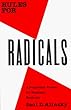
To understand them, it might be helpful to review Rules for Radicals by Saul  D. Alinsky.  Alinksy, who would have given Machiavelli doubts, wrote this book to give tactics to community organizers and others about how to defeat in people their nature inclinations to commonsense, conservatism and tradition, and drag them through emotion and disinformation over to a leftist agenda.

Alinsky dedicated his book to Satan.  That dedication appeared in the first editions, but I understand that it was later removed.

Here is a quote from Rules:

There’s another reason for working inside the system. Dostoevski said that taking a new step is what people fear most. Any revolutionary change must be preceded by a passive, affirmative, non-challenging attitude toward change among the mass of our people. They must feel so frustrated, so defeated, so lost, so futureless in the prevailing system that they are willing to let go of the past and change the future. This acceptance is the reformation essential to any revolution. To bring on this reformation requires that the organizer work inside the system, among not only the middle class but the 40 per cent of American families – more than seventy million people – whose income range from $5,000 to $10,000 a year [in 1971]. They cannot be dismissed by labeling them blue collar or hard hat. They will not continue to be relatively passive and slightly challenging. If we fail to communicate with them, if we don’t encourage them to form alliances with us, they will move to the right. Maybe they will anyway, but let’s not let it happen by default.

It might be helpful for some of you to read Rules.  If you can get it used, that would be better.  Otherwise, if you want to buy a copy, use my link and I will get a percentage of the sale.  That might take the sting out of it a bit.  I think we have to study the tactics of the enemy in order to recognize what they are up to.

I found a great summary of Alinsky’s pointers here.   Here are the first set of summarized rules:

Rules for Power Tactics:

1. Power is not only what you have but what the enemy thinks you have.
2. Never go outside the experience of your people.
3. Whenever possible, go outside of the experience of the enemy.
4. Make the enemy live up to their own book of rules.
5. Ridicule is man’s most potent weapon.
6. A good tactic is one that your people enjoy.
7. A tactic that drags on too long becomes a drag.
8. Keep the pressure on with different tactics and actions, and utilize all events of the period for your purpose.
9. The threat is usually more terrifying than the thing itself.
10. The major premise for tactics is the development of operations that will maintain a constant pressure upon the opposition.
11. If you push a negative hard and deep enough, it will break through into its counterside.
12. The price of a successful attack is a constructive alternative.
13. Pick the target, freeze it, personalize it, and polarize it.

Consider now what you read in liberal catholic web sites and publications.  Do those points sound familiar?  They may… they may not.  You decide.

In my first look at St. Augustine’s commentary on the 1 John, we saw that Augustine has three levels of love, the most perfect of which is that charity which is love of enemy.  We can reprove, correct, remonstrate, and even do so with great energy and harsh words.  But we cannot stop trying to love them.  For Augustine, we try to love our enemies in order that, some day, they might have fellowship with us.

We have to resist them and call them out when they harm the Church and the Faith.  But when we do so, we should check ourselves and self-edit so that what we write and say is not done in hatred, and is not personal.

Let’s not become them in calling them out.

Posted in "How To..." - Practical Notes, ASK FATHER Question Box, New Evangelization, Our Catholic Identity, The Drill, The future and our choices | Tagged , , ,
35 Comments

QUAERITUR: Doing the Roman salute/blessing gesture

From a reader:

The recent post about the LCWR has got me wondering. Is there ever a time in the liturgy (in the rubrics, anyway) when the laity are encouraged to raise their hands in blessing? I am under the impression that the orans posture is reserved for the priest at Mass, but I have seen parts of the RCIA in the context of Mass where laypeople are instructed to raise their hands in blessing.

Not that I can think of, in either Form of the Roman Rite.

I cannot think of a moment when the people are directed by the rubrics to do that or a priest/deacon is allowed to invite people to do that.

However, I think that during their special closed door sessions they are indeed directed by rubrics (a more sinister term in that setting), to raise their arms while chanting:

Darksome night and shining moon,
Hearken to the witches’ rune.
East then South, West then North,
Hear! Come!  I call thee forth!

By all the powers of land and sea,
Be obedient unto me.
Wand and Pentacle and Sword,
Hearken ye unto my word.

Cords and Censer, Scourge and Knife,
Waken all ye into life.
Powers of the witch’s Blade,
Come ye as the charge is made.

Queen of Heaven, Queen of Hell,
Send your aid unto the spell.
Horned Hunter of the night,
Work my will by magic rite.

By all the powers of land and sea,
As I do say, “So mote it be.”
By all the might of moon and sun,
As I do will, it shall be done.

That said, if people spontaneously want to stand around doing the Roman salute, I guess they can.  When they do, however, they may be giving the impression that they don’t understand either who they are during Mass or what that gesture signifies.

But I wouldn’t worry much about what the LCWR does.  They make up their own liturgies and they probably won’t be around much longer, judging from the photos.

Posted in "How To..." - Practical Notes, ASK FATHER Question Box, Liturgy Science Theatre 3000 | Tagged , ,
48 Comments

Bad or heterodox theologians, a “curse and affliction upon the church”

The ultra-liberal NCFishwrap‘s solitary boast, my friend the nearly-ubiquitous, fair-minded John L. Allen, Jr., has an interesting piece today about a theologian working for the US Bishops, recently in the news because of the USCCB doctrine committees remarks on Sr. Elizabeth Johnson’s odd ideas.

Here is a taste from Mr. Allen, with my emphases and comments.

Bishops’ staffer on doctrine rips theologians as ‘curse’
Aug. 16, 2011
By John L Allen Jr

Theologians can be a “curse and affliction upon the church,” according to the U.S. bishops’ top official on doctrine, if their work is not grounded in church teaching and an active faith life, and ends up promoting “doctrinal and moral error.”  [I am sure most of your are doing air fist-pumps right about now.  I can, however, pick up the faint sound from the far left… it sounds rather like back molars breaking from stress.]

Capuchin Fr. Thomas Weinandy, executive director of the Secretariat for Doctrine at the U.S. bishops’ conference, has warned of a “crisis” in Catholic theology, caused by theologians who “often appear to possess little reverence for the mysteries of the faith as traditionally understood and presently professed within the church.”

Those remarks came in a May 26 address to the Academy of Catholic Theology in Washington, D.C., and were published in July in Origins, the official documentary service of the U.S. bishops[It is hard to imagine such a think being published in Origins 10 years ago.]

[… Mr. Allen reviews the situation of Sr. Johnson, other points, and then goes on…]

“Theology may be the only academic pursuit where one can seemingly be considered a theologian without actually having to know the subject matter,” he said. “It would appear at times that a theologian need not actually know God.” [“theos + logein”]

Weinandy, 65, holds a doctorate in historical theology from King’s College in London and is a former professor of theology at Oxford University. He’s served as the U.S. bishops’ chief of staff for doctrinal issues since 2005.

In his May 26 address, Weinandy strongly defended the idea that a Catholic theologian should have a mandate, or license, from the local bishop. Such a mandate does not curb their freedom, he argued, but gives their vocation “a dignity and gravity that it truly deserves.”

Weinandy devoted a section to “the present crisis within Catholic theology.”

“Much of what passes for contemporary Catholic theology,” he said, “often is not founded upon an assent of faith in the divine deposit of revelation as proclaimed in the sacred scriptures and developed within the living doctrinal and moral tradition of the church.”

Instead, he said, much Catholic theology has become “an attempt by reason to pass judgment on the content of the faith as if it were of human origin,” with theologians as “judges who stand above the faith and arbitrate what is to be believed and what is not.”  [Modernism, right?]

That approach, Weinandy said, “sometimes undermines genuine faith within the body of Christ” and ends up leading people “into the darkness of error.” It also, he said, “inevitably produces fragmentation within the church.

Weinandy acknowledged that over the centuries, the Catholic church has recognized different “schools” of theology.

Yet today, he said, “the church is experiencing not a debate among legitimate schools of theological thought, but a radical divide over the central tenets of the Catholic faith and the church’s fundamental moral tradition.”

“This is not simply an expression of a plurality of Catholic theologies,” Weinandy said, “but the very disintegration of the Catholic faith itself.”

[…]

Read the full article over there.

Again, we can apply the old quidquid recipitur adage.  But I am glad that Mr. Allen covered this for Fishwrap, even as they have a subscription drive going.

That said, allow me to test drive an analogy.

In London and elsewhere in England there were riots, and there will be more upheaval there and in Europe, because those values which restrain people, which make them think about others, which instil in young people a sense of right and wrong, have been undermined.  They are imbued with relativism and its fruits, and they rampage around, doing what they feel like doing, without reference to the common good.  This has come about because parents and schools and the media have in a double effort of reckless irresponsibility, not exercised governance and discipline over their children.  In London and elsewhere they are now reaping the results.  Neighborhoods are terrorized, businesses harmed, and the fabric of society weakened, thus perpetuating the recourse to violence.

In the Church, there has been relatively little exercise of discipline of the Faith in schools and pulpits as far as teaching is concerned, and little oversight in some places for liturgical worship.  The lack of clear Catholic teaching or the mixed messages that come from heterodoxy in one parish and fidelity in another, even between priests in the same parish, has produced the impression that even the clearest dogmas of the Faith are up to personal choice and interpretation.  This has produced gangs which can roam nearly unchecked up and and down the streets of the Church, rampaging and intimidating and spiritually bullying the faithful, leaving them spiritually impoverished and confused.  The theological hoods, yobs, are now almost entirely beyond hope.  They do violence to the Church’s doctrine and worship, and thereby diminish the fabric of the Church wherever they are.

Posted in SESSIUNCULA | Tagged , , ,
35 Comments

St. Joachim, husband, father of the Blessed Virgin, grandfather of the Lord

Today in the traditional Roman calendar is the Feast of St. Joachim, father of the Blessed Virgin Mary.

Joachim in Hebrew means “he whom YHWH has set up”.

His feast was not in the 1570 Missale Romanum. It was added in 1584 for 20 March (the day after the Feast of St. Joseph). In 1738 it was moved to the Sunday after the Octave of the Assumption of Mary. All of those Octaves were eliminated sometime before 1962. Pope St. Pius X moved it 16 August in order to associate it more closely with the Blessed Virgin Mary. In the post-Conciliar calendar St. Joachim’s feast was joined to that of St. Ann, his wife and mother of the Blessed Virgin for 26 July.

I am happy to have relics of St. Joachim and St. Ann.

To think: the grandfather of the Lord would share something of His DNA.  Relics of Joachim and Ann are about as close as we can get to relics of Mary and the Lord.

Posted in Saints: Stories & Symbols | Tagged ,
14 Comments

Scenes from the annual LCWR meeting: the fecundity of chaos

Today on the invaluable site of NCFishwrap we learn that at the meeting of the Leadership Conference of Women Religious (LCWR) the gathered sistren are turning to a brand new plan in the face of their dwindling numbers.

Here are a few excerpts.

Accompanied by the sound of bells, they encircled her as she stood in the center of the stage. Then all 600 sisters in attendance extended their right hands as they chanted a blessing: “Receive strength and light; receive power, receive love.”

This reframing of the “tried and true” verbal introduction was a fitting prelude to the message Bracamontes delivered — that traditional ways of exercising authority and power are breaking down and new structures of equality and shared responsibility are emerging.

Well!  That‘s new!

I am looking for photos or, oh please oh please oh please, video of that.  I’ll make the popcorn.

Remember, what was it, last year?  Exactly one year ago today!  And don’t forget the great Vincenzo’s version!

Here is the insight the LCWR’s special speaker brought about breaking male-domination in the Church:

“To practice a Gospel alternative,” she said, “we need to de-construct the domination-submission model that most of us have internalized and which is an underlying condition of our cultures.” [1 Tim 2:11-15]

To illustrate her point, she told of two Mexican seminarians who were delighted to have their hands kissed by parishioners during a Holy Week mission. When she questioned them about their attitude, they said they’d been taught not to resist this sign of respect. Calling this attitude part of a “clerical culture” that needs to be reformed, she said, “I suggested that at least they could offer to kiss the person’s hand in return as a sign of mutual respect.”

You can see they are confronting the big issues of the day even as elitists they run down the customs of the poor devout faithful.  If men do it or like it, it must be stopped.

This is a great example of the the FFLF (Female Fun Limitation Factor, defined as that effect produced on one or more males having fun when a female of any age asks in that special tone of voice, “Do you really think you should be doing that?”, and in all its variations, especially through The Look and other non-verbal signals.)

But wait!  There’s more from LCWR:

“Once we realize that cultural models are human creations and, therefore, can be changed and adapted, we become more creative and dynamic in our search for transforming alternatives: other worlds become possible, other ways of being church become possible, other forms of religious life become possible.”  [To seek strange new worlds where no man has gone before!]

She called on women religious to probe “Christian Memory,” to make the conscious choice to be attentive to the groans of the divine “Ruah,” the breath of God, that “is hovering over the darkness of our decaying civilization, yearning to bring forth the light.”

They are facing down male institutional domination.  I wonder how it is working out.

In another story, here, I read that they are exploring the complexity of the birthing metaphor, and – I am not making this up – the fecundity of chaos.

QUAERITUR: Why do some institutes of religious women have vocations and others have none?

BTW… scroll down here and look at the comments about SNAP in their combox over at Fishwrap.

UPDATE 2113 GMT:

Commentator APX found the photos page!  KUDOS!

Here is a sample… little tiny photos….

Look familiar?

Here they are gathered in “circles of contemplation”.

They do seem to be contemplating themselves, no?

I don’t think the Horst Wessel Song played any part in this.

And….

And I don’t think the Horst Wessel Song has ever been played on a guitar, so let’s rule that out right now.

What we also discover from that page is a letter from The White House… really!  Look!

Among other things the LCWR is congratulated by the signers for help with the health care issue.  You remember, the big White House initiative a while back during which the Magisterium of Nuns defied the US bishops and helped POTUS pass something that would ultimately provide federal funding of abortion?  Yah… that’s the ticket.   The White House letter is signed by Joshua DuBois, Executive Director and Special Assistant to the President from the White House Office of Faith-Based and Neighborhood Partnerships and Alexia Kelley, Deputy Director and Senior Policy Advisor for the
White House Office of Faith-Based and Neighborhood Partnerships.

And I know this will surprise everyone.  the LCWR gave an award to Sr. Keehan!

Posted in Lighter fare, Our Catholic Identity, The Drill | Tagged , , ,
73 Comments

Remember: Father isn’t talking to you.

I was once accosted in St. Peter’s Basilica after my daily Mass by an angry modernist visiting American pants-suit, hair-do and lapel-pin sister … I guess angry was redundant, wasn’t it… who griped at me that she couldn’t hear the Eucharistic Prayer.  She had not been there from the beginning of Mass, and so maybe wasn’t tracking well.  I said that I was using the 1962 Missale Romanum and that the Eucharistic Prayer was silent.  She persisted that everyone should hear it.  I continued that raising our voices disturbed the other Masses nearby.  She continued with her harpy upbraiding, braying about the right of all to hear everything.  I explained, before I returned to the sacristy and a more pleasant day, even at the hands of the liberal-nazi sacristans of those times, that when I was reading the Eucharistic Prayer, I wasn’t talking to her.

Here is something I just sent in for my And With Your Spirit column for The Catholic Herald, the UK’s best Catholic weekly.

I wrote this week about the beginning of the Roman Canon.  Toward the end:

Unless you are attending Mass in the Extraordinary Form, you now hear pretty much everything the priest says.  For centuries, however, the Roman Canon was pronounced nearly silently.  When you hear Eucharist Prayers at Mass, remember this: the priest is not talking to you.  He is addressing God the Father on your behalf in the way that only an ordained priest can.

Even when the Eucharistic prayer is spoken aloud, priests should remember to whom it is addressed and reflect this understanding in their manner of speech.  It is no surprise that the tenor and style of Mass devolved over the last decades in English speaking countries.  The language we have been using is neither solemnly humble nor courteously confident.

A change of the texts of Mass won’t by itself accomplish everything we hope for in a reform of our liturgical worship. Nonetheless, the content and the tone of the new translation will help reorient congregations with their priests and guide them back to being a manifestly worshipping people.

Posted in "How To..." - Practical Notes, New Evangelization, Our Catholic Identity, The Drill, The future and our choices | Tagged , , ,
31 Comments

Brick by brick… it is happening

Over at the excellent Chant Cafe, I found this from a priest contributor, Fr. Christopher Smith.  My emphases and comments.

I was recently at a Cathedral down South on a weekday and I wanted to celebrate a private Mass. As I was vesting in my Roman chasuble [unthinkable 10 years ago] and my altar server, a seminarian, was preparing the altar for my EF Mass [Extraordinary Form] on the feast of Saint Dominic, a newly ordained priest was vesting in a Gothic chasuble and a layman was preparing another side altar for his OF Mass on the feast of Saint Jean-Marie Vianney. [And 10 years ago it would have been unthinkable to have different side altars in use.] My newly ordained priest friend has not yet learned the EF, but is interested. We both went to side altars at the same time to offer two forms of the Roman Rite, with clergy, seminarians and laity in attendance. It just kind of happened that way, was something not planned. Later that week, my newly ordained priest friend sat in choir at an EF High Mass that the seminarian and I helped to sing, and I concelebrated the OF in the same Cathedral where he was ordained. The Director of Religious Education for the Cathedral, a young woman theologian and student of liturgy, happened to be present at all of these occasions, and she commented on how, in our own way, we were making real Pope Benedict’s vision of the Roman Rite in two forms. [NB:] No one was confused, no one was angry, no one was ideologically motivated to criticize the other.

As I said before, that would all have been unthinkable 10 years ago.

Brick by brick.

Meanwhile…

[CUE MUSIC]

And coffee bean by coffee bean!

Have you enough coffee on hand right now?  Fresh coffee ready for that WDTPRS mug?

I’ll bet the Carmelites in Wyoming have some for you, even as they haul heavy blocks around to build their new monastery.

Mystic Monk Coffee

It’s swell!

http://www.chantcafe.com/2011/08/why-are-seminaries-afraid-of.html
Posted in Brick by Brick, Just Too Cool, Mail from priests, New Evangelization, Our Catholic Identity, SUMMORUM PONTIFICUM, The future and our choices | Tagged , ,
17 Comments

How to treat sinners

A quote via Good Jesuit Bad Jesuit from St. Ignatius of Loyola which reminds me of how imperfect I am in charity.

“Treat sinners as a good mother treats her child when sick; she bestows on him many more caresses than when he is in good health”


Posted in "How To..." - Practical Notes, New Evangelization, Non Nobis and Te Deum, Our Catholic Identity, The Drill | Tagged , , , ,
13 Comments
























