Finally another reaction about NCR’s insulting article

Late is better than never.

From CNA with my emphases and comments.

Catholic leaders rip ‘ludicrous’ article that argues celibacy causes abuse
By Marianne Medlin

Denver, Colo., Jun 15, 2011 / 06:00 am (CNA).- Catholic leaders are calling a recent National Catholic Reporter [aka Fishwrap] article “ludicrous” after it criticized Kansas City Bishop Robert W. Finn and compared him to the scandal-plagued New York Rep. Anthony Weiner and former California governor Arnold Schwarzenegger.

Writer Phyllis Zagano said in her June 8 piece for the Reporter that Bishop Finn – who recently apologized for failing to deal swiftly with a priest whom police found possessed questionable photos  – could also be compared to mogul Dominique Strauss Kahn, who was arrested for sexually assaulting a hotel maid.

“None of these four players speaking loudly on the stages of politics and finance seems to have much respect for women, or anyone else for that matter,” said Zagano, a former professor at Fordham University in New York.

Her criticism of Bishop Finn comes after he publicly expressed his remorse for neglecting to heed warnings about local priest Fr. Shawn Ratigan that were raised in a letter sent by Saint Patrick School principal Julie Hess to the diocese’s vicar general. The letter detailed parents’ concerns about the priest’s behavior around children.

However, Zagano’s remarks did not sit well with Catholic League president Bill Donohue and the internationally-known author Fr. Alfred McBride, O Praem., who both believe she went too far[So they are finally getting around to this?  I wrote about this 5 days ago!  Where have they been?]

“Arnold Schwarzenegger impregnates his housekeeper, Rep. Anthony Weiner sends porn pictures of himself to strangers, and Dominque Strauss-Kahn allegedly rapes a hotel maid,” Donohue said.

“To be sure, they have something in common, but to conflate their sordid behavior with Kansas City-St. Joseph Bishop Robert W. Finn’s failure to move quickly against a problem priest is so forced as to be ludicrous,” he told CNA in a June 12 interview.

“That, however, is exactly what Phyllis Zagano has done.”

Zagano also criticized Bishop Finn’s celibate formation, saying she felt “sorry for him” that he entered seminary at age 12. She wrote that the bishop is a “product a system left over from the Council of Trent,” which directed dioceses to create minor seminaries to provide initial formation for diocesan clergy.

“An all-male environment from the age of twelve can ensure celibacy, but at what price?” Zagano said. “If the only way to get celibate clergy is to lock up twelve-year-olds until they are ordained, maybe the hierarchy should reconsider requiring priestly celibacy.”

Donohue said in response that “her lashing out at Bishop Finn, and her inane analogies comparing Finn to sexual deviants in public life, smacks of an agenda.”

Fr. Alfred McBride, a professor at St. Norbert’s College in Wisconsin who has helped form hundreds of seminarians, also took on Zagano’s criticism of priestly celibacy. He told CNA that it’s inaccurate to blame celibacy for sexual misconduct or mismanagement of cases within the Church.

“When we look at the celebrity politicians of late who broke their marital promises to their wives, did that happen because they were married?” he asked. “No. It happened because they failed to nurture their vow of fidelity which they pronounced on their wedding.”

Fr. McBride, a popular speaker who’s authored over 40 books and appeared regularly on TV networks such as EWTN, said that the “central issue of our culture is fidelity, not adultery or sex abuse.”

“Whether one is married or celibate, the virtue of fidelity is central to their lives.”

“Marriage does not cause adultery,” he added. “An evil soul causes that. So also celibacy does not cause what Pope Benedict calls the ‘filth’ of sex abuse, but the permission given by priests to let evil overtake their souls.”

Fr. McBride said that the real reason for sex abuse and sexual misconduct by priests is not celibacy but “the failure to practice the virtue of chastity when faced with temptations to abandon their vow of celibacy.”

He noted that people often make the unfortunate mistake of defining celibacy in a negative way as if it’s simply the act of giving up marriage and and children.

However, “the positive view of celibacy,” he said,  “is that it is a form of loving God and people with an undivided heart.”

“Celibacy did not block Blessed John Paul II from being admired as one of the most courageous priests on earth,” Fr. McBride underscored. “See how one celibate priest stood up against one of the most corrupt governments of his time.”

“Priests that abused children did not do so because of their celibacy, rather they failed because they broke their vow to be chaste,” he said.

“When four million people elbowed their way into the Vatican to pay tribute to a celibate priest, what does that tell you? It states that John Paul knew how to keep his promises,” he said, referring to Bl. John Paul II’s funeral.

I am glad they finally got on board with this… very late.

Posted in SESSIUNCULA | Tagged , , , , ,
10 Comments

Vienna: Another sacrilegious “Western Mass”

Yet again, a sacrilegious “Western Mass” was celebrated in Austria with the approval of Card. Schoenborn, Archbishop of Vienna.

This happened again, in pretty much the same way. despite the fact that it happened last year.

Posted in Liturgy Science Theatre 3000 | Tagged , ,
66 Comments

Salad: just keep it simple

Put a large bowl on the counter.

With a very sharp knife, shave a clove of garlic into the finest slices you can manage.

Put them in the bowl.

Add good balsamic vinegar.

Add about 3 times as much excellent olive oil.

Add a large pinch of salt.

Dice a tomato and add it to the bowl.

Give it a little mix a and let it all macerate for a few minutes.

Add your salad greens.   I put in a few fresh herbs from the garden: taragon, basil, thyme.  Optional.

Mix.

Eat with a dash of great enjoyment and a glass of Chianti.

Posted in Fr. Z's Kitchen | Tagged
18 Comments

Sr. Fiedler’s summation of the American Catholic Council. Fr. Z agrees.

Fishwrap has a wrap-up, in their own paper, if you get my drift, of the American catholic “Council” held in Detroit over the weekend.

The Fishwrap wrap-up is by nun-other than Sr. Maureen Fiedler.  We seen her insights here and here and here.

She has some interesting points and conclusions.  This may surprise you, but I agree with some of this!

My emphases and comments.

Reflections after the American Catholic Council meeting
by Maureen Fiedler on Jun. 14, 2011

I’m a veteran of conferences on church reform. I started out at the first Women’s Ordination Conference in 1975, attended the original Call to Action (the one the U.S. Bishops called in 1976) and participated in numerous Call to Action and Women’s Conferences since then. I’ve even attended a couple in Europe, including the 8th of May Movement in the Netherlands.

So, the American Catholic Council meeting in Detroit this past weekend (June 10-12) was of great interest to me. I was especially interested in signs of change and maturing in the movement. [Maturing.. yes… there was that.] Here’s what I sensed and observed:

The issue of women’s ordination, and gender equality generally, has risen to a new level of prominence on the roster of reform. It is at the top of many reformers’ lists — men as well as women. It’s clear as never before: the denial of women’s equality just makes no sense to most Catholics anymore, especially these Catholics. [Two premises need to be checked.  First, are the “reformers”?  Or are they just “wrong”?  Second, are they “Catholics”?  A group such as gathered this weekend is sure to be pretty heterogeneous.  So… who knows?]
The issue of gay and lesbian rights has become mainstream in the movement, just as in society at large. [First… blech.  Second, that only means that they are “conforming themselves to the wisdom of this world”.] It’s not a “fringe” issue for Dignity or New Ways Ministry; it’s everybody’s issue. And of course, over the years, Call to Action has had a lot to do with that.
New and independent communities are flowering as never before. [Key word: independent.] If the Church is a garden, new sprouts are proliferating. [Is the Church a “garden”?  Okay…we can play along.] There have always been tall trees and shrubs (cathedral and parish communities) in the church. But now, there are new flowerings: intentional communities – lots of them, the communities of the Roman Catholic Women Priests’ movement, the “Ecumenical” and “American” Catholic churches and dioceses, even new religious orders like Green Mountain Monastery in Vermont. Most of these are outside the purview of the hierarchy.  [Indeed.  In the garden there also be weeds.]
The “priesthood of the faithful” was visible. [No, Maureen.  What was visible were some people pretending that there is no distinction between the priesthood of the faithful, the baptized, and the ordained priesthood.  What you say were people who were pretending.] When the celebrant at the Pentecost Sunday mass said the words of consecration, hundreds of people in the congregation chimed in without prodding or instructions in the program. Why? I suspect that many do it routinely in their intentional communities, and they believe that they have the power, along with the priest, to call for the presence of Christ.  [And they can call and call and call.  Thousands and thousands of lay people can scream the words of consecration over and over again and transubstantiation will not take place.  A single priest, alone, whispering, can do that.  But note that Maureen has clung to to the old and outdated language of “consecration”.  Men are consecrated with Holy Orders.  I just thought I would add that.]
There is something increasingly “American” about this movement. [Which may mean that it is decreasingly “Catholic”.] The leaders of the conference formulated a “Catholic Bill of Rights and Responsibilities” modeled on our own Bill of Rights. [What did I say about conforming to this world?] The whole crowd affirmed it.
Nobody expects that the world of Catholic “officialdom” will change soon, maybe not even in their lifetimes. [Well… they better hurry, ’cause they aren’t going to have another generation.] Common comments about the hierarchy or bishops included: “Can it get any worse?” “Do you think they know how ridiculous they look?” “When will they leave the Middle Ages behind?”  [I have often thought the same, but different reasons.]
No one feels guilty about working for reform. [Interesting.  So, keep telling them that they are reformers instead of sinners.  Good.  They reformers, not dissenters.  Just use another term, repeat it loudly.  Repeat it enough times.  No more guilt.] If anyone worried about what the hierarchy would say in response to this meeting, it was not in evidence. “Excommunication… what’s that?[I am reminded of the guy who asked a Jesuit if it would be a sin to recite a novena so he could get a Maserati.  The Jesuit puzzled for a moment and said “What’s a novena?”]

A couple things other things to note:  [This, friends, is good…]

This was a “graying” crowd: the “Vatican II generation” still hoping to fulfill the promise of that Council. There was surely outreach to the young, but both Call to Action and the Women’s Ordination Conference have had more success in attracting youth. [And not many, either.  They are “graying”.  FAIL 1.]
It was a very “white” crowd, and the major speakers — with the exception of Jeanette Rodriquez — were white and Anglo. I know the organizers tried to attract people of color, but Call to Action conferences definitely exhibit greater diversity. [Lot’s of talk about diversity, but not much real diversity. FAIL 2.]
Barring some re-appearance of Christ on earth, no one expects the hierarchy to change course any time soon. [That’s sure to rouse up the troops!  But read on… the most important line is coming…] Meanwhile, new communities grow and create what is essentially a small parallel church. How all this will ultimately play out only God knows.

“Small parallel church.”

And that, my friends, is a wrap.

Posted in Just Too Cool, New Evangelization, Our Catholic Identity, The Drill, The future and our choices, Throwing a Nutty | Tagged , , , , , ,
51 Comments

McBrien thinks the Pope is … wait for it… wrong about women’s ordination!

Richard McBrien in his column in the National catholic Fishwrap says that the Church’s infallible teaching about the impossibility of the ordination of women isn’t really infallible.  How dare the Pope say that it is?

His basic idea is that since the 1983 Code of Canon Law says in can. 749.3 that “if there is any doubt about the infallible nature of a teaching, it is not infallible. The canon reads: ‘No doctrine is understood to be infallibly defined unless it is clearly established as such.’”

McBrien doubts that it is infallible.  Therefore it isn’t.   See?  See?

But wait!  Other theologians think it isn’t infallible!   And some other folks too!  They doubt it.

And therefoooooooore … it isn’t infallible.

It’s all a mass of twaddle, of course.  McBrien is just plain wrong.

But this twaddle points to two important facts you ultraconservative Catholics should keep in mind when daring to disagree with McBrien.  We are just puir slow-witted gowks.

First, you are stupid.   As McBrien writes: “ultraconservative Catholics — most or all of whom have had no formal education in theology, Scripture, liturgy, or canon law”.  Then he says that Archbp. Chaput is an “ultraconservative”.  He thinks Pope Benedict is an ultraconservative.  McBrien thinks anyone who sticks to the Church’s teachings are ultraconservatives.

Second, there are pecking orders within academe which leave the hierarchies of the Church waaaaay behind.  There are, for example, levels of professorships.  There are assistants and associates.  There are visiting and full professors.  But then there is the crème de la crème of professors.  There are the holders of endowed chairs, endowed chair professors.  McBrien is the Crowley-O’Brien Professor of Theology at the University of Notre Dame.  What was the little radio program on NPR?  Mister Science?  Remember him?  “He knows more… than you do!”

McBrien, who surely values his endowed chair even more than being a priest, given the way he dresses… after all, anyone can be a priest ….errrr… ummmm… any man can be a priest, we should probably refer to him as “Holder” McBrien.

Think of the College of Cardinals and, within the College, the Cardinal Bishops.  They’ve got nuthin‘ on the Endowed Chair Holder!

He’s an Endowed Chair Holder.  Think of the prestige!  The authority!

Who needs the Magisterium?

Holder McBrien is wrong about Ordinatio sacerdotalis, even though he… he, The Holder, and others beneath him, have a “doubt”.

We, the stupid, were capable of reading both Ordinatio sacerdotalis and the CDF response and, afterward, set aside doubts.  Imagine how many subtleties we must have missed, subtleties spotted only by Holders of Endowed Chairs and their like.

I suspect the thought of the Holders is so far above ours that they have a hard time understanding why we don’t doubt the Church on this point of women’s ordination.

Let me try to explain to them why we, the stupid, still have faith.

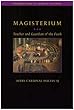
A good source for clarity on the infallibility of the Church’s teaching on the ordination of women, see Avery Dulles’s excellent book Magisterium

Put succinctly for you stupid ultraconservatives, the doctrine about women’s ordination is infallible as part of the ordinary and universal Magisterium.

The language used by John Paul in Ordinatio sacerdotalis makes it clear:

“Wherefore, in order that all doubt may be removed regarding a matter of great importance, a matter which pertains to the Church’s divine constitution itself, in virtue of my ministry of confirming the brethren (cf. Lk 22:32) I declare that the Church has no authority whatsoever to confer priestly ordination on women and that this judgment is to be definitively held by all the Church’s faithful“.

If that wasn’t enough, and it isn’t for the ineducable… but remember, the ultraconservatives are the stupid ones, the Congregation for the Doctrine of the Faith explained the Pope’s teaching for those who were still inexplicably having doubts.

This, from the CDF, removes the doubts:

“In response to this precise act of the Magisterium of the Roman Pontiff, explicitly addressed to the entire Catholic Church, all members of the faithful are required to give their assent to the teaching stated therein. To this end, the Congregation for the Doctrine of the Faith, with the approval of the Holy Father, has given an official Reply on the nature of this assent; it is a matter of full definitive assent, that is to say, irrevocable, to a doctrine taught infallibly by the Church. In fact, as the Reply explains, the definitive nature of this assent derives from the truth of the doctrine itself, since, founded on the written Word of God, and constantly held and applied in the Tradition of the Church, it has been set forth infallibly by the ordinary universal Magisterium (cf. Lumen Gentium, 25). Thus, the Reply specifies that this doctrine belongs to the deposit of the faith of the Church. It should be emphasized that the definitive and infallible nature of this teaching of the Church did not arise with the publication of the Letter Ordinatio Sacerdotalis. In the Letter, as the Reply of the Congregation for the Doctrine of the Faith also explains, the Roman Pontiff, having taken account of present circumstances, has confirmed the same teaching by a formal declaration, giving expression once again to quod semper, quod ubique et quod ab omnibus tenendum est, utpote ad fidei depositum pertinens. In this case, an act of the ordinary Papal Magisterium, in itself not infallible, witnesses to the infallibility of the teaching of a doctrine already possessed by the Church”.

Hey!  Stooopid people!  There are actually criteria by which we can tell that some teaching is infallible.

First, the Pope must be intending to teach.  Pope John Paul was teaching in Ordinatio sacerdotalis.

Second, the Pope must intend to teach by virtue of his supreme apostolic authority, his role as Peter to strengthen the brethren.  He did that pretty clearly, even making reference to Luke 22.

Third, it must be about a point of faith or morals, not on the baseball season.  This is a matter of faith, for certain.

Fourth, it must be a teaching that is to be held by the all the faithful, the whole Church. John Paul II explicitly mentioned all the faithful in Ordinatio sacerdotalis.

Ordinatio sacerdotalis does all these things.  John Paul II taught, spoke of his role as Peter, said that this is a matter of faith and not just of some law or custom, and he said that all the faithful are to accept this.

With all these factors in play, he didn’t need the word “infallible”.

Then the CDF, with the approval of John Paul, made the situation clear.

There is no way to say that there is any doubt … unless you are stupid.

In any event, Holder McBrien ironically tries to support his dissent by citing Canon Law.

But the Rome Pontiff is the Legislator, the Lawgiver.

Posted in O'Brian Tags, Our Catholic Identity, Puir Slow-Witted Gowk, The Drill, Throwing a Nutty | Tagged , , ,
52 Comments

A liturgical, bliblical treasure hunt

I suppose it is a confluence of factors, including the rhythm of the liturgical year and various factors in life, I found the Introit for today’s Mass, for Pentecost Tuesday, quite moving.

Introitus
4 Esdr 2:36 2:37
Accípite iucunditátem glóriæ vestræ, allelúia: grátias agéntes Deo, allelúia: qui vos ad coeléstia regna vocávit, allelúia, allelúia, allelúia
Ps 77:1.
Atténdite, pópule meus, legem meam: inclináte aurem vestram in verba oris mei.
V. Glória Patri, et Fílio, et Spirítui Sancto.
R. Sicut erat in princípio, et nunc, et semper, et in saecula saeculórum. Amen
Accípite iucunditátem glóriæ vestræ, allelúia: grátias agéntes Deo, allelúia: qui vos ad coeléstia regna vocávit, allelúia, allelúia, allelúia

When I am struck by a verse during Mass, when a particular antiphon stops me in my tracks, I – in my best Indiana Jones imitation – will often hunt up the treasure after Mass to get the context.  Sometimes an antiphon is merely a pointer to a larger context, or something else in the chapter which the singer/listener should know.

Now… a question arises.  Where to find 4 Esdr 2:36 2:37 in the Bible?

“Esdras”, quoth I.  “Why did it have to be Esdras?”

Esdras is complicated.  Here is a handy chart from wikipedia which shows the various ways the books of Esdras are named and numbered.

Clement VIII, who revised the Vulgate after the Council of Trent to reflect the Council’s canonical list of recognized books of the Bible, moved the “Prayer of Manasses”, 3 Esdras and 4 Esdras into an appendix, “ne prosus interirent… lest they entirely perish”.  Protestant Bibles number these books differently and what is 4 Esdras in the Vulgate is 2 Esdras in the KJV.

Here is another chart, from here.

Catholics are interested in 4 Esdras for a variety of reasons.  For example, the prayer “Requiem aeternam dona eis, Domine” is based on 4 Esdras 2:34-35.

Hey.  Wait!   That’s our chapter for the verse for the Introit today, no?

Yes!

Here is something from the Catholic Encyclopedia about 4 Esdras:

Fourth Book of Esdras

The personage serving as the screen of the real author of this book is Esdras (Ezra), the priest-scribe and leader among the Israelites who returned from Babylonia, to Jerusalem. The fact that two canonical books are associated with his name, together with a genuine literary power, a profoundly religious spirit pervading Fourth Esdras, and some Messianic points of contact with the Gospels combined to win for it an acceptance among Christians unequalled by any other apocryphon. Both Greek and Latin Fathers cite it as prophetical, while some, as Ambrose, were ardent admirers of it. Jerome alone is positively unfavourable. [No surprise there.] Notwithstanding this widespread reverence for it in early times, it is a remarkable fact that the book never got a foothold in the canon or liturgy of the Church. Nevertheless, all through the Middle Ages it maintained an intermediate position between canonical and merely human compositions, and even after the Council of Trent, together with Third Esdras, was placed in the appendix to the official edition of the Vulgate. Besides the original Greek text, which has not survived, the book has appeared in Latin, Syriac, Armenian, Ethiopic, and Arabic versions. The first and last two chapters of the Latin translation do not exist in the Oriental ones and have been added by a Christian hand. And yet there need be no hesitation in relegating the Fourth Book of Esdras to the ranks of the apocrypha. Not to insist on the allusion to the Book of Daniel in xii, 11, the date given in the first version (iii, 1) is erroneous, and the whole tenor and character of the work places it in the age of apocalyptic literature. The dominant critical dating assigns it to a Jew writing in the reign of Domitian, A.D. 81-96. Certainly it was composed some time before A.D. 218, since it is expressly quoted by Clement of Alexandria. The original text, iii-xiv, is of one piece and the work of a single author. The motive of the book is the problem lying heavily upon Jewish patriots after the destruction of Jerusalem by Titus. The outlook was most dark and the national life seemed utterly extinguished. In consequence, a sad and anxious spirit pervades the work, and the writer, using the guise of Esdras lamenting over the ruin of the first city and temple, insistently seeks to penetrate the reasons of God’s apparent abandonment of His people and the non-fulfilment of His promises. The author would learn the future of his nation. His interest is centered in the latter; the universalism of the book is attenuated. The apocalypse is composed of seven visions. The Messianism of Fourth Esdras suffers from the discouragement of the era and is influenced by the changed conditions produced by the advent of Christianity. Its Messias is mortal, and his reign merely one of happiness upon earth. Likewise the eschatology labours with two conflicting elements: the redemption of all Israel and the small number of the elect. All mankind sinned with Adam. The Fourth Book of Esdras is sometimes called by non-Catholics Second Esdras, as they apply the Hebrew form, Ezra, to the canonical books.

Also, Esdras is found as a Saint in the 2005 Roman Martyrology for 14 July:

2. Commemoratio sancti Esdrae, sacerdotis et scribae, qui, tempore Arataxeris regis Persarum, Babylone in Iudaeam rediens populum dispersum congregavit et omni studio enisus est, ut legem Domini investigaret, impleret et doceret in Israel.

I will let one of you tackle that pithy entry.  A nice example of the use of the imperfect subjective after a perfect verb… all that sequence of tenses stuff.

In any event, you can access the text of 4 Esdras here.

Here is 4 Esdras 2:33-40 in the RSV:

I, Ezra, received a command from the Lord on Mount Horeb to go to Israel. When I came to them they rejected me and refused the Lord’s commandment.

Therefore I say to you, O nations that hear and understand, “Await your shepherd; he will give you everlasting rest, because he who will come at the end of the age is close at hand. Be ready for the rewards of the kingdom, because the eternal light will shine upon you for evermore. Flee from the shadow of this age, receive the joy of your glory; I publicly call on my Savior to witness. Receive what the Lord has entrusted to you and be joyful, giving thanks to him who has called you to heavenly kingdoms. Rise and stand, and see at the feast of the Lord the number of those who have been sealed. Those who have departed from the shadow of this age have received glorious garments from the Lord. Take again your full number, O Zion, and conclude the list of your people who are clothed in white, who have fulfilled the law of the Lord. The number of your children, whom you desired, is full; beseech the Lord’s power that your people, who have been called from the beginning, may be made holy.”

Turning to my beautiful Baronius Press edition of the Scriptures, having in parallel columns the Douay-Rheims Version and the Clementine Vulgate, I found the passages used for the Introit for the Mass of Pentecost Tuesday.

20110614-092207.jpg

20110614-092220.jpg

20110614-092229.jpg

20110614-092253.jpg

Useful book.  And beautifully bound.

So, there is something of the text for the Introit in the Extraordinary Form.

Posted in "How To..." - Practical Notes, The Drill | Tagged , , ,
14 Comments

Deluded wymyn playing dress up

Ultra-liberal, double-standard riddled NPR has a puff piece about women pretending to be priests.

From the onset, let’s be clear.  No woman can ever be validly ordained a priest.

No what they say or do, they can only ever simulate a sacrament.   I suppose they could validly baptize, just as even an atheist can, provided they use the right matter and form.

They can never be priests and everything they do is empty.

In the following, my emphases and comments.

Female Priests Defy Catholic Church At The Altar
by Lily Percy

June 12, 2011

In 2002, seven women were secretly ordained as priests by two Roman Catholic bishops in Germany. After their ordination, a kind of domino effect ensued. [The writer, in the bag, so to speak, for the issue, wants to to accept some premises.  The problem with this is that a) women can’t be ordained, they can never be priests, they can never be bishops.  Then, there can be no real “domino effect.]

Those seven women went on to [pretend] ordain other women, and a movement to [pretend] ordain female priests all around the world was born. The movement, named Roman Catholic Womenpriests, says more than a hundred women have been [pretend] ordained since 2002, and two-thirds of them are in the U.S.

On a recent June day in Maryland, four more women were [pretend] ordained as priests. The gallery at St. John’s United Church of Christ was filled with Catholic priests and nuns, there to support the women and the ordination movement — though visitors were asked not to photograph them. [cowards] Witnessing the ceremony was enough to risk excommunication. [Well merited, too.]

The audience turned to watch as the women made their way down the aisle, beaming like brides. The two-and-a-half-hour ceremony ended with [pretend] Holy Communion — the moment they’d been waiting for. Each woman performed [faked] the rites for the first time as a [pretend] priest, breaking bread and serving wine as tears of joy flowed down their faces.

Marellen Mayers is one of the women [pretend] ordained that day, and like her fellow [dress-up] ordinands, she was raised in the Catholic Church. Her mother had an altar at home, and when Mayers was a child, she would stand in front of it, wearing a cloth as her vestments and saying the Latin Mass.

“My brother and sister would be kneeling behind me, and if I said, ‘Dominus vobiscum,’ I would turn around and say, ‘You’re supposed to say ‘Et cum spiritu tuo,’ ” Mayers recalls.  [All that shows is that she’s bossy.]

Fellow [dress-up] ordinand Patti LaRosa had a similar experience growing up. She came from a close-knit Italian family and always felt comfortable in the Catholic Church. In the late ’70s she got married, had two kids and was working as an assistant at a law firm in Rochester, N.Y. [She was perhaps on a better path.  Now her immortal soul is at risk.]

Several times a week she would go to church during her lunch break, and one day she realized, “I’m supposed to be a priest.” [LOL!  Nooooo….]

As members of the Roman Catholic Church, these female [pretend] priests are all [get this…] breaking church rules, [Not a “rule”.  This is is a teaching, not a rule.  It is an irreformable, infallible teaching.  The Church has no power to ordain women.  It can never happen.] which allow ordination only to baptized males. No member of the Roman Catholic Womenpriests has been excommunicated by the Church, but they have felt repercussions. [?  Is that actually the case?] They’ve not only been threatened but also have lost friends and colleagues within the Church — many of whom fear they will lose their jobs if they support the women’s ordination movement openly.  [Good.]

LaRosa recognizes they are breaking Church law [But the law is based on a teaching.  Because the Church believes A,B,C, we have laws X,Y,Z.] — specifically Canon 10:24 [10:24?  She really did her homework.] — but says, “when you have an unjust law, [It’s not just a law.] sometimes it needs to be broken before it can be changed.”

They are deceiving themselves.  They are delusional.

Women can never be priests.

They can put on whatever clothing they want and go through whatever ceremony they want, they will never… never… be priests.

This just isn’t going to get anywhere.  The liberal press will try to make this seem bigger than it is.  Note that “domino” image… 7 women faked an ordination, then another 7, and another and another… give me a break.

UPDATE:

One of our commentatrices posted about a cartoon she made.  Be sure to check out her comment and look at the cartoon.

Posted in SESSIUNCULA, The Drill, Throwing a Nutty | Tagged
58 Comments

Pentecost Sermon, reposted.

As some people are telling me, apparently that second audio file I posted, along with some excerpts of the Pentecost Mass at Assumption Grotto in Detroit, didn’t show up on the iTunes feed.

I repost it here.  Sorry about that.

Posted in SESSIUNCULA | Tagged , , , , ,
Comments Off on Pentecost Sermon, reposted.

Putting things into perspective

From xkcd.

Posted in Lighter fare | Tagged ,
4 Comments

QUAERITUR: Lack of support shown to a convert.

From a reader:

I joined the Church at this year’s Easter Vigil and am so glad to be Catholic. My family and most of my friends are very supportive, but there are a couple who are so derisive of my faith that it truly bothers me. Nothing I say seems to get them to stop looking down on me for living my faith. Is there anything I can say to people who are supposed to be my close friends to get them to lay off? I don’t see why it’s their business.

I understand what you are talking about and I sympathize.

When they begin to make “it their business”, it may be that they have a bit of envy.

My suggestion is that you continue to study well so that you are cable to “give reasons for the hope that is in you”, as we read in 1 Peter 3:15.   But beware of engaging in long arguments.  And never let them become bitter in any way.

I think the most powerful argument that you can use towards those who would cast gloom, is above all to show your joy.

Be a happy Catholic. If you have to take jabs, take them.  Remember that one of the Fruits of the Holy Spirit involves “long suffering” and one of the Spiritual Works of Mercy is to bear wrongs patiently.

People are attracted to happiness, especially those who are unhappy and searching for something to give them a little peace of mind.  Let them see in you a potential path to their own joy.

Posted in "How To..." - Practical Notes, ASK FATHER Question Box, New Evangelization, Our Catholic Identity, The future and our choices | Tagged , , , ,
26 Comments