Cardinals to take possession of their titular churches in Rome

A couple of WDTPRS’s favorite Cardinals will soon be taking possession of their cardinalatial titles in Rome:

Sabato 5 febbraio 2011, alle ore 18.30, l’Em.mo Cardinale Raymond Leo Burke, Prefetto del Supremo Tribunale della Segnatura Apostolica, prenderà possesso della Diaconia di Sant’Agata de’ Goti, Via Mazzarino, 16.

[…]

Domenica 13 febbraio 2011, alle ore 12.00, l’Em.mo Cardinale Albert Malcolm Ranjith Patabendige Don, Arcivescovo di Colombo, prenderà possesso del Titolo di San Lorenzo in Lucina, Piazza di San Lorenzo in Lucina, 16/A.

I am delighted that they both received ancient titles, rather than a newer one created from some parish on the periphery.

For those of you who are interested in such things, Cardinal Henrico  Dante is interred at Sant’Agatha de’Goti and at San Lorenzo in Lucina there is a great painting of the Crucifixion by Guido Reni.  I believe Poussin is there as well.

Meanwhile… from another cardinal, once Cardinal of San Giorgio in Velabro …

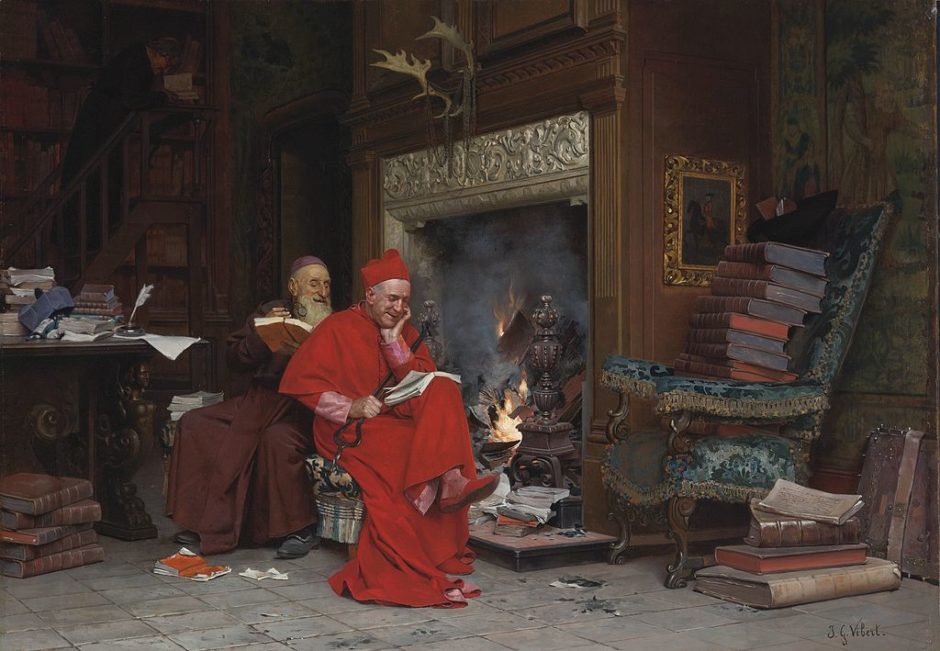
Deep in History

Posted in The Campus Telephone Pole | Tagged ,
7 Comments

Why we needed Summorum Pontificum: Reason #746589

A reader alerted me to this. I am not making this up.

From Inquirer.net of Luzon in the Philippines:

Nuns dance to get recruits in Baguio City
By Elmer Kristian Dauigoy
Inquirer Northern Luzon

BAGUIO CITY—Never too old for “Toyang.”

Catholic nuns on Saturday night danced to this Eraserheads hit inside Baguio Cathedral as part of a vocational drive to recruit new blood.

[…]

You can read the rest over there.

I know that some communities of women religious aren’t on average 72 years of age… but… still…

Is this how we do these things?

Read.  Think for a while (before posting).  Discuss (after thinking).

Posted in I'm just askin'..., Our Catholic Identity, The future and our choices |
24 Comments

A “post hoc ergo propter hoc” observation

There were attacks on Christians in Egypt.

The Pope spoke out against attacks on Christians in Egypt.

The Egyptian government resented the Pope.

Where is the Egyptian government now?

I’m just askin’….

Posted in I'm just askin'... | Tagged
16 Comments

QUAERITUR: Can a pastor/liturgist force servers to receive Communion under both kinds?

Vote for Fr. Z!From a reader with my emphases:

Our parish liturgist has sent out the following to all Altar Servers and Acolytes who assist at the Novus Ordo mass.

Servers at Saint Mary receive both Species if they receive at all.  If you receive the body, you receive the blood.  Some servers are refraining from receiving the blood.  Servers receive both so as to show by our actions that both are Christ.  If anyone would like to have a longer conversation with me on this issue, I am happy to do so, but so long as it is morally permissible to receive both, we will.”

From my reading and formation I find his statements contrary to Church teaching, tradition, and practice. What do you think?

Let me get this straight.  Servers are being told that if they wish to receive Holy Communion when they serve they must receive under both kinds?

Also, what is this about “morally” permissible?  It is permissible under the Church’s law for Holy Communion to be offered under both kinds under certain conditions.  It is permissible for people to receive under both kinds, if they so desire, when it is offered.   What the writer (and I assume the pastor) are trying to do here is put head pressure on servers to receive in order to put head pressure on the congregation to receive under both kinds.

No.  You cannot force any communicant, server or not, to receive under both kinds.  The only person there obliged to receive under both kinds is the priest celebrant.  Every one else, server and congregant alike, is free to receive or not to receive Communion even under one kind when both are offered.

I think this sort of head-pressure is irresponsible and oppressive.  It violates the individual’s freedom and constitutes an intrusion into their personal, spiritual life.   If the server is a minor, it may also violate the rights of the parents of the servers as to how the child should receive Communion.

I think the Congregation for Divine Worship and Discipline of the Sacraments would be interested to read a bulletin with that printed in it.  Perhaps a copy should be sent to the local bishop and to the congregation.

I can see that a priest and/or liturgist might be so convinced that everyone should receive under both kinds that he might want to persuade people.   But to force or oblige them?  The implicit message to the servers here is, “Receive under both kinds or you can’t be a server.”

I wonder if there is such attention paid in that place to people receiving Communion regularly in the state of mortal sin.

Posted in "How To..." - Practical Notes, ASK FATHER Question Box, Liturgy Science Theatre 3000 | Tagged
36 Comments

QUAERITUR: How to confess well? I worry I am not doing a good enough job of it.

From a reader:

Hi. I am convert. [… S]ince being brought up in a protestant
tradition and only becoming catholic as an adult, I was never exposed to the traditions, the formality. In our confirmation classes we was taught the believe system and not the liturgy. So when going to confession I never know how to start, what sins to confess.

But that is not the biggest problem: How do you remember all your sins? How do you remember how many times you have done a particular sin? The one thing I am convinced of is that is, even while I am writing this, I am sinning…the nature of our existence. The problem also becomes exponential, since the knowledge becomes so overpowering that I feel as if I am doing a “half-a-job” confessing and that I have not achieved grace after going to confession that I stop going to confession for months at a time…and then I feel that I should not receive the Eucharist.

I am so glad you see the need for a good confession.  A good regular confession.  A good regular thorough confession.

Go to confession anyway, even if you are not sure you are doing a perfect job of it.  Just go anyway.  Please.

From the onset be assured that, if you do your best, even if you can’t remember everything, your sins are forgiven.  Even those you forgot are forgiven.  If you make your confession but through no fault of your own forgot somethings – either because in that moment maybe you were nervous or you simply forgot – and you walk out of church and a construction crane falls on you, you go before your Maker in pretty good shape, as far as mortal sins go.  Temporal punishment might be another matter… but the really big deal is getting those mortal sins forgiven.

First, learn a standard way to make your confession and use it ever time.  This helps keep the nervousness down and the priest always knows where you are at.   The standard way every kid in the USA learned is probably the best.   When you start (for example when the little window opens and the priest may say intro thing) you say “Bless me Father, for I have sinned.  It has been [X days, weeks, months, years] since my last Confession.  These are my sins.  Confess your mortal sins in number and kind.  When you are done, say “For these and all the sins of my past life I am truly sorry and ask a penance and absolution.”  That let’s the priest know you are done.  Sometimes people just fall silent, which could leave the priest wondering if you are trying to summon the courage to confess the big one.  The priest will maybe give you some counsel, he may ask a question or two.  He will assign a penance and, usually, say something like “Act of Contrition”, meaning that you should say the Act of Contrition.  He will give you absolution.  Sometimes the priest will start with the form of absolution before you are finished with your Act of Contrition.  Then he will probably say something like “Your sins are forgiven.  Go in peace.”  It is nice to say “Thank you” before you get out.

I suggest this Act of Contrition, for it has all the elements the priest needs to hear and you need to say:

O my God, I am heartily sorry for having offended you and I detest all my sins, because I dread the loss of heaven and the pains of hell; but most of all because they offend you, my God, who are all good and deserving of all my love. I firmly resolve with the help of your grace, to confess my sins, to do penance, and to amend my life. Amen.

You can do this with “you” or “thee”, whatever.   I say “thee” because that’s the way i learned it.  There are various forms of Acts of Contrition, Acts of Sorrow.  I think this one is as good as they get.

About remembering your sins.

Every night before you go to sleep, examine your conscience.  Make this a regular part of your routine before going to sleep.

I suggest to people just getting going, to start making examination of conscience when you start brushing your teeth.  Why?   Because, unless you are really strange, you always brush your teeth before going to bed, and if you don’t you should.  By tying the examination of conscience to some other thing you never omit, you can develop the habit of examining your conscience regularly.

Review your day.  Look for things you did that were wrong and, don’t forget, things you failed to do that you should have.  Use the commandments… use the virtues… whatever.  Just do it.  Every evening.  Just do it.

There are good little booklets with examinations of conscience and preparation for confession that you can find in any good Catholic book shop.  The point is: pick one and start.  You may find a better one later, but get at it right away.  We make baby steps in all these things at first, and that’s okay.  God sees your heart and knows you are trying.  With a little time, you’ll be more confident and aware of what you are doing.

Brick by brick.

By doing this every evening, you will more easily remember what you have done so that your examination of conscience before confession will be much easier and your confession more precise.

Why is such precision and care important?  Why should you instantly dismiss any suggestion that this is just making a “laundry list” and that numbers of sins aren’t important?

When you examine your conscience you are also looking for your ingrained habits, vices, the things which are real dangers to your soul.  You quickly identify with stark clarity the fissures and fault lines in your life.  When sometime gets into the confessional and says “It has been one week sicne my last confession. I lied, I cheated, I kick my dog…”, there is no way of telling if the person lied one time, and therefore this was an aberration, or if she lied 52 times in that week.  Lying 52 times in week is a real problem.  If she is confessing this sort of thing with this sort of frequency often, then she would be a liar, an inveterate liar.  This gives her and the priest the chance to start fixing the problem through grace, common sense and elbow grease.  We have to identify our principal faults so that we can make progress in holiness.  This is ongoing.  We need an objective eye and some inescapable honesty.  We attain this through a daily examination of conscience.

It doesn’t have to be long.  But it has to be honest.

If you do this regularly, you will not have such a hard time remember sins also in number when you go to confession.

Also, if you start remembering things you forgot about, and you haven’t confessed, or aren’t sure you confessed, just mention them when you go to confession the next time.

The confessional is not a torture chamber.   You don’t have to put yourself on the rack.

Pray for some help from your guardian angel to be honest with yourself and to keep the enemy at bay, and examine your conscience.

Then just go.

Finally, about receiving the Eucharist in Holy Communion.

If you know that you are in the state of mortal sin, do not go to Communion.  If you are not sure if you are in the state of grace, you could probably go, or you could sit that one out.  If you are not sure, make a very good act of contrition, and go.  If you don’t choose to go, make a spiritual communion (there are good prayers for that).  If you are pretty sure that you are in the state of grace, happy you, then go to Communion with happy and confident fear and trembling.  We can’t be presumptuous about the state of our soul, but we can nevertheless be pretty sure after examining our consciences and using the sacrament of penance wisely.

The worst thing a person can do is never ask a question about the state of his soul.  For that sort of person, I worry.
Posted in "How To..." - Practical Notes, ASK FATHER Question Box | Tagged , , ,
27 Comments

A Papal Nuncius with sharp words about bishops who resist Summorum Pontificum.

Yesterday we saw with the help of Rorate and Messa in Latino that an Italian bishop had some things to say about other bishops who resist Pope Benedict’s visions and provisions.

Today, our friends at NLM clue us in about the remarks of a Papal Nuncius concerning bishops and others who resist Summorum Pontificum.

My emphases and comments:

In his homily for last Sunday, January 30, 2011, the Apostolic Nuncio to the Antilles Islands, H.E. Most Rev. Thomas E. Gullickson [WDTPRS has written about the Archbishop before HERE.  He is an American, a priest of Sioux Falls.], Titular Archbishop of Bomarzo, had some pointed remarks about bishops resisting the implementation of the motu proprio Summorum Pontificum:

Why, even three years after the issuance of Summorum Pontificum (just to name one example), are well-meaning lay folk still treated with such great disdain by no less than bishops, bishops in communion (of heart, soul, mind and strength?) with the Successor of St. Peter when they ask for Mass in Latin? Is this anything other than blind hypocrisy (the plank!)? [This is great… this should qualify him for instant promotion….] You tolerate no small amount of bad taste, bad music and caprice, while begrudging some few a port in the storm of liturgical abuse which seems not to want to subside? [And that “few” is slowly growing larger.] Can we be after His own Heart and not just claim to be members of Christ’s Body while still acting so at odds with the example set by the Holy One of God, meek and humble of heart? Such prelates are at counter or cross purposes to the sense in which the Church wants to go; they are ignoring what the Spirit is saying to the Churches and doing so with a backhand to some who are branded common and contemptible, but certainly not in the eyes of Christ… Let me say it more clearly! My issue is with the contempt shown for an outstretched hand, contempt such as would not be shown toward someone asking for some other benefit.

When the Holy Father speaks of his will to see these two forms of the Roman Rite (ordinary and extraordinary) enrich each other, when he and others express eagerness for a recovery of the sense of the sacred in our churches and in how we worship, I am convinced that he has indicated the true nature of the rupture which has indeed occurred and needs to be mended or healed. You would think that those in communion with the Pope would seek to understand him and embrace his point of view. There is too much room for caprice and hence the need to reform contemporary Catholic worship. This is evidenced time and again, by way of one example, in the sense of helplessness many priests experience when confronted by musical groups moving into church with inappropriate repertoires, not to mention the dance and puppet troupes which should have been banished long ago. If a bishop does not want to discipline at least he can respect and foster those seeking good order. [This underscores how Summorum Pontificum was a huge gift to priests.  It was the first document in a long time that actually did something concrete to help priests.]
Archbishop Gullickson has spoken out repeatedly about both the usus antiquior and the reform of the reform; have a look at his thoughts here.

He also implements these thoughts practically: In 2009, he began to exclusively celebrate Holy Mass ad orientem in the chapel of the Apostolic Nunciature in Port of Spain, Trinidad & Tobago. See his detailed explanation here.

WDTPRS KUDOS to Archbp. Gullickson.

Posted in Fr. Z KUDOS, Our Catholic Identity, SUMMORUM PONTIFICUM, The future and our choices | Tagged ,
23 Comments

CNS: CHA Pres. Sr. Keehan affirms bishop’s role in interpreting health directives

I saw this on CNS.  My emphases and comments.

First, you might review this: the Magisterium of Nuns (and this).

CHA president affirms bishop’s role in interpreting health directives [Uh huh.]

By Nancy Frazier O’Brien
Catholic News Service

WASHINGTON (CNS) — In an exchange of letters with the president of the U.S. Conference of Catholic Bishops, the head of the Catholic Health Association has affirmed that the local bishop is the “authoritative interpreter” of the ethical and religious directives that guide Catholic health care.

Sister Carol Keehan, a Daughter of Charity who is CHA president and CEO, said her organization “has a sincere desire to work with the church and individual bishops to understand as clearly as possible clinical issues and bring the majesty of the church’s teaching to that.”

In response to the letter, Archbishop Timothy M. Dolan of New York, USCCB president, said the church must “speak with one voice” against the “increasing political and social pressures that are trying to force the church to compromise her principles,” including “the problem of illegitimate government intrusion in our health care ministries.”

[…]

CHA and the USCCB took opposing stands on whether the health reform bill passed last March would adequately protect against the possibility of federal funding of abortion and guard the conscience rights of health care providers and institutions.

Sister Carol also sided with Catholic Healthcare West, the health system that sponsors St. Joseph’s Hospital and Medical Center in Phoenix, in the hospital’s dispute with Bishop Thomas J. Olmsted of Phoenix over whether an abortion that occurred at the hospital in late 2009 violated the “Ethical and Religious Directives for Catholic Health Care Services,” often referred to as the ERDs.

[…]

Archbishop Dolan said in his Jan. 26 letter to Sister Carol that “any medical case, and especially one with unique complications, certainly requires appropriate consultation with medical professionals and ethical experts with specialization in the teaching of the church.””Still, as you have reasserted, it is the diocesan bishop’s authentic interpretation of the ERDs that must then govern their implementation,” he said. “Where conflicts arise, it is again the bishop who provides the authoritative resolution based on his teaching office. Once such a resolution of a doubt has been given, it is no longer a question of competing moral theories or the offering of various ethical interpretations or opinions of the medical data that can still be legitimately espoused and followed. The matter has now reached the level of an authoritative resolution.”

Sister Carol said in her letter, dated Jan. 18, that CHA has always told sponsors, board members and clinicians that “a bishop has a right to interpret the ERDs and also to develop his own ethical and religious directives if he chooses.”

“We are absolutely convinced that the teaching of the church, in combination with a clear understanding of the clinical situation, serves the people of God very well,” she added. [Which is why she and the CHA defied the bishops when she gave cover to pro-abortion Catholic politicians to vote for Obamacare and why she supported Catholic Health West against Bp. Olmsted.]

Archbishop Dolan welcomed the CHA support, expressed in a Jan. 24 letter from Sister Carol to Rep. Joe Pitts, R-Pa., for the congressman’s Protect Life Act, which would amend the health reform law to ensure there is no funding for abortion or abortion coverage.

Noting that “our staffs have recently met and are working together on this and other policy matters,” Archbishop Dolan said, “We look forward to CHA’s collaboration with the bishops and the USCCB staff as we advocate for the bill’s passage and implementation.”

But the archbishop said the USCCB also has “significant and immediate concerns” about threats to conscience rights in the health reform law passed last year.

We bishops have some specific ideas on how to address this problem, and we would welcome your suggested solutions as well,” he said. “For the sake of the common good and to assure the moral and doctrinal integrity of the exercise of the apostolate, we should work together to confront this and similar threats to conscience.”

In an interview with the National Catholic Reporter newspaper published online Jan. 31, Archbishop Dolan said Sister Carol “feels very strongly that the decision (to revoke the Catholic status of St. Joseph’s Hospital) was terrible, but she knows that the bishop of the diocese is the authentic interpreter and implementer” of the directives. [But is this a case of her saying one thing and doing another?  They came out against the bishops more than once on issues the bishops have a right to teach about.]

“She wholeheartedly believes that, and CHA believes that,” he said.  [Okayyy….]

The archbishop also said that “defending the integrity” of health care might mean that other Catholic facilities will have to cut their ties with the church. [Which is why WDTPRS dubbed Bp. Olmsted “The ghost of Christmas yet to come” during his conflict with the hospital in Phoenix.]

“The worry is that our Catholic hospitals are now where our universities were back in the 1980s, slowly drifting out of the Catholic orbit,” he said.  [Not so slowly.]

The young Papist has a suggestion to Sr. Keehan:

Return to Pres. Obama the pen he sued to sign the Obamacare legislation.

“Sr. Keehan! Give back that pen!

Posted in Emanations from Penumbras, The future and our choices | Tagged , , ,
20 Comments

A priest who ‘get’s it’ about how people receive Communion!

Vote for Fr. Z!WDTPRS KUDOS to Fr. Lankeit!

Here is the text from his 30 January bulletin of the Cathedral of Sts. Simon and Jude in , Very Rev. Fr. Fr. John Lankeit.

Here is a link to the PDF if you want to see his emphases!

Here is the text, ne pereat.

While you read this, do an examination of conscience.  Do you do any of the things he describes?

A Letter from Our Cathedral Rector

Dear Parishioners,

I want to thank all of you who have recently started receiving Holy Communion on the tongue, not to mention those of you who already had been.  [Do I hear an “Amen!”?] This subject has generated a lot of buzz over the past few weeks, the vast majority of which has been overwhelmingly positive.

While my main objective in encouraging reception on the tongue is to deepen appreciation for the Eucharist,  I also have a pastoral responsibility to eliminate abuses common to receiving in the hand.  Such abuses are no doubt unintentional.

Nevertheless, what I witness troubles me.  And I’m not alone.

In 2004, responding to the problem of Eucharistic profanation, the Vatican’s Congregation for Divine Worship and the Discipline of the Sacrament released an official instruction entitled REDEMPTIONIS SACRAMENTUM: On certain matters to be observed or to be avoided regarding the Most Holy Eucharist.

Regarding Holy Communion, the document states:

“[S]pecial care should be taken to ensure that the host is consumed by the communicant in the presence of the minister, so that no one goes away carrying the Eucharistic species in his hand. If there is a risk of profanation, then Holy Communion should not be given in the hand to the faithful.” (Paragraph #92).

Here are just a few examples of profanation that I see all too frequently:

•  Blessing oneself with the host before consuming it. (The act of blessing with the Eucharist is called “Benediction” and is reserved to clergy).
•  Receiving the host in the palm of the hand, contorting that same hand until the host is controlled by the fingers, then consuming it (resembling a one-handed “watch-the-coin-disappear” magic trick)
•  Popping the host into the mouth like a piece of popcorn.
•  Attempting to receive with only one hand.
•  Attempting to receive with other items in the hands, like a dirty Kleenex or a Rosary.
•  Receiving the host with dirty hands.
•  Receiving the host, closing the hand around it, then letting the hand fall to the side (as if carrying a suitcase) while walking away and/or blessing oneself with the other hand.
•  Walking away without consuming the host.
•  Giving the host to someone else after receiving…yes, it happens!

We would never treat a  piece of GOLD with such casualness — especially in this  economy!!  Yet many treat this Eucharistic “piece” of GOD with casualness at best, indifference and irreverence at worst.

Of course, much abuse is due to ignorance, owing to poor catechesis, which is precisely why I have written about this issue for four consecutive weeks. [OORAH!]

Yet we have another great incentive…

When Holy Communion is received on the tongue…every single one of these abuses is instantly eliminated!  [ERGO….]

The way we treat another person says more  about our relationship with  that person than any words we might say.  This is especially true of our relationship with the Divine Person, Jesus Christ.  So let us continually seek to increase our reverence for our Eucharistic Savior, and to eliminate anything that degrades the respect He deserves.  The graces we receive will surely be greater than anything we can imagine!

God’s Blessings… my prayers…

Very Rev. Fr. John Lankeit
Rector
Ss. Simon & Jude Cathedral

If you do any of those those things…. KNOCK IT OFF.

You priests and bishops out there… please help people receive more reverently.

Kneeling and directly on the tongue is a great start.

Say a prayer, now please, for Fr. Lankeit.

By the way… this is the Cathedral of the Diocese of PHOENIX, AZ.

Remember who the bishop is there?

Posted in "How To..." - Practical Notes, ASK FATHER Question Box, Fr. Z KUDOS, Just Too Cool | Tagged ,
33 Comments

QUAERITUR: What should members of a chant group wear?

From a reader:

I am a member of a men’s Gregorian chant group, and recently a local priest whose parish we were singing at voiced reservations about our uniform (black cassock and white surplice).  He preferred we not look like a performance group up front (there’s no choir loft), so we wore shirts and ties.  It did get me thinking, however,about proper clothing for a schola.

I have heard that it is not really proper for females to wear cassocks because it is clerical garb, and females can never become clerics, so we shouldn’t muddle the issue.  However, is clerical garb appropriate for a lay schola cantorum?

So… a priest thinks that a schola cantorum wearing cassocks and surplices looks like a performance group?

How can I put this delicately…

He’s wrong.

If a schola cantorum is in the loft, they can wear anything it pleaseth them to wear.  If they are visible in the sanctuary because they are singing something like Vespers, they should be in choir dress proper to males.

If there isn’t a choir loft… well… they have to be somewhere.  Where ever it is, they should not be in full view.  Let them be in back somewhere.

The cassock and surplice is, in my opinion never proper for females of any age.  Dreadful thought.   If there is a schola of women – and I am all in favor! – let them sing from the loft.  The issue of choir dress should never come up because they shouldn’t be in the sanctuary.

If there isn’t a choir loft… well… they have to be somewhere.  Where ever it is, they should not be in full view.  Let them be in back somewhere.

But… cassock and surplice on males in a schola cantorum makes them look like a performance group?

I don’t buy it.

Posted in "How To..." - Practical Notes, ASK FATHER Question Box | Tagged ,
27 Comments

QUAERITUR: Lay people decide on their own to have a Communion service, help themselves.

From a reader:

At Mass yesterday morning, the substitute priest forgot to show up.
Several members of the congregation took it upon themselves to have a “Communion Service” with all the readings, etc. One of the EMHCs
opened the Tabernacle and got the Consecrated Hosts out and proceeded to distribute them, along with another EMHC.

QUESTION: Are EMHCs allowed to open the Tabernacle and distribute
Consecrated Hosts when no priest or deacon is present?

I think your diocesan bishop would like the chance to answer that question.

Ask him.

Sounds sort of like a Little Rascals movie, doesn’t it?

Hey! Let’s have a communion service! Mom can sew the costumes and we can use Mr. Feltcher’s barn!

I have a sneaking suspicion that a few women were involved in this caper.

Ah… the hijinx just gets better and better these days.

But wait!

While the show… errrr…. service is going on the priest and the deacon finally show up… better late than never.

[wp_youtube]8iNUfXltGnc[/wp_youtube]

Posted in ASK FATHER Question Box, Liturgy Science Theatre 3000 | Tagged
32 Comments
























