Theme for 2011 World Day of Social Communications

From VIS:

THEME FOR WORLD DAY OF SOCIAL COMMUNICATIONS

VATICAN CITY, 29 SEP 2010 (VIS) – Made public today was the theme chosen by the Pope for the forty-fifth World Day of Social Communications: “Truth, proclamation and authenticity of life in the digital age”. His Message for the Day will be published on 24 January 2011, feast of St. Francis of Sales, patron of journalists.

An English-language note released by the Pontifical Council for Social Communications explains that the theme is “to be understood as focusing on the human person who is at the heart of all communicative processes. Even in an age that is largely dominated, and at times conditioned, by new technologies, the value of personal witness remains essential.

To approach the truth and to take on the task of sharing it“, the note adds, “requires the ‘guarantee’ of an authenticity of life from those who work in the media, and especially from Catholic journalists; an authenticity of life that is no less required in a digital age.

“Technology, on its own, cannot establish or enhance a communicator’s credibility, nor can it serve as a source of the values which guide communication. The truth must remain the firm and unchanging point of reference of new media and the digital world, opening up new horizons of information and knowledge. Ideally, it is the pursuit of truth which constitutes the fundamental objective of all those who work in the media”.

Posted in SESSIUNCULA | Tagged
2 Comments

Tutorial videos of the new chants for Mass in the Corrected Translation

My friend Mr. Jeffrey Tucker has posted on his blog, Chant Cafe, videos with audio of new chants for the Novus Ordo in English according to the upcoming corrected translation.  These are intended as tutorials.

Some people are claiming that the corrected English is not “singable”.  Go over and check them out.  Decide for yourselves.

A REMINDER TO LIBERALS: If you don’t like the new translation, you can always ignore it and use Latin.

Posted in "How To..." - Practical Notes | Tagged ,
22 Comments

Bp. Aquila (D. Fargo) leads procession to abortion clinic

From CNA:

Bp. Samuel AquilaNorth Dakota bishop leads procession at abortion clinic amid protests

Fargo, N.D., Sep 29, 2010 / 12:51 am (CNA).- In time for the upcoming Respect Life Month of October, Bishop Samuel Aquila of Fargo, North Dakota presided over an annual Mass and led a procession over 700 people to a local abortion clinic last Saturday, encountering oppositional protestors for the first time.

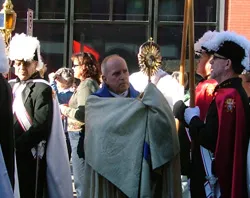
The Diocese of Fargo estimated that on Saturday, 700 to 800 people from St. Mary’s Cathedral processed to the local Red River Women’s Clinic, North Dakota’s only abortion facility in downtown Fargo. Director of Communications for the diocese Tanya R. Watterud told CNA that Bishop Aquila led the procession several blocks, carrying a monstrance with Blessed Sacrament and also sprinkling the clinic with holy water amidst pro-abortion demonstrators.

During his homily at the Mass preceding the procession, Bishop Aquila stated that the purpose of the event was “to give witness to the gift of life and particularly the dignity of human life from the moment of conception to natural death.”

“Even reason and science would point to the truth that life begins at the moment of conception,” he noted. “For those who are unbelievers, they can come to know the truth of the dignity of human life through both reason and science.”

“We must also, when speaking of abortion, speak the truth about it,” and refrain from using terms such as “interruption of pregnancy” or “only a mass of cells.”

“Every time a child is aborted it is murder and it is important for us to call it by its proper name.” Individuals, he added, should not use the “politically correct language” of the media but “speak the truth and to speak it clearly.”

He then encouraged those present to pray for the gift of fortitude “to be those people who constantly remind our society and remind others that life is a gift…that every human being created is created in the image and likeness of God from the moment of conception…that every human being has the right to life.”

The bishop also explained that the holy water that would be used to sprinkle the facility showed “prayers for purification…in terms of reparation for what happens there because, ultimately, it is the murder of unborn that takes place there.”

Watterud told CNA that later at the procession following the sprinkling, Bishop Aquila again took the monstrance into his hands and continued back to the Cathedral, while parishioners in attendance prayed the Rosary while walking.

Posted in Emanations from Penumbras | Tagged
25 Comments

VORTEX REPORT: VENUS VORTEX?

You have read about…

The Vortex.

I have wondered where things go, if they are pulled into the Vortex and can’t get out.

I wonder.

Look at this portentous photo from Astronomy Pic of the Day.

This is a vortex on the planet Venus. At the southern pole

Vortex on Venus

Portentous.

I understand that the Venus Express spacecraft, which shot the photos, is powered on …

[CUE MUSIC]

… Mystic Monk Coffee!

Mystic Monk CoffeeWhen you’ve had a tough day of flying through space and shooting photos of planets with truly horrible atmospheres, refresh your spirits with some piping hot Mystic Monk Coffee!

Your own refreshing cup of coffee may not be as hot as the 758 K venusian surface temperature, but it’ll warm cockles of your heart all the same.

Mystic Monk!  Refresh that supply right now!

It’s swell!

DATA REPORTS TO COME!

Posted in Global Killer Asteroid Questions, Just Too Cool |
Comments Off on VORTEX REPORT: VENUS VORTEX?

Card. DiNardo on upcoming Respect Life Month

Card. DiNardoFrom CNA:

USCCB pro-life chairman issues statement on upcoming Respect Life month

Washington D.C., Sep 28, 2010 / 03:03 pm (CNA/EWTN News).- In light of the upcoming Respect Life Month of October, Cardinal Daniel DiNardo of Galveston-Houston issued a statement on what he perceives to be the greatest threats to human dignity in society, calling on Catholics to work towards transforming culture “into one that welcomes every human person.”

Cardinal DiNardo, who serves as chairman for the U.S. Conference of Catholic Bishops (USCCB) Committee on Pro-Life Activities, opened his remarks on Sept. 28 by stating that with “each passing year, the need for personal and public witness grounded in God’s boundless love for each and every human being grows more urgent.

“With over one million innocent children dying from abortion each year, the plague of abortion remains embedded in our culture. It is encouraging to see the continuing decline nationwide in the number and rate of abortions – due in large part to fewer teens becoming sexually active, and to growing recognition of the humanity of the unborn child.”

“Yet the loss of even one child,” he noted, “and the pain experienced by the child’s mother and father in the aftermath of abortion, should impel us to redouble our efforts to end legal abortion, and to ensure that every pregnant woman has whatever help she needs to turn away from this heartbreaking choice.”

“In many areas of public policy, the rift continues to widen between the moral principles expressed by a majority of Americans and the actions of government,” the cardinal continued.

For example, although “Americans oppose public funding of abortion by wide margins,” he said,  in “March of this year, Congress passed a health care reform law that allows for federal funding of abortion in some programs and could pressure millions of Americans to help subsidize other people’s abortions through their health care premiums.”

[…]

Read the rest there.  Discuss.

Posted in Emanations from Penumbras |
4 Comments

BLOG RENEWAL / POLL: Speed… again

I have been receiving mixed feedback about the speed with which the blog now loads for people.

Let’s try this again, with a poll.

Please pick the best answer and then give your observations about the speed of the blog loading below.  Restrict yourself to the speed issue, please.

Since the blog update, the blog is loading ...

  • ... faster. (50%, 567 Votes)
  • ... about the same speed. (41%, 461 Votes)
  • ... slower. (9%, 103 Votes)

Total Voters: 1,131

Posted in SESSIUNCULA |
20 Comments

QUAERITUR: The “sign of peace” is optional?!? Can I opt out?

From a reader:

Wait, the sign of peace is an option, not a requirement?!?! How did I not know this? Am I bound by obedience to participate if the priest uses this option? Can I decline the invitation?

The so-called “sign of peace” during the Novus Ordo is an option, not a requirement.  Initiating the sign of peace is an option left to the discretion of the priest celebrant.  He is not obliged to use this option.

The rubrics in Latin GIRM no. 154 indicate that the invitation to the “sign of peace” is something made pro opportunitate.  This is repeated in the rubrics in the Ordo at 128.  The phrase pro opportunitate means “insofar as it is fitting, opportune, advantageous”, or otherwise, “as circumstances indicate”.  The priest can determine that the circumstances to not call for a “sign of peace” on the part of the people, that it is not, in fact, advantageous.  He can make this determination because, for example, the sign of peace is not carried out with the proper decorum and that it therefore is inappropriate.

Can you decline?  I guess so.

The Latin for this invitation is “Offerte vobis pacem… Offer ‘the pax‘ to each other.”  The pax here being the Roman kiss of peace or its legitimate substitution.  That offerte is an imperative.  Latin imperatives are not always strict commands.  We use imperatives in addressing our liturgical prayers to God all the time.  We are not actually bossing God around when we use imperatives.  They can be a strong petition or invitation.  In any event, offerte isn’t just a suggestion.  You are being strongly urged.

So, yes, you can refuse to participate.  I don’t, however, think that it is quite right simply to ignore that “Offerte“.  That doesn’t mean you have to go bananas or contort yourself to greet everyone within possible reach.  It certainly doesn’t mean leaving your place.  And it should never mean doing something that is undignified, like the idiot wave at someone on the other side of the building, or overly invasive like hugs and kisses which usually involves the risk of either disease or disgust.

I think the very best option for the sign of peace is for the priest to leave people in peace.

Posted in ASK FATHER Question Box | Tagged
64 Comments

QUAERITUR: Everyone must stand until distribution of Communion is over

From a reader:

Our last pastor decided we should all stand up before the Great Amen (going so far as to pause the Mass until all were standing -and some peoples refusal to stand became a horrible distraction and battle of wills between us and him …so we all eventually stood). People remained standing until everyone had received Communion. When he retired the new pastor (thankfully) instructed everyone to remain kneeling until after the Great Amen. But has retained the practice of standing until everyone returns from Communion. Everyone sits down when he sits down, even though the Blessed Sacrament has not yet been returned to the tabernacle. What is the purpose of standing after Communion? If there is some wonderful significance to it, it is lost on the congregation

It seems to me that kneeling is appropriate, not only to receive Holy Communion, but also to pray after having returned to one’s place in the pews.

In any event, we can look to the GIRM for some instruction on this question:

43. The faithful should stand from the beginning of the Entrance chant, or while the priest approaches the altar, until the end of the Collect; for the Alleluia chant before the Gospel; while the Gospel itself is proclaimed; during the Profession of Faith and the Prayer of the Faithful; from the invitation, Orate, fratres (Pray, brethren), before the prayer over the offerings until the end of Mass, except at the places indicated below.

They should, however, sit while the readings before the Gospel and the responsorial Psalm are proclaimed and for the homily and while the Preparation of the Gifts at the Offertory is taking place; and, as circumstances allow, they may sit or kneel while the period of sacred silence after Communion is observed.

In the dioceses of the United States of America, they should kneel beginning after the singing or recitation of the Sanctus until after the Amen of the Eucharistic Prayer, except when prevented on occasion by reasons of health, lack of space, the large number of people present, or some other good reason. Those who do not kneel ought to make a profound bow when the priest genuflects after the consecration. The faithful kneel after the Agnus Dei unless the Diocesan Bishop determines otherwise.

Is it possible that, since the GIRM says “unless the Diocesan Bishop determines otherwise”,  the local bishop has thought to interpret the time after the Agnus Dei to include the time after reception of Holy Communion and that therefore he is imposing his will on people to require them to stand through the completed distribution of Communion?

Nahhhh…. that can’t be right.  That would be just plain weird.

I cannot see the point in trying to force people to stand until every one has received Communion.   What’s that all about?  Can’t there be a little flexibility at this point… as there has always been?

Some people cannot receive and need to remain in place, perhaps to kneel and pray and make a spiritual communion, maybe or to reflect with sorrow on their black, soul-threatening unconfessed sins.

Perhaps you could drop a respectful note to the pastor and/or local bishop asking why people are being forced to stand until everyone has received Holy Communion.

ASK FATHER and the readers here would like to know what response you get.

Posted in ASK FATHER Question Box, Liturgy Science Theatre 3000 |
41 Comments

QUAERITUR: Using the orginal “main” altar rather than the “table”

Ironing-boardFrom a seminarian reader:

My present church is thinking on having a EF Mass as well as a Versus Deus [Deum] OF Mass. The Original High Altar is still in place with the Tabernacle.

There is however a smaller “fixed” “table” Altar in place a few feet in front of this. The “table” Altar is too small too accommodate a EF Mass. Is is still O.K. to celebrate a Mass in the OF & EF with the Old High Altar, while disregarding the “table” Altar.

It is always good idea to ignore iron-board altars whenever the main altar is still there and still usable.  The next step is to get rid of the interloper-altar and use the original main-altar exclusively, as was intended in the church’s design.

There was never a directive that table altars were to be set up in front of main altars or that main altars were to be abandoned or destroyed.

Furthermore, in an issue of the Congregation for Divine Worship’s official publication Notitiae in May 1993 there was some years ago an editorial article which stated:

The principle of the unicity of the altar is theologically more important than the practice of celebrating facing the people.

Clearly the main altar was intended to be the focus in the design of the church.  It is absurd to put up another altar, within the sanctuary, in front of the original altar.

But, yes, it is always appropriate to use the original, main altar of a church for either the Extraordinary or Ordinary Form.

As a matter of fact, celebration ad orientem is the way assumed in the rubrics of the Ordinary Form.  For example, in GIRM 154 we read that the priest turns to the people if he is going to use the option of inviting the people to make a sign of peace. thus: “… extendens et iungens manus, pacem annuntiat, versus ad populum, dicens… opening and then joining his hands he announces ‘peace’, having turned toward the people, saying….

Finally, as a seminarian, you should run, not walk, to get yourself your very own copy of Joseph Ratzinger’s The Spirit of the Liturgy. In this useful book, the future Pope lays out the theological significance of ad orientem worship.  You will want to study this section carefully and commit it to memory.  I have a few PODCAzTs on Ratzinger’s view.

Posted in ASK FATHER Question Box | Tagged , ,
21 Comments

QUAERITUR: Gathering around the altar at school Mass

From a reader:

It was announced during our school Mass today, by the associate here at the parish where I teach, that henceforth, whatever class has “planned” the school Mass each week will be invited to gather around the altar for the Eucharistic Prayer and will remain until they have given the Sign of Peace to Father.

This is sloppy sentimentality.  This crude attempt at being “meaningful” demeans both the Mass and everyone involved.

I don’t believe there is an explicit prohibition in any document against this.  However, there are documents which describe who should be where.

For example, in GIRM 295 we read.

The sanctuary is the place where the altar stands, where the word of God is proclaimed, and where the priest, the deacon, and the other ministers exercise their offices. It should suitably be marked off from the body of the church either by its being somewhat elevated or by a particular structure and ornamentation.

Lay people are not to be in the sanctuary unless they have a ministerial role.  “Standing there” is not a role.

Furthermore, in the USA people are to kneel – not stand – from the Sanctus until after the Amen at the end of the Eucharistic Prayer.

Also, back in 1981 the Congregation for Divine Worships official publication Notitiae (No. 17 (1981) p. 61) responded to a question about this matter.

Query: At the presentation of gifts at a Mass with congregation, persons (lay or religious) bring to the altar the bread and wine which are to be consecrated. These gifts are received by the priest celebrant. All those participating in the Mass accompany this group procession in which the gifts are brought forward. They then stand around the altar until communion time. Is this procedure in conformity with the spirit of the law and of the Roman Missal?

Reply: Assuredly, the Eucharistic celebration is the act of the entire community, carried out by all the members of the liturgical assembly. Nevertheless, everyone must have and also must observe his or her own place and proper role: ‘In liturgical celebrations each one, minister or layperson, who has an office to perform, should do all of, but only, those parts which pertain to that office by the nature of the rite and the principles of liturgy’ (SC 28). During the liturgy of the Eucharist, only the presiding celebrant remains at the altar. The assembly of the faithful take their place in the Church outside the ‘presbyterium,’ which is reserved for the celebrant or concelebrants and altar ministers.

While this does not say explicitly that that people with no ministerial role mustn’t stand around the altar, it is pretty clear that that is the meaning of the response.

Furthermore, at no point is there an indication in the rite for the priest or anyone else to invite people to come into the sanctuary and stand (against the Church’s clear direction during the Eucharistic prayer) near the altar.

Moreover, the Ceremonial of Bishops 50 states,

“A minister who is not wearing a vestment, a cassock or surplice, or other lawfully approved garb may not enter the sanctuary during a celebration.”

The priest who has this in mind should be dissuaded from starting this, perhaps over a couple mugs of rich and aromatic Mystic Monk Coffee.  If he will not be dissuaded, then he should be compelled, either his superior if he is a religious and/or by the local diocesan bishop, whose task it is make sure that the Church’s liturgical directives are followed.   One could also explain the situation to the Congregation for Divine Worship and Discipline of the Sacraments and ask for advice.

Posted in ASK FATHER Question Box, Liturgy Science Theatre 3000 |
10 Comments
























