St. Jerome’s final resting place

I have posted this is years past, but I worked so hard on it when I originally wrote it that I want to get as much mileage out of it as I can.  Besides, there are new readers here all the time!

Some time ago, there was a discussion on one of our splendid Catholic blogs making mention of the burial place of St. Jerome perhaps in the Major Basilica of St. Mary Major in Rome. This is an interesting story and I dug into it a little. This is what I found.

We read in J.N.D. Kelly’s work Jerome: His Life, Writings, and Controversies (Duckworth, 1975, p. 333 – emphasis mine) :

Apocryphal lives extolling [Jerome’s] sanctity, even his miracles, were quick to appear, and in the eighth century he was to be acclaimed, along with Ambrose, Augustine, and Gregory the Great, as one of the four Doctors of the Church.[2] In the middle ages his works were eagerly copied, read, and pillaged; while towards the end of the thirteenth century the clergy of Santa Maria Maggiore, at Rome, were to persuade the public, perhaps themselves too, that his remains had been transported from Bethlehem to Italy, and could be venerated close to certain presumed fragments of the Saviour’s crib.[3]

Note 2: This was formally ratified by Pope Boniface VIII on 20 Sept. 1295: see Corpus iuris canonici II, 1059 (ed. E. Freidburg, Leipzig, 1879-81). The original number four (the list was later to be greatly expanded) was chosen so that the Doctors could match the Evangelists.

Note 3: The story of their alleged translation, in response to a visionary appearance of Jerome himself, is set out by J. Stilting in Acta Sanctorum XLVI, Sept. VIII, 636 (Antwerp, 1762); it is reprinted in PL 22, 237-40. Stilting also provides a discussion of its date, veracity, etc. on pp. 635-49.

In the Acta Sanctorum for 30 September, under the entry for St. Jerome, we find the following section with its articles:

LXV. Corpus Sancti ex Palestina Romam translatum, depositumque in basilica s. Mariae Majoris. The body of the saint was brought to Rome from Palestine, and put in the Basilica of St. Mary Major.
LXVI. Inquiritur tempus quo Sancti corpus Romam delatum. An investigation is made into the time when the body of the saint was brought back to Rome.
LXVII. Corpus Sancti depositum prope aediculam Praesepis, conditum deinde ibidem altare, sub quo positum, ubi mansit usque ad pontificatum Sixti V, quando dicitur clanculum ablatum & absconditum. The body of the saint was placed near to the small chamber of the Crib, established then right at the same altar, under which it was placed, where it remained until the pontificate of Sixtus V, when it is said to have been secretly taken away and hidden.
LXVIII. Corpus Sancti clanculum ablatum & absconditum dicitur, ne transferretur alio a Sixto V: deinde frequenter frustra quaesitum. The body of the saint is said to have been secretly taken away and hidden lest it were to be transferred to another place by Sixtus V: aftward it is frequently sought in vain.
LXIX. An reliquae, sub altari principe S. Mariae Majoris inventae, videantur illae ipsae, quae ut corpus S. Hieronymi ad illam basilicam fuerunt translatae. When the relics found under the main altar of St. Mary Major which had been transferred to that Basilica seem to be the very same as the body of St. Jerome.
LXX. Admodum verisimile & probabile inventas esse S. Hieronymi. Clearly the [relics] found are most like and probably of Saint Jerome.
LXXI. Respondetur ad objectionem ex reliquiis Nepesinis: reliquiae, quae verisimiliter sunt S. Hieronymi sub mensa principis altaris depositae. An objection is answered about the relics at Nepi: relics placed under the main altar which more than likely are those of St. Jerome.
LXXII. Reliquiae Sancti in pluribus civitatibus Italiae, Galliae, Germaniae, Belgii, & aliis provinciis. The relics of the saint in more cities in Italy, France, Germany, Belgium and other provinces.
LXXIII. Cultus S. Hieronymi: festivitates eius & Officia. The veneration of St. Jerome: his feasts and offices.

Here is the page where these articles begin. If you want to have a fuller experience of the joys (the chore) of reading the Acta Sanctorum for any length of time click here for a larger image.

Posted in Classic Posts, Saints: Stories & Symbols | Tagged ,
4 Comments

QUAERITUR: crossing stole and using maniple in Novus Ordo

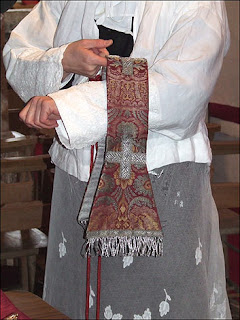
ManipleFrom a priest reader:

I try to bring into the Novus Ordo as many elements from the old rite as I can, where permitted.

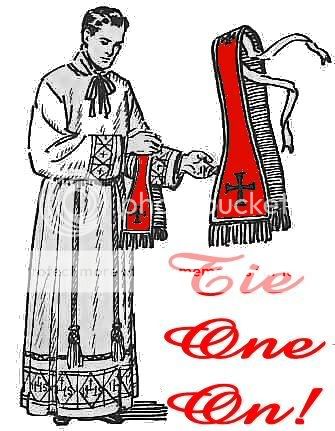
My question is:  is it licit for a priest celebrating Mass according to the new rite to cross his stole, as in the old rite?  Similarly, is it valid to wear a maniple while celebrate Mass according to the new rite?

It is the immemorial custom that priests cross their stoles, right over left, when using the chasuble and the cope at Mass.  Priests in the West have been crossing their stoles since the 7th century, though it became widespread later in the medieval period.  Bishops and abbots don’t do this.  The symbolism of forming a cross over your heart is obvious.

For the Novus Ordo the GIRM 340 states:

340. Stola defertur a sacerdote circa collum et ante pectus pendens; a diacono vero ab umero sinistro per transversum super pectus ducitur ad partem dexteram corporis, ibique retinetur.

This paragraph says that the priest’s stole hangs in front of the chest from around the neck while the deacon’s crosses the chest from the shoulder.  It doesn’t say anything about whether the priest’s stole hangs straight down on either side.  A crossed priest’s stole still hangs down in front.

You can cross the priest’s stole for the Novus Ordo.

As a matter of fact, I highly recommend that you do so, especially when wearing the pianeta, the Roman chasuble.  The crossed stole serves also to “fill in” part of the square opening in front.  That is a practical reason, an aesthetic reason, but a good reason nonetheless.

The rubrics of the Novus Ordo are silent about the maniple.  Again, it is the custom of well over over a thousand years that the maniple is used in the Roman Rite.  It is a Roman vestment that goes back to the 6th c.

It was never abolished.

Whereas it was once obligatory for Mass, it no longer is (cf. 1967 Tres abhinc annos, 25.).

One of the consultors of the Office of Pontifical Ceremonies, Fr. Mauro Gagliardi, said during an interview with ZENIT that:

“The maniple is an article of liturgical dress used in the celebration of the extraordinary form of the Holy Mass of the Roman Rite. It fell into disuse in the years of the post-conciliar reform, even though it was never abrogated.”

I think Gagliardi is right.  For the Novus Ordo, put it one, leave it off as it pleases you to do so.

My practice is that if there is a maniple available, with the set, I’ll put it on.  If there isn’t a maniple, I don’t worry about it one way or another.  Maniples aren’t magic (though some people think they are… perhaps because they have attached so much significance to them because of the liturgical iconoclasm after the Council).

I think that these are very good elements – crossing the stole, using the maniple –  to bring into the Novus Ordo.  They could represent something of the “gravitational pull” that the expanding use of the traditional form of the Roman Rite will have on our general liturgical worship.

This is not a matter of maniples for maniples’ sake.  These detail contribute something to the priest’s self-awareness in his role in the sacred action.  They point his attention to his identity.  Some might say that he shouldn’t need pointers of this kind.  I respond, “Don’t they?”  Wedding rings don’t change your married state but they are signs to yourself and others about who you are.  We all, not being angels, benefit from reminders.  These details also send signals to the congregation that what is happening is not mundane.  Something special is happening.  They are all part of the ars celebrandi.

Tie One On

Posted in "How To..." - Practical Notes, ASK FATHER Question Box, Mail from priests, Our Catholic Identity, SUMMORUM PONTIFICUM | Tagged , , ,
11 Comments

RATS IN THE RECTORY: The mugs

Over at the blog Southern Orders I see that Fr. McDonald and Fr. Justin received their new WDTPRS coffee mugs.  These are Say The Black (Translation Edition) mugs.

coffee mugs

Posted in Linking Back, Mail from priests | Tagged , , ,
Comments Off on RATS IN THE RECTORY: The mugs

Consistory…. when?

One of these days Pope Benedict will announce a consistory and the names of those whom he intends to make cardinals.

There remains speculation that a consistory might be called for the Solemnity of Christ the King in November.   If that is the case, time is getting short.

The present legislation foresees 120 voting cardinals.  That number fluctuates according to the workings of the biological solution and the will of the Roman Pontiff.

There are at present quite a few important curial positions and sees around the world which usually have cardinals… but don’t.

At the time of this writing, I believe there are 103 voting cardinals (men who have not turned 80 years old).  By the end of November two more cardinals will hit 80 (Tumi, Pujats), bringing the number of voting cardinals down to 101.  By the end of next February, four more (Panafieu, Vidal, García-Gasco, Ruini – sadly) – 97.  By the end of April two more (Keeler, Sebastiani) – 95.  So, an American and two Italians will have dropped from the list, leaving 10 Americans and 15 Italians as electors.

I am guessing that the USA would pick up 3, including Dolan (NY), Burke (Curia), and probably Wuerl (D.C. although there still as two living retired cardinals), and I doubt that Detroit and Baltimore will remain cardinalatial sees.  That would give the USA 13.  The Italians will probably pick up 8 including Romeo (Palermo), Bettori (Florence), Amato (Curia), De Paolis (Curia), Baldelli (Curia), Ravasi (Curia), Vegliò, (Curia), Monterisi (Curia).  Italy – 23, which strikes me a few too many.  Spain could get 3 (Toledo, Valencia, Sevilla).  Spain will have lost one.  Spain – 8.

Of course important sees such as Westminster, Rio, Toronto, Warsaw, Munich will get cardinals.  A few others.  Hong Kong?  Colombo?  There will surely be a sprinkling of hats for men over 80, probably old theologians.

So an announcement … Sunday at the Angelus?  Next Wednesday’s General Audience?  Postponed until after next Easter?  Guesses?

Posted in SESSIUNCULA |
49 Comments

BLOG RENEWAL: Full Text in RSS Feed

I have activated the Full Text option for the RSS feed.

Enjoy the full text along a nice WDTPRS mug of hot Mystic Monk Coffee!

WDTPRS MUG

Posted in Just Too Cool |
16 Comments

WDTPRS POLL: What direction do you prefer for the altar?

We have had a few entries lately about the position of the altar.  Let’s have a quick poll.

Please pick the best answer and share your reasons in the combox, below.

I believe non-registered reader may be able to vote.

If I had a choice, all things being equal, I would...

View Results

Posted in POLLS | Tagged , , , ,
34 Comments

QUAERITUR: Can phrase on USCCB website be used against “ad orientem” worship?

From a seminarian:

I … have recently had some discussions with others in the house about implementing ad orientem style of the Mass. I think that the rubrics are very clear in assuming that the Mass is said ad orientem, regardless of whether we like or not (however, I love it!). We see this in sections of the rubrics, “versus ad populum.” I believe you recently put an article up about this. [He probably means this.]

However, the response was GIRM 299, “The altar should be built apart from the wall, in such a way that it is possible to walk around it easily and that Mass can be celebrated at it facing the people, which is desirable wherever possible.” [That is the errant phrase!]

This is from the USCCB website. I know that the key phrase “which is desirable whenever possible” offers some ambiguity, but it clearly sets up a basis in official Church documents which can be stretched to oppose the ad orientem style. Could I get your thoughts on this? I would like to see the implementation of ad orientem worship back in the Mass, but I am not sure how to respond to the GIRM statements. Thanks for your thoughts and God bless. Know of my prayers for you and your readers.

Thank you for the prayers.

Can that phrase, found on the USCCB website (and elsewhere) be used to prevent ad orientem worship?

No.  Not if you are honest.

When we quote official Church documents, we must at a certain point refer to the Latin text.  This is absolutely the case with GIRM 299.

The USCCB website uses an incorrect translation.  This isn’t just WDTPRS’s opinion.  It is the clear statement of the Congregation for Divine Worship and Discipline of the Sacraments, which responded to a dubium on this very matter (Prot. No 2036/00/L).  The CDWDS actually went so far as to explain the Latin grammar.  I find it astonishing that, to this date, the USCCB has not corrected their texts.  What makes this worse is that the document Built of Living Stones – which quotes the errant translation of 299 was issued after the CDWDS response.  I fear the unhappy translator fell into the schoolboy trap of merely sticking to the Latin word order.  I can’t imagine that they did this … on purpose!

I have written about GIRM 299 several times.

Briefly, here is the skinny.

This is what GIRM 299 really says:

Altare maius exstruatur a pariete seiunctum, ut facile circumiri et in eo celebratio versus populum peragi possit, quod expedit ubicumque possibile sit.

The main altar should be built separated from the wall, which is useful wherever it is possible, so that it can be easily walked around and a celebration toward the people can be carried out.

The quod refers back to the first clause, the placement of the altar, and not to the ut clause.

Before the USCCB put out their document Built of Living Stones, with the incorrect translation you cited, the Congregation for Divine Worship responded to a question about this very paragraph and actually explained the Latin grammar.

Here is the meat of the CDWDS’s response about that which, I repeat, was made before the USCCB issued Built of Living Stones.

The Congregation for Divine Worship and the Discipline of the Sacraments has been asked whether the expression in n. 299 of the Institutio Generalis Missalis Romani constitutes a norm according to which the position of the priest versus absidem [facing the apse] is to be excluded. The Congregation for Divine Worship and the Discipline of the Sacraments, after mature reflection and in light of liturgical precedents, responds:

Negatively, and in accordance with the following explanation.

The explanation includes different elements which must be taken into account. First, the word expedit does not constitute a strict obligation but a suggestion that refers to the construction of the altar a pariete sejunctum (detached from the wall).  It does not require, for example, that existing altars be pulled away from the wall. The phrase ubi possibile sit (where it is possible) refers to, for example, the topography of the place, the availability of space, the artistic value of the existing altar, the sensibility of the people participating in the celebrations in a particular church, etc.

The paragraph is talking about the construction of a new altar.  New construction is to ensure that, wherever it is physically possible and it is a good thing to do, the altar is separated far enough from the wall that a person can walk around it, for example, to incense it or use if for Mass versus populum.  That does not mean a) that existing altars must be changed or, b) that free standing altar must be used versus populum.

I believe the response of the CDWDS was in Communicationes of the Pontifical Council for Legislative Texts.  You should be able to find it quickly in your seminary library.

One of the consequences of this, by the way, there is no obligation to set up a table in front of a main altar that is ad orientem.  As a matter of fact, it would be a bad idea to do so, because of the important of having but one altar in the sanctuary.

Posted in "How To..." - Practical Notes, ASK FATHER Question Box, The Drill |
17 Comments

2012 … Into the heart of darkness?

A few days back the best Catholic weekly in the UK, The Catholic Herald, posted a blurb that the Holy Father might visit Ireland in 2012.

Now I read on CNA:

Four Irish archbishops summoned to Rome to meet apostolic visitors

Rome, Italy, Sep 29, 2010 / 11:27 am (CNA/EWTN News).- Preparing for renewal in the Irish Catholic Church, the island’s four archbishops have been invited to meet with the apostolic visitors appointed to their archdioceses. The visitation is meant to aid the local Church as it works to better respond to cases of sexual abuse.

According to a press release from the Irish bishops’ media office, Cardinal Archbishop of Armagh Seán Brady, Archbishop of Dublin Diarmuid Martin, Archbishop of Cashel and Emly Dermot Clifford, and Archbishop of Tuam Michael Neary will make the trip over to Rome next week for discussions led by the Congregation for Bishops.

They will be meeting with the four apostolic visitors designated by the Pope to carry out the visitation he promised in the pastoral Letter to Irish Catholic released last March. A statement dated May 31 later outlined the scope of the visitation and provided the names of the visitors.

The visitors and the respective archdioceses subject to their examination are Cardinal Cormac Murphy-O’Connor to Armagh, Cardinal Sean Patrick O’Malley to Dublin; Archbishop Thomas Christopher Collins to Cashel and Emly and Archbishop Terrence Thomas Prendergast to Tuam.  [I am sure that the Holy Father knows what he is doing, but I can’t help but think that perhaps it would have been a good idea to chose visitors from Anglophone regions in, say, Africa… India… men who haven’t necessary been taken out to lunch at the best Roman restaurants or have been regulars at the cool kids’ table.]

No mention was made in the statement of the apostolic visitations planned for Irish seminaries and religious houses.

[…]

Read the rest there.  Discuss.

Posted in SESSIUNCULA | Tagged ,
10 Comments

The Feeder Feed

I haven’t posted much from the feeder, these days.Twitter

Right now the baby Goldfinches are buzzing around, making noises like squeaky-toys and incessantly following their parents.   They flap their wings, squeak, and beg.

More begging action.

A large flock of turkeys recently changed their roaming habits.  They regularly troop the line in front of the house now.

These Chicakdees are doing their High Noon thing.  The one on the right is particularly fearsome, don’t you think?

Here is a finch having a splash in the base of the feeder after a heavy rain.

Posted in The Feeder Feed |
11 Comments

Theme for 2011 World Day of Social Communications

From VIS:

THEME FOR WORLD DAY OF SOCIAL COMMUNICATIONS

VATICAN CITY, 29 SEP 2010 (VIS) – Made public today was the theme chosen by the Pope for the forty-fifth World Day of Social Communications: “Truth, proclamation and authenticity of life in the digital age”. His Message for the Day will be published on 24 January 2011, feast of St. Francis of Sales, patron of journalists.

An English-language note released by the Pontifical Council for Social Communications explains that the theme is “to be understood as focusing on the human person who is at the heart of all communicative processes. Even in an age that is largely dominated, and at times conditioned, by new technologies, the value of personal witness remains essential.

To approach the truth and to take on the task of sharing it“, the note adds, “requires the ‘guarantee’ of an authenticity of life from those who work in the media, and especially from Catholic journalists; an authenticity of life that is no less required in a digital age.

“Technology, on its own, cannot establish or enhance a communicator’s credibility, nor can it serve as a source of the values which guide communication. The truth must remain the firm and unchanging point of reference of new media and the digital world, opening up new horizons of information and knowledge. Ideally, it is the pursuit of truth which constitutes the fundamental objective of all those who work in the media”.

Posted in SESSIUNCULA | Tagged
2 Comments