During his General Audience of 3 Nov, the Holy Father made the following observation.
“[G]arbage is not just in the different streets of the world. There is also garbage in our consciences and in our souls.”

During his General Audience of 3 Nov, the Holy Father made the following observation.
“[G]arbage is not just in the different streets of the world. There is also garbage in our consciences and in our souls.”
From a reader:
Recently, a friend who goes to the same parish as me told me that he goes to Fr. So-and-so instead of the pastor, since the pastor uses “I forgive you of your sins, Father, Son and Holy Spirit.”
I have searched your blog for this particular wording, and I couldn’t find the answer. Can the priest use “forgive” in place of “absolve”?
I have always assumed this was okay, but now I want to hear “absolved.” Because of my friend, when I last made my confession, I gently asked the priest if he could use the “regular” words. He seemed a bit taken aback (upset, even), and I added “could you use the word ‘absolve'” and he said he DID use those words. I went to pray my penance, but felt compelled to go back in line to wait for the other priest to make my confession again. Please tell me “I forgive you your sins (or sometimes ‘all your sins’)” is valid and complete!
Yes, your sins were forgiven.
Here is another example of how the faithful are disturbed by the variations priests decide to adopt.
BISHOPS… and lots of you are reading…. think about this.
BISHOPS… people are going back to other priests because YOUR PRIESTS don’t seem to be able to give the words of absolution as they are in the book.
JUST READ THE DAMN WORDS.
One day you bishops, you priests, will face the DREAD KING OF MAJESTY.
Do you want to go to hell because of your neglect?
Are you not ashamed that YOUR PEOPLE think they have to go to a BLOG to have the security that their sins were forgiven?
I beg you, bishops. Have some sort of workshop for priests, just to review the basics of the sacramental form. Even just… send a letter. Do something.
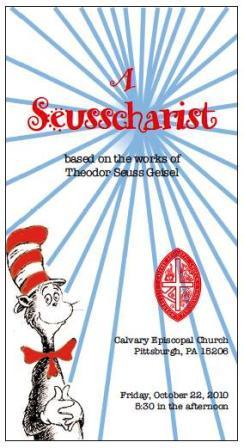 If you were looking for another reason why the Pope Benedict, the Pope of Christian Unity, issued the provisions of Anglicanorum coetibus, take a look at the liturgy recently perpetrated at an Episcopalian church in Pittsburgh.
The whole this is based on the style of Dr. Seuss.
Yes, this seems to have been intended for children and I don’t think it really was intended to be for their Episcopalian eucharist.
What a way to teach children how important worship is, right?
Remember, this is an Episcopalian thing and not a lame-duck ICEL translation.
Celebrant: God be with you.
People: And with you too.
Celebrant: Let us pray.
Celebrant: Almighty God, who gave us fun all this week,
So that we could be at our best, and at our peak;
Give us grace, as we leave this place,
Let the lessons that we have learned not go to waste
All this we ask through your loving name –
Father, Son and Holy Ghost, one in the same.First Reading Yertle the Turtle [I am pretty sure this is a reading from Yertle’s inspired book rather than by Yertle himself.]
Gospel Matthew 5:1-12
Prayers of the People
Let us bow our heads and fold our hands
To pray for all across the spansSilence
We pray for people everywhere
For those who want or need your care
We pray for people everywhere
There is a lot more. There are a few photos.
Pope Benedict is the Pope of Christian Unity.
Remember the flash mob choir brindisi thing?
Get a load of this, which I picked up from CMR.
600 choristers break out in song with the largest organ in the world, in Macy’s in Philadelphia.
It’s a random act of culture.


I received an email from a reader having a hard time getting the blog on his Palm phone. He actually offered to do some research to help figure out how to solve the problem. And he did.
He pointed me to how to add a setting for his type of mobile browser. I added “blazer” and now he is now able to get the mobile version of the blog, rather than the desktop version.
This information may help others. If I can find out what browsers/platforms to add, perhaps some people having trouble with the blog on their mobile devices will have more WDTPRS at their fingertips.
 I just hammered out another article for The Wanderer. This week I concluded some comments about the pro multis issue and then moved on to look at the “mysterium fidei” and the acclamations.
Here are a few points.
The words “mysterium fidei”, not found in the biblical institution narrative, have been embedded in the formula of consecration of the chalice since at least the 7th century.
They were displaced in the 20th.
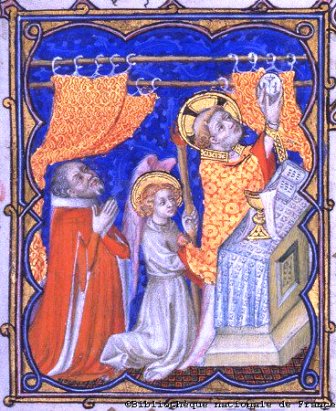
It is possible that in the ancient Church a deacon said these words aloud to clue people in about what was going on behind the curtains drawn before the altar.
History shrouds exactly how the non-Scriptural mysterium fidei was inserted into the consecration formula. In 1202, Bishop John of Lyon wrote to Pope Innocent III (+1216) asking about the consecration. Innocent explained that the words of consecration, while coinciding with Scripture in many ways and departing in others, are part of the sacred Tradition received by the Apostles from Christ and duly handed down. Innocent specifically treats the words “mysterium fidei” saying that they were important to combat errors about the sacramental mystery taking place on the altar (cf. ep. 5, 121; DS 782 and PL 214:1119a ff.). They make explicit the Church’s teaching about what happens at Mass.
The “mysterium fidei” is so important, as a matter of fact, that some traditionalists today, mostly of the Sedevacantist stripe, argue that its removal from the consecration makes every Novus Ordo Mass invalid. They are as wrong about that, but they are on target in stressing the theological importance of the phrase!
Over the years WDTPRS has spent a lot of energy on the concept mysterium, (Greek mysterion). In early Christian Latin, mysterium was connected with the word sacramentum.
In the traditional form of Holy Mass with the 1962MR (and for more than a 1000 years before), the mysterium fidei – imbedded within the sacramental form of consecration of the chalice – accentuates the substantial change of the Precious Blood and its sacramental effects. This is why some important theologians had serious problems with the removal of the “mysterium fidei” to after the two-fold consecration.
St. Thomas Aquinas (+1274) taught that removing an essential part of the formula of consecration would make the consecration invalid (cf. STh III, q. 60, a. 8). Aquinas opined that “mysterium fidei” was an essential part of the form of the consecration of the chalice (cf. STh III, q. 78, a. 3; Super I Cor, c. 11, v. 25).
Aquinas’s teaching is not automatically the equivalent of the Church’s Magisterium, mind you.
Aquinas explains in his commentary on 1 Corinthians 11:25 that while the simple consecration formula for Body of Christ needs nothing added to it, the form for the Blood of Christ requires additional clarification beyond simply saying “Hic est (enim) calix Sanguinis 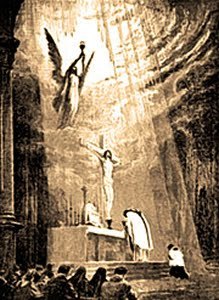 mei”. While the species of the Eucharistic “bread” represents the subject of the Passion, Christ Himself, the species of the Eucharistic “wine” expresses also the effects of the Passion which come to us through this sacramental mystery.
According to Aquinas, the effects of the Passion in the pouring out of the Blood (“for you and for many”) are three-fold: 1) remission of sins; 2) the justification of faith, and 3) the attaining of heavenly glory. The Sacrifice is tied into our reward at the end of the world.
In 1969, after witnessing a trial run of the projected Novus Ordo of the Mass, a document now called the “Ottaviani Intervention” was addressed by important theologians to Pope Paul VI. The chief authors were Alfredo Card. Ottaviani (head of the Holy Office, now called the Congregation for the Doctrine of the Faith) and Antonio Card. Bacci (distinguished Latinist). They objected strongly to the change, saying that “‘mysterium fidei’ was an immediate confession of the priest’s faith in the mystery realized by the Church through the hierarchical priesthood….”
In the Novus Ordo, “mysterium fidei” becomes a preface of an acclamation made by the congregation who share in Christ’s priesthood by baptism, not by the qualitatively different hierarchical priesthood.
In the Novus Ordo there is no immediate affirmation by the consecrating priest of the Church’s faith in Christ’s saving work through transubstantiation as he consecrates the Precious Blood. Instead there is now an acclamation by the priest and congregation affirming the connection of the two-fold consecration with the Lord’s saving work in His death and resurrection.
The new acclamations stress the inseparable bond of the Passion to the Last Supper in light of the need of Christians to persevere in holy and Catholic faith regarding the effects of the whole Mysterium Paschale, the Paschal Mystery (Cenacle – Golgotha – Empty Tomb), until Christ comes and the dead rise after the example of the Lord’s own resurrection.
In the Novus Ordo the mysterium fidei section refers to an eschatological concept: the return of the Lord. (“Eschatology” is from Greek eschaton, “last”, and so it is the study of the “last things”.)
No one should doubt the validity of the consecration in the Novus Ordo because the words mysterium fidei were displaced.
First, the words of consecration have, over the history of the Church, varied. Eastern Catholics and Orthodox did not use the phrase. Also, it is impossible that the Vicar of Christ and Holy Church would permit continuous use of an invalid sacramental form in the Church’s most precious treasure, the Mass. Furthermore, it is the tradition of the Church that Christ effected the transubstantiation of His Body and Blood by saying ‘This is My Body,’ and ‘This is My Blood’.” These words are in every form of consecration. They are essential for validity.
Nevertheless, the removal of the mysterium fidei was a titanic innovation. I consider it in light of the explicit words of the Council Fathers in Sacrosanctum Concilium, the Constitution on the Liturgy:
23. That sound tradition may be retained, and yet the way remain open to legitimate progress careful investigation is always to be made into each part of the liturgy which is to be revised. This investigation should be theological, historical, and pastoral. Also the general laws governing the structure and meaning of the liturgy must be studied in conjunction with the experience derived from recent liturgical reforms and from the indults conceded to various places. Finally, there must be no innovations unless the good of the Church genuinely and certainly requires them; and care must be taken that any new forms adopted should in some way grow organically from forms already existing.
I quite enjoyed Mo Dowd of Hell’s Bible falling to piece over the election results.
Here are a few excerpts.
[…]
Even though it was predicted, it was still a shock to see voters humiliate a brilliant and spellbinding young president, who’d had such a Kennedy-like beginning, while electing a lot of conservative nuts and promoting this central-casting congressman as the face of the future: a Republican who had vowed in a written pledge to restore America to old-fashioned values, returning to a gauzy “Leave It to Beaver” image that never existed even on the set of “Leave It to Beaver.”
Republicans outcommunicated a silver-tongued president who was supposed to be Ronald Reagan’s heir in the communications department.
[ROFL! It must be hard to deal in actual reality when you live in a Salvador Dali landscape. And for the record, I have never thought that Pres. Obama was in the least eloquent. Nearly every time he is off the prompter or the stump he knows, he goes to the zoo. Reading Dowd, however, … ]
[…]
The new leader of the House took a more black-and-white approach than the nuanced president. It’s enshrined in the Declaration of Independence that you need the consent of the governed and the governed did not consent.
[Do you know what else is “enshrined” in the Declaration of Independence? “…We hold these truths to be self-evident, that all men are created equal, that they are endowed by their Creator with certain unalienable rights…” CREATOR…. CREATOR….]
Ascending to third in the line of succession for the presidency: a working-class kid who rose in the House as a rabble-rouser willing to throw bombs to score points against powerful Democrats. [Pelosi’s rhetoric was never tendentious!]
[…]
Living in a fantasy.
From a reader:
At the meeting of the Altar & Rosary Society this morning, the
discussion about Christmas poinsettias came up. It was suggested that
even though real flowers would be used for most of the decorations,
that fake poinsettias be used around the Tabernacle. (!) The reasoning
is that real flowers would be a pain to water and might leak. I
mentioned that I thought that there was a prohibition against fake
Altar flowers, but I couldn’t remember where I had seen it. Is there
such a prohibition? (Other than just a general distaste for
tackiness?) I should also mention that there are fake flowers
underneath the statue of Our Lady of Fatima (our patroness), which are also quite ugly. The statues and tabernacle are front and center
behind the Altar, so they are seen throughout Mass.
The Church has always favored that which is natural. The unamplified human voice is better than the amplified. Pipe organ is better than electronic with speakers. Wax candles are better than artificial substances. Real bells are better than recordings.
Draw your own conclusion.
I would only add that if you don’t over do it with the flowers they won’t be so hard to tend.
Here is an entry for some post-election discussion. CIVIL comments are welcome.
My first observation:
If the GOP was not going to take control of the Senate, then it is probably good that Sen. Harry Reid won his race in Nevada and will return to as Majority Leader. Had Reid lost, I believe that Sen. Schumer of NY would have become Majority Leader. He could have been a more serious obstacle regarding issues most of us think are important.
And, as a Minnesotan, allow me again to apologize for my state’s “election” of Al Franken a couple years back.
Meanwhile…
[CUE MUSIC]
Are you blearly-eyed from watching election returns all night?
Are you a liberal, and therefore tired from crying into your pillow?
Are you simply a fan of good coffee and helping people?
If you said “Yes, Father! I am!” to any of those, and even if you didn’t, then you are in desperate need of the caffeine fix found in a piping hot WDTPRS mug of Mystic Monk Coffee!
Then why not seize this opportunity to refresh your coffee supply by ordering some, say it with me, Mystic Monk Coffee?
They have recently changed their ordering links for those of us who are helping them sell coffee and earn their daily bread. Therefore, right away, before you think twice…. click on THIS and see what happens?
Mystic Monk Coffee…
It’s swell!
BTW… did you see that they have chocolate-covered espresso beans?


Coat of Arms by D Burkart
 B on Daily Rome Shot 1116: “It just gets worse and worse. The Pope needs to publicly and very clearly put a halt to these shenanigans.…”
 on Daily Rome Shot 1116: “The origin of difference and division, the pharmakos represents evil both introjected and projected. Beneficial insofar as he cures—and for…”
 on Daily Rome Shot 1116: “White to move and mate in 4 Unless I’m missing something, this would seem to fall into the too easy…” on Daily Rome Shot 1115 – Different St. Martin today: “Black to move and mate in 4 1. …Rb2+ 2. Ne2 {or Kg3,Rd2} Rxe2+ 3. Kg3 {forced} Qf4+ 4. Nxf4…”
 on Daily Rome Shot 1116: “This reminds me of something Thomas Pink said in a response to a question fromAndrew Cusak: Many European Bishops are…”
 on Continue the Rome shot posts? I dunno.: “Sometimes I wonder if people who champion for abortion have ever had anything charitable done for them in their entire…”

A Daily Prayer for Priests








They find you a pro-life agent in your area who commits to giving a portion of the fee to a pro-life group!

PLEASE subscribe via PayPal if it is useful. Zelle and Wise are better, but PayPal is convenient.
A monthly subscription donation means I have steady income I can plan on. I put you my list of benefactors for whom I pray and for whom I often say Holy Mass.
In view of the rapidly changing challenges I now face, I would like to add more $10/month subscribers. Will you please help?
For a one time donation...



Help Monks in Wyoming (coffee – UPDATED LINK) and Norcia (beer) and the wonderful "Soap Sisters" of Summit, NJ!


Please follow me on Twitter!










Visits tracked by Statcounter
since Sat., 25 Nov. 2006: