New consultors to the CDWDS

From VIS we learn that the Holy Father has appointed new consultors to the Congregation for Divine Worship and Discipline of the Sacraments.

I will highlight a few who will be particularly good.

Hopefully the Anglophones will be able to provide some balance and good contributions even during the process of reworking the English translation of the Roman Missal.

Some people are whining that Rome is making changes to the translation submitted by the conferences of bishops.

I will opine more about this someday.

In the meantime…

NOMINA DI CONSULTORI DELLA CONGREGAZIONE PER IL CULTO DIVINO E LA DISCIPLINA DEI SACRAMENTI

Il Santo Padre Benedetto XVI ha nominato Consultori della Congregazione per il Culto Divino e la Disciplina dei Sacramenti i Reverendi: Mons. José Aparecido Gonçalves de ALMEIDA, Sotto-Segretario del Pontificio Consiglio per i Testi Legislativi; P. Dieter BÖHLER, S.I., docente presso la Facoltà Teologica Sankt-Georgen, Frankfurt (Germania); Sac. Nicola BUX, del clero dell’Arcidiocesi di Bari-Bitonto, docente presso l’Istituto di Teologia Ecumenico-Patristica Greco-Bizantina San Nicola, Bari (Italia); P. Joseph CAROLA, S.I., docente presso la Pontificia Università Gregoriana, Roma; Sac. José Manuel Garcia CORDEIRO, Rettore del Pontificio Collegio Portoghese e docente presso il Pontificio Istituto Liturgico, Pontificio Ateneo Sant’Anselmo, Roma; Sac. Renato DE ZAN, docente presso il Pontificio Istituto Liturgico, Pontificio Ateneo Sant’Anselmo, Roma; P. Cassian FOLSOM, O.S.B., Priore di Norcia (Italia), Professore Consociato del Pontificio Istituto Liturgico, Pontificio Ateneo Sant’Anselmo, Roma; Sac. Mauro GAGLIARDI, docente presso il Pontificio Ateneo “Regina Apostolorum”, Roma; Sac. Aurelio GARCÍA MACÍAS, del clero dell’Arcidiocesi di Valladolid, Presidente dell’Associazione Spagnola dei Professori di Liturgia (Spagna); Mons. Angelo LAMERI, del clero della Diocesi di Crema (Italia), docente presso la Pontificia Università Lateranense, Roma; Sac. Dennis McMANUS, del clero dell’Arcidiocesi di Mobile, docente presso l’Università Cattolica d’America, Washington (Stati Uniti d’America); Sac. Juan José SILVESTRE, del clero della Prelatura personale dell’Opus Dei, docente presso la Pontificia Università della Santa Croce, Roma; P. Ab. Michael John ZIELINSKI, O.S.B. Oliv., Vice Presidente della Pontificia Commissione per i Beni Culturali della Chiesa e della Pontificia Commissione di Archeologia Sacra; Mons. Markus WALSER, Vicario Generale
Posted in Brick by Brick |
10 Comments

QUAERITUR: Is it right to genuflect in a Catholic church?

QUAERITUR: Is it right to genuflect in a Catholic church?From a reader:

I have become confused by genuflexion and I am hopeful you may be able to clear up my problem. I am a convert from Anglicanism and in that tradition I had always genuflected when entering or leaving the pew, and when crossing the church in front of the tabernacle. So, if I walked through the church without sitting down I would still stop in the middle, turn towards the tabernacle, and genuflect.

What I am wondering is whether genuflecting at that time is actually
the right thing to do in a Catholic church? After coming over to Rome
I naturally continued to do this, whenever I thought I could, as by
then it was the natural thing for me, but recently I have begun to
feel like perhaps I shouldn’t. Nobody, including priests, genuflects when crossing a church and so I have begun to suspect this is not an orthodox or Catholic practice. [grrrrrr]

On a related note I am also confused about what constitutes “in front
of a tabernacle.” As an Anglican it was easy as the churches were
generally straightforward affairs with a single aisle down the middle.
I had no trouble knowing I was walking in front of the altar and
tabernacle as “in front” was a simple and observable condition.
However, all of our churches here are roundish buildings with numerous radiating aisles. If it is still proper to genuflect when “passing in front of a tabernacle” how can we know when exactly we are doing this? I suppose I am curious about when exactly it is proper for us to genuflect in a Church?

Yes, it is appropriate to genuflect in a Catholic Church when passing before the tabernacle or when entering and exiting a pew.

Your post underscores the confusion that has arisen because of architectural tinkering, rearrangement – derangement – of churches, etc.   Some designs and some changes to church have had a negative impact on our Catholic identity, because they leave us confused about what to do.  Sometimes it is hard to find the Blessed Sacrament!

But, yes, it is appropriate to genuflect when passing before the tabernacle.  When entering your pew and exiting, genuflect facing or angled toward the Blessed Sacrament.

Another point: if the Blessed Sacrament is not in the center of the church, it is not wrong to make a reverential gesture toward the altar.  Usually this is done with a bow.

Finally, shame on those priests if they are not showing reverence to the Blessed Sacrament, especially when lay people are present.  Shame on them.  Shame on them.  They have contributed to confusion and have weakened the Catholic identity of the faithful in one of the most important aspects of our faith.

Posted in "How To..." - Practical Notes, ASK FATHER Question Box, New Evangelization, Our Catholic Identity | Tagged
50 Comments

What is a “neocon”, “paleocon”, etc. And WDTPRS POLL: Which are you?

I know that I have posted about this before, but it bears another round.

Sometimes in these electronic pages we see people tossing around terms such as

  • neocon
  • paleocon
  • crunchycon
  • theocon
  • etc.

What do these terms mean?

Also…. chose your best answer and give your reasons in the combox.

[HINT: It is okay to read some of the explanations of the terms and then vote.]

I consider myself to be a...

View Results

Loading ...
Posted in POLLS |
57 Comments

QUAERITUR: Work or school on Holy Days of Obligation

From a reader:

I have a question regarding Holy Days.  I am no longer a student, but when I was I always remember having school on Holy Days (and I went to a Catholic grade school and high school).  Yet, my parents remember that when they were young, school was always cancelled on Holy Days.

According to Canon 1247, “On Sundays and other holy days of obligation, the faithful are obliged to participate in the Mass. Moreover, they are to abstain from those works and affairs which hinder the worship to be rendered to God, the joy proper to the Lord’s Day, or the suitable relaxation of mind and body.”

Wouldn’t these “works and affairs” include school work??  It seems like Canon Law is confirming the old practice of cancelling school on Holy Days.  Of course, the counter-argument is that if you don’t have the kids come to school, they won’t go to Mass at all on those days.

Now that I work in a Catholic school, I’m just curious as to your thoughts on this issue.

At my home parish, the old pastor for years saw to it that there was no school at the parish school on Holy Days of obligation or half days, and would also have all school Masses.  Something that complicates this now is that, in many instances, children are not walking to school.  Also, if they have a half day, is there a parent or someone to pick them up?  Is there a parent at home?

It seems to me that c. 1247 is pretty clear.  People must fulfill their obligation.  That may require them to set aside some other thing they want to do.  They may have to make some sacrifice to fulfill their obligation.

The idea behind the canon is that people must have adequate relief from work and worldly obligations so that they can see to their spiritual obligations.  This, historically, was also intended to defend the poor and workers from being set to work too much on Holy Days.

That said: I am not entirely sure why a student who goes to Mass on a Holy Day of obligation couldn’t also do some homework on the same day.   I think that once your obligation is fulfilled, it is possible to do some “work” activities, though for the sake of the day it is best, if possible, to avoid too much that would be “menial” work.

And what is “menial”?

It is hard for me to imagine that washing the dishes after a meal violates the spirit of the Holy Day.  There are things that must be done no matter what the day.  Dairy farmers still have to milk the cows everyday, whether it is a holy day or not.  It is okay to take out the garbage.

And how many people out there simply must go to work just like it was any other day?  Is this the reason why bishops decide to suspend the obligation on some Holy Days?  Perhaps.  I still think it is not unreasonable to ask Catholics to go to Mass more than once a week, even if that requires planning and some sacrifice.

I also think it is possible to over-analyze and over-interpret “relaxation” of mind and body.

Perhaps the best approach is to make sure, even if you have to work, go to school, etc., that in addition to fulfilling the Mass obligation, you try to make something about that day special, different from your regular routine.

Posted in "How To..." - Practical Notes, ASK FATHER Question Box | Tagged ,
15 Comments

QUAERITUR: In mortal sin, but I have to go to Mass. What do I do? Fr. Z rants.

confessionalFrom a reader:

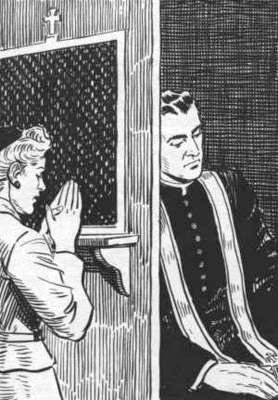
I feel horrible I fell in to mortal sin today and I am supposed to go to Mass, what do I do?

Why is this hard?

You go to Mass anyway.  Just go.  If you shouldn’t receive Holy Communion, then don’t.

Go to confession as soon as possible.

Part of the confusion comes from the mistaken notion that people should or can receive Holy Communion every time they go to Mass without any consideration of the state of their souls.   People go forward automatically these days. They connect going to Mass with going to Communion automatically.  Therefore, if they go to Mass they must receive.

Folks, if you know you can’t receive, go to Mass anyway!  You still have your Sunday or Holy Day obligation to fulfill.  You fulfill it by going to Mass, not by going to Communion.  Catholics are obliged to receive Communion once a year, which also implies confession before that Communion.  Let’s leave aside here the issue of making a “perfect act of contrition” and then receiving Communion and stick to the obvious.

Who knows how long it has been since 95% of some congregations have been to confession?  And yet they blithely troop up and stick out their hands.

We have a disastrous situation these days with the use/availability of the sacrament of penance.

Many people have no idea what is required to be properly disposed to receive Holy Communion.

Bishops and priests are to blame for this disastrous state of affairs.  Through their neglect of teaching about and preaching about and trying to build up the sacrament of penance they have placed the souls of their flocks in danger of eternal separation from God in hell.  They have endangered their own souls as well, because they will be held responsible for this before the King of Dreadful Majesty at their judgment.

And some of them – some of you, Fathers – are a lot closer to the end than the beginning.

Posted in "How To..." - Practical Notes, ASK FATHER Question Box, New Evangelization, Our Catholic Identity, Wherein Fr. Z Rants | Tagged , ,
34 Comments

Military chaplains opposing ‘Don’t Ask, Don’t Tell’ told to “get out” if they don’t like it

Here is a disturbing story from CNA:

Chaplains opposed to ‘Don’t Ask, Don’t Tell’ repeal coming under pressure

Washington D.C., Nov 3, 2010 / 06:13 am (CNA).- A federal court has again reinstated the U.S. military’s policy against open homosexuals in service. While military chaplains are “hopeful” the policy will stay in place, some have been told they should “just get out” if the “Don’t Ask, Don’t Tell” policy is repealed. [That is a deeply disturbing message.  Anyone who has exercised command in the military over a significant number will confirm how important the chaplain can be.  And then there is the issue of chaplains for the wounded.  The US military is desperately short of chaplains as it is.]

On Monday two of the three judges on the panel of the 9th U.S. Circuit Court of Appeals halted a judge’s order which forbade the enforcement of the U.S. military’s policy against open homosexuals in the armed forces.

The judges in the majority said they agreed with the U.S. Department of Justice that a federal district court judge’s global injunction against the policy “will seriously disrupt ongoing and determined efforts by the Administration to devise an orderly change” if such a change will happen.

The case will be “moot” if the administration persuades Congress to eliminate the policy, the two judges added. They said four other federal appeals courts’ decisions cast doubt on whether the lower court judge exceeded her authority and ignored existing legal precedents.

District Court Judge Virginia Phillips had ruled that homosexuals could not serve in the military without having their First Amendment Rights breached.

President Barack Obama has opposed the policy and has worked to end it legislatively. The Log Cabin Republicans, a homosexual group, has been trying to overturn the policy through the federal judiciary.

[…]

“One chaplain stood up in a high-level meeting created precisely for the purpose of getting service members’ thoughts on the repeal of the policy. And he asked ‘What should chaplains do? What should people of faith do if this policy changes and we have problems of conscience with how it’s going to affect us?’” Blomberg said.

“That individual was told by a high-ranking member of the panel that they should just get out of the military.”  [And then what?  Would they be “replaced” with chaplains who are themselves homosexual or at least pro-homosexual?  “Tolerant”?]

[…]

Archbishop for the Military Services Timothy J. Broglio has opposed repealing “Don’t Ask, Don’t Tell.” In an interview with CNA last month, he warned of a “latent” danger to religious liberty in the agenda advanced by some people in the name of tolerance.

“(T)here is an agenda to force everyone to accept as normal and positive behavior that is contrary to the moral norms of many religions, including the Catholic Church,” he commented, voicing concern that teaching morality or forming young people in their faith could be misconstrued as intolerance.

Posted in The future and our choices | Tagged , ,
16 Comments

MUGS GONE WILD! This time MAGNET gone wild!

I love emails with photos of WDTPRS stuff, coffee mugs and other swag… in the wild.

A seminarian reader sent a note:

Hi Father, I thought you’d appreciate this.

This is on the…wait for it…”liturgy fridge” that has the wine and hosts for Mass in it at IHM Seminary in Winona.  Our priests, do, in fact “say the black and do the red.”  We have some truly great priests here, for whom I am very thankful.

MUGS GONE WILD! This time MAGNET gone wild!

OORAH!

Don’t forget the Oremus pro Pontifice items!

Posted in Just Too Cool |
8 Comments

QUAERITUR: “free from attachment to sin” for plenary indulgence

QUAERITUR: "free from attachment to sin" for plenary indulgenceSeveral readers have asked along these lines:

To get a plenary indulgence we have to be completely detached from sin, affection for sin, even venial sins.  Since only Our Lord and Our Blessed Mother were perfectly free from attachment to sin, how can any of us ever gain a plenary indulgence?  Doesn’t the Church set an impossibly high standard?  Why bother trying?

First, having high standards is a good thing.  Shouldn’t we be free from attachment to sin?  To what degree is being attached to sin okay?

In the final analysis, perhaps we have to admit that gaining plenary indulgences is rarer than we would like.

That said, it is not impossible.  And I don’t think we have to be a hermit living on top of a tree beating his head with a rock to be free of attachment to sin so as to gain this plenary or “full” indulgence.

Also, we do not know the degree to which a “partial” indulgence is “partial”.  It could be a lot.  That in itself is something which should spur us on!

Generally, if someone is motivated to obtain an indulgence, he does so from true piety, desire to please God and to help oneself and others.

When it comes to complete detachment from sin, even venial, few of us live in that state all the time.  Nevertheless, there are times when we have been moved to sorrow for sin after examination of conscience, perhaps after an encounter with God as mystery in liturgical worship or in the presence of human suffering, that we come to a present horror and shame of sin that moves us to reject sin entirely.  That doesn’t mean that we, in some Pelagian sense, have chosen to remain perfect from that point on or that by force of will we can chosen never to sin again.  God is helping us with graces at that point, of course.  But we do remain frail and weak.

But God reads our hearts.

Holy Church offers us many opportunities for indulgences.  The presupposition is that Holy Church knows we can actually attain them.  They can be partial (and we don’t know to what extent that is) and full or plenary.  But they can be obtained by the faithful.

Holy Church is a good mother.  She wouldn’t dangle before our eyes something that is impossible for us to attain.  That doesn’t mean that a full indulgence is an easy thing.  It does mean that we can do it.  In fact, beatifications and canonizations have been more common in the last few decades and in previous centuries.  The Church is showing us that it is possible for ordinary people to live a life of heroic virtue.

Therefore, keep your eyes fixed on the prize of indulgences.   Never think that it is useless to try to get any indulgence, partial or full, just because

Perhaps you are not sure you can attain complete detachment from all sin, even venial.  Before you perform the indulgenced work, ask God explicitly to take away any affection for sin you might be treasuring.  Do this often and, over your lifetime, and you may find it easier and easier. Support your good project with good confessions and good communions.  You need those graces.

A person does not become expert in worldly pursuits overnight or without effort. It takes time and practice to develop skills and virtues.  It takes time to develop habits of the spirit as well.

We can do this.  And when we fall short, we still have the joy of obtaining the partial indulgence and that’s not nothing.

Posted in "How To..." - Practical Notes, ASK FATHER Question Box, Our Catholic Identity | Tagged
23 Comments

Stephen Maturin would be delighted

Which it is great news.

From CNA:

Pope’s first words in Barcelona to be in Catalan

Rome, Italy, Nov 1, 2010 / 10:01 pm (CNA/Europa Press).- The first official words pronounced by Pope Benedict XVI during his visit to Barcelona on Nov. 7 will be in Catalan, at the Dedication Mass of the Church of the Holy Family.

The opening rites of the liturgy will be Catalan, as well as the readings for the Mass and the rite of consecration of the Church.

The Pope will also speak in Gallego—the local dialect in the Spanish region of Galicia–when he celebrates Mass Nov. 6 in Santiago de Compostela.

According to Vatican spokesman Father Federico Lombardi, the Mass at the Church of the Holy Family will be celebrated in Spanish, Catalan and Latin.  The Gospel and the Communion rite will be in Spanish.

Father Lombardi said the Holy Father would deliver part of his homily in Catalan, but that most of the speeches during the visit would be delivered in Spanish.

He also said the Pope’s homily in Barcelona would include a reference to Antonio Gaudi, who designed the Church, and would focus on the relationship between art and faith, the Christian life and the family as the basic unit of society.

However, the spokesman explained, the motive behind the Pope’s visit “is not to support Gaudi’s  cause for beatification,” but rather “to consecrate a magnificent work that has great meaning for the Church in Catalonia.”

Posted in Just Too Cool | Tagged
9 Comments

QUAERITUR: “bishops in soutanes with big, gaudy riiiiiiings”

We now shift away from the less important issues – salvation outside the Church and American exceptionalism – to focus on something of momentous significance.

From a reader:

At times I have seen priests wearing a short black cape over their
cassock, and in my research, I have not been able to figure out if
there are any restrictions for their use. Certain religious orders,
Bishops and the Pope, I see, are allowed to wear it, but how about
your normal run-of-the-mill parish priest? Thank you for your time,
and keep up the good work!

The little cape over the shoulders was once upon a time a mark of jurisdiction.  Bishops use it.  Pastors of parishes could use it I believe (back when there was far more complicated ecclesiastical clothing).

These days, I think most priests use it because it looks nice.  I have a cassock with one of these.  I used it because it was warm.

Paul VI did away with a lot of the things that clerics used to wear.  For example pompoms on the ends of fascias were abolished.  Some priests use them anyway.   Back in the day, priests were not to use black watered-silk fascia.  These days some do.  Why?  They look nice.

“But Father! But Father!”, some will say.  If these things are forbidden, then they shouldn’t be used!  You are antinomian!”

To which I respond: big deal.

If using these things makes their black (or purple) socks roll up and down, great.

It was a mistake to simplify ecclesiastical garb to the degree that it was simplified.  We will see that usage, praxis, will reintegrate some of the old things back into general use.

I don’t know if this is part of the “gravitational pull” that the older forms are exerting on the new or if this is something else.

One think I do know – liberals hate stuff like this.  All the more reason to use it.

Meanwhile…

[CUE MUSIC]

From the official WDTPRS parodohymnodist to the Sound of Music tune “My Favorite Things”:

Dalmatics on deacons and cassocks on priests,
habits on nuns and immovable feasts,
bishops in soutanes with big, gaudy rings –
these are a few of my favorite things.

Devotions to Mary, novenas and stations,
fasting and penance on Days of Rogation,
High Mass and Low Mass and papal blessings –
these are a few of my favorite things.

Rosaries and incense and fiddleback vestments,
BINGO on Mondays with homemade refreshments,
statues of angels with halos and wings –
these are a few of my favorite things.

When RENEW strikes!
When the rail’s gone!
When I’m feeling sad,
I simply pop into a Solemn High Mass
and then I don’t feel so baaaaaad!

[MUSIC CONTINUES IN BACKGROUND]

When you’ve had a hard day sorting out what fancy gear priests can wear, … nay rather… when you have had a hard day biting your tongue over the shabby way most priests usually dress these days…. for the love of GOD can’t these men put on clerical clothes?  Can we have a little liturgical decorum?   In the name of all that is holy, isn’t about time that clerics start dressing as if both their own role in the Church and what they are doing in church might be slightly Buy some coffee!important, rather than throwing on something they rummaged up from the laundry bag behind the “Tasty Bakery” after the night shift?

It’s enough to make you….

Why not relax with a WDTPRS mug filled to the brim with piping hot Mystic Monk Coffee?

Refresh your supply now! Not just Monk Coffee … Mystic Monk!

It’s swell!

Posted in "But Father! But Father!", ASK FATHER Question Box, Our Catholic Identity, Parody Songs | Tagged ,
26 Comments