Rosemary Reuther’s article in the NCR: Women’s ordination hits a snag!

In olden days a glimpse of stocking was pretty common.  Once those old silk stockings got a snag in them, they would get a ladder-like run in them.  It was inevitable.  Once they got a run, there was no stopping it.

So it is with the women ordination movement.

Quite a few readers have urged me to examine closely a piece in the National Catholic Fishwrap written by that venerable old feminist theologian Rosemary Radford Reuther.

It is a labor arduus to drill into these articles of open dissent.  For every word they write, the Faith requires us to write ten. 

Lest it be said that RRR’s piece has gone unanswered I will give you a some hooks you can snag some ideas on as you read it on your own and then talk about it with others… if you must.

First, put it into the context of what the National Catholic Reporter is trying to do. 

Recently there have been many articles in NCR, all positively promoting the ordination of women.  These articles are, in my opinion, not merely for the purpose of lively discussion of a burning issue in the Church.  They are contumacious gestures of dissent from the Church’s defined, infallible teaching.  The timing of this gush of articles in NCR is payback for the inclusion of the attempt to ordain a women among the graviora delicta listed in Sacramentorum sanctitatis tutela.

Now to Rosemary’s article.  If we put this in the context of NCR, put it also in the context of RRR’s life.  Check quickly her wikipedia entry.

As a Patristicist I was attentive to her long argument that there is no solid evidence of a conscious Apostolic Succession in the early Church.  Instead, she argues, there were various ways by which people (men and women) were called to various ministries in the Church.  She quotes various Patristic sources.  Rosemary has been out of the loop for a while.  She is unaware it seems that no good scholar thinks that Hippolytus was the author the Apostolic Tradition. Manlio Simonetti has taken care of the question.

But, leave that all aside.  This is not the real point we have to focus on when reading RRR’s article.  Her long Patristic thing is really a head fake.

Let us stipulate that, yes, ministry in the early Church was messy. It took centuries for the Church in both the East and West to figure things out clearly.  Fine.  The relationship of the norms of doctrine and authority with the Patristic tradition is thorny.  No news there.  Let her have that ground for the time being, though someone could really have fun picking her references apart. 

So. The early Church was messy.  There were schisms and dissenters and fights and arguments all the time.  This is the history of the Church.  No surprise there.

In fact, as the situation was in 2nd-5th centuries, so to it is today.  Today all sorts of different people in a myriad of different communities call themselves ordained.  Not all the "ordained" are recognized even by others within their own faith communities.

But this is still not the real snag in her article.   

Most of the time when you read a womanpriest dissenter, the writer is actually begging, desperately pleading for Rome’s approval of what they are doing.  They are never going to get it, which makes their dissent so pathetic.  Rosemary doesn’t care about Rome’s approval for the ordination women are attempting.  When she argues against a secure basis for claims of an unbroken Apostolic Succession, she is not arguing that women could have been part of the valid Apostolic Succession (though she suggests that).  Her real point is that the Apostolic Succession, unbroken or not, doesn’t make any difference

Watch what happens in her article.  From the very beginning of her piece, she merely assumes that ordination of women, in any form, is valid. 

But then she turns to the example of a breakaway community in California, the Mary Magdalene Apostle Catholic Community.  This MMACC is simply calling forth women they think embody what they are doing and "ordains" them on their own, without the involvement of any of those Danube-riverboat-style ordinations which meticulously tried to show that they had some involvement of Catholic bishops in the Apostolic Succession.

Get it?

On the one hand, we have the Euro/Teutonic womenpriests of the Roman Catholic Women Priest thing, who in a good German style want to build the precision autobahn machine.  They really care about the Apostolic Succession and Rome’s approval.  They want to tinker with that engine can get it just right.

On the other hand, we have the California gals who could care less about the precision of the engine.  They just want to turn up the radio and whip down the road with the top down.  They could care less about Apostolic Succession and Rome’s approval.

Cutting through the long Patristic thing and the long-rehearsed feminist stuff in RRR’s article, RRR is terrified that there is going to be a messy split between two groups of women who want to be ordained.

This is what keeps RRR awake at night: not that Rome might not give approval to their ordinations, but that one group of women not approve the other.  One group will tell the other that they are not – wait for it – validly ordained because there was not womenpriest bishop from some river-boat thingy involved.  The Eurowymyn will point at the Calgals and say "You are not validly ordained!"

Just as the early Church was messy, and RRR describes this at length, RRR is worried that these groups could get all messy.  They could even "excommunicate" each other. 

These women – in either group – can claim that they are priests till the cows come in, so to speak.  Christian history of who says whom is ordained is a mess.   Some denominations might accept some of the wymyn as ordained, some won’t.  Some catholics will migrate to the Magdalen Catholic Church or the Roman Catholic Women Priests thing.  It could happen.  So what.  We have seen this movie before. Heck, millions could join! 

They will never have approval of Rome and they will never be priests.

But Rosemary Radford Reuther is worried about a first schism in their new birthing church.  She covers her fear over with a little anger about graviora delicta.  She deflect us from her real concern in her long exposition about the early Church.  

Her new church – and she favors the non-Apostolic-Succession-style California-Gal Magdalen Church Community stuff and not the precise i-dotting t-crossing Euro-boat-riders – Rosemary’s new church even in its birth pangs is already going into schism with itself over the question of Apostolic Succession.  Her new heroines are on the verge of a cat fight over true priesthood and how it is transmitted.

One of these days it is going to happen, you know. 

The boat-riders are going to say that the California gals are going to have to be ordained by one of them or they will not be validly ordained. 

Sardonic Question: Will the Roman Catholic Women Priests establish a doctrinal congregation to settle this?  Will they need their own CDF? 

Which penalties will be applied by women to women when they attempt ordain without a bishop in the Apostolic Succession?

I will make popcorn.

Posted in SESSIUNCULA, The Drill, Throwing a Nutty | Tagged
43 Comments

Archbp. Burke on altar girls and EMCHs in the Extraordinary Form

I picked up from Il blog degli amici di Papa Ratzinger that H.E. Most Rev. Raymond Burke (Prefect of the Ap. Segnatura) wrote a preface to a canonical study in German of Summorum Pontificum by Fr. Gero P. Weishaupt.

In his preface, Archbp. Burke says, inter alia, that neither altar girls nor Extraordinary Ministers of Holy Communion are admissible in the Extraordinary Form of the Roman Rite because the integrity of the Rite must be respected.

And as I was writing those words, I had another signal that NLM posted a rough English translation of the German original of Archbp. Burke’s preface.  The original text is available on the blog Summorum Pontificum.  My emphases.  Comments will follow.


In the second chapter of his commentary, Weishaupt answers a number of practical issues that arise regarding the implementation of Summorum Pontificum  and result from recent changes to the discipline of the celebration of the sacraments, such as e.g. those regarding female altar servers or lay people who perform the ministry of lecturers or extraordinary ministers of Holy Communion. To answer these questions , the commentary correctly applies two general canonical principles.

The first principle requires that liturgical norms, which were in force in 1962, are to be diligently observed for the celebration of the Extraordinary Form of the Roman Rite, for these norms protect the integrity of the Roman rite as contained in the Missal of Blessed John XXIII. The second principle states that the subsequent liturgical discipline is only to be introduced in the Extraordinary Form, if this discipline affects a right of the faithful, which follows directly from the sacrament of baptism and serves the eternal salvation of their souls.

The application of these two principles to the cases mentioned leads to the conclusion that neither the service at the altar by persons of the female sex nor the exercise of the lay ministries of lecturer or extraordinary ministers of Holy Communion belong to the basic rights of the baptized. Therefore, these recent developments, out of respect for the integrity of the liturgical discipline as contained in the Missale Romanum of 1962, are not to be introduced into the Extraordinary Form of the Roman rite. The commentary presents here in an impressive manner that the mutual enrichment of both forms of the Roman rite is only possible if discipline peculiar to each of the two forms is accordingly carefully observed.

A few comments.


  • This is not an official document.  It is a preface by an official of the Holy See to a book which is a commentary by a writer who is not an official of the Holy See.  The preface has no legal force.
  • Archbp. Burke is a distinguished canonist who also knows inside and out the older, Extraordinary Form because he has been so open to it and has often been celebrant for liturgies in the traditional form.  He knows the logic of the rite from within and not as some onlooker.
  • Archbp. Burke was consulted about the text of Summorum Pontificum before its release.  He knows more than a little about its genesis and intention.
  • As a canonist, Archbp. Burke understands the rights of the baptized from the point of view of the Church’s law.
  • He did not speak in that excerpt about Communion in the Hand in the older, Extraordinary Rite.
  • He also did not speak about "straw subdeacons".

His dictis

  1. It is not a right of the faithful for the sake of their salvation, that they be allowed to serve at Mass or to act as an EMCH.
  2. Since reception of Holy Communion – and the manner of Its reception – comes far closer to the issue of the salvation of the baptized, that might be a stickier issue.  Nevertheless, it seems to me that it is not a manner that touches on the salvation of the baptized to be permitted to receive on the hand when clearly it is contrary to the Church’s normative way of receiving.  Remember that permission to receive in the hand is actually an exception.
  3. I have held (pace Burke) that Summorum Pontificum did not in fact revive the laws that were in force in 1962, thus creating a parallel set of laws.  Was I wrong?
  4. Also, if there is to be such a strict separation of 1962 and 1970/2002, is mutual enrichment possible insofar as rites are concerned?
  5. Or, and this is where I have put all my stress over the last few years, does it have more to do with ars celebrandi?


Posted in Brick by Brick, SUMMORUM PONTIFICUM, The Drill | Tagged
41 Comments

Your good news?

Folks I am feeling dreadful today (I have been for a day or so now) and would enjoy learning of good things happening out there.

What is your good news?

I am happy to report that 4000+ people have viewed Archbp. Burke’s explanation of why he helped to build the Shrine of Our Lady of Guadalupe.

Archbp. Burke describes why he built the Shrine to Our Lady – VIDEO

Posted in SESSIUNCULA |
61 Comments

Damian Thompson’s take on the music CD for the papal visit

Damian Thompson has rained vituperation down upon a music CD prepared in advance of the Holy Father’s visit to the UK.

Papal visit CD: musical atrocities that make the Birdie Song sound like Mozart 

[I admit that I didn’t know what "The Birdie Song" was, but when I clicked the youtube video embedded in Damian’s post, I – too my everlasting horror – recognized it.]

Despite everything I’ve written about the incompetence of its organisers, I firmly believe that Pope Benedict XVI’s visit to Britain needs to be a success. Time is running out. The sad trendies of Eccleston Square [For US readers, Eccleston Square is the location of the Catholic Bishops’ Conference of England and Wales] have done enough damage without them handing their critics fresh ammunition at this late stage. My heart sank when I saw that the papal visit team had released two tracks from the official “Pilgrim Journey” CD that comes with the (expensive) tickets for papal events. But nothing could have prepared me for the awful reality.

I’ve just played “Urban Pilgrim (Reprise)” by Alessandro Cherin and “Deus Tuus Deus Meus” by Fr Gerard Bradley to my colleagues in the Telegraph newsroom. And they’re keeling over in embarrassment. “Urban Pilgrim” is described by a friend as “the stuff they play on planes when they switch off your in-flight movie as your prepare to land”. As for Fr Bradley, his vocation does not lie in the area of composition – and the singer has the upper register of a deputy accounts manager on a karaoke machine. [Update: I’ve just discovered that the poor guy is a seminarian who was presumably pushed into this. So, feeling guilty, I’ve taken out his name. His voice is perfectly pleasant – it’s just that the nonsense he’s singing is pitched far too high for him.]

It doesn’t give me any pleasure to make fun of this crap, because it proves that the Church in England and Wales is still in the grip of philistines. I’m not suggesting that visitors to papal events should be given a CD of Renaissance polyphony. [How about the new Gregorian chant CD from the sisters at Le Barroux?] There is such a thing as good Christian rock and pop music; it’s just that Catholics don’t produce it. Instead, “with-it” monsignors and their mates force-feed the faithful with sclerotic folk-style antiphons – or worse.  [The cuts I have heard, and I am not sure I need to hear more, are imbued with the sentimentality that characterizes most of the ditties written for World Youth Day gatherings.  So, I wonder who the target audience was for this CD?]

Seriously, why didn’t the tone-deaf papal visit team just release the song on the video below? It would be no less humiliating for Catholics.

Don’t take his word for it.

Listen and decide for yourselves.

How to describe my impressions as I listened to the tunes? 

I imagine this is what it would be like to be waterboarded first with with Robinson’s Barley Water and then with Lyle’s Golden Syrup.

Posted in The Drill | Tagged
48 Comments

Pre-order Gregorian Chant CD by Benedictines of Barroux

A while back I posted about the Benedictine nuns who signed a recording contract.  Read that here.

If you are a user of amazon.co.uk (the UK store for Amazon) you can pre-order their Gregorian chant CD.

Click here.

I am sure that anyone could order if from the .co.uk site if they want to pay a little extra for shipping.

On the US site is is available as an IMPORT.

Posted in Brick by Brick | Tagged , , ,
3 Comments

QUAERITUR: “Body of Christ” not “The Body of Christ” because people embody Christ

From a reader:

Our priest informs the extraordinary ministers of Holy Communion [Indeed, they are not "Eucharistic Ministers".  In fact, we need to have the discussion of whether they are techincally ministers at all.] of our parish that, henceforth, they are not to raise the Host as they give it to the faithful, and that they are not to say "The Body of Christ" but rather "Body of Christ", addressing the communicant, because the focus is on the communicant, who embodies the Body of Christ is thereby worthy to receive the actual Body of Christ. [Wow… just… wow.]

The italicised quote from Fr.’s letter is probably rather wrong-headed – one wonders how he squares it with the Lord, I am not worthy we have all just recited.  Probably laymen should not, in fact, "elevate" the Host, since that is rather a priestly gesture; but in the Missal I can only find the words and actions of the priest and deacon.    Are the proper words and actions of the EMHC specified anywhere?

I frankly don’t know if there are official directives or books issued by the Holy See or the bishops conferences describing in detail the exact manner of distribution of Holy Communion by an EMCH (in church).  I suppose we will know about 5 minutes after I post this entry.

Other points to help resolve the situation:

First, have fewer but better trained EMCH’s, or no EMCH’s at all.

Second, follow what the book says.

In Latin, which is the official language of the Latin Church, we say "Corpus Christi".  It is always permissible to use Latin and it has the advantage of avoiding the entire debate about the translation.

As far as the translation is concerned, in English you correctly translate Corpus Christi as either "Body of Christ" or "The Body of Christ". 

There is also the theological consideration.  Do those two versions, one with "the" and one without, mean different things?  More on that down the line.

In the "White Book" of the new approved English language translation of the Roman Missal we find an answer to your question.   This is what Rome has approved.

134. After this, he takes the paten or ciborium and approaches the communicants. The Priest
raises a host slightly and shows it to each of the communicants, saying:

The Body of Christ.

The communicant replies:

Amen.

And receives Holy Communion.

I think this issue of EMCH’s raising the Host to "show" it to the communicant probably is done in imitation of the priest when he shows the Host to the whole congregation (see the rubric, above).  So, it seems to me that the communicant has already seen the Host at the elevation and the moment before the priest’s Communion.  She therefore gains nothing additional from an additional stare.  In the meantime, the EMCH is sending mixed signals about her role.  (I use her because I am being inclusive.)

Back to the theological point that priest was trying to make in his letter: because the focus is on the communicant, who embodies the Body of Christ is thereby worthy to receive the actual Body of Christ.

The priest is saying that "THE Body of Christ" indicates that the Eucharist, the Host, is THE Body of Christ, whereas saying "Body of Christ" implies a more inclusive way of understanding Christ’s Presence.

The priest is confused – and confusing others – about ways in which Christ is present. 

Since the Council many enthusiasts have blurred the distinct ways in which is known to be present to us.  He is present in the Word, Scripture, in the assembly of the baptized gathered in His Name, in the symbol of the altar, in the person of the priest himself, and – in a way that is preeminent and unlike every other way of being present, in the Eucharist.  No other manner of Christ’s presence is comparable to the Eucharist.  You might say that in Scripture the Lord Himself says that when you feed the hungry, you feed Christ Himself.   The priest himself might say, the communicant is the hungry one (Christ) coming to be fed on the bread of life (Christ) and so, – wait for the grip of logic’s steel jaw to close around you now – since they are both Christ, the Eucharist isn’t more Jesus than the person in front of you.

This is, of course, rubbish.  The communicant is a dignified baptized member of the Body of Christ, the Church.  As St. Leo shouts at Christmas, Agnosce O Christiane dignitatem tuam.  And he is right to do so.  But the Eucharist is GOD, Jesus truly present Body, Blood, Soul and Divinity.  The Communicant is not divine.  And though in heaven we will undergo a "divinization" which is foreshadowed in our proper reception of Communion, the Communicant is not the Glorious Risen Savior, Creator of Heaven and Earth.

The proper action of the communicant should be to kneel before the presence of Almighty God, barely daring to raise her eyes (I’m being inclusive today by using feminine pronouns) and humbly receive the Host.  The proper action of the EMCH should be, in most cases, "Father, no… I should not distribute because my hands are not consecrated for this task."  (Though I understand that there are genuine cases of need for help when the numbers truly are too great.)

The priest has confused all sorts of terms.  The Church is Body of Christ.  The communicant is a member of the Body of Christ.  The Host is the Body of Christ.  But these other manifestations of the Body of Christ are not like the Body of Christ which is the Eucharist.

Get the priest a Say the Black. Do the Red coffee mug and other swag to stimulate his theological reflection.

Posted in ASK FATHER Question Box, Our Catholic Identity, SESSIUNCULA | Tagged , ,
50 Comments

Ridi, Pagliaccia! Sr. Kane smiling, through her tears.

National Catholic Fishwrap has published a talk by Sr. Theresa Kane.   It is about what you would expect, a sustained and blinkered whine. 

It never ceases to amaze me that these people can’t see they are galumphing along toward oblivion in a group-hugging assisted-suicide pact.

Honestly, I hope these women eventually do find some peace.  They are obviously confused and tortured souls.

Sr. Theresa Kane speaks on effective liturgy at Celebration conference in Chicago
Aug. 09, 2010
By Theresa Kane

Mercy Sr. Theresa Kane was president of the Leadership Conference of Women Religious in 1979 [the gift to women religious that keeps on giving] when she was asked to make a welcoming address to Pope John Paul II during his first visit to the United States. In the address, Kane urged the pope to include “half of humankind” in “all the ministries of the church.”  [And she got her answer.  No.]

Mercy Sr. Theresa Kane spoke July 22 in Chicago during the second annual Celebration Conference on Effective Liturgy., “A Knock at Midnight: Celebrating Christ in Urgent Times.” The title of her talk, presented on the Feast of St. Mary of Magdala, was “Woman, Why Are You Weeping?”  [Can you hear the whine already?]

Sr. Kane is internationally known for her 1979 welcome to Pope John Paul II during his first visit to the United States with an appeal for the inclusion of women in all ministries in the church and her subsequent public support over the years for the ordination of women.

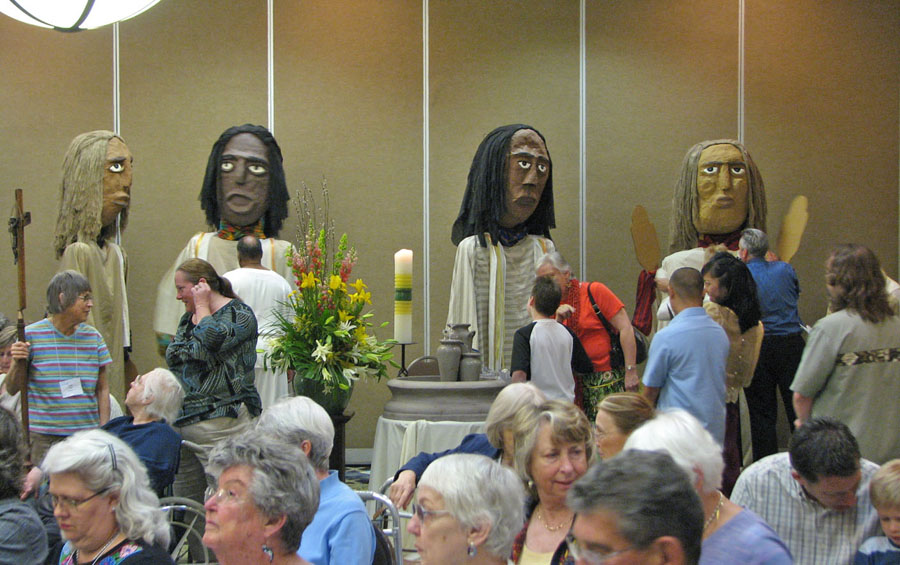
She began her talk with a brief history of the current biblical scholarship to recover the figure of Mary of Magdala from layers of distortion in order to recognize her role as a significant leader in the early church. [I bet that was a hoot!] Sr. Kane praised the organization Future Church, founded in Cleveland in 1997, for its work in assessing the projected impact of the priest shortage and promoting creative approaches [I suggest big puppets.] to meeting the church’s need for liturgical and pastoral leaders.

Sr. Kane reminded her audience that Mary of Magdala is mentioned prominently in all four Gospels as a companion and disciple of Jesus, one of a group of women who accompanied and supported him in his ministry, were present at his death and burial and the first witnesses to his resurrection. Mary’s status as “the apostle to the apostles” was celebrated in the early church and is still preserved in the Eastern church. But by the fourth century in the West, as part of an official suppression of female leadership, Mary of Magdala was represented in sermons and iconography though a conflation of scriptural passages that identified her primarily as a prostitute and public sinner.

In the second half of her talk, Sr. Kane spoke of the current situation of women in the church and the inspiration to be found in examining the witness of St. Mary of Magdala. An edited version of her remarks follows [to which I may add some of my own observations in the usual way] :

Woman, why are you weeping?

“Let us place ourselves for a moment in the garden where Mary was. This is a woman who has just experienced the torture and most brutal form of death of a very close friend, [Notice how she diminishes the LORD, reducing Him to "friend" status.  Modernists always reduce the supernatural to the merely natural.] a death that was indeed an execution, capital punishment, [It was, Sister, deicide.] with very few supporters. The disappearance of people after his death and burial was more out of fear that they would be captured and arrested and perhaps tortured.

“But we get the image of Mary of Magdala as someone who was a close, intimate friend, a companion, [I wonder what her implication is here.] certainly a benefactor [? Evidence?  For any of that?] to Jesus, and a disciple. So each of us here, we also weep openly or we weep interiorly at the death of loved one, whether that death be from what we call natural causes or much more traumatic and sudden. But we need to enter into that garden scene, feel the depth of grief, the anguish and pain at so horrible a death, and we know the relationship that Mary had to Jesus, [Essentially, there is no evidence to back up what she is saying.  Instead, she is lowering this whole discourse to the level of mere sentimentality.] certainly a close, intimate friend and companion. And at his death, we can conclude [ROFL! But get this next line…] that she probably had a conviction that a grave injustice had been done. [D’ya think?] When one has a clear vision and insight about injustice, one weeps not only with anguish but from anger, with rage. Rage comes from courage, and at any injustice, [And now we get to her theme…] all of us should be filled with rage[This actually would be a more apt title for this talk.   This is what women such as Kane are all about, perpetuating anger based not so much on any solid and dependable evidence – certainly not on what the Church teaches as a starting point – but personal sentiment, personal rereading of texts, personal desires.  It’s all about her and her feelings and – damn it – she’s angry and wants everyone to as angry as she is. Misery loves company.  So, she’ll put on her smile for her talks, but inside something else is going on. Ridi del duol, che t’avvelena il cor!]

[Let’s wallow in the theme of anger for a while….] “The scriptures have said continually, ‘God is slow to anger.’ God is not without anger. Why does God have a sense of anger? Because of injustice. Why do we have a sense of anger? Because of injustice. [RRARRR.  I just had the image of the scene in the Monty Python movie where the women have false beards so they can be fully participate as equals in the ministry of stoning.] So such an emotion is core to righting the wrong, core to bringing about justice. [Emotion, not reason or facts.] So I feel that her weeping in the garden is certainly because of a great a loss, [loss of a… what?  A friend?] but also because she was facing of a grave injustice. [Okay…. she was really angry too.  Angry at the Apostles!  Those meanies.]

“And then the question, what do we do about that?  [RRARRR!]

Twitter“Let me speak now of the women of our Catholic community today. Why do we weep? [sniff] Without the full incorporation of women into leadership, discipleship and all church ministries — which was the vision of the church council — without full incorporation into and participation at the liturgy, [BUZZ WORD ALERT…] we do not experience community as women at liturgy, [LOL!] and we do not experience life-giving worship. Our presence at liturgy has become and continues to be a source of anguish, sadness, even emptiness. [The Anglican Church is ready!  Go to them!  They are waiting to heal your brokenness, dry the tears of the womany community of weeping…ness.] We continue in severe tension over the basic language to describe humanity, and this has gone on for decades, the sexist language that we refer to as exclusive language The continued use of terms like ‘man,’ ‘his,’ and ‘mankind’ denies our very presence. [It’s ineffable, sister.] It certainly doesn’t give recognition and respect; and we are surely invisible. [If only.] The anguish, the distress, the absence of a sense of worship in community has gotten much more severe.

“In 1978, Pope John Paul I said publicly, and I have never forgotten this and continue to proclaim it. ‘We need to call God mother as well as father.’ It was a powerful statement. I can still remember him being quoted. Actually I saw him on television at the end of a conference he was having. Because until we do that, our language of God is exclusive, patriarchal, [Wait for it!] militaristic[Was that a collective groan I heard from the readers?]

“And one of the severe tensions we have in the church is between the vision we have of community and governance that is monarchical. [RRARR!  But wait for this next shocker…] I have been with bishops who say, ‘We are not a democracy.’  [Can you imagine such a thing?] And the question to the bishop is then, what form of governance are we? And do we not respect cooperation and participation and inclusion? We talk of community but we still have the governance of a monarchy.  [With neither a full grasp of history nor clear reason as her strong points, she seems to think that monarchy excludes cooperation and participation and inclusion.]

“So the language about God is a source great distress to a growing number of women. Catholic women weep because male catholic leaders, many of them bishops and pastors, are culturally ignorant and culturally impotent [LOL!] regarding the presence, the potential, the human aspirations of women to be adult, mutual co-responsible collaborators. A wonderful word. ‘collaborate.’ It means we co-labor. I am mutually equal with you[There should be some canonical penalty, some gravior delictum, for what she does to the English language.]

“When I was president of the Leadership Conference of Women Religious, we were called to Rome and been having meetings with the Vatican year after year after year, since before 1970. If anyone wants to know why this (current) investigation is happening, they have not been listening for 35 years. [I bet that was a laugh line, too.] We have done it repeatedly. So much so that we say, why should we do it again? But, good women that we are, women religious, we go back again. A very difficult issue.

As Sr. Mary Collins said, she would love to have a conversation with the bishop who told her they worshiped different Gods. [There, folks, it is.  These women believe in a different religion.] I find myself saying, there are so few of them I could have ever had a conversation with. Even if there was a conversation, there isn’t the mutuality, there isn’t the respect, there isn’t the sense that indeed we are radically equal. [You see… she has relational wisdom.  She understands.]

‘When we finished our meeting in Rome, I said to one of the sisters, find out what they thought about us being there, what they thought about the meeting, and let me know when you come home. Very faithfully, she came home and said, ‘Theresa, they’re saying over there that you sisters came over here as if you were equal.’ I said, ‘That’s a compliment. Please tell them we are equal!’  [She is using the word "equal" a lot.  And she is using it in the context of things that happened in Rome.  Italian "uguali" isn’t the same in its impact.  I can hear it: "come fossero uguali"… as if they were the same" as men.  This sort of thing happens all the time in a language.  A non speak of English will get the nuance slightly wrong and the American hears something that wasn’t intended.  What we have here is a failure to communicate.   There is equality.  There is not equivalence.  Men and women are equal but not the same.  Equal in dignity, but different in many other aspects.  The differences, which God must have wanted, mean something.  One of the things they mean is that women can never be ordained.  Women are equal in dignity, but not equivalent in roles in the Church.  So, not only is she spinning some idiot tale about Mary Magdalen, she is spinning a totally false reconstruction of something told third hand and filtered through a different language.]

“That’s the mindset. How do we have a conversation about that? We need to weep. [The… just… get on with it.  Tramuta in lazzi lo spasmo ed il pianto / in una smorfia il singhiozzo e ‘l dolor, Ah!] There is a sense of ignorance about the human aspirations of women to be adult, mutual collaborators.

“Women of the Catholic community. Why are we weeping today? We are in crisis. [Things not going your way these days?] There are a number of women who have already moved out of traditional Sunday worship. They are still finding where they want to go. [Like sheep, without a male shepherd.] We have a number of women who have begun very courageous, strong alternative liturgies, [cf. puppet liturgy photo, above.  But get this… ] which we believe are valid, mystic, pastoral, spiritual — all the qualities that are needed for the human soul. [Except for the whole part about risking going to hell.]

We have many who are moving to other protestant traditions. [The Anglican Church embraces you, Sister, in your angerrrrrr!  Feel the anger.  Feel the power of the dark side of the Force.] We also have a growing number of women who are doing to feminist liturgies, taking turns presiding, co-presiding, perfectly comfortable with it. [Yahhhhhh riiiight…. perfectly comfortable.  I wonder how they decide which of them is going to "preside".  Imagine that scenario. Does she have more right to preside since she was head of the LCWR?  If the actual head of the LCWR comes along, can she only co-preside?  Who get’s to preside?  Can the sister who has fewer articles in NCR be chosen to embody their embodied…ness?] I think it’s a conscience call. Maybe it is the beginning of a new church. Maybe this is how we have to look at a Pentecost. I think we need to be willing address it. To continue in an exclusively male priesthood is in my judgment both a form and expression of idolatry. [And that, friends, strike me as a clear example of both heresy and blasphemy.  Perhaps Sister’s superior needs to have a chat with her after getting a note from the CDF.]

Why is it we cannot have a woman, why is it in our congregations, or you go into your parish church and 80 to 90 percent of those present are women, and no woman can be up there presiding at Eucharist. If the priest doesn’t show up, we have a wonderful Communion service, [Note the reasoning: Communion service is "wonderful" because a woman can do it.  It is not Mass, which requires a man.  There is no reference to the LORD.] but you can’t even give a homily because that isn’t allowed.  [If this is an example,….]

“One story. A group of sisters in the Midwest were having their community assembly. Out of courtesy, they invited the bishop. [They hated him, but they invited him.] We generally do not invite the bishop because we are such good friends and want to celebrate, but unfortunately – and I feel very sad about this — we do it because it is expected and out of courtesy. The bishop wrote back and said, it must be in a parish church and not at the motherhouse, you must have altar boys come in to assist me, and no sister may carry the cross at the beginning of the procession. With real regrets, [after passing around those fake beards] they met as a group, they really prayed about it and decided not to have liturgy. [Because that is their decision.] They didn’t want to disinvite the bishop, so they said that their plans had changed. They should have said, we are disinviting you, because so many of us have experienced being disinvited. When anything is a little bit not quite right, we get disinvited.  [You know.  I agree with this.  So, in that spirit.  Sister!  I disinvite you from the Catholic Church!  The Anglicans, on the other hand, are standing their with tissues to dry your tears.  Go! Sister.  Fly! Be Free to explore your other-invitedness.]

“But the real tragedy is that a magnificent opportunity is lost for a bishop to gather with a group of women to worship together.

[And whine begins to soar….]

“So women of the 21st century have done what we have done down through the ages. We weep. [A lot.] But we have also done other things. The material from FutureChurch shows that we can do something about this. We are creating new liturgies, a new space for ourselves [Cue gathering song musicness: " Isn’t it rich, isn’t it queer. / Losing my timing this late in my career. / And where are the clowns. / Quick send in the clowns / Don’t bother, they’re here."]

“As a Catholic woman, I continue to hope. Why? At gatherings such as this for these three days, [three … whole… days…] I hear so many women and women who are so open and want to make this a new church. So I go home having been inspired. I don’t really have a need to run back to traditional worship. [Remember that this is a matter of perspective.  For her, you could have just about any wacko thing take place, but if there is a male priest, it is "traditional".  See how language shifts depending on the context?  But remember: they are open!  They are sooooo open.  Would they be open to a man presiding at their non-traditional self-expression liturgies?  I have a learnéd dubitation about that.] There are many organizations that are very much alive, spiritual and Vatican II: Call to Action, Women’s Ordination Conference, Future Church., [AND…] the congregations of women religious ourselves. [That, friends, may suggest a reason for the Apostolic Visitation.  Am I reading too much into it?] In many ways we are a counter organization within an organization.

“I’ve had women say to me, ‘How do you put up with those bishops?’

“I say, ‘To be perfectly honest, I really have very little to do with them. How do you put up with your husband?’  [HAR HAR HAR!]

“Women still me stories that are shocking. ‘I can’t drive when he is in the car. He still pays all the bills, and I have to get some money from him.’ This goes on on a regular basis.

“But basically I believe that the congregations of women religious have much more equality and I think that the renewal that took place in our communities brought about that equality. [Minor detail: You are all old now and there are no new vocations.] We worked hard at this for many years. [And look at all the wonderful empty convents you have made.] I think that alternative communities are worshipping and are also ecumenical, which is a major breakthrough.

“And finally I get hope from the words of scripture. In the fullness of time God’s purpose will be revealed. [It sure will.  In the meantime, the last sister left needs to switch off the light and lock the door behind her.] The question is, when will the renewal come? In the fullness of time. It may be tomorrow. Maybe next week. But it’s God’s time, not my time. In the fullness of time. I also have the deep conviction that nothing is impossible with God. [So STAY ANGRY.] People will say to me, ‘You can’t do that, it’s not possible.’ With God, all things are possible. And those are the things that give me great hope.”

I can hear the opening song for their made up liturgies, as they vest for … whatever you call it:

Vesti la giubba, …. e la faccia infarina.

[youtube:http://www.youtube.com/watch?v=Ky271W94VHA]

Finally, I think it would annoy Sister and the editor of NCR were you to follow me on Twitter or buy me a cup of coffee.  Just the thought of it….

UPDATE 1935 GMT
:

I am delighted to report that a few people have sent donations through the coffee cup icon!  Let the annoying begin!

UPDATE 11 Aug 1342 GMT:

I am even more delighted to be able to report that even more readers have sent liberal-annoying donations using the coffee cup icon below or the button on the side bar!

Posted in SESSIUNCULA, Throwing a Nutty | Tagged ,
80 Comments

A short rant on sacred art and architecture

I was at a conference on sacred music in Rome some years back where something occurred that was both irritating and amusing.

A liberal leaning choir director was going on and on about the sort of music we need for liturgy.  He was dead wrong about everything, of course.  He was, as you might suppose, a bit of a composer himself and he was exalting the rubbish he wrote.  By contrast many of the people at the conference were interested in Gregorian chant and real sacred music.  When it was observed that Gregorian chant had been shoved into the dustbin since the Council, the liberal self-promoter objected that Gregorian wasn’t dead, that it was indeed used – he himself rewrote melodies for his own compositions for responsorial psalms, that we have all these new books of chant from Solesmes!   The crushing response came from Msgr. Miserachs of the PIMS: In that view, Gregorian chant must be seen and not heard.

It is more and more apparent that the setting for our sacred music is not merely a desktop, or in a concert hall, but in church during our liturgical worship.

There is a vast treasury of worthy sacred music.  The doors to that treasury were slammed shut in the name of a false understanding of active participation.  Generations are being denied their patrimony and the opportunity to worship God in continuity with their forebears.

Now shifting to a slightly different gear….

At Sandro Magister‘s site there is a very good article about the famous painting by Raphael of the Transfiguration of the Lord.  You will want to read it.

During your reading you will come to these paragraphs, which I want to highlight with my emphases.

Monsignor Marco Agostini, an official in the second section of the secretariat of state, master of pontifical ceremonies, and a scholar of liturgy and sacred art, has rightly complained in "L’Osservatore Romano" that this improper placement deprives the painting of "three fourths of its capacity to speak."

Above the altar and during the Mass, in fact, the "Transfiguration" helped the priest and the faithful to "see" the mystery that was being celebrated, to identify in the consecrated white host the glorious Christ. This was why Raphael had conceived and painted it. While in a museum, this expressive power and liturgical function disappear.


I often visit museums when I travel.  I always have twinges of regret when I look at altarpieces.  Even as I admire their beauty, I wish that they could still be altar pieces.   The same thing applies during a concert of sacred music. 

Our church should be filled with the very best that we can offer.   The building itself, all that ornaments it, and everything that fills its space through gesture, word and song must be sacred and must be art.

I say: if a building was built in a certain style and it a good example of that style, leave it be.  I’ll grant that some buildings and their accoutrement are not particularly worthy.  Fine.   But generally, if you want something new, then don’t destroy the existing work by bastardizing it.  Go build something new.  But leave things alone.  Leave them whole.

Posted in Wherein Fr. Z Rants |
22 Comments

The stupidest thing I have read in a long time

On a site called – ironically – The Moderate Voice I saw one of the stupidest things I have ever read.  As a matter of fact, this is the sort of entry that brings well-deserved scorn down on many slapdash internet sites and gives blogs and so forth a bad image.

I will not reproduce the whole thing here, because it is so riddled with errors of thought and of history that it would take too much time to untangle them.

I think what is at the heart of this idiotic piece is both baggage about the Church and a desire to destroy traditional marriage in favor of homosexual unions.

Here are a couple samples.  Set your coffee down.

Raise your hand if you knew that the linkage of “marriage” and religious norms is an artifact of the Catholic Church’s fight for its life in the 16th century?

I’m guessing that many Americans would shudder if they realized that their current religious beliefs were so wedded to the Church’s fight with Protestants. The supremacy of The Church in all things marriage was formalized with The Council of Trent (1545 – 1563), which was organized in response to the “heresies” of the Protestants, led by Martin Luther.  From Wikipedia (emphasis added):

The writer then quotes some things about the reaction of the Church at the Council of Trent in the face of Protestant attacks on marriage as a sacrament (Protestants don’t believe marriage is a sacrament).

The writer thinks that because the Church reacted to Protestant errors, and established a theology of marriage and canons about belief in marriage as a sacrament and its celebration then… wait for that… that is what the Church – I am not making this up – invented marriage.

Yes, friends, the Church invented marriage in the 16th century.  It seems that during the first 15 centuries of her mission the Church didn’t bother much with marriage.

So why would this person write something which is so obviously absurd?  Keep in mind that the writer doesn’t have clue about any dimension of her subject.

The rhetoric surrounding California’s Prop 8 has its roots in the evolution of marriage from a means of male lineage preservation (Jews and the God of Israel and the Old Testament) to a convenience of economics (where women were chattel) to a ceremony of religious sanctity. It is time for America to truly throw off the shackles of the Church and embrace marriage as “an expression of the right to happiness,” a journey with a major milepost during my lifetime — Loving v Virginia. We need a clean break between state and church, marriage that is a private contract between two consenting adults. Period.

Get the picture?

The next step in this program will allow you to marry your dog.

Posted in One Man & One Woman, The Drill, Throwing a Nutty | Tagged , , , ,
32 Comments

Blessed Sacrament targeted for theft from a church

Some years ago I had to stop reserving the Blessed Sacrament at the church I had in Italy because of break ins.  The area is a well-known zone of satanic activity.  There are also many drug users.  These will two groups will overlap: people break into church and then sell the Blessed Sacrament to satanists.

The following story is about a church break in during which only a ciborium with Hosts was taken from a tabernacle.  The fact that this was the only thing taken points to some satantic cult, rather than a prank or mere desire for something to sell.

From the thetimes-tribune.com

Carbondale Church desecrated by theft
BY JEREMY G. BURTON (STAFF WRITER)
Published: August 6, 2010

A golden container and the hosts for Holy Communion inside it were stolen during an overnight break-in Tuesday at St. Rose of Lima Church in Carbondale.

Called the ciborium, it was the only thing taken.

The theft rendered the building desecrated under Catholicism, in which practitioners believe the hosts change into the body of Jesus Christ. On Wednesday afternoon, Bishop Joseph C. Bambera led a ritual ceremony and celebrated Mass to rededicate and bless St. Rose.

Monsignor David L. Tressler, the church’s pastor, described the Catholic community as stunned and hurt. There is a "real sense of violation," and it is all the more disheartening because the thief targeted the hosts, which are at the heart of the religion’s identity, he said.

There were certainly more valuable items. "Once they were in the church, they could’ve had a field day," Monsignor Tressler said.

The thief broke into the church through a window sometime late Tuesday or early Wednesday and then walked out the front doors, Monsignor Tressler said.

Further information from Carbondale police was unavailable.

The ciborium is a gold metallic cup with a lid, about 6 to 8 inches tall. It was taken from the locked tabernacle.

For security, the tabernacle’s lock has been changed, and the church will now be closed immediately after the daily noon Mass, Monsignor Tressler said. Typically, the building closed at 2 p.m.

The community uses the church too frequently to limit access during the morning, Monsignor Tressler said.

"I don’t want to punish all the people because of this one situation," he said.

During Bishop Bambera’s ceremony to cleanse St. Rose, the altar was stripped bare and special prayers were said, according to a Diocese of Scranton statement about the theft. The bishop blessed the altar, tabernacle, walls of the church and the people with holy water.

In his homily, according to the diocese, Bishop Bambera expressed hope that whoever stole the ciborium would return it and seek forgiveness for the crime.


This certainly would fall into the category of graviora delicta if the person who did this was not in some way mentally impaired.   Generally these thefts occur because the Hosts are desired for filthy and diabolical reasons.

I ask the readers to make some act of reparation today, perhaps through fasting and or almsgiving, as well as prayer for the thief who – if acting in such malice – risks roasting for eternity in the deep cinders of hell.
 

Posted in SESSIUNCULA |
19 Comments