Meteoric procession

And now for a different sort of procession…

A very cool story brings together things processional, astronomical, a census year and a reference to Manhattan (where I am as I write):

Walt Whitman Meteor Mystery Solved

(June 3) – The long-standing mystery over exactly what famed poet Walt Whitman saw streaking though the sky 150 years ago has apparently been solved by a team of bookworm astronomers.

Following a trail that began with a 19th century painting and led to hundreds of newspaper reports, the researchers discovered that the "strange huge meteor-procession" mentioned in Whitman’s noted collection "Leaves of Grass" indeed refers to a rare procession of earth-grazing meteors that occurred in 1860.

"Meteor processions are so rare most people have never heard of them," said Texas State University physics professor Donald Olson, who worked on the investigation. "There was one in 1783 and a Canadian fireball procession in 1913. Those were all the meteor processions we knew of."

Earth-grazing meteors unmasked

Earth-grazers enter the atmosphere at low angle, from the point of view of a given skywatcher, and appear to scoot slowly and dramatically along the horizon. They’re much different than meteors appearing overhead and shooting swiftly toward the horizon

For years, Whitman’s description had been alternately attributed to several events, including: The 1833 Leonid meteor shower, the 1858 Leonids shower and a famous 1859 fireball.

But the timeframe of the poem, which is titled "Year of the Meteor," listed under "1859-1860," and includes a definite reference to the Great Comet of 1860, conflicted with the 1833 sighting.

Evidence for the1858 sighting was also weakened when the date of a separate meteor shower observation by Whitman was corrected from 1858 to 1833. Additionally, a fireball is only one blaze in the sky, while a meteor procession exhibits multiple blazing objects.

Olson and his team describe their astronomical investigation in the July 2010 edition of "Sky & Telescope" magazine.

Painting shows the way

A single painting by 19th century landscape artist Frederic Church was the happenstance clue in solving the puzzle behind Whitman’s reference. Titled "The Meteor of 1860" and picturing a procession of meteors

Upon visiting Church’s house in New England and a research library that contained old diaries of a friend, the team learned that Church lived in Catskill, N.Y., in July 1860, when the painting was produced.

That date allowed the researchers to focus their study on the time period’s newspapers, which surprisingly enough verified the sighting of an Earth-grazing meteor during the evening of July 20, 1860.

Breaking apart in the atmosphere, the meteor split into multiple fireballs that burned overhead in skies visible from the Great Lakes to New York State.

The New York Times, Smithsonian, and Harper’s Weekly all covered the event, with Scientific American calling it "the largest meteor that has ever been seen."

According to Olson, the eyewitness accounts from town newspapers alone totaled in the hundreds and provided enough information about the meteor’s changing location for the team to extrapolate its route.

"From all the observations in towns up and down the Hudson River Valley, we’re able to determine the meteor’s appearance down to the hour and minute," Olson said. "Church observed it at 9:49 p.m. when the meteor passed overhead, and Walt Whitman would’ve seen it at the same time, give or take one minute."

"A really cool part is that the Catskill newspaper describes it as dividing into two parts with scintillations, exactly like the painting," said co-researcher Ava G. Pope, an Honors Program at Texas State University who contributed to the project.

Despite its extreme rarity as an astronomical phenomenon and its heavy documentation in the day’s newspapers and magazines, the event was forgotten by the mid-20th century, researchers said in a statement.


Let’s see Walt Whitman (+1892) "Year of Meteors, 1859 ’60" from Leaves of Grass.

YEAR of meteors! brooding year!     
I would bind in words retrospective, some of your deeds and signs;     
I would sing your contest for the 19th Presidentiad;     
I would sing how an old man, tall, with white hair, mounted the scaffold in Virginia;     
(I was at hand—silent I stood, with teeth shut close—I watch’d;             5
I stood very near you, old man, when cool and indifferent, but trembling with age and your unheal’d wounds, you mounted the scaffold;)     
—I would sing in my copious song your census returns of The States,     
The tables of population and products—I would sing of your ships and their cargoes,     
The proud black ships of Manhattan, arriving, some fill’d with immigrants, some from the isthmus with cargoes of gold;     
Songs thereof would I sing—to all that hitherward comes would I welcome give;      10
And you would I sing, fair stripling! welcome to you from me, sweet boy of England!     
Remember you surging Manhattan’s crowds, as you pass’d with your cortege of nobles?     
There in the crowds stood I, and singled you out with attachment;     
I know not why, but I loved you… (and so go forth little song,     
Far over sea speed like an arrow, carrying my love all folded,      15
And find in his palace the youth I love, and drop these lines at his feet;)     
—Nor forget I to sing of the wonder, the ship as she swam up my bay,     
Well-shaped and stately the Great Eastern swam up my bay, she was 600 feet long,     
Her, moving swiftly, surrounded by myriads of small craft, I forget not to sing;     
—Nor the comet that came unannounced out of the north, flaring in heaven;      20
Nor the strange huge meteor procession, dazzling and clear, shooting over our heads,     
(A moment, a moment long, it sail’d its balls of unearthly light over our heads,     
Then departed, dropt in the night, and was gone;)     
—Of such, and fitful as they, I sing—with gleams from them would I gleam and patch these chants;     
Your chants, O year all mottled with evil and good! year of forebodings! year of the youth I love!      25
Year of comets and meteors transient and strange!—lo! even here, one equally transient and strange!     
As I flit through you hastily, soon to fall and be gone, what is this book,     
What am I myself but one of your meteors?
Posted in SESSIUNCULA | Tagged ,
1 Comment

Your Corpus Christi Sunday experiences

People have been mentioning their Corpus Christi processions under my WDTPRS entries.

Here is an entry specifically for your processions.

Yesterday I was at St. Mary’s in Norwalk, CT where, coincidently, I found also my friend Fr. Uwe Michael Lang.

Fr. Markey is pastor at St. Mary’s.  We have seen him before in these electronic pages.

The parish church is getting a renovation, by stages.  The sanctuary has been spiffed up and it looks splendid.   They have more work to do on the nave.

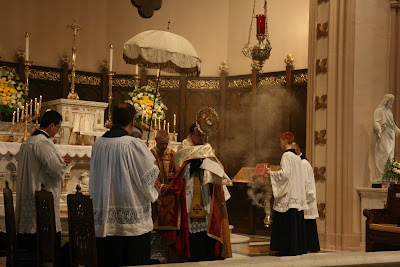
Your Corpus Christi Sunday experiencesFor Corpus Christi (external celebration on Sunday) there was a Solemn Mass in the Extraordinary Form.  The ceremonies were very smooth and you could tell that the servers were well-trained and comfortable with them.   There are certain points during a Solemn Mass when you can tell if they really know what they are doing: the sanctuary takes on the aspect of one of those wonderful clocks in a German town square with smoothly moving figures.

It was good to see the range of ages among the servers.  Some of the little shavers had just made their First Holy Communions.  They alternated between the sort of solemn that only the very young are able to convey and moments of wandering attention.  Solemn won in the end.  The range of ages in the sanctuary assure that they will have well-trained servers in the future.  The young one learn from the older boys and they absorb the manner and attitude required near the Lord’s altar.

The music was polyphony and Gregorian chant.  The Mass setting was Palestrina’s Missa Lauda Sion, which was entirely appropriate.  There were a number of children involved.   I am not a great proponent of mixed Gregorian chant groups (males and females singing at the same time), and would prefer separate but equal choirs.  When a women’s schola sings Gregorian chant, the effect is stunning.  But everyone sang very well and greatly contributed to the reverence of the rite.

Your Corpus Christi Sunday experiencesThe procession was quite long, winding down to the town center and then back to the church. During the procession there were prayers in English and Spanish, as well as hymns and, thanks for Fr. Markey with a blowhorn readings citing the Council of Trent about the usefulness of processions to combat heresy. Very festive.

After the procession I stopped in briefly at the informal reception and met some very nice folks, including readers of this blog.

It was a fine Sunday.

St. Mary’s in Norwalk is a happy, healthy Catholic parish with a strong liturgical life and a sound, dedicate pastor.   They are revitalizing their Catholic identity brick by brick in Norwalk. 

WDTPRS kudos.

Posted in Brick by Brick |
83 Comments

What is your good news?

Let’s hear your good news… pick us up a bit.

For my part, though I am not at 100% I no longer feel as if I were about to die, which significantly brightens the day.

Posted in SESSIUNCULA |
41 Comments

The Classic

It is a fantastic morning in Manhattan. This morning is as fresh and cool as the last days have been muggy and oppressive.

I have strolled to a nearby shop for something you just don’t seem to be able to get elsewhere in the USA.

A good bagel.

Bagels I have had elsewhere in the USA seem to have been made – perhaps by Michelin or Uniroyal – from some mixture involving, at one point or another, sawdust.

Behold the classic plain bagel with cream cheese.

The Classic

I won’t need lunch after this.

I may not need supper or even breakfast tomorrow.

The bagel is made in the premises, of course, and is about the size of a softball.

It is a perfect 10 on the Chewy Scale.  Chewiness is a necessary benchmark of the bagel.

The coffee is flesh removing hot and must cool to be enjoyable.  I like a little darker roast, frankly, and a little stronger, but this isn’t bad coffee.

All in all a strong start to what I hope is a productive day!

Posted in SESSIUNCULA |
13 Comments

Into the heart of darkness…

Into the heart of darkness...

UPDATE:

The great Vincenzo‘s version….

Posted in My View |
28 Comments

WDTPRS: Corpus Christi – Post Communion (2002MR 1962MR)

The Solemnity of the Body and Blood of the Lord, or Corpus Christi, Corpus Domini in some places, actually falls on the Thursday after Trinity Sunday.  

In the 1975 Missale Romanum, after the texts for the Mass, there is a note that the observance of the feast of Corpus Christi can be transferred to Sunday.   In the newest edition, the 2002MR, we read not about the transferal of the feast, but rather:

Expedit ut processio fiat post Missam, in qua hostia in processione deferenda consecretur. Nihil tamen impedit quominus processio peragatur etiam post publicam et protractam adorationem quae Missam sequatur… It is advantageous that a procession be held after the Mass, in which the Host to be borne in procession is consecrated.   However, nothing prevents the procession from being held after the public and extended adoration which follows Mass….

In other words… really, folks, you should have a procession!

The Solemnity of the Most Holy Body and Blood of the Lord celebrates the institution of the Eucharist in a more focused way than it is even on Holy Thursday, in the context of the Triduum. 

It was established by Pope Urban IV in 1264 and its Mass and Office composed by St. Thomas Aquinas.   The feast itself was inspired by a great miracle.  In 1263 a German priest, Peter of Prague, making a pilgrimage to Rome stopped at Bolsena. He was having serious doubts about the Real Presence of Christ in the Host.  While celebrating Holy Mass in Bolsena at the tomb of the virgin martyr St. Christina, at the consecration blood began to drip from the Host.  The Host bled over his hands onto the altar and the corporal (the linen cloth spread under the Host and chalice during Mass). Fr. Peter stopped the Mass and asked to be taken to the neighboring city of Orvieto, where Pope Urban was in residence with his court (also there were St. Bonventure and St. Thomas).  The Pope listened to the priest’s account then began a complete investigation.  Afterward, Urban ordered the bishop of the diocese to bring to Orvieto both the Host and the linen corporal stained with the blood. The Pope made a great procession with the entire papal court out of Orvieto to meet the other procession approaching with the Host and corporal.  He brought the relics to Orvieto, where the great new cathedral church or “Duomo” was raised for their display, the cornerstone laid in 1290.  They are still visible in Orvieto today.  The gold reliquary is one of the wonders of medieval craftsmanship and religious aspirations.  Pope Urban prompted the drafting of an Office and Mass for the new feast which he instituted in August 1264.    Anyone going to Rome would do very well to travel north also to Orvieto, which is not far at all, to see the magnificent cathedral with its bas reliefs by Lorenzo Maitani (1255-1330) and also a chapel decorated with frescoes by Luca Signorelli (1441-1523) and Fra Giovanni da Fiesole – “Beato Angelico” (1387-1455) whose tomb is at S. Maria sopra Minerva in Roma and who was beatified by Pope John Paul II in 1984.  Bolsena is also not far, with the church and tomb of St. Christina where there is also a fine small catacomb you can visit.

We saw the Collect and Super Oblata in other entries.

Let’s now see the …

POST COMMUNION…

LAME-DUCK ICEL VERSION:
Lord Jesus Christ,
you give us your body and blood in the eucharist
as a sign that even now we share your life.
May we come to possess it completely in the kingdom
.

This is what you hear in most parish churches on this feast.  But is this what the prayer really says? 

Let us take a look now at the Latin version which was and is the Postcommunio for Corpus Christi in the 1962MR.  

LATIN: (2002MR):
Fac nos, quaesumus, Domine,
divinitatis tuae sempiterna fruitione repleri,
quam pretiosi Corporis et Sanguinis tui
temporalis perceptio praefigurat
.

I suspect that there is more to this Latin prayer that the lame-duck ICEL version suggests.  Sliding the hefty Lewis & Short Dictionary a little closer we can examine some of the vocabulary and pry its treasures loose.  

The first word we should dig into is fruitio which means, “enjoyment”.  It is derived from the deponent verb fruor, famous to Latin students as one of the several deponent verbs (utor, abutor, fruor, fungor, potior, vescor) whose “object” is usually in the ablative case, rather than the accusative or (in the case of 65 verbs) the dative.   Fruor (infinitive frui) is “to derive enjoyment from a thing, to enjoy, delight in (with a more restricted significance than (utor) uti, to make use of a thing, to use it)”. 

One might remember the use of “use” in the Early Modern English of Shakespeare such as when Brutus says to the peevish Cassius in the tent before the battle, “By the gods / You shall digest the venom of your spleen, / Though it do split you; for, from this day forth, / I’ll use you for my mirth, yea, for my laughter, / When you are waspish. (Julius Caesar IV.iii.51-55)” or when the Bawd says to Marina in Pericles Prince of Tyre, “Pray you, without any more virginal fencing, will / you use him kindly? He will line your apron with gold” (IV.vi.51-2).  

Note that the L&S definition I cite above makes a distinction between utor and fruor.   Both mean “use” but fruor has the added note of enjoyment.  

St. Augustine of Hippo in Book I of his magisterial De doctrina christiana makes some distinctions about uti and frui.  Before he became Pope, our Holy Father John Paul II wrote a book in 1960 entitled (in its English translation of 1981) Love and Responsibility (originally Miłośći odpowiedzialność) which grew out of his lectures during 1958-59 at the Catholic University of Lublin.   He explores the difference between uti and frui in the context of human sexuality. 

Taking a cue from St. Augustine, Karol Wojtyła explained that, since human beings are images of God, they are consequently the dignified subjects of actions.  They must not be objectified and turned into the objects of uti – of “use” – for “utilitarian” purposes.   That sort of “use” must never be applied to a human being in any sphere of human activity, whether sexual, economic, or other.  As a contrast, the other way of “use” which is more aligned with frui use, includes the element of “enjoyment”, by which is meant far more than mere sensory pleasures. 

Proper “enjoyment” includes an appreciation of what things (or people) truly are. 

This sort of enjoyment-use is found in interpersonal relationships only when there is genuine love, in the sense of charity.  Thus, all utilitarian-use (uti) of another person is wrong while enjoyment-use (frui) is proper when subordinated to authentic love.  Simply put, people cannot be used as a means to an end without any respect for the fact that they, too, are “acting agents”, the acting subjects of their own actions.  All “use” of others must be subordinated to the good of the persons involved.  

We also have the word perceptio, (from the verb percipio) which basically signifies a “a taking, receiving; a gathering in, collecting.”  It is also, by extension, “perception, comprehension”.   St. Ambrose in his Commentary on Luke 4, 15 uses this noun with “frugum fructuumque reliquorum… a gathering of the produce of the earth and of the remaining fruits”.  Both frux (which gives us the genitive plural frugum) and fructus (whence comes fructuum) are both related/derived from fruor, frui, fructus.  

At the time of his own Holy Communion in the 1962MR the priest said silently (and may say with the 1970MR in a truncated version):

"Perceptio Corporis tui, Domine Iesu Christe, quod ego indignus sumere praesumo, non mihi proveniat in iudicium et condemnationem: sed pro tua pietate prosit mihi ad tutamentum mentis et corporis, et ad medelam percipiendam…Let not the partaking of Your Body, O Lord Jesus Christ, which I, unworthy, presume to receive turn out to be unto my judgment and condemnation: but by Your goodness, may it become a protection of soul and body and remedy to be received.…”

LITERAL VERSION:
Cause us, we beseech you, O Lord,
to be filled with the eternal enjoyment of your divinity,
which the worldly reception of Your precious Body and Blood prefigures
.

Reception (perceptio) of the Host at Mass is the climatic moment in a sacred action which, glorious as it is, constitutes but a foreshadowing of our participation in the heavenly liturgical banquet before the throne of God.  We receive Communion in this life (temporalis perceptio) as a token or promise of future glory (praefigurat).  We want this gift of God to transform us in such a way that we will never loose this perceptio.  We all have our own role to play in this transformation. 

The words fruitio and perceptio both have a subtle agricultural overtone.  We gather grain for bread that will be made into hosts for Mass, grapes for wine.  Spiritually we reap what we sow as well.  We must cultivate our relationship with God in the Eucharist, carefully and loving, with even greater attention than we might give to cultivating earthly relationships.  Indeed our earthly relationships, for devout Catholic Christians, must reflect the bond of love and unity with have with Christ.

In our prayer we have the phrase divinitatis tuae sempiterna fruitione which speaks of the eternal “use-enjoyment” of God’s divinity.  This sort of use implies an interpersonal relationship built on charity. 

God loves us in His own divine way of loving His creatures.  We, on the other hand, are often at fault in how we treat God and His gifts to us, even His sacrificial self-gift in the Eucharist. 

We must avoid simply “using” the Eucharist by, for example, knowingly and purposefully receiving Holy Communion when not in the state of grace.  We cannot, for another example, present ourselves to the priest and knowingly, willingly, omit confessing mortal sins and then expect to be forgiven.  We must never presume on God’s love and mercy when faced with a temptation by saying something like, “I’ll just do it.  I can always go to confession later.”  These are ways of “using” God in a utilitarian way rather than giving Him the respect, love and worship which is His due.  And we reap what we sow.

In the prayers we say before the Blessed Sacrament during Exposition we sing with the priest the verse and response, “Panem de caelo praestitisti eis… Omne delectamentum in se habentem… You have given to them bread from heaven… Having within itself every delight.” 

Truly the sacrament of the Body and Blood of the Lord contains every delight, for of all the sacraments this sacrament of the Eucharist actually is what it signifies: Jesus Christ truly with us, Body, Blood, Soul, Divinity even in the smallest fragment or tiny precious drop.  

Our consideration of who gives and who is being given in this sacred gift must draw forth from us our very best in every aspect of our lives.

Posted in SESSIUNCULA, WDTPRS | Tagged
19 Comments

WDTPRS: Corpus Christi – Super Oblata (2002MR)

Most of the world’s parishes are observing Corpus Christi today.  In another place I drilled into the Collect.   Let’s look at the Super Oblata, or "Prayer over the gifts".

SUPER OBLATA (2002MR):
Ecclesiae tuae, quaesumus, Domine,
unitatis et pacis propitius dona concede,
quae sub oblatis muneribus mystice designantur
.

ICEL (1973 translation of the 1970MR):
Lord,
may the bread and cup we offer
bring your Church the unity and peace they signify
.

LITERAL TRANSLATION:
We beseech You, O Lord
graciously grant to Your Church gifts of unity and peace
which are mystically signified under offered gifts.

The vocabulary of today’s prayer doesn’t drive us scratching our heads to the informative Lewis & Short Dictionary, so let’s consider what the prayer is really saying in its content. 

In Thomas Aquinas’ beautiful sequence for Corpus Christi, the Lauda Sion, we hear sung, “Signs, not things, are all we see… here beneath these signs lie hidden priceless things.”  We can use this to pry open the prayer, seeking also insight from the Doctor of Grace, St. Augustine of Hippo (+430). 

Augustine looks at the Eucharist in his monumental City of God (ciu.) Book X where he is examining the kind of worship which is due to God (latreia).   He reminds us that God does not need sacrifices offered to Him.  We need the sacrifices. 

He wrote in a letter, “God commands nothing for His own benefit but for the benefit of the person to whom He gives the command”. Sacrifices are, “…signs of gifts God has bestowed either for imbuing the soul with the virtues or for attaining eternal salvation, and by the celebration and performance of them we carry out acts of piety useful to us, not to God” (ep. 138.6).  

The outer physical actions of sacrifices are signs of something else: “The visible sacrifice is the sacrament, the sacred sign, of the invisible sacrifice” (ciu. 10.5). 

Augustine says that in the Eucharist Christ, who is the mediator, accepts the Church’s sacrifice “in the form of God”.  However, Christ, “in the form of a servant” also is the sacrifice He receives.  Christ is both priest and victim who commanded the Church to continue this sacrifice in the celebration of the Eucharist, the sacramental sign.  “

The Church, being the body of which He is the Head, learns to offer itself through Him” (ciu. 10.20).  Christ’s Sacrifice unifies Christians in offering themselves to God through their participation in the inner reality perceived in outward sacramental signs, sacramenta. 

For Augustine sacramenta fall into three categories:

1) the rites of the Law and those commanded by Christ;
2) symbolic figures or types, such as the Red Sea which was parted;
3) mysteries like the Trinity or resurrection. 

This three-fold division wasn’t Augustine’s idea.  Augustine did, however, give a definition for a sacrament. 

In ep. 138.7 he says “signs are called sacraments when they have reference to divine things (ad res divinas pertinent)”. 

For Augustine, in his theory of signs, a sign is an intermediary which causes something to enter into our thoughts.  Signs do not distract from the truth of things.  They lead us away from the sign itself onward to something greater, the res.  Similarly, a sacramentum which is a rite leads us beyond the rite itself. 

Later, in Medieval theological reflection founded on Augustine, we get the tripartite distinction of sacramentum (the outward sign of a greater spiritual reality) and res (the invisible reality it points at) and res et sacramentum (in the Eucharist at least, how Christ is truly present).   Augustine, however, considers only sacramentum and res.  This is why some people get confused into thinking that when Augustine speaks about the Eucharist in terms of sacramentum he thought they were merely symbols and not really the Body and Blood of Christ. 

On the contrary, Augustine in an Easter Sunday sermon (s. 229.2), describes to newly baptized Catholic neophytes what is going on in the Eucharistic section of the Mass to which they were not previously admitted.  He describes the effect of the consecration by the priest’s “word” (i.e., the Eucharistic Prayer):

“And from there we come now to what is done in the holy prayers which you are going to hear, that with the application of the word we may have the Body and Blood of Christ.  Take away the word, I mean, it’s just bread and wine; add the word, and it’s now something else.  And what is that something else?  The Body of Christ, and the Blood of Christ.  So take away the word, it’s bread and wine; add the word and it will become the sacrament.  To this you say, Amen.  To say Amen is to add your signature.”

Most of the time when discussing the Eucharist Augustine doesn’t dwell on the change from bread and wine to Christ’s Body and Blood.  Instead, he moves quickly to talk about what the Eucharist means to us and what effect it has, that is, our unity with Him and in Him with each other in the Body of the Christ the Church.  

This is the gift of the Eucharist, what later theology called res tantum whereas the Real Presence would be called res et sacramentum.  The res tantum is the effect in us. 

Let’s listen to another Easter sermon (s. 229A, 2).   Remember, there were stenographers writing his words down as he preached and this is exactly how we have his sermons today!  Augustine compares the people of his flock, especially those just baptized during the night, to the Eucharistic species:

“What you can see on the Lord’s table, as far as appearance of the things goes, you are also used to seeing on your own tables; they have the same aspect, but not the same value.  I mean, you yourselves are the same people as you used to be; you haven’t brought us along new faces, after all.  And yet you’re new; the same old people in bodily appearance, completely new ones by the grace of holiness – just as this too is new.  It’s still, indeed, as you can see it, bread and wine; come the consecration, that bread will be the Body of Christ, and that wine will be the Blood of Christ.  This is brought about by the name of Christ, brought about by the grace of Christ, that it should continue to look exactly like what it used to look like, and yet should not have the same value as it used to.  You see, if it was eaten before, it would fill the belly; but now when it’s eaten it nourishes the spirit.”  

Augustine then explains that on many altars there can be many loaves but in reality all are just one loaf.  So too in the Church there are many people but one Body of Christ (cf. 1 Cor 12:27). 

“What you receive is what you yourselves are, thanks to the grace by which you have been redeemed; you add your signature to this, when you answer Amen.  What you see here is the sacrament of unity.”

Thousands of altars.  Millions of Hosts.  Thousands of chalices.  Millions of faithful.  One Christ.

The Eucharist is our sign of unity. 

It is also the flashpoint of division. 

Pride is the catalyst of discord. 

Many kernels of grain go into the one bread offered at the altar for the renewal of Christ’s Sacrifice. 

Many grapes make one wine. 

Wheat and grapes, the individual elements, are crushed and brought into a deeper unity.  

Humility is the catalyst of unity.

Posted in WDTPRS | Tagged
7 Comments

Brick by Brick in Edinburgh

From your brick by brick file from Damian:

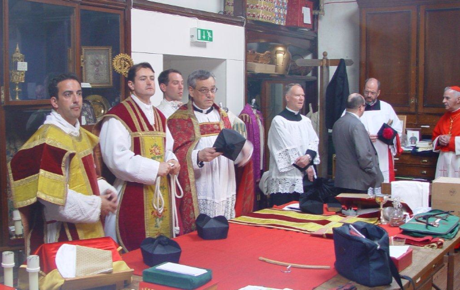
Brick by Brick in EdinburghI like this picture, courtesy of the Papa Stronsay blog, of a young priest preparing to celebrate his first Mass today – in the beautiful Extraordinary Form, since Fr Simon Harkins belongs to the Priestly Fraternity of St Peter (FSSP). And who is that chap in red in the corner? Why, none other than Keith Patrick Card. O’Brien, who preached at the Mass in his own Edinburgh Cathedral.

The Scottish bishops as a whole are pretty unfriendly to the usus antiquior, but by his gesture today Cardinal O’Brien showed that he at least is serious about implementing Summorum Pontificum. I find him a much more approachable figure than other Scots prelates, less inclined to stand on his dignity despite (or perhaps because of) his red hat. I met him once at a party to relaunch the Scottish Catholic Observer, to whom he’s been a good friend; he didn’t sweep in surrounded by flunkeys, but hung around chatting in ordinary priest’s dress, reminding me a bit of Basil Hume in that respect.

Anyway, now that Britain’s senior Catholic bishop (which is what Cardinal O’Brien became when Cardinal Murphy-O’Connor retired) has assisted at Mass in the Extraordinary Form in his own cathedral, don’t you think it might be time for the current Archbishop of Westminster to take the plunge? My traditionalist friends were delighted when Archbishop Vincent Nichols celebrated a Latin Mass in the newer form of the Roman Rite at the London Oratory on the feast of St Philip Neri the other day, something his predecessor never did. (+Vincent is the first Archbishop of Westminster for a very long time to have a fan club at the Oratory.) Perhaps it might be expecting too much to ask him to celebrate in the older form in Westminster Cathedral – but if he were to preside at an EF Mass there, that would help make him, like Cardinal O’Brien, a visible symbol of unity in his diocese.

I had the pleasure of meeting now Fr. Harkins in Washington DC, who also came to the blognic magnum.

Posted in Brick by Brick, SESSIUNCULA |
10 Comments

What’s up with the chaos surround Pope Benedict’s trip to England?

What's up with the chaos surround Pope Benedict's trip to England?My friend Fr. Blake of St. Mary Magdalen in Brighton has this observation about chaos surround Benedict XVI’s upcoming trip to England.

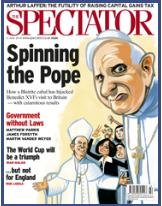
Damian Thompson’s Spectator article on the Papal Visit is online.

I tend not to believe in conspiracies but maybe Damian’s suggestion should at least be examined, he is suggesting that the visit is being hi-jacked by a coalition of what Damian terms the "Magic Circle" and Tony Blair’s Faith Foundation, I am not sure about that, in fact I am not sure why The Tablet wasn’t thrown into the mix, now Chris Patten – Tablet board member – has been made Visit-Tsar.

What there does seem to be are an awful lot of people who seem to live in a world that hopes the Pope will be dead soon, and somehow the Church will return to the confusion of the Paul VI era, maybe that is one of the reasons that lays behind not booking either Coventry Airport or Hydepark, I am sure it lies behind the "Can’t we just wait" petition to delay the new English Missal translations.

Rad-trad Frenchmen might see it all as a Masonic conspiracy. That is emotive, but, if that is shorthand for a hodge-podge of people; the secular world, protestant Christians of one sort or another, Catholic laity, priests bishops and cardinals who are pushing Enlightenment views of religious and moral Relativism, it is most probably a pretty fair assumption. The difficulty I have is in believing that there is much more than simple opposition to the Pope that unites them.

The alternative to the Benedictine Project is turning the Church into a sterile desert containing nothing but aging bishops and a vast lay staff, with a few lay people, with a few vague post-Christian beliefs
.

Exactly.

I was discussing this issue last night with a priest friend in NYC and made the observation that where Benedict goes he energizes the Catholic base.

Committed English Catholics have endured a lot over the years… er… decades… nay rather, centuries.  It occurs to me that, given the controversies building in England and the societal challenges they face, there may be not a few bishops and liberal ecclesial apparatchiks who would not welcome an energized Catholic base urging them to stand up and fight in the public square.

Posted in SESSIUNCULA, The Drill | Tagged ,
28 Comments

Sr. Keehan off hospital board for defying bishops, supporting Obamacare

Remember A Magisterium of Nuns?

From Lifesite:

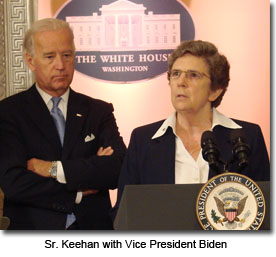
Sr. Keehan off hospital board for defying bishops, supporting ObamacareSister Keehan Off Prestigious Hospital Board over Obamacare Fallout

By John-Henry Westen

WASHINGTON, DC, June 4, 2010 (LifeSiteNews.com) – Sister Carol Keehan, President of the US Catholic Health Association, has been pressured off the prestigious Holy Family Hospital Foundation board over her support for the federal health care bill. Sr. Keehan, in opposition to the United States bishops, was a key supporter of the abortion-expanding bill – so much so that she was given one of the 21 ceremonial pens President Obama used to sign the measure into law.

The hospital is a work of a Catholic Order known as the Knights of Malta.  

One of the members who holds the position of Hospitaller, a leading office in the ancient Order, wrote a letter of concern to the presidents of all the Order of Malta associations in the United States noting that Sister Keehan remained on the board of the Holy Family Hospital Foundation even though she supported the health care bill, which opens taxpayer funding of abortion, and even though she acted in contradiction to U.S. bishops.

In response to the complaint, Sister Keehan resigned from the board with a letter of her own in which she expressed great displeasure with the criticism directed at her, characterizing it as “abusive.”

However, the “abusive” criticisms in the letter of complaint were mostly a compilation of quotes from the Vatican’s Archbishop Raymond Burke who, like other bishops in the US such as Kansas City Archbishop Joseph Naumann, expressed shock at Sister Keehan’s defiance of their pro-life opposition to Obamacare.

“Who could imagine that consecrated religious would openly, and in defiance of the bishops as successors of the apostles, publicly endorse legislation containing provisions which violated the natural moral law in its most fundamental tenets – the safeguarding and promoting of innocent and defenseless life, and fail to safeguard the demands of the free exercise of conscience for health care workers?," wrote Burke.

“The spiritual harm done to the individual religious who are disobedient and also the grave scandal caused to the faithful and people in general are of incalculable dimensions.” [How is that "abusive"?  Sorry… I needed to throw that switch and try to think like a liberal.]

Although LifeSiteNews viewed Keehan’s letter of resignation decrying "abusive" treatment, Fred Caesar, Special Assistant to the CHA President, Keehan denied the situation.  "Sr. Carol Keehan was not ‘pressured off the Holy Family Hospital Foundation Board’ in any way,” Ceasar responded to LifeSiteNews.  “You can verify that fact with the Chairman,” he added, refusing further comment.

In fact, Chairman James Murray’s letter to the Hospitaller, also seen by LSN, said specifically that “Sister Carol has tendered her resignation from the Board as a result of your letter.”

The Chairman expressed displeasure with the situation saying that the Hospitaller had, by causing Keehan to resign, harmed the work of the foundation and the hospital as well as the women who use it.

In the end, suggested a Knight who wished to remain unnamed, “Carol Keehan was basically forced out under pressure by Knights and Dames of Malta.”  It was, he said “part of an ongoing effort to keep the Order of Malta true to its pro-life foundations.”

Posted in Emanations from Penumbras | Tagged
34 Comments