 UPDATE: 10 April 1743 GMT:
The New York Times has a piece which essentially echoes what I wrote, below. I added it at the end.
_______
ORIGINAL POST 9 April 2050 GMT:
_______
I am sure that some of the writer’s at AP are having a great time, as they sit back and allow themselves to be fed leaked documents by lawyers. Great reporting.
This is an AP story about another case in California. AP’s willing accomplices, who more than likely have some monetary interest in the matter, are trying to pin another case on Pope Benedict while he was Prefect of the Congregation for the Doctrine of the Faith.
Remember, the Congregation dealt with many cases from the USA over the decades. Therefore, we could be seeing one per week thrown out like so much spaghetti against a wall – with journalistic sophistication of course – until a strand sticks and dries in place.
At the heart of this seems to be a letter from then-Prefect Card. Ratzinger about the case. A few observations before you start readings.
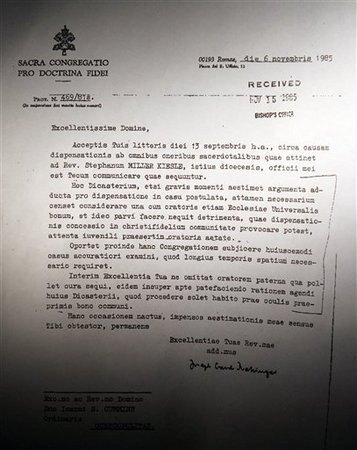
First, the letter in the article seems to be a fax or slightly off-center photocopy, as the stripe on the right side indicates. Also, the protocol stamp at the top is in English, so the letter came from the diocesan chancery in question. Also, this was obviously a photograph of the letter taken with a digital camera, as the light suggests. I suspect some grass in the chancery who had access to the file, or someone in a lawyer’s office leaked this.
Now,… my emphases and comments:
Apr 9, 1:54 PM (ET)
By GILLIAN FLACCUS ["flaccus"… Which in Latin means "flabby", if memory serves, "flappy-eared’.]
LOS ANGELES (AP) – The future Pope Benedict XVI resisted pleas to defrock [Can’t they find a better and more accurate cliché?] a California priest with a record of sexually molesting children, citing concerns including "the good of the universal church," according to a 1985 letter bearing his signature. [Does it strike you that the quote might be slightly out of context?]
The correspondence, obtained by The Associated Press, [Much as a sewer obtains its contents, perhaps… but wait… there’s more drama to come!] is the strongest challenge yet to the Vatican’s insistence that Benedict played no role in blocking the removal of pedophile priests during his years as head of the Catholic Church’s [clichés abound] doctrinal watchdog office.
The letter, signed by then-Cardinal Joseph Ratzinger, was typed in Latin and is part of years of correspondence between the Diocese of Oakland and the Vatican about the proposed defrocking [sigh] of the Rev. Stephen Kiesle.
The Vatican refused to comment on the contents of the letter Friday, but a spokesman confirmed it bore Ratzinger’s signature.
"The press office doesn’t believe it is necessary to respond to every single document taken out of context regarding particular legal situations," the Rev. Federico Lombardi said. "It is not strange that there are single documents which have Cardinal Ratzinger’s signature."
The diocese recommended removing Kiesle (KEEZ’-lee) from the priesthood [wait for it…] in 1981, [NB] the year Ratzinger was appointed to head the Vatican office that shared responsibility for disciplining abusive priests. [This is misleading. The then Sacred Cong. for the Doctrine of the Faith did not have competence unless the case also involved something that pertained to the Congregation, such as solicitation in the context of the sacrament of penance, in the confessional. Unless there was something else…]
The case then languished for four years [Does AP know why?] at the Vatican before Ratzinger finally wrote to Oakland Bishop John Cummins. It was two more years before Kiesle was removed; during that time Kiesle continued to do volunteer work with children through the church. [What does "volunteer work" mean? Was he functioning as a priest? Would that not have been a situation for the DIOCESE OF OAKLAND to handle rather than the Holy See?]
In the November 1985 letter, Ratzinger says the arguments for removing Kiesle are of "grave significance" but added that such actions required very careful review and more time. [So, he recommended that they be thorough in a canonical process that probably wasn’t being handled by the CDF?] He also urged the bishop to provide Kiesle with "as much paternal care as possible" while awaiting the decision, [I suspect that people forget that priests who harm children also have souls which are in danger of eternal damnation, and that the Church is also in the business of saving souls, no matter how wicked their sins. Or is it inappropriate to hope that nobody is condemned to Hell by other human beings?] according to a translation for AP by Professor Thomas Habinek, chairman of the University of Southern California Classics Department. [Because no one in the highly educated crew at AP have studied one of the most important languages in the history of the world, and one that is currently pertinent to the story they are so focused on.]
But the future pope [right… 20 years later] also noted that any decision to defrock [AGAIN?] Kiesle must take into account the "good of the universal church" and the "detriment that granting the dispensation can provoke within the community of Christ’s faithful, particularly considering the young age." Kiesle was 38 at the time. ["DISPENSATION"? AP has been talking about the priest’s "removal" but not about a "dispensation". What dispensation? Dispensation from the obligations of the clerical state? That is not the same as the "removal" impiled in dismissal from the clerical state, which is a punishment. Of course the half-informed scribblers of AP probably don’t understand this. But, dear reader, this was an interesting line in the letter, if that is what it actually says in Latin. As I read these things, here is what comes to mind. And this is where the AP’s desires fall apart in this case. In the 60’s and 70’s hordes of priests simply left ministry or, if they requested a dispensation from the obligations of the clerical state, they were often caused to wait a great deal of time – often a decade or more – until the priest was older and had a change to reflect – with the hope that somehow they might be recovered as priests. Clearly this case is more complicated because the priest concerned had harmed children. But back in the day, the standard operating procedure was to try to save priests from quitting. Therefore, when a petition for dispensation had been made, the Congregation followed their standard operating procedure. I suspect there was "boiler plate" in that letter. I am simply musing aloud here. If AP can make wild and aggressively obtuse statements, I think I as someone far better informed than their writers, can muse a little having observed the chicken-tracks of truth they left here and there in the piece. A WDTPRS reader said he would transcribe the Latin of the letter and send it so I can have a look and a get a feel for it. Once upon a time I wrote Latin for an office in the curia and know the style. But I digress… It’s just that I have the sense that the AP interpretation misses the point entirely… but, as I said.. I digress. That "dispensation" is the key. We will keep reading.]
Kiesle had been sentenced in 1978 to three years’ probation [this is a civil charge, of course] after pleading no contest to misdemeanor charges of lewd conduct for tying up and molesting two young boys in a San Francisco Bay area church rectory.
As his probation ended in 1981, Kiesle asked to leave the priesthood [Ah hah! SEE? If he had requested a dispensation from the obligations of the clerical state, then some boiler-plate kicked in. Cardinal Ratzinger may have signed something like a form letter, with language common to these cases.] and the diocese submitted papers to Rome to defrock [Someone… please… help… ] him.
In his earliest letter to Ratzinger, Cummins warned that returning Kiesle to ministry would cause more of a scandal than stripping him of his priestly powers. [Oooo! the purple patch as well. "priestly powers"! Ooooo!]
"It is my conviction that there would be no scandal if this petition were granted and that as a matter of fact, given the nature of the case, there might be greater scandal to the community if Father Kiesle were allowed to return to the active ministry," Cummins wrote in 1982. [I am inclined to agree with Bp. Cummins… perhaps a first.]
While papers obtained by the AP [From some grass… or is it "pipe"? "mole"? But read carefully…] include only one letter with Ratzinger’s signature, correspondence and internal memos from the diocese refer to a letter dated Nov. 17, 1981, from the then-cardinal to the bishop. [NOTA BENE:] Ratzinger was appointed to head the Vatican’s Congregation for the Doctrine of the Faith a week later. ["appointed… a week later". So, this was revving up when Card. Seper was there. We should look at the Annuario Pontificio from that time and see who else was working there.]
California church officials wrote to Ratzinger at least three times to check on the status of Kiesle’s case. At one point, a Vatican official wrote to say the file may have been lost and suggested resubmitting materials. ["At one point… " Would that have been during the time when the file was in another dicastery?]
Diocese officials considered writing Ratzinger again after they received his 1985 response to impress upon him that leaving Kiesle in the ministry would harm the church, Rev. George Mockel wrote in a memo to the Oakland bishop.
"My own reading of this letter is that basically they are going to sit on it until Steve gets quite a bit older," the memo said. "Despite his young age, the particular and unique circumstances of this case would seem to make it a greater scandal if he were not laicized." [Again, my comments above seem to apply.]
Irwin Zalkin, an attorney representing some of the victims, said he was familiar with the correspondence but wouldn’t provide documents to AP. ["wouldn’t provide documents"]
"Cardinal Ratzinger was more concerned about the avoidance of scandal than he was about protecting children," Zalkin said in a phone interview. "That was a central theme." [I don’t know how he, a lawyer in California, could possible know what Cardinal Ratzinger was thinking in Rome. Does he have special psychic powers?]
As Kiesle’s fate was being weighed in Rome, the priest returned to suburban Pinole to volunteer as a youth minister at St. Joseph Church, where he had served as associate pastor from 1972 to 1975. [I wonder if, in that time, he committed any other crimes against minors. Also, though this story is clearly focusing on then-Prefect Ratzinger, why isn’t AP crawling all over the Diocese of Oakland asking why that priest – once convicted – was being allowed to work with young people? If the diocese saw that the priest in question was doing this and was not concerned, could it be that someone in the diocese was hoping that he could be returned one day to active ministry? That was the usual approach in those days, after all. They were listening to the psychologists and other experts about therapy for molesters, etc. If there was a memo in the chancery about greater or lesser causes of scandal, there must have been divided opinions about what to do in his case. In the meantime, Rome, which usually wanted sometimes many years to pass before dispensing men from the obligations of the clerical state, was following its usual procedure before putting the dispensation on the Holy Father’s desk for his signature. The Pope would ultimate have to sign it.]
Kiesle was ultimately stripped of his priestly powers [Ooooo.] in 1987, ["stripped"… really? Or was the dispensation granted? Those are not the same thing. One is a punishment, and the other is not.] though the documents do not indicate when, how or why. They also don’t indicate what role – if any – Ratzinger had in the decision. [So… with all that in mind… is AP really trying to get you to think that Ratzinger was the one blocking the "stripping" of the "frock".]
Kiesle continued to volunteer with children, according to Maurine Behrend, who worked in the Oakland diocese’s youth ministry office in the 1980s. After learning of his history, Behrend complained to church officials. When nothing was done she wrote a letter, which she showed to the AP. [Ummmm… what does the Holy See have to do with that? Isn’t that a problem for the Diocese of Oakland?]
"Obviously nothing has been done after EIGHT months of repeated notifications," she wrote. "How are we supposed to have confidence in the system when nothing is done? A simple phone call to the pastor from the bishop is all it would take." [And yet for some reason that did not take place? I wonder why.]
She eventually confronted Cummins at a confirmation [Okay!] and Kiesle was gone a short time later, Behrend said.
Kiesle was arrested and charged in 2002 with 13 counts of child molestation from the 1970s. All but two were thrown out after the U.S. Supreme Court struck down as unconstitutional a California law extending the statute of limitations. [Keep in mind that Papa Ratzinger lead the charge to change the Church’s process in these cases so that a "statute of limitation" could be waived if the case merited. Right? Ratzinger got that change put in. AP doesn’t mention this.]
He pleaded no contest in 2004 to a felony for molesting a young girl in his Truckee home in 1995 and was sentenced to six years in state prison.
Kiesle, now 63 and a registered sex offender, lives in a Walnut Creek gated community, according to his address listed on the Megan’s Law sex registry. An AP reporter was turned away when attempting to reach him for comment.
William Gagen, an attorney who represented Kiesle in 2002, did not return a call for comment.
More than a half-dozen victims reached a settlement in 2005 with the Oakland diocese alleging Kiesle had molested them as young children. [What they don’t say is whether any of those crimes occurred during the time he was being allowed to "volunteer" with youth ministry at that parish… that is after he had been suspended.]
"He admitted molesting many children and bragged that he was the Pied Piper and said he tried to molest every child that sat on his lap," said Lewis VanBlois, an attorney for six Kiesle victims who interviewed the former priest in prison. "When asked how many children he had molested over the years, he said ‘tons.’" [sick… monstrous]
Cummins, the now-retired bishop, told the AP during an interview at his Oakland home that he "didn’t really care for" Kiesle, but he didn’t recall writing to Ratzinger concerning the case.
"I wish I did write to Cardinal Ratzinger. I don’t think I was that smart," Cummins, now 82, told AP.
Documents obtained by the AP last week revealed similar instances of Vatican stalling in cases involving two Arizona clergy. [No, actually, they don’t. But this is AP’s official line and they will push it no matter what the facts might be. After all, if they do, maybe more lawyers and pipes will feed them more stolen or leaked documents!]
In one case, the future pope took over the abuse case of the Rev. Michael Teta of Tucson, Ariz., then let it languish at the Vatican for years despite repeated pleas from the bishop for the man to be removed from the priesthood. [That has been dealt with else where. I wrote about that.]
In the second, the bishop called Msgr. Robert Trupia a "major risk factor" in a letter to Ratzinger. There is no indication in those files that Ratzinger responded.
The Vatican has called the accusations "absolutely groundless" and said the facts were being misrepresented. [Indeed they were.]
—
Associated Press writers Brooke Donald in Oakland, Eric Gorski in Denver, John Mone in San Diego, Raquel Maria Dillon in Los Angeles and Victor L. Simpson in Rome contributed to this report. [So… quite a group effort, wasn’t it.]
I have little respect for AP.
Moreover….
It is one thing to dismiss a man from the clerical state after a canonical process. That is what the cliché-smiths of AP et al. are talking about with that tiresome "defrock", or "stripping" of "priestly powers" (which is inaccurate… it only "strips" the Church’s permission to use those "powers"). This is a punishment.
It is another thing to "dispense from the obligations of the clerical state" on a man’s request.
Sometimes the inaccurate terms "laicized" or "reduced to the lay state" are used loosely in regard to both of these, the punishment and the dispensation.
When you read these half-witted stories in the MSM, keep your eyes open to the terms and remember that they are often being used loosely.
_____
UPDATE 10 April 1743 GMT:
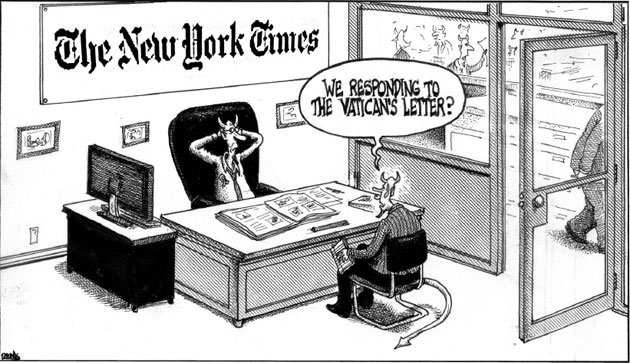
From Hell’s Bible
Pope Handled Priest Case Quickly, Lawyer Says
By DANIEL J. WAKIN
Published: April 10, 2010
ROME — The future Pope Benedict XVI, dealing with a request to defrock a child-molesting priest in California, [They are clinging to the line the want to push, contrary to the other factual indications. Keep this in mind as you read.] was handling it as a dismissal from the priesthood — not an abuse case — and acted “expeditiously” by the standards of the time, a Vatican lawyer [What on earth is a "Vatican lawyer"? Is such a critter similar to an albino assassin?] said in a statement released Saturday. [Spot the errors? First, cases which dealt with dismissal, as a punitive measure, were in those years generally not handled by the CDF unless they dealt with other grave sins (such as those involving the confessional). The case was a matter of a request for dispensation from the obligations of the clerical state, which is not a a matter of punishment. Hell’s Bible can hide its mendacity behind the vague cliche of "defrock", which could mean several things. Their squishy language serves to hide the truth while they push an anti-Catholic agenda.]
The Vatican issued the remarks a day after reports emerged that Benedict, then Cardinal Joseph Ratzinger, signed a letter to the priest’s bishop saying the matter needed more time and that the “good of the Universal Church” had to be taken into account. It took two years for the man, the Rev. Stephen Kiesle, to be removed from the priesthood. [Again, a misrepresentation.]
The bishop, John S. Cummins, wrote to Pope John Paul II in 1981, saying that the priest had been criminally charged with molesting six boys ages 11 to 13 several years earlier [NOTE…] and that he was asking to be dismissed. [Get that? The priest was asking for a dispensation. That is why the CDF was handling this dimension of the case of the former priest.] He wrote to Cardinal Ratzinger at least three more times, to provide information and check on the case’s status.
The lawyer, Jeffrey Lena of Berkeley, Calif., [Who wrote this slop? Is this the "Vatican lawyer"?] denied that a 1985 letter from Cardinal Ratzinger to Bishop Cummins showed him “resisting pleas from the bishop to defrock the priest.” Mr. Lena was quoted in the statement as saying there was a “rush to judgment going on here.”
The matter was the third recently reported instance in which documents have indicated [read that last part again… notice the assumptions, the premises you are simply supposed to accept…] that Benedict or [OR! OR!] his subordinates failed to act strongly ["act ‘strongly’"? What the hell does that mean? Where they supposed to … what … deny them judicial process according to the Church’s processes at that time? Rack them?] against abuser priests — a failing that Vatican officials, cardinals and many bishops have heatedly rejected. The reports have surfaced amid a wave of disclosures about past sexual abuses by Roman Catholic priests around Europe.
In the Kiesle case, Mr. Lena [Again.. is he the "Vatican lawyer"? This fellow from Berkeley?] said it had been completely up to the local bishop to make sure the priest was prevented from doing harm again. “The abuse case wasn’t transferred to the Vatican at all,” he said. [But.. the request for the dispensation was. Right?]
Cardinal Ratzinger’s letter, written in Latin, [Keep in mind what I wrote in my analysis of this yesterday and my comment about dispensations and "boiler-plate"….] “appeared to be a form letter typically sent out initially with respect to laicization cases,” the lawyer said, although it specifically mentions Father Kiesle’s relatively young age. [Not an uncommon factor in requests for a dispensation, btw.]
At the time Cardinal Ratzinger led the Congregation for the Doctrine of the Faith, which took over abuse cases in 2001, four years before he became pope. [Therefore many years before the Kiesle case.] In years before, some of the cases landed at the congregation for various reasons. In this case, Mr. Lena said the congregation was handling only the laicization aspect.
The defrocking was handled “expeditiously not by modern standards, but by the standards at the time,” he said. [But you would not get that by scanning the top of this article. You have to read to the bottom to get the point. In the meantime, the writer front loaded all the news that fits their pre-judged position.]
Furthermore, in the Hell’s Bible the lazy and less unbiased Laurie Goodstein with some other guy have yet another piece pressing the same errors despite the facts staring them in the face.
In that Goodstein piece she and her accomplice write, "The priest, convicted of tying up and abusing two young boys in a California church rectory, wanted to leave the ministry" and move on with, "That decision did not come for two more years, the sort of delay that is fueling a renewed sexual abuse scandal in the church that has focused on whether the future pope moved quickly enough to remove known pedophiles from the priesthood, despite pleas from American bishops."
Again we find in Goodstein’s article the tiresome and vague word "defrocked" … four times.
I doubt Laurie Goodstein is mentally deficient. I conclude that she and/or her editors drone that inexact but titillating word in order to blur the distinctions that must be made so as to understand the cases they "report".
Does Goodstein ask questions about the internal policies of the Diocese of Oakland? No. That would not serve the goal of her masters:
GET BENEDICT… HURT BENEDICT…
UPDATE: 20:05 GMT
Fr. Fessio gets it right.




 t time Kiesle continued to do volunteer work with children through the church. [What does "volunteer work" mean? Was he functioning as a priest? Would that not have been a situation for the DIOCESE OF OAKLAND to handle rather than the Holy See?]







 Fr. John Zuhlsdorf on Daily Rome Shot 1117 – A *POLL* about 2026-27: “Sorry… my bad. It is indeed SIX. 1. Rh8+! Kxh8 2. Qh2+ Kg8 3. Qh7+ Kf8 4. Qh8+ Ke7 5.…”




























