Commonweal’s editor reacts to Archbp. Chaput’s Houston speech on JFK’s sellout

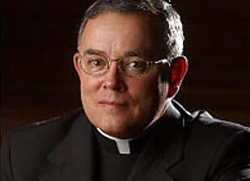
Commonweal's editor reacts to Archbp. Chaput's Houston speech on JFK's selloutWe knew liberals wouldn’t like Archbishop Chaput’s important speech in Houston.

They never disappoint.

The blog Mirror of Justice found a comment by Paul Baumann, the editor of the liberal leaning Commonweal, on Commonweal’s blog under an entry by Fr. Joseph Komonchak.

The editor of Commonweal comes out swinging against Archbp. Chaput and tries to defend JFK’s error in Houston.

I’ll give you signposts along the way, but Baumann has three arguments. 

The first point begins with the first paragraph and ends with "So it seems clear to me that Chaput’s reading of the speech is anachronistic at best." 

The second ends, "let alone fellow Christians." 

The third begins thereafter and ends, " to lay the blame at Kennedy’s door." 

The last part just connects JFK with Commonweal through Cogley… which let’s the agenda out of its bag.

Let’s together read Baumann’s comment closely and try to follow his logic with my emphases and comments.

Commonweal’s Paul Baumann on Archbishop’s Chaput’s Houston Speech

[Several comments on the speech here, including this by Paul Baumann, editor of Commonweal:]

I attended the Fordham conference on Kennedy’s speech, and remember well Shaun Casey’s rebuttal to those, such as Chaput, [author of ] who insist that the speech was an effort to “privatize” religion. “After the [Kennedy] speech there was a question-and-answer period,” Casey said, “The transcript of the Q&A session is actually three times as long as the speech itself. The exchanges there, in particular, I think helped knock down the argument that somehow Kennedy was declaring his Catholicism to be purely private, and hence irrelevant. He embraces his Catholicism. He says he’s not renouncing his church. At the very end, he said, ‘I don’t think I made any converts to my church in the process of this meeting, but I don’t repudiate my faith.’”

So [THEREFORE!] it seems clear to me [Oh yah?] that Chaput’s reading of the speech is anachronistic at best. [No one has said JFK "repudiated" his Catholic faith.  Chaput didn’t say that.  This is a canard.  Chaput said that JFK was "wrong" to do what he did.  The flaw in Baumann’s logic is this: Baumann read’s Casey‘s statement as if it proves that Chaput’s statement is anachronistic.  Baumann’s doesn’t quote JFK.  He quotes CASEY.  And therefore Baumann is "sure"?  And we are just supposed to believe him?  Ask yourself how Baumann get’s to this certaintly.  B would have us believe that JFK did the opposite of what Chaput says just because Casey says so, but Baumann quotes nothing of substance. So, it can’t be clear to anyone else.  That ends Baumann’s first argument.  Thus the second begins…] Chaput’s talk is also studded with provocative but vague declarations about the false faith of others:  [Hereafter follow snippets…] “It’s a form of lying,” “They’re not optional,” “I wonder if we’ve ever had fewer of them who can coherently explain how their faith informs their work, or who event feel obligated to try,” “Too many live their faith as if it were a private idiosyncrasy—the kind that they’ll never allow to become a public nuisance. And too many just don’t really believe.” This doesn’t strike me as the kind of language one uses when trying to persuade those who might disagree with you, let alone fellow Christians. [Baumann says Chaput makes "vague" allegations.  Do we not remember the absurd but clear declarations made in public by such figures as Speaker Pelosi and then-Senator Biden?  Patrick Kennedy?  Very recently again Archbp. Niederauer corrected Pelosi.  Many US bishops have made public statements in clear terms.  Is Chaput being "vague"?  Chaput was very clear in Houston that he was talking about the abortion issue.  There is a point at which bishops must shift from trying to correct the politician (persuade) to warning the faithful about their errors.  Baumann paints what Chaput said about the faith of politicians as "vague".   Chaput wasn’t vague, though we grant him the "provocative".  Chaput did not go to Houston to try to persuade the likes of Nancy Pelosi and her ilk (she is just the most prominent).  He went there to show that they are the fruits of the 50 year old JFK Tree.  Chaput was not trying to persuade so much as point out that these so-called Catholics in public life are not acting in accord with their Catholic faith.  That is probably what Baumann objects to.  That ends Baumann’s second argument.  Thus begins the third…] In any event, Chaput fails to make a plausible case that Kennedy’s speech “profoundly undermined the place not just of Catholics, but of all religious believers, in America’s public life and political conversation.” Even if you accept the notion that religious believers have been marginalize in this way—which I don’t—it’s quite a stretch to lay the blame at Kennedy’s door.   [Mormons and Jews and Catholics are in Congress, but they are not allowed to bring confessional perspectives into their words or deeds.  In the sense that there are religious people in the public square, Baumann is right: they haven’t be marginalized.  He is wrong in the sense that action on the basis of religion has in fact been marginalized.  Let them go to temple or church on Sunday.  Fine.  The fruit of the JFK Tree is that the religious beliefs and motivations of religious people have been marginalized.  That’s what is not allowed.  Perhaps Baumann thinks it is acceptable that Catholics set aside the Church’s teaching on abortion on and that it is perfectly harmonious for Catholic politicians to vote in favor of abortion.  I don’t know.  But if that is the case, then I understand why Baumann can think that Catholics haven’t been marginalized: just look at Pelosi!  Chaput is saying that there is a different sense of how to be a Catholic in political life.  We cannot be cafeteria Catholics or park our Catholicism at the door of the church.  Finally, is it such a stretch to connect what is going on today with what JFK did 50 years ago?  I don’t think so.  The speech took on a life of its own, resonating down though decades.  It was one of the most important speeches of JFK’s career and many refer to it today.  Wonks immediately connected Mitt Romney with JFK during the last presidential campaign. It comes up all the time with there is a question of conflict of religious faith and public role.  So, is it really such a stretch?  JFK’s Houston Speech is part of the American political psyche.]

As many contributors to this blog know, long-time Commonweal columnist John Cogley was an important adviser to Kennedy and a speechwriter Ted Sorenson for the Houston address. Cogley concluded his 1973 book “Catholic America” as follows: “While Catholicism can coexist very well with separation of church and state, its best representatives will always refuse to separate religion and life. And that makes all the difference.”
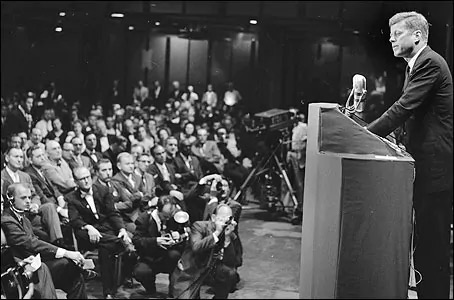
JFK HoustonBaumann’s logic is pretty bad.

But you can see that Chaput has gotten under the skin of the liberals.

It has taken a while, but they are starting react.

There is probably a John Courtney Murray/JFK axis here in the liberal mind.

Remember our context: Liberals are going bananas about a perceived assault on their version of Vatican II.   They are losing control of the narrative.

Liberals have flipped out about what is happening with the Church’s liturgy, of course.  They see that deeper connections are being made with tradition.  They think this is an attack on Vatican II.

When Archbishop Chaput gives a speech in Houston about the fruits of the 50 Year Old JFK Tree, they are going to hear an attack on… what?  What they think Vatican II taught on religious liberty.

Think about this.

First: Consider how wrong liberals are about inculturation and liturgy. 

Now imagine how wrong they are about religious liberty.

When you watch liberals getting upset about Chaput’s speech in Houston, ask yourself why.
Posted in Our Catholic Identity, SESSIUNCULA, The Drill, The Last Acceptable Prejudice | Tagged , , , , ,
18 Comments

WDTPRS – Monday 3rd Week of Lent – Prayer over the people (2002MR & 1962MR)

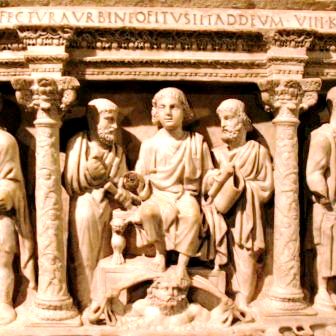
Catacombs of DomatillaToday we will compare the Oratio super populum from the Ordinary Form and the Extraordinary Form.
A great new feature of the 2002 Missale Romanum in Latin is that for Lent the "Prayer over the people" or Oratio super populum has been revived as an option.

Priests can use this prayer NOW at the end of Mass, but still only in the Latin.

Let’s have a look at today’s:

ORATIO SUPER POPUUM (2002MR):
Tueatur, quaesumus, Domine,
dextera tua populum deprecantem.
et purificatum dignanter erudiat,
ut consolatione praesenti ad futura bona proficia
t.

This prayer was in the Liber sacramentorum Augustodunensis, et alibi, in which it was the Super populum for Monday of the 4th Week of Lent when the Station is at Four Crowned Martyrs.  As you can see if you check your missals, the Super populum for that day changed in the Tridentine reform.  It was already changed by the time of the Missalis Romani editio princeps from Milan in 1474.  The prayer was, in the post-Tridentine Missale Romanum, moved to the Super populum of Saturday in Passion Week.

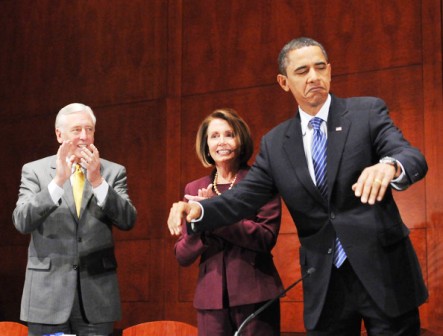
Junius BassusYou see… in centuries past prayers were moved around too.
SLAVISHLY LITERAL VERSION:
May Your right hand, O Lord,
defend Your pleading People,
and worthily instruct it (they/us), once purified,
so that by present consolation it (they/us) may attain to good things to come
.

This prayer presents to my mind the image of God either as Father or perhaps better as Teacher.

In the ancient world, children were given over for instruction to the paedagogus.  Instruction, as Augustine and others describe, was accompanied by plenty of beatings.  Perhaps then children might turn to mother for consolation, or some other house servants (famuli). Consider that tension between "purify" and "instruct", with the promise of rewards down the line with consolation. 

Ancient depictions of Christ as Teacher were similar to His depiction as Pantocrator, Almighty, and Him "in Majesty".  Christ as Teacher is usually depicted seated, as a magister would be in his teaching chair or cathedra, in philosopher’s garb, with a book or scroll and with a hand raised in a teaching gesture.  Often He is surrounded by Apostles, who also make gestures of apprehension and approval.

Christ is the great Teacher.  He teaches us outwardly, through his words and deeds in the Gospels, as well as inwardly though more subtle means.  Augustine commonly presented Christ as "inner teacher".  Christ is also the "Wisdom of God".  Within us all is the presence of the Word, Logos, which guides the mind.  Christ guides us particularly in his self-emptying, His lowliness.

Nevertheless, the Teacher will apply correction to our lives. 

Let’s jump now to the corresponding prayer in the Extraordinary Form today and see if there is any difference in style.

In the abovementioned Liber sacramentorum Augusttodunensis this prayer was Collect, it seems, during Advent.  A variation begins, Excita Domine quaesumus potentiam tuam et veni ut…  If anyone doubted whether Advent was a penitential season, just look at the prayers of our forebears.

That said, those Advent versions were somewhat abbreviated compared to our prayer today.  I did find the longer version with the ablative absolutes in the final part, but beginning Excita, in various codices but none of them a ancient as the LsA.  For those who care to see more, here is a detail from the page which is one of my sources, the CCL series.

Fascinating, I am sure.

ORATIO SUPER POPUUM (1962MR):
Subveniat nobis, Domine, misericordia tua:
ut ab imminentibus peccatorum nostrorum periculis,
te mereamur protegente eripi,
te liberante salvari
.

LITERAL VERSION:
In Your mercy, O Lord, come to our aid:
so that in the imminent dangers of our sins,
you protecting us we may merit to be saved,
you freeing us we may be saved
.

After reading the Latin and my versions of the Super populum prayers in the 2002MR over the last weeks, you can hear immediately a very different tone in this version from the Extraordinary Form.  

And this is typical of the changes made to and choice of the prayers for the post-Conciliar Missale Romanum. 

The older prayers will not shy from addressing our sinful nature and the fearful judgment we face. 

The newer prayers tend to stress less the guilt of sin and our need for mercy and need for His intervention. They focus rather on the fulfillment of God’s mercy and His intervention obtained.

Posted in SESSIUNCULA |
8 Comments

“on da groun'”

Budget on da groun’…

Budget on da groun’…!

"on da groun'"

The photo…. just too good.

Posted in SESSIUNCULA |
45 Comments

Gregorian chant education in Southwark

Mulier Fortis has an interesting item from her native Archdiocese of Southwark, where His Hermeneuticalness is not yet the Archbishop… alas…. but I digress.

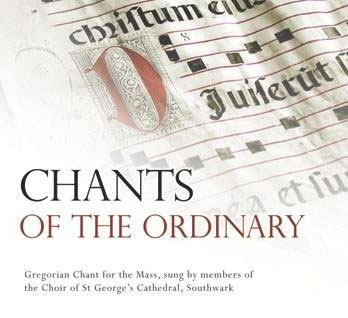
Gregorian chant education in SouthwarkAt the Cathedral of St. George a Gregorian chant schola is producing educational CDs for the singing of chant.

Chants of the Ordinary (Cantus Angeli) Volume 1 is the first of three educational CDs of Gregorian Chant designed for use in parishes. The Chant is performed by a small group of singers from the Choir of St George’s Cathedral, London, under the direction of Nick Gale. Nick is a UK-based teacher of Gregorian Chant and the Director of Music at St George’s Cathedral. Volume One features complete performances of seven Gregorian Masses, the Ambrosian Gloria, the Asperges and Vidi Aquam, three Credos and a selection of alleluias with verses.

The chanting is clear, as befits its educational purpose, and has a haunting quality, which its rival, Plainsong for Parishes, lacks. I am keen to find out when Volumes 2 (Advent – Candlemas) and 3 (Lent – Trinity) are due to be published.
My one gripe is that the Kyrie is the double form (for the Novus Ordo), not the triple, which might catch a few people out… however, it’s not impossible to work out what to chant for the Extraordinary Form, and I suppose that it would have been harder to do the other way around…
The website advertises Gregorian chant tuition sessions, both one-day and residential, which Nick Gale leads. The testimonials page indicates that he has taken the workshops far and wide, and they have been very successful in giving confidence to parish choirs of all abilities.

[mp3]10_03_07_asperges.mp3[/mp3]

Posted in SESSIUNCULA |
2 Comments

Looking forward…

The next time I am in Old Blighty, I need to do this.

Looking forward...

UPDATE 8 March 1854 GMT:

Can you believe that this entry was picked up by the Scottish Clergy Railway Circle?

Posted in SESSIUNCULA |
16 Comments

Recent posts of interest

Some posts that may scroll off:

I am on Twitter: fatherz
and Facebook: fatherz
and Plurk: fatherzTwitter

There is a Google thingy on the left sidebar…. not sure what that is all about but sign up anyway and help SkyNet… er.. um… sorry… don’t want to make the machines mad… sorry…

You know… come to think of it… that Google thingy probably helps your own blogs, and the blogs you want to push, more visible… especially when they are on the sidebar of a blog that gets as much traffic as this one.  Just a thought.

I use these – and also neglect them – in various ways.

Posted in SESSIUNCULA |
Comments Off on Recent posts of interest

GUEST RANT from a reader: priest constantly ad libs

From a reader.  You can make your own comments.

I have just returned from Mass.  As usual, during the Mass I was constantly distracted by the consistent ad libbing by the priest celebrant.  Permit me to offer a  sample:

Before the Sign of the Cross:  Father reads a snippet from a "liturgical cheat sheet" that introduces the "theme" of the Mass.

Introduction to the Penitential Rite:  Father gives a introductory monologue that gives the weather report and welcomes our visitors, who we are always happy to have with us.  He then calls us to recall "the times when we have been too much to ourselves and loved each other less." 

The Prayers of the Faithful:  After the banal intercessions from the "liturgical cheat sheet," Father improvises prayers for the suffering in Haiti, announcing how much money was collected and thanking the parishioners for their generosity; for those serving in the military–living and deceased–their "parents, grandparents, aunts, uncles, and surrogates" (I’m NOT making this up); and on and on and on.  The Prayers of the Faithful went on for 5 minutes!  I realize that, in the great scheme of things, 5 minutes doesn’t seem long, but it is an eternity at Mass.

The "Orate Fratres":  "Let us pray that this our sacrifice and all that we do will become acceptable to God the Almighty Father."

The "Mysterium Fidei":  "In song, let us proclaim this great mystery of our faith."

The "Per ipsum et cum ipso":  "For it is through Him, and with Him and in Him…."

The Invitation to the Our Father:  "Let us with faith and love, in union with God our Father and as one family, we proclaim that prayer which Jesus taught us."

The "Ecce Agnus Dei":  This is Jesus Christ, our hope and our peace, the Lamb of God who takes away the sins of the world.  How happy and blessed are we to be called to supper."

This said, my question is this:  after over 35 years of priesthood and over 35 years of "doing his own thing" at Mass, will he, all of a sudden with the new translations, actually start to "say the black and do the red"?  Will bishops and those entrusted with implementing the new translations, actually INSIST that priests not do what this man has been doing Sunday after Sunday for years and years since his first Mass?  And who is going to hold them accountable?  Bishops?  The laity?  In fairness to the bishops, bishops can’t be everywhere.  As to the laity, priests often resent, no matter how tactfully, respectfully, and charitably states, any constructive criticism about the way a priest celebrates Mass. 

My great fear is that, despite the new translations, priests will continue to do whatever they wish with their parts in the Mass simply because no one is going to hold them accountable for otherwise. 

Thanks for listening

Posted in HONORED GUESTS, Wherein Fr. Z Rants |
102 Comments

WDTPRS 3rd Sunday of Lent – Prayer over the people (2002MR)

WDTPRS 3rd Sunday of Lent - Prayer over the people (2002MR)Historically, this was the Sunday in the ancient Church when, in Rome, catechumens underwent examinations.  They would come in their penitential garments in a procession across the City to be "grilled" as it were near the tomb of this famous martyr.  There were exorcisms at this time as the catechumens began their series of "scrutinies" before baptism at Easter.
Imagine the sense of mystery with which they proceeded through these weeks of trial and preparation.

The Station was and remains the St. Lawrence outside-the-walls.   The older form of Holy Mass retained a very ancient formulary for this Sunday.

A great new feature of the 2002 Missale Romanum in Latin is that for Lent the "Prayer over the people" or Oratio super populum has been revived as an option.

Priests can use this prayer NOW at the end of Mass, but still only in the Latin.

Today we enter into the second stage of Lent.

Let’s have a look at today’s:

ORATIO SUPER POPULUM (2002MR):
Rege, Domine, quaesumus, tuorum corda fidelium,
et servis tuis hanc gratiam largire propitius,
ut in tui et proximi dilectione manentes
plenitudinem mandatorum tuorum adimpleant
.

I think this is a new composition for the 2002MR.

This prayer is used on a day when the Preface De Samaritana is used… at least once in a while.

MY LITERAL RENDERING:
Direct, O Lord, we beg, the hearts of your faithful,
and propitiously grant this grace to your servants,
that, remaining in the love of you and neighbor,
they may bring to fulfillment the fullness of your commandments.

Notice the use of adimpleo, “to fullfil”.  “Fulfillment” in various senses – to complete and to be satisfied by being filled – seems a major point for Holy Mother Church this week, given the final positions of those “filling” verbs in the two final prayers of Mass this Sunday (cf. the Post communionem*).

If you recall the description of this “prayers over the people” which I presented a couple weeks back, these prayers are spoken to God by the priest for the sake of the people.  Thus, he is not speaking for the people present at Mass, he is rather speaking for himself and asking God to do something for the people for whom he is alter Christus.  

The two prayers at the end of Mass (this and the Post communion) remind me of the statement of the great N. African bishop and doctor, St. Augustine of Hippo (+430) on the anniversary of his ordination.  He refers in his sermon to the heavy weight of his duties as bishop, which he calls a sarcina – the heavy Roman soldier’s military backpack – and of the how his vocation and that of the people are intertwined.   In his anniversary sermon, Augustine describes the dutiful living out of their respective vocations in connection with what Christ does for us, the aid and strength he gives us together with the heavy task we are to fulfill in His service.  He says,

“This burden (sarcina) of mine, about which I am speaking, what other is it than you yourselves?  Pray for me strength, as I pray that you not be heavy!  For the Lord Jesus would not have spoke of his burden (sarcinam suam) unless He was going to carry the one carrying it. But if you would sustain me, that we may bear our burdens for each other according to the precept of the Apostle, then thus we will together and for each other be fulfilling (impleamus) the law of Christ” (cf. Gal. 6, 2).  If He does not carry it with us, we will sink under its load (succumbimus); if He does not carry us, we die (occumbimus).  In the times when I am frightened that I am for you, I am then consoled that I am with you.  Vobis enim sum episcopus, vobiscum sum Christianus… I am a bishop for you, I am a Christian with you” (s. 340, 1 – date uncertain).

In speaking of the Church, Augustine distinguishes Christ the Head, Christ the Body, and the whole Christ (Christus totus).  In this sermon, we can see how Christ the Head (in the person of the priest) and Christ the Body (in the people gathered around the priest) form one Christ (totus).   They are with each other and for each other, with quite different roles but with one single aim: the salvation of souls – their own and of their neighbors.  Augustine says in another homily, when he is taking his people to task, “I do not want to be saved without you” (s. 17, 2). 

The priest and the people must sustain each other each in their own way, according to their proper roles, and form one Christ in doing so. 

These realities can also be a starting point for consideration of what it means to participate at Holy Mass. 

Perhaps in the years to come, when people far and wide will have also the benefit of the Oratio super populum, accurate translations will support the reality of different roles in the liturgy, of the priest, of the congregation, and help them not to be respected and not confused.   They are complimentary and not interchangeable.

*My rendering of the Post communionem:
Taking the down payment of the sacred heavenly mystery,
and, placed on earth, having been filled already with bread from on high,
we kneeling in entreaty beseech you, O Lord,
that, what is being accomplished in us by the sacramental mystery, may be brought to fulfillment (
impleatur) by work.


Posted in SESSIUNCULA | Tagged , ,
5 Comments

Really fun photo

From rom, römer, am römsten:

Really fun photo

Posted in SESSIUNCULA |
20 Comments

WDTPRS – Saturday 2nd Week of Lent – “Prayer over the People” (2002MR)


A great new feature of the 2002 Missale Romanum in Latin is that for Lent the "Prayer over the people" or Oratio super populum has been revived as an option.

Priests can use this prayer NOW at the end of Mass, but still only in the Latin.

Let’s have a look at today’s:

ORATIO SUPER POPULUM (2002MR):
Sacramenti tui, Domine, divina perceptio
penetralia nostri cordis infundat,
et sui nos participes potenter efficiat
.

This is a rewriting of a prayer in the ancient Gelasian in the forms of the Liber sacramentorum/Augustodunensis/Engolismensis/Gellonensis.   It used to run: Sacramenti tui domine diuina libatio penetralia nostri cordis infundat, et sui participes potenter effitiat.

The older form of this prayer was also the Postcommunio for this very day in the 1962MR.

Perceptio, (from the verb percipio) is basically a “a taking, receiving; a gathering in, collecting.”  It is also, by extension, “perception, comprehension”.   I "perceive" that you "gather" what I am saying.  We get the paring perceptio with sacramenti fairly often in our prayers.  In the priest’s prayers in the older form of Mass he prayers before Communion – and this is one of the most moving of the priest’s prayers at Mass –

Perceptio Corporis tui, Domine Iesu Christe, quod ego indignus sumere praesumo, non mihi proveniat in iudicium et condemnationem; sed pro tua pietate prosit mihi ad tutamentum mentis et corporis et ad medelam percipiendam: Qui vivis et regnas in saecula saeculorum. Amen. … Let the receiving of Thy Body, O Lord Jesus Christ, which I presume to receive, though unworthy, turn not unto me for judgment and condemnation, but, according to Thy mercy, let it be profitable to me for the receiving of protection and healing, both of soul and body: Who livest and reignest for ever and ever. Amen.


If you were looking for a key difference between the spiritualities of the older form and newer form of Mass, I think that prayer is a good example: in the newer form of Mass many of the references to the priest’s humility were removed.  Penetralia are "innermost places, or secrets places".

But I digress.

SLAVISHLY LITERAL VERSION:
O Lord, may the divine receiving of Your sacrament
pour into the inmost depths of our heart,
and may it mightily bring us to be Its participants.

Take note that this was a Postcommunion changed into an Oratio super populum.

The older form had libatio, which was a "drink offering" poured out to the gods.  But clearly in the context of a prayer at Mass Eucharistic reference.  But libatio made better sense of infundo.  The imagery of pouring into the secret places of the heart… well… much clearer, no?

Consider that this prayer underscores the reception of the sacramental mystery. 

We receive.

In worship worthy of the name, and of the moment, mystery flows around us, into us, within us.  Or it should.

We have a sense of the powerful working of the Holy Spirit in this prayer, though at heart it is Eucharistic.  You might even think of what we ask the Holy Spirit to do in the Veni Sancte Spiritus.

The presence of the Lord (us before the Eucharist, the Eucharist within us) can indeed wear us down, polish and smooth us, like the erosion over time by water pouring around and into something.

Note also that it is the Lord, in the prayer, who does all this.  He makes us His participants. 

How wrong it seems to me the physical gesture of "receiving" Communion in the hand.  Sure it is reception, of sorts, but it seems far more like a grasping at or taking from.

Finally, we desire that this go to the very heart of who we are, the inmost recesses, the secret place we all have which God knows better than we do, away from which we so often avert our inner eyes and ears.

Do all you can to make that inward flowing of graces God is offering to you, a straight and open path.  This is in large measure what Lent is for.

Posted in LENT, SESSIUNCULA |
4 Comments