“Omnium in mentem” English translation by a reader

A reader has offered the following.  Canonists will be interested:

I recently translated Pope Benedict’s revisions to the Code of Canon Law, which he made this past December in the document Omnium in mentem.  It appears that there is still no English translation of this document available online, and so I was wondering if you would be interested in posting it on your blog.  The translation is attached.  If you have any questions, I would love to answer them.

Click HERE for the document in English.

Posted in HONORED GUESTS | Tagged
4 Comments

Card. Levada’s speech in Canada on Anglicanorum coetibus

I am starting a lot of entries with anecdotes these days about old Vatican days.

I was speaking one day, some time ago, to high official involved in the Vatican’s efforts for Christian unity.  I pushed him, hard, on a question despite his lofty hierarchical state.  I kept asking, in different language each time, whether or not the point of ecumensim was ultimately that every one become Catholic, or not?  Yes? No?  If we believe that our Church is the True Church Christ founded and that all other Churches, are in some way defective, isn’t the point of any ecumenical dialogue to make the whole world Catholic?  Not?  Yes?

Finally, he agreed.  Yes, the point of ecumenism was that everyone become Catholic.

Not sure how I missed this, but on 6 March His Eminence Wm. Card. Levada, Prefect CDF, gave a speech at Queen’s University in Kingston, Ontario, about Anglicanorum coetibus.  The speech is long (4788 words).

There is a story about the speech today from Catholic World News on Catholic Culture.

Cardinal Levada: ‘Union with the Catholic Church is the goal of ecumenism’

March 09, 2010

In a lengthy address delivered in Canada on March 6, Cardinal William Levada, prefect for the Congregation for the Doctrine of the Faith, stated that the reception of communities of Anglicans into the Catholic Church is consistent with Anglican-Catholic ecumenical dialogue because “union with the Catholic Church is the goal of ecumenism.”  [And there, folks, it is.]

Tracing the history of Anglican-Catholic dialogue [One of the important things to do is to define the narrative.  Get the real story of the process out there.] since the Second Vatican Council, Cardinal Levada noted that Anglican decisions to ordain women and countenance homosexual activity were not consistent with earlier statements agreed to by Anglican and Catholic theologians. “No wonder, then, that the ordination of a bishop in a homosexual partnership in New Hampshire, with subsequent approval by the General Convention of the Episcopal Church of the United States in 2003, and the authorization of rituals for the blessing of gay unions and marriages by the Anglican Church in Canada, have caused an enormous upheaval within the Anglican communion,” the cardinal observed.  [Furthermore, it doesn’t end there.  Eventually they will want to ordain, … who knows what.]

Cardinal Levada then compared the reception of Anglican communities into the Catholic Church to the addition of an instrument to an orchestra. Professing the Catechism of the Catholic Church, these communities will play the same doctrinal notes, yet will enrich the orchestra with another sound.

“Let me add right away that when I say enrichment I am referring not to any addition of essential elements of sanctification and truth to the Catholic Church,” [OORAH] said Cardinal Levada. “Christ has endowed her with all the essential elements. I am referring to the addition of modes of expression of these essential elements, modes which enhance everyone’s appreciation of the inexhaustible treasures bestowed on the Church by her divine founder.”

“Turning to the Anglican Communion, we can see the many elements that impel toward full unity: regard for the unifying role of the episcopate, [though still a problematic issue for Anglicans from our point of view] an esteem for the sacramental life, a similar sense of catholicity as a mark of the Church, and a vibrant missionary impulse, to name but a few,” he continued. “These are by no means absent from the Catholic Church, but the particular manner in which they are found in Anglicanism adds to the Catholic understanding of a common gift. These considerations help us appreciate the Catholic Church’s insistence that there is no opposition between ecumenical action and the preparation of people for full reception into Catholic communion.”

“ Moreover, among the distinctive elements of Anglican heritage should be included the spiritual and intellectual gifts of the Oxford movement in the 19th century, the then-Anglican cleric Newman together with his fellow Tractarians have left a legacy that still enriches a common Catholic patrimony,” he added.

Take a look at the address and discuss below.   I hope there is video.

Posted in SESSIUNCULA | Tagged , ,
33 Comments

ACT XXIV, SCENE 13. On the eve of the health care battle.

A tip of the biretta o{]:¬)   to American Catholic who got this in turn from IowaHawk.

Enjoy! 

And remember!  Talk Like Shakespeare Day is coming up!

(with apologies to the Bard)

ACT XXIV, SCENE 13. On the eve of the health care battle.

Enter the PRESIDENT.

PELOSI.

O that we now had here
But one one-hundred of those Blue Dogs 
That face no re-election to-day!

OBAMA.

What’s she that wishes so?
My handmaiden Pelosi? No, my fair lady;
If by ballot we are mark’d to die, we are enow
To do our party loss; and if to live,
The fewer men, the greater share of ear-marks.
Who cares! I pray thee, wish not one vote more
Than is needed for simple majority.
By Alinsky, I am not covetous for gold,
Nor care I who doth feed at my state dinners;
It yearns me not that Ashton and Demi my t-shirts wear;
Such outward things are cool but dwell not in my desires.
But if it be a sin to covet permanent state control,
I am the most offending soul alive.
No, faith, Madame Speaker, wish not a man from a swing district.
Screw that! I would not lose so great a bill
As one man more methinks would share from me
For the last hope I have. O, do not wish one more!
Rather proclaim it, Pelosi, through my hosts on CNN,
That he which hath no stomach to this fight,
Let him depart; his passport shall be made,
And a token DNC contribution put into his media fund;
But speak not again his traitorous name,
For his re-election is likewise screw’d. 
We would not die in that man’s company
That fears the Teabaggers to die with us.

This day is call’d the feast of Reconciliation.
He that votes aye this day, and comes home
To face the slings and arrows and pitchforks of the town-hall mob,
Will stand a tip-toe when this day is nam’d,
And rouse him at the name of Reconciliation.
He shall have returned to DC on this day, and have the last laugh,
And a seven-figure sinecure on K Street.
In his stately paneled office with Potomac view
He will yearly on the vigil feast his lobbying-staff,
And say ‘To-morrow is Health Care Day.’
A PowerPoint graph of his Gallups he will show,
And say ‘These wounds I had on Reconciliation day.’
Electorates forget; soon all this shall be forgot,
Save that health care is each man’s sacred entitlement,
Like college loans and high speed rail.
But he’ll remember, with advantages,
What parliamentary feats he did that day to make it so.
Then shall our names, familiar in his mouth as talking points-
Harry of Searchlight, Rangel and Boxer,
Stark and Durbin, Grayson and Nelson-
Be in their flowing cups freshly rememb’red.
This ratchet effect shall the consultant teach his interns;
And Reconciliation Day shall ne’er go by,
From this day until it all goes broke,
But we in it shall be remembered-
We few, we ballsy few, we band of ******s;
For he to-day that sheds his approval ratings with me
Shall be my brother; be he ne’er entangle in scandals so vile,
This day shall gentle his legacy;
And squishy Dems from swing states now in flight
Shall think themselves accurs’d they chickened out,
And hold their manhoods cheap whiles any speaks
That voted with us upon Reconciliation day.

Hmmm…. I had forgotten that under that Talk Like Shakespeare entry I had written a parody of Shakespeare on the ICEL, Bp. Trautman, and "ineffable" issue.

Memories!

Posted in Lighter fare, Parody Songs | Tagged , , ,
22 Comments

The terms we use for liturgy make a difference

Once upon a time…

… I stopped to visit my old chief and friend His Eminence Augustine Card. Mayer at his residence.  Sister said that he still had a guest with him, but they should be done soon.  I waited for a few minutes and out came His Eminence with His Eminence Joseph Card. Ratzinger. 

Since he knew me, they shared what they had been talking about: the loose use of terms and the problems the equivocations cause.  Card. Ratzinger put a question to me: What term, in my opinion, was in urgent need of clarification.  I immediately replied "ministry".  We are constantly hearing "minister" of this and of that, "ministries" of this and of that.  That loose usage created confusion of the roles of lay people and the ordained.  

The smiling cardinals replied that that was exactly the word they had been chatting about.

Words make a difference. 

When they are repeated over a long period of time, they have an effect on the knowledge and faith of the people.   This is certainly the case in the mistranslation of "pro multis" and many other mistranslations now being corrected.  The cumulative effect has been damaging.

But I digress.. though not much.

Prof. William Mahrt has a good article in Sacred Music.  This is a good example of why you should subscribe to Sacred Music. 

My emphases and comments.

Forthcoming in the Spring 2010 issue of Sacred Music

Words, Words
By William Mahrt

Words make a difference. Even though two words are identical in basic meaning, their connotations may suggest that one is much more appropriate than the other. When it comes to music and liturgy, the connotations of some commonly-used words point to a mistaken ecclesiology. [Bingo!] This was an issue in the discussions of Music in Catholic Worship and Sing to the Lord. The former document represented an anthropocentric view of the church and her liturgy, while the latter, while far from perfect, yet included a much more theocentric view. I would suggest that if musicians and liturgists would consistently use the more appropriate terms, a change in attitude might gradually be effected. [Do I hear an "Amen!"?]

Take, for example, two words: assembly and congregation. [Oooo… good one to tackle.] “Congregation” was used before the council, but has largely been replaced by “assembly.” Etymologically there are subtle differences. “Assembly” derives from ad + simul, a coming together, making similar. “Congregation” comes from con + grex (flock), a gathering together in a flock. Some would object to calling the people in church a flock, as in a flock of sheep, who are simply herded around without exercising their own independent judgment. [Then people would take exception to our Lord describing His people as a "flock" and as "sheep".] But I would suggest that the difference between the two terms is more functional: “assembly” implies bringing people together without distinction, being made similar; “congregation” implies being brought together under the guidance of a shepherd. That shepherd, as we know, is Christ, who is represented liturgically by the priest, who acts in persona Christi, who leads in the place of Christ himself.

Moreover, in the use of the English language, congregation is specifically religious, while assembly is not. [YES!] In my recollection, “assembly” was something we had in elementary school, where all the classes gathered in the auditorium, either for some extraordinary entertainment or for some stern exhortation in the face of a looming problem of behavior. [There is still a connotation to "assembly".  Music styles still have connotations.]  It was a noisy affair, but it had the benefit of interrupting the normal schedule of classes, which, even for those who loved school, was a pleasant break in the routine; there was certainly nothing sacred to it. In modern church usage, “assembly” sometimes includes everyone in the liturgy, priests, ministers and people, emphasizing their similarity, while “congregation” retains the distinction of people from clergy. I would suggest, then, that “congregation” better represents the Catholic view of the hierarchical nature of the church, and that “assembly” represents the anthropocentric view of focusing only upon the people. This stands in striking contrast to a Christocentric view of the liturgy, in which the focus is upon the action of Christ, which subsumes priest and congregation without erasing the distinction between them.

There is a consequent term that follows from the de-emphasis upon the distinction of the ordained from the congregation: “the president of the liturgical assembly” [UGH!] or more commonly “presider,” [ARGH!] as opposed to “celebrant.” [ahhh!] A president is a member of a group, elected by the group as one of them to preside for a time. The notion of a minister, elected by the congregation out of the congregation is characteristically Protestant, and stands in striking contrast to the Catholic notion of priesthood, whose vocation is principally from God, and whose appointment is from the hierarchy of the church. [And this was at the heart of the discussion which ensued with Cardinals Mayer and Ratzinger, which I mention above.  Also, Papa Ratzinger wrote some very good paragraphs about this protestantizing view of minister and presider, etc.  I can’t remember where right now… perhaps an English version got into HPR.  Anyone?] Some will say to single out the priest as celebrant is to deny the fact that the congregation celebrates the Mass, too. That objection can be answered by using the term “priest” itself, though “celebrant” is the traditional term. Either is preferable to “presider,” which has the connotation of being temporary and provisional and not particularly sacramental.

If the liturgy should be Christocentric, then Christ should be the focus of attention, not the congregation. [Do I hear an "Amen!"?] The question of orientation is addressed very well in this issue by Msgr. Guido Marini, Papal Master of Ceremonies, who reports two solutions, clearly endorsed by Pope Benedict: facing east, or facing the crucifix. The eastward direction places the priest at the head of the congregation, with all facing the same direction, making it clear that the action is addressing God. If that is not possible, the usage of the early church of having a large image of Christ in the apse of the church, which is faced when facing east, is approximated by placing a crucifix on the altar which serves the priest as a focal point for his celebration of the Mass.

It is not widely known that the stance facing the people is not required by the liturgy; all that is required is that in constructing new churches, altars be built so that it is possible to celebrate the Mass facing the people. This, of course, should mean that it should remain possible to celebrate ad orientem as well, something not always observed in the construction of new churches.

There are two different Latin terms for the stance “facing the people,” versus ad populum, and coram populo. [This should be good…] We know “versus” from its legal usage in expressing an adversarial relationship, as in Brown versus Board of Education, clearly not the kind of relation to be expressed concerning the priest and the people. Etymologically, it stems from “verso,” I turn, so it says “turned to the people.” This is in fact used in the Latin missal, even the new edition of 2002; there it substantiates the ad orientem stance: at certain points the missal directs the priest, “versus ad populum,” turned toward the people, to address of the congregation, such as at “orate, fratres”; or at communion, “conversus ad populum.” Such rubrics clearly express the normal stance of the priest as facing the altar, [Right!] suggesting a new term “facing God.” This is an important distinction, since the popular media insist on describing the stance of the priest in the old rite as turning his back to the people, consistently overlooking the fact that both priest and people face God.

“Coram populo,” on the other hand, with its use of the dative, suggests a less direct relation; the priest is not facing the people in the sense of directly addressing the people, but celebrating the Mass, “before the people.” [Okay.] I remember the first years after the council, when priests began to celebrate coram populo, seeing the priest begin the Canon of the Mass by incongruously looking the congregation in the eye while saying “We come to you Father.” [How I loath that sort of shallow mummery.] The whole direction of the Eucharistic prayer is to the Father in renewing Christ’s sacrifice, and must bring the congregation into the act of offering up as the direction of prayer. Too direct address of the congregation by the priest runs the risk of both priest and people overlooking the necessarily transcendent object of the dialogue.

Other terms indirectly express an anthropocentricism. One names the entrance hymn a “gathering song,” often including its function as “greeting the priest.” [GRRRRR] The introit of the Mass is the procession of the clergy into the church processing to the focal point of the liturgy, the altar, and marking the altar as a sacred pace by incensing it. The music of the introit is to accompany that action and to establish the sacred character of the whole liturgy which is to take place. It is not about the congregation, but about the Mass; the congregation has already gathered, and it need not “greet” the priest yet; this takes place after the introit, when the priest greets the congregation, “The Lord be with you,” and the congregation responds.

To call it a “song” is also a misnomer;  it is true that song is a translation of cantus, but in English usage, there is quite a difference between “song” and “chant.” “Song” implies the kind of pseudo-pop music that pervades our churches, and which has no particular musical characteristics which identify it as being for the introit. Chant, for the introit, means that this chant is only sung for the entrance of the priest and only on that day, that it is proper. The loss of the Propers of the Mass and of the great repertory of proper chants is one of the negative results of the council that is only now beginning to be remedied by the revival of chant scholas and the introduction of English propers, whose purpose ultimately will be to lay the ground for the revival of the singing of the Latin propers. [Do I hear a big "Amen!"?]

Another misnomer is “opening prayer.” This is properly called a collect, which means the closing prayer of a liturgical action, collecting the prayers and intentions of that rite in a general summarizing prayer. Thus the collect at the beginning of the Mass concludes the entrance rite as a whole, just as the prayer over the offerings concludes the offertory rite, and the postcommunion prayer concludes the communion. The Latin collects of the Roman Mass are models of concise statement and little schools of prayer all in themselves; we rarely hear them, though, because their present English translations are banal, and longer alternative prayers have been provided, leading most celebrants understandably to chose the seemingly more interesting prayers, overlooking the classic Roman collects. [Good point.]

A similar misnomer is the “Prayer over the gifts.” The Latin is oratio super oblata, and “oblata” is better translated as “offerings,” being etymologically linked to “offero,” I offer. It has always seemed to me a bit presumptuous to call the bread and wine offered in preparation for the Holy Eucharist “gifts.” The real gift is what is made of them, the Body and Blood of the Lord, his gift to us. Our humble offerings are but natural elements offered in preparation for the Eucharist; they do not give the Lord anything he needs or wants, but rather are symbols of our offering of ourselves to be incorporated into his Mystical Body, by his action, not ours.

Why address these matters in a journal about sacred music? Because music is an essential element of the liturgy, [pars integrans] making substantial contributions to its sacredness and beauty. The words discussed above are off the mark precisely because they contribute more secular connotations, which militate against the sacredness of the liturgy and are thus out of consonance with its music. So let us always choose the more sacred term, that the underlying notion of the sacredness of the liturgy will be properly expressed and thus be consonant with the same purposes of the music.

WDTPRS kudos to Prof. Mahrt.

This is a good example of why you should subscribe to Sacred Music.

Posted in Our Catholic Identity, SESSIUNCULA, The Drill | Tagged , ,
31 Comments

WDTPRS Tuesday 3rd Week of Lent – Prayer over the people (2002MR)

A great new feature of the 2002 Missale Romanum in Latin is that for Lent the "Prayer over the people" or Oratio super populum has been revived as an option.

Priests can use this prayer NOW at the end of Mass, but still only in the Latin.

Let’s have a look at today’s:

ORATIO SUPER POPULUM (2002MR):
Vivificet nos, quaesumus, Domine,
huius participatio sancta mysterii,
et pariter nobis expiationem tribuat et munimen.

Here is our word munimen again.WDTPRS Tuesday 3rd Week of Lent - Prayer over the people (2002MR)

This prayer is in various old manuscripts such as the Liber sacramentorum Augustodunensis and Engolismensis and Gellonensis as Post communions for a Mass in time of war and in the 14th Sunday after Pentecost.  There is a variation for vivificet in a purificet.  I don’t think it was in the pre-Conciliar Missale Romanum.

SLAVISHLY LITERAL VERSION:
May holy participation of this sacramental mystery
quicken us, we implore, O Lord,

and may it impart to us equally an expiation as well as a defense.

I love the word "quicken" for vivifico. You will probably think immediately of "vivify", and you would be right.  But in English, "vivify" can mean not just to "bring to life" but also "to bring back to life", "to restore life".  Thus vivifico is "to make alive, restore to life, quicken, vivify". 

How dead we would be without God’s mercy.  He quickened each one of one from the beginning, from our conception, according to a plan He formed from before the creation of the rest of the universe. 

He quickened us in baptism because we were dead in original sin.  In the sin of our First Parents the whole human race sinned. 

He quickens us in the sacrament of penance when we are dead in actual mortal sin.

He quickens us in many small ways with actual graces.

Our prayer reminds us that at the heart of our quickening is expiation.

Expiation requires sacrifice.  At the heart of expiation lies our debt, a debt paid by another, freely, in perfect love.

The gifts we gain from God’s grace require protection.

For today’s COLLECT.

Posted in LENT, WDTPRS | Tagged
Comments Off on WDTPRS Tuesday 3rd Week of Lent – Prayer over the people (2002MR)

NCReg: Normalizing the Extraordinary Form

From the NCR that’s actually Catholic, the National Catholic Register, comes this on the increasingly wide-spread use of the Extraordinary Form of the Roman Rite.

My emphases and comments.

Normalizing the Extraordinary Form
Priests Are Free to Celebrate the Traditional Latin Mass at Any Time

by Thomas Wehner

The Vatican has issued a directive to a Polish diocese that emphasizes the freedom of priests to celebrate Mass in the extraordinary form whenever they choose.  [At the time of the release of SP I said often in writings and interviews that this Motu Proprio was unique in that it stressed the rights of priests… for a change.  Summorum Pontificum is a great gift to priests, especially.  Learning the older form of Holy Mass teaches priests more about who they are and what Holy Mass is.  In turn that affects all the other spheres of their activity.]

The Pontifical Commission Ecclesia Dei made the clarification in January in a series of responses to questions from a Polish diocese, which sought clarification regarding the use of the traditional Latin Mass. The answers, which came to public attention in mid-February, concerned Pope Benedict’s 2007 apostolic letter Summorum Pontificum, issued “motu proprio” (on his own initiative).

However, the Vatican stresses that the clarification is addressed to a particular group and is “not a set of guidelines.” [Right.  This clarification was also made here on the blog under that entry.  A canonist helped with some clarifications as well.] Officials are still working on a comprehensive set of guidelines on Summorum Pontificum, which are expected to be published soon.

Two points of the ruling are considered most significant: A Mass in the extraordinary form “may replace a regularly scheduled Mass in the ordinary form,” and a parish priest “may schedule a public Mass in the extraordinary form on his own accord.” [It is hardly to be imagined that directives such as these are not also to be applied every where.]

Another response also stipulates that the calendar, readings or prefaces of the 1970 Roman Missal “may not be substituted for those of the 1962 Roman Missal in Masses in the extraordinary form.”  [Something which could be a disappointment to many.  However, let us not forget that the Holy See is presently engaged in talks with the SSPX.]

Michael Dunnigan, chairman of Una Voce America , said the commission’s response “forcefully reaffirms both the plain meaning of Summorum Pontificum and also the rights of the laity and clergy [especially] who are devoted to the traditional Mass.”

The first response begins: “If there is no other possibility, because for instance in all churches of a diocese the liturgies of the Easter triduum are already being celebrated in the ordinary form, the liturgies of the Easter triduum may, in the same church in which they are already celebrated in the ordinary form, be additionally celebrated in the extraordinary form, if the local ordinary allows.”  [Which some will find too restrictive, but which is a clear signal that Summorum Pontificum is not as restrictive as liberals claimed.]

The second response clarifies that a Mass in the usus antiquior (extraordinary form) “may replace a regularly scheduled Mass in the ordinary form.” The question contextualizes that in many churches Sunday Masses are more or less scheduled continually, leaving free only very inconvenient mid-afternoon slots, but this is merely context, the question posed being general. The answer leaves the matter “to the prudent judgment of the parish priest,” and emphasizes “the right of a stable group to assist at Mass in the extraordinary form.”  [However, the flip side is that the Novus Ordo must also be offered, for those who desire to attend it.]

In the third response, it states that a parish priest “may schedule a public Mass in the extraordinary form on his own accord (i.e. without the request of a group of faithful) for the benefit of the faithful including those unfamiliar with the usus antiquior.” The response of the commission here is identical to No. 2.  [But this is a huge deal.]

Fourth, it adds that “the calendar, readings or prefaces of the 1970 Missale Romanum may not be substituted for those of the 1962 Missale Romanum in Masses in the extraordinary form.”

Lastly, it states: “While the liturgical readings (epistle and Gospel) themselves have to be read by the priest (or deacon/subdeacon) as foreseen by the rubrics, a translation to the vernacular may afterwards be read also by a layman.”

Regarding the second and third responses, Dunnigan said that, strictly speaking, they should “not have been necessary at all, because the language of Summorum Pontificum already was clear.” [Perhaps not.  Some clarifications are necessary in the case of most juridical documents.] However, he added that in the United States the faithful have experienced the same type of obstruction to celebration of the traditional Latin Mass as has happened in Poland.

“Some leaders in the Church seem determined to relegate the traditional Mass to second-class status by restricting the pastor’s prerogative to revise his parish’s Mass schedule,” said Dunnigan. “I am grateful to the commission for making clear that these obstacles find no support in Summorum Pontificum and amount to unjust restrictions on the rights of the faithful.”  [Now the PCED needs to write a similar letter to a priest in the USA.]

The last two responses may not be as rigid as they seem. A committee of Ecclesia Dei is currently studying what parts of the new Missal can be used in the extraordinary form and, although not yet certain, it is probable that saints canonized since 1962 will be incorporated into the 1962 Missal. (There are already communities where the 1970 sanctoral cycle is followed with the commission’s tacit approval, such as the Abbey of Fontgombault and all its daughterhouses, including Clear Creek in Hulbert, Okla.)

This means, for instance, that the two forms of the Mass could celebrate saints on the same days, something which would be in line with Pope Benedict XVI’s accompanying letter to Summorum Pontificum. [The calendar situation really needs work.]

The Holy Father wrote: “The two forms of the usage of the Roman Rite can be mutually enriching: New saints and some of the new prefaces can and should be inserted in the old Missal.”  [Thus, the interdict on the use of these elements in the older form of Mass really must be temporary while the details get worked out.]

The directive on liturgical readings may also be looser than it might appear in these responses, as there are already communities using the traditional Latin Mass with the new lectionary in the vernacular. [Where?  Will they have to stop?]

The Vatican has long been concerned about resistance to allowing stable groups of faithful and priests to celebrate the traditional Latin Mass.

Although it believes these obstructions are beginning to die down, Ecclesia Dei still plans on issuing a “clarification document” on Summorum Pontificum.

Rumors have long circulated that the Vatican has been drawing up such a document and that it was delayed because some officials found problems with the drafts. These recent responses, apparently issued with minimal consultation, are therefore not meant to replace the forthcoming document.


Posted in SUMMORUM PONTIFICUM, The Drill | Tagged ,
22 Comments

QUAERITUR: priest consecrates more Hosts during Communion

From a reader:

At a Mass in our Diocese this past Sunday, the priest was running very low on consecrated hosts.  Even after breaking some of the hosts in order to distribute more, it was clear that there would not be near enough to accommodate everyone.  When the hosts ran out, the priest returned to the altar and said the words of consecration over additional unconsecrated hosts.  He then used these to distribute to those who did not receive from the first set.  Are these hosts validly consecrated?  What should a priest do in a situation where it becomes clear that a substantial portion of the congregation will not be able to receive?

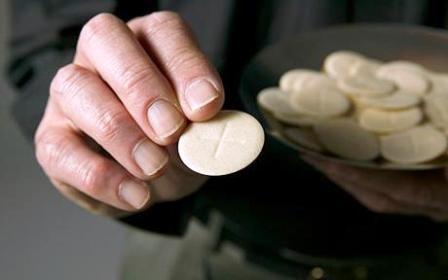
communion hostsThe consecration was valid.  When a priest says the words of consecration over valid matter and with the proper intention, the Eucharist is confected.

However, while breaking Hosts during Communion is one thing, consecrating more during Communion is another.

It is permissible to break Hosts in great need.  But the Eucharist should not be consecrated apart from its proper moment, in the Canon or Eucharistic Prayer of Holy Mass. 

An exception is when, for example, it is discovered that a chalice full of water with a couple drops of wine was "consecrated" by mistake. Also, if the priest is pretty sure that he didn’t say the form of consecration properly, he could repeat it later, even conditionally.  The point is that the priest must consume both kinds, therefore he must have both kinds.  It is not necessary for Mass to be valid that anyone else consume the Eucharist.  Even if people don’t receive, they have been to Mass. 

Another situation where the priest would need to consecrate outside of the normal moment would be if he finds that the Host has disappeared somehow.  Perhaps wind took it.  Imagine Mass in a war zone on the hood of a jeep.

In the old tract on "defects" of Mass at the beginning of the pre-Conciliar, Extraordinary Form of the Roman Missal, provision is made for a "missing" Host.  Not only does De Defectibus speak about wind, but perhaps some animal got the Host.  I can certainly imagine a bird swooping down, or a big rat, etc.  There is a funny story about that last one, as a matter of fact, but I will save it.  Another situation for the disappearance of the Host during Mass, thus requiring the priest to consecrate again, would be – as described in De Defectibus – and I love this – is that it disappears because of a miracle. 

Yes, miracles happen. 

I don’t recommend that you kneel in the pews asking God to "disappear" the Host.  The priest, on the other hand….

But to consecrate not so as to assure the validity of Mass, but that more people can have Communion… no.  Not right.

The best thing to do, IMO, is simply to explain the situation and urge people to make a spiritual Communion, perhaps offering to say Mass again (if it is permitted to binate etc. for pastoral reasons, etc.) immediately after.

I have had to do this, as a matter of fact, at a parish where I was visiting.  I was told that there should be a full ciborium in the tabernacle: there wasn’t.  I explained.  No one threw a nutty.  It was a "teachable moment".  I took a couple minutes after Mass to run through the points and everyone was fine.

Posted in "How To..." - Practical Notes, ASK FATHER Question Box, SESSIUNCULA | Tagged , ,
37 Comments

MOBILE USERS – UPDATE

[uc]

I am testing a new version of the MOBILE version of the blog template for your handhelds and phones.

Feedback, please.

MOBILE USERS - UPDATE

Keep checking for changes.

Posted in SESSIUNCULA |
36 Comments

TO ARMS! Denver priest attacked for being obedient: POLL ALERT!!

THIS IS A WDTPRS POLL ALERT!
I will have actions items for you, below.

___

UPDATE 9 March 1850 GMT:

Archbishop Chaput chimes in more directly.
___

TO ARMS! Denver priest attacked for being obedient: POLL ALERT!!There is a real kerfuffle going on in Boulder, CO, in the Archdiocese of Denver. 

The Archdiocese of Denver that catholic schools in the Archdiocese are not to accept as students the children of same sex "parents".

The policy is here:

Parents living in open discord with Catholic teaching in areas of faith and morals unfortunately choose by their actions to disqualify their children from enrollment. To allow children in these circumstances to continue in our school would be a cause of confusion for the student in that what they are being taught in school conflicts with what they experience in the home.

The policy would also protect teachers in the school.

At the catholic pre-school of Sacred Heart parish in Boulder, CO, a decision was made to adhere to archdiocesan policy and not admit the child of a lesbian "couple".

Liberals and homosexual activists are now staging a professional nutty.

A fire storm is now whirling about the parish, Sacred Heart, and the parish priest, Fr. William Breslin, who has a blog called The Heart of the Matter.

Fr. Breslin is personally taking a great deal of heat for adhering to archdiocesan policy and his parish and school are being picketed.  He is being attacked on his blog.

You can imagine the canards the protesters are tossing around. 

  • What Would Jesus Do?  (…as if they know…)
  • Don’t pick on a child!  (… they aren’t… this is about not hurting the child …)
  • Teach Acceptance!  (… by which they mean ignore the Church’s teachings on homosexual actions, etc…. )

I have some comments.

First, the protestors and the couple are the ones abusing that child by instrumentalizing her.  Knowing the Archdiocesan policy, the only reason why the lesbian "couple" would press this is to hurt the Church or try to force their own sinful agenda on an institution of the Church.  They are using the child as a tool in their fight.  So are the protesters. 

Second, the parish priest did not set the policy.  If people want to protest, go to the chancery and protest.  Follow the Archbishop around and protest.  Protesting at the parish or the school to protest at the point of weakness not of strength.  That is what bullies do.

Third, this sounds like a concrete use of the tactics of Saul Alinsky.  Am I wrong?  As a result, there are larger forces behind these protests and probably even the original decision to test the archdiocesan policy at that school… where the parish priest (I am guessing) had a reputation for being strong… thus ensuring that there would be a conflict.  If you want a fight, you never pick fights with people whom you know won’t fight back.

Fourth, this is part of our struggle right now over our Catholic identity and that ad intra and ad extra.  Remember: If Catholics don’t know what their faith is, if they don’t embrace it, then they will have nothing to contribute in the public square.  But when they do, the prevailing secularist and relativistic zeigeist will fight back with demonic ferocity.  Their objective is to driven the Catholic voice from the public square.  They will do their best, therefore, to subvert Catholic identity from within and from without.

Now, something from Fr. Breslin’s blog, with my emphases and comments.

This past week we implemented a policy that has been the most difficult decision of my life.  The choice could have been made to do nothing and allow a lesbian couple to enroll their child in our Kindergarten.  But that choice would have been against Archdiocesan policy; and when a priest is ordained he promises obedience to his bishop; and I cannot violate that vow; and I will not.

    The choice before me was either to protect the beliefs of our faith or pretend nothing was happening.  But our school, after all, is a Catholic school. [This is about identity.] And our reason for existence, both as a parish and as a Catholic school, is to make disciples of Jesus Christ. [Not of the world.]  Being disciples of Jesus Christ is very demanding. Yes, being disciples entails adherence to the many examples of Jesus’ love: love one another as I have loved you; be not the first to throw a stone; judge not lest you be judged.  Think of the Good Samaritan story and the Prodigal Son.

But when it came to making disciples, He spoke in a different way, a more radical way: unless you take up your cross and follow me, you can have no part of me.  Repent and change your ways.  If someone slaps you on one cheek, turn and offer him the other cheek.  Unless you hate your mother and father, brothers and sisters, you cannot be my disciples.  Unless you eat My body and drink My blood, you have no life within you. And when the throngs deserted him, He turned to the 12 and said, “Do you also want to leave?”   These are only a few of the hard sayings Jesus gives to those who really want to be his disciples.  [Do I hear an "Amen!"?]

    Would that I could wave a magic wand and make all of the present struggle disappear.  I hate the fact that I had to make a choice between being loving and protecting the teachings of the church.  [But what he did was choose truer love in choosing adherence to the teachings of the Church.]

    As I look around Boulder I recognize that there is ample love all around; but there is a scarcity of discipleship. [That suggests that what one sees "around" is not truer love, the love that is charity.]  I chose to be on the side of what was lacking.  I chose to protect the faith over doing what would have looked like the loving thing to do.  ["looked"] Perhaps some of you parents have been in the position to make a decision for your family that looked like the opposite of love, but was the right decision anyway.

    My brothers and sisters, our school is a Catholic school and our teaching on the sanctity of marriage is as clear as a bell.  So, the decision I made was based on my conviction that we needed to rest on the side of backing our beliefs and our values.  We need to fight for our Catholic values because here in Boulder it seems, no one else is. [kaBOOM] In many ways, I feel quite alone, even though I know I am not alone.  [No, Father.  You are not alone.  WDTPRS has your back.] But I do feel like Coleridge’s Ancient Mariner—“alone, alone, all, all alone- alone on a wide, wide sea.”  If you’re upset, blame me.  Not our principal.  She’s an excellent principal.  I’m the one who made this decision.  If you want to blame, blame me, your Catholic priest for being – Catholic!  [OORAH!]

Some links:

Video from a local newspaper from yesterday’s protest:

The Denver Post
KDVR
CNA
America Magazine

ACTION ITEMS

1.  Right now… now… stop and pray the St. Michael Prayer for Fr. Breslin and Archbp. Chaput.
2.  Immediately after pray the Memorare for the conversion of the couple of that child.
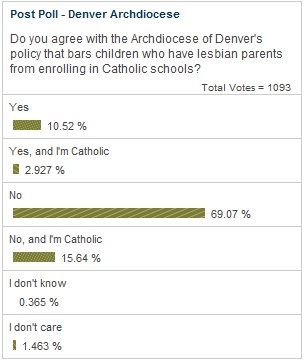
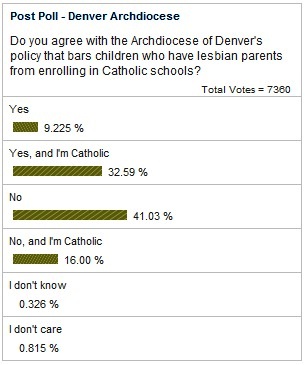
3. VOTE in that poll from the denverpost.com .
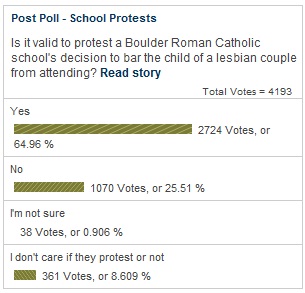
4. Then vote in the second poll farther down on the right side.

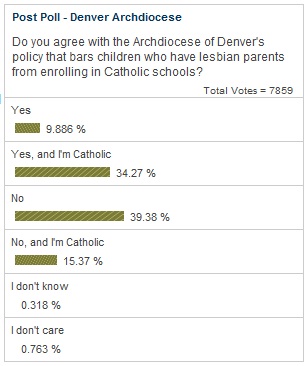
TwitterAs of now, 2029 GMT, here are the results of that poll.  MOVE THEM.   PUT THIS ON YOUR BLOGS.  TELL AND E-MAIL FRIENDS.  TWEET.  ETC.  I will update results on Twitter from time to time.

TO ARMS! Denver priest attacked for being obedient: POLL ALERT!!

The second poll, farther down on the right side is about protesting:

TO ARMS! Denver priest attacked for being obedient: POLL ALERT!!

UPDATE 9 March 1505 GMT:

You are doing your work!  Thanks!  Keep going!

TO ARMS! Denver priest attacked for being obedient: POLL ALERT!!

 UPDATE 9 March 1837 GMT:

Getting there!  Great progress!

TO ARMS! Denver priest attacked for being obedient: POLL ALERT!!

 UPDATE 10 March 1813 GMT:

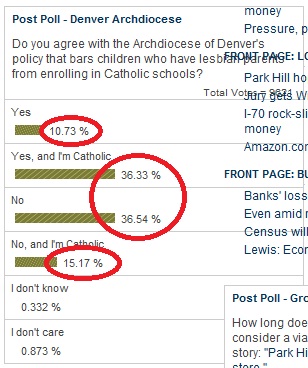
LOOK WHAT YOU HAVE DONE!

The poll graphic on the denverpost.com page is screwed up.

This is the best I could get

TO ARMS! Denver priest attacked for being obedient: POLL ALERT!!

UPDATE 10 March 1839 GMT:

I see that on Fr. Breslin’s blog, the comments have been deleted under all the posts.  Hard to blame him, poor guy.

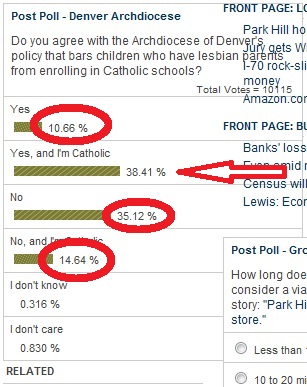
UPDATE 10 March 2344 GMT:

The Yes, I am Catholic category has pulled ahead!  

But the bad opinion is still head if you add their two categories together.

TO ARMS! Denver priest attacked for being obedient: POLL ALERT!!

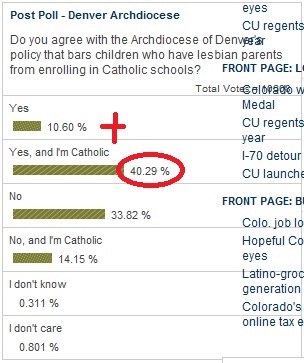
UPDATE 11 March 1344 GMT:

The poll has been turned around!

Keep up the good work!

TO ARMS! Denver priest attacked for being obedient: POLL ALERT!!

UPDATE 11 March 2304 GMT:

The good guys are winning.

TO ARMS! Denver priest attacked for being obedient: POLL ALERT!!

Posted in Our Catholic Identity, POLLS, SESSIUNCULA, The Last Acceptable Prejudice, Throwing a Nutty | Tagged , , ,
135 Comments

Another comparison of editions of the Vulgate

I posted at another time on an entry from Canterbury Tales about versions of the Vulgate.  It was interesting, indeed.  Go spike his stats and give him kudos!

He is at it again.

About the Nova Vulgata or "Neo-Vulgate" and How it Relates to the Clementine Vulgate and Pian Vulgate

The current edition employed by the Catholic Church (since 1979) is the Nova Vulgata. It is the official Scriptural Latin text for the Church and was promulgated by John Paul II’s apostolic constitution Scripturarum Thesaurus.

If you follow the Novus Ordo Lectionary or the Liturgy of the Hours in Latin, this is the textual edition that you are reading. Here’s a an example of minor differences between the old Jerome/Gallican/Clementine Psalter and the Nova Vulgata Psalter. I marked the differences.

Gallican Vulgate
i.e. Clementine

Psalmus 94

Nova Vulgata
i.e. the current one

Psalmus 95

Venite, exsultemus Domino; jubilemus Deo salutari nostro; præoccupemus faciem ejus in confessione, et in psalmis jubilemus ei: quoniam Deus magnus Dominus, et rex magnus super omnes deos. Venite, exsultemus Domino; iubilemus Deo salutari nostro. Praeoccupemus faciem eius in confessione et in psalmis iubilemus ei. Quoniam Deus magnus Dominus, et rex magnus super omnes deos.
Quia in manu ejus sunt omnes fines terræ, et altitudines montium ipsius sunt; quoniam ipsius est mare, et ipse fecit illud, et siccam manus ejus formaverunt. Quia in manu eius sunt profunda terrae, et altitudines montium ipsius sunt. Quoniam ipsius est mare, et ipse fecit illud, et siccam manus eius formaverunt.
Venite, adoremus, et procidamus, et ploremus ante Dominum qui fecit nos: quia ipse est Dominus Deus noster, et nos populus pascuæ ejus, et oves manus ejus. Venite, adoremus et procidamus et genua flectamus ante Dominum, qui fecit nos, quia ipse est Deus noster, et nos populus pascuae eius et oves manus eius.
Hodie si vocem ejus audieritis, nolite obdurare corda vestra sicut in irritatione, secundum diem tentationis in deserto, ubi tentaverunt me patres vestri: probaverunt me, et viderunt opera mea. Utinam hodie vocem eius audiatis: “Nolite obdurare corda vestra, sicut in Meriba, secundum diem Massa in deserto, ubi tentaverunt me patres vestri: probaverunt me, etsi viderunt opera mea.

Quadraginta annis offensus fui generationi illi, et dixi: Semper hi errant corde. Et isti non cognoverunt vias meas: ut juravi in ira mea: Si introibunt in requiem meam. Quadraginta annis taeduit me generationis illius et dixi: Populus errantium corde sunt isti. Et ipsi non cognoverunt vias meas; ideo iuravi in ira mea: Non introibunt in requiem meam.”

By the way, the Breviaries printed between 1945 and 1971 have the so-called "Pian Psalter" issued by Venerable Pius XII – which has more Hebraisms – just like the Nova Vulgata. For example, "sicut in Meriba, secundum diem Massa," instead of the Latinized older version: "sicut in irritatione, secundum diem tentationis."

I recently discovered this when I noticed a friend’s Breviary (the one used by the FSSP). I was surprised to see that the Venite there did not correspond to the Gallican/Clementine Venite. The reason why, I learned, is that it seems to conform to the Pian Psalter (post 1945) – which makes perfect sense.


Posted in SESSIUNCULA |
22 Comments