A cautionary tale about why we must NEVER stop praying for priests

I read the news that former priest and liberal critic of the Catholic Church James Kavanaugh died at the age of 81.  The story is on mlive.com.

One of my spies told me something that the obituary does not mention: Kavanaugh asked for and received the Apostolic Pardon just before he died.

Never stop praying for priests… priests who are faithful and those who are not, those who are capable and those who are less so, those whom you like, those you don’t.

The devil HATES priests with a malice that humans cannot fathom.  With diabolical angelic abilities they do what they can to drag priests – upon whom so much rests – down and then farthest down of all.

Pray for priests.

I once had an experience that underscores this plea.

I used to commute by train into Rome from Velletri everyday at oh-dark-hundred … every…day.

One morning there was a commotion on the platform in one of the little stops on the way.

Someone had thrown himself in front of the train.

There were a couple other priests there, standing around with their hands in their pockets.  Therefore, I – who always carry an oil stock – got down on the messy track and anointed the still slightly shuddering body and sent him heavenward with the Apostolic Pardon.

The next day my bishop called me in and asked for my version of what had happened.  I told him.

He then told me that the man was an ex-priest, a Salesian. 

Simply the luckiest desperate ex-priest ever, perhaps. 

Who knows what prayers, what work of angels sent by others, saved that man that morning.

Never stop praying for priests, effective or hapless, faithful or not, near saints or obviously lacking. 

Do not stop praying for priests.

Posted in Year of Priests | Tagged
50 Comments

Out with the old, in with the new director of the Sistine Chapel Choir

Although not recently, I have on several occasions mentioned that with the ousting of former papal master of ceremonies Piero Marini, and the beginning of a new approach to papal liturgies with the arrival of Msgr. Guido Marini, it was only a matter of time before the director of the Sistine Chapel Choir, Msgr. Giuseppe Liberto, would also get the hook.

For reasons I cannot fathom, it took a long time, but it this too has come to pass.

I read in L’espresso of Sandro Magister that the new director of the Sistina will be Fr. Massimo Palombella, SDB… yes… yet another Salesian, the same order to which Sec. State Cardinal Bertone belongs.

With the hoisting up of all these Salesians, people in are starting to quip that SDB actually means "Socio di Bertone … or Bertone’s Club Member" rather than "Salesiani di Don Bosco".

Magister observes in his Italian article that it was clear something was on the horizon when in L’Osservatore Romano there appeared a piece in (undeserved) praise of Liberto.

Fr. Palombella has directed the Inter-university Choir of Rome for 15 years.  Not all have been favorable about the choir’s expertise or direction. 

If that is the case, he should fit right in with the Sistine Choir… or "the Sistine Screamers" as some in Rome have dubbed them.

However, I am thinking that the new director’s choices of what to sing will be more along the lines of what Papa Ratzinger and Msgr. Guido Marini think appropriate for the papal liturgy in St. Peter’s Basilica.

We will have to keep an eye on this fellow as we as an ear tuned to any improvements in the Sistina.

Posted in SESSIUNCULA | Tagged , ,
8 Comments

Reminder: Blessing chalk, houses on Epiphany

Wednesday is 6 January and therefore Epiphany.

Don’t forget, Fathers, the wonderful tradition of blessing chalk and houses.

(In other words, get some chalk today, if you don’t already have some.)

Posted in "How To..." - Practical Notes, Christmas and Epiphany | Tagged ,
23 Comments

Lentil purée with croutons and escarole… sort of…

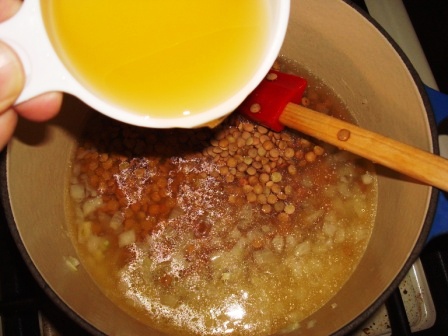
Lentil purée with croutons and escarole... sort of...Some time ago a friend gave me a subscription to a great food magazine called La Cucina Italiana.  If feasible I try to make at least a couple things from each issue.  The last issue has a whole bunch of really good ideas.  Last night I made a soup, listed as Lentichie in vellutata con crostini e scarola, or lentil purée  with croutons and escarole.

Except… the store didn’t have any escarole.  So I used a flashy on sale purple kale instead.

Lentils are a great winter dish.  And super cheap.

I started with a cup, and rinsed them.

Lentil purée with croutons and escarole... sort of...

In a medium sized pan I softened up a half cup of finely chopped onion in olive oil.

Lentil purée with croutons and escarole... sort of...

Add your lentils and a couple cups of vegetable broth and a cup of water.

Lentil purée with croutons and escarole... sort of...

Cook for 40 minutes.   Put it through a blender or food processor in small batches.  You might keep some broth handy if it is too thick.  Return it to the pan and adjust the flavor with salt and pepper if you need to.  I don’t have a large food processor, so I used a blender.

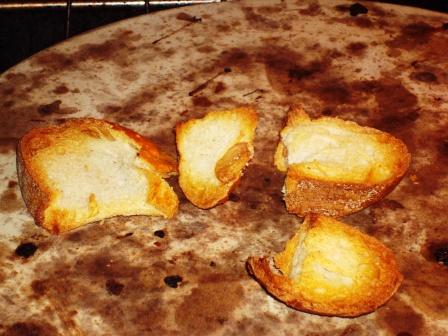
In the meantime, in 350F oven make some croutons from good crusty bread.  I got a small loaf of one of those warm-it-at-home breads with some garlic it.  I cut some pieces and put them on a pizza stone.

In the meantime, I cut up the science fiction vegetable and put it into a frying pan with some olive oil, and wilted it down.

Lentil purée with croutons and escarole... sort of...
 
I really wanted the escarole, but… oh well.  I think you could also do very well with baby bok choy.

Out come the croutons.

Lentil purée with croutons and escarole... sort of...

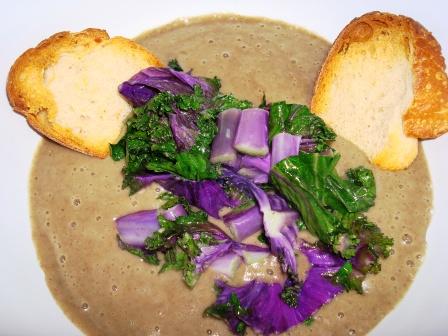
Put it together. 

There were still some bubbles from the blending process, but it was still hot and I was hungry… so…

Lentil purée with croutons and escarole... sort of...

This made 4 servings.

A patient reheating before serving will get rid of the bubbles and escarole will make it look less Klingon.

Also, you could add more liquid for a thinner soup or leave it thick and use it almost like a sauce.

The texture was velvety.  It was a very nice, almost-makes-itself cold weather meal.

I will probably also try the vellutata di cavolfiore next, which is garnished with leek and veal, and then the crema di fagioli e orzo.  There is also an interesting one from carrot with little fish-meatballs.  If I can get some mussels on sale I will for sure try the squash purée with mussles.

Posted in Fr. Z's Kitchen |
16 Comments

Tall building

Today the world’s tallest building is being inaugurated.

I mean, of course, the Burj Building in Dubai.

Tall building

When will someone try to bring this one down?

Or is it "safe" because it is in an Arab, Islamic country?

Tall building

I don’t think you could print enough money to get me to work or live in this building.

Posted in SESSIUNCULA |
13 Comments

A kind of contrapasso

Remember the story about the Anglican priest, Fr. Tim Jones in York, who advised poor people to ignore one of the commandments of the Decalogue and go ahead and steal?

There has been a development in Father’s life.

A reader tipped me to an article in The Guardian:

A priest who advised poor people to shoplift was showered with a bucket of pasta for making the remarks, the Church of England confirmed today.

The Rev Tim Jones, from St Lawrence and St Hilda in York, attracted harsh words earlier this month from the police and a former archbishop of Canterbury for telling his congregation it was acceptable for the needy to steal to feed their families.

But there came a very different rebuke last weekend, when a man approached the priest outside the church and threw 30 tins worth of ravioli and spaghetti on him. The contents of the bucket may well have been inspired by Jones himself, who said he would "rather that people take an 80p can of ravioli rather than turn to some of the most appalling things".  [Jones’ mistake was to suggest stealing ravioli.  If he had suggested robbing a bank, maybe someone would have thrown a box of money at him!]

Martin Stot, 48, thought the priest’s comments could encourage young people to steal and decided to take action. He told York Press: "One theft could be on their record for 10 years. It would be difficult for them to get a job. I was just offended by what he said. I thought I would make my own little protest." He bought the canned pasta from Asda and hid in a phone box until the priest emerged from the regular Sunday service.

In the controversial sermon, given the week before Christmas, Jones said society had failed many needy people and it was far better that they shoplift than turn to more degrading or violent options such as prostitution, mugging or burglary.


Okay folks, get out there are start robbing banks!

Posted in SESSIUNCULA |
17 Comments

Mayonnaise and dark energy, Bless the Lord! Praise and exalt Him above all forever.

Fluctus et Casimiri Effectus, benedicite Domino!  Laudate eum et superexaltate eum in saecula!

Consider a startlingly unique element of the Judeo-Christian message:

Almighty God, who really is involved, created the universe and all that is in it from nothing.  And God has a plan, for the whole universe, and for you as an individual made in His image and likeness.  He has revealed something of this plan to us.  Even in the details of the mechanics of the universe, He reveals something of Himself.

Now this… from Astromony Pic of the Day:

See Explanation.  Clicking on the picture will download  the highest resolution version available.

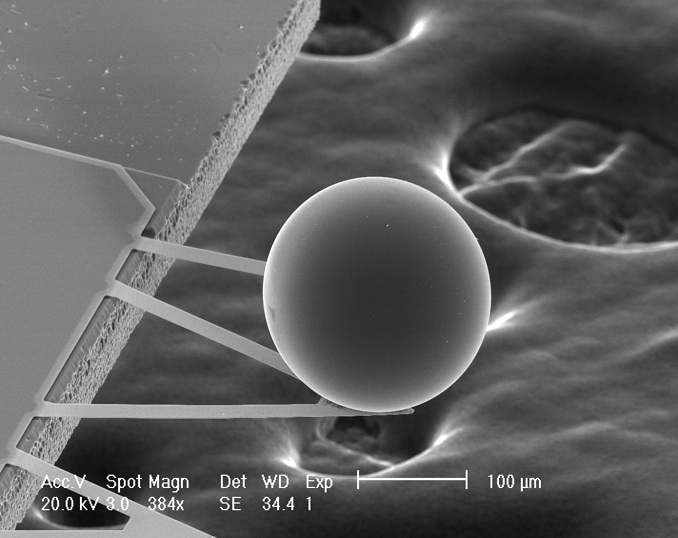
A Force from Empty Space: The Casimir Effect
Credit & Copyright: Umar Mohideen (U. California at Riverside)

Explanation: This tiny ball provides evidence that the universe will expand forever. Measuring slightly over one tenth of a millimeter, the ball moves toward a smooth plate in response to energy fluctuations in the vacuum of empty space. The attraction is known as the Casimir Effect, named for its discoverer, who, 50 years ago, was trying to understand why fluids like mayonnaise move so slowly. Today, evidence is accumulating that most of the energy density in the universe is in an unknown form dubbed dark energy. The form and genesis of dark energy is almost completely unknown, but postulated as related to vacuum fluctuations similar to the Casimir Effect but generated somehow by space itself. This vast and mysterious dark energy appears to gravitationally repel all matter and hence will likely cause the universe to expand forever. Understanding vacuum fluctuations is on the forefront of research not only to better understand our universe but also for stopping micro-mechanical machine parts from sticking together.

Posted in Just Too Cool, SESSIUNCULA | Tagged , ,
37 Comments

A paragraph of hope from Pope Benedict’s Angelus message

Today in his Angelus address, Pope Benedict said the following, which I excerpted from his message (in my translation):

On this Sunday –  the second since Christmas and the first of the new year – I am pleased to renew for all of you my best wishes in the Lord.  Problems are not lacking, in the Church and in the world, as indeed in the daily life of families.  But, thanks be to God, our hope doesn’t depend on improbable prognostications nor on economic forecasts, important as they are.  Our hope is in God, not in the sense of a generic religiosity, or a fatalism wrapped in faith.  We trust in God who in Jesus Christ reveald in a complete and definitive way His will to remain with man, to share our history, to guide us all to His Kingdom of love and life.  And this great hope animates and at times corrects our human hopes.


Read the rest here (in Italian).

Posted in SESSIUNCULA |
4 Comments

WDTPRS – Epiphany – COLLECT (2002MR)

Epiphany is from the Greek word for a divine “manifestation” or “revelation”. The Church’s liturgy for the feast, especially in its antiphons for Vespers, reflect the tradition that Epiphany was thought to be the day not only when the Magi came to adore Christ, but also the same day years later when Jesus changed water into wine at Cana, and also when He was baptized by St. John at the Jordan.

Images of these three mysteries has been maintained in the 2002 edition of the Missale Romanum in the artwork on the facing page for the texts, artwork as I have said in the past that is every bit as good as that which Mommy might proudly display on the refrigerator fixed on with magnets of plastic fruit.

The “art” for the Missale is based on the mosaics of a new chapel of the Vatican’s Apostolic Palace built during the Jubilee. In any event, in each of these three mysteries Jesus is revealed to be more than a mere man. He is man and God. The are many “epiphanies” of God in the Scripture, for example, the burning bush seen by Moses, the Transfiguration, and the above mentioned.

The history of the modern feast of Epiphany is ancient and complicated history. In the East Epiphany was an extremely important feast far more important than the relative latecomer Christmas. In the West, the Nativity developed first and the celebration of Epiphany came later. In many places in the world, Epiphany, and not Christmas, is the day to exchange gifts, in imitation of the Magi.

Epiphany truly really falls on the 6th of January, the twelfth day after Christmas (as in “On the Twelfth day of Christmas, my true love gave to me…” – which some think comes from Ireland during the time when Catholicism was illegal). Twelfth Night as in Shakespeare’s play, refers to Epiphany. In the post-Conciliar calendar, it can be transferred to Sunday and perhaps this is good (though I suspect it isn’t): the ancient and mysterious feast now gets more attention than it did when it was observed strictly on January 6th.

Today’s “Opening Prayer” for Mass, or more properly Collect, was in the 1962MR and in other ancient sacramentaries. Enjoy the sound of the Latin by reading it aloud, with the fine rhythmic clausula at the end.

COLLECT – LATIN TEXT (2002MR):
Deus, qui hodierna die Unigenitum tuum stella duce revelasti,
concede propitius,
ut qui iam te ex fide cognovimus,
usque ad contemplandam speciem tuae celsitudinis perducamur.

ICEL (1973 translation of the 1970MR):
Father,
you revealed you Son to the nations
by the guidance of a star.
Lead us to your glory in heaven
by the light of faith.

Well that is what ICEL gave us. But is that what the prayer really says?

I suspect not.

We are justifiably suspicious when the translation is shorter than the Latin original (which just doesn’t happen, friends).

In case you are trying to figure out the ending of revelasti it is a syncopated (shortened) form of revelavisti. Stella duce is an ablative absolute (duce is from dux). Don’t fall into the trap of translating an ablative absolute beginning with “with” (e.g., “with a star as leader”). “With” gives an impression of accompaniment rather than the existing circumstance at the time of the action of the main verb. The adjective hodiernus, a, um, is “of this day, today’s”, so hodierna dies literally is “today’s day”, stronger than a simple “today”. Perhaps we could say, “this day of day’s” or “this of all days”. To my Latin ear this emphasizes the weight of the feast of Epiphany with its three events that are traditionally associated with it. Celsitudo, in your revelatory Lewis & Short Dictionary, indicates in older Latin a loftiness of carriage while in later Latin it points to majesty, as in the title “Highness”.

LITERAL TRANSLATION:

O God, who today revealed your Only-begotten, a star having been the guide,
graciously grant,
that we, who have already come to know you from faith,
may be led all the way unto the contemplation of the beauty of your majesty.

There is depth in the phrase usque ad contemplandam speciem.

The noun species (three syllables) is too broad in meaning for this narrow space. Species often means “beauty” in prayers, but it is also a technical philosophical term about the way the human intellect apprehends things. Species, (frequently also called forma, another word for “beauty, splendor”) points at a relationship between the thing known and our knowing power. It allows us to perceive objects directly and without a bridge or intermediary. A famous philosophical adage says, “Quidquid recipitur per modum recipientis recipitur…. Whatever is received, is received in the mode of the one doing the receiving” (cf. St. Thomas Aquinas, STh I, q. xii, a. 4). Species has a transforming effect on the mind of the one perceiving a thing. The object being considered acts upon our power of knowing, and this knowing power acts simultaneously on the object known. So, our knowing power’s “active and passive” dimensions come together in the process and the object of consideration is known directly, without intermediaries. This is what we are praying for, hoping for, living our earthly lives for: we want to see God face to face, directly and immediately.

In this life, we know God indirectly, by faith, our intellect being aided by authority of revelation and by grace. This is St. Paul’s “dark glass” (1 Cor 13:12) through which we peer toward Him in longing. In the next life we will not need faith because we will have direct knowledge. In this phrase usque ad contemplandam speciem (a gerundive construction indicating purpose) we are praying to be brought “all the way to the beauty” of God “which is to be contemplated”. This vision of His beauty will increase our knowledge of Him and therefore our love for all eternity. This is what we were made for: His glory and splendor. They will transform us, making us more and more like what God is by our contemplation of them for ever and ever.

The Fathers of the Church, such as Hilary of Poitiers (+367), spoke of the glory of God as a transforming power which divinizes us by conforming us more and more to His image. In our prayer, there is a move from faith to knowledge in the Beatific Vision. Christ is the visible image of the invisible God, He is the Beauty and Truth of the Father. Christ could be seen as the species of this prayer. In heaven, God’s Truth and Beauty are indistinguishable and we will see them directly and be thus transformed during all eternity.

This prayer has meaning for our earthly lives: we need beauty now as well. The influence of post-modernism, particularly in education, has made it harder and harder for people to grasp the existence of objective truth. Ugly images flood our vision, hideous noises our ears. This numbs us to beauty and therefore apprehensions of truths.

In a post-modern view everything relative, we cannot really know things with certainty nor can we communicate them, and nothing is admitted as unchanging or eternal. The discord and restlessness this provokes in life has nothing to do with God. But it has nothing to do with man either, at least in the way he was made and what he is intended for. Dante in the Paradiso of the Divine Comedy invents a new word, “transhumanize”, to describe what happens to us through the Beatific Vision. In our direct contact with God we are simultaneously made more and more like God and also more and more what we are supposed to be, God’s images.

In being “transhumanized” in this world and the next, His grace perfects our nature, not destroys it. In this life, holiness and the life of virtues is what does this. Think of the document of the Holy Father, concerning moral theology, called Veritatis splendor… The Splendor of the Truth.

If eternal beauty transforms man, “divinize” him, then in this life beauty (Truth’s echo) can change him as well. So will ugliness.

The current dissolution of formal education in fundamentals and tools of learning has rendered many people incapable of following easily a linear argument to a conclusion that they will accept because it must perforce be true: “It is true for you, maybe,” they often respond. Could the proper use of and fostering of beauty in our churches help us reach people in a way that the systematic approach and arguments may not be able to effect at this time? Once people have seen God’s truth shining through beauty (of music, motion, language, environment) they can be reached in other ways. The Church has given two things as a common inheritance for all mankind: art and saints. In art, God’s truth and beauty are reflected in inanimate creation. In the lives of saints, God’s truth and beauty shines forth in living creatures, His images. In both, we find the beauty which points to the truth. The beauty of the truth and the truth of beauty can affect every dimension of our lives now, in anticipation of heaven.

Our true Catholic faith and our splendid liturgy show forth the truth and beauty of God in a way that urges us to find the most accurate and beautiful words, actions, music we can possibly summon from human genius, labor and love. What we say and do in church ought to be a foretaste of heaven and the Beatific Vision.

The Church must once again reclaim her role as the greatest patron of the arts in human history. Beauty in liturgy can be a manifestation of the divine, a revelation, an “epiphany”. In a new translation of the Missal, our bishops will have the chance to give us a precious gift: a new glimpse of God through beauty and truth in words. When we go to Mass we are like shoe-less Moses’ meeting God in the burning bush which is not consumed. We are like the Magi whose penetrating sight is fixed upon the infant Jesus, in whose perfect image something of the invisible Father is revealed.
Posted in SESSIUNCULA |
18 Comments

Shipping your suitcase

Do any of you have experience of Fedexing or UPSing your suitcase instead of checking it on an airplane trip?

Posted in SESSIUNCULA |
25 Comments