The Feeder Feed

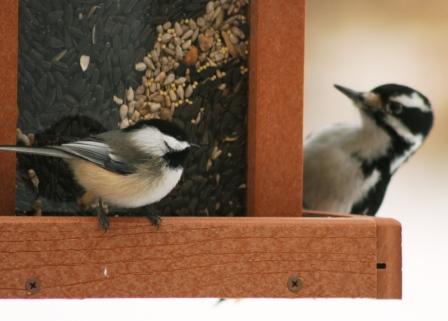
The Feeder FeedBetween various bouts with the keyboard today, I took a few photos of the every busy birds at the feeder.

Lots of black and white these days.

The Feeder Feed
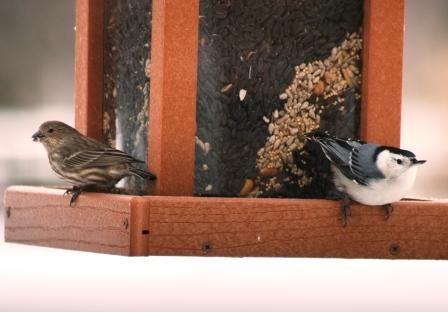
Though other muted colors come around.The Feeder Feed

The Feeder Feed

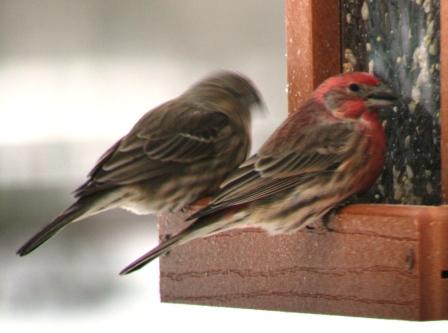
I am glad to see some House Finches back.  They were gone for a while, perhaps on that same cruise the Chickadees were on.  Not with Celebrity, I hope.

The Feeder Feed

poing!

The Feeder Feed

Once in while I catch some bird just hanging out.  The Feeder Feed

This Nuthatch, during a lull, just sat there, looking around for the longest time.

The Feeder Feed

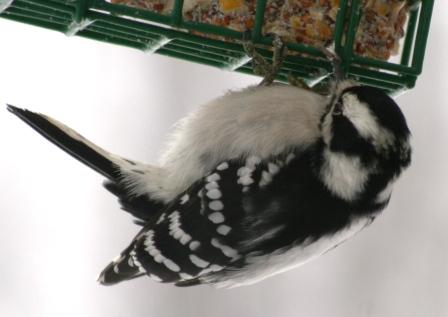
Similarly, I caught this woodpecker actually dozing upside down, pretty much motionless for a few minutes.

Like I said… just hanging around.

The Feeder Feed

I feed the birds from your donations.

Posted in The Feeder Feed |
7 Comments

Update on a parish conflict in Michigan

You might remember that there was a dust up in the Diocese of Lansing, Michigan.  Some parishoners of Our Lady of Fatima were trying to get their pastor, Fr. Jeffrey Robideau, removed.  

So often these stories about about a conservative-minded priests who begins to effect changes in a parish and aging-hippie parishioners rise up against him no matter how diplomatic (or undiplomatic) the pastor has been. 

And it is almost always from liturgical changes.  

That makes sense, of course.  When you change the liturgy, you are making statements about faith and morals.

Sadly, in the past many bishops pretty much by default sacked the pastor, thus contributing to sacerdotal morale and that special bond that exists between bishop and priests. I think those days are passing, by the way.

From mlive.com comes this update with my emphases and comments.

Catholic bishop says priest will stay at Michigan Center church despite complaints from parishioners

By Jackie Smith
December 28, 2009, 11:36PM

The Catholic Diocese of Lansing will keep a controversial pastor in place at a Michigan Center parish, more than a month after parishioners sent a petition asking for his removal. 

Some 150 members of Our Lady of Fatima had asked Bishop Earl Boyea to remove the Rev. Jeffrey Robideau. Last week, the parish and diocese sent letters to parishioners saying that Robideau will stay.

In his letter, Robideau acknowledged that some of his decisions have prompted members to leave the parish. Robideau, 42, was appointed in July, replacing the Rev. Andy Dunne.

"While I am saddened and sorry that people have taken offense, I continue to understand that a transition from a pastor of 30 years to a young, zealous pastor like myself is difficult," he wrote.  [Could it be that there was an old supporter of the Spirit of Vatican II in that post who let lay people have more authority?]

Included in parishioners’ concerns were Robideau’s decision to disband the church’s choir [Very often a problem in a parish for a new pastor.] and his apparent refusal to train girls to perform altar services [Entirely within his right] or hold church committee meetings. [Depending in what they mean by "committee", that could be a point.]

"It is clear that the pastor has the prerogative to make the decisions in these matters," Boyea stated in his Dec. 17 letter. [God bless him.] "You are no doubt aware that in our diocese, as in any diocese, priests will vary, within the guidelines established by universal or diocese law, in their choices in these matters."

Helen Navarre, a longtime member of Our Lady of Fatima, said she found the response discouraging.

"It seems as though none of the problems we have will be solved," she said. [Actually, they were resolved.  Just not in the way she liked.] "I don’t give up very easily. I will continue to go there, hoping things get better." [And I am sure she will be a source of joy for all concerned.]

Navarre said she understood Robideau’s authority to make decisions, but said the change is just too drastic for some.  [Drastic?  When you read or hear "drastic", what comes to mind?  This stuff?]

"Our church has been just like a big family and everybody’s worked together to have what we’ve got now," she said.

In the letter, Boyea told parishioners that he and Robideau "consulted about all the matters which you have raised and discussed every one of them." Much of its content regarded parish finances over construction, specifically a $1.3 million project that could put an addition on the church to seat a total of 940. The project’s planning, he said, is still being discussed.  [Okay, that is a good thing to discuss.  But church design isn’t a matter of a vote for everyone.]

Michael D. Diebold, a spokesman for the diocese, could not be reached for comment Monday.

Robideau also defended many of his actions in a Thanksgiving letter to parishioners. In his letter, Boyea also mentioned Robideau’s sincerity in bringing parishioners back who have left. [Good!]

Navarre is skeptical over whether they would want to return.

"Each Sunday it seems like there are fewer and fewer people in attendance," she said. "My personal opinion is they never will (return) as long as he’s there."  [There’s a fine response.  It remains to be seen if the new pastor will attract new people.  The reporter apparently didn’t care to explore that.]

It is a sad fact that some changes are painful.

I have in mind St. Augustine’s description of the Christ as medicus, physician.  Sometimes painful correction is received in life.   The saint describes, nevertheless, that the doctor doesn’t stop cutting just because the patient is screaming for him to stop.

You might stop for a moment and pray to Mary Mother of the Church for that parish, the priest, and the bishop.

Posted in SESSIUNCULA | Tagged , ,
52 Comments

New USPS stamp … surprise!

In the now defunct but still relevant series The West Wing there is an episode in which the staff must chose figures for new US postage stamps.  Witty political correctness ensues.

At the time of the actual run of the series, the staff of the The West Wing seemed pretty far to the left.  These days, however, Pres. Bartlett and helpers seem like right-wing extremists compared to the present denizens of Pennsylvania Avenue.  Well… maybe not Josh….

You might have seen the episode in Season 2, "Galileo"….

Chief of Staff Leo is walking with the darkly snarky Toby, Communications Director and amped-up terrier Josh, Leo’s deputy.  There is going to be a landing of a Mars probe called Galileo

LEO: Walk me out.
Josh and Toby get up and follow Leo.
JOSH: Oh Leo, ask me how long a Martian day is.
LEO: No, I don’t think I will. Toby, do you know how a stamp is chosen?
TOBY: A stamp?
LEO: Yeah.
TOBY: No.
The three walk out of mess.
LEO: You’re gonna learn.
TOBY: Why?
LEO: The Postmaster General needs your help.
TOBY: Why?!
LEO: The Citizen’s Stamp Advisory Committee has…
JOSH: There’s a Citizen’s Stamp Advisory Committee?
LEO: Yes.
JOSH: Made up of members of the There-But-For-The-Grace-of-God-go-I Club?
LEO: You want to mock people or let me talk to Toby?
JOSH: I want to mock people.
LEO: The Citizen’s Stamp Advisory Committee has recommended to the Postmaster General that
Marcus Aquino be put on the next stamp issue.
TOBY: You know who he is?
JOSH: No.
LEO: He’s a former Resident Commissioner of Puerto Rico and a Korean War hero.
TOBY: Then what’s the problem?
JOSH: He advocated statehood, right?
LEO: Strongly advocated it.
TOBY: Give it to somebody else!
LEO: No.
TOBY: Please?
LEO: This is a public face thing, and the Postmaster General wants your help!
TOBY: Well he can wait on a line around the block! Even while I have two of my 20 teller windows are open!
LEO: Make a recommendation by the end of the day.
TOBY: Yeah.
They stop walking.
LEO: [to Josh] What are you smiling at?
JOSH: Nothing, I just… Toby got the stamp assignment. [chuckles]
TOBY: Leo, I might need some help.
LEO: Take Josh. [goes into an office]
TOBY: Thanks. [to Josh] Congratulations, you’re choosing the next stamp. [leaves Josh alone]
JOSH: Wow, that happened fast.

His rebus gestis, a reader sent me a link to the site of the United States Postal Service where, lo and behold, we find this surprise about a new stamp for 2010.

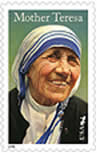
Mother Teresa.

She is right up there with actress Katharine Hepburn, Negro Leagues Baseball and the Cowboys of the Silver Screen, Roy Rogers, Tom Mix, Gene Autry and William Hart. 

You ask: William Hart but no John Wayne?!  I guess the Duke has a stamp already.

The USPS explains (with my usual … but this time a little more skeptical… treatment):

With this stamp, the U.S. Postal Service recognizes Mother Teresa, who [and here I think we have the true reason for the stamp…] received the Nobel Peace Prize in 1979 for her humanitarian work. Noted for her compassion toward the poor and suffering, Mother Teresa, a diminutive Roman Catholic nun and honorary U.S. citizen, served the sick and destitute of India and the world for nearly 50 years. Her humility and compassion, as well as her respect for the innate worth and dignity of humankind, inspired people of all ages and backgrounds to work on behalf of the world’s poorest populations.  [It is probable that two things are going on here.  First, the Obama Administration is continuing its in efforts to suborn Catholics.  Second, in honoring a Nobel Peace Prize winner, the President is honoring himself.]

Mother Teresa, an ethnic Albanian, was born Agnes Gonxha Bojaxhiu on Aug. 26, 1910, in Skopje in what is now the Republic of Macedonia. [A fact Macedonians always point out.] Drawn to the religious life as a young girl, she left her home at the age of 18 to serve as a Roman Catholic missionary in India. “By then I realized my vocation was towards the poor,” she later said. “From then on, I have never had the least doubt of my decision.” Having adopted the name of Sister Mary Teresa, she arrived in India in 1929 and underwent initial training in religious life at a convent in Darjeeling, north of Calcutta. Two years later, she took temporary vows as a nun before transferring to a convent in Calcutta. She became known as Mother Teresa in 1937, when she took her final vows.

New USPS stamp ... surprise!Following a divine inspiration [Surprised at the language?  Remember: This stamp might not really be about Bl. Teresa after all.] and deeply moved by the poverty and suffering she saw in the streets of Calcutta, Mother Teresa left her teaching post at the convent in 1948 to devote herself completely to the city’s indigent residents. [Sorta like a community organizer!] Two years later, she founded her own congregation, the Missionaries of Charity. Like Mother Teresa, the nuns of the new order wore white saris with a blue border rather than traditional nuns’ habits. In addition to the traditional vows of chastity, obedience, and poverty, they took a fourth vow of wholehearted free service to the poorest of the poor. “In order to understand and help those who have nothing,” Mother Teresa told the young women, “we must live like them.”

When Mother Teresa accepted the 1979 Nobel Peace Prize—one of her numerous honors and distinctions—she did so “in the name of the poor, the hungry, the sick and the lonely,” and convinced the organizers to donate to the needy the money normally used to fund the awards banquet. Well respected worldwide, she successfully urged many of the world’s business and political leaders to give their time and resources to help those in need. President Ronald Reagan presented Mother Teresa with the Presidential Medal of Freedom in 1985, [And now a different President gives her a stamp!] the same year she began work on behalf of AIDS sufferers in the U.S. and other countries. In 1997, Congress awarded Mother Teresa the Congressional Gold Medal for her “outstanding and enduring contributions through humanitarian and charitable activities.”

Mother Teresa died in Calcutta on September 5, 1997, and is buried there. She had been a citizen of India since 1948.

In 1996, President Bill Clinton and the U.S. Congress awarded Mother Teresa honorary U.S. citizenship. [I didn’t know that.] As of February 2009, the honor has only been bestowed on five others. Winston Churchill received it in 1963, Raoul Wallenberg in 1981, William Penn and Hannah Callowhill Penn in 1984, and the Marquis de Lafayette in 2002. With the exception of Hannah Callowhill Penn, each of these figures has also appeared on a U.S. postage stamp: the Marquis de Lafayette four times (1952, 1957, 1976, and 1977), William Penn in 1932, Churchill in 1965, and Wallenberg in 1997.  [Well!  There’s the reason she is on the stamp, right?]

The stamp features a portrait of Mother Teresa painted by award-winning artist Thomas Blackshear II of Colorado Springs, CO.

Okay, folks, there’s my cynical reading of the story.

I am still glad to see Bl. Teresa on the stamp.

His rebus gestis, quidquid id est timeo Albae Domus adiutores et dona ferentes.

Posted in SESSIUNCULA | Tagged , , , , ,
8 Comments

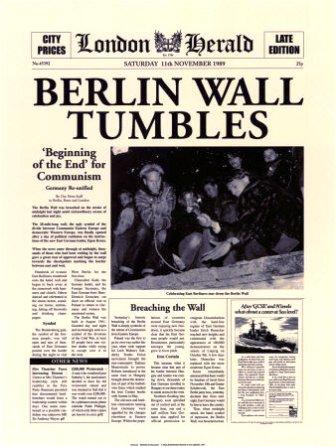
Benedict XVI’s Anglican provisions like the razing of ecumenical Berlin Wall

Benedict XVI's Anglican provisions like the razing of ecumenical Berlin WallIn your discussions of things ecumenical, remember to refer to Pope Benedict as "the Pope of Christian Unity".
A reader alerted me to the following piece In the Canadian daily The Globe and Mail by Ian Hunter,
Ian Hunter is professor emeritus in the faculty of law at the University of Western Ontario. 

My emphases and comments.

The big news: The Pope welcomes disaffected Anglicans

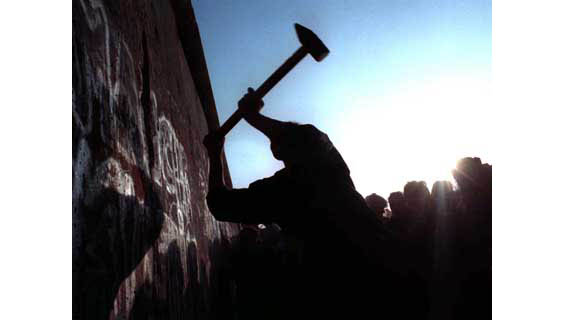
Will Oct. 20 be remembered as the day when the Berlin Wall of religious separation began to crumble? [I like that image.]

Ian Hunter

From Wednesday’s Globe and Mail
Last updated on Wednesday, Dec. 30, 2009 2:04AM EST

With year’s end fast approaching, columnists and pundits will hold forth on what was the most significant news story of 2009. The story I nominate is unlikely to bulk large in their consideration, unlikely even to be mentioned, but I suggest that the most important story was Pope Benedict XVI’s overture to disaffected Anglicans. [Certainly the big story in religion.]

The story really begins a couple of years earlier, when a group of breakaway Anglicans (most had left the church after 1977 over Anglican ordination of female priests) who call themselves the Traditional Anglican Communion (TAC) petitioned Rome en masse through their primate, Archbishop John Hepworth.

The TAC, whose size is estimated at 300,000 to 500,000 souls worldwide, asked for full communion with Rome without preconditions or demands, while expressing the hope that it might be possible to retain traditional Anglican liturgy and hymnody. Their petition was cordially received at the Vatican, but for many months, there was only silence.

Then, [TA DA!] on Oct. 20, the response of Pope Benedict XVI was a decisive, magnanimous “Yes.” The subsequently published Apostolic Constitution (Anglicanorum Coetibus) confirmed that TAC members will be permitted to join collectively and will be allowed to retain the liturgies and traditions “that are precious to them and consistent with the Catholic faith.” Small wonder that Archbishop Hepworth called the Pope’s offer “generous at every turn … very pastoral” and “a beautiful document.”

Benedict XVI's Anglican provisions like the razing of ecumenical Berlin WallTAC bishops and congregations will consider and vote on the Vatican’s offer in a series of national and regional synods to be held early next year.

This means, in practice, that a place will be made within Catholic liturgy for Thomas Cranmer’s 1662 Book of Common Prayer – considered by many to rival William Shakespeare’s plays as the apotheosis of the English language. [Meanwhile, we are still using the lame-duck ICEL versions… "O God, you are so big.  Help us to be big like you."]  Also to be welcomed is the rich treasure of Anglican hymnody. All of this is (to paraphrase Hamlet) “a consummation devoutly to be wished,” and it was greeted as such by many thoughtful Catholics and Anglicans of my acquaintance.  [As the incoming Anglicans raise the liturgical level, everyone’s standard will be shifted upwards.  As the tide rises, all boats rise.]

The immediate benefits are obvious: [1] First, the Catholic Church will be strengthened by an influx (no one can yet say exactly how many) of committed, orthodox Christians. The priests who arrive with them will be men following Christ’s instruction to leave everything behind – job security, income, pensions and, in some cases, families – to follow Him. [Do I hear an "Amen!"?] These priests may help to alleviate, to some extent at least, what is in danger of becoming a chronic shortage of Catholic vocations.

Until 2006, I was an Anglican. By the time I left, I had grown sick of hearing colleagues whimper about the growing apostasy within Anglicanism but doing nothing about it. Well, now they can do something. Pope Benedict XVI has called their bluff. The destination was always there; now, there is a bridge to cross over. [And the Pope is the "great bridge builder".  He unites.  He is the Pope of Christian Unity.] No one need jump; no one need swim. It will be fascinating to see who crosses and who stays put; those who stay put should be heard from no more.  [Do I hear an "Amen!"?]

Yet I also have reservations.

First, I worry that the liberal element within Catholicism, particularly in North America, will do all it can (which could be considerable) to frustrate this welcome initiative. There are some Catholics who would rather move the church in the direction of Anglicanism, even Anglicanism in its death throes, than to see orthodoxy strengthened.  [And they are welcome to leave at any time.]

Second, it is unclear how Rome will reconcile its traditional teaching (e.g. on the invalidity of Anglican orders) with this new initiative. [I think that will be fairly easy to resolve.  Will there really be any Anglican clergy who object to being ordained by a Catholic bishop?]

Finally, it is unclear whether this rapprochement with Anglicanism is only the first step of an initiative to all orthodox Protestants; in other words, [watch this!] is Pope Benedict XVI signalling that the ecumenism of the 21st century is not more pointless dialogue with the decaying husks of old-line Protestantism, but rather a new beginning with any ecclesial community willing to engage with Rome on historic Christendom? [Well said.]

I hope this is so. If it is, then the Pope’s Oct. 20 announcement will be remembered as the day when the Berlin Wall of religious separation began to crumble; the wall erected five centuries ago – on Oct. 31, 1517 – when Martin Luther affixed his 95 theses to the church door in Wittenberg, Germany. If we have lived to see that breach healed, to witness the Christian church finally taking seriously Jesus’s prayer that “they may be one, as I and the Father am one,” then this is the most important story of 2009.

Ian Hunter is professor emeritus in the faculty of law at the University of Western Ontario.

Great piece.

Comments?

Posted in SESSIUNCULA, The Drill | Tagged , ,
27 Comments

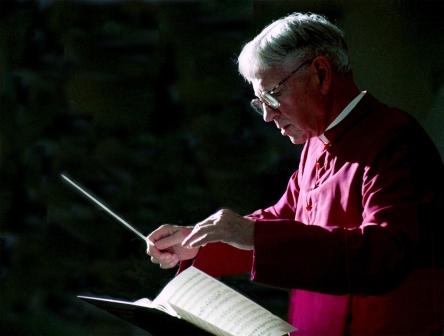
Msgr. Richard Schuler, RIP… 89th birthday

Today would have been the 89th birthday of Msgr. Richard Schuler, pastor and musician. 

He labored in the dark years after the Council to keep sound liturgy alive, promote proper sacred music, foster vocations to the priesthood, and hold the line against both heresy and stupidity.

In this Year of the Priest, would you take a moment to pray for the repose of the soul of Msgr. Schuler? 

Many people in places far and wide indirectly owe a lot to his work, though they might not have ever known him in life.

Msgr. Richard Schuler, RIP... 89th birthday

And… an interesting tidbit.

Posted in SESSIUNCULA | Tagged
19 Comments

Pro-abortion Speaker Pelosi gives more public scandal

A reader alerted me to an interview in the execrable Newsweek with House Speaker Nancy Pelosi (D-CA), pro-abortion but self-named "Catholic".   You might remember some of her scintillating theological explanations about how she justified promoting abortion.

Here is a bit from the interview with my emphases and comments.


The Target

Nancy Pelosi doesn’t care if you like her. All that matters is getting the job done.
By Eleanor Clift | NEWSWEEK

Published Dec 21, 2009
From the magazine issue dated Jan 4, 2010

[…]

Q It was reported that you were negotiating with the conference of bishops.

I talked to one of the cardinals. I said to him that I believe that what we are doing honors the principles we talked about: we want to pass a health-care bill, we want it to be abortion neutral, and we want it to [have] no federal funding [for abortion], which is the law. And we believe that our language does that. They said, "We believe that it does not." I said, let’s sit down at the table and our lawyers can compare language. That’s what the meeting was about—to make our case. Clearly, the people at that table were not willing to accept what we know to be a fact.  [Someone isn’t telling the truth.]

Q I think you have had some brushes with [church] hierarchy.

[Remember… this person calls herself "Catholic"…] I have some concerns about the church’s position respecting a woman’s right to choose. [What sort of addled comment is that?  Note the language she uses.  She lives entirely within her liberal political view and even imposes its language on the teaching of the Church.] I have some concerns about the church’s position on gay rights. I am a practicing Catholic, although they’re probably not too happy about that. But it is my faith. I practically mourn this difference of opinion [Is that what it is?  A difference of opinion?  As if her opinion could possible have some sort of equivalence with the teaching of the Church… which is just the Church’s "opinion"?] because I feel what I was raised to believe is consistent with what I profess, and that is that we are all endowed with a free will and a responsibility to answer for our actions. And that women should have that opportunity to exercise their free will. [But apparently she wasn’t raised to believe that people have a right to be born.]

Q Is it difficult for you to reconcile your faith with the role you have in public life?

You know, I had five children in six years. The day I brought my fifth baby home, that week my daughter turned 6. So I appreciate and value all that they want to talk about in terms of family and the rest. When I speak to my archbishop in San Francisco and his role is to try to change my mind on the subject, well then he is exercising his pastoral duty to me as one of his flock. When they call me on the phone here to talk about, or come to see me about an issue, that’s a different story. Then they are advocates, and I am a public official, and I have a different responsibility.  [So, she has adopted the Kennedy Dichotomy.]


I cannot fathom why she hasn’t been told she must not receive Holy Communion.

How much more public scandal does she have to give before the bishops of the places where she resides take concrete action?

Posted in Emanations from Penumbras, Our Catholic Identity | Tagged
60 Comments

The Feeder Feed

I’m back and the birds are busy!

This Red-bellied Woodpecker is having a hard time with the shape of this feeder.

The Feeder Feed

This Hairy Woodpecker spent some time tapping on my window next to my desk.

The Feeder Feed

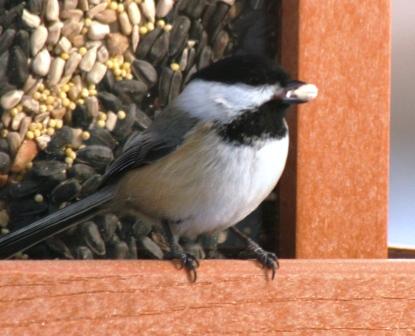
Chickadee.

The Feeder Feed

Nuthatch, scrounging.

The Feeder Feed

Posted in The Feeder Feed |
6 Comments

REMINDER – 1 January – Holy Day of Obligation

1 January 2010 is a Holy Day of Obligation in the United States. 

It is among the Holy Days for the Latin Church.

If you are able to go to Mass on 1 January and do not go, you commit a sin you must confess.  You are not obliged to receive Holy Communion, but you have to go to Mass.

So, right now, make your plan about going to Mass on Friday, 1 January.

Do you remember your Precepts of the Church?

1. You shall attend Mass on Sundays and on holy days of obligation and rest from servile labor.
2. You shall confess your sins at least once a year.
3. You shall receive the sacrament of the Eucharist at least during the Easter season.
4. You shall observe the days of fasting and abstinence established by the Church.
5. You shall help to provide for the needs of the Church.

Cf. The Catechism of the Catholic Church 2041-3.

II. THE PRECEPTS OF THE CHURCH

2041 The precepts of the Church are set in the context of a moral life bound to and nourished by liturgical life. The obligatory character of these positive laws decreed by the pastoral authorities is meant to guarantee to the faithful the very necessary minimum in the spirit of prayer and moral effort, in the growth in love of God and neighbor:

2042 The first precept ("You shall attend Mass on Sundays and holy days of obligation and rest from servile labor") requires the faithful to sanctify the day commemorating the Resurrection of the Lord as well as the principal liturgical feasts honoring the mysteries of the Lord, the Blessed Virgin Mary, and the saints; in the first place, by participating in the Eucharistic celebration, in which the Christian community is gathered, and by resting from those works and activities which could impede such a sanctification of these days.82

The second precept ("You shall confess your sins at least once a year") ensures preparation for the Eucharist by the reception of the sacrament of reconciliation, which continues Baptism’s work of conversion and forgiveness.83

The third precept ("You shall receive the sacrament of the Eucharist at least during the Easter season") guarantees as a minimum the reception of the Lord’s Body and Blood in connection with the Paschal feasts, the origin and center of the Christian liturgy.84

2043 The fourth precept ("You shall observe the days of fasting and abstinence established by the Church") ensures the times of ascesis and penance which prepare us for the liturgical feasts and help us acquire mastery over our instincts and freedom of heart.85

The fifth precept ("You shall help to provide for the needs of the Church") means that the faithful are obliged to assist with the material needs of the Church, each according to his own ability.86

The faithful also have the duty of providing for the material needs of the Church, each according to his own abilities.87

82 Cf. CIC, cann. 1246-1248; CCEO, cann. 881 § 1, § 2, § 4.
83 Cf. CIC, can. 989; CCEO, can. 719.
84 Cf. CIC, can. 920; CCEO, cann. 708; 881 § 3.
85 Cf. CIC, cann. 1249-1251; CCEO, can. 882.
86 Cf. CIC, can. 222; CCEO can. 25; Furthermore, episcopal conferences can establish other ecclesiastical precepts for their own territories (Cf. CIC, can. 455).
87 Cf. CIC, can. 222.

Posted in "How To..." - Practical Notes | Tagged ,
62 Comments

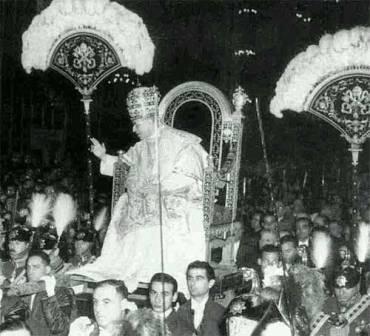
WDTPRS POLL: attacks on the Pope and the sedia gestatoria

WDTPRS POLL: attacks on the Pope and the sedia gestatoriaWe all know that Pope Benedict would not want to be completely surrounded by bullet proof glass everywhere he went.


On the other hand, security around our Popes has been relatively light.

The use of the sedia gestatoria would both help people to see the Pope and also protect him from the sort of attack that took place on Christmas Eve in the Basilica.  You could put a line of Swiss Guards on either sides.  Frankly, I would prefer Recon Marines, but the Pope doesn’t have them available.

Some would argue that by raising the Pope higher he would be an easier target to shoot.   I think if someone wanted to shoot the Pope, he would shoot the Pope even if he wasn’t on the sedia gestatoria.

Some would argue that the sedia gestatoria sends the wrong message about what Catholics think about Popes.   I say we can answer those questions easily.  The knuckleheads who want to cling to the falsehoods about Catholics will cling to them no matter what we explain. 

I am sure there are other pros and cons.

Here is a WDTPRS POLL for you.  Please vote and then give your reasons in the combox.

n

{democracy:39}

Posted in POLLS, SESSIUNCULA | Tagged
81 Comments

Yes, liturgical abuses are still going on

I case you had stopped wondering about why we needed Summorum Pontificum, try this.

For Christmas Mass, we had a different priest by the name of Fr. ___. He started to get all the children to sit in front of the altar, and then during the homily he started singing Rudolph the Red Nosed Reindeer, and his homily was about how the reindeer, and Santa Claus related to Christmas. It didn’t really relate much, but that’s what he preached. I much rather the TLM than the Novus Ordo, and this was a very Conservative Parish ….
What do you have to say about this?

We need to remember that bad things are still happening and then do what we can to fix them.


Posted in SESSIUNCULA |
60 Comments