First “ineffable” sighting of 2010

I am told that seminarians of the Diocese of Erie, headed by His Excellency Most Rev. Donald Trautman, served Mass in St. Peter’s Basilica for the Holy Father. 

I am sure would have been a thrill for them.

Or it would have been, …. had the Holy Father not spoiled everything.

In his sermon, the Holy Father said, in my quick translation:

The Child looks at the Mother, and she looks at us, almost so as to reflect towards one who is observing, and praying, the tenderness of God, descended in Her from Heaven and incarnated in that Son of man whom she carries in her arms.  In this Marian icon we are able to contemplate something of God Himself: a sign of ineffable love ("amore ineffabile") that spurred Him to "give His only-begotten Son" (John 3:16).


Imagine the confusion as the servers from Erie milled around, confused, wounded, groping to understand.

Posted in SESSIUNCULA |
29 Comments

Spaghetti al seminario

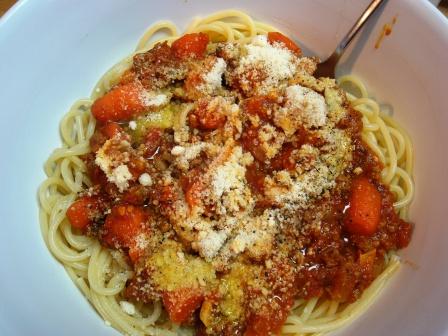
I mentioned on Plurk/Twitter that I was going to make what I call "spaghetti al seminario".  This is pretty simply stuff and you can put it together with brutal speed. 

The name comes from the fact that in my seminary in Rome we got this stuff all the time.  We got horse all the time too, but that is another story.

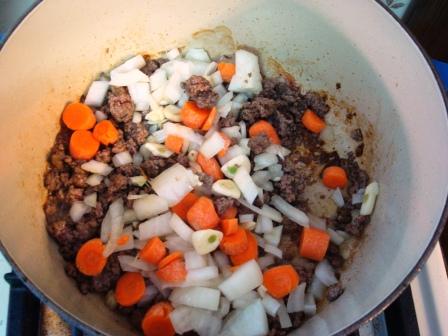
Get the water, with salt or chicken/beef broth in it started right away.  Begin browning some ground beef… or horse, as you please in a good sized pot.  Your carrots and onions will add a lot of volume. Season a bit with course salt and ground pepper.  I work with a pretty hot surface and like the darker flavor the browning gives.  This is 96%lean beef.  I have some elk in the freezer that would have been perfect.  Use a higher fat content if you want.
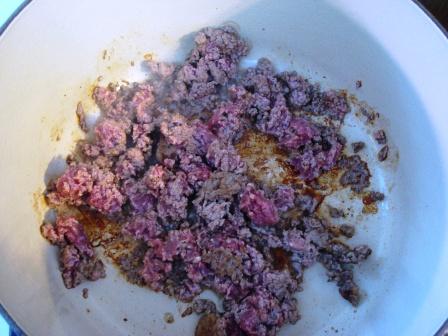
Spaghetti al seminario

Meanwhile, chop up carrots, onion and garlic.  Don’t be fancy.  Just whack away.  This is rough and ready.

Spaghetti al seminario

Add the veg with olive oil.  Season again, stirring to cover with oil and pick up some brown.

Spaghetti al seminario

At this point I added some beef stock and sweated it down a bit.  You can use a little of the paste type of stock/flavor too.

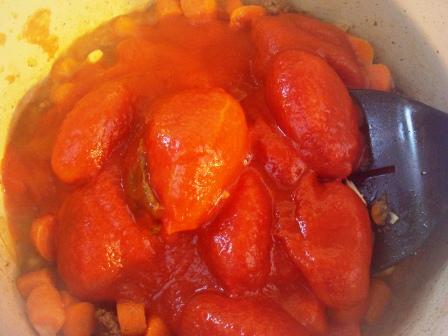
When most of the liquid was gone I added my canned tomatoes. 

In this case the tomatoes were San Marzano and they were a gift from a reader here from my Amazon Wish List.  Many thanks to TG of MO who checked the wish list and sent theSpaghetti al seminario flat of San Marzano tomatoes!

Spaghetti al seminario

Chop up the tomatoes right in the pan.  Don’t worry about breaking them up finely.  The cooking will take care of a lot of that.  At the end I like to have some identifiable pieces with a rough and ready preparation like this.

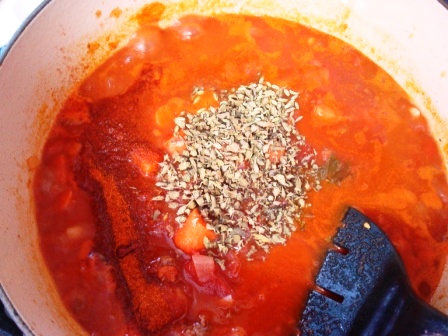
My oregano, which I brought in before the first freeze, has gone the way of all flesh.  I therefore used dried oregano from my summer plants.  Also, dried oregano has a very different flavor.  Work with caution.  I added finely ground hot red pepper, animi caussa.  Season it to your liking. Use a little lemon juice if you want to keep the salt down and still brighten it up.

Spaghetti al seminario

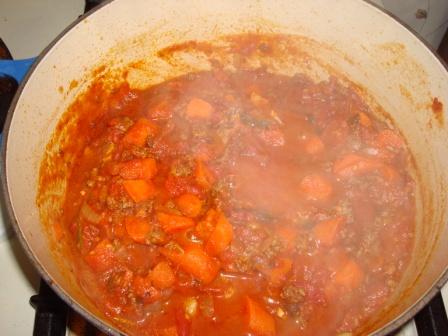
I added a little more beef stock and then put the fire to low and let it reduce for a time the merciless way: I was hungry.  If you use the paste form of stock you can work faster, though I like some time for everything to integrate.

Spaghetti al seminario

When I am making an express sauce like this, the fast and cruel way, I will often let it rest a minute or so just to see if it is going to separate a little, get watery.  In that case, I crank up the fire again for a bit.  This can be a little harder to gauge when working with whole or fresh tomatoes. 

Finish with grated Parmigiano and ground pepper and a drizzle of good peppery first press olive oil.  Garnish ad libitum.

If you want, you could cook your pasta (I recommend spaghetti for this, rather than penne or rigatoni) to just the underdone side of al dente and then finish cooking it right in the sauce.  That can produce some nice results and the starch from the pasta can take care of some of your texture if the sauce needs more reduction. I didn’t do that this time.  That technique permits the sauce to permeate the pasta a bit.  Think about it. 

Your pasta is going to taste like what you cook it in, right? 

Just a tip.  Try it.

Ecco.  "Spaghetti al (Fr. Z’s) seminario".  Un primo piatto sia veloce sia sostanzioso.

Spaghetti al seminario

The carrots impart a sweetness that contrasts well with the salt and dark tones of the beef.  Furthermore, they greatly increase the volume of sauce!  Excellent for many guests and it keeps the cost down.

Serve with a modest but sturdy Italian red such as Santa Cristina.   This doesn’t need a fancy wine.  I would avoid anything light and fruity such as the incoming Italian novello or Beaujolais.  Stick to the drier and structured end of the spectrum.  A Chianti would work.  But you can always do as the Romans do and wash this fast plate down with a cold sharp white, in the style of the Castelli Romani, which was all we got in seminary.  Try a cold bottle of Frascati.

Having crusty bread to scrape the bowl will help.  This is called "fare la scarpetta" or mop the plate/bowl.  Literally something like "doing the little shoe thing".  The image has to do with the shape of the heal, like the piece of bread cut in a slice off an oblong loaf and then halved.  "Fare la scarpetta" is not done in a fancy place or formal meal.  I can assure you it is done in a Roman seminary.

If you want a variation when it is well reduced, add a little heavy cream or half and half as it is resting and blend it in. Yum.

Many "slow food" style Italian recipes will work with beef and at least some carrot as well as milk or cream.  This is the fast method when you need lots of food in a pinch. 

Reverend Fathers, you can whip this up in no time when hungry seminarians descend on your rectory.


Posted in Fr. Z's Kitchen | Tagged
43 Comments

Happy New Year of Salvation 2010!

May God bless you all abundantly for this New Year of Salvation.

Have any resolutions?

Posted in SESSIUNCULA |
28 Comments

A priest “ties one on” for the New Year!

From a priest friend and reader in an e-mail entitled simply:

MANIPLE

In honor of Fr. Z, I’m tying one on tonight, and tomorrow morning!

Happy New Year!

I love it when a priest is determined to tie one on to celebrate the New Year!  In public too!

A priest "ties one on" for the New Year!

Posted in SESSIUNCULA | Tagged
14 Comments

Blue moon eclipse revisited

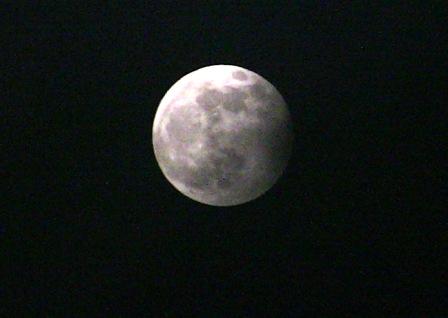
One of you readers caught the partial eclipse of the blue moon!

Very cool.

As view from Sutton Coldfield, West Midlands, GB at 1928 local time.

Blue moon eclipse revisited

Another, a priest friend, sent this from Ascona, Switzerland at 2010 GMT!

Blue moon eclipse revisited

Posted in Just Too Cool | Tagged ,
3 Comments

1st Vespers in St. Peter’s: Pope Benedict’s exhoration to vocation

During 1st Vespers of the Solemnity of Mary, Mother of God, with the singing of the Te Deum for the end of the year, the Holy Father said, in my translation:

Dear brothers and sisters, Rome needs priests who will be courageous heralds of the Gospels and, at the same time, will reveal the merciful face of the Father.  I invite young people not to be afraid to respond with a complete gift of their own being to the call that the Lord extends to them to follow the road of the priesthood or of consecrated life.

Posted in SESSIUNCULA |
6 Comments

Jesuits comment on the new translation, and get it right

A couple weeks ago in my column for The Wanderer I spoke of the work of Christine Mohrmann.  Also, I have on various occasions opined that sometimes it is okay for something you know to be a translation to actually sound like a translation.

This is from, Whosoever Desires, a group blog by young Jesuits.   They seem to be getting the right ideas!

In Praise of Clunky Translations

On November 17 the USCCB approved the final segments of a new English version of the Roman Missal.  A few have already criticized the Vox Clara translation as “slavishly literal” (here) [Imagine!  A "Slavishly literal" translation!  O the humanity!] and disrespectful of the “natural rhythm and cadences of the English language” (here).  On purely grammatical and stylistic grounds, I am actually inclined to agree with these criticisms.  However, a recent rereading of Liturgical Latin, Christine Mohrmann’s slim classic from 1957, has reminded me that slavish literalism and barbarous constructions have always been a hallmark of Christian liturgical language.

Mohrmann—at pains to show that early Christian Latin was hardly the Latin of the “common man”—notes that biblical Latin was marked by precisely those stylistic features most criticized in the new Roman Missal:

The earliest Christian Latin, like the Greek, bears a strong Biblical imprint.  The translating procedure, however, of the earliest translators, does not markedly differ from that employed by the translators of the Septuagint.  We find the same word-for-word method of translation which differed so radically from that recommended by Cicero.  The Latin translators of the Bible show the same reverence for the original text which had also been a guiding principle of the Septuagint translators.

Barbarisms, neologisms, and foreign idioms abounded in the first Latin translations of the Bible.  This translation philosophy naturally spilled over into Latin liturgical texts.  Besides Hebrew barbarisms such as “Amen” and “Alleluia,” Mohrmann singles out words that were plucked from their profane use and almost entirely retooled for Christian prayer, words such as confiteor, gloria, credo, and humlitas.

Mohrmann also observes that, even when Jerome re-translated the Bible, he was more concerned to account for the shifting sensus of Latin words than to update archaisms or recherché diction.  Jerome naturally saw that, in view of the effects of time on language,

some changes were obviously necessary to conserve the purity of meaning.  When the old words rendered the meaning accurately, these words were preserved. For instance, when there was a general movement to replace the old words magnificare, honorificare, and clarificare by the “European” term glorificare, Jerome will have nothing to do with it, because in his opinion the use of the words threatened with extinction does not endanger the original meaning… [consubtantial] We may say that Jerome, like Ambrose and Augustine, had a sincere appreciation of the biblical style, and he tries to leave it intact and maintain it as far as possible.

If Jerome were apply this translation philosophy to the English Missal, he might leave a rare or archaic word like “gibbet.”  [Of maybe even…. gulp… "ineffable"?] On the other hand, he would probably update Holy “Ghost” to Holy “Spirit,” since recent shifts in the English language freighted “ghost” with a cargo of eeriness and malevolence.

On Mohrmann’s view, the net effect of this conservative tendency was actually creative.  Christians slowly forged a sacred language, one perhaps less apt for instantaneous communication, but one more apt for corporate expression.  This second function of language was no less important:

Whereas … language used primarily as a means of communication normally strives toward a degree of efficiency … language as expression usually shows a tendency to become richer and more subtle.  It aims at becoming, by every possible means, more expressive and more picturesque, and it may try to attain this heightened power of expression both by the coining of new words and by the preservation of antiquated elements already abandoned by the language as communication.

In this connection, English speakers might call to mind the solemn “thy’s” of the Our Father and the stern “thou-shalt-not’s” of the Decalogue. [Gosh!  We did a poll about that here, didn’t we?] They might also contrast the expressiveness of a cup that “runneth over” to that of a cup that merely “overflows.”

In fact, compared to the slavish deference that the first Latin “missal” showed to the Hebrew Scriptures, the respect that the Vox Clara translation pays to its Latin forebear is actually very slight.  For this reason, the aura of the sacred will be faint.  The new translation does, however, begin to give due consideration to the expressive power of language.  To this extent, it joins the age-old mainstream of Christian liturgical piety.

Once again, our cup runneth over.

"Runneth" twice in one article?

Tooo haaard!

Good work men.  WDTPRS kudos.

Posted in SESSIUNCULA | Tagged , , ,
24 Comments

Rush taken to hospital for chest pain

In a FOXNews story:

HONOLULU —  Conservative radio talk show host Rush Limbaugh was taken to a hospital with chest pains on Wednesday, a Honolulu television station reported.

Paramedics responded to a call at 2:41 p.m. from the Kahala Hotel and Resort where Limbaugh is vacationing, KITV reported. The station, citing unnamed sources, said the 58-year-old Limbaugh was taken to The Queens Medical Center in serious condition.


Read the rest.

Posted in SESSIUNCULA |
71 Comments

This is too cool: BLUE MOON ECLIPSE!

Space Weather News for Dec. 31, 2009

BLUE MOON ECLIPSE:  For the first time in almost 20 years, there’s going to be a "Blue Moon" on New Year’s Eve.  In Europe, sky watchers will witness an even rarer event–an eclipse of a Blue Moon on New Year’s Eve.  What are the odds? Probabilities and observing tips may be found at http://spaceweather.com.


A blue moon is the 2nd full moon in a calendar month.

From NASA we read this:


If you told a person in Shakespeare’s day that something happens "once in a Blue Moon" they would attach no astronomical meaning to the statement. Blue moon simply meant rare or absurd, like making a date for the Twelfth of Never. "But meaning is a slippery substance," says Hiscock. "The phrase ‘Blue Moon’ has been around for more than 400 years, and during that time its meaning has shifted."

The modern definition sprang up in the 1940s. In those days, the Farmer’s Almanac of Maine offered a definition of Blue Moon so convoluted that even professional astronomers struggled to understand it. It involved factors such as the ecclesiastical dates of Easter and Lent, and the timing of seasons according to the dynamical mean sun. Aiming to explain blue moons to the layman, Sky & Telescope published an article in 1946 entitled "Once in a Blue Moon." The author James Hugh Pruett cited the 1937 Maine almanac and opined that the "second [full moon] in a month, so I interpret it, is called Blue Moon."

That was not correct, but at least it could be understood. And thus the modern Blue Moon was born.

Blue moon has other connotations, too. In music, it’s often a symbol of melancholy. According to one Elvis tune, it means "without a love of my own." On the bright side, he croons in another song, a simple kiss can turn a Blue Moon pure gold.


This is too cool: BLUE MOON ECLIPSE!But back to the eclipse:


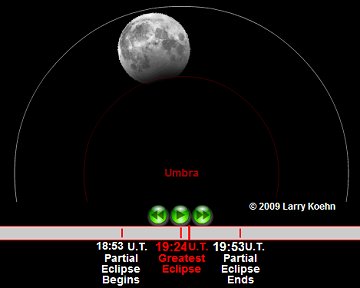
On Dec. 31st, the Blue Moon will dip into Earth’s shadow for a partial lunar eclipse. The event is visible from Europe, Africa and Asia: map. At maximum eclipse, around 19:24 Universal Time, approximately 8% of the Moon will be darkly shadowed. Click on the image to launch an animated preview:

Blue Moons are rare (once every ~2.5 years). Blue Moons on New Year’s Eve are rarer still (once every ~19 years). How rare is a lunar eclipse of a Blue Moon on New Year’s Eve?

A search of NASA’s Five Millennium Catalogue of Lunar Eclipses provides an approximate answer. In the next 1000 years, Blue Moons on New Year’s Eve will be eclipsed only 11 times (once every ~91 years). So this is a rare event, indeed.


Very cool.


Posted in Just Too Cool | Tagged
6 Comments

From First Things and Forum Letter: “Temple prostitution: a modest proposal”

Want to have a chuckle while looking at a serious issue?

Serious for the Lutherans, that is.

You remember the ELCA decision last summer about homosexual clergy and same-sex unions?

I picked up on the site of First Things their replay of a piece in the Lutheran Forum Letter by the nephew of the late Fr. Neuhaus, Pastor Peter Speckhard, entitled … Temple prostitution: a modest proposal.

Pastor Speckhard may have learned from his uncle to be a master of the absurd to underscore a point.

First, he explains the Lutherans have some big problems, namely…

  • —Inability to retain or reach out to young, single people, especially men. …
  • —Failure to use the gifts of the laity. Sure, it is easy to use the gifts of creative, educated, energetic, talented people. …
  • —Declining revenue. …
  • —Legalism. …
  • —Biblicism. …
  • —Irrelevance. …
  • —Worship without impact. …

Big hurdles, nicht wahr?   Pastor Speckhard has a solution.

Temple Prostitution!

Sure, some will object.  Blah blah blah.  As he points out with deadly satire, there may be Scriptural grounds for objections but, hey…  

The Biblical writers never foresaw or contemplated sanctified, faithful, God-pleasing prostitution in the churches and thus never wrote about it.

We also have to consider "interpretive nuance" and "love", which conquers all.

Go read the piece and have a good time, for free!

In effect, this type of mordent commentary truly strips away the whatever clothing the emperor/ess may have retained.

I wonder if the whole wymyn priest movement thingie understands that this is the direction they are headed.

Just askin’

Posted in I'm just askin'..., Lighter fare, The Drill | Tagged
16 Comments