Possible Eucharistic miracle in Poland

From a Polish reader, comes a translation of a piece on Kronika Novus Ordo about a Eucharistic miracle:

?roda, 14 pa?dziernik 2009
Eucharist Miracle in Sokolka – Curia speaks
For our English speaking readers we have:

Communication from the Metropolitan Curia of Bialystok on the case of Eucharistic phenomena in Sokó?ka

Metropolitan Curia of Bialystok announces that the Ecclesial Commission appointed by Archbishop Edward Ozorowski (on 30 March 2009) to investigate the phenomena of the Eucharist in Sokó?ka has just completed its work. It examined and interrogated the witnesses and the patomorphology experts. Here follow conclusions.

1. On 12 October 2008 a consecrated Host fell out of hands of priest distributing Holy Communion. He has picked It up and placed in the vasculum in tabernacle. After the Mass, vasculum with contents has been transferred to the safe in sacristy.

2. On 19 October 2008 after opening the safe one could see a red stain on the Host, giving the impression of being the blood stain.

3. On 29 October 2008 the vessel with Host was transferred to the tabernacle in the chapel of the rectory. Next day The Host has been removed from the water and placed on the corporal in the tabernacle.

4. On 7 January 2009 the sample from the Host has been taken and examined independently by two professionals in patomorfology of Medical University in Bialystok. They have issued a common statement as follows: "the sample sent to assess (…) in our opinion (PhD. Maria Sobaniec-?otowska and Prof. PhD. Stanislaw Sulkowski) looks like the myocardial tissue, at least of all the tissues of living organisms it most resembles."

5. The Commission found that the Host, which was sampled for the assessment is the same that has been moved from the sacristy to the tabernacle in the chapel of the rectory. Third party intervention was not found.

Files of this case has been submitted to the Apostolic Nunciature in Warsaw.

The Case of Sokolka does not oppose to the faith of the Church, rather confirms it. Church believes that the words of consecration, by the power of the Holy Spirit, transform a bread into the Body of Christ and wine into His Blood. It also provides a call to ministers of the Holy Communion to distribute the Body of Christ with faith and attention and to faithful – to receive It with reverence.

Fr. Andrew Kakareko
Chancellor


Sort of like the miracle of Lanciano, no?

We will need to follow this.

Posted in SESSIUNCULA | Tagged
19 Comments

ALERT! Relics of St. Damian – Detroit, San Francisco and near Oakland

St. Therese the Little Flower is not the only saint who is still getting around.

From CNA:

Relics of St. Damien making short U.S. tour on way back to Hawaii

Honolulu, Hawaii, Oct 14, 2009 / 05:44 am (CNA).- Relics of the newly canonized St. Damien de Veuster, the Leper Priest of Molokai, will be presented for veneration by the faithful in Detroit, San Francisco and near Oakland, California as the Bishop of Honolulu carries them back to Hawaii.

The nineteenth century Belgian priest of the Congregation of the Sacred Hearts of Jesus and Mary ministered to those isolated to the Molokai leper colony in Hawaii. After sixteen years in service to them, he died of leprosy at the age of 49.

His canonization took place on Sunday.

"Not without fear and loathing," Pope Benedict XVI remarked at the canonization, "Father Damien made the choice to go on the island of Molokai in the service of lepers who were there, abandoned by all. So he exposed himself to the disease of which they suffered.

“With them he felt at home. The servant of the Word became a suffering servant, leper with the lepers, during the last four years of his life."

"To follow Christ, Father Damien not only left his homeland, but has also staked his health so he, as the word of Jesus announced in today’s Gospel tells us, received eternal life."

The figure of Father Damien, Pope Benedict added, "teaches us to choose the good fight –not those that lead to division, but those that gather us together in unity."

The priest’s remains were returned to Belgium in 1936.

According to the Diocese of Honolulu’s website, Bishop Larry Silva is taking the relic of the Hawaiian saint to three locations on his way back from the canonization in Rome. St. Damien’s relic will stop at Detroit’s Blessed Sacrament Cathedral from Tuesday to Wednesday, St. Mary’s Cathedral in San Francisco on Thursday evening and St. Joseph’s Basilica in the Oakland diocese on Friday. Bishop Silva will arrive with the relic in Honolulu on Saturday.

In addition to hosting the relic, St. Mary’s Cathedral in San Francisco will host a daytime performance of the one-man play “Damien,” written by Aldyth Morris and performed by Casey Groves.

For more information on the opportunities to venerate the relic of St. Damien, visit HERE.

Posted in SESSIUNCULA |
2 Comments

NYC Carnegie Hall – lots of Chinese stuff!

Those of you in NYC should pay attention to the interesting Chinese culture festival centered on Carnegie Hall.

I think if I were there I would go to nearly everything!

Posted in SESSIUNCULA |
3 Comments

QUAERITUR: so-called Eucharistic Prayer for Various Needs and Occasions (Swiss Synod prayer)

From a reader come a question I must toss to the readership, since I simply don’t know what the situation is in the UK and Ireland:

Is the so called Eucharistic Prayer for Various Needs and Occasions (otherwise known as the Swiss Synod prayer) approved by the Apostolic See for use in the UK and Ireland. I have checked with our liturgy office but they don’t seem to know!! I came across it used at an Installation Mass for a parish priest and found it strange as the per ipsum was sung at great length by all of the congregation, the singing of this part lasted about three minutes. Is this proper?

Posted in ASK FATHER Question Box |
13 Comments

Newt on becoming Catholic

From newt.org comes this interesting interview with the former Speak of the House, Newt Gingrich about Catholic issues, including his conversion.

Boston.com
October 9, 2009
Michael Paulson

Newt Gingrich came to town yesterday. In the morning, he spoke to a breakfast gathering in Boston hosted by Catholic Citizenship; in the evening, he was at Harvard to speak at the Kennedy School. Gingrich, of course, is an interesting figure for a lot of reasons; I wanted to talk with him about his recent conversion to Catholicism, and the film he is now making about Pope John Paul II’s 1979 visit to Poland. The interview was pretty limited — I had seven minutes with him at the venerable Union Club on Beacon Hill — but here’s what he had to say in that period of time:
Gingrich2.jpgQ: Can you first tell me why you wanted to become a Catholic?
A: I don’t know that I wanted to become a Catholic so much as I became a Catholic. I don’t know that it was volitional in that sense. Having gone to the basilica (The Basilica of the National Shrine of the Immaculate Conception, in Washington) with my wife, who sings in the choir there, for about a decade, I think it gradually grew on me. And when Pope Benedict came to the basilica for vespers with the bishops, and my wife and the choir were singing, and I was allowed to come as a spouse — I had been talking with Monsignor Rossi, who is the rector of the basilica, for about five years, just about faith, and secularism, the challenges we have in the modern world with our civilization, and that afternoon seeing Pope Benedict XVI fairly close up, and both really believing in his central theme of ‘Christ Our Hope,’ and seeing the joy in his eyes, fundamentally different than the news media portrait of a severe German intellectual, something in me just was triggered. And I said to Monsignor Rossi that night that I wanted to convert. And we spent the following six or eight months studying with Monsignor Rossi, and it was more a process of becoming more and more comfortable that this was — this is — the place that I belong, and the taking of the Eucharist is the experience that enriches my life.

Q: How did you think about Catholicism, growing up among Protestants?
A: I grew up all over the world. I was born in Pennsylvania, and was raised originally as a Lutheran, and then was, my dad was in the Army, so I was whatever the Protestant chaplain was. I was at one point a Presbyterian acolyte. And I think, as a professional historian, you can’t study modern European history without some sense of the church, and the sense of the depth and the history of the church. I think, probably from the time I was a child, when my dad was stationed in France…this sense of the — I may use the word wrong — but the sense of the magisterium of the church, the sense of the power and majesty of the church, the fact that you’re dealing with 2,000 years of history. My dad had studied Augustine in college, and had a copy of Augustine’s ‘City of God’ when I was a child, and you just had this sense of, that you are encountering a continuum of effort to understand God and to explain God to humans, that is pretty overwhelming.

Gingrich3.jpgQ: Tell me about how you decided to make a film about a pope as one of your first public acts as a Catholic?
A: Well, we had made a movie, called ‘Rediscovering God in America,’ which really contextualized American history, in terms of the Washington monuments. Then, we made a film about Reagan, called ‘Rendezvous with Destiny,’ and in filming the Reagan movie, we had gone to Gdansk, and interviewed Lech Walesa, and we had gone to Prague, and interviewed Vaclav Havel, and both said in their interviews that the decisive moment in the breaking of the Soviet Union was June of 1979, and the pope’s 9-day visit. As we thought about that, and began to put it in context, I’d been reading Weigel, starting with ‘The Cube and the Cathedral,’ and then ‘The Final Revolution’ and then his biography of the pope, and if you read ‘The Final Revolution,’ Weigel really argues that the central role of religious belief and the central role of religious organization was at the center of what was happening in Eastern Europe. And then when you interview Lech Walesa, he says, ‘You can’t understand what happened with Solidarity if you don’t understand what the church was doing, if you don’t understand what the pope was doing.‘ And even Vaclav Havel, who is a playwright, was saying – he’s not Polish, but he’s saying, ‘As a neighboring Czech, let me tell you what it meant to us to have a Slavic pope and to have somebody who understood tyranny’ and so forth. So I dug into all of that. And then you get to this extraordinary story of the pope, who is born about a year and a half after Poland becomes a country again for the first time since 1793; as a teenager, sees Poland destroyed again by Germany and the Soviet Union; participates in the Rhapsodic Theater at a time when it means a death penalty, in order to sustain Polish culture; enters the seminary for the priesthood at a time when there’s a death penalty; becomes a priest under the emerging Communist dictatorship; serves all of his priesthood under the Communists; knew many Jews, understood Auschwitz, has a childhood friend who is Jewish; and this is the man who, in 1978, becomes pope. I mean it is an extraordinary moment in history. And he is an athletic energetic actor who is a charismatic leader. And he has the key underlying insight that you defeat Communism at a cultural level, that you pit the cross against the Soviet emblem, and that the cross ultimately will defeat atheism.

Q: Do you see this as a personal film in any way, or is this purely an academic, documentary exercise?
A: No, I think this which will be — if we can do it right, and this is a big challenge — this is a film which I hope will be personal, immediate, people won’t walk out and say, ‘Gee, that was interesting 30 years ago,’ they’ll walk out and say, ‘What does this mean for my life in my country today.’ We hope to translate the film into Mandarin, and we’ve been asked to translate it now into Vietnamese because there are 5 million Vietnamese Catholics; we hope to translate it into Polish, Italian, Portuguese, Spanish, because we see this as a universal film that has an impact for people everywhere on the planet.

Q: So do you still have political aspirations, or is filmmaking now your mission?
A: I think I have a public citizen aspiration. Whether it goes beyond that, we’ll find out over the next few years.

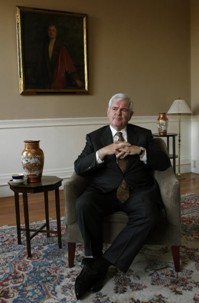
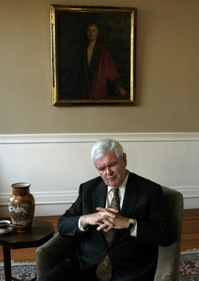
(Photos, by David L. Ryan of the Globe staff, show Newt Gingrich at the Union Club in Boston on Oct. 8, 2009.)

Posted in SESSIUNCULA |
Comments Off on Newt on becoming Catholic

UK health care… foreshadow?

From The Times:

Daughter saves mother, 80, left by doctors to starve

AN 80-year-old grandmother who doctors identified as terminally ill and left to starve to death has recovered after her outraged daughter intervened.

Hazel Fenton, from East Sussex, is alive nine months after medics ruled she had only days to live, withdrew her antibiotics and denied her artificial feeding. The former school matron had been placed on a controversial care plan ["care plan" having a rather loose meaning here] intended to ease the last days of dying patients.

Doctors say Fenton is an example of patients who have been condemned to death on the Liverpool care pathway plan. They argue that while it is suitable for patients who do have only days to live, it is being used more widely in the NHS, denying treatment to elderly patients who are not dying.  [Get that?  Read it again.]

Fenton’s daughter, Christine Ball, who had been looking after her mother before she was admitted to the Conquest hospital in Hastings, East Sussex, on January 11, says she had to fight hospital staff for weeks before her mother was taken off the plan and given artificial feeding.

Ball, 42, from Robertsbridge, East Sussex, said: “My mother was going to be left to starve and dehydrate to death. It really is a subterfuge for legalised euthanasia of the elderly on the NHS. ”

Fenton was admitted to hospital suffering from pneumonia. Although Ball acknowledged that her mother was very ill she was astonished when a junior doctor told her she was going to be placed on the plan to “make her more comfortable” in her last days.

Ball insisted that her mother was not dying but her objections were ignored. A nurse even approached her to say: “What do you want done with your mother’s body?”

On January 19, Fenton’s 80th birthday, Ball says her mother was feeling better and chatting to her family, but it took another four days to persuade doctors to give her artificial feeding.

Fenton is now being looked after in a nursing home five minutes from where her daughter lives.

Peter Hargreaves, a consultant in palliative medicine, is concerned that other patients who could recover are left to die. He said: “As they are spreading out across the country, the training is getting probably more and more diluted.”

A spokesman for East Sussex Hospitals NHS Trust, said: “Patients’ needs are assessed before they are placed on the [plan]. Daily reviews are undertaken by clinicians whenever possible.”  [Sooo…. daily reviews are not always possible?]

In a separate case, the family of an 87-year-old woman say the plan is being used as a way of giving minimum care to dying patients.

Susan Budden, whose mother, Iris Griffin, from Norwich, died in a nursing home in July 2008 from a brain tumour, said: “When she was started on the [plan] her medication was withdrawn. As a result she became agitated and distressed.

“It would appear that the [plan] is . . . used purely as a protocol which can be ticked off to justify the management of a patient.”

Deborah Murphy, the national lead nurse for the care pathway, said: “If the education and training is not in place, the [plan] should not be used.” She said 3% of patients placed on the plan recovered.


One of the important points to remember is that food and water are not medicine.  A person is a vegetative state remains a human being with the need for what is basic to human life.  If people see food and water as medicine, as if that person was receiving them as if they were therapy, then you can more easily argue for their denial.  Of course there are situations in which adminstering food and water actually harm a person more than they help.  Then hard decisions must be made.

But never forget, and keep yourselves attuned to the basic principles.  If food and water are seen as therapy for a bad condition, they can be more easily denied.  That is the fundamental error being made in many cases.   That is why this statement, the response from the CDF, is so important.

Review THIS.  An excerpt about people in persistent vegetative state who are given this "treatment":

  So, as you lie there, what is going on in your body? When your body’s fluid supply is severely depleted (because you are taking none in) and down by around 15%, hypovolemic shock or "physical collapse" occurs, that is, your blood supply gets lower and lower until you don’t have enough blood volume to function.

  Your skin becomes pale and clammy. Your heart starts to race and your breathing becomes rapid and shallow. Unless you get water soon, it will get harder and harder to reverse your condition. You soon desperately need medical care. Your blood pressure drops so low that sometimes it can’t be detected at all. Then your extremities become blotchy and mottled as your body starts to shut down the periphery, shunting an ever-decreasing volume of available blood to the core, the heart and vital organs.

  If you are conscious, your thirst is agony. Your temperature rises and when it hits 107°F (41.7°C), it starts to damage your brain and other organs. Your lips and tongue crack. Your nose bleeds from the dryness of the mucous membranes. You are wracked with pain from the heaving and attempts to vomit. You can’t tell anyone how much you are suffering. Since those around you don’t see your suffering, they think you must not have any pain. This appears to be "merciful."

  This is how they purposely kill helpless people. Let dehydration happen to a football player during practice on a hot summer day and everyone goes crazy, pointing fingers and making accusations, filing lawsuits and suing everyone in sight. But this is done daily in the USA and other countries to people who are otherwise healthy, and simply need the love and care that any person with a disability needs. Lock a horse in a stall without food and water and you will go to jail.

Posted in Emanations from Penumbras, The future and our choices | Tagged , , , ,
29 Comments

GUEST RANT: the present Eucharistic Fast is a JOKE

Stuart Reid, a regular columnist in the UK’s best Catholic weekly, The Catholic Herald, wrote a smart thing the other day!

My emphases and comments:

Perpend…

Counter-Reformation corner (first in an occasional series on ways to reform the reforms): The present fasting rules must go (with respect), [Do I hear an "Amen!"?] and at the very least the three-hour fast must return, ["AMEN!"] perhaps to begin with through local initiatives. The requirement that Catholics should refrain from food and drink for only one hour before receiving Communion – that is, for half an hour before Mass begins – is an insult. It calls into question the strength, determination and moral fibre of the people now known as the People of God.

At school we managed the fast from midnight by going to Mass before breakfast. This was not, of course, a voluntary act of piety on our part, and I can’t say it was always an especially happy or holy experience. But I am pretty sure that none of us ever fainted from hunger.

There is no risk of anyone fainting from hunger at Mass these days, of course. Here’s how it now works in the Church Militant: you must finish your 10-course meal, with 17 different wines, plus cigars, by 5.30 in the evening if you want to go to Communion at the six o’clock Saturday-for-Sunday Mass. [ROFL!] Communion will not be distributed until at least 6.30, so you will have observed the fast. Provided that you are sober enough to reach the altar rails, or, depending on your parish, the "collection point" for Holy Communion, and have not been so gluttonous that you are in a state of mortal sin, you will be able to receive.

Fast? What fast? There is no fast. [Do I hear an "Amen!"?] It’s time there was one. Might we make an exception for tea, though? The older among us, I have been told, can’t quite get off to a flying start without regular cups of tea in the morning.

Good for Mr. Reid.  Bang on and kudos.

Posted in The future and our choices | Tagged ,
67 Comments

QUAERITUR: World of Warcraft

From a reader:

I have a question. I have a son who is into World of Warcraft. I am not peaceful with this game and asked him to pray about the occult possibilities of the game. Can you advise about this, please?

With all things having to do with children, especially young kids, parents should be directly involved and know what they are doing.

I don’t know much about World of Warcraft other than what I have seen, and briefly, at the home of a friend. 

I think I would be less worried about the problems that you might imagine from "occult" references as I would to the addictive power of these role playing games and the potential harm it might do to motivation.

All these things need to be used in good measure.

These games have a powerful ability to capture you and, before you know it, a great deal of time has been lost to you which might have been spent also on other things.

My own experience with other games is that they can exercise a strong draw on your time and mind.  I use one of those console games solely during the time when I exercise, such as the time I spend on an exercise bike.  I alternate with audio books, too.  They really help the time pass quickly.  They are so engaging, as a matter of fact, amazing in their technology, that I can stay on that bike or whatever machine for far longer than I would have otherwise if stuck in silence or with music or with TV.  In itself, that is an indication of the powerful influence they can have on you.

So, again, I think I would be more concerned about the power of these games to form habits or addictions.

There might be an additional question: Whether children should be give such compelling and realistic ways to be nearly godlike in the ambit of the game.

I am no expert on this topic, but those are my few personal observations.

At the end, however, I should also add – and WOW aficionados will get this – that a character in a novel outline I have put together is Leeroy Card. Jenkins!

Posted in ASK FATHER Question Box | Tagged
64 Comments

13 October: Miracle of the Sun

Is not today the anniversary of the miraculous dancing of the Sun over Portugal?

You know the story.

An Eyewitness Account by Dr. José Maria de Almeida Garrett, professor at the Faculty of Sciences of Coimbra, Portugal

     “It must have been 1:30 p.m when there arose, at the exact spot where the children were, a column of smoke, thin, fine and bluish, which extended up to perhaps two meters above their heads, and evaporated at that height. This phenomenon, perfectly visible to the naked eye, lasted for a few seconds. Not having noted how long it had lasted, I cannot say whether it was more or less than a minute. The smoke dissipated abruptly, and after some time, it came back to occur a second time, then a third time.

“The sky, which had been overcast all day, suddenly cleared; the rain stopped and it looked as if the sun were about to fill with light the countryside that the wintery morning had made so gloomy. I was looking at the spot of the apparitions in a serene, if cold, expectation of something happening and with diminishing curiosity because a long time had passed without anything to excite my attention. The sun, a few moments before, had broken through the thick layer of clouds which hid it and now shone clearly and intensely.

13 October: Miracle of the Sun“Suddenly I heard the uproar of thousands of voices, and I saw the whole multitude spread out in that vast space at my feet…turn their backs to that spot where, until then, all their expectations had been focused, and look at the sun on the other side. I turned around, too, toward the point commanding their gaze and I could see the sun, like a very clear disc, with its sharp edge, which gleamed without hurting the sight. It could not be confused with the sun seen through a fog (there was no fog at that moment), for it was neither veiled nor dim. At Fatima, it kept its light and heat, and stood out clearly in the sky, with a sharp edge, like a large gaming table. The most astonishing thing was to be able to stare at the solar disc for a long time, brilliant with light and heat, without hurting the eyes or damaging the retina. [During this time], the sun’s disc did not remain immobile, it had a giddy motion, [but] not like the twinkling of a star in all its brilliance for it spun round upon itself in a mad whirl.


“During the solar phenomenon, which I have just described, there were also changes of color in the atmosphere. Looking at the sun, I noticed that everything was becoming darkened. I looked first at the nearest objects and then extended my glance further afield as far as the horizon. I saw everything had assumed an amethyst color. Objects around me, the sky and the atmosphere, were of the same color. Everything both near and far had changed, taking on the color of old yellow damask. People looked as if they were suffering from jaundice and I recall a sensation of amusement at seeing them look so ugly and unattractive. My own hand was the same color.

“Then, suddenly, one heard a clamor, a cry of anguish breaking from all the people. The sun, whirling wildly, seemed all at once to loosen itself from the firmament and, blood red, advance threateningly upon the earth as if to crush us with its huge and fiery weight. The sensation during those moments was truly terrible.

“All the phenomena which I have described were observed by me in a calm and serene state of mind without any emotional disturbance. It is for others to interpret and explain them. Finally, I must declare that never, before or after October 13 [1917], have I observed similar atmospheric or solar phenomena.”

    13 October: Miracle of the SunProfessor Almeida Garrett’s full account may be found in Novos Documentos de Fatima (Loyala editions, San Paulo, 1984)


There will be a film released called The 13th Day on Fatima.

UPDATE: Someone in the comments mentioned Socci’s book on the so-called “Fourth Secret of Fatima“.  Glad to say it is in English now.  It is worth reading.  Marco Tossati’s book is not available yet.

Posted in SESSIUNCULA | Tagged , ,
12 Comments

INEFFABLE ALERT!

Before reading this be sure to remove all children below High School age from proximity to the monitor or screen.

From a reader comes this troubling note:

I had to share this with you, seeing as you seem to enjoy finding "ineffables" lying around. 

On October 10th, I took the SAT at the Catholic highschool down the road.  In both the SAT I took on that day, and one of the practice tests I had taken beforehand,  there was an "ineffable" sighting!  In a standard, generalized test taken by your run-of-the-mill highschool student!!! 

I have always felt insulted every time the media, or others who know better, water it down for all of us poor, everyday simpletons who then go out and find it in a standardized public test, so I got a kick out of finding out that this word can be found in the SAT!
Here is one of the sightings, the excerpt (part of a  reading section) from my practice booklet (emphasis mine) [That is, the writer’s…]:
 
"43  When human flight suddenly went from fantasy to reality, the great French aviator Louis Bleriot, exclaimed, ‘the most beautiful dream that has haunted the heart of men since Icarus is today reality.’  Perhaps the reality has been too vexing, too powerful for artists to capture.  Perhaps the limitations of the artist’s imagination have been confronted with the ineffable.  Perhaps the experience of flight itself is so overwhelming that it simply cannot be portrayed suitably on canvas or on film."

How vexing to find vocabulary like unto "ineffable" in a standarized text for High School students.

How inexpressibly cruel… how unspeakably mean-spirited.

Can you imagine having words like this in our liturgical translations?INEFFABLE ALERT!

INEFFABLE ALERT!

Posted in WDTPRS | Tagged
8 Comments