Much in the same way the book that came out under the name of Archbp. Marini in all sincerity explained the project to overturn Catholic theology through liturigical reform… as a good thing… so this American Sister in all sincerity gives insight as to why most orders of women religious are dying.
The sister in question is Ilia Delio, O.S.F., of the Franciscan Sisters of Washington, D.C., professor and chair of the department of spirituality studies at Washington Theological Union.
You can see in her narrative about how she and her sisters in religion became free of their chains of oppression, they – now liberated – have killed their communities.
It is a common tale: Sister starts down the path of self-liberation and self-realization, and … presto chango… you need a new model of "religious life" to justify your new ways.
Her guiding lights seem to be Timothy Radcliffe, O.P. and Pierre Teilhard de Chardin, S.J.
 Confessions of a Modern Nun
The Vatican visitation prompts reflection on a religious divide.
Ilia Delio | OCTOBER 12, 2009
Religious life among women is undergoing a massive evolutionary change that can only be described as cataclysmic. The Vatican’s apostolic visitation of congregations of women religious in the United States and the recent investigation of the Leadership Conference of Women Religious indicate that Rome is unhappy with so-called post-Vatican II nuns who have donned secular clothes and abandoned traditional community life. The current statistics show a trend. The number of religious sisters and cloistered nuns in the United States was almost 180,000 in 1965. In 2009 there are just over 59,000, according to the Center for Applied Research in the Apostolate at Georgetown University. A steady decline in the number of women religious, together with the fact that their median age is 75, is a sign that religious life in the United States is a dying institution. Yet new communities have sprouted up in which women religious don a traditional habit and follow a daily schedule of prayer and service. These communities are attracting youthful, vibrant vocations. On the surface, the future of religious life seems to be on their side.
Those who have taken off the habit and those who are putting on the habit mark two distinct paths in religious life today. What is happening? Did most women religious misinterpret the documents of the Second Vatican Council? Is what some see as a rebellious streak taking its toll? Have women defied the church? Some interpret empty novitiates and an aging membership as evidence that women religious have made the wrong choice—for secularization. Others maintain that their intent was to live more authentically as women religious in a world of change. [Lemme see… some are growing… others are dying. Those that are growing are traditional… those shrinking are secularized. Hmmm…]
The chasm between traditional and progressive religious life was made evident in 1992 with the publication of The Transformation of the American Catholic Sisterhood by Lora Ann Quiñonez, C.D.P., and Mary Daniel Turner, S.N.D.deN. The book impelled Cardinal James Hickey, bishop of Washington, D.C., at the time, to travel to Rome to fight for the establishment of a congregation of women religious that would be more faithful to the church. [Good info here:] Hence the Conference of Major Superiors of Women Religious was formed with membership based on wearing the habit, communal prayer, eucharistic adoration and fidelity to the church. Meanwhile, the Leadership Conference of Women Religious continued in the spirit of Vatican II to be open to the world, exploring avenues of liberation theology, feminist theology and the plight of the poor, among others. Although dialogue was sought between L.C.W.R. (to which the majority of women religious communities still belong) and C.M.S.W.R., that desire for dialogue was not mutual. Rome has thrown its weight on the side of C.M.S.W.R., giving its members top ecclesiastical positions.
While the two groups of women religious seem to oppose each other, they form what Timothy Radcliffe, O.P., the former master general of the Dominicans, calls in What Is the Point of Christian Life? two different theologies based on different interpretations of Vatican II. [Interesting distinction coming about Communio and Concilium poles… this is helpful.] Members of the Leadership Conference embrace modernity and the work of the council as the Holy Spirit breathing new life in the church. They fall under what Father Radcliffe identifies as the Concilium group, who focus on the Incarnation as the central point of renewal. Members of the Conference of Major Superiors, by contrast, are Communio Catholics, who emphasize communion through proclamation of the faith, a clear Catholic identity and the centrality of the cross. Members of the Conference of Major Superiors, by contrast, are Communio Catholics, who emphasize communion through proclamation of the faith, a clear Catholic identity and the centrality of the cross. (Concilium and Communio are the names of two periodicals founded in the postconciliar era. The first stressed conciliar reforms; the second stressed the continuity of the council documents with the community of the faithful through past centuries.) Thus, one group focuses on doxology and adoration (Communio), the other on practice and experience (Concilium). One sees Christ as gathering people into community (Communio); the other sees Christ as traversing boundaries (Concilium). The C.M.S.W.R. recently held its eucharistic congress under the title “Sacrifice of Enduring Love,” while the L.C.W.R. continues to work on systemic change. The former sees religious life as divine espousal with Christ; the latter sees Christ in solidarity with the poor and justice for the oppressed. [So… CMSWR is into adoration and divine espousal while the LCWR sounds like, what, …. adherents of Liberation theology?]
As Father Radcliffe states, this is not a conflict between those who are faithful to the council and those who would return to a preconciliar church. Nor is it between those who are faithful to the tradition and those who have succumbed to the modern world. Rather, the conflict is about two different understandings of the council and how to carry its work forward. [Indeed yes. This is what Pope Benedict described in his 2005 Christmas address to the Curia. This is about a hermeneutic of discontinuity and rupture against a hermeneutic of reform in continuity. The writer was on target with that Communio/Concilium comparison. You have the Rahner/Kung faction and their adherents (LCWR) and the John Paul/Benedict faction (CMSWR). There is a conflict between the two. This is not just a matter of hermeneutics which we haven’t yet figured out how to harmonize.] While I appreciate Father Radcliffe’s thoughtful distinctions, my own experience of women religious tells me that the root of the differences between the two associations [NB:] is fear of change. I say this not by way of judgment but from personal experience.
[I think she is suggesting that the new liberation theology – Communio – Rahner/Kung – feministic – Chardin sisters are the courageous prophets gazing with hope into the future (while their communities age and dwindle) while the other, traditional sisters are mired in the old ways because of fear of change. Is that it? Let’s keep reading!]
My Journey to a New Theology
When I entered religious life in 1984, [okay… so she never had the old formation sisters had or had the traditional habit? Read on…] I had a newly minted Ph.D. in pharmacology and an opportunity for a postdoctoral fellowship at Johns Hopkins School of Medicine. Yet I had discovered Thomas Merton’s The Seven Storey Mountain and could not let go my desire to renounce the world and live for Christ. [Why couldn’t one live for Christ as a pharmacologist? Or as a traditional sister?] My understanding of theology, church and religious life then was rudimentary. I flourished in the 1970s as a budding scientist, [wait for it…] writing manifestos of liberation. [So, you can see her starting points.] Though I attended Mass weekly, I did not appreciate the liturgical changes of Vatican II. Instead I longed for the mystical ritual of the Latin Mass I knew as a child, even though I had never understood a word the priest said. [You mean… you were smart enough to get a PhD in Pharmacology but not smart enough to follow the book?] When I made the decision to enter religious life, I sought an austere community where I could make a lifetime sacrifice to live for God alone. Wearing a habit was important to me because it represented holiness and religious identity. I entered a Carmelite cloister of nuns who wore a long, traditional habit and followed a set schedule of daily prayer, silence, adoration and the rosary. [So… she did have the traditional experience.]
My idealized view of religious life began to collapse in the cloister. Day in and day out I recognized how far I was from any noble aspiration of sanctity. I lived with women who suffered manic-depression, came from alcoholic families or were widowed early in life. [So, you are saying,… they were human beings?] There was little personal sharing and little contact with the world. [What did you expect in a cloistered Carmelite monastery?] The God to whom I had once felt so drawn began to melt into the darkness. I wondered whether I had chosen solitary confinement. I asked for a leave to discern my path and was sent to a Franciscan community near a university where I could resume my research. This community also wore a habit and followed a similar daily schedule, but the sisters’ openness to the world was liberating. I studied theology at Fordham University, wearing a full habit and feeling separate from my classmates. On weekdays, I lived in the Bronx with Ursuline sisters.
[Interesting description follows…] My first conversion in religious life centered around the final examination in a New Testament course. I had no computer or place to work until an Ursuline sister offered me her office and computer—and a cooked dinner. Sister Jeanne’s attentiveness to my needs, which included waiting up with me until after midnight, opened my eyes to the meaning of Incarnation. [?] For the first time I saw God humbly present in jeans and a sweatshirt. Next I saw God in frail Sister Catherine, who carried out an extensive outreach to the local poor, and in Sister Lucy, whose 40 years as a missionary in Alaska gave me more than just the entertainment of her fascinating dinnertime stories. In the simple common life of the Ursuline sisters, I saw God fully alive. I saw the same God among the Allegany Franciscans who provided me a home where I could write my doctoral dissertation. They drew me out of my study cell, took me to the park and out to eat and listened to my woes. By graduation, I had resided at three different motherhouses among sisters whose congregations were all members of the Leadership Conference of Women Religious. [See?]
Through the study of theology I began to reflect on the Incarnation and the two different ways of religious life I had experienced. [And now we get to the conclusions.. the insights…] I realized that Jesus practiced Jewish customs and rituals, lived the humble life of a carpenter and felt called to public ministry around age 30, but he did not separate himself from others by dress or occupation. Engaging in the sociopolitical and economic struggles of his day, [We need a better theology of Christ as Liberator than this, folks…] he reached out to the poor and showed compassion for the sick and dying. Jesus proclaimed the reign of God and gave his life as witness to the fidelity of God’s love. For that he died the public death of a criminal, without honor or glory. The early Christians who experienced the risen Lord were empowered to proclaim it. They had to be: until the conversion of Constantine, living as a Christian was a recipe for martyrdom. Today, too, Gospel life means giving witness to God’s goodness in Christ. In 2005 Dorothy Stang, of the Sisters of Notre Dame de Namur, gave her life as a martyr for the impoverished people of the Amazon.
Both contemporary groups of women religious—the Conference of Major Superiors of Women Religious and the Leadership Conference of Women Religious—witness to the Gospel revealed in Jesus Christ, but their trajectories differ. The former primarily seeks to be espoused to Christ; their focus is a heavenly nuptial union. The latter group primarily follows Christ the liberator, [just as I said…] witnessing to Christ amid the struggles of history. [A little tinge of a marxist view there?] In both groups one can find idols, secrets and dysfunction as well as saints, prophets and mystics. Both groups are sinful and redeemed. Both follow canon law; both maintain health insurance, car insurance, retirement funds and plots for burial. [And one group is growing and the other is dying off.]
Teilhard’s Evolutionary Vision [You knew he had to come in here somewhere.]
What difference does religious life make to the world? Pierre Teilhard de Chardin, S.J., brought light to this question by understanding Christianity in an evolutionary universe. What we do and the decisions we make in history, Teilhard said, influence the genesis of Christ. [… the genesis of Christ… ] Christ is the goal of the universe, the new creation, the future of what we are coming to be. We who are baptized into Christ must let go in love and descend into solidarity with the earth. Teilhard noted that there is nothing profane on earth for those who know how to see. Adoration means seeing the depths of divine love in ordinary reality and loving what we see. [Adoration of the Eucharist? Maybe not so much… McBrien would be pleased.] This universe is holy because it is grounded in the Word of God. [Wait for it…] It [the universe] is Christ, the living one, who is coming to be. [The universe is Christ. Sound right to you? The universe is evolving and therefore Christ is evolving… ]
For many years I wondered whether women religious had misread the signs of the time. [Are they missing their shrinking numbers?] Yet as I have pondered the mystery of God, I have come to believe that the evolutionary universe is moving forward in part because women religious are working in the trenches of humanity among those who are poor, oppressed and forgotten. [This is some pretty amazing navel gazing.] Today world religions are playing a greater role in the synthesis of a new religious consciousness. [Let’s read that again: "world religions are playing a greater role in the synthesis of a new religious consciousness."] The women of L.C.W.R. have risked their lives [Oh brother….] in the pursuit of authentic Incarnation and have proclaimed prophetically that the love of God cannot be exterminated or suppressed. They continue to fight for systemic change on behalf of oppressed people. [Liberation theology fused with Chardin.] Congregations may die out, [and they are!… but we are going to hear now how that is really a good thing! It is probably even more liberating!] but the paths inscribed in history by the women religious of Vatican II are nothing less than the evolutionary shoots of a new future. [Another step toward a new synthesis of religious consciousness with other world religions, as a matter of fact! How liberating!]
[Watch now the incredible multiplication of buzz words.]
As Teilhard noted, suffering and sacrifice are part of the evolutionary process. Isolated structures must give way to more complex unions. [Here is a nice way of spinning the dying of religious orders and justify that dying…] To live with an evolutionary spirit is to let go of old structures and to engage new structures when the right time comes. The new heaven and earth promised by God will not come about by cutting ourselves off from the world or [get this…] forming Catholic ghettos. [Like those other women, locked up in fear as brides of Christ (and not an evolving Christ either!) as they refuses to evolve into liberated… synthetic… um… you know… maybe … Cylons?] It will not unfold through the triumph of ecclesiastical power. It will come about as we follow the footprints of the crucified one, descending into the darkness of humanity and rising in the power of love. This is the path to a new creation symbolized by Christ. [I need to go wash after this.]
We believe that what happened between God and the world in Christ points to the future of the cosmos. That future involves a radical transformation of created reality through the unitive power of God’s love. To be a Christbearer is to focus on the inner depth of love. [And the sure sign of Christbearing is the wearing of jeans, I think.] It is love that puts flesh on the face of God, love that makes Christ alive; love is the power of the future and the unfolding of Christ. History will not remember what we wore, where we lived or how we prayed, whether as Concilium or Communio Catholics. In the evening of life we all shall be judged on love alone. [True.]
Ilia Delio, O.S.F., of the Franciscan Sisters of Washington, D.C., is professor and chair of the department of spirituality studies at Washington Theological Union.
This is a smart woman, obviously. She offers some very interesting categories to help us understand what is going on.
But this was like reading an autopsy after an avoidable train wreck. Throw the wrong switch at the wrong time – go onto the wrong track – and wham… you are ever after writing autopsy reports…
.. on your friends and yourself.


 It is a blustery day and the birds are dealing with wind and rain.










 Confessions of a Modern Nun
 ver at Fallible Blogma there was an interesting poll about Catholic speakers.
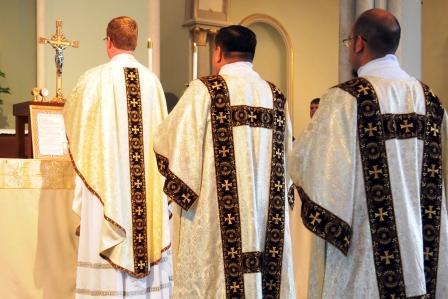 On that note, I want to share a nice brick by brick note from a priest, Fr. Ryan Hilderbrand in Montgomery, IN. I asked him if I should "anonymize" his note and he said I could post away. My emphases and comments.
 r spurious ideology.


 fac on Daily Rome Shot 1118 – Paddywhack!: “Speaking of the disputatio back on October 31st between Archbishop Vesco and Bishop Barron (Vesco saying the Catholic Church was…”




























