FYI, Jeffrey Steel, former Anglican clergyman and now a Catholic layman, has returned to blogging at de cura animarum.
WDTPRS will be watching and reading with interest!
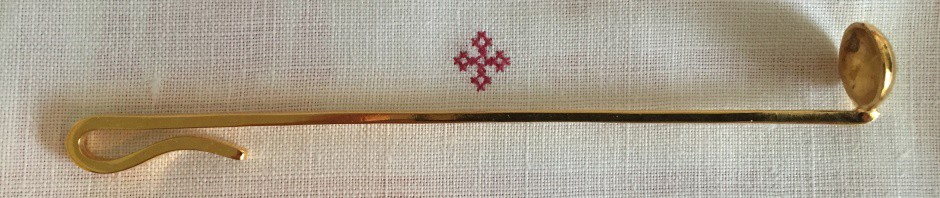
FYI, Jeffrey Steel, former Anglican clergyman and now a Catholic layman, has returned to blogging at de cura animarum.
WDTPRS will be watching and reading with interest!
True ecumenism… brick by brick…
Episcopal nuns in Archdiocese of Baltimore to join Catholic Church
By George P. Matysek Jr.
gmatysek@catholicreview.org[Mother Christina Christie (left), Sister Mary Joan Walker and Sister Emily Ann Lindsey depart the chapel of the All Saints Sisters’ of the Poor convent in Catonsville. The sisters are part an Episcopal order that will be joining the Roman Catholic Church Sept. 3. (CR Staff/Owen Sweeney III)]
After seven years of prayer and discernment, a community of Episcopal nuns and their chaplain will be received into the Roman Catholic Church during a Sept. 3 Mass celebrated by Archbishop Edwin F. O’Brien.
The archbishop will welcome 10 sisters from the Society of All Saints’ Sisters of the Poor when he administers the sacrament of confirmation and the sisters renew their vows of poverty, chastity and obedience in the chapel of their Catonsville convent.
Episcopal Father Warren Tanghe will also be received into the church and is discerning the possibility of becoming a Catholic priest.
Mother Christina Christie, superior of the religious community, said the sisters are “very excited” about joining the Catholic Church and have been closely studying the church’s teachings for years. Two Episcopal nuns who have decided not to become Catholic will continue to live and minister alongside their soon-to-be Catholic sisters. Members of the community range in age from 59 to 94.
“For us, this is a journey of confirmation,” Mother Christina said. “We felt God was leading us in this direction for a long time.”
Wearing full habits with black veils and white wimples that cover their heads, the sisters have been a visible beacon of hope in Catonsville for decades.The American branch of a society founded in England, the All Saints’ Sisters of the Poor came to Baltimore in 1872 and have been at their current location since 1917.
In addition to devoting their lives to a rigorous daily prayer regimen, the sisters offer religious retreats, visit people in hospice care and maintain a Scriptorium where they design religious cards to inspire others in the faith.
Throughout their history, the sisters worked with the poor of Baltimore as part of their charism of hospitality. Some of that work has included reaching out to children with special needs and ministering to AIDS patients. Together with Mount Calvary Church, an Episcopal parish in Baltimore, the sisters co-founded a hospice called the Joseph Richey House in 1987.
Orthodoxy and unity were key reasons the sisters were attracted to the Catholic faith. Many of them were troubled by the Episcopal Church’s approval of women’s ordination, the ordination of a gay bishop and what they regarded as lax stances on moral issues.
“We kept thinking we could help by being a witness for orthodoxy,” said Sister Mary Joan Walker, the community’s archivist.
Mother Christina said that effort “was not as helpful as we had hoped it would be.”
“People who did not know us looked at us as if we were in agreement with what had been going on (in the Episcopal Church),” she said. “By staying put and not doing anything, we were sending a message which was not correct.”
Before deciding to enter the Catholic Church, the sisters had explored Episcopal splinter groups and other Christian denominations. Mother Christina noted that the sisters had independently contemplated joining the Catholic Church without the others knowing. When they found out that most of them were considering the same move, they took it as a sign from God and reached out to Archbishop O’Brien.
“This is very much the work of the Holy Spirit,” Mother Christina said.
The sisters acknowledged it hasn’t been easy leaving the Episcopal Church, for which they expressed great affection. Some of their friends have been hurt by their pending departure, they said.
“Some feel we are abandoning the fight to maintain orthodoxy,” said Sister Emily Ann Lindsey. “We’re not. We’re doing it in another realm right now.”
The sisters have spent much of the past year studying the documents of the Second Vatican Council. They said there were few theological stumbling blocks to entering the church, although some had initial difficulty with the concept of papal infallibility.
In addition to worshipping in the Latin rite, the sisters have received permission from the archbishop to attend Mass celebrated in the Anglican-use rite – a liturgy that adapts many of the prayers from the Episcopal tradition. Mother Christina said 10 archdiocesan priests, including Auxiliary Bishop Denis J. Madden, have stepped forward to learn how to celebrate the Anglican-use Mass.
The sisters expressed deep affection for Pope Benedict XVI. The pope exercises an authority that Episcopal leaders do not, they said. The unity that Christ called for can be found in the Catholic Church under the leadership of the pope, they said.
“Unity is right in the midst of all this,” said Sister Catherine Grace Bowen. “That is the main thrust.”
The sisters noted with a laugh that their love for the pope is evident in the name they chose for their recently adopted cat, “Benedict XVII” – a feline friend they lovingly call “His Furyness.”
Click here to read how the Episcopal sisters hope to form ‘diocesan institute.’
Click here to see a slide show of the All Saints’ Sisters of the Poor.
On the site of National Review our friend Fr. Robert Sirico has an obituary for the late Sen. Edward Kennedy.
Kennedy the Catholic [Rev. Robert A. Sirico]
I only met Edward Kennedy once.
I had been invited to visit then-senator Phil Gramm, who was contemplating a run for the Republican presidential nomination in 1996. Having read some of my musings on the topic, Senator Gramm wanted to brainstorm about some innovative welfare-reform policies that would simultaneously make economic sense and really help the poor.
After we had chatted for some time in his office, a bell rang and Senator Gramm rose. “I need to take a vote. Walk with me and let’s continue this conversation,” he said.
As we walked down the corridor, I could spy familiar names on the various Senate office doors. We came to an elevator that would take us down to an underground subway connecting the Senate offices to the Senate chamber. It was a small elevator, no more than a large closet. Senator Gramm, an aide, and I tucked ourselves in and the door began to slide shut.
Just before closing, an arm came through to stop the door’s close. As it reopened, I found myself standing face-to-face with the Lion of the Senate, arguably the most prominent Catholic layman in the country, scion of the most prominent Catholic family, perhaps, in U.S. history. Kennedy immediately looked me up and down, and then quizzically glanced over to Senator Gramm trying to figure out why his colleague was hanging out with a priest.
As Senator Kennedy stepped into the elevator, Senator Gramm welcomed him with his Southern tones, “Come on in, Teddy. We’ve called you here to pray for you.”
Without missing a beat, Senator Kennedy tossed a mischievous wink in my direction, nudging me with his elbow in Catholic camaraderie and replied in his Bostonian accent, “Uhh [there was that familiar pause of his], uhh, no Phil, Father and I have called you here to pray for you.”
There was laughter as the elevator door slid closed. It was my turn to speak so I decided to enter the spirit of the moment.
I stood erect, place my hand on Senator Kennedy’s broad shoulder and said, “Actually, senator, this is an exorcism.”
The laughter in that elevator, which spilled out onto the train platform, was electric, causing the by-standing senators to look in our direction and wonder what in the world would have Senators Kennedy and Gramm in such uproarious laughter with a Catholic priest.
And so, I had mixed feelings on the news of Ted Kennedy’s passing. A memory of a pleasant encounter, but knowledge that despite our common baptism, Senator Kennedy and I differed in some very radical ways on issues of public policy, economics, heath care, marriage, and, most fundamentally, on matters related to life.
James Joyce once remarked that the Catholic Church was “Here comes everybody,” and [This is good…] while I relish the experience of being part of a Church rather than a sect, a Church in which there are a host of matters on which faithful Catholics can disagree, I also recognize that there are some defining issues from which are derived the very sense of a shared identity. [We can disagree and argue about many things. But when it comes to life, we need to be on the same page.] From my own life and in my pastoral work, I understand that not everyone lives up to the demands of the faith all the time. Graham Greene’s famed “whiskey priest” in The Power and the Glory was the prototype of an essentially good, yet flawed man.
Yet there are some matters so grave that they go beyond mere flaws and work to diminish or even fracture an identity. I fear that this will be part of Ted Kennedy’s legacy, notwithstanding his other personal weaknesses.
What might the face of the Democratic party, indeed American politics, today look like if Ted Kennedy had, instead of reversing himself, maintained the unflinching stance of his late sister Eunice in her consistent defense of vulnerable human life — whether that of a mentally handicapped child or sister or an infant in the womb? Instead, the senator took the dubious advice of certain Boston Jesuits [Repeat after me… 1964 … Jonsen… Fuchs… Milhaven… McCormick… Curran… Drinan… Hyannisport ] to abandon that tradition and hence those most vulnerable.
Many will speak and write of the legacy of Ted Kennedy in the days ahead. For me, as an East Coast “ethnic” grandchild of immigrants, Kennedy’s death symbolizes several cogent moments in Catholic America.
It marks the passing of a generation that thought that being Catholic, Democratic, and pro–New Deal were synonymous. We now live in an age where many Catholic Americans are very happy to be described as pro-market and are suspicious of New Deal–like solutions — [wait for it…] as, of course, they are entitled to be in a way that they are not on, for example, life issues. [Exactly!] Senator Kennedy had it exactly the wrong way around.
Kennedy’s death also brings the Church face-to-face once again with the fact that there is a massive problem of basic Catholic education — catechesis — among the faithful. So many Catholics — even some clergy — [here it is again…] make an absolute out of prudential issues such as economic policy, while relativizing absolutes, such as abortion, euthanasia, and marriage. This is done in the face of clear, binding teachings from John Paul the Great, who said that no other right is safe unless the right to life is protected, or, as Pope Benedict wrote recently in Caritas in Veritate, that life issues must be central to Catholic social teaching. [Let us not forget Gaudium et spes 51: "God, the Lord of life, has entrusted to men the noble mission of safeguarding life, and men must carry it out in a manner worthy of themselves. Life must be protected with the utmost care from the moment of conception: abortion and infanticide are abominable crimes."]
This also marks the passing of a certain type of cultural Catholicism — Northeast, Irish and increasingly Italian, concerned with obtaining political power while maintaining an identification with the Church, yet happy to relinquish the substance of the faith if it gets in the way. Indeed, today such cultural Catholics have dispensed even with the identity aspect and are often outright hostile to the Church of their baptism. [Ain’t it da truth!]
I would like to think that the letter, reported to have been ten pages, that Ted Kennedy wrote and asked President Obama to hand to Pope Benedict early in the summer renders an account of his life before God and the Church. I certainly pray he died at peace, reconciled with the Church of his fathers, and in God’s merciful grace. And I shall pray for his eternal beatitude.
— Rev. Robert A. Sirico is president and co-founder of the Acton Institute.
Fr. Sirico’s comments about cultural Catholics are apt indeed. Rem acu tetigit.
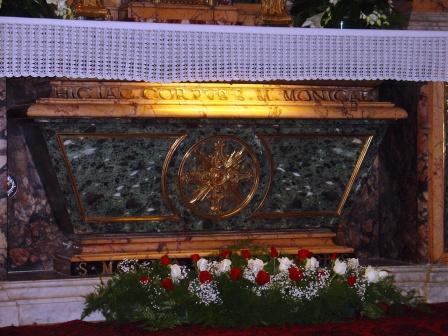
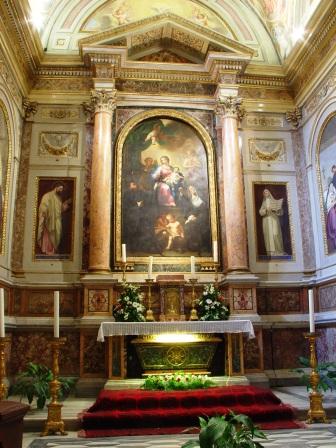 This is the chapel in the church of St. Augustine in Rome (literally across the street from my back door when in the City) where the mortal remains of St. Monica (+387), the mother of Augustine of Hippo now rest.
To the right is a shot of the chapel on the day some years ago when the bones of her son, St. Augustine, were brought from their resting place in Pavia (near Milan) to Rome.
For the first time since 387, son and mother were reunited.
How did St. Monica’s tomb wind up here?
Here is an excerpt from an article I wrote for Inside the Vatican (December 2004) on the above mentioned event. I used the alternate (and more accurate Punic) spelling of the saint’s name – “Monnica” (emphasis not in the original):
Most visitors to the Eternal City find it puzzling and wondrous that Monnica’s remains would be in Rome and even more so that Augustine’s should be in northern Italy, or that we have them at all. How did this come to pass? Monnica died at age 56 of a malarial fever at Ostia, Rome’s port city, not far from where modern Rome’s port, DaVinci airport, is situated. After Augustine’s baptism in 386 by Milan’s bishop St. Ambrose (+ AD 397), Monnica and Augustine together with his brother Navigius, Adeodatus the future bishop’s son by his concubine of many years whom Monnica had forced Augustine to put aside, and friends Nebridius, Alypius and the former Imperial secret service agent (agens in rebus) Evodius were all waiting at Ostia to return home to Africa by ship. They were stuck there for some time because the port was blockaded during a period of civil strife. As she lay dying near Rome, Monnica told Augustine (conf. 9): “Lay this body anywhere, let not the care for it trouble you at all. This only I ask, that you will remember me at the Lord’s altar, wherever you be.” She was buried there in Ostia. In the 6th century she was moved to a little church named for St. Aurea, an early martyr of the city, and there she remained until 1430 when her remains were translated by Pope Martin V to the Roman Basilica of St. Augustine built in 1420 by the famous Guillaume Card. D’Estouteville of Rouen, then Camerlengo under Pope Sixtus IV. As fate or God’s directing have would have it, in December 1945, some children were digging a hole in the courtyard of the little church of St. Aurea next to the ruins of ancient Ostia. They wanted to put up a basketball hoop, probably having been taught the exciting new game – so different from soccer – by American GIs. While digging they discovered the broken marble epitaph which had marked Monnica’s ancient grave. Scholars were able to authenticate the inscription, the text of which had been preserved in a medieval manuscript. The epitaph had been composed during Augustine’s lifetime by no less then a former Consul of AD 408 and resident at Ostia, Anicius Auchenius Bassus, perhaps Augustine’s host during their sojourn. It is possible that Anicius Bassus placed the epitaph there after 410 which saw the ravages of Alaric the Visigoth and the sacking of Rome a
nd its environs. One can almost feel behind these traces of ancient evidence Augustine’s plea to his old friend sent by letter from the port of Hippo Regius over the waves to Ostia. Hearing of the devastation to the area, far more shocking to the ancients than the events of 11 September were for us, did Augustine, now a renowned bishop, ask his old friend to tend the grave of the mother whom he had so loved and who in her time had wept for her son’s sins and rejoiced in his conversion?
Looking for a great book on Augustine? Try this!
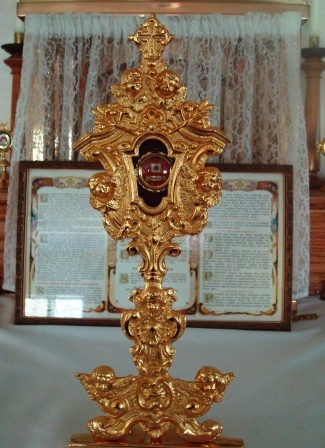
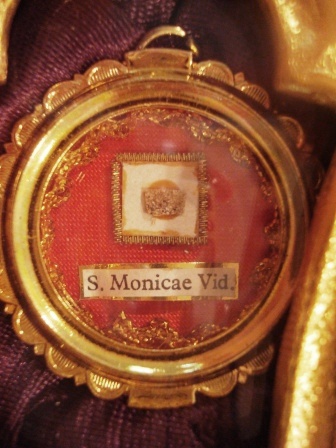
Meanwhile, in the chapel here there is a relic of St. Monica. May she pray for us, for widows and for parents of children who have drifted from the Church.
The August newletter of the USCCB’s Committee on Divine Liturgy has some pages dedicated to music for the upcoming translation of the Roman Missal.
Among the points made by the Committee…
Why Should Priests Sing?
The ICEL introduction to the chants for the new Roman Missal notes a number of reasons why the priest celebrant
should sing:1. To preserve the tradition of unaccompanied singing which gives the Liturgy a more noble form;
2. To continue the realization of a goal given by the Second Vatican Council in the Constitution on the Sacred Liturgy of “full and active participation” of all the people;
3. To reinforce, by chanting, the accentuation of the English language; and
4. To preserve the vernacular chants already in use. [What about Latin? Sacrosanctum Concilium says that people should be taught – by their pastors – both to speak and to sing all the parts pertaining to them in both Latin and their mother tongue. Do we belong to the Latin Church? cf. Sacrosanctum Concilium 54; Musicam sacram 47]
The USCCB’s 2007 guidelines on music in the Liturgy, Sing to the Lord: Music in Divine Worship, explicitly address the role of the priest in singing the Liturgy in paragraphs 18-21. These paragraphs highlight the importance of the priest singing the presidential prayers and the dialogues of the Liturgy according to his ability. As previously stated, the implementation of the revised Roman Missal is an opportunity for priests to expand their own abilities and to learn to sing the revised texts of the parts of the Mass.
Even if the priest himself is not confident singing alone he should definitely pay attention to his singing with the rest of the community in congregational song. [cf. Sacrosanctum Concilium 54; Musicam sacram 47] If the celebrant is not perceived as interested in the communal singing of the Liturgy, it will almost always influence the way in which the community will respond in song. Here the truism can apply: “lead by example.” [This is perhaps an issue for discussion: is this something woven into the warp and weft of the Novus Ordo? The priest has to … encourage?] In addition, the priest, by his attention and participation, should support the role of the cantor and psalmist. The priest also needs to be careful in the use of the microphone when singing with the gathered assembly, in order to avoid having his voice overpower that of the people.
Finally, in preparation for the reception of the Missal, pastors can point out to the faithful the overall importance of music in the Liturgy, [perhaps even along the lines the Church actually write about sacred music… about Gregorian chant and polyphony having pride of place, for example, about how the true texts to be sung are found in the Roman Missal rather than in a hymn book.]as well as the various parts of the Mass that should be sung and who should sing them.
I am all for promoting sung liturgy.
Let us sing the liturgical music of the Church!
Later in the same newsletter we read also:
In his 2006 Apostolic Exhortation Sacramentum Caritatis, Pope Benedict XVI notes that liturgical song has “preeminent place” as an aspect or building block of the ars celebrandi, the art of liturgical celebration (see no. 42). [See below.] Singing not only at the Liturgy but singing of the Liturgy (i.e., singing the rites themselves), [NB: The texts to be sung are in the Roman Missal. They are first and foremost the antiphons in the Missale Romanum.] which involves both the priest and the gathered assembly, is an important tool for fostering the full, conscious, and active – and therefore fruitful – participation in the Liturgy. The implementation of the revised Roman Missal provides an opportunity for pastors and parishes to evaluate their practices and commit to embracing the ars celebrandi, which will lead to more fruitful worship and prayer.
Let’s quote what Pope Benedict wrote in Sacramentum caritatis:
42. In the ars celebrandi, liturgical song has a pre-eminent place. Saint Augustine rightly says in a famous sermon that "the new man sings a new song. Singing is an expression of joy and, if we consider the matter, an expression of love". The People of God assembled for the liturgy sings the praises of God. In the course of her two-thousand-year history, the Church has created, and still creates, music and songs which represent a rich patrimony of faith and love. This heritage must not be lost. Certainly as far as the liturgy is concerned, we cannot say that one song is as good as another. Generic improvisation or the introduction of musical genres which fail to respect the meaning of the liturgy should be avoided. As an element of the liturgy, song should be well integrated into the overall celebration. Consequently everything – texts, music, execution – ought to correspond to the meaning of the mystery being celebrated, the structure of the rite and the liturgical seasons. Finally, while respecting various styles and different and highly praiseworthy traditions, I desire, in accordance with the request advanced by the Synod Fathers, that Gregorian chant be suitably esteemed and employed as the chant proper to the Roman liturgy.
Back in January, the Wall Street Journal had an article about how the late Sen. Edward Kennedy, Catholic and staunchy pro-abortion, came to embrace the pro-abortion position he championed for decades in the most public way possible.
The article was sparked from the possibility that Caroline Kennedy would be appointed to fill the senatorial seat opened by Sec. Hilary Clinton’s choice to take a pay check from the Obama Administration.
My emphases and comments.
JANUARY 2, 2009
How Support for Abortion Became Kennedy Dogma
By ANNE HENDERSHOTT
For faithful Roman Catholics, [Ms. Hendershott thinks that the Catholic dimension is important enough to raise here. She leads with it.] the thought of yet another pro-choice Kennedy positioned to campaign for the unlimited right to abortion is discouraging. Yet if Caroline Kennedy, the daughter of Catholics John F. Kennedy and Jacqueline Kennedy Onassis, is appointed to fill the U.S. Senate seat being vacated by Hillary Clinton, abortion-rights advocates will have just such a champion.
Ms. Kennedy was so concerned to assure pro-abortion leaders in New York, Britain’s Guardian newspaper reported on Dec. 18, that on the same day Ms. Kennedy telephoned New York Gov. David Patterson to declare interest in the Senate seat, "one of her first calls was to an abortion rights group, indicating she will be strongly pro-choice."
Within the first week of her candidacy, Ms. Kennedy promised to work for several causes, including same-sex marriage and abortion rights. In responding to a series of 15 questions posed by the New York Times on Dec. 21, Ms. Kennedy said that, while she believes "young women facing unwanted pregnancies should have the advice of caring adults," she would oppose legislation that would require minors to notify a parent before obtaining an abortion. On the crucial question of whether she supports any state or federal restrictions on late-term abortions, Ms. Kennedy chose to say only that she "supports Roe v. Wade, which prohibits third trimester abortions except when the life or health of the mother is at risk." Presumably Ms. Kennedy knows that this effectively means an unlimited right to abortion — including late-stage abortion — because the "health of the mother" can be so broadly defined that it includes the psychological distress that can accompany an unintended pregnancy.
Ms. Kennedy’s commitment to abortion rights is shared by other prominent family members, including Kerry Kennedy Cuomo and Maryland’s former Lt. Gov. Kathleen Kennedy Townsend. Some may recall the 2000 Democratic Convention when Caroline and her uncle, Sen. Ted Kennedy, addressed the convention to reassure all those gathered that the Democratic Party would continue to provide women with the right to choose abortion — even into the ninth month. ["the ninth month"] At that convention, the party’s nominee, Al Gore, formerly a pro-life advocate, pledged his opposition to parental notification and embraced partial-birth abortion. Several of those in attendance, including former President Bill Clinton and the Rev. Jesse Jackson, had been pro-life at one time. But by 2000 nearly every delegate in the convention hall was on the pro-choice side — and those who weren’t simply kept quiet about it.
Caroline Kennedy knows that any Kennedy desiring higher office in the Democratic Party must now carry the torch of abortion rights throughout any race. [This is liberal dogma, to be sure. Sadly it is nearly liberal Catholic dogma.] But this was not always the case. Despite Ms. Kennedy’s description of Barack Obama, in a New York Times op-ed, as a "man like my father," there is no evidence that JFK was pro-choice like Mr. Obama. Abortion-rights issues were in the fledgling stage at the state level in New York and California in the early 1960s. They were not a national concern.
Even Ted Kennedy, who gets a 100% pro-choice rating from the abortion-rights group Naral, was at one time pro-life. In fact, in 1971, a full year after New York had legalized abortion, the Massachusetts senator was still championing the rights of the unborn. In a letter to a constituent dated Aug. 3, 1971, he wrote: "When history looks back to this era it should recognize this generation as one which cared about human beings enough to halt the practice of war, to provide a decent living for every family, and to fulfill its responsibility to its children from the very moment of conception."
But that all changed in the early ’70s, when Democratic politicians first figured out that the powerful abortion lobby could fill their campaign coffers (and attract new liberal voters). Politicians also began to realize that, [wait for it] despite the Catholic Church’s teachings to the contrary, its bishops and priests had ended their public role of responding negatively to those who promoted a pro-choice agenda. [Bishops and priests at the time failed in their duty. However, consider also the horrific damage done by enablers such as the late Fr. Robert Drinan, SJ. Men like Drinan gave the Kennedy’s and others their instructions on how to dodge the abortion issue, how to relegate faith (at least concerning abortion) to the sphere of the private so that it would not impinge on their public actions.]
In some cases, [as I just said] church leaders actually started providing "cover" for Catholic pro-choice politicians who wanted to vote in favor of abortion rights. At a meeting at the Kennedy compound in Hyannisport, Mass., on a hot summer day in 1964, the Kennedy family and its advisers and allies were coached by leading theologians and Catholic college professors on how to accept and promote abortion with a "clear conscience."
[READ THIS NEXT PART WITH CARE]
The former Jesuit priest Albert Jonsen, emeritus professor of ethics at the University of Washington, recalls the meeting in his book "The Birth of Bioethics" (Oxford, 2003). He writes about how he joined with the Rev. Joseph Fuchs, a Catholic moral theologian; the Rev. Robert Drinan, then dean of Boston College Law School; and three academic theologians, the Revs. Giles Milhaven, Richard McCormick and Charles Curran, to enable the Kennedy family to redefine support for abortion. [Get that? There was a workshop for them to help them get around the teaching of the Church.]
Mr. Jonsen writes that the Hyannisport colloquium was influenced by the position of another Jesuit, the Rev. John Courtney Murray, a position that [AGAIN… pay attention…] "distinguished between the moral aspects of an issue and the feasibility of enacting legislation about that issue." It was the consensus at the Hyannisport conclave that Catholic politicians "might tolerate legislation that would permit abortion under certain circumstances if political efforts to repress this moral error led to greater perils to social peace and order." [And there it is, folks.]
Father Milhaven later recalled the Hyannisport meeting during a [And refresher courses were necessary….]1984 breakfast briefing of Catholics for a Free Choice: "The theologians worked for a day and a half among ourselves at a nearby hotel. In the evening we answered questions from [from who?] the Kennedys and the Shrivers. Though the theologians disagreed on many a point, they all concurred on certain basics . . . and that was that a Catholic politician could in good conscience vote in favor of abortion." [Have you wondered how Catholic Democrat pols such as Speaker Pelosi and VP Biden, not to mention a score of other Catholic pro-abortion pols, could justify avoiding the evil of their stand on the instrinsic eveil of abortion? This is how it was done. They were given formation by Catholic theologians. They were given a framework whereby they could justify supporting what Catholics know is evil.]
[QUAERITUR] But can they now? There are signs today that some of the bishops are beginning to confront the Catholic politicians who consistently vote in favor of legislation to support abortion. Charles J. Chaput, the archbishop of Denver, has been on the front lines in encouraging Catholics to live their faith without compromise in the public square. Most recently in his book "Render Unto Caesar," Archbishop Chaput has reminded Catholic politicians of their obligation to protect life.The archbishop is not alone. The agenda at November’s assembly of the U.S. Conference of Catholic Bishops included a public discussion of abortion and politics. The bishops’ final statement focused on concern about the possible passage of the "Freedom of Choice Act," and referred to it as "an evil law that would further divide our country." The bishops referenced their 2007 document, "Faithful Citizenship," which maintains that the right to life is the foundation of every other human right. In it, they promised to "persist in the duty to counsel, in the hope that the scandal of their [Catholic congregants’] cooperating in evil can be resolved by the proper formation of their consciences." [Moreover, the Notre Dame Debacle has not been forgotten. For the USCCB, this is not over.]
Whether the bishops truly will persist remains to be seen. New York’s Cardinal Edward Egan, for instance, has not publicly challenged Ms. Kennedy’s pro-choice promises. This is unfortunate. Until the clerics begin to counter the pro-choice claims made by high-profile Catholics such as Nancy Pelosi, Joe Biden and, now, Caroline Kennedy, faithful Catholics will continue to be bewildered by their pastoral silence.
Ms. Hendershott is a professor of urban studies at The King’s College in New York. She is the author of "The Politics of Abortion" (Encounter Books, 2007).
This was an excellent piece. I remember when it came out.
Do yourselves a favor and memorize those dates and names.
1964 … 1984 … Jonsen… Fuchs… Milhaven… McCormick… Curran… Drinan… Hyannisport
I n the lefty Jesuit weekly, something called America, there is a strong attack on, well, pretty much anyone who didn’t think that late Sen. Kennedy was just the bees knees. Singled out for a pouring of the choicest liberal acid is our friend Patrick Madrid.
Let’s have a look with my emphases and comments.
The Boors Who Demean Ted Kennedy
Posted at: 2009-08-27 08:18:22.0
Author: [Someone named…] Michael Sean WintersMy father is a very calm, imperturbable man. We speak just about every morning and his voice only rises when reporting that the Red Sox lost to the Yankees. [A man after my own heart.] He rarely calls in the evening but he did so last night. He had gone to Mass at St. Joseph’s Living Center, in Windham, Connecticut, the nursing home where my mother died two years ago and where his sister is a patient. The deacon preached the homily and, according to my father, had spoken ill of Sen. Ted Kennedy because he was not pro-life. [Just to be clear, for a prominent Catholic figure, not being pro-life is a serious matter, right? Let’s go on.]
The news report of Kennedy’s death at the Catholic News Agency included this qualifying phrase: "though he worked hard for the poor" and mentioned his "dedication to education." The article managed four sentences on Chappaquiddick and an extensive account of his pro-choice voting record. (It also misspelled, three times, the name of Washington’s archbishop who is the Most. Rev. Donald Wuerl, not Donald Wurel.) The Catholic News Agency, alas, is not really a news agency like Catholic News Service. It is an ideological rant pretending to be a news agency. [CNS isn’t also ideologically bent? BTW… an organization can’t be "a rant".]
Someone named Patrick Madrid, [Excuse me, but if you are pretending to be a Catholic writer, you at least should know who Patrick Madrid is, even if you don’t chose to follow any of his work. Winter’s comment reveals the sort of blinkers worn most liberals: they have a visor only on the right side. Only their own kind are worthy of notice.] who runs a blog and is involved with something called the Envoy Institute at Belmont Abbey in North Carolina, decided to attack my colleague at NCR Sister Maureen Fiedler for her post remembering the late Senator. "Maureen, with all due respect," he begins, words that reek of condescension. [Why assume Madrid didn’t mean that?] He writes: "Whatever his positive qualities may have been, and no doubt he had some, the tragic reality is that Senator Kennedy’s long political career was squandered by his vociferous, relentless promotion of abortion. [Well.. that is true. Isn’t it?] And that, sadly, will be his enduring legacy. I agree with you that tears are appropriate upon hearing the news of this man’s death, but not for the reasons you are crying them." I have my moments of hubris but it has never occurred to me to tell another soul why and why not to cry, still less in a blog post. [Ironic, this falling on the feast of St. Monica… but I digress.]
Who are these people? [As I said before. Liberals think that only their own kind, their own views are worthy of notice. Everyone else is just a kook, the fringe.] To what level of boorishness have the spokespeople for the pro-life community descended? [If he asks this question, is he saying that he does not belong to the pro-life community?] And, it is any wonder we ["we"?] keep losing the political fight for life when some of our own exercise such obvious, callous, inhumane indecency as to ignore a lifetime of good works, [ummm… those good things can be recognized, but does that mean we turn a blind… or blinkered eye… from the harm that he caused for decades on the issue of life itself, at a national level?] render judgment not just on a man’s ideas but on his soul, and to speak ill of the dead when the body is still warm. [Wait a moment. I don’t think that Patrick Madrid said anything about the state of the late Senator’s soul, which we simply cannot know. He said that to cry over him was not appropriate. Or did I miss something? Madrid wrote: "I agree with you that tears are appropriate upon hearing the news of this man’s death, but not for the reasons you are crying them."] It is shameful. And, [Now comes the true aim of this philippic. It looks like he wants the American bishops to be silent about pro-abortion Catholic politicians.] I hope the bishops recognize that it is counter-productive to the pro-life goals we should share. Hatefulness is not attractive or persuasive. [And criticism is "hateful".]
To say that Sen. Kennedy was flawed is to say that he was a human being. [Okay… Errare est humanum. But what, Mr. Winters, is the rest of that quote? "…sed perseverare est diabolicum". Sen. Kennedy persisted in his error, and his publicly scandalous support of abortion, despite the clear teaching of the Church in which he professed membership.] To dismiss his career because of his stance on abortion is to be ignorant of the complicated way the issue of abortion manifested itself in the early 1970s: [Huh? Did Catholics not know that abortion was evil in the 70’s? The Second Vatican Council’s Gaudium et spes reinterated that fact in the strongest language. Paul VI had issued Humanae vitae. Perhaps the only people for whom this was "complicated" were the likes of the late Fr. Robert Drinan, SJ, and others who provided the arguments pro-abortion Catholics would lean on so as to dodge the truth of Catholic teaching in their public actions.] I think Kennedy got it wrong [Thank heavens for that!] but I do not find it difficult to understand why and how he got it wrong. [Really?] If the pro-life leaders would stop ranting for a second and study that history [Liberals think conservatives are stupid. Only they have the true and clear perspective.] they might become more effective at advancing their cause. Besides, Ted Kennedy got many more things right than he got wrong. [Riiiight. That one thing outweighs the others. People can freely and with good conscience disagree and argue about the best ways to help the poor, improve public health, intervene in foreign lands, spend tax money, etc. The sanctity of life from conception is not one of those things which Catholics may set aside.]
Yesterday, watching the news shows, it was especially moving to see Kennedy’s political foes, conservatives like Sen. Orrin Hatch, come on and praise their former colleague. Kennedy maintained such friendships, which had their political usefulness, because of his heartfelt, contagious, infectious Catholic humanity, because he did not keep score, because he was quick to forgive, because he did not take himself too seriously, and because he saw that the promise of American democracy was greater than its failures. [All admirable qualities.] These loudmouths from the right should study his behavior and emulate, not castigate him. As I watched Sen. Hatch recall his memories of Ted Kennedy, I cried. I suppose Mr. Patrick Madrid will tell me I cried for the wrong reason. I don’t think so.
There is an old adage: de mortuis niihil nisi bonum.
I subscribe to this. I will not make any firm judgment about the state of the late Senator’s soul. In the course of a career of decades in the Senate, Edward Kennedy unquestionably made his positive contributions. But as his mortal remains are laid to rest, we cannot simply ignore what was a keystone of his political life: Senator Kennedy was a famous defender of abortion rights, more famous for his stance precisely because he was Catholic.
Sen. Kennedy will be exalted by Catholic liberals precisely because he was a liberal. May will lionize him because he was a Democrat. All of them will seek to diminish his record on abortion.
What the writer of this piece did, however, is use this opportunity to argue that the bishops should not speak out forcefully or act in the case of pro-abortion politicians. "I hope the bishops recognize that it is counter-productive to the pro-life goals we should share."
This is why we must not allow the left simply to set aside Sen. Kennedy’s pro-abortion record even as we readily acknowledge his achievements and, in charity, pray for the repose of his soul and God’s forgiveness for his failings.
From HeadlineBistro with my characteristic treatment of emphases and comments:
Kennedy’s Priest Discusses the Role of Faith in the Senator’s Life and Death
Rev. Patrick Tarrant of Our lady of Victory Church, priest to the Kennedy clan, discussed with TheBostonChannel.com the role faith played in the final days and moments of Senator Edward M. “Teddy” Kennedy’s life.
“The truth is,” Fr. Tarrant said, who was called to the compound shortly before Kennedy passed, [Thanks be to God!] “he had expressed to his family that he did want to go. He did want to go to heaven. He did want to die…
"I think the whole world knows certain parts very well, but I think there’s another part of his life that very few people know, and that’s his deep faith. His very deep faith in God and his love for his family" Tarrant said. [We all hope so.]
Recalling how Kennedy, the fierce political crusader, led the family in prayer at the death of his sister Eunice, Fr. Tarrant remarked "He was there and very reverent. I wish the world had known that part of him, but that was his secret. It was like it was the secret of his power, to be involved in doing good for others and it was what, I believe, drove him." [He was a very public figure, famous for his positions precisely because he was Catholic. Wouldn’t it have been nice to see something more of that reverence in public? I am glad he revealed it in more private settings. But faith musn’t be merely private. This is the dodge used by many Catholic pro-abortion pols: their beliefs are private matters and shouldn’t have any influence on their work as a [FILL IN BLANK]. "I’m personally opposed, but I can’t let that influence my decision on how to vote for [FILL IN BLANK]!"]
Kennedy’s passing has been marked by condolences from friends on both sides of the aisle.
While we didn’t see eye to eye on many political issues through the years, I always respected his steadfast public service," said President George H.W. Bush.
Respect for the man and his service, combined with a disagreement on some critical issues, was a tone struck by many in the Catholic community as well.
"His deep and personal commitment to causes affecting the poor and needy among us flowed from his deep Catholic faith, and the life and outreach of Jesus Christ," said Cardinal Roger Mahoney of Los Angeles in an interview with CNS, who joined forces with Kennedy on immigration reform.
"Over the years, however, I was never able to bring him to promote fundamental rights for one important group in our society — the unborn." [So, Card. Mahony does not gloss over the issue. He is willing to speak of it even as he acknowledges the late Senator’s other works.]
And the Vatican paper L’Osservatore Romano offered a similar assessment: “Edward Kennedy was constantly in the front lines of battles such as those for protection of immigrants, arms control and a minimum wage for the less well-off. But unfortunately he also took positions favorable to abortion." [And, pace America, the Vatican’s newspaper also speaks of the problem of the late Senator’s public pro-abortion dedication.]
His support for stem cell research and gay marriage also put him at odds with Church teaching.In as much the abortion issue complicates how one views Senator Kennedy’s Catholicism, the issue continues to complicate the passage of the health care legislation he was so adamant in his final months to see passed; and as the crucial 60th vote, his passing puts the future of the bill in question. [Thus, we must not allow liberals simply gloss over the facts about the late Senator’s career in their frenzy to instrumentalize his passing for political reasons.]
As the Wall St. Journal reports, “Most versions of the Democratic health plan would create subsidies for lower-income people to buy private health insurance. If that insurance includes coverage for abortion, [this is the point!] as many existing private plans do, it effectively means federal taxpayers are subsidizing abortion, critics of the legislation argue. While it gets less attention than some other parts of the plan, abortion has often been raised by critics at town-hall meetings during the August congressional recess.” [And some people, such as a writer for America, doesn’t want us to mention this subject in the wake of Sen. Kennedy death.]
This debate combines with a controversy of how Senator Kennedy’s seat will be filled. The senator, shortly before his passing, had pushed for a change in Massachusetts law to allow for Governor Patrick to make a temporary appointment, when in fact Democrats had pushed for the opposite policy under Governor Mitt Romney.
As the New York Times reports, “Republicans have attacked Mr. Kennedy’s proposal as flagrantly partisan, [Well…. it was nothing else!~] and indeed, the state’s Democrats are in the awkward position of being asked to reverse their own 2004 vote to keep vacant Senate seats empty until a special election.”
The article continues, “Until that year, Massachusetts law had called for the governor to appoint a temporary replacement if a Senate seat became vacant. But when Senator John Kerry, a Democrat, was running for president in 2004, the Democratically-controlled State Legislature wanted to deny the Republican governor at the time, Mitt Romney, the power to name a successor if Mr. Kerry won. The resulting law requires a special election 145 to 160 days after the vacancy occurs.”
Joseph Kennedy, the senator’s nephew, is already being mentioned as possible successor to the seat held by “Teddy” for so many decades.
Paul Ciarcia, Communications Associate
I have spent says doing things electronic and computerine. Time for a break.
A damp Oriole. The male Orioles should be leaving soon, alas.

This fellow… um… gal… specializes in eating fish from Sabine Pond.

Something different.

On Sabine Pond, by Monet.

More Orioles.

Nuthatch.

Did the ancient Romans have recipes for Baltimore Oriole tongues… and grape jelly?


As I fix computers at home, the blog is running veerrryyyyy sllllloowwwwwwlllllyyyyyy…..
Not all the time, but… from time to time during the day I have noticed that it takes a while to load pages, etc.
sigh
From the blog itself:
Aug 26 18:51:01 xxxx.xxxx.xxxx tmpfs: [ID 518458 kern.warning] WARNING: /tmp: File system full, swap space limit exceeded
sigh
High traffic day, I guess!
This should be solved pretty soon.
Your patience is appreciated!


Coat of Arms by D Burkart
 fac on Daily Rome Shot 1118 – Paddywhack!: “Speaking of the disputatio back on October 31st between Archbishop Vesco and Bishop Barron (Vesco saying the Catholic Church was…”
 on Continue the Rome shot posts? I dunno.: “Please call continue the Rome photo posts if it not too much of a burden. Thank you, Father!”
 on Daily Rome Shot 1117 – A *POLL* about 2026-27: “Sorry… my bad. It is indeed SIX. 1. Rh8+! Kxh8 2. Qh2+ Kg8 3. Qh7+ Kf8 4. Qh8+ Ke7 5.…” on Encrypted Yeast? The Fathers on “What does the “leaven” really say?” (6th Sunday after Epiphany Resumed): “I especially like St. John Chrysostom’s insight, that when we are “hidden” in the normal places we live and work,…”
 on Daily Rome Shot 1117 – A *POLL* about 2026-27: “pestolover: For what it’s worth, your solution was the best I could do also.”
 on Daily Rome Shot 1117 – A *POLL* about 2026-27: “Fr Z thanks so much for 2 reminders. 1. Using your Amazon link! For heaven’s sake it costs us nothing…”
 on 10 November – St Andrew Avellino (Vetus Ordo). Wherein Fr. Z rants.: “So interesting that you bring this up, a couple weeks ago a priest at a neighboring parish died unexpectedly. They…”

A Daily Prayer for Priests








They find you a pro-life agent in your area who commits to giving a portion of the fee to a pro-life group!

PLEASE subscribe via PayPal if it is useful. Zelle and Wise are better, but PayPal is convenient.
A monthly subscription donation means I have steady income I can plan on. I put you my list of benefactors for whom I pray and for whom I often say Holy Mass.
In view of the rapidly changing challenges I now face, I would like to add more $10/month subscribers. Will you please help?
For a one time donation...



Help Monks in Wyoming (coffee – UPDATED LINK) and Norcia (beer) and the wonderful "Soap Sisters" of Summit, NJ!


Please follow me on Twitter!










Visits tracked by Statcounter
since Sat., 25 Nov. 2006:


