“Please, Father, Help Me To Be Holy”

"Please, Father, Help Me To Be Holy"Here is a piece from a blog of Edward Mechmann hosted by the Archdiocese of New York.   Mr. Mechmann in the archdiocesan Respect Life Office.

My emphases and comments.

Please, Father, Help Me To Be Holy

August 19, 2009

I’m trying to be holy.  I try to set aside time for prayer, and I particularly try to be attentive during Mass.

But, the basic problem is me.  I’m just very, very easily distracted.  [Welcome to the human race!  o{];¬)  ] My mind whirls around, thinking about what I was doing, what I’m going to be doing, the current list of things I’m worried about, and on, and on.  I just have a hard time focusing during Mass.  [Note: This is why I say that paying attention, listening attentively, is far more challenging than singing and carrying stuff around.  ]

That’s why I follow along in a missal, so I can concentrate two of my senses at once on the prayers of the Mass, and try to get my heart and mind to join in those prayers.  I’m trying to actively participate in the Mass, instead of just being there and mouthing the responses.  By doing this, I have come to appreciate the beauty and noble simplicity of the prayers of the Mass, and they draw me upward to God — after all, He’s the one we’re addressing our prayers to.

That’s also why it’s a disaster for me when the priest change the words of the Mass.  It throws me off, takes my mind out of the prayers, and adds yet another layer of distraction.  The human element jumps in front of me, blocking my view of the divine.  [Well… I don’t want to cede the idea that the present, lame-duck ICEL translation has anything of the divine, but you get his point.] 

This rarely happens at my home parish, or at the parish where I attend daily Mass.  But it has happened on occasion when I’ve been travelling.  For example, there’s the priest who seems to make up the words of the Eucharistic prayers as he goes along.  [He should be reported to his, pastor/superior/bishop.] How can I join my prayers to his if I have no idea what he’s going to say next?  Or the priest who decided to re-write the Eucharistic Prayer so that it was in the form of a dialogue — some parts he said, and others were said by the congregation.  I can’t even tell you what a strange experience that was.  Or the priest who decided last weekend to use the Gospel reading from Saturday, the Solemnity of the Assumption, instead of the regular Sunday Gospel.  That totally threw me off — I love Mary, and I’m sorry that the Assumption wasn’t a Holy Day of Obligation this year, but for goodness sake, the Sunday Gospel was the climax of the Bread of Life discourse from John 6, perhaps the most important thing that Jesus ever said.   [There are occasions when substitutions are permitted.  However, we can admit that getting a curve thrown at you is a distraction.]

It’s particularly difficult when the priest chooses a manner of speaking as if he is having a conversation with us.  [Remember that comment Bp. Slattery made in his explanation of why he is opting for ad orientem worship?]  That’s even more distracting.  I can’t help but thinking, why are you talking to me?  Shouldn’t we all be talking to God?  

I know that this kind of thing is usually done with a good intention, to make the Mass more open and inviting, or to make the congregation feel more a part of the Mass.  But it has the exact opposite effect on me — it pushes me away, and makes it much harder for me to actively participate in the Mass.

I’m not a regular at the Traditional Latin Mass, but I imagine that this is not a problem — unless you’re an exceptional linguist, you probably couldn’t ad lib in Latin.  There’s also the old instruction to the priest to "do the red and say the black"  [HEY!  I know that one!] — do all the required movements and gestures, which are written in the Sacramentary in red, and say the required words, which are written in black.  The few times I’ve attended the Extraordinary Form, it actually helped me that it was in Latin, because I had to concentrate harder to follow along, [yes] and I felt myself entering into the prayers more,  [yes indeed] and joining the priest in offering them.  [Do I hear and "Amen!"?] That experience has helped me be more attentive and focused while attending Mass in the Ordinary Form. [Gravitational pull, folks.  And this serves to demonstrate what I have been talking about all along.  Familiarity with the older form of Mass will help our celebrations of the newer form.]

I don’t want to be critical of our priests, whom I love and pray for daily.  And I don’t want to be some kind of "liturgical police", constantly looking for problems at Mass and acting like I’m more Catholic than the Pope.  That’s not my job, and I wouldn’t want it anyway.

I’m just trying to be holy.  But I’m a weak, restless person who has a hard time concentrating on the Lord during Mass.

So, I’m begging.  Please, Father, help me be holy.  Please don’t change anything. 


Kudos to the writer!  Keep up the good work!

Posted in Brick by Brick |
16 Comments

Another grrrr update

After considerable effort yesterday, my desktop crashed and burned again today.  How my heart quailed.

However, I think I may – again after considerable effort and frustration – have found a work around. 

Right now, with the blessing, it is running and I am actually posting from my main computer, the desktop!

As for the laptop which powers all the video, etc., the display is a goner.  Requiescat.  I have an small external monitor hooked up to it now.  It beats going in through a remote log in and it is sufficient to use the box.  However, this is no longer a portable computer … so long as the display is dead.

I managed to fix, I think, the problem with the hard drive on the other, old laptop used for video in the chapel. 

This whole thing has been for the birds.

Well.. that is just a turn of phrase.

The feed is for the birds… that is… well you get the picture…. unless of course you have my laptop. 

I better stop.

Another grrrr update

Posted in SESSIUNCULA |
11 Comments

Frank interview of Msgr. Domenico Bartolucci, “maestro in perpetuo”

In my years in seminary in Rome, I would walk often passed the door leading to the rehearsal rooms of the boys choir of the Sistine Chapel choir.  I could hear them rehearsing with their maestro, Mons. Domenico  Bartolucci, the maestro in perpetuo, director for life, of the Sistina.   Mons. Bartolucci lived in the same palazzo as that in which our seminary was housed and he also spent some time in the countryside in my diocese as well.

The way Mons. Bartolucci was muscled out of his position by the Master of Ceremonies and chapter of St. Peter’s was a pretty shameful affair.  But, it happened.

Don’t get me wrong.  The Sistina was dreadful.  It still is dreadful.  But at least the old maestro had the right idea about sacred music. 

I was very interested to read the other day an interview with the old maestro, in Italian on the site Disputationes Theologicae.  I didn’t have the time to translated it, since I have been fighting with my computers, more than one of which has decided to try to die on me.  So, I was delighted that Rorate put some elbow grease to the task, thus saving me time and doing us a service.  Be sure to visit Rorate.

My emphases and comments and only a few adjustments here and there.

August 12, 2009

Mons. Bartolucci speaks about the liturgical reform and the “reform of the reform”

The liturgical reform of the 1970-ies is today taking up much space in the theological discussions, because liturgy and theology are mixed up in a – may we venture to say so – “transcendental relation”. It is not possible to discuss the one without taking up the other, if one does not want to fall into that theology of watertight compartments that was in use in the 1950-ies. Today it is necessary – in the wake of a more vast debate in which we engage ourselves – to formulate an open and straightforward analysis of what has happened and take an appropriate attitude towards the practical remedies and above all remedies that are “realizable” (realizzabili) as Saint Pius X used to repeat. Upon the request of so many of our readers, our Editorial Office also would like to occupy itself with the argument, if possible avoiding the repetition of the methodological errors of the past. Therefore it is our wish to initiate the true transmittance of the authentic Tradition.– basing ourselves on the testimony of those who have known the past, because of their age and their prestige, and not only because of their authority. As liturgy is also practical science, we have not wished to start off with pontificating “liturgists” who say they have read so and so many books and codices, but rather [NB:] take the matter up with someone who has lived and touched the liturgy as nobody else has, because he has prepared, repeated, coordinated and known the religious ceremonies in his Tuscan countryside, ceremonies which concluded with the “Messa in terza” (a mass celebrated by three i.e. Solemn Mass — CAP) and the unfailing processions with a musical band, as well as the splendors of the “Cappella Papale” in the Sistine chapel. We have the honor of introducing to you Monsignor Domenico Bartolucci, in an interview done by us lately. He was born in 1917 in Borgo San Lorenzo (Florence)., Tuscan by birth, Roman by pontifical summons, in 1952 he became substitute next to Perosi in the Sistine Chapel and from 1956 he became its Maestro Perpetuo. On the 24th of June, 2006 the reigning pontiff organized a special ceremony in honor of the musician (see the picture above), in order to consecrate “ad perpetuam rei memoriam” his closeness to the great master. During the occasion the Pope said: “ sacred polyphony, especially the one belonging to the Roman school, is a legacy which we must preserve with care (..); a genuine updating of the sacred music can only take place within the great tradition of the past of the Gregorian chant and of the sacred polyphony”. S.C.

INTERVIEW WITH MONSIGNOR. DOMENICO BARTOLUCCI
by Pucci Cipriani and Stefano Carusi

A meeting with Monsignor Domenico Bartolucci, the distinguished Mugellan musician, Maestro Emeritus of the Sistine Chapel, admirer, friend and collaborator of Benedict XVI.
It is a sunny afternoon on the green hills of the Mugellan landscape, when we arrive on the Roman church of Montefloscoli, in the antique rectory full of memories the Maestro Perpetuo of the Sistine Chapel is enjoying the fresh air, behind him a framed photo of the hug the reigning pontiff is giving Monsignor Domenico Bartolucci, the successor of Lorenzo Perosi in the Sacred Palace. On his writing-desk the now-famous book of Monsignor Brunero Gherardini: “Il Concilio Vaticano II- un discorso da fare” (“The Second Vatican Council – a debate to be started”), edited by Edizioni Casa Mariana.

It is on the subject of the liturgical reform that we start our conversation with the Maestro, with Domenico Bartolucci, who in liturgical and musical matters has been at ease working and giving counsel to five popes and who is a friend and collaborator of Benedict XVI, whose work he says is “an immense gift to the Church, if only they would let it work”.  [An old friend of Bartolucci, in his day, the late Msgr. Richard Schuler – a warrior for decent, properly understood sacred music on the other side of the Atlantic – would just "Just do what the Council asked!"]

Maestro, the recent publication of the Motu proprio “Summorum Pontificum” has brought a gust of fresh air into the desolate liturgical panorama which surrounds it. Even you may now celebrate the Mass of all time (“messa di sempre”.)

To tell the truth, I have always and without interruption celebrated it since my ordination … on the contrary, I sometimes found it difficult to celebrate according to the modern rite, even if I never said so.

The Mass which never was abolished, is it not?

Those are the words of the Holy Father even if some people pretend not to understand and even if many in the past have argued that the opposite is true.

Maestro, you have to admit to those who are denigrating the old Mass that it is not a Mass open to participation.

So that you won’t think that I’m just saying anything, I know how participation in old times was like, [As you read what follows, remember that liberals think people are tooo stooopid to understand liturgy in Latin.  Now … read on…] both in Rome, in the (St. Peter’s) Basilica and outside it, for instance down here in Mugello, in this parish, in this beautiful countryside, which was then populated by people strong in faith and full of piety. During Sunday Vespers the priest could just start singing “Deus in adiutorium meum intende” and thereafter fall asleep on his seat to wake up only at the “chapter”, the peasants would have continued alone and the heads of the family would have intoned the antiphon!  [I know this is entirely possible.  Consider first that once the liturgical movement took hold, hand missals had texts also for vespers.  Also, I have been in a parish where Vespers was still sung every Sunday afternoon.  People knew the antiphons at least of the regular Green Sundays by heart and the psalms as well.]

Do we see a veiled polemic, Maestro, in your confrontation with the current liturgical style?

I do not know, if you have ever been at a funeral and witnessed those “hallelujahs”, hand-clapping, giggly phrases, etc. One really asks oneself if these people have ever read the Gospel. Our Lord himself cried over Lazarus and his death. Here now, with this oily sentimentalism, nothing is respected, not even the suffering of a mother. I would like to show you how the people in old times participated in a Funeral Mass and how in the midst of that compunction and devotion, the magnificent and tremendous “Dies Irae” was intoned.

Was the reform not done by people who were conscious of what they were doing and well educated in the teachings of the Roman Church?

I beg your pardon, but the reform was done by arid people, arid, arid, I repeat it. And I knew them. As for the doctrine, Cardinal Ferdinando Antonelli himself, once said, I remember it well: “How come that we make liturgists who know nothing about theology?”

We agree with you, Monsignore, but is it not true that the people did not understand….

Dearest friends, have you never read Saint Paul: “It is not important to know anything but what is necessary”, “it is necessary to love knowledge ad sobrietatem”. At this rate, after a few years people will pretend to understand “transubstantiation” in the same way as they explain a mathematical theorem. But just think of it that not even the priest may quite understand this mystery!

But how could it have come to this twisting of the liturgy?

It became a kind of fashion. Everybody talked about it, everybody “was renewing”, everybody was trying to be like popes (tutti pontificavano) in the wake of sentimentalism, of eagerness to reform. And the voices that raised themselves to defend the two thousand year old Tradition of the Church, were cleverly hushed. There was the invention of a kind of “people’s liturgy” … when I heard these refrains, it came into my mind something which my professor at the Seminary used to say: “the liturgy is something given by the clerics to the people” (“la liturgia è del clero per il popolo”). It descends from God and does not come up from the bottom. I have to admit, however, that this mephtific air has gotten a bit rarefied (quell’aria mefitica si è un po’ rarefatta). The young generations of priests are maybe better than those who came before them, they do not have the ideological fury of an iconoclastic ideology, they are full of good feelings, however they lack in education.

What do you mean, Maestro, when you say “they lack in education”?

It means that they need it! I am speaking of the structure that the wisdom of the Church had so delicately chiseled in course of centuries. You do not understand the importance of the seminary: a liturgy that is fully lived, the orderly articulation of the different periods of the year and all this experienced in social communion with the brothers… Advent, Lent, the big feasts that follow after Easter. All of this is educational and if you only knew how much!

A foolish rhetoric wants to depict the seminary as something which spoils the priest, that the seminarians, remote and far away from the world, remain closed in themselves and distant from the people. This is pure imagination, invented by people who wish to dissolve an age-old formative richness and replace it with emptiness.  [A little "rupture" there, maybe?]

Let us return to the crisis of the Church and to the fact that so many seminaries have closed down, do you, Monsignore, support a return to the continuation of Tradition?

Look here, to defend the old rite is not the same as being a worshiper of ancient times; it is to be “eternal”. You see, when one gives the traditional mass names like “Mass of Saint Pius V” or “Tridentine” one is wrong, it makes it seem as if it is a mass belonging to a certain epoch. It is our Mass, the Roman universal Mass, valid everywhere and in all times, a single language spoken from the Oceania to the Arctic’s. Concerning the continuity in time, I would like to tell you an episode. Once we were together with a Bishop whose name I forgot, in a small church in Mugello, when there came the sudden notice that a brother of ours had died. We suggested that we at once celebrate a Mass, but then we realized that we only had old Missals at hand. The Bishop refused categorically to celebrate. I will never forget it and I repeat that the continuity of the liturgy means that – except for small details – it can be celebrated today, with that old dusty missal standing on a bookshelf and which for four centuries or more has served my predecessors.

Monsignore, there is much talk about a “reform of the reform” which could take away the deformities that came in the 70-ies.

The question is rather complicated. That the new rite had deficiencies is by now becoming evident for everybody, and the Pope has many times said and written that we must “keep what is ancient” (guardare all’antico). However we must beware of the temptations of introducing hybrid measures. [Hmmm… no gravitational pull?  Or only in one direction?] The liturgy with a big “L” is the one that comes to us from centuries back, it is the reference, it is not the debased liturgy which holds so many compromises “that make God sad and the enemy happy” ("a Dio spiacenti e a l’inimici sui”)

What do you mean, Maestro?

Let us for instance take the innovations in the seventies. Some ugly songs in beat that were in vogue in the churches in 1968, are today already archeological pieces. Giving up perennity and emerging oneself in time, means that one is condemned to the fads of fashion. In this connection I come to think of the Reform of the Holy Week in the 1950’s, made with some hurry under the pontificate of a Pope Pius XII who was already exhausted and tired. Only some years later, under Pope John XXIII who in liturgical matters was of a convinced and moving traditionalism, [I often remind people that John XXIII was not the liturgical liberal.  That came later.] came a telephone call to me from Mons. Dante, Master of Ceremonies of the Pope, who told me to prepare the “Vexilla Regis” for the coming celebration on Good Friday. I was somehow taken aback and answered: “They have forbidden me to do it”. The answer was: “But the Pope wishes it.” In a few hours I organized the practices of the songs and very happily we sang again the same songs which the Church had sung in many centuries on that day. All this only to say that when one distances oneself from the liturgical context those voids become difficult to fill and you can be sure they are noticed! In front of our liturgy of many centuries we should contemplate it and venerate it and remember that in our mania for “improvements”, we only risk doing great damage.

Maestro, what role does music play in this process?

It has an incredibly important role for many reasons. The affected “Cecilianism” to which certainly Perosi was no stranger, with its tones that were so mild and enticing to the ear had introduced a new romantic sentimentalism, which had nothing to do, for instance, with the eloquent and solid physicality of Palestrina. Some extravagant deteriorations introduced by Solesmes had cultivated a subdued gregorianism, which also was the fruit of a pseudo-restoring passion for the Medieval ages, which were so popular in the nineteenth century.

The idea of an opportunity to recuperate the archeological vein, both in music and liturgy, of a past, from which the so called “dark ages” (seculi bui) of the Council of Trent separated it ….. in short an archeology which has nothing at all to do with Tradition and which wishes to restore something which maybe never existed, is a bit similar to certain churches restored in the “pseudoromantic” style of Viollet-le-Duc.

What does it mean, Monsignore, when in the musical field you attack Solesmes?

This means that the Gregorian chant is modal, not tonal and not rhythmical, it has nothing to do with “one, two, three, one, two, three”. We should not despise the way people sung in our cathedrals and replace it with a pseudo-monastic and affected murmuring. A song from the Middle Ages is not interpreted with theories of today, but one should go about it as it was then. Moreover the Gregorian chant of another historical time could also be sung by the people, sung using the force with which our people expressed their faith. Solesmes never understood this, but we should recognize the learned and large philological work executed on the old manuscripts.

Maestro, how far have we come in our days with the restoration of Sacred Music and the Liturgy?

I cannot deny that there some signs of restoration, but I still can see that there persists a certain blindness, almost a complacency for all that is vulgar, coarse, in bad taste and also doctrinally foolharfy. Most important, do not ask me, please, to make a judgement on the guitar-players and on the tarantellas which are sung during the Offertory.….The liturgical problem is serious, do not listen to the voices of those persons who do not love the Church and who oppose the Pope and if you want to cure the sick then remember that the merciful doctor makes the wound fester (fa la piaga purulenta).

I am sure you will want to dig into some of the points he raised.

Posted in SESSIUNCULA |
37 Comments

Quantitative Metathesis

You might want to check out the latest of Quantitative Metathesis.

Posted in SESSIUNCULA |
1 Comment

Robert Novak, RIP

The long-time political commentator and journalist Robert Novak has died at 78 year of age from a malignant tumor. 

Mr. Novak was brought up as a Jew, lived for years as an agnostic, but he made a conversion with his wife to Catholicism late in life, in 1998, a conversion he called "his most important change of heart".

Requiescat.

Posted in SESSIUNCULA |
7 Comments

Bishop of Tulsa: his choice for ad orientem worship

WDTPRS has written about H.E. Most Rev. Edward Slattery before, and very favorably indeed.  We have all the more reason to issue official WDTPRS kudos to His Excellency.

This is from the Eastern Oklahoma Catholic.

My emphases and comments.

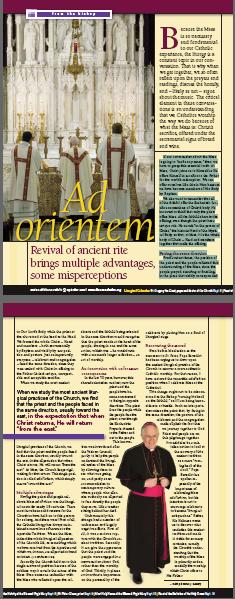
Bp. Slattery has decided that in the Cathedral of Tulsa, he will offer Holy Mass ad orientem.

Bishop Edward Slattery of Tulsa, Oklahoma, has returned to the practice of celebrating the Eucharistic liturgy ad orientem in his cathedral. Bishop Slattery explained in his diocesan newspaper that he recognized the advantages of the Mass celebrated with the priest facing the people, but:

Bishop of Tulsa: his choice for ad orientem worshipUnfortunately this change had a number of unforeseen and largely negative effects. First of all, it was a serious rupture with the Church’s ancient tradition. Secondly, it can give the appearance that the priest and the people were engaged in a conversation about God, rather than the worship of God. Thirdly, it places an inordinate importance on the personality of the celebrant by placing him on a kind of liturgical stage.

Because the Mass is so necessary and fundamental to our Catholic experience, the liturgy is a constant topic in our conversation. That is why when we get together, we so often reflect upon the prayers and readings, discuss the homily, and – likely as not – argue about the music. The critical element in these conversations is an understanding that we Catholics worship the way we do because of what the Mass is: Christ’s sacrifice, offered under the sacramental signs of bread and wine.

If our conversation about the Mass is going to “make any sense,” then we have to grasp this essential truth: At Mass, Christ joins us to Himself as He offers Himself in sacrifice to the Father for the world’s redemption. We can offer ourselves like this in Him because we have become members of His Body by Baptism. [RIGHT!  Our ability to participate in the Church’s worship with full participation is our baptismal character.  It is an interior reality.]

We also want to remember that all of the faithful offer the Eucharistic Sacrifice as members of Christ’s body. It’s incorrect to think that only the priest offers Mass. All the faithful share in the offering, even though the priest has a unique role. He stands “in the person of Christ,” the historic Head of the Mystical Body, so that, at Mass, it is the whole body of Christ – Head and members together that make the offering.  [But not in the same way.]

Facing the same direction

From ancient times, the position of the priest and the people reflected this understanding of the Mass, since the people prayed, standing or kneeling, in the place that visibly corresponded to Our Lord’s Body, while the priest at the altar stood at the head as the Head. We formed the whole Christ – Head and members – both sacramentally by Baptism and visibly by our position and posture. Just as importantly, everyone – celebrant and congregation – faced the same direction, since they were united with Christ in offering to the Father Christ’s unique, unrepeatable and acceptable sacrifice.

When we study the most ancient liturgical practices of the Church, we find that the priest and the people faced in the same direction, usually toward the east, in the expectation that when Christ returns, He will return “from the east.” At Mass, the Church keeps vigil, waiting for that return. This single position is called ad orientem, which simply means “toward the east.”

Multiple advantages [It is a practical practice as well.]

Having the priest and people celebrate Mass ad orientem was the liturgical norm for nearly 18 centuries. There must have been solid reasons for the Church to have held on to this posture for so long. [D’ya think?  Still, this is something that some people need to contemplate.  The Church’s liturgical worship didn’t begin in 1969.]  And there were!

First of all, the Catholic liturgy has always maintained a marvelous adherence to the Apostolic Tradition. [continuity] We see the Mass, indeed the whole liturgical expression of the Church’s life, as something which we have received from the Apostles and which we, in turn, are expected to hand on intact. (1 Corinthians 11:23)

Secondly, the Church held on to this single eastward position because of the sublime way it reveals the nature of the Mass. Even someone unfamiliar with the Mass who reflected upon the celebrant and the faithful being oriented in the same direction would recognize that the priest stands at the head of the people, sharing in one and the same action, which was – he would note with a moment’s longer reflection – an act of worship.  [Worship should be for worship.  It seems circular, but it bears repeating.]

An innovation with unforeseen consequences

In the last 40 years, however, this shared orientation was lost; now the priest and the people have become accustomed to facing in opposite directions. [That is a good way to put it: opposite.]  The priest faces the people while the people face the priest, even though the Eucharistic Prayer is directed to the Father and not to the people. This innovation was introduced after the Vatican Council, partly to help the people understand the liturgical action of the Mass by allowing them to see what was going on, and partly as an accommodation to contemporary culture where people who exercise authority are expected to face directly the people they serve, like a teacher sitting behind her desk.

Unfortunately this change had a number of unforeseen and largely negative effects. First of all, it was a serious rupture with the Church’s ancient tradition. Secondly, it can give the appearance that the priest and the people were engaged in a conversation about God, rather than the worship of God. Thirdly, it places an inordinate importance on the personality of the celebrant by placing him on a kind of liturgical stage.

Recovering the sacred

Even before his election as the successor to St. Peter, Pope Benedict has been urging us to draw upon the ancient liturgical practice of the Church to recover a more authentic Catholic worship. For that reason, [HERE IT IS…] I have restored the venerable ad orientem position when I celebrate Mass at the Cathedral.

This change ought not to be misconstrued as the Bishop “turning his back on the faithful,” as if I am being inconsiderate or hostile. Such an interpretation misses the point that, by facing in the same direction, the posture of the celebrant and the congregation make explicit the fact that we journey together to God. Priest and people are on this pilgrimage together.

It would also be a mistaken notion to look at the recovery of this ancient tradition as a mere “turning back of the clock.” Pope Benedict has spoken repeatedly of the importance of celebrating Mass ad orientem, but his intention is not to encourage celebrants to become “liturgical antiquarians.” Rather, His Holiness wants us to discover what underlies this ancient tradition and made it viable for so many centuries, namely, the Church’s understanding that the worship of the Mass is primarily and essentially the worship which Christ offers to His Father.

Well done, Your Excellency.

May all diocesan bishops do this as well.

Think about this: with proper catechesis and a little diplomacy, no priest of the diocese can be criticized for introducing ad orientem worship.  If he is a little careful, he will have the support of the bishop.

Posted in "How To..." - Practical Notes, Brick by Brick, Fr. Z KUDOS, SESSIUNCULA, SUMMORUM PONTIFICUM |
33 Comments

Colorado Diocesan paper has a two parter on Summorum Pontificum

An alert reader sent this from the Colorado Catholic Herald.  This is a two parter (1 & 2) by John Hartnett on Summorum Pontificum.

My emphases and comments.


COLORADO SPRINGS. Two years have passed since Pope Benedict XVI released Summorum Pontificum, an apostolic letter specifying new rules for celebrating Mass and administering the sacraments in the form used before the Second Vatican Council. During that time, renewed interest in this "extraordinary form" of the Mass, based upon the Missal of 1962 promulgated by Blessed Pope John XXIII, has slowly spread within the Diocese of Colorado Springs.

A MASS FOR THE AGES

Until 40 years ago, the Tridentine (Latin) Mass was the "ordinary form" of Mass in the Roman rite, not significantly changed since the sixth century, according to Father Adrian Fortescue in his book, "The Mass: A Study In the Roman Liturgy" (Longmans, Green and Co. 1912). Today, this Mass of legions of saints is unknown by many Catholics and widely misunderstood. Yet, in light of Summorum Pontificum, its celebration may become more commonplace.  [Commonplace… we will say this more often, you know.]

Signs of this are already visible. Father Stéphane Dupré of the Priestly Fraternity of St. Peter, an order whose charism [well… apostolate…] is to promote and celebrate the Tridentine Mass, celebrates a Low Mass every morning at 8 a.m. at Immaculate Conception Parish in Security, where he is the pastor. He also offers a 10:30 a.m. Sunday High Mass. Msgr. Ricardo Coronado-Arrascue, diocesan chancellor and judicial vicar, offers a weekly Low Mass at Pauline Chapel in the Broadmoor neighborhood of Colorado Springs on Friday evenings at 6 p.m., with a High Mass on First Fridays.

In the Low Mass, the priest prays many of the prayers quietly, such as the Canon which begins before the consecration and ends with the Pater Noster (Our Father). There is no music and no incense, and the Mass typically has no more than two altar servers.

The High Mass is ceremonious, with many of the prayers sung in Gregorian chant by a choir, joined in parts by the faithful and usually accompanied by an organ. The priest also chants certain parts of the Mass. There are several altar servers, sometimes a deacon and a frequent use of incense. The Mass usually begins and ends with a procession.

[It is good to have a little instruction for people who may not be familiar with these things.]

One additional priest in the diocese, Father Robert Manning, pastor of St. Gabriel the Archangel Parish in Colorado Springs, has also spent time learning to celebrate the extraordinary form.

"Others are interested, perhaps daunted by the required proficiency in the rubrics as well as Latin," said Msgr. Coronado-Arrascue.

"While many of the diocesan seminarians receive the experience of the extraordinary form,"  ["many" might be overstating it a bit, but things are getting better.] Bishop Michael Sheridan added, "those attending Kenrick-Glennon Seminary in St. Louis are being groomed to offer it as well as the ordinary form." Bishop Sheridan is a graduate of the seminary and is a member of its board of directors.  [Bishops on boards of directors of seminaries can really help with this.]

This direction is consistent with the growing attraction this Mass seems to hold for young people. Twenty-year-old convert and new Immaculate Conception parishioner Eric Jensen said he was drawn "by its solemnity and deep reverence." Like many of those in attendance at these Masses, Jensen is too young to harbor nostalgic memories of this form of the liturgy. The same is true for the 20 or so altar servers who rotate serving at Father Dupré’s Masses.  [Which gives the lie to those who claim that this is about nostalgia.]

Father Dupré pointed out that Immaculate Conception Parish has the same far-flung borders as those of the diocese. Parishioners travel from Monument, Castle Rock, Penrose, Divide, Colorado City, Limon and points in between, some for daily Mass. Yet, parishioners are quick to counter that such distances do not present obstacles to Father Dupré in his devotion to their spiritual wellbeing.

"(This is) evidence," said parishioner Byron Harris, "that the fervor and commitment of this energetic priest’s growing flock reflects that of its pastor."  [Fathers… notate bene.]

The Old Latin Mass: A Brief History

"The first source for the history of the Mass is obviously . . . the account of the Last Supper in the New Testament," wrote Father Fortescue.

It is because of Our Lord’s command to do "this," namely what he himself had done, in memory of him, that liturgies exist.

"We have here the essential nucleus of the holy liturgy in any rite. This we may be sure was constant from the beginning," Father Fortescue wrote.

Other practices in the development of the Mass, familiar to us today, were soon adapted from Jewish customs. Father Fortescue wrote that "the first part of the liturgy with its readings from the Bible, sermons and prayers is a Christianized form of the old Synagogue service."

"A definite pattern for the celebration of the Eucharist had developed within decades of the death of Our Lord, which can still be discerned clearly in the finalized Roman Mass of 1570," he added.

He goes on: "Our knowledge of the details of the liturgy increases from the earliest Church Fathers and with each succeeding century. There is a gradual and natural development. The prayers and formulas, and eventually the ceremonial actions, develop into set forms. There are varying arrangements of subsidiary parts and greater insistence on certain elements in different places (locales)."

This produced different liturgies, among them our Roman rite, "but all go back eventually to the biblical pattern," he wrote.

"From roughly the consolidations of Pope St. Gregory the Great [who died in 604]," he continued, "we have the text of the (Roman) Mass, its order and arrangement, as a sacred tradition," still intact, except in unimportant details, in the modern extraordinary form.  [In some prayers, the Novus Ordo versions restore a more ancient text.]

He added that the keynote of the reform of Pope Gregory was fidelity to the traditions that had been handed down. It consisted principally of the simplification and more orderly arrangement of the existing (Roman) rite. It is also to this pope that the church owes, to a large extent, the codification of Gregorian chant.

In Gregory’s time, the Gallican and other rites were celebrated in much of Europe outside of Rome. But as the Roman rite spread, supplanting its Western rivals, it adopted some of their peculiarities.

[Again… catechesis is very important.  This may also be of help to people in accepting the changes to the translation of the Novus Ordo coming up.  After all, fidelity to the text is part of the continuity we need as faithful Catholics.]

"The Gallican additions are, in general, decorative or symbolic ritual. The pure Roman rite was exceedingly simple, austerely plain. Its prayers were short and dignified compared with the exuberant rhetoric of the East. In our missal then we have from non-Roman sources the decorative processions, blessings and much of the Holy Week ritual," wrote Father Fortescue.

Father Fortescue added that subsequent changes to the Mass over the next 1,000 years amounted primarily to minor additions and amplifications. Apart from these, the 1570 missal of St. Pius V corresponds very closely with the order established much earlier by St. Gregory. Beginning in 1969 with the promulgation of the new Missal of Pope Paul VI, celebration of the ancient form diminished considerably. However, Pope John Paul II took steps in 1984, and again in 1988, to increase access to this Mass. Finally, with his motu proprio Summorum Pontificum, Pope Benedict XVI moved to facilitate its renewed widespread usage.

NEXT ISSUE: Impressions From A Latin High Mass and Journal of a Latin Parish.

___

IMPRESSIONS FROM A LATIN HIGH MASS

Father Frederick Faber, a popular figure in 19th century English Catholicism, called the ancient Catholic Mass of the Latin rite, "the most beautiful thing this side of heaven."

A decade ago, Mother Angelica, founder of Eternal Word Television Network (EWTN), had similar praise: "It was almost mystical. It gave you an awareness of heaven, of the awesome humility of God, Who manifests Himself in the guise of bread and wine."

Rooted in the early church and infused with powerful symbolism, it is a tapestry interwoven with richly colored vestments, moving ritual, clouds of incense and deep solemnity. This, along with the sacred music of Gregorian chant, offset with contrasting silences, led convert to Catholicism and Immaculate Conception parishioner Viki Hackett of Divide to call it "a spiritual feast."

"I am moved by the humility of it from the opening procession," she said. "Fittingly, the choir goes on to chant biblical verses asking God for cleansing, while the priest sprinkles the faithful with holy water. Then he prays humbly at the foot of the altar before daring to ascend to the altar proper (which symbolizes Mount Calvary), bowing as he prays the Confiteor, striking his breast at the self-accusatory words . . . mea maxima culpa."

The altar servers, kneeling, then do the same, faces almost touching the sanctuary floor in a posture of atonement. These expressions of penitence and unworthiness — as well as prayers asking for mercy and forgiveness — permeate this Mass, which is a bloodless re-presentation of Christ’s sacrifice on the Cross.

As the Mass proceeds, Gregorian chant wafts from the choir loft in response to expressions of prayer from the priest. While the priest quietly says such prayers as the Kyrie, Gloria, Credo, Sanctus and Agnus Dei, the choir chants them aloud. The priest also chants at various points in the Mass, such as the Epistle and Gospel, which he also proclaims in English preceding the homily.

"The effects of the sacred music, eye-filling ritual, pervasive reverence and sense of awe and mysticism stir feelings of piety and faith," said Byron Harris, who with his wife Mary is a parent of three Immaculate Conception altar servers. "The beauty and dignity of the offertory prayers only add to it, followed by those of the Canon," which surrounds the priestly action of the consecration. This is the moment where, by the miracle of transubstantiation where the bread and wine become the body and blood of Christ, Christ himself joins the priest on the altar.

New Immaculate Conception member Douglas Montgomery said he likes to reflect at this point of the Mass on the meaning of these prayers together with those after the consecration, and to also pray for people dear to him.

Once the priest chants the Pater Noster (Our Father), the time to receive the Son of God is drawing near.

Hackett’s husband, Tom, noted that "it is here, especially, that I experience a rising sense of anticipation and awe. The Son of God is about to come to me."  [I ask:  Do you get this sense from the Mass you attend?]

Following the chanting of the Agnus Dei, Montgomery silently prays some of the Prayers Before Communion found in the missal. He said he finds this an intimate way to ready himself to receive the Creator.  [This would seem to fly in the face of those who claim that no prviate devotions are permitted.]

Moments later, those able to receive Communion file in reverential silence to kneel abreast at the Communion rail, there to receive the King of Kings. The choir sings Panis Angelicus or another hymn of adoration, while people meditate on the God-come-to-dwell-within-them. In a few short minutes, the Mass will end. And for Tom and Viki Hackett, Montgomery, the Harris family and many others, the high point of the week will be coming to a close.

JOURNAL OF A LATIN MASS PARISH

[Here is a good "brick by brick" section.]

When Father Stéphane Dupré transferred from Our Lady of Mount Carmel Parish in Littleton to pastor Immaculate Conception Parish in July 2008, he wanted to offer the fullness of the ancient Roman Liturgy, including regular High Mass, to his new congregation. One of his first acts was to evaluate the readiness of two critical areas.

"While the parish celebrated the extraordinary form of the Mass," he told The Colorado Catholic Herald, "the High Mass and certain other expressions of the liturgy had been offered infrequently. In assessing the choir, they were experienced and very professional. But they sang a cappella (unaccompanied), and with only four adult members. There was not only a need for the choir to expand but also to make use of the organ for High Mass, which I wanted to begin offering every Sunday starting in one month."  [Hmmm… it is good for organ to be used.  But… it is not strictly necessary for a High Mass, after all.]

Similar expansion seemed necessary for the Altar Server’s Guild.

"Fortunately," said Father Dupré, "Mr. Collins (parishioner Richard Collins, who had trained the servers) had built a very fine foundation here, and we had a capable and dedicated group of young servers. But in fairness to the guild, up to that point they had not been expected to produce the greater numbers of highly experienced servers suddenly needed. So while a number of the boys were making their way up the ladder, we were a little light on the senior positions."

Individual mastery of the altar positions, including the Latin responses, takes years, from postulant up through torchbearer, junior and senior acolyte and up to master of ceremonies.  [Brick by brick.  We mustn’t complain if we don’t think things are moving fast enough.  Don’t let the perfect be the enemy of the good.]
 
James Sullivan, cantor of Gregorian chant, was quick to size up the choir’s new challenge from Father Dupré.

"For us," he said, "this meant quickly integrating an influx of volunteers, including an organist."

Gregorian chant, which most scholars agree dates to at least the sixth century, had all but disappeared in many quarters following the 1960s.

"Therefore," Sullivan said, "while most of the volunteers had some choir experience, few had sung much Gregorian chant."

Among the new recruits were the Carmack girls, Therese, then 14, and Mary, then 13, who had both trained on piano and organ from the age of 6. Neither had ever played sacred music, but after a break-in period on the temperamental, old church organ, which actually let out smoke at times, it was decided the sisters would alternate.

In an article in the June 21, 2008, edition of The Times-Picayune (New Orleans), Sacred Music [one with which I am quite familiar] magazine managing editor Jeffrey Tucker said chant "has an inner pulse like a heart beat, but it doesn’t have a regular rhythm. The effect is like musical incense. It’s always sort of floating and rising."

He added that there are tens of thousands of Gregorian chants, and few of them are easy to master.  [Well… you know… it isn’t exactly lyric opera or quantum mechanics.  Chant is hard for those unfamiliar, but it isn’t that hard.]

Said Sullivan: "(Immaculate Conception) had no time to waste. With more than 15 newcomers, including an organist, we took the advice of the music director at the Priestly Fraternity of St. Peter Seminary in Denton, Neb., and went back to the basics."

Meanwhile, some members of Father Dupré’s former parish who happened to live in Monument were intrigued by his plans for Immaculate Conception Parish. Chad Higgs had been in charge of the huge Altar Guild there and, according to Father Dupré, had achieved "something absolutely wonderful." Higgs volunteered to help Collins meet the new pastor’s expectations. Moreover, Higg’s son, together with the three Harris boys also transferring, had been in that program for years. These four were qualified to serve even the most senior positions.

"The Altar Guild members, ranging in age from seven to 19, alternate serving daily Mass as well as other sacramental offerings," said Higgs. "The time and distance traveled to Mass is but a fraction of the commitment required of them and their families. With so much to learn, they need to be available for ongoing training, and depend on family members for transportation." [It is a parish project.]

As the weeks of preparation flew by, the one-time Baptist church building, now the home of the ancient Catholic Mass, [true ecumenism] rang with the sound of chant and organ music, while the integration of the new servers proceeded at a hectic pace.

"Looking back," Father Dupré said, "despite the challenges, that initial High Mass went very well."

All the same, fostering the growth of these young altar servers is a commitment spanning years, and Collins, in order to meet other obligations, has since handed the Altar Guild to Higgs, with involvement from Father Dupré.

"In a similar manner, it takes years of singing together for a Gregorian chant choir to reach its potential," added Sullivan.

One year later, the old organ has been replaced by a donated cathedral organ, while Therese and Mary Carmack recently spent a week in Chicago as the youngest participants of this year’s Sacred Music Colloquium, attended by Chicago Cardinal Francis George.

For Sullivan, Higgs, the servers, choir members and their families from as far away as Monument, together with two young organists from Eagle Mountain, the labor of love continues.

(For more information, visit www.cosfssp.org.)

(Hartnett is a new member of Immaculate Conception Latin Mass Parish in Security.)


Brick by brick!

Posted in Brick by Brick, SUMMORUM PONTIFICUM |
12 Comments

Diocesan bishop lets ordinands choose older or newer rite for ordination

Here is some interesting news.

Every once in a while I get the question whether a diocesan bishop could ordain priests using the older, traditional Roman Pontifical.

I always write back Yes.

Now this news comes via our friends at Rorate.

Bishop Dominique Rey of Frejus-Toulon will be ordaining two priests according to the traditional rite of ordination on September 26, 2009 in the cathedral of Toulon.

Of note is the fact that both of them will be ordained for the diocese. Deacon Marc de Saint-Sernin will be serving as a diocesan priest for Frejus-Toulon. The other ordinand, Deacon Eloi Gillet, will be serving with the Missionary Society of Divine Mercy, which runs the personal parish for the TLM in the same diocese (St. Francois de Paule).

To my knowledge, Frejus-Toulon is the only diocese in the whole world that offers to its seminarians the choice of being ordained either according to the usus recentior or the usus antiquior. (14 priests and 11 deacons had been ordained for the diocese of Frejus-Toulon according to the liturgical books of Paul VI last June.)

As mentioned previously in this blog, the diocesan seminary of Toulon is open to those who wish to become priests of the diocese while continuing to prefer the usus antiquior.


Now that is an enlightened bishop.

WDTPRS kudos.

Posted in Brick by Brick |
13 Comments

Sundry grrr updates and thanks to a reader

Still fighting the good fight.

My desktop is… being… difficult.  So difficult that I have had to set aside the laptop problems.

The laptop which powers the Z-Cam… the display died.

Anyway, the desktop … I eventually got it to boot up and give me enough of a readable screen to initiate an update of the graphic card driver.

I now have functioning monitors. 

In the process… various other things crashed and burned.  I have been reinstalling drivers and programs.

However, this cage match is hardly over. 

Sorry about the relative inactivity on the blog.  Right now I am doing pretty much everything the blog requires from my phone… which is why I have the iphone in the first place: for needs such as these.

I must, however, immediately thank CG of IL for the COFFEE… o blessed bean, beloved of God, roasted and prompt for grinding.  This coffee was sent via the amazon wishlist and it lifted my hitherto hideous day (one of several lately).  When that UPS truck pulled up, my spirits rose and so I raise the mug!

Sundry grrr updates and thanks to a reader

Posted in SESSIUNCULA |
5 Comments

Grrr update

I have managed to get the desktop working and have installed new a new driver for the graphics card.

So far so good.

Posted in SESSIUNCULA |
11 Comments