Do you use Twitter?
Follow me!
@fatherz

An article posted on the indispensable C-FAM with my emphases and comments.
Volume 12, Number 35
August 13, 2009
Radical NGO Paints Abortionists as Human Rights DefendersBy Samantha Singson
(NEW YORK – C-FAM) In a recently released report from the Center for Reproductive Rights (CRR), the advocacy group is appealing to the United Nations (UN) to formally recognize abortion-providers as "human rights defenders." In "Defending Human Rights," CRR presupposes that abortion is part of the accepted human rights framework and targets legal restrictions on abortion, funding restrictions on abortion and "failure to reduce abortion-related stigma" as "human rights violations." [These people are monstrous wackos. They are, however, clever. You see, they surely have no realistic hope that this will go through. They know this will not be accepted. So, what is their real motive? They seek in introduce new terms, a new notion. They are trying to bump the paradigm in a direction… their direction… just a little bit. They will keep bumping it a little bit. Imperceptibly, as in the case of the frog in the pot of water to be boiled, they will try to more people to their way of thinking.]
CRR asserts that abortion providers should be recognized as "human rights defenders" because the targeting of abortion providers directly infringes on women’s fundamental human rights by restricting "women’s ability to realize their right to reproductive healthcare, including safe abortion."
According to the website of the UN Office of the High Commission on Human Rights, "human rights defender" is a term used to describe people who "individually or with others, act to promote or protect human rights." To be a human rights defender, a person "can act to address any human right on behalf of individuals or groups" and "seek the promotion and protection of civil and political rights as well as the promotion, protection and realization of economic, social and cultural rights."
Critics point out that none of the binding UN human rights treaties mention abortion or "reproductive rights" [Yet.] and that CRR is using the non-binding recommendations of UN committees and a creative interpretation of existing human rights to claim that there is a global right to abortion.
CRR’s interpretation of international law attaches abortion to recognized and established human rights. In the paper, CRR asserts that the human rights to dignity, liberty and security "require that women have reproductive and sexual self-determination." This right to "reproductive autonomy" includes "women’s ability to control the number and spacing of their children," the rights to information, privacy and confidentiality. In addition, the right to health necessarily comprises the right to sexual and reproductive health, including "reproductive healthcare services" – which include abortion, according to CRR. ["abortion" = "healthcare"]
CRR charges that policy and legal measures to regulate abortion qualify as discrimination against abortion providers, who are acting as "human rights defenders." CRR cites mandatory delays and counseling laws as a human-rights-defender violation that "prohibits" the exercise of providers’ "rights to practice."
CRR also seeks to make governments portray abortion in a positive light, claiming that governments failure to address the "deeply rooted stigma" of abortion is tantamount to condoning and encouraging "the targeting of providers for harassment and legal restrictions on their work." CRR also charges that funding restrictions on abortion are discriminatory because they "single out one category of medically necessary services for elimination."
CRR’s recommendations include creating measures to increase the number of physicians performing abortions (including by teaching abortion in medical school), advocating the repeal of laws restricting abortion and repealing funding restrictions.
The report is just the latest attempt by CRR to get abortion-providers recognized as "human rights defenders." In 2008, CRR led the charge at the Inter-American Commission on Human Rights to get abortion-providers classified as defenders of human rights.
Great, huh?
Perhaps they will come to claim that they want to reduce the number of abortions too.
I discovered on CNA a interesting feature. Louie Verrecchio writes a column called Harvesting the Fruit of Vatican II. One of his columns concerns active participation in the liturgy.
WDTPRS has been working to spread a correct understand of active participation for a long time and combat the madness that has corroded our identity through a distorted understanding.
Let’s see what Mr. Verrecchio has to say, with my emphases and comments.
July 23, 2009
Active Participation: Doing liturgy and becoming church
By Louie VerrecchioI don’t remember the first time I encountered the phrases "doing liturgy" and "becoming church," nor do I recall my specific reaction. [I remember. The US seminary I was in, and out of. And I felt sick.] Regular readers of this column, however, can pretty much imagine what that might have been, but I’m getting a little ahead of myself.
I’d like to share with you a snapshot of my home parish, which I suspect is probably not unlike most others.
My parish of record is a warm and inviting place. It’s my home-base community within the Church Universal; a place where I have worshipped and celebrated and mourned with family and friends for many years.
I have a great deal of affection for my parish’s pastor. He is a kind and genuinely loving caretaker of souls who has offered me and others who are dear to me priestly ministry and good counsel on more than one occasion.
Why then over the last twenty months or so have I been traveling more than thirty miles out of my way to participate in Sunday Mass at a different parish? Simply put, because my home parish has unfortunately become overly enamored with the idea of "doing liturgy" and "becoming church." [Anyone else had this experience? Stop! STOP! Don’t trample… okay… I get it!]
To that end, my parish has a "Liturgy Committee" whose mission statement – taken almost verbatim from the Second Vatican Council’s Constitution on the Sacred Liturgy – reads, "Our goal is to enable the People of God to engage in full, conscious, and active participation in the celebration of the sacred liturgy." [A good goal… provided they have a correct understanding of what that means.]
The result of their effort is a Mass that is increasingly nuanced by what appears to be the self-imposed pressure to constantly inject new forms of creativity into the liturgy. In practice this means that liturgical prayers and procedures are altered; liturgical roles are assigned to as many lay persons as possible, individuals are singled out during the Mass for special recognition and applause, and music for the Mass is apparently selected more for the catchiness of its tune than for the meaning of its content. [Anyone else had this … no wait… STOP already!]
I have no doubt that the Liturgy Committee means well, but I wonder how many its members have actually read Sacrosanctum Concilium; the aforementioned conciliar document to which they attribute their stated mission?
Those who have explored the Constitution on the Sacred Liturgy would know that the Council’s idea of "active participation" has nothing whatsoever to do with turning the Mass into a production with an ever increasing number of lay cast members, much less its entertainment value.
Before we examine the Council’s thoughts more closely, it’s important to consider that the desire for liturgical participation on the part of a well-formed laity was not invented in the 1960’s.
In 1947 Pope Pius XII lauded and encouraged the laity’s active participation in the liturgy – yes, the Traditional Latin Liturgy – saying:
"Therefore, they are to be praised who, with the idea of getting the Christian people to take part more easily and more fruitfully in the Mass, strive to make them familiar with the ‘Roman Missal,’ so that the faithful, united with the priest, may pray together in the very words and sentiments of the Church. They also are to be commended who strive to make the liturgy even in an external way a sacred act in which all who are present may share. This can be done in more than one way, when, for instance, the whole congregation, in accordance with the rules of the liturgy, either answer the priest in an orderly and fitting manner, or sing hymns suitable to the different parts of the Mass, or do both, or finally in high Masses when they answer the prayers of the minister of Jesus Christ and also sing the liturgical chant." (Mediator Dei – 105)
Pope Pius XI some two decades earlier had offered similar encouragement saying, "The faithful come to church in order to derive piety from its chief source, by taking an active part in the venerated mysteries and the public solemn prayers of the Church." (Divini Cultus – 1928)
Neither of these examples represent "out of the box" thinking, mind you; on the contrary. Active participation in the liturgy is as old as the Church itself as indicated by St. Paul’s exhortation to the Corinthians, a letter written sometime in the mid-first century, in which he underscored the importance of proper disposition when participating in the Body and Blood of Christ. (cf 1 Cor. 11:23-34)
So [here is the big question] what does active participation in the context of the Mass as we know it actually mean, and what did the Council have in mind? For clarity of the matter, let us turn directly to one of the Council Fathers, Pope John Paul II.
In his Ad Limina Address to the Bishops of the United States in 1988, the Holy Father saw fit to expound upon some of the misunderstandings that lead to "abuses, polarization, and sometimes even grave scandal" in the liturgy.
"Full participation does not mean that everyone does everything, since this would lead to a clericalizing of the laity and a laicizing of the priesthood; and this was not what the Council had in mind," the Holy Father said.
"Active participation certainly means that, in gesture, word, song and service, all the members of the community take part in an act of worship, which is anything but inert or passive," he said, honing in on the most overlooked point of all. "Active participation does not preclude the active passivity of silence, stillness and listening: indeed, it demands it." [Get that?]
The Council Fathers notion of how authentic participation is achieved is indicated in the very title to Chapter II of Sacrosanctum Concilium, "The Promotion of Liturgical Instruction and Active Participation."
You see, "instruction," according to the mind of the Council, is the essential key to "participation;" one cannot possibly hope to penetrate the sacred Mysteries in such way as to actively participate in them without first comprehending, to the extent that it is possible, what is taking place. [He is correct. And that phrase "to the extent that it is possible" is important by the fact that we are dealing with an encounter with mystery. The point of worship is an encounter with mystery. Our understanding, opened by what we can learn and comprehend, edges us a little close to that chink in the rock through which we peer at the God who passes by.]
To the Council Fathers, fostering active participation among the laity meant providing the "liturgical instruction" necessary in order for the "faithful to take part in the sacred liturgy fully aware of what they are doing." (cf SC 11) [Perhaps a bit too optimistic, unless we mean that we come to understand that we don’t understand. What we know helps us to know what we don’t know.]
The Mass itself is a teacher, [well… yes… okay… well… Mass is not a didactic moment. Mass is not a teaching experience. Yes, we learn things through the texts and other elements, but the purpose of Holy Mass is not for "learning".] according to the Council Fathers, [?] and they envisioned a revised liturgy that might more effectively communicate our belief that "every liturgical celebration, because it is an action of Christ the priest and of His Body which is the Church, is a sacred action surpassing all others." (SC 7) [I don’t think SC 7 supports the claim that "Mass itself is a teacher". Yes, we can learn things from perceptible signs. But this is not the point of Mass.]
"Liturgy," in other words, is not so much something we "do" as it is a gift we are privileged to receive along with the invitation to unite ourselves to the Lord’s sacred action. [EXACTLY. A constant theme here at WDTPRS has been that the core of a proper understanding of active participation is interiorly active receptivity. Our active participation begins with our interior character, our baptismal character which makes us members of Christ and allows us to receive the other graces offered through the sacraments. We must strive to unite ourselves to the liturgical action, which is really being enacted by the true Actor, Christ the Priest. Our interior receptivity becomes outward expression at the appropriate times and in the appropriate ways indicated in the liturgical rites.] Likewise, "church" is not so much something we "become" as it is that which we already are by virtue of our incorporation into Christ’s Body through Baptism; the gateway to fully conscious and active participation in the sacred liturgy. [After years of writing this in my columns and on the blog, I sense that progress has been made.]
A focus on "doing liturgy" and "becoming church" has brought us to the unfortunate point where Mass in many places, including my parish, all too often obscures the inherent sacredness of the action as much as it communicates it.
Though I admit to being somewhat apprehensive, I will one day "bite the bullet" and respectfully share some of these thoughts with my pastor in the hope that by the grace of God I may be able to repay him well for the good counsel that he’s so freely given to me over the years.
Louie Verrecchio is the author of Harvesting the Fruit of Vatican II; a highly acclaimed adult faith formation tool – endorsed by George Cardinal Pell – that has been helping parish based study groups and individuals worldwide to faithfully explore the documents of the Second Vatican Council since 2004. For more information please visit: www.harvestingthefruit.com
WDTPRS kudos to Mr. Verrecchio for getting it right!
Think about this.
If it can happen there, it can happen here.
Proof: There actually has to be a discussion in the USA about "conscience clauses".
This is from CNA:
Spain’s Justice Minister says doctors not allowed to object to abortion
Francisco Caamano, Spain’s Minister of Justice
Madrid, Spain, Aug 14, 2009 / 04:13 pm (CNA).- The Collegial Medical Organization and various pro-life groups in Spain have strongly rejected statements by the country’s Minister of Justice, Francisco Caamano, who said Thursday that “there is no room for conscientious objection” when it comes to abortion. [Does this mean they will be jailed if they object?]
The president of the Collegial Medical Organization, Dr. Juan Jose Rodriguez Sendin, said, “The right doctors have in Spain to conscientious objection is going to be respected, whether they like it or not, and it is better this is accepted on good rather than on bad terms.”
Conscientious objection is universally recognized in the medical profession, he insisted, noting that the commitment not to kill, not to abort, not to take part in torture, not to betray patients has been part of medical practice for more than 40 centuries. [40 centuries… primum non nocere …]
“It should not seem strange to any normal person that doctors do not want to perform abortions, what ought to seem strange is the opposite,” he added. “Because it is not an ideological problem, it is simply a question of freedom. For this reason, we are going to defend the right of doctors to conscientious objection,” Rodriguez said.
The Association for the Defense of Conscientious Objection issued a press release calling the statements by the Minister of Justice “sectarian, imprudent and revealing of a manifest scorn for constitutional law, which considers conscientious objection to abortion a right of doctors and other health care professionals.”“For the vast majority of doctors, the rejection of abortion is not based on moral principles but on the conviction that it presupposes ending human life,” the association warned.
It also noted that conscientious objection is the last resort for a citizen “when an obligation imposed by law causes rejection or a grave moral conflict.” “We are certain that the Minister would not want to ‘taste his own medicine’ if he found himself in other circumstances,” the group said.
“We deplore the ‘crusade’ that has been launched in recent days against freedom of conscience,” the association said, calling on the Minister of Justice to publicly clarify “whether his respect for freedom of conscience is sincere or is subject to political interests.”
Right to Life spokesperson, Gador Joya, warned Caamano that no minister and no government “can force a doctor to end a human life and harm the health of his patients. No matter what Mr. Caamano says, we doctors protect life and care for our patients. The vast majority does not practice abortion nor will we,” she stressed.
You will want to pay attention to this and read it carefully.
Here is a provocative line:
The successes and failures of the expansion of Christianity are often mirrored precisely by the practice of this slaughter [of babies and children].
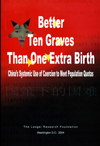
Sandro Magister of Chiesa has a fascinating piece on an article from an Italian daily on the new book by Harry Wu Better Ten Graves Than One Extra Birth: China’s Systematic Use of Coercion to Meet Population Quotas.
Here is Magister’s introduction to the excerpts:
ROME, August 14, 2009 – "Better ten graves than one extra birth," preaches a slogan of the one-child campaign in China. And this is also the title of the book in which Harry Wu has described and analyzed the Chinese anti-childbearing policy, made up of sterilization, forced abortion, infanticide.
The book was released in the United States, where Wu lives – in exile from China – and heads the Laogai Research Foundation. And now it has also been released in Italy, just as [get this…] the parliament approved, on July 15, a motion that requires the Italian government to present to the general assembly of the United Nations a resolution against abortion as a means of population control, and for the affirmation of the right of every woman not to be forced to abort.
In China, the obligatory one-child policy was introduced in 1979. Wu’s assessment of these thirty years is expressed well in the title of his book in its Italian version: "Slaughter of innocents."
The book has been highlighted in Italy mainly by two newspapers: "Avvenire," owned by the episcopal conference, and "Il Foglio," directed by Giuliano Ferrara, a non-Catholic intellectual deeply involved in the defense of unborn life and in promoting an international moratorium on abortion.
The following article appeared in "Il Foglio" on July 29, 2009. The author takes his cue from Wu’s book. But he goes farther. He shows that the slaughter of the unborn and of infants is not the sole prerogative of China over the past few decades, but has accompanied many civilizations over the span of millennia. Pagan ancient Rome had it. The China of past centuries had it. Today’s India has it. The missionary expansion of Christianity has often found it it on its path.
Not only that. Abortion and infanticide are also regaining ground in the West today. They are common currency in the "new world" promoted by bioethicists like Peter Singer. They emerge in laws like the one providing for the euthanasia of children up to the age of twelve, in Holland.
[Get this…] The successes and failures of the expansion of Christianity are often mirrored precisely by the practice of this slaughter.
It would seem that Christianity is in a perpetual cage match with the culture of death.
If that isn’t enough to get your attention…. here is the rest of what Magister put on his site.
 Be sure to visit Chiesa. You get there things translated from Italian which you can’t find anywhere else.
You can purchase Harry Wu’s book using this link HERE.
Moratorium against the new pagans
by Francesco Agnoli
Harry Wu’s book "Better Ten Graves than One Extra Birth"- in Italy entitled "Slaughter of innocents. The one child policy in China" – demonstrates how today, in the twenty-first century, thousands and thousands of children in that country are killed in their mother’s wombs, at any stage of gestation, or are drowned, strangled, left to die in the cold once they are born. Similar things also happen in India. [And… it would also be the case in … Illinois?]
So then, anyone who loves history knows that what is happening today in these two huge countries, which together constitute almost one third of the world population, has always happened in the past, including in old Europe or in the New World. Up until the coming of Christianity. [The fact is that Christianity and the "culture of death" are locked through the millennia in a war to the end.]
One of the ideas that recur most in the writings of the first Christians is in fact their desire to frequently repeat one concept: we Christians are different from the pagans, in part because we do not kill our children, neither within our women’s wombs or outside of them. [We do not kill our children. We do not kill our children. Tell that the Catholic politicians, any Christian politician, who supports abortion legislation.]
In chapter XXX, paragraph 2 of his "Octavius," the second-century apologist Minucius Felix, [Perhaps the earliest Latin writer… some say Tertullian, some say Minucius Felix.] comparing the teaching of Christ with that of the pagans, writes: "you expose your newborn children to wild beasts and to birds; or strangling them you crush with a miserable kind of death. There are some women who, by drinking medical preparations, smother in their very bowels the seed destined to become a human creature, and thus commit a parricide before they bring forth. And you learn these things from your gods, for Saturn did not simply expose his children, but even devoured them."
For his part, the great Tertullian, in his "Apologeticum," chapter IX, states: "For us Christians murder is expressly forbidden, and therefore it is not even permitted for us to destroy the fetus in its mother’s womb. Preventing birth is murder in advance. It doesn’t matter at all whether one destroys a life already born or crushes it at birth: what is about to be born is already a human being. Every fruit is already contained in its seed."
Another very important document from second-century Christianity, written in Asia Minor, the Letter to Diognetus, reiterates the same ideals in this rather concise manner: "Christians marry like everyone else and produce children, but they do not throw away their newborns."
On this same theme of infanticide, the historian A. Baudrillart has written: "There may be no matter on which ancient pagan society and modern Christian society are in more stark opposition than in their respective ways of thinking about children."
In effect, if we look at the ancient world, we note that abortion and infanticide are fairly widespread. "Seneca," recalls the American sociologist Rodney Stark in ‘The Rise of Christianity, "regarded the drowning of children at birth as both reasonable and commonplace. Tacitus charged that the Jewish teaching that it is ‘a deadly sin to kill an ‘unwanted child’ was but another of their ‘sinister and revolting’ practices. It was common to expose an unwanted infant out-of-doors where it could, in principle, be taken up by someone who wished to rear it, but where it typically fell victim to the elements or to animals and birds."
So in Rome just as in Greece, children were casually killed, or sold, or exposed and left to die of hunger and cold when there was no one to rescue them, usually in order to make them slaves. We know of the discovery, in the Roman sewers, of piles of bones from infant children who were abandoned and then thrown away like trash or garbage.
The victims of infanticide were usually girls, as in China and India today, while abortion, in addition to killing the fetus, often killed the mother as well, or left her sterile.
The first Christians’ refusal to resort to abortion and infanticide, which was connected to a high rate of fertility among them, was not only a great victory of humanity, but also one of the elements that, together with conversions, allowed the first Christians to expand more and more, to the point of surpassing the pagans in numbers. [Do you get that? And what do we face in many Western nations today with an aging population?]
But infanticide was not practiced only in Rome, as demonstrated in part by the legend of Romulus and Remus, or in Greece, but in the entire ancient world.
The [monster but] famous bioethicist and animal rights supporter Peter Singer forcefully upholds the idea that this ancient practice should be rediscovered today, together with legal abortion. In fact, if it is true that only Christians forcefully rejected it – Singer argues – why should we believe that they alone were right, while all the other peoples and religions of the past were wrong?
"Killing unwanted infants or allowing them to die has been a normal practice in most societies throughout human history and prehistory. [Because we did it before, we should do it now. Is that the argument? We used to enslave black Africans too. Should we do that again?] We find it, for example, in ancient Greece, where disabled infants were exposed on the mountainside. We find it in nomadic tribes like the Kung of the Kalahari Desert, whose women will kill a baby born while an older child is still too young to walk. Infanticide was also common on Polynesian islands like Tikopia, where food supplies and population were kept in balance by smothering unwanted newborn infants. In Japan before westernisation, ‘mabiki’ – a word that has its origins in the thinning of rice seedlings so that there is room for each plant to flourish, but which came to be applied to infanticide too – was very widely practiced, not only by peasants with limited amounts of land, but also by those who were quite well off."
With the spread of Christianity over much of the world, abortion and infanticide became much more rare and isolated phenomena, while legislation, beginning with Constantine, intervened in defense of infants, and works of charity and assistance were developed for abandoned children and for families in difficulty. Up until the return of abortion in communist and Nazi legislation in the twentieth century, and of infanticide with the new law on euthanasia for children up to the age of twelve, in Holland.
***
If we turn our minds now to the two huge countries in which abortion, even forced abortion, and infanticide are mass phenomena, it is easy, after this brief excursus, to understand the reason for all this: China and India are among the countries least penetrated by the Gospel of Christ, and Western culture with it, which intentionally or not is a bearer of this message, or at least of part of it.
When the first Jesuit missionaries reached China, they were rather impressed by this great civilization. But what made the biggest negative impression on the great Matteo Ricci, when he set foot in the Celestial Empire in 1583, was the widespread prostitution, the rampant corruption, the frenzy for money, and above all, the extent of the practice of infanticide. The communist regime, which is capable of planning millions of forced abortions, mass sterilizations, mass killing of infants, still has a long way to come, but respect for children, in that country which is admirable in other ways, is entirely missing.
As J. J. Matignon would write at the beginning of the twentieth century in "Superstition, crime e misère en Chine," the Chinese often sell their daughters as prostitutes, or kill them, because of poverty but also because of their magical superstitions, their obsessive ancestor worship: "As it always has in China, superstition plays a key role: in fact, the eyes, nose, tongue, mouth, brain of children are believed to be organic materials endowed with great therapeutic power. It can happen that after giving birth the mother falls ill, and then, in order to appease the spirits, the girls or in certain cases the boys are destroyed. There are women who have the specific task of bringing about the death of newborn girls . . . The newborns are destroyed by tossing them into a corner of the house or a garbage bin, where the dust and filth will not take long to block the child’s respiratory tract." Other times the children are drowned or smothered with pillows, although the influence of the Europeans, Matignon concludes, seems to have a certain limiting effect on these customs.
During Matignon’s own time, two missionaries were saying the same things about China. The first was a Jesuit, Saint Alberto Crescitelli, who was later decapitated and disemboweled at the age of 37, on July 21, 1900, during the Boxer Rebellion. The second was a Divine Word missionary from Val Badia, in Trentino Alto Adige, Saint Giovanni Freinademetz. Having arrived in the country that he would love his entire life, to the point of dying of typhus there, he wrote to his loved ones, on more than one occasion, that the Chinese have "the custom of exposing their own children, or simply exchanging or selling them . . . One of our best Christians, before his conversion, had killed his daughter by throwing her against the rocks, simply because she was crying too much" (Sepp Hollweck, "Il cinese dal Tirolo", Athesia, 2003).
In another letter, written from Hong Kong on April 28, 1879, Freinademetz recounts how the Catholic nuns had built two orphanages, where they received more than a thousand children per year. The Chinese "give them away for nothing or for a few pennies, and don’t give it another thought."
So the missionaries – he wrote from Puoli on July 2, 1882 – went through the streets looking for them, baptizing thousands of them at the point of death, and saving the ones they could: [How are our Catholic religious doing these days?] "Many souls have already been saved since we arrived here, many children of pagans who died after being baptized, and again yesterday we had the solemn burial of a little girl of just over a year old, who had died. Her mother had wanted to strangle her in order to be able to breastfeed another woman’s child for money, she then heard that we accept all sorts of children, and we raise them well; so she brought her to us more than two months later. The girl became ill, and died after being confirmed by us half an hour before her death. We wanted to bury her with great ceremony in order to demonstrate to the pagans how we honor their own children whom they throw away. The pagans here do not use coffins for little children, but as soon as they are dead they dig a hole and throw them in. We made the girl a beautiful little casket painted red, we dressed her in a beautiful blue dress and brought her to the church, all of us missionaries accompanied by the Christians, who had never seen anything like it. Many pagans came to see . . ." (G. Freinademetz, "Lettere di un santo," Imprexa). [What will today’s pagans do?]
***
As in China, where today infanticide is nothing less than state business, a similar situation is found in India. In the huge country dominated by the Hindu religion as well, killing, especially of girls, is very widespread, for economic and other reasons. The missionary agency "Asia News" recently reported this story: "Among tribal populations female children are regarded as a burden and social attitudes permit both foeticide and infanticide. In 2006 eleven newborn girl babies were starved to death by their parents in a tribal hamlet of Ranga Reddy district, 80 km from Hyderabad. It is a long-standing practice to wrap the unwanted girl child in a cloth and leave them to die. According to local press reports Jarpula Peerya Nayak, a 27 year old father said ‘My wife gave birth to a female baby for the third time, a daughter is a burden and we decided not to feed her. So she died. It is very difficult to bring up girls and marry them off’. On February 25, his cousin J. Ravi and wife Sujatha let their newborn baby starve to death. ‘My daughter died two days after birth since we did not feed her,’ admitted Ravi. ‘We already have two girl children and can’t afford to have one more.’ A tribal leader outlines the dowry he is expected to give for his daughter in marriage ‘a scooter, five to six tolas of gold and Rs 50,000 cash to a good groom.’ After starving and killing the girl children, the tribals dig a grave in their fields and bury them. Then they put a stone on the grave. Villagers said that dogs had eaten parts of the body of Ravi’s daughter and he had to bury her again. Most of the 40-odd families in the village have either witnessed such killings or have performed it themselves over the years. Jarpula Lokya Nayak has starved to death two daughters."
In India as well, the efforts of the missionaries and of the Christian minorities is aimed, in addition to the attempt to break down the boundaries of caste and of social inequalities, to the defense of unborn life and of childhood, in the name of the God who became a child. Just one example is enough: that of Mother Teresa of Calcutta.
Everyone knows that the mission of this woman was that of helping the poor of India, the marginalized, the weak, the least. Among these, Mother Teresa never forgot to mention the children in their mother’s womb, whom she called "the poorest of the poor." In the book "Dateli a me. Madre Teresa e l’impegno per la vita", Pier Giorgio Liverani presents the thought of this holy woman, expressed in a thousand circumstances and with great power, as in these words of hers: "Abortion is the greatest destroyer of peace today. Because if a mother can kill her own child – what is left for me to kill you and you kill me – there is nothing between. This is what I ask in India, and everywhere: What have we done for the child? We are fighting abortion by adoption, we have saved thousands of lives, we have sent words to all the clinics, to the hospitals, police stations – please don’t destroy the child, we will take the child."
The fight on behalf of children, against abortion and infanticide, has been conducted by Mother Teresa and her sisters, sometimes to the point of martyrdom, with great force, clashing with a culture unaware of the sacredness of life from its beginning. For the Hindus, for example, the children who are abandoned or rejected by their parents, if they survive, are and remain pariahs, outcastes making up for previous sins. Women in general, and girls even more so, are expensive because of their dowries, and are considered inferior to males, "to the point that they are not infrequently poisoned at the breast, which is sprinkled with poison while they are sucking their mother’s milk."
So it sometimes happens that there is a very high number of births, in the effort to have a boy at all costs, and as a result a high number of female infanticides: selective abortion is used until the child desired, a boy, is obtained. Mother Teresa and her sisters founded many houses of charity, schools, and orphanages, receiving great appreciation, but also the opposition of prime minister Morarji Desai, who in 1979 accused them of helping children with schools and orphanages for the sole purpose of baptizing and converting them. Mother Teresa responded to him: "It seems to me that you do not realize the evil that abortion is causing for your people. Immorality is on the rise, many families are breaking apart, there is an alarming increase in the cases of insanity among mothers who have killed their own innocent children. Mr. Desai: [Or … FILL IN THE BLANK] it may be that before long you will find yourself face to face with God. I do not know what explanation you will be able to give him for having destroyed the lives of so many children who were unborn, but certainly innocent, when you find yourself before the judgment seat of God, who will judge you for the good you have done and for the evil you have caused from your high position in government."
And Mother Teresa added how over the previous year the 102 centers that she operated in Calcutta had seen 11,701 Hindu families, 5,568 Muslim families, and 4,341 Christian families who had been taught the meaning of the family, respect for life, the necessity of responsible procreation, reducing births without recourse to abortion or infanticide! The cry of the unborn children, of the slain infants, Mother Teresa said, echoing in another way the concepts expressed centuries and centuries before by Minucius Felix, Tertullian, and many others, "hurts the ear of God."
__________
The book:
Harry Wu, "Better Ten Graves Than One Extra Birth: China’s Systematic Use of Coercion to Meet Population Quotas", Laogai Research Foundation, 2004.
The foundation established and directed by the author:
> Laogai Research FoundationThe newspaper in which Francesco Agnoli’s article appeared on July 29, 2009:
> Il FoglioHarry Wu’s interview in "Avvenire" on July 28, 2009:
> Il dissidente cinese Wu: Pechino, Erode invisibileThe articles from www.chiesa on two countries in which infanticide is a current practice:
> Focus on CHINA
> Focus on INDIAEnglish translation by Matthew Sherry, Ballwin, Missouri, U.S.A.
Liberals pit the experience of the individual during Mass against the assembly. Most liberals think congregations should be nearly constrained to do everything everyone else does (including what the priest does).
Is it possible that the Novus Ordo lends itself to this more than the TLM, the Extraordinary Form?
Some will argue that it does. Some will argue that it does by intention and design.
Perhaps we need a townhall meeting to discuss this?
BUGNINICARE
UNIVERSAL SPIRITUAL-CARE REFORM FOR THE CATHOLIC CHURCH
(Socialized Worship)
Taking his cue from post-war European national health care programs, Annibale Bugnini, assisted by a small circle of spiritual-care specialists and church policy makers, spearheaded a massive overhaul of the Catholic Church’s spiritual care system in the 1960s. The centerpiece of “Bugninicare” was a program known as Novus Ordo, so-called because it introduced a New Order into the regulation of the Church’s worship. The NO regulations were aimed at extending spiritual-care benefits to those for whom active participation was previously thought to be inaccessible. Bugninicare guaranteed that barriers to full participation were removed, thus permitting access to spiritual care on the part of ordinary believers. Bugnini and his consultants were convinced that the costs their programs would exact would not be excessive.
Special guarantees were built in to Bugnini’s socialized spiritual care system to protect the rights of women. The program also reached out to previously disenfranchised sectors of the general population, ensuring that mainline Protestants, Pentecostals and charismatics would no longer be excluded from participation. In fact, Bugninicare so lowered the bar of spiritual care throughout the Church that other obstacles to full participation, stemming from language, education, religion, gender and sexual orientation, were also effectively removed. The goal of equal distribution of spiritual care in the Church was now guaranteed. Novus Ordo was designed by Bugnini as a monopoly, a “single-provider” liturgy that would allow no room for competition from previous forms of spiritual care delivery. In order to ensure that élite types would not be able to opt out of the Novus Ordo, spiritual care decisions in the Church were left to a small circle of bureaucrats, headed by Bugnini.
He sent some photos.
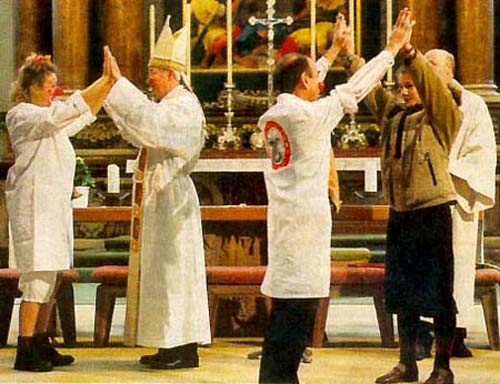
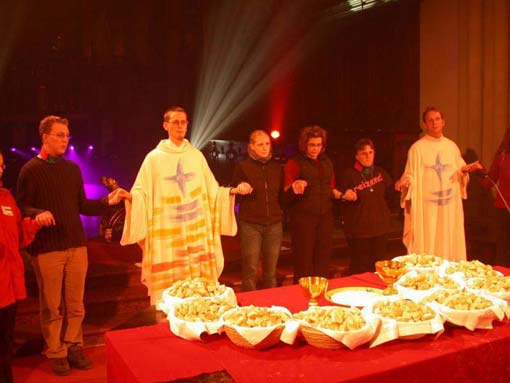
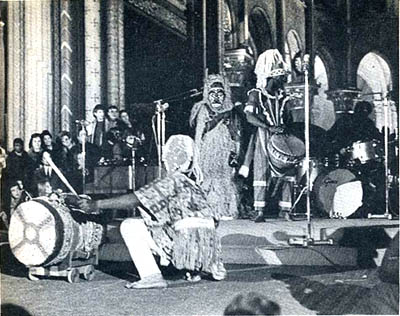
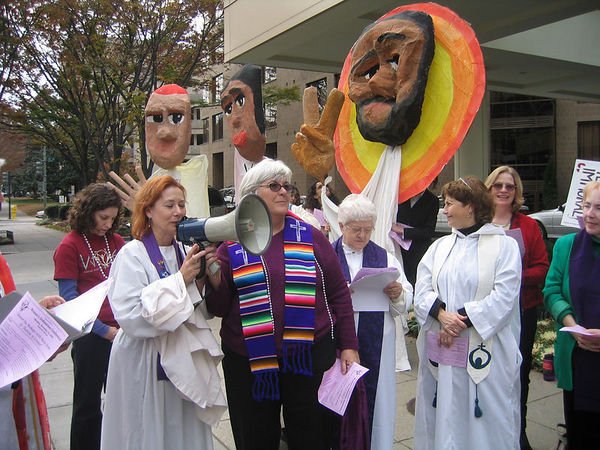
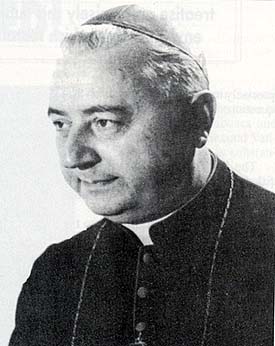
 Say you want to eliminate, just for example, slavery. You stand up in public and make speeches especially to, for example, the student body of the fictional William Willberforce University. You protest that you are going to do your best to reduce the number of slaves.
At the same time, you are working through international agencies to pressure anti-slave countries to expand slavery laws. You then decide that you will work to reduce the number of slaves by expanding slave owners rights.
This is all hypothetical, of course.
From CNA with my emphases:
Obama wants abortion coverage in reform bill, Catholic League charges
New York City, N.Y., Aug 11, 2009 / 02:36 pm (CNA).- Health care reform is hitting a wall, claims Catholic League president Bill Donohue, and if you want to know why, the answer is opposition to coverage for abortion.
According to Donohue, President Obama has thus far refused to ask Congress to pass an amendment to exclude abortion coverage from public funding because Obama is so committed to making the procedure more available.
Echoing observations made by pro-life advocates, the Catholic League president notes that only 35 percent agreed with Obama on allowing funding of abortions overseas and that a later Gallup poll found that a majority of Americans now consider themselves pro-life.
Despite these findings, Donohue charges that the president and his staff are so extreme that they are "apparently willing to sink health care reform before ever excluding abortion from the final bill."
As it tries to deal with the public backlash against the various health care proposals, the White House has created a "Reality Check" section to answer objections people have to the bills.
Noticeably absent from a list of objections that includes rationing, euthanasia, veteran’s care and private insurance, is the issue of taxpayer funding for abortions, notes Donohue. "There’s a reason for that—every time an amendment has been introduced to formally exclude abortion, it has been defeated."
Amendments to exclude abortion from any health care coverage were proposed by Bart Stupak (D-Mich.) and Joseph Pitts (R-Penn.) but were voted down.
An amendment was later proposed by Rep. Lois Capps (D-Calif.) to the House Energy and Commerce Committee and was approved. The Capps proposal was billed as a compromise on the abortion issue, but it contained a provision requiring that at least one insurance plan in each ‘premium rating area’ would cover abortion.
Although the U.S. Bishops support health care reform, they have strongly voiced their objection to including abortion in health care coverage on two occasions.
Bishop William Murphy first expressed the bishops’ objections in a letter sent to members of Congress on July 17, saying that it was objectionable to make Americans "pay for the destruction of human life."
Cardinal Justin Rigali, the U.S. bishops’ pro-life chairman, followed up the earlier letter by writing on July 29 to Senate House Energy and Commerce Committee members. His message was: "Much-needed reform must not become a vehicle for promoting an ‘abortion rights’ agenda or reversing longstanding current policies against federal abortion mandates and funding."
A note from a reader:
Fr. Z
I was pleasantly surprised to see your post on the article in U. S. Catholic. I am just beginning my first year at a college seminary … and that magazine is in our library. There are quite a few of us here that exchanged questioning glances when we saw it. But we thought it best to not discuss it openly for we are not yet sure whether or not we are on friendly ground. (We have been forbidden from receiving our Lord while kneeling.). So thanks for posting; you put into words what we were too cautious to speak. I look forward to turning to you for solace and formation throughout this journey.
In Christ
__ (another brick)
I once saw a cartoon of two souls up to their necks in a hellish lake of fire, demons leering over them. One soul says to the other, "At least yours were sins of commission!"
We can sin by commission or by omission.
We can also commit scandal by what we don’t do.
A friend of mine in KC, MO, sent this comment about a local parish. He was working from a notice in the bulletin about the confession schedule:
Notice the times available for confession. 1 hour a month (on the second Saturday each month.) This is a parish of around 1,000 families. I guess they are so "holy," they don’t need it.
Here is a snippet from the bulletin he sent me.
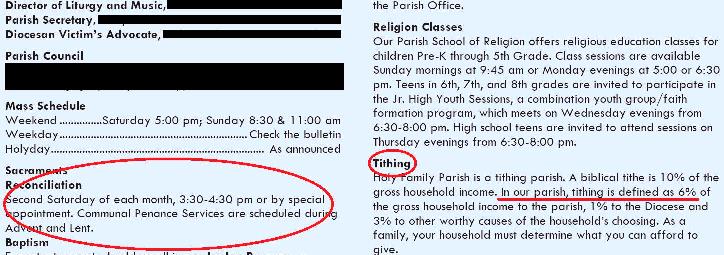
I find it interesting that they speak so clearly about tithing but opportunities for confession are so …. thin.
Think about this…. one… hour… per month.


Coat of Arms by D Burkart
 fac on Daily Rome Shot 1118 – Paddywhack!: “Speaking of the disputatio back on October 31st between Archbishop Vesco and Bishop Barron (Vesco saying the Catholic Church was…”
 on Continue the Rome shot posts? I dunno.: “Please call continue the Rome photo posts if it not too much of a burden. Thank you, Father!”
 on Daily Rome Shot 1117 – A *POLL* about 2026-27: “Sorry… my bad. It is indeed SIX. 1. Rh8+! Kxh8 2. Qh2+ Kg8 3. Qh7+ Kf8 4. Qh8+ Ke7 5.…” on Encrypted Yeast? The Fathers on “What does the “leaven” really say?” (6th Sunday after Epiphany Resumed): “I especially like St. John Chrysostom’s insight, that when we are “hidden” in the normal places we live and work,…”
 on Daily Rome Shot 1117 – A *POLL* about 2026-27: “pestolover: For what it’s worth, your solution was the best I could do also.”
 on Daily Rome Shot 1117 – A *POLL* about 2026-27: “Fr Z thanks so much for 2 reminders. 1. Using your Amazon link! For heaven’s sake it costs us nothing…”
 on 10 November – St Andrew Avellino (Vetus Ordo). Wherein Fr. Z rants.: “So interesting that you bring this up, a couple weeks ago a priest at a neighboring parish died unexpectedly. They…”

A Daily Prayer for Priests








They find you a pro-life agent in your area who commits to giving a portion of the fee to a pro-life group!

PLEASE subscribe via PayPal if it is useful. Zelle and Wise are better, but PayPal is convenient.
A monthly subscription donation means I have steady income I can plan on. I put you my list of benefactors for whom I pray and for whom I often say Holy Mass.
In view of the rapidly changing challenges I now face, I would like to add more $10/month subscribers. Will you please help?
For a one time donation...



Help Monks in Wyoming (coffee – UPDATED LINK) and Norcia (beer) and the wonderful "Soap Sisters" of Summit, NJ!


Please follow me on Twitter!










Visits tracked by Statcounter
since Sat., 25 Nov. 2006:

