HELP!
The Goldfinch Eating Team is teaching the Hummingbird how it is done.

These birds eat from your donations.

HELP!
The Goldfinch Eating Team is teaching the Hummingbird how it is done.
These birds eat from your donations.
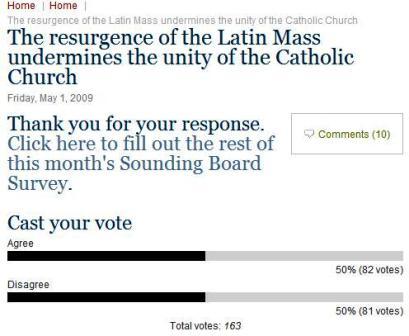
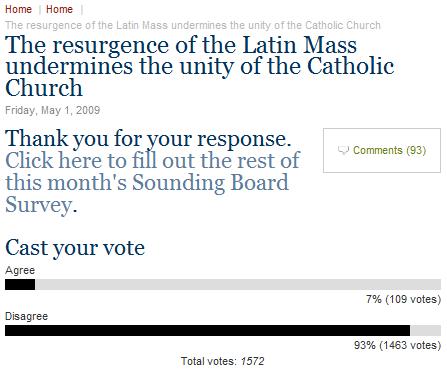
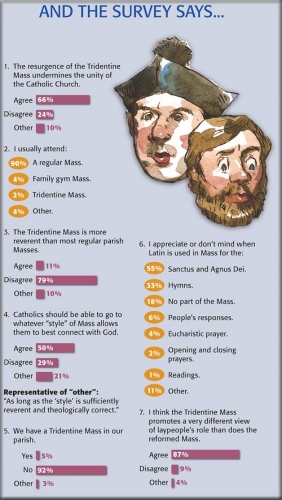
Folks… there is a POLL attached to that US CATHOLIC article. You can click HERE for the POLL. Just mentioning the POLL on the chance someone might be interested in chiming in about whether you agree or disagree with the writer.
UPDATE 14 Aug 1711 GMT:
Someone alerted me to an article which appeared on 14 July, last, on at U.S. Catholic – publication/site to which I haven’t paid much attention.
My emphases and comments.
Two rites make a wrong
Tuesday, July 14, 2009
By goodwink
Ted RoseanWe are one church and we need just one Mass, this Catholic argues – even if that one Mass is celebrated in any number of languages. [I guess the Eastern Catholics are pretty much out of luck, not to mention everyone in Milan.]
At one end of the archdiocese where I live, a Mass is held in a gymnasium every Sunday, and a group of lively folk musicians accompany the assembly through a relaxed and informal liturgy. The mood reflects the music. Because it’s a gym, children seem to act less restrained, feeling free to roam a bit. Folding chairs are set up in a semi-circle around a portable altar that this group has used for many years.
There are no kneelers, of course, reflecting to some extent the impracticality of portable kneelers, but reflecting to a greater extent the theology of those gathered: These are "looking up to God in trust, not bowing down to God in fear" Catholics, [Initium sapientiae est timor Domini.] nurturing a view of church and theology that was born at the Second Vatican Council. [That is what the Council wanted for liturgy? Remember: there is a reciprocal relationship between how we pray and what we believe. Believe certain things and you will pray in a manner that reflects those believes.. and vice versa. As you pray, so you will come to have certain beliefs. ]
I know many of these Catholics and consider them to be very good people. Their liturgy is, I believe, a scandal.
At the other end of the archdiocese, a priest adorned in shimmering vestments murmurs prayers in Latin, facing the tabernacle, his voice barely audible to the assembly of worshipers kneeling behind him. [Because he is following the rubrics?] Many of these are silently and privately praying the rosary. At certain moments there is an exchange of words between the priest and the assembly. These words are in Latin. [Sounds as if there is more authentic active participation at this Mass.]
The atmosphere is reverent, reflecting to some extent the mood naturally created by silence, candles, and Latin, but reflecting to a greater extent the theology of those gathered: These are "kneeling before God in awe, not back-slapping brother Jesus" Catholics, preserving a view of church and theology set aside at the Second Vatican Council. [HUH? Who is this guy and has he ever read the Council’s document?]I know one of the people in the assembly to be one of the finest human beings alive-my father-but his liturgy is, I believe, a scandal. [What was done for so long, and which aided saints in their lives is a "scandal"?]
An outsider observing the two rituals Would never guess they belonged to the same church. [right] And in fact, many of the participants at the respective assemblies might admit that they don’t really share a faith with the participants in the "other" group. [Given the differences in their prayer, I would tend to agree.]
This is what makes these liturgies scandalous. They represent such polarized expressions of worship that they drift from the central purpose of liturgy as stated in the introduction of Sacrosanctum Concilium, the Second Vatican Council’s Constitution on the Sacred Liturgy: "to be a sign lifted up among the nations, to those who are outside, a sign under which the scattered children of God may be gathered together until there is one fold and one shepherd." A church practicing such divergent forms of worship will hardly unite the scattered children of God. [The problem with this is that he doesn’t take into account that one of those expressions might actually be legitimate. Certainly the Vicar of Christ thinks that at least one of them is a legitimate expression. As a matter of fact the last Pope, John Paul II, thought at least one of them was a legitimate expression.]
Currently we are many folds under a shepherd who last year stirred the pot with his apostolic letter Summorum Pontificum (Of the Supreme Pontiffs), sanctioning wider use of the old Latin or Tridentine Mass. Besides allowing individual parishes to conduct Latin Masses at the pastor’s discretion, secondhand reports suggest that Pope Benedict XVI would like to see a Latin Mass offered at every parish. Upon hearing this, I felt a rumbling that I’m certain was Pope John XXIII, who opened the Second Vatican Council, rolling in his grave. [Again, this fellow lacks perspective. John XXIII was quite the liturgical trad. ]
The problem with the gym mass is not the gym, or the folk music, or even the lack of kneelers. The gym liturgies I’ve participated in mostly adhere to the rite promulgated by the Second Vatican Council. The scandal is the fact that 100 yards from the gym, a splendid church sits where liturgy is celebrated by the other 90 percent of the parish every Sunday.
Once, when gym repairs required the gym Mass to move back into the regular church for a while, there was some talk that the gym altar should be moved in to replace the regular church altar. Two altars at one parish screams division to me: "Our church is not your church; our worship is not your worship; we are not you." Such practices divide the Body of Christ-not the sort of thing those who led the council had in mind when they promulgated changes.
In the zeal that followed the council, many well-intentioned but liturgically ill-informed experiments cropped up in parish liturgies. Some progressive liturgies went too far [How far outside the law should they have gone?] and abused the intent of the council’s changes. [Who made them the arbiters of the Council’s intent?]
Many of these alternative practices have fueled the reaction of extremists [HUH? Why do people who want the older Mass have to be "extremists"?] who now want to [cliché alert! …] rewind church history and drop us all back into a Bells of St. Mary’s world, as black and white as the cassock and surplice of a 10-year-old altar boy. At one end of our church, progressives dance to the beat of their very own drummer, while at the other end nostalgic traditionalists turn back the hands of time. [When you read articles, be sure to watch out for the premises the writer wants you to accept without a challenge. Here the writer wants you to just accept that people want the older Mass because they want to "turn the clock back" out of some sort of "nostalgia". Is it not possible that people find something worthy in the Rite itself?]
In my judgment, the progressive, alternative Masses are much less troubling than the return of the Tridentine Mass. [Oh reallllly…. ] As mentioned, gym liturgies are mostly faithful to the changes promulgated in the council. While they may cross the line at times, at least they seem to be reaching in the direction the council members were pointing us toward. [According to whom? Certainly not Sacrosanctum Concilium. For example, SC says that Latin is to be retained, Gregorian chant has pride of place, and that no changes should be made in the reform of the liturgy unless they were genuinely for the sake of the good of the faithful. I contend that the older form of liturgy, unmarked by the reforms mandated by SC is still more in line with SC than the gym liturgy described above. In fact, the older form of Mass is more in line with SC than what we actually got via the Novus Ordo Missae. The fact is that the Consilium went far beyond the mandates of the Council Fathers.]
And let’s face it, my generation, the flower-power gang, is, well, beginning to push up daisies. [So, the writer is an aging hippie? Nah…. ] Progressive liturgies are fading away as the jingle-jangle of our tambourines increasingly exits stage left.
But prancing in stage right are the Tridentine Troubadours, flipping the altar around and turning their backs to the monumental progress of the Second Vatican Council. [And… that progress was…. ?]
What is scandalous about this practice is not the Latin. After discussing the issue with theologians and liturgists Keith Pecklers, S.J. and Mark Francis, C.S.V., [More evidence about the presuppositions of the writer. Note that he didn’t consult anyone favorable toward the older form of Mass.] both independently made the distinction between the Tridentine Mass, celebrated by Catholics between 1570 and approximately 1965, and the post-conciliar rite practiced in the Latin language. [WOW! What INSIGHT!]
Pecklers explains that the church has, since the council, always allowed the use of Latin in the reformed liturgy. Saying the Mass in Latin is no different than saying it in Spanish or Polish or English. [Well… no. That can’t be the case. There is nothing "magical" in the Latin language, but we are talking about the Latin Rite, not the Polish Rite or the English Rite. Latin means something, after all.]
The reformed liturgy is flexible enough to allow the use of Latin at times. Many parishes replace the "Lamb of God" and the "Holy, Holy, Holy" with the Agnus Dei and the Sanctus during the season of Lent. Besides being in complete conformity with the changes promulgated by the council, this appropriate use of the Latin can often deepen the spiritual tone of the liturgy and underline the gravity of the season.
The Tridentine Mass [no one really uses this term anymore mostly because it is inaccurate.] is not simply the current Mass (the one promulgated by Pope Paul VI in 1970) spoken in Latin. The Tridentine Mass, which dates from 1570, reflects a very different-and incomplete-understanding of the early church. [? And the Novus Ordo is somehow more complete? If that is the case, why were certain important theological concepts stripped out of the Latin orations?] Francis argues that "the 16th-century framers [of the Tridentine Missal] lacked adequate historical resources, as they were unable to refer to manuscripts dating earlier than the pontificate of Innocent III, around 1216."
A church digging in its defensive heels at the peak of the Reformation developed the Tridentine Mass, taking shots at pagans, heretics, schismatics, and "perfidious" Jews. The rich revelation of the Old Testament is mostly absent, and the participation of the laity barely exists.
The Second Vatican Council had some very good reasons to call for an end to the Tridentine Mass and to promulgate a new rite. More sophisticated research uncovered a fuller understanding of how liturgy was celebrated in the early church. Improved scripture scholarship developed into a new lectionary with a wider selection of readings. Better historical research removed fictional saints from the liturgical calendar.
Perhaps most important for the average Catholic, the Mass was celebrated in the language of the people. [In violation of Sacrosanctum Concilium the Latin langauge was jettisoned.] Interestingly, while the Tridentine Mass began to be used in 1570, [Actually… the so-called "Tridentine" form of Mass is a lot older in its essential structure and orations than simply 1570.] Masses were celebrated in Latin as early as A.D. 350. Originally, the Latin replaced Greek because people understood Latin, and using Latin allowed more people to understand what was going on. [Another problem: the Latin of the liturgical texts was not the Latin spoken in the streets.] In 1965 the church once again came to the seemingly obvious conclusion that people should understand what is being said in Mass. [They did. They had books. Also, ask people after your average Sunday Mass these days what the readings were, or what the Collect meant.]
The Mass that emerged from the reform of Vatican II is wonderful, divine, human, and sublime. It works, [And yet vocations are down, people aren’t going to confession, and churches are closing.] and it is enormously superior to the Tridentine rite. We do not need to celebrate an old rite. We need to get more people to celebrate the existing rite well. [This is just bunk. I wholeheartedly agree that the newer form of Mass must be celebrated better. But these other claims are simply specious. He has no evidence other than his personal taste for his claims that the newer form is superior or sublime. If we look at what the life of the Church was before the changes to the liturgy and what is going on now, we might have some concrete points to work with. We need more time to make judgments like this. Perhaps one day in the future we will look back and be able to make a list of the many saints who were nourished by what the Novus Ordo gave them. We can’t do that yet.]
The stakes are high. We participate in the liturgy to praise God and to be transformed so that we can transform the world. [It sounds almost as if he got that from WDTPRS.] We need to do this together. We cannot gather the scattered children of God together if we ourselves are scattered.
Actually, I spent more time on this than it was worth. But specious claims do need to be answered.
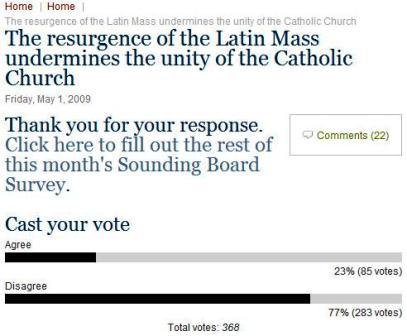
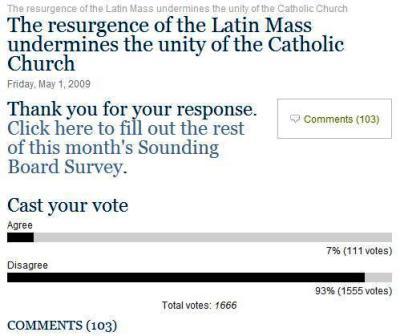
Folks… there is a POLL attached to that article. You can click HERE for the POLL. Just mentioning the POLL on the chance someone might be interested in chiming in about whether you agree or disagree with the writer.
UPDATE 13 AUG 1524GMT:
UPDATE 3 Sept 0544 GMT:
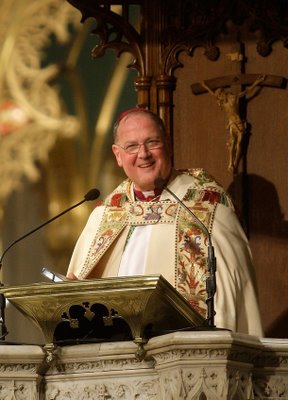
From CNA comes this piece about what Archbp. Dolan of New York thinks we are facing.
My emphases and comments.
N.Y. archbishop takes stock of challenges in the American Catholic Church
Phoenix, Ariz., Aug 13, 2009 / 12:33 am (CNA).- Archbishop Timothy Dolan of New York told CNA last week that the Catholic Church is currently facing many challenges, four being: the vocation to marriage, the state of Catholic parishes and schools, the great number of lapsed Catholics and finally the difficulties in a culture desperate to keep the Church and morals out of the public square. [WDTPRS has been talking about this incessantly: It is about our Catholic identity. If we don’t know who we are, we won’t have anything compelling to say in the public square. Why would anyone bother to listen, if we don’t have anything to say?]
Sitting down with CNA in Phoenix, Arizona during the 127th annual Knights of Columbus convention, the archbishop noted that while he loves his new assignment as the Archbishop of New York, his archdiocese of 2.6 million Catholics, as well as the Church in the United States, is currently facing some serious challenges. [Do I hear an "Amen!"?]
The archbishop then broke down Jesus’ words into four practical challenges the Church currently faces in preaching the Gospel to all people, the first [1] being the instability of marriage and family.
“That’s where we have the real vocation crisis,” he remarked, noting that “only 50% of our Catholic young people are getting married.”
“We have a vocation crisis to life-long, life-giving, loving, faithful marriage. If we take care of that one, we’ll have all the priests and nuns we need for the church,” Dolan said. [Chicken – egg conundrum?]
The [2] second challenge the Church faces, according to Archbishop Dolan, is that it must “maintain and strengthen the blessed infrastructure that we have in the Catholic Church in the United States.” This infrastructure, the parishes, schools, religious education programs, Catholic Charities and hospitals, has “fortified the Church” for “over 200 years.” Now, however, these same institutions are struggling because of their size and cost.
The aim isn’t only to maintain them, he continued, they need to be strengthened because “now more than ever does the Church need a public face.” [He ties this into the "public square" issue… and he is right.]
The Church needs to have a good public profile because there are “a lot of people out there who would like to exclude the Church from any type of public witness and we can’t let that happen,” the Archbishop of New York said. [Do I have an "Amen!"?]
Moving on to the [3] third challenge for the U.S. Catholic Church, Dolan simply described it as reaching out and inviting our people home.
“It scares the life out of me when I find out that second most identifiable religious grouping on the religious landscape of the United States are people who say, ‘I used to be a Catholic.’” [I have had this conversation many times with a friend of mine. I am constantly stressing the need to get our people home.]
We bishops have to do something about this, he insisted. “We have to say, ‘no, look, there is no such thing as a former Catholic. Your Catholicism is, as a matter of fact, in your DNA. And whether you like it or not you’re born into it just like you’re born into a natural family.’”
Now, he continued, “you might say, ‘I’m ticked off at my natural family, I’m not hanging around with them anymore, I’ve got things to work out.’ But you’re still a member of that family and sooner or later you usually make your peace with it and go home.”
In comparison, “the Church is our supernatural family,” he explained, “you might be upset with it, you might not be showing up for Sunday dinner, you might be mad at it about a couple of things…but you’re still a member.”
The Church “is your supernatural family, and, darn it, we need you and want you to come back home. You’re always welcome,” Dolan offered.
The [4] final challenge the he listed is confronting “a culture” with many “strident voices who want to keep” God, morals, virtue and the Church “out of the public square.”
He explained that those voices will say that “religious is fine as an individual hobby… but don’t enforce it on the rest of us.” [That is what prominent Catholics, such as politicians, say. This is the sort of thing which Speaker Pelosi would say… VP Biden. "We can’t push our values on other people who don’t share them." Again.. we have a serious identity problem.]
However, Dolan argued, without the voice of the Church, “our public square is reduced if the Church isn’t part of it, and what makes America great is that religion has always had a strong, respected place at the table.” Those who want to exclude the voice of the Church, he said, are involved in “galloping secularism.”
He explained: “There are those movers and shakers in society that want to take the teeth out of religion and we can’t let that happen” because America, individuals, the world and culture would be much worse off.
“We’ve got something to say, and darn it, we want to say it,” he stated.
I whole heartedly endorse what the Archbishop says here.
I will add another note, specially about the last point.
Here is part of what I wrote after the Notre Shame Debacle:
I urge all priests and bishops who read this blog with any slight quaver of resonance or benevolence, to consider this with care:
If you sense that something quite serious and important is going on right now, for the love of God rethink your approach to how you foster Holy Church’s proper public worship.
Do all in your power and through your influence to foster a worship of God which conforms not to worldly goals – as praiseworthy as they may be in a world still dominated by its dire prince – but rather to the real point of religion: an encounter with mystery.
Our worship must become more and more focused on the one who is Other. Seek what is truly above in your rites and raise people to encounter mystery.
You will be challenged and reviled, blocked and attacked as you do. You will be worn down and afraid under the weight of resistance.
But I think that to save the world we must save the liturgy.
Sunday reaffirmed this for me.
They can’t compete with the fullness of Catholic liturgy and sound preaching.
Reforming the liturgy along the lines Pope Benedict has proposed may be the most loving and effective option we have in these ever hotter times.
People will have to keep working very much in the sphere of the secular. Of course! Our inward Catholic Christian identity must find outward expression and bring concrete fruits.
But I think the real work now – where we will make some effective headway – must be done at the level of our public worship.
In the present circumstances, we are not going to argue most people out of danger or error. But together we can draw them in and along and back through worship.
So long as we remain doctrinally faithful and active in works of mercy both spiritual and especially temporal, if we get our public worship together we will have a strong bastion against error.
Holy Catholic worship will be an attractive force for conversion.
We need to foster worship which stuns, which leaves the newcomer, long-time practicing Catholic, above all the fallen-away simply thunder stuck. Worship must at some point leave people speechless in awe. We need language and music and gesture which in its beauty floods the mind with light even while it swells the heart to bursting.
The more people encounter mystery through liturgy, the more hollow will clang the false or incomplete messages of those who have strayed from the good path, either to the left or to the right.
Our goal must be that which is good and beautiful because it is true, that which reflects what is of God, not man’s image merely. Give us mystery, not fabrications smacking of the world, fallen and transitory.
Fathers, and you Reverend Bishops, if anything of alarm has sounded in your hearts and minds of late, rethink your approach to our worship. Examine your approach with an eye on the signs of the times. Take a new approach.
The approach we have had least last few decades isn’t getting it done. Really … it isn’t
Going neither left nor right along the road toward the Lord, even as He comes to us, take the flock now deeper, now higher on that path, but always to encounter the mystery which distinguishes truly Catholic liturgy… and therefore true Catholics.
Lines are being drawn, sides taken, choices made.
More than ever we need what Christ, the true Actor of our liturgy, desires to offer us through Holy Church’s worship.
From Good Jesuit, Bad Jesuit this news:
The 9.9 Gigapixel Apotheosis of St. Ignatius
Another breathtaking italian fresco
HAL9000 Srl, under the artistical direction of the Inventory Office – dept. Cultural Property of Diocese of Novara, realized the high definition digital picture of the Apotheosis of St. Ignatius, a fresco painted on the barrel vault of the St. Ignatius church in Rome, Italy property of “F.E.C.- Fondo Edifici di Culto” of the italian “Ministero dell’Interno” and conducted by the Jesuits order. The church is located in the ancient Rome near the Pantheon and Trevi Fountain.
The fresco was painted in the last years of the 17th century (1685-1694) by Andrea Pozzo, an italian baroque architect and painter who entered the Jesuits order in 1668.
The fresco is considered a masterpiece of perspective; from the center of the church appears another order of columns leading to the Holy Trinity and St. Ignatius that reflects the light of Jesus all over the world.
Link (here)
On the blog of Italia n journalist Luigi Accattoli there is an amusing short piece… in my translation:
"Mens sana in corpore Benedetto" is the goliardic title which the daily Liberal gave yesterday to one of my articles on the Pope’s physical and mental agility.
The main subject I took was the exchange of jokes with Cardinal Ruini one evening when there was a game between Italy and Holland in the European Championship and the Pope had to open a conference of the Diocese of Rome in the Basilica of St. John Lateran:
"Are there any people here?", Benedict asked as he got out of the car in the courtyard of the Vicariate.
"The Basilica is full", the Cardinal responded.
"But isn’t this first game of the Italian team for the European Championship?"
"They came all the same, Holiness."
"They are going to miss at least the first half", the Pope replied, looking at his watch.
For the whole article.
Right now the ability to post comments freely is shut down. You must be a registered user at this moment in order to comment.
I was doing registration manually for a while.
I now have a self registration process in place. CLICK HERE.
I will have to approve the registration, which I do on my own schedule.
If you sent a request for registration and did not hear back, drop me a line.
I am working the bugs out of this registration feature.
There may be a time when I open up free commenting again… and/or shut it off.
Registering and logging in can help you avoid the headache.
UPDATE 1643 GMT
Since putting up this post a little while ago, a couple dozen people have registered. It seems to be working properly.
UPDATE 2040 GMT
BTW… if you decide you are not going to provide the information I ask for, I might decide not to approve your registration. Most of what I ask for is not going to be displayed on the blog even if you do decide to comment.
UPDATE 3 Aug 1256 GMT
Quite a few of you have registered. I will keep checking during the day to sign you in.
UPDATE 1839 GMT
Folks, I am not just sitting at my computer hitting the refresh key. I am going to have to review and approve the registrations as is convenient for me. I am trying to review them and approve them in blocks.
UPDATE 7 Aug 1432 GMT
I find that when people have included something in their biographical blurb, which doesn’t appear on the blog when and if they comment, I am able more quickly to approve their registration. FYI. Also, I tend to delete right away people who think they do not need a username, or who simply put initials in the first and last name spots.
UPDATE 11 Aug 2145 GMT
Quite a few of you have registered. Remember…if you register, you have to wait for me to approve the registration. I look at them pretty often, but I am not always looking.
Be sure to check out what is going on with The Crescat who is recovering from a heart problem.
SPIKE those stats as a get well present!
The Bitter Pill‘s editors have attempted in their desperation to pit Archbp. Nichols against Pope Benedict.
This is something I – were I the Archbishop of Westminster – would resent in the extreme.
The Tablet instrumentalized Archbp. Nichol’s note written for the booklet of an upcoming TLM training conference.
Here is the Archbishop’s note with my emphases and comments.
Priests’ Residential Training Conference, 24-28 August 2009
All Saints Pastoral Centre, London Colney, HertsMessage from the Most Reverend Vincent Nichols
Archbishop of Westminster.I welcome this short Training Conference provided by the Diocese of Westminster in conjunction with the Latin Mass Society. [Note the words "welcome" and "conjunction". The Archbishop aligns himself with this conference and he will not want it to fail.] This is the correct description of this event. In both the teaching and law of the Church it is the bishop who has responsibility for the provision and oversight of the Liturgy.
In the Motu Proprio ‘Summorum Pontificum’ Pope Benedict permitted the use of the 1962 Form of the Mass, under clearly defined circumstances. In doing so he insisted that there is one Rite of the Mass in the Latin Church. This makes clear that the ordinary Form of the Mass and this extraordinary Form serve one and the same Rite. [At least juridically.] They are, therefore, both finding their place in this Summer School and participants will wholeheartedly celebrate the Mass in each of these Forms. The view that the ordinary Form of the Mass, in itself, is in some way deficient finds no place here. [Well… the newer form of Mass is not to be assumed to be perfect. I think there is, indeed, some room for discussion of its strengths and deficiencies.] Indeed anyone who holds such a view does not come under the generous provision of ‘Summorum Pontificum’. Such a person is inexorably distancing themselves from the Church. [Perhaps that states the case a little too forcefully. Perhaps what is intended here is denial of the validity of the the Novus Ordo?] The Mass is the source and expression of the unity of the Church, for that unity comes from Christ. [Yes… Holy Mass is indeed this source, whether it is celebrated according to either use of the Roman Rite or with the Ambrosian Rite in the newer or traditional form, or the Braga Rite or as the Maronites do, or by the Divine Liturgy, or the Syro-Malabar Rite,… etc.] We have no other. Our unity does not consist in a uniformity of personal use or preference. [But…we can still have them… right? If I were to choose to go, say, to a Ukrainian Catholic Church for a while for Divine Liturgy, would I be inexorably distancing myself from the Church?] Indeed, such matters should play a minimum part in our liturgy, particularly in the ministry of the priest. What we priests are to provide, as a key element of our ministry, is the Liturgy of the Church. [I am so glad to read this. Priests must be diligent in making use of all those tools which can help the unity of the Church! They should be diligent to learn all that will help them in their ministry and their identity as priests of their own proper Church and Rite! They should, therefore, be eager to learn also the older, traditional form of the Roman Rite if they are priests of the Roman Rite. They should do this from their sense of duty to strengthen their identity and to be all things to all who might approach them for Holy Mass in the Roman Rite.]
The established principle of good liturgy – such as the ‘active participation’ of all taking part in the Mass, in both the Liturgy of the Word and the Liturgy of the Eucharist – apply whichever Form of the Mass is being used. [Indeed, according to a more profound sense of active participation than we have often seen in the last decades. The older form of Mass will certainly aid people in their true, active and conscious participation at Holy Mass.] This principle needs careful consideration and application by every celebrant and any who help in the preparation of the liturgy. I trust it will find its place in this Summer School.
Pope Benedict has given an additional and delicate task to priests and bishops: the provision of the extraordinary Form of the Mass in response to genuine needs as outlined in the Motu Proprio. [Indeed! I am glad His Lordship has reminded us of this. I hope he will give a good example by means of his own generous response to Holy Father’s provisions, show his support for all involved out of love of unity of the Church, and celebrate a Pontifical Mass in Westminster Cathedral!] I am grateful to you all for helping us to respond to this task, always within the work of sustaining and nurturing the unity of the Church.
+Vincent Nichols
This isn’t at all what The Bitter Pill suggested.
Again… given the scurrilous treatment by The Tablet used Archbp. Nichols, I should think he would want to open up questions about that once worthy publication at the Bishops’ Conference meetings. Should The Tablet really have such an artificially inflated circulation if the editors are set to pit the new Archbishop against Pope Benedict?
The great Fr. Blake of St. Mary Magdalen in Brighton says this, by way of introduction to his own comments about The Tablet’s latest public display of hysteria:
I can only conclude the Tablet was being deliberately malicious
Go and read his piece.


Coat of Arms by D Burkart
 fac on Daily Rome Shot 1118 – Paddywhack!: “Speaking of the disputatio back on October 31st between Archbishop Vesco and Bishop Barron (Vesco saying the Catholic Church was…”
 on Continue the Rome shot posts? I dunno.: “Please call continue the Rome photo posts if it not too much of a burden. Thank you, Father!”
 on Daily Rome Shot 1117 – A *POLL* about 2026-27: “Sorry… my bad. It is indeed SIX. 1. Rh8+! Kxh8 2. Qh2+ Kg8 3. Qh7+ Kf8 4. Qh8+ Ke7 5.…” on Encrypted Yeast? The Fathers on “What does the “leaven” really say?” (6th Sunday after Epiphany Resumed): “I especially like St. John Chrysostom’s insight, that when we are “hidden” in the normal places we live and work,…”
 on Daily Rome Shot 1117 – A *POLL* about 2026-27: “pestolover: For what it’s worth, your solution was the best I could do also.”
 on Daily Rome Shot 1117 – A *POLL* about 2026-27: “Fr Z thanks so much for 2 reminders. 1. Using your Amazon link! For heaven’s sake it costs us nothing…”
 on 10 November – St Andrew Avellino (Vetus Ordo). Wherein Fr. Z rants.: “So interesting that you bring this up, a couple weeks ago a priest at a neighboring parish died unexpectedly. They…”

A Daily Prayer for Priests








They find you a pro-life agent in your area who commits to giving a portion of the fee to a pro-life group!

PLEASE subscribe via PayPal if it is useful. Zelle and Wise are better, but PayPal is convenient.
A monthly subscription donation means I have steady income I can plan on. I put you my list of benefactors for whom I pray and for whom I often say Holy Mass.
In view of the rapidly changing challenges I now face, I would like to add more $10/month subscribers. Will you please help?
For a one time donation...



Help Monks in Wyoming (coffee – UPDATED LINK) and Norcia (beer) and the wonderful "Soap Sisters" of Summit, NJ!


Please follow me on Twitter!










Visits tracked by Statcounter
since Sat., 25 Nov. 2006:
 This is what makes these liturgies scandalous. They represent such polarized expressions of worship that they drift from the central purpose of liturgy as stated in the introduction of Sacrosanctum Concilium, the Second Vatican Council’s Constitution on the Sacred Liturgy: "to be a sign lifted up among the nations, to those who are outside, a sign under which the scattered children of God may be gathered together until there is one fold and one shepherd." A church practicing such divergent forms of worship will hardly unite the scattered children of God. [The problem with this is that he doesn’t take into account that one of those expressions might actually be legitimate. Certainly the Vicar of Christ thinks that at least one of them is a legitimate expression. As a matter of fact the last Pope, John Paul II, thought at least one of them was a legitimate expression.]
 “Oh, there’s tons of challenges, my Lord, there’s never any dearth of challenges,” the archbishop began, explaining that the basic challenge for all Catholics is the same one that Jesus gave on Pentecost Sunday: “Go out to the world and preach the Gospel.”

