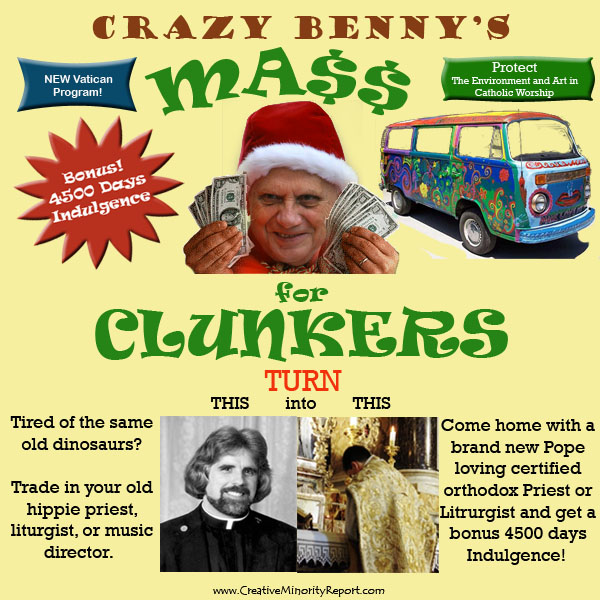
Creative Minority Report has struck again! Double WDTPRS chuckles.
 Did you know that today is the titular feast of the Basilica of St. John Lateran, the Cathedral of Rome?
"But Father! But Father", I can hear you objecting. "Don’t you know that that basilica is called ‘St. John‘? How can the Transfiguration of the Lord be the titular feast?"
Glad you asked. The real name of the Lateran Basilica is the Archbasilica of the Most Holy Savior, St. John Baptist and St. John the Evangelist at the Lateran. So, for a titular feast you really need a feast of the Lord.
While today is the main day for the basilica, they do make much over the two saints John as well. I do too. For my "onomastico", as the Italians call it, or "name day" I claim both the Baptist and the evangelist. That way I get two says in the summer (don’t forget the feast of the Beheading of St. John the Baptist) and one in the winter.
And let us not forget that the Lateran Basilica is a Major Papal (formerly Patriarchal) Basilica. There are lots of minor basilicas in Rome and throughout the world There were five Patriarchal Basilicas in Rome to go with the five ancient patriarchal sees, four major patriarchal basilicas and one minor. How did that happen? The patriarchs always were allocated (symbolically) a basilica in Rome, thus Constantinople, Alexandria, and Antioch, had St. Peter’s in the Vatican, St. Paul’s outside the walls, and St. Mary Major. When Jerusalem was added as a patriarchate it was assigned St. Lawrence outside the walls, though it remained a minor basilica.
The Bishop of Rome as Patriarch of the West had the Lateran Basilica obviously. And he still does, even though the Pope seems to have dropped the title of Patriarch of the West (remember that?). Interesting move that. And now some of the Orthodox are irritated that the Pope dropped the title.
I opined a long time ago that by dropping the title the Pope might be signaling that he is not patriarch of the West ONLY, but patriarch of pretty much everywhere (except for outer space, which I think belongs to someone else whom I shall not name).
Anyway, this is the titular feast of the Lateran Basilica.
We continue our Patristic Rosary Project today with the:
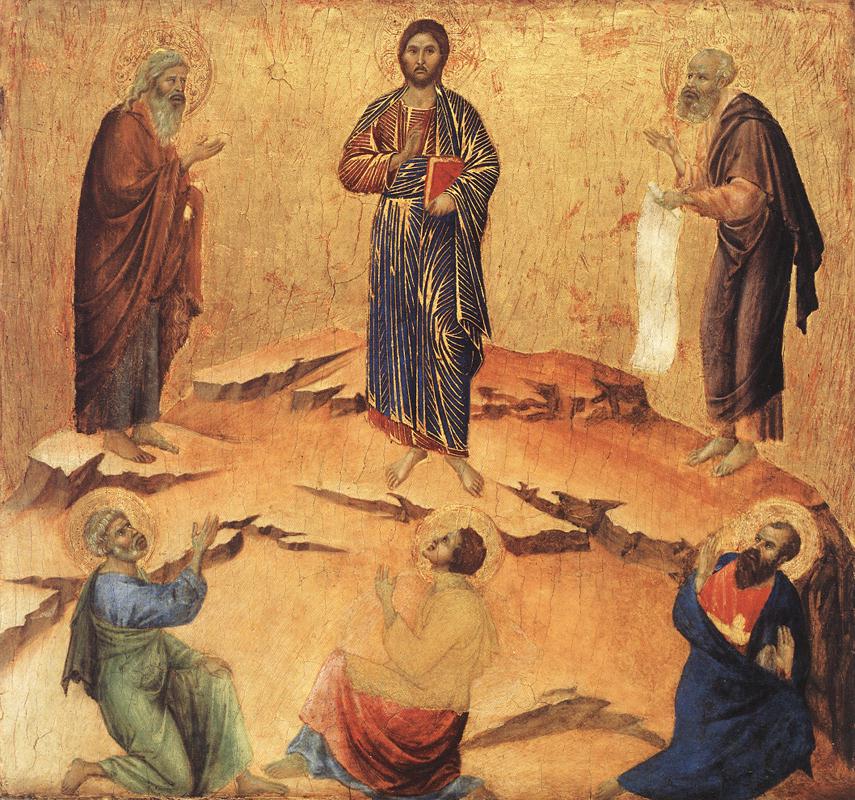 4th Luminous Mystery: The Transfiguration
The Mystery of the Transfiguration was a matter of intense reflection on the part of the Fathers.
Remember that this takes place some eight days after the Lord confers the keys on Peter by the Jordan at Caesarea Philippi. The Fathers thought everything in Scripture was significant and they attached great meaning to numbers. Let us see what the mighty Ambrose of Milan (+397) has to say about the timing of the Transfiguration in relation to the events at Caesarea Philippi:
You may know that Peter, James and John did not taste death and were worthy to see the glory of the resurrection. It says, "about eight days after these words, He took those three alone and led them onto the mountain." Why is it that he says, "eight days after these words"? He that hears the words of Christ and believes will see the glory of Christ at the time of the resurrection. The resurrection happened on the eight day, and most of the psalms were written "For the eighth". (cf. e.g., Ps 6:1; 12:1 LXX and Vulgate) It shows us that He said that he who because of the Word of God shall lose his own soul will save it, (Luke 9:24) since he renews his promises at the resurrection. (Matthew 16:25-27) But Matthew and Mark say that they were taken after six days. (Cf. Matthew 17:1; Mark 9:2) We may say that they were taken after six thousand years, because a thousand years in God’s sight are as one day. (Ps 89:4 LXX) We counted more than six thousand years. We prefer to understand six days as a symbol, because God created the works of the world in six days (Gen 2:1), so that we understand works through the time and the world through the works. [Exposition of the Gospel of Luke 7.6-7]
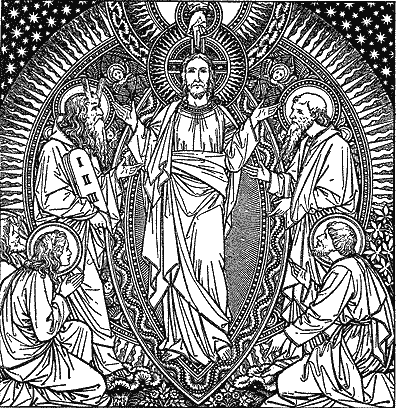 St. Augustine (+430) also gets into this issue of six days, as recounted in Matthew and Mark, and eight days (as in Luke) in a discussion of the resurrection three days after the Passion and death of the Lord. He is trying to make sense of the numbers. In other places I have explained how the ancients numbered their periods of days, that is, inclusively.
St. Cyril of Alexandria (+444) wrote of the Transfiguration in terms of the connection between suffering and glory, between the Law and the Prophets, between the foreshadowings of the past and their fulfillment.
"I say to you, there are some of those standing here who shall not taste of death until they have seen the kingdom of God." … By the "kingdom of God" He means the sight of the glory in which He will appear at His revelation to the inhabitants of earth. He will come in the glory of God the Father and not in a humble condition like ours. How did He make those who received the promise spectators of a thing so wonderful? He goes up into the mountain taking three chosen disciples with Him. He is transformed to such a surpassing and godlike brightness that His garments even glittered with rays of fire and seemed to flash like lightning. Besides, Moses and Elijah stood at Jesus’ side and spoke with one another about His departure that He was about, it says, to accomplish at Jerusalem. This meant the mystery of the dispensation in the flesh and of His precious suffering upon the Cross. It is also true that the law of Moses and the word of the holy prophets foreshadowed the mystery of Christ. the law of Moses foreshadowed it by types and shadows, painting it as in a picture. The holy prophets in different ways declared before hand that in due time He would appear in our likeness and for the salvation and life of us all, agree to suffer death on the tree. Moses and Elijah standing before Him and talking with one another was a sort of representation. It excellently displayed our Lord Jesus Christ as having the law and the prophets for His bodyguard. It displayed Christ as being the Lord of the Law and the Prophets, as foretold in them by those things that they proclaimed in mutual agreement beforehand. The words of the prophets are not different from the teachings of the law. I imagine this was what the most priestly Moses and the most distinguished of the prophets Elijah were talking about with one another. [Commentary on Luke, Homily 51]
The last line here is interesting. It makes me call to mind what one finds in studying ancient historiography, such as Herodotus and Thucydides. When reporting the speeches great figures made, about which they might at the very best have some distant report from someone who heard about the content of the speech, such as Pericles’s great oration, from a generation or more removed, Thucydides would record what the great man ought to have said in that momentous occasion. This sounds much like what Cyril is doing.
 Have you ever wondered why some get some graces and others do not? St. Maximus Confessor (+682) gives an interesting insight while he comments on the Transfiguration:
The Lord does not always appear in glory to all who stand before Him. To beginners He appears in the form of a servant (Phil 2:7); to those able to follow Him as He climbs the high mountain of His Transfiguration He appears in the form of God, the form in which He existed before the world came to be (John 17:5). It is therefore possible for the same Lord not to appear in the same way to all who stand before Him, but to appear to some in one way and to others in another way, according to the measure of each person’s faith. When the Logos of God becomes manifest and radiant in us, and His face shines like the sun, then His clothes will also look white. That is to say, the words of the Gospel will then be clear and distinct, with nothing concealed. And Moses and Elijah – the more spiritual principles of the Law and the Prophets – will also be present with Him.
St. John Chrysostom (+407) takes on this same issue:
"Now after six days Jesus took Peter, James and John his brother, led them up on a high mountain by themselves;" (Matt. 17:1) …Note, I pray you, the severe goodness of Matthew, not concealing those who were preferred to himself. Also, John often does this (in his Gospel), recording the peculiar praises of Peter with great sincerity. For the choir of these holy men (disciples) was everywhere pure from envy and vainglory. Having taken, therefore, the leaders, "He was transfigured before them. His face shone like the sun, and His clothes became as white as the light. And behold, Moses and Elijah appeared to them, talking with Him." (Matt. 17:2,3) Why does Jesus take with Him these three only? Because these were superior to the rest. And, Peter indeed showed his superiority by exceedingly loving Him; John; by being exceedingly loved by Him; and James again by his answer which he gave with his brother, saying "We are able (to drink this cup);" (Matt. 20:22) but not by this answer only, but also by his works …For so earnest was he (James), and so grievous to the Jews, that Herod himself supposed that he found favor with the Jews by slaying him (James)." [St. John Chrysostom, Homily 56]
I suppose we ought to be careful what we ask for. Our earthly fate notwithstanding, we are always able to have a moment of Transfiguration in the proper reception of Holy Communion, which is far more than a mere vision of something of Christ’s divine shining through our humanity. The Eucharist is not only the Body, Blood, Soul and Divinity of Christ, it is for us a "pledge of future glory, containing in Itself all delight", as St. Thomas Aquinas (+1274) wrote for the feast of Corpus Christi, and which we all sing whenever there is Benediction of the Blessed Sacrament. A good reception of Communion is an even greater encounter with the Lord, than a Transfiguration. It opens up the way to a bright future for us. On that note, Gregory of Nazianzus (+389) ties us all into the mystery of the Transfiguration, saying:
He was bright as the lightning on the mountain and became more luminous than the sun, initiating us into the mystery of the future. [Oration 3.19, On the Son]
I occasionally receive note from parents whose children are interested in "playing Mass".
This note came from a reader with photos.
Father Z.,
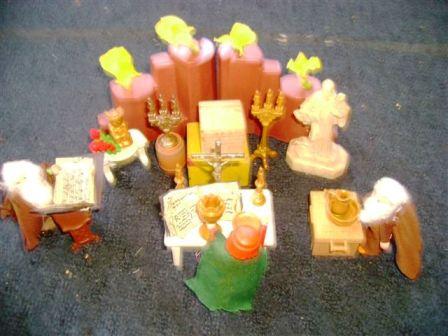
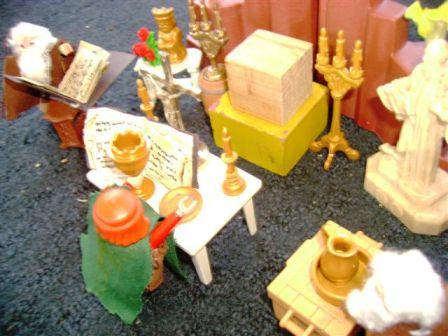
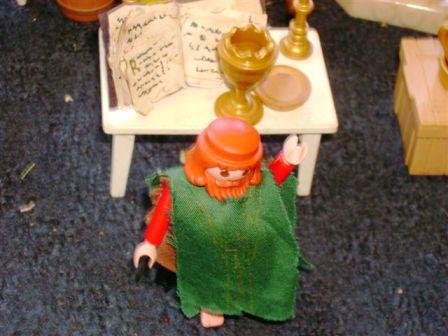
Sometimes I notice that you put up snippets and photos about children pretending to celebrate Mass. My son, who is 9, also likes to "celebrate Mass," but lately his attention has gone to setting up his Playmobil figures in the liturgy.
He did all this on his own, and without prompting from his parents: sewed the brown habits and green chasuble, made the little Missal and chant book, added the yellow flowers from the garden, and put the St. Benedict statue there. Intriguingly, although 90% of the liturgies he attends are versus populum, he knows to set up Mass ad orientem, put the crucifix on the altar, and the tabernacle in the center. He added the beards to the server and the schola master for authenticity, I think. Obviously some things had to be improvised, like the beer barrel that supports one of the candelabra, or the little idol on the side that is supposed to represent a saint.
I was so charmed when I came home one day to find this set up that I had to take some photos of it. Sorry they’re not the greatest photos but they still show it well.
Kudos to the kid!


This not horrible interview comes from the ultra-lefty National Catholic Reporter comes this, with my emphases and comments. There are flaws here, but it is interesting to read this in this publication.
Year aims to boost the priesthood
Aug. 04, 2009
By Jason PetosaYear aims to boost the priesthood
Pope Benedict XVI promulgated a “Year for Priests” last June, saying its aim is “to deepen the commitment of all priests to interior renewal for the sake of a more forceful and incisive witness to the Gospel in today’s world.”
It began on the feast of the Sacred Heart of Jesus, June 19, and is to conclude on that feast day in June 2010.
In announcing the Year for Priests, the pope said he wanted to commemorate the 150th anniversary of the death of St. John Mary Vianney, the Curé of Ars, the patron saint of parish priests.
“May this Year of the Priest bring all priests to identify themselves totally with Jesus, crucified and risen,” the pope said during a general audience held in St. Peter’s Square.
To get a better handle on the meaning and purpose of the Year for Priests, NCR interviewed Sulpician Superior General Fr. Ronald D. Witherup. The mission of the Sulpicians, who are headquartered in Paris, is to provide formation of priests. Technically, the Sulpicians are not a religious order, but rather a group of diocesan priests banded together for a particular ministry and approved by Rome.
NCR: With all that is going on in the church and the world, why institute a Year for Priests now?
Witherup: Many Vatican officials, among others, and some priests themselves, feel that that the priesthood has been under a cloud — the horrific pedophilia scandal in particular. The actions of a small percentage of priests have tarnished the whole group.
Also, for decades we have been dealing, in the wake of Vatican Council II, with what some feel is an insecure identity of the priesthood. Almost anyone would acknowledge that the council did not produce an adequate theology of the priesthood. … [Indeed. Instead it seemed greatly to inflate the ministry of bishops pretty much at the expense of the priest.]
It seems a little strange that there would be any doubt as to what the corporate identity of a priest is.
The emphasis on corporate identity, I think, is the desire for a proper understanding of the priesthood so there is no confusion between the priesthood of the laity — the common priesthood of all the baptized — and the ordained priesthood. [YES.]During the ’70s and into the ’80s, I think some people got carried away with the notion of many forms of ministry. And some priests felt insecure because of that. In the ’90s, though, I think this imbalance has been addressed and is not particularly prevalent today. [I think that is overly optimistic. While among younger priests there seems to be little inclination to conflate and confuse roles, there are many older priests – even in positions of power – who still have some screwy ideas. Also, I think this tendency might be stronger among religious than diocesan.]
However, in different countries and cultures a uniform understanding of priesthood is not there. Especially in areas where you have strong ministries of catechists, deacons and the like in the absence of priests — people can get the wrong idea. That is not in any way to denigrate the important ministry of catechists and deacons, but they are not exercising the same ministries as priests. [And so… it is important to take steps clearly to differentiate them.]
Is this special “Year of the Priest” also meant to be a heavy-duty marketing effort to attract men to the priesthood — and to really address the priest shortage?
Even the Holy See indicates there is a shortage despite the fact that the number of priests has grown to about 408,000 today. This is still not enough to keep pace with the worldwide growth of the Catholic population. So I wouldn’t be surprised that this will be a year to promote the vocation of priesthood to young men. I think the year will also be used to boost the morale and the image of priests in the church. [I can’t disagree. But I think it is more than that. It has to do with deeper issues of identity.]
Isn’t it a responsibility of bishops to provide the sacraments for their people? Given the drastic shortage of priests — which is worsening — shouldn’t we call out the bishops, at least to acknowledge the situation and to be accountable? [I think this is an attempt to push for some of those screwy ideas about priesthood mentioned above.]
It is true that not all bishops are doing as much as they should. For some bishops, it is not their highest priority — they have other priorities as shepherds. But it is a mistake for any organization not to promote future generations of leaders, because that is the future. But I think we are also up against an increased secularization of the world, especially the Western world. That is an enormous obstacle to overcome. Frankly, the vocation of priesthood is not necessarily attractive to young men today. They may be career-oriented. Some do not have a lot of stability in their lives. The idea of making a lifelong commitment and then being required to be celibate on top if it — this is a countercultural message. [But it is one that young people have responded to in the past. I think this is more of an identity and leadership issue than it is of overcoming cultural trends.]
Do you think some effort will be made to fashion some kind of reconciliation with the 10,000 or so priests in the U.S. who left to get married — given that would be a pretty quick and substantial resource to help with the shortage? [I think the questioner wants married priests. Am I wrong?]
I don’t see anything so far to indicate that this is a direction the Vatican is going to take. … I don’t see the Vatican reaching out to those who have gone down another path, for the most part, because of celibacy questions.
Last year there was a Vatican-initiated visitation of U.S. seminaries. What was that all about? [HUH?]
First of all, it is important to note that the general conclusion of the visitation’s report was positive. There were some critical comments on centers of formation run by religious communities. … There were concerns about some faculty members who were thought not to be adequately faithful to the magisterial teaching of the church. Two areas singled out were moral theology and the theology of priesthood, but the report said that these concerns were satisfactorily addressed.
There was a fear that the visitation would be a witch-hunt and that it particularly sought a “smoking gun” to explain why the pedophilia scandal happened. Some eagerly awaited blame to be put on the modern seminary formation system. The visitation found no such blame. [hmmmm I remember something about homosexuals in seminaries coming from that visitation. No? Do I not remember correctly?]
In fact, the reasons for the scandal are not fully understood at present, nor has a thorough study of the complex reasons for it been concluded. But at least one cannot say that seminaries were wholly to blame. [?…. well… okay…]
Are today’s seminarians strong candidates?
Sometimes there are weaker candidates and this was pointed out in the report. Once in a while, seminaries are pressured into taking candidates who really aren’t very strong. Seminaries should resist pressure from bishops to do that, but this is easier said than done. [In my travels, the men in formation whom I have met have been pretty darn good. But… the plural of anecdote is not "data", contrary to popular belief.]
That happens because there is a big shortage of vocations?
Exactly, and therefore bishops and vocation directors are grasping at straws and trying to open the gates a little wider than perhaps is wise. [I don’t know about that. I think that might be overly cynical. I wonder if this fellow doesn’t have some other concern floating around in the back of his head… such as… the seminarians are now more traditional….? Just’ askin’]
What do you think some of today’s seminarians find attractive about going back to the 1950s and resurrecting old clerical stuff — like birettas and cassocks out in public — that most people thought was gone for good? [Yep…. this is NCR, isn’t it!]
Some seminarians, I think, are really enamored of what seems a very secure, unchanging lifestyle. They yearn for the time when everything was defined clearly in black and white. … I think there is a bit of nostalgia for that. And some, no doubt, like the built-in respect for authority that often went with the role of the priest. [Okay, he lost me here. I don’t agree at all. Sure, some seminarians may be involved in that. I think most seminarians are interested in that which supports their identity. They aren’t nostalgic for something they never knew. They see the utility in what is "clerical"… which I think the questioners and probably respondent here are taking as "bad".]
Some younger seminarians think that if we put the trappings of the priesthood back in place, especially the clerical side of it, the rest of the Catholic ethos will come with it. [And I think that is a condescending view. The men are smarter than that and they are not laboring under the burden of the baggage certain older priests – even just a little older – are still carrying around.]
I think that is a naive expectation. There’s no going back. [Nor is there much desire… unless we are talking about a time when there were lots of vocations, hospitals and schools were being opened, people got married in church and there were lines at confessionals. Yah… let’s go back to that! But this "they want to turn the clock back" thing is simply rubbish and the simple fling of a lazy mind.] On the other hand, this is a generation of people, perhaps a couple of generations, who are looking for some kind of still point in a very shifting and fluctuating world. [It has ever been so. We have prayed for centuries about the vicissitudes of this world, this world in which nothing is fixed and stable.] They have experienced such rapid change, and so many things seem to be in flux, that they are looking for stability. They see the church and the priesthood as providing that sort of stability. [Did he just suggest that men seek priesthood for the stability? Not some other reason?]
And in conclusion?
This year will be a great opportunity for the church, and especially for priests. I hope that people will embrace it as a way to support priests and their ministry — a ministry that is also respectful of the diverse ministries that exist in the church. [yah Yah…. we have been doing that incessantly for a few decades now, I think. We are not going to forget in a year even if we didn’t mention them again and again all year anyway.] This should not be a time to re-clericalize the priesthood or put it on a false pedestal, but to place it again on its firm spiritual foundations that rest in Jesus Christ, the great high priest.
Jason Petosa, a former NCR publisher, is the owner of Steadfast Publishing in Kansas City, Mo.
 Pope Liberius (352-366) was Bishop of Rome in difficult times.
In 350 Constans was assassinated and Constantius became the sole Emperor by defeating Magnentius. Some bishops in the East who opposed St. Athanasius in Egypt appealed to Liberius to get involved with the Arian controversy in which Athanasius was embroiled.
The Arian heresy and controversy was raging. (Arians didn’t want to acknowledge Christ as consubstantial with the Father: sound familiar?) Thus, Liberius called a for a Synod in Rome, but the Synod came to nothing. Liberius then made an appeal to Constantius to call a council to be held at Aquileia.
Constantius had Athanasius condemned by both the Synod of Arles (353) and the Synod of Milan (355) and tried to win Liberius over to his side. When Liberius resisted, Constantius summoned Liberius to Milan and then exiled him to Bearea in Thrace. Liberius eventually acquiesced to Constantius once he was weakened from his sufferings in hardship and the Thracian cold.
St. Hilary of 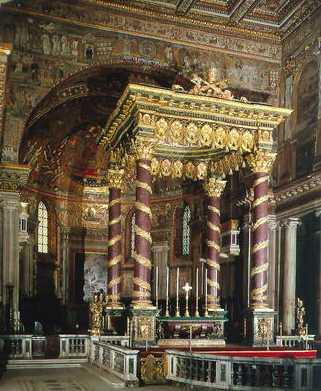 Poitier preserved letters of Pope Liberius attesting to what happened (Frag. Hist. 4,6).
Eventually Constantius let Liberius come out of his exile in Thrace. He went to Sirmium in 358 and then back to Rome. In Rome Felix II had taken over as bishop, but the people backed Liberius as the true Bishop of Rome.
Liberius had more than likely subscribed to the formula of Sirmium of 351 which was a "fundamentally" orthodox statement. Some Eastern bishops and "moderate" Arians met in the presence of Constantius to oppose Photinus. Photinus was condemned. Liberius did not subscribe to Sirmium 357, however. This meeting issued a pro-Arian statement. Nevertheless, St. Athanasius and St. Hilary and others considered Liberius to have erred gravely, but they were probably mistaken. Granting that Liberius was weak and his pontificate was fraught with problems, partly of his own creation, Liberius seems to have been more sinned against than sinner.
Yes, Liberius did condemn Athanasius, that staunch defender of Nicaean faith against the heretic Arians. but he was forced under duress and perhaps even torture to give support to the Arians. Nevertheless, Liberius refused to subscribe to an obviously Arian formula of faith and instead signed on that, while not explicitly condemning Arianism, did support for the most part the Nicaean faith. Sometimes anti-Catholics will fling Liberius in our faces as an example of how the Pope cannot be thought to teach infallibly. SSPXers often invoke him and Athanasius as a way of justifying their disobedience. Liberius, however, is a complex figure in difficult times and much of the "story" of his "fall" in weakness is not properly grasped.
After Constantius, the infamous Julian adopted a policy of toleration. Pope Liberius issued a letter to the bishops of Italy in 362 and a letter of reply to the bishops of the East in 366 which both affirmed the faith of the Council of Nicaea.
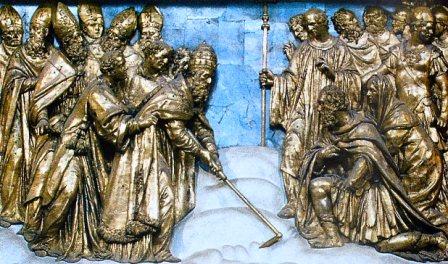
Pope Liberius is important to us today because of the feast we celebrate: the Dedication of St. Mary Major, known as the Liberian Basilica. The Basilica is associated with Pope Liberius because of the famous story we all know about the miraculous snowfall on this day on the Esquiline Hill in Rome. Anyone who has been in Rome in August will not question that at a snowfall would be indeed a miracle. To give you an idea of how hot it is in Rome in 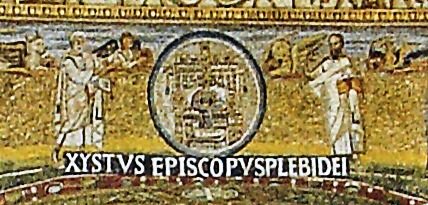 August, the soles of a pair of my running shoes melted and the layers came apart. In any event, the Basilica was completed by Pope Sixtus III and his archdeacon Leo (later Pope Leo I "the Great"). Here is what the Roman Martyrology says:
Dedicatio basilicae Sanctae Mariae, Romae in Exquilis conditae, quam in memoriam Concilii Ephesini, in quo Maria Virgo Dei Genetrix salutata est, Xystus papa Tertius plebi Dei obtulit…. The dedication of the basilica of Saint Mary founded in Rome on the Esquiline hill, which Sixtus III, Pope consecrated for God’s People as a memorial of the Council of Ephesus during which the Virgin Mary was hailed as Mother of God.
In the basilica you can see the great triumphal arch decorated with beautiful mosaics prepared and directed by the future Pope Leo I having anti-Manichean themes. On the summit of the curve of the arch you see the name of "Xystus Episcopus Plebi Dei" even to this day.


Coat of Arms by D Burkart
 fac on Daily Rome Shot 1118 – Paddywhack!: “Speaking of the disputatio back on October 31st between Archbishop Vesco and Bishop Barron (Vesco saying the Catholic Church was…”
 on Continue the Rome shot posts? I dunno.: “Please call continue the Rome photo posts if it not too much of a burden. Thank you, Father!”
 on Daily Rome Shot 1117 – A *POLL* about 2026-27: “Sorry… my bad. It is indeed SIX. 1. Rh8+! Kxh8 2. Qh2+ Kg8 3. Qh7+ Kf8 4. Qh8+ Ke7 5.…” on Encrypted Yeast? The Fathers on “What does the “leaven” really say?” (6th Sunday after Epiphany Resumed): “I especially like St. John Chrysostom’s insight, that when we are “hidden” in the normal places we live and work,…”
 on Daily Rome Shot 1117 – A *POLL* about 2026-27: “pestolover: For what it’s worth, your solution was the best I could do also.”
 on Daily Rome Shot 1117 – A *POLL* about 2026-27: “Fr Z thanks so much for 2 reminders. 1. Using your Amazon link! For heaven’s sake it costs us nothing…”
 on 10 November – St Andrew Avellino (Vetus Ordo). Wherein Fr. Z rants.: “So interesting that you bring this up, a couple weeks ago a priest at a neighboring parish died unexpectedly. They…”

A Daily Prayer for Priests








They find you a pro-life agent in your area who commits to giving a portion of the fee to a pro-life group!

PLEASE subscribe via PayPal if it is useful. Zelle and Wise are better, but PayPal is convenient.
A monthly subscription donation means I have steady income I can plan on. I put you my list of benefactors for whom I pray and for whom I often say Holy Mass.
In view of the rapidly changing challenges I now face, I would like to add more $10/month subscribers. Will you please help?
For a one time donation...



Help Monks in Wyoming (coffee – UPDATED LINK) and Norcia (beer) and the wonderful "Soap Sisters" of Summit, NJ!


Please follow me on Twitter!










Visits tracked by Statcounter
since Sat., 25 Nov. 2006:


