Magnus Martyr

My interest in the works of T.S. Eliot in wanted to visit Magnus Marytr. And so… after my journey through Southwark and location of the last wall of Marshalsea Prison, and a visit to Southwark Cathedral, I walked across London Bridge and descended past the Monument to the little church. Some images.

O City city, I can sometimes hear
Beside a public bar in Lower Thames Street,
The pleasant whining of a mandoline
And a clatter and a chatter from within
Where fishmen lounge at noon: where the walls
Of Magnus Martyr hold
Inexplicable splendour of Ionian white and gold.

Magnus Martyr

Magnus Martyr

Magnus Martyr

Magnus Martyr

Magnus Martyr

Magnus Martyr

The sacristy has Roman vestments, birettas, and an papal blessing of His Holiness of our Lord, Pope Benedict XVI.

Magnus Martyr

I have some video, since when I entered, the organist was practicing. 

Posted in SESSIUNCULA |
1 Comment

Going to jail…gaol…

No, not the Clink. I am off to find the remains of Marshalsea Prison.

Going to jail...gaol...

Posted in SESSIUNCULA |
3 Comments

Fulton Sheen confession story

I had mentioned in my post about St. Patrick’s Soho the famous story of Fulton Sheen and a confessional in the same church. 

People sent notes asking more about that.

I found it on the web, and just slightly edited it.

Fulton Sheen told a story of how he was opening the door of the church where he worked in London on a foggy November morning when a young lady fell in the door. "Who are you"?

"Where am I ?" was the reply.

"Drunk"?

"Yes".

"Men drink because they like the stuff, women drink because they don’t like something else, what are you running away from?"

"I am involved with 3 men and they are beginning to find out and so I decided to get drunk."

"Who are you"?

She pointed across the square at a name in big neon lights. She was the leading lady at the local musical.

He brought her in and gave her a cup of tea, to which she said, "thank you".

He said, "No, don’t thank me now, come back this afternoon before the matinee and then you can thank me."

She said "I will only come back if you promise you will not ask me to go to confession."

"OK, I promise I will not ask you to go to confession."

"Say it again, you will not ask me to go to confession".

"OK, I promise again, I will not ask you to go to confession".

She came back that afternoon and he met her at the church door. He told her that there were paintings by Rembrandt and Van Dyke in that chapel and would she like to see them? She said yes.

"And as we walked up the side aisle to see the paintings, I pushed her into a confession box." ("I did not ask her if she wanted to go to confession.") "I was present three months later when she took her veil as a member of the perpetual adoration sisters where she is to this day." 


I understand that the sister in question died not too long ago.

Posted in SESSIUNCULA |
1 Comment

QUAERITUR: relics and lost documents: what to do?

From a reader:

I thought you would be just the one to ask…

I have several first class relics without their "papers."

Is there anyway these relics can be authenticated for public veneration?  Perhaps someplace they can be sent to receive the necessary verification and letter?

Most of the time you will find a was seal inside cover of the "teca" or container which houses the relic(s).  I most cases this seal will be unbroken.  Usually the seal will bear the imprint of the entity which prepared the reliquary.  Sometimes this is going to be the Generalate of a religious order, if the relic is of one of their saints and the relic was obtained there.  Otherwise, it could be a diocese or some Roman entity.

If you find and identify the seal, then you would have to go to that entity for a verification and documentation.

It might also be possible to obtain additional help from the Congregation for Causes of Saints.  For issues of official translation and recognition of relics the diocese and Rome must be involved.

Keep in mind that if the reliquary is very old, you might never be able to obtain documents after the fact.  In tha tcase some history of the reliquary, provenance etc, would help if you contact a some to help rehouse or restore what you have.

Posted in "How To..." - Practical Notes, ASK FATHER Question Box | Tagged
Comments Off on QUAERITUR: relics and lost documents: what to do?

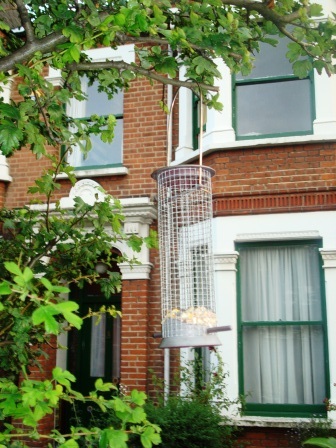
On my walk home

It is a bit of a trudge from the subway station to the rectory where I am staying in Clapham Park.

Today, on the hike I noticed that someone feeds birds.

On my walk home

Posted in SESSIUNCULA |
Comments Off on On my walk home

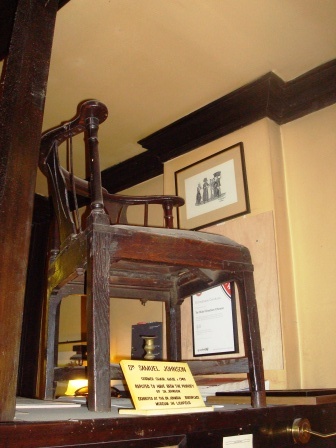
Dr. Johnson speaks

Today the Laudator gave us a reflection from Dr. Johnson.

No Satisfaction
Samuel Johnson, The Idler, No. 88 (Saturday, December 22, 1759):

    He that in the latter part of his life too strictly enquires what he has done, can very seldom receive from his own heart such an account as will give him satisfaction.

Today, living high on the hog as I do, I sat beneath his chair and eat fish and chips… as someone’s guest.

Dr. Johnson speaks

Posted in SESSIUNCULA |
5 Comments

A pint at Seven Dials

I am heading for a pint and Internet before my next move. If anyone is in the area… 0750185255

Posted in SESSIUNCULA |
2 Comments

Royal Academy – Waterhouse

After lunch I headed to the Royal Academy for to see the exhibition of works by the modern pre-Raphaelite painter J.W. Waterhouse. His idealized feminine beauty is a recognizable characteristic of his paintings. If you are looking for a modern equivalent, perhaps the actress who played Scully in X-Files or better the recent version of Bleak House. Gillian something… can’t recall right now. You would think she was a model for many of his works. Evoked an era and deep Englishness.

Royal Academy - Waterhouse

Compare to Hunt’s.

Posted in SESSIUNCULA |
4 Comments

Brighton

After the jaunt to Eastbourne I was happy to overnight at St Mary Magdalen with the great Fr Blake on the feast day of the parish.

Windy!

Brighton

_____

Posted in SESSIUNCULA |
3 Comments

Archd. of Miami Director of Worship on Summorum Pontificum

A reader alerted me to a piece written by the director of Liturgy for the Archdiocese of Miami.  He writes on the website of the Archdiocese about Pope Benedict’s emancipation proclamation, the 2007 Motu Proprio Summorum Pontificum.  Let’s see what he has to say with my emphases and comments.

On July 7, 2007 Pope Benedict XVI published the Apostolic Letter Summorum Pontificum by which the Holy Father allows for and promotes [Get that?  Not just "allows" but "promotes"] a wider usage of the liturgical books that were in use by the Roman Catholic Church in 1962. Pope Benedict XVI seeks in this Apostolic Letter [inter alia] to reconcile “in the heart of the Church” those individuals who have demonstrated an attachment to the liturgical forms that were in place before the liturgical renewal of the Second Vatican Council. He begins by defining two forms of the rule of prayer of the Latin Church: an ordinary form contained in the Roman Missal of Pope Paul VI, and an extraordinary form, as contained [once upon a time] in the Roman Missal of Pope Saint Pius V. [But more recently in that of Bl. John XXIII.] Both make up the Liturgy of the Roman Rite.
 
Any priest of the Latin Church may, without permission from the Holy See or his bishop, celebrate the extraordinary form in a Mass without the people at any time except during the Easter Triduum. It is noted that he may be joined by the faithful, since the extraordinary rite is primarily a private Mass. [I think I will take gentle exception to this.  No Mass is primarily a private Mass.  All Masses, that is all rites of Mass, are not intended to be private.]  In parishes where a group of faithful are attached to the extraordinary form of the Mass, they may approach the pastor to request the celebration of the extraordinary rite, without permissions from the Holy See or the bishop. If a priest cannot demonstrate a minimum rubrical or linguistic ability in Latin, he is not to celebrate the extraordinary form of the Mass.  [However… that doesn’t mean that those people making the request are out of luck… or rather, out of their rights.  First, the priest really ought to know his own Rite, right?  So, he should learn the older form if he doesn’t know it.  Second, if he cannot see to these people himself, he ought to take steps to find someone who can help.  That is part of his role as pastor.  It is understood that if the group is very small, it might be hard to take a huge initiative.  Yet large initiatives are implemented for very small groups all the time.  Third, if the pastor can’t get anything going, then the diocesan bishop needs to help get things going… in that parish.  Not just anywhere.]
 
Pope Benedict XVI is very clear in his apostolic letter that the current Roman Missal (Missale Romanum) is the ordinary form of the Eucharistic Liturgy and the extraordinary form is found in the 1962 Missal of Blessed John XXIII. He points out that there is “no contradiction between the missals” […and, therefore, one form of Mass is not  "primarily" private….]  and that the history of liturgical books is characterized by “growth and progress, but not rupture.” In both the ordinary and extraordinary forms of the Roman Missal, full, conscious, and active participation of the faithful is to be desired above all else. [Properly understood, of course.  And since this included the phrase "above all else" we can most suitably begin with the person’s baptized character and then his or her state of grace.  You see, true active participation is first of all an interior reality, not an outward expression.  It leads to outward expression, the most perfect of which – in the liturgy of Mass – is the reception of Communion by a baptized person in the state of habitual grace.  To that end…. watch what this smart writer does….]  This begins with interior participation [YAY!  See?  Interior!  This priest gets it.] in the sacrifice of Christ. The ordinary form customarily accomplishes this participation through listening and responding to the prayers of the Mass in the vernacular [well… vernacular…. okay…] and by taking part in forms of exterior communal action. The extraordinary form accomplishes this interior participation largely by listening to the prayers in Latin and following the words and actions of the priests and joining our hearts to “what is said by him in the Name of Christ and [what] Christ says [to] him.”   [hmmm…. those two forms of participation sound an awful lot alike.]
 
From all of the above we see that the Church continues to treasure the riches of its past, [which is now its present] especially with regard to the sacred liturgy. The spirit of earlier liturgical forms, which permeated the spirit and culture of many who still remember these forms, continues in the celebration of both rites. Thus, it was through pastoral concern that Pope Benedict XVI was motivated to more easily allow for the celebration of more ancient liturgical rites and prayers by issuing Summorum Pontificium.
 

Msgr. Terence Hogan
Director, Office of Worship and Spiritual Life

WDTPRS kudos to Msgr. Hogan.  Well done.

I think I might have added something stemming from that organic growth comment about another objective of Summorum Pontificum and the use of the older Rites.  The use of these older forms will exert an influence on the way the newer forms are celebrated.

Still and all, you folks in Miami can be pleased that this priest has a clear sense of some very important concepts for a sound liturgical praxis.  He has a far better understanding of active participation than we have seen coming from most liturgical offices for several decades.  He speaks with respect about the older form and has not merely conveyed a reluctant tolerance toward it.  He speaks of continuity and eschews clichés about the Second Vatican Council.

Posted in Brick by Brick, SESSIUNCULA, SUMMORUM PONTIFICUM |
32 Comments