For progressivists even the sloppiest Mass is not “diverse” enough

From Damian Thompson‘s blog.  Be sure to go over and take a look at the comments there, too.

My emphases and comments:

I recently came across this parish magazine article, by a former seminarian called Damian Rhodes, which shows that for some progressive Catholics even the sloppiest modern Mass is not “diverse” enough. Please read it. Oh, and make sure you pay close attention to the final paragraph.

Recently I found myself meditating about our own local faith community. Worshipping our loving and vulnerable parent God in the company of fellow journeyers, I feel pained on behalf of people who are victimised in society.

Only last Sunday, the bidding prayers asked for God’s healing for those facing challenges of health and wholeness, and for those of other faith traditions, but are we really brave enough to embrace true difference?

When did you last hear a bidding prayer for the transvestite, lesbian, transgendered, bisexual or asexual communities? What about a prayer for our divorced and civilly-partnered sisters? It is common to hear us addressed as “sisters and brothers”, excluding – albeit without meaning to – those who refuse to identify with either gender.  [Ummm…. how are these people "victims"?]

Throughout our celebrations, when we should raise our hearts to our Parent-Creator, [yuk] the celebrant looks down on us from on high. Instead of worshipping alongside his sisters, brothers and sister-brothers he faces us like an accusing judge .

We worship in foreign languges – but has it ever occured to us that for some worshippers even these carry imperialist associations? [blech]

Our native-Nicaraguan sisters must feel excluded when the words are those of their Spanish oppressors. What about our sisters from Africa who find that the colonial languages of French or English are often used, rather than their local dialect? What thought is given to persecuted Roma who have to hear the tongue of a contemtuous majority rather than their own?

How often have I longed for a liturgy that unites rather than divides, a worship in conformity with the Spirit of Vatican II rather than the culturally compromised liturgy we have today.  [As do most of us, I think.]

I am delighted to say, though, that a nearby parish recently had a novel and radical solution to this problem. They have discovered a way of expressing our desire to gather as people of faith without siding with oppressors. In conformity to Vatican II they avoided using the language of any of wou world’s oppressive regimes.  Instead of us proclaiming that God became “man” in the Creed it uses a word meaning “human being”.

Not only this, but the worship-facilitators faced the same direction as us, [!] pilgrims together with those marginalised in our communities. Instead of hearing a man’s voice throughout, I was able to enjoy silence in which I could meditate on humankind’s oneness with nature.

Alas, most presiders are far too entrenched in their traditionalist-conservative outlook to even consider this novel solution. But what is the name of this diversity-aware service, I hear you ask?

It is called, I believe, the “Extraordinary Form” of the Roman Rite.

Posted in SESSIUNCULA |
46 Comments

A favorite fast lunch spot

When I am in St. Paul I sometimes take a break from the good Chinese to stop at a well-known deli, Cecil’s on Cleveland.

If you can’t be in New York, you can come here.

Service is … well, you never know. At least it is cheerful. Lunch can be nuts here and they are short on staff.

Great sandwiches! The matzah ball soup and beet borscht are excellent. Try an egg cream.

I usually get a couple loaves of bread too.

A favorite fast lunch spot

A favorite fast lunch spot

A favorite fast lunch spot

Posted in SESSIUNCULA |
21 Comments

M. Novak on liberal trembling over upcoming encyclical

From the site of First Things, Michael Novak has a comment about the anticipation felt by liberals over the Holy Father’s upcoming encyclical.

My emphases and comments.

Economic Heresies of the Left
Jun 29, 2009
Michael Novak

What exactly is in Benedict XVI’s new encyclical on the economy and labor issues is not yet known. Catholic leftists and progressives, though, are already trembling with excitement. Three glaring errors have already appeared in these heavily panting anticipations.

An accurate presentation of real existing capitalism requires at least three modest affirmations:

1)
Markets work well only within a system of law, and only according to well-marked-out rules of the game; unregulated markets are a figment of imagination.

2) In actual capitalist practice, the love of creativity, invention, and groundbreaking enterprise are far more powerful than motives of greed.

3) The fundamental systemic motive infusing the spirit of capitalism is the imperative to liberate the world’s poor from the premodern ubiquity of grinding poverty. This motive lay at the heart of Adam Smith’s important victory over Thomas Malthus concerning the coming affluence—rather than starvation—of the poor.

Since the origins of modern capitalism around 1780, more than two-thirds of the world’s population has moved out of poverty. In China and India alone, more than 500 million have been raised out of poverty just in the last forty years. In almost every nation the average age of mortality has risen dramatically, causing populations to expand accordingly. Health in almost every dimension has been improved, and literacy has been carried to remote places it never reached before.

Whatever the motives of individuals, the system has improved the plight of the poor as none ever has before. The contemporary left systematically refuses to face these undeniable facts.

Fr. Thomas Reese, S.J., one of our most reliable leftist bellwethers, [how one tires of him] has recently opined that Benedict XVI’s new encyclical will cry out for more regulation, rather than unregulated markets. Further, the pope will denounce greed and cry out for more attention to the urgent need to aid the world’s poor.  [Woiw… the Pope an advocate for the poor.  Such insight.]

Reese thinks these are anticapitalist positions. That is ridiculous. They lie at the heart of why capitalism has worked as well as it has to liberate the poor—first in the United States and Europe, then in one continent after another, as it is now doing in almost all areas of Asia.

Fr. Reese says that the pope will blame the greed of U.S. bankers for the current global financial crisis. [What do you want to bet that the Pope won’t get so specific.  It is Reese himself who is pushing his agenda into a fantasy about the Pope’s encyclical.] While many institutions, including banks, failed in their basic duties, government action was the principal villain in the 2009 debacle. It was the federal government that forced banks to make sub-prime loans to poor families (who were known to be unable to pay their mortgages on a regular basis). It threatened banks that did not invest in poisonous packages of mortgages, vitiated by the bad ones.

The federal government even guaranteed the work of two huge quasigovernment mortgage companies—Fanny Mae and Freddy Mac—that wrote more than half of all mortgages during the fateful years. Of course, when the house of cards fell, government was not there to make good on its guarantees—or even to accept responsibility for its own heavy-handed actions.

For at least ten years before the disaster finally occurred, my colleagues at the American Enterprise Institute had been warning of the government abuses that were heading toward this calamity. Partisans of big government refused to listen.

For moralists, it is essential to see how often (not always) government itself sins grievously against the common good, out of a lust for power and domination over others. Furthermore, government often (not always) generates foolish and destructive regulations, and often dispenses justice that winks rather than justice that is blind. [Wait until we see more and more federal judges with "empathy".] Government is more frequently the agent of injuring the common good than the ordinary lawful actions of free citizens. During the twentieth century, governments too often destroyed the common good of their citizens for years to come.

In the United States, the existing code of federal regulations for businesses is enormous. Title 12 covering “Banks and Banking” runs to 4,786 pages; Title 15 on “commerce and Foreign Trade” is 1,941 pages; Title 16 on “Commercial Practices,” 1,600 pages; Title 17 on the “Securities and Exchange Commission,” 2,708 pages; and Title 31 on “Money and Finance: Treasury,” 1,917 pages.

The total number of pages in this code is 12,592. Laid out end to end, the volumes of the code extend for 2.35 miles. If you count the pages in feet (30 inches per linear foot is the standard measure) the code runs for six linear miles.

An unregulated market indeed! The real world of American capitalism is more like Gulliver bound down by thousands of threads. Many of the regulations are out of date, obsolete, costly, destructive, and—in their actual effects—counter to the very intentions that gave them birth. But regulation there is, and regulation there must be. Without rules, American capitalism cannot function.

As for greed, Max Weber pointed out that greed is present in every age and every system of human history. [Darn Adam anyway!] Yet greed was rather more socially central in ancient times than today, and played a much more decisive role. And nowadays, greed flourishes most wherever government power is concentrated.

By contrast, in enterprise societies such as the United States, it is possible to become rich—even very rich—by methods that focus on innovation rather than greed. The great universities of the Middle West and Far West, were founded expressly to give spur to new inventions in mining, agriculture, and other technical fields. Texas A & M, Iowa State, Wisconsin State, Oklahoma State, and scores of others have been the hothouses of ideas in agriculture, engineering and electronics, geology, mining and drilling—ideas rendered practical by the makers of many fortunes. They have mightily served the common good of Americans and the entire human race.

As John Paul II wisely commented in Centesimus Annus, practical knowledge is the main cause of wealth today. Ideas rather than great landholdings are the main form of wealth in our time. As both Caesar and Cicero long ago observed, although it seems as though community ownership ought to serve the common good best, in practice private property does. The right to private property has long been justified by virtue of its superior service to the common good.  [Beware of those who speak badly about "self-interest" and do not specify that what they mean.]

And in the United States, scores of entrepreneurs are ready to risk losing everything they have in order to create something new, create something that will make life better for their fellow men. Henry Ford failed repeatedly in several businesses before he finally made the Ford Motor Company the great model for business that it once was. (It was the first establishment in history to pay its laborers a handsome wage of five dollars per day. At the time, ordinary lawyers averaged about $1500 per year. Ford’s motives, of course, were not altruistic; he wanted his workers to purchase the cars they helped build.)  [A kind of "self-interest" which includes and expands benefits for others.]

As Oscar Handlin once noted, almost every industrialist who built a new railroad North and South in the United States in the nineteenth century prospered. Nearly every tycoon who tried to build an East–West railroad lost money. What spurred men to keep trying had less to do with greed that with the sheer romance of conquering the deserts and the Rockies. The element of romance in business is simply not grasped by dialectical materialists. [Interesting observation.]

In brief, nearly all the leftish critiques of American and other forms of capitalism are empirically false. They do not fit the actual facts. [Liberals will always ask you to deny the evidence of your senses and of common sense.  They don’t like facts or distinctions and will accuse you of being uncivil if you counter their positions with reason and facts.] But these three—greed, unregulated markets, and the idea that capitalism makes the poor of the world worse off—are especially tiresome, and very far from reality.

Will all those good Catholic leftists who announce their own enthusiastic preference for the poor actually help to liberate the poor, even by a little? Will their anticapitalist policies help alleviate poverty? The historical record offers very little evidence for that contention.

And yet wherever a healthy, inventive capitalism goes, the poor soon rise by the millions out of poverty, come to better physical health, and advance into higher education.

You can look up the record.

Michael Novak, a member of the editorial board of First Things, holds the George Frederick Jewett Chair in Religion and Public Policy at the American Enterprise Institute. His most recent book is No One Sees God (Doubleday, 2008).
Great article!  Kudos to Novak!

Posted in SESSIUNCULA | Tagged
242 Comments

Good commentary about new Pauline discoveries

There is a very interesting piece from Sandro Magister’s Chiesa on the new discoveries about St. Paul which have recently come to light.  

This is one you want to read carefully… especially you seminarians out there.

My emphases and comments.

Good commentary about new Pauline discoveriesNew Discoveries. Why St. Paul Was Given a Philosopher’s Face
The oldest depiction of the apostle has been found just a short distance from his tomb, which is also the object of new investigations. The Church wanted to represent him as the Christian Plato. [interesting] A daring decision. And still extremely relevant, even today

by Sandro Magister

ROME, June 30, 2009 – The year dedicated to St. Paul, two millennia after his birth, has concluded with two important discoveries announced on the same day, the vigil of the saint’s feast.

The first discovery was revealed by Benedict XVI in person, in his homily for vespers on June 28, in the Roman basilica of St. Paul’s Outside the Walls:

"We are gathered at the tomb of the apostle, whose sarcophagus, kept under the papal altar, was recently made the object of a careful scientific analysis. A tiny perforation was made in the sarcophagus, which had not been opened for many centuries, for a special probe that picked up traces of a valuable linen cloth dyed purple, laminated with pure gold and a blue-colored cloth with linen thread. It also detected grains of red incense and of substances containing protein and calcium. Moreover, very tiny fragments of bone, subjected to Carbon-14 dating by experts who were unaware of their origin, were determined to belong to a person who lived between the first and second centuries. This seems to confirm the unanimous and unopposed tradition that these are the mortal remains of the apostle Paul."

So for Paul, too – as also for the apostle Peter, whose tomb has already been identified with certainty beneath the main altar of the basilica of St. Peter at the Vatican – there is important confirmation that he is buried precisely where he has always been venerated: under the main altar of the Roman basilica dedicated to him.  [Time and again, we see how modern science confirms what the ancients said.]

***

The second discovery was announced by "L’Osservatore Romano" in its June 28 edition.

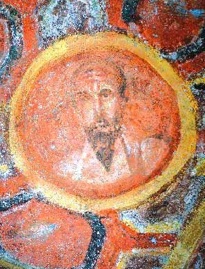
It is the discovery of the oldest known depiction of the apostle Paul, dating back to the fourth century: the depiction reproduced at the top of this page.

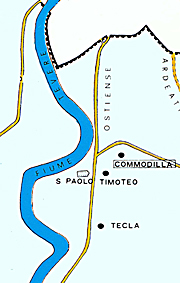
Good commentary about new Pauline discoveriesThis image of Paul emerged last June 19, from the excavations that are underway in a catacomb named after St. Thecla, along the Via Ostiense leading from Rome to the sea, a short distance from the basilica of the apostle.
Using laser beams to clean the vault of a niche, the archaeologists saw a rich fresco decoration reemerge. At the center of the vault appeared the image of the Good Shepherd, surrounded, in four arches, by the figures of Paul – the best preserved of the four – of Peter, and probably of two other apostles.

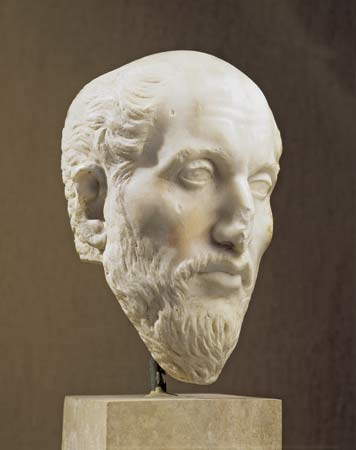
The archaeologists Fabrizio Bisconti and Barbara Mazzei provided all of the details of the discovery in two extensive accounts in the newspaper of the Holy See. But one element is more striking than all the rest. And it concerns the reasons that led to depicting the apostle Paul as we see him in this fresco, and then in so many others that followed: with the appearance of a pensive philosopher, with the penetrating expression, the high forehead, the incipient baldness, the pointed beard.

Good commentary about new Pauline discoveriesIn effect, in an art exhibition dedicated to St. Paul and inaugurated a few days ago in a wing of the Vatican Museums, two of the pieces on display are busts made in the Roman era, of two philosophers – one of which is probably Plotinus – who bear a strong resemblance to the ancient depictions of Paul, beginning with the one that has just been discovered.

The same question is posed for the apostle Peter, who is traditionally depicted with short, thick white hair, his face broad and his expression decisive, his beard also short and full. And so on for other characters of sacred history.

Portraiture was very widespread in Greek and Roman art. But in Jewish culture, human images were forbidden, and therefore it was unthinkable that Paul and the others would have themselves depicted. It was only later that the Church accepted the depiction of figures of the Christian faith.

But how? Here is the evocative explanation given by Professor Antonio Paolucci, director of the Vatican Museums and a great art historian, in presenting the exhibition on St. Paul:

"The problem was posed between the third and fourth centuries, when a Church that had become widespread and well structured made the great and brilliant wager that is at the basis of our entire artistic history. [very cool] It accepted and made its own the world of images, and accepted it in the forms in which the Greco-Roman stylistic and iconographic traditions had developed it. It was in this way is that Christ the Good Shepherd took on the appearance of Pheobus Apollo or Orpheus, and that Daniel in the lion’s den had the appearance of Hercules, the victorious nude athlete.

"But how could one represent Peter and Paul, the princes of the apostles, the pillars of the Church, the foundations of the hierarchy and doctrine? Someone got a good idea. He gave the first apostles the appearance of the first philosophers. So Paul, bald, bearded, with the serious and focused air of the intellectual, had the appearance of Plato or perhaps of Plotinus, while that of Aristotle was given to the pragmatic and worldly Peter, who has the task of guiding the professing and militant Church through the snares of the world."

If this is what happened, then the Church in the early centuries had no reservations about attributing to the apostles, and to Paul in particular, the title of philosopher, nor of handing down, studying, and proclaiming in its entirety his thought, which is certainly not easy to understand and accept.

The same can be said of the Fathers of the Church. In a phase of Christianity in expansion, in a phase in which the transmission of the Christian faith to the Gentiles was in full development, the Church never considered watering down or domesticating its own message in order to make it more acceptable to the men of the time.  [Thus the high dependence of many of the Fathers on Platonism in its variious forms.]

The depiction of Paul the philosopher is an eloquent warning to those who today deny relevance to a pope theologian like Benedict XVI, a modern Father of the Church.

Posted in Just Too Cool, SESSIUNCULA |
9 Comments

Ed Peter’s takes L’Osservatore to the woodshed

Ed Peter’s of In The Light Of The Law has correctly understood a burning issue of our day.

L’OR and the Loss of Reason

For most of my life L’Osservatore Romano has been a sleepy Roman rag that arrived weeks after its publication date, printed in cheap ink that soiled the fingers of those who felt the need to read page after page of boilerplate remarks on the latest ambassador from anywhere shown in his tuxedo presenting diplomatic credentials. Aside, I suppose, from an occasionally interesting book review, L’OR has for decades carried nothing of serious interest that could not be found much more quickly in a half-dozen other venues, ones, moreover, that didn’t compel readers to wash their hands before handling anything beige or white.

But lately, [Behold!  A line to be quoted….] L’OR has decided to become relevant. God help us.

Having just emerged, battered, but, I thought, moderately chastened after its embarrassingly naive and harmful editorial in praise of Pres. Obama, L’OR treats the world to a high-schoolish tribute to the highly talented and utterly pathetic entertainer Michael Jackson.

Jackson might not be fully responsible for the swirling chaos that was his life and death, but for L’OR even to mention his death – – [get this…] without simultaneously urging Catholics to pray for his soul and the souls of all the faithful departed – – astounds me.

Worse, the L’OR report leaves Catholics little sense that much of Jackson’s work was sexually exploitative, at times quasi-obscene; it dismisses as insignificant the terrible example that Jackson’s chronic pursuit of superficial "beauty" gave to millions of young people; and, worst of all, it trivializes the serious, and in some cases unresolved, allegations of child sexual abuse made against him. L’OR need not assume the worst about Jackson’s conduct in these cases, but it should never have implied that such allegations, even if they are true, cannot tarnish the world-wide esteem in which he is held! Good grief. Has L’OR completely lost its reason?

If the Vatican wants a newspaper to provide a Catholic perspective on the world, fine. Item Number One on the to-do list, though, should be to find Catholics who can write and edit such a paper coherently. Anyone can lurch from gaff to gaff.

In the meantime, if you really want to get in on the Jackson Praise Train, check out M-TV, dude. Their graphics are like way better than L’OR.


Dude!

Posted in SESSIUNCULA | Tagged
28 Comments

Have any good news?

What is your good news today?

Posted in SESSIUNCULA |
54 Comments

Support of “cap and trade”?

More and more I have the impression that "the environment" is rapidly becoming the focus of a new age sort of a religion.

I missed this when it came out, from Catholic World News:

Catholic World News (CWN)
Feature Stories
US Catholic hierarchy shows support for legislation requiring massive tax hike
Jun. 26, 2009 (CWNews.com) –

The US bishops have given their enthusiastic support to the Waxman-Markey bill, a piece of legislation designed to address climate change, which Republican opponents have characterized as entailing "the largest tax increase in American history."

The American Clean Energy and Security Act of 2009 proposes a complicated series of schemes known as "cap and trade," ultimately imposing taxes on the carbon-dioxide emissions that are cited as a major factor in global warming. Even before the 1,200-page legislation was made available to Congress, the members of the House of Representatives received a letter from two leading representatives of the American Church, giving their strong endorsement for the bill.

Bishop Howard Hubbard, [With due respect to His Excellency, and to the writer, how on earth is Bp. Hubbard a "leading representative of the American Church"?] who chairs the US bishops’ committee on international justice and peace; and Ken Hackett, the president of Catholic Relief Services, welcomed the introduction of the Waxman-Markey bill. They criticized the legislation only because, in their view, it did not include adequate funding to protect the poor– in the US and abroad– [More taxes?] from the bill’s economic impact. Bishop Hubbard and Hackett argued that "the funding resources committed to international adaptation fall fundamentally short of what is needed." Their letter also suggested measures to protect churches and non-profit agencies from the adverse economic effects. [Soooo… ]

By pointing to the ways in which the legislation could harm the economic interests of the poor and the non-profit sector, Bishop Hubbard and Ken Hackett demonstrated that they were aware of the bill’s economic costs. But their letter to Congressmen betrayed no concern at all about how the bill would affect ordinary American families above the poverty level.

The Congressional Budget Office, in its analysis of the legislation, concluded that the Waxman-Markey bill would entail new costs of $770 a year for the average American family. A separate analysis by the Heritage Foundation suggested that this figure was grossly understated, and the actual costs would be closer to $3,000 per year for a typical family of four– rising steadily up to $4,600 by the year 2035. The Heritage analysis added that the bill would increase gasoline prices by 58%, home heating oil by 56%, and electric rates by 90%. The total drag on the economy would likely result in a loss of over 1 million jobs, Heritage concluded. In spite of this enormous cost, the Foundation argued, the Waxman-Markey bill would produce only a miniscule effect on the process of climate change, producing a drop in world temperatures of "only hundredths of a degree Celsius" in the next 40 years. [Would a Magic 8-Ball work better?.]


So, after reading that, go back and look at the title of the article. 

"US Catholic hierarchy shows support for legislation requiring massive tax hike"

Two people are cited.

Posted in SESSIUNCULA |
39 Comments

about that Windows 7 upgrade thing….

People are telling me I must upgrade to Windows 7.  Riiiight.   Like we had to upgrade to Vista… is that it?

So… asuming for a moment that this is in the cards….

Do you have to upgrade from the same version of the old version to the same version of the new version?

For example, if you have Vista Groovy version, do you upgrade to Windows 7 Groovy, or can you go to Windows 7 Far Out, or even father to Gnarly?

For the same of this entry leave the "Just switch to Mac" comments to languished UNWRITTEN in the back of your minds… along with any references to "emergency powers".

Posted in SESSIUNCULA |
34 Comments

The consecration begins

Please pray for the consecrandus. The consecration begins

The consecration begins

The consecration begins

The consecration begins

The consecration begins

The consecration begins

The consecration begins

The consecration begins

The consecration begins

Posted in SESSIUNCULA |
28 Comments

Fun Catholic iPhone ap “commercial”

With a tip of the biretta to Fr. Roderick,  I present this great iPhone ap commercial spoof with a Catholic twist.

It was made by P. Camarata.

It looks like that guy needs to charge his iPhone… a common experience we share.

Posted in Lighter fare |
14 Comments