Mosaic of Benedict XVI at St. Paul’s “outside-the-walls”

From a reader comes yet another e-mail without a link:

Info from theratzingerforum: Our Pope’s Mosaic in St. Paul’s Outside the Walls hat been altered and shows now the pallium which the Pope is wearing now, no longer the one he wore at his installation.

The Forum is "astonished".

Are you also?


No.

Posted in SESSIUNCULA |
22 Comments

QUAERITUR: Feast of the Precious Blood

QUAERITUR: Feast of the Precious BloodFrom a reader:

As you know, July 1st is the Feast of the Precious Blood in the pre-1969 calendar.  Unfortunately, this is one of the "idea feasts" which didn’t make the "expert" cut in 1969 (and the highest-ranking victim of tinkeritis [good word] – I think it was a second-class feastday).

Happily, July 1st is a feria in the modern calendar, with only an optional memorial for Blessed Junipero Serra otherwise obligating the day.  Thus, priests are free to use the votive mass of the Precious Blood which is found in the 2002 M.R. (not that I’ve ever really seen this done).

My question is the following: for those laity (or even obligated religious and clergy) who use the LOTH for daily prayer, is there a way to celebrate the Precious Blood?  I notice in the Liturgia Horarum that there is an office for "Christ, Our Eternal High Priest."  Would that be appropriate to use?  It has many references to the Precious Blood of Our Lord.  This "votive office" is also a good one to keep in mind for the Year for Priests, even if it’s only in the Latin editio typica.

The alternative, of course, is simply to pray the July 1st office in the extraordinary form.

Non-obliged lay people can do as they please, since they have no obligation to say the Office at all and they do so from devotion.

As for those who are obliged, I like the idea of "Christ the Eternal Priest", especially during this Year.

The feast of the Precious Blood is a fairly new feast for the Roman Calendar.  It was observed in Spain in the 16th centur, brought to Rome by the great St. Gaspar del Bufalo and them placed on the universal calendar in 1849 by Pius IX. 

I don’t see why one could not, on a feria, use another office. 

Posted in ASK FATHER Question Box |
29 Comments

Prayer request

Today is the consecration as bishop of Fr. Lee Piche.   It will take place in the Cathedral of St. Paul, in St. Paul, Minnesota.

In your charity will you please pray for him?

Perhaps you might stop right now and say, right now, a prayer to St. Michael the Archangel, or a Memorare.

Posted in SESSIUNCULA |
9 Comments

National Catholic Register thanks priests

On the very day the Year for Priests began, I was happily able to post about a nice thing that happened to me on an airplane.

This now comes from the editors of the National Catholic Register with my emphases and comments.

Thank You, Father

BY The Editors

June 14-20, 2009 Issue | Posted 6/5/09 at 7:05 AM

As the Year for Priests begins, we lay editors of the Register want to take a moment to thank priests.

We want to thank not only the priests who have been our friends, but also those we barely knew, who did more for us than our friends ever could.

We want to thank not only the priests who inspire us with their words, but also those who moved us more deeply with the daily work of their priesthood than they ever could with words.

We want to thank not only those men who gave up their retirement, and their well-deserved rest, to enter the priesthood as late vocations, but also — especially — those who as young men saw their whole life ahead of them and handed all of it to Christ.

We want to reassure them that the attacks on the priesthood will not prevail, because Christ doesn’t take their kind of generosity lightly. [A good point to remember during this Year.]

We know that there have been terrible, scandalous priests. This has been true from the beginning — from the original Twelve Apostles [Indeed.  The first collegial act of bishops/priests was to abandon the Lord.] through the early Christian heresies, from the scandals before the Reformation to the scandals of the 20th century.

But we also know that the priesthood is under attack.  [I believe this is true.  I also think that this is one of the reasons why Pope Benedict is giving "gifts" to priests, such as this Year and also Summorum Pontificum.]

Priests know it, too.

Whenever someone looks at them suspiciously, whenever a mother hurries her children away from them, whenever they read an antagonistic article about how the life of a priest makes them prone to become monsters, they know it.

Their noble, loving sacrifice is so often made to look ugly and twisted — the opposite of what it is. The whole group is too often defined by the exceptions in a way few of us ever have to deal with.  [You know… even most of the liberal, confused, progressivists are trying to be good men, thinking that what they are doing is the right thing.]

But the priesthood will survive, and grow stronger. In fact, it is already growing stronger. There are more new priests than we have seen in a long time, and the new generation of priests is more committed to the Church’s mission than any in memory. [Everywhere I go, the seminarians I meet are solid.]

We want to tell the faithful priests who unjustly suffer from these attacks that we’re on their side and, more importantly, remind them what Christ said: Rejoice and be glad on this day, for your name is great in heaven.

Thank you, priests, for sacrificing the fulfillment of “making it in the world” in order to give us a chance to make it in the next world. You don’t take on jobs — they are appointed to you. You put your own will at the disposal of the Church, for us. We are grateful.

Thank you for bringing our children into the Church, and sustaining their souls with the sacraments. And thank you for welcoming them into the Church informally, as well. We see them look at you like celebrities, and we’re glad the first “celebrity” they got to meet was a man of God. Thank you for patiently listening to them, for taking such joy in teasing them, and for showing them the true face of Christ: the gentle one who said “Let the children come to me.”

Thank you, priests, for presiding at our marriages, even while you yourselves live such that you can be ready to serve your people at a moment’s notice. Sometimes married people sigh and think envious thoughts about living alone. But in the end, it’s hard for us to imagine how you do it. Thank you for risking loneliness to serve us and our families.

Thank you, priests, for putting yourself in the unenviable position of dealing with us at our worst moments — when we’re anxious, upset, depressed, even a little out of our minds, focused on our own problems to the exclusion of all else.

When we see the care you have to take in listening to the problems of so many kinds of people, we can’t imagine how you do it. How do you listen to angry people, whining people, weeping people, nervous people, suspicious people and clueless people? How do you listen to us?

Thank you, priests, for sitting in empty confessionals on Saturday afternoons. You wait there, not even knowing if we’ll come, like the Prodigal Son’s father on the road. Thank you for all the times we hear “I absolve you from your sins” and feel a great burden lifted from our hearts. This gift of God’s forgiveness brings the greatest joy back into our lives. We can give you nothing in return that even comes close to that.

 And thank you, priests, most of all, for bringing Christ himself into our lives. Where would we be without your astonishing ability to make the body, blood, soul and divinity of Christ present on our altars and in our tabernacles? You are there for us every Sunday, every morning, giving us this infinite gift. Thank you.

In the end, that’s what is so great about you: not you, in yourself, but who you bring us — Christ.  [Illum oportet crescere, me autem minui.]

People call from the hospital and say, “I need a priest.” They point to the confessional and ask, “Is there a priest in there?” They approach in the airport and ask, “Are you a Catholic priest?”

When people need a priest, any priest will do.

Because a priest is nothing but a representative of Christ. Christ is the main actor in the consecration at Mass. It is Christ who forgives sins. It is in Christ that we are baptized.

“The story of my priestly vocation?” wrote Pope John Paul II. “It is known above all to God. At its deepest level, every vocation to the priesthood is a great mystery; it is a gift which infinitely transcends the individual. Every priest experiences this clearly throughout the course of his life. Faced with the greatness of the gift, we sense our own inadequacy.”

Your inadequacy is your secret weapon.

You aren’t acting on your own behalf or through your own powers. You are acting for Christ. And that’s why, despite all the attacks, the priesthood will prevail. We depend too much on you to ever let you go.

Thank you, Father, for being Christ for us.

Posted in Year of Priests |
13 Comments

Help from readers?

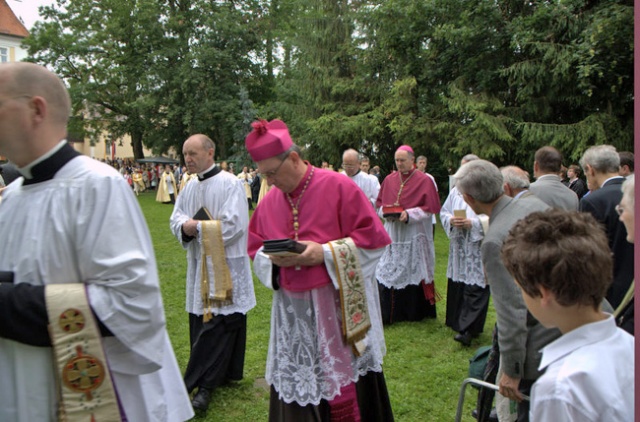
Can anyone identify this bishop?

Help from readers?

I am wondering if this isn’t he.

UPDATE: 1 July

All the photos are here.

Posted in SESSIUNCULA |
81 Comments

St. Paul, Apostle – new finds

St. Paul, Apostle - new findsIn December of 2006 I attended a presser on the unearthing, but not opening, of the tomb of St. Paul, Apostle, in the Basilica of St. Paul outside-the-walls.

At that time questions were raised about the opening of the tomb, but answers were dodgy.  We knew it was going to happen but didn’t know when.

The Pope gave permission in 2007.

I find this now, in the pages of the Nicole Winfield of AP.

My emphases and comments.

Pope: Scientific analysis done on St. Paul’s bones

By NICOLE WINFIELD
The Associated Press
Sunday, June 28, 2009 8:31 PM

ROME — The first-ever scientific test on what are believed to be the remains of the Apostle Paul "seems to confirm" that they do indeed belong to the Roman Catholic saint, Pope Benedict XVI said Sunday.

It was the second major discovery concerning St. Paul announced by the Vatican in as many days.   [second]

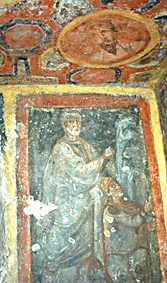
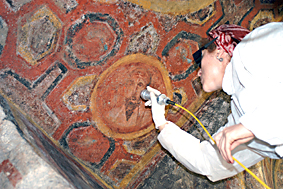
St. Paul, Apostle - new findsOn Saturday, the Vatican newspaper L’Osservatore Romano announced the June 19 discovery of a fresco inside another tomb depicting St. Paul, which Vatican officials said represented the oldest known icon of the apostle.
Benedict [Pope since 2005] said archaeologists recently unearthed and opened the white marble sarcophagus located under the Basilica of St. Paul’s Outside the Walls in Rome, which for some 2,000 years has been believed by the faithful to be the tomb of St. Paul.

Benedict said scientists had conducted carbon dating tests on bone fragments found inside the sarcophagus and confirmed that they date from the first or second century.

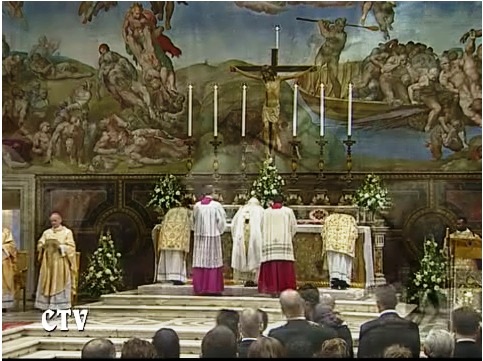
"This seems to confirm the unanimous and uncontested tradition that they are the mortal remains of the Apostle Paul," Benedict said, announcing the findings at a service in the basilica to mark the end of the Vatican’s Paoline year, in honor of the apostle.

Paul and Peter are the two main figures known for spreading the Christian faith after the death of Christ.

St. Paul, Apostle - new findsAccording to tradition, St. Paul, also known as the apostle of the Gentiles, was beheaded in Rome in the 1st century during the persecution of early Christians by Roman emperors. Popular belief holds that bone fragments from his head are in another Rome basilica, St. John Lateran, with his other remains inside the sarcophagus.
The pope said that when archaeologists opened the sarcophagus, they discovered alongside the bone fragments some grains of incense, a "precious" piece of purple linen with gold sequins and a blue fabric with linen filaments.  [I believe that purple imperial cloth was found in the tomb of Peter under the Vatican Basilica, probably from the time of Constantine.]

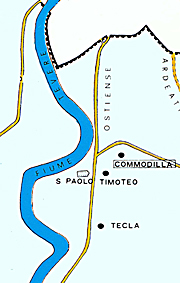
On Saturday, the Vatican newspaper announced that a round fresco edged in gold featuring the emaciated face of St. Paul had been discovered in excavations of the tombs of St. Tecla in Rome. It was believed to have been dated from the end of the fourth century, making it the oldest known icon of St. Paul, meaning it was an image designed for prayer, not just art, L’Osservatore Romano said.

St. Paul, Apostle - new findsMonsignor Gianfranco Ravasi, presidente of the Vatican’s culture department, said the discovery was an "extraordinary event" that was an "eloquent testimony" to the Christianity of the first centuries, L’Osservatore said.

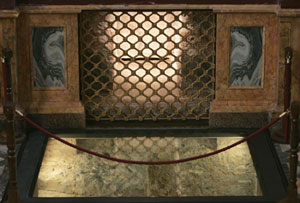
Vatican archaeologists in 2002 began excavating the 8-foot(2.4-meter)-long tomb of St. Paul, which dates from at least A.D. 390 and was buried under the basilica’s main altar. The decision to unearth it was made after pilgrims who came to Rome during the Roman Catholic Church’s 2000 Jubilee year expressed disappointment at finding that the saint’s tomb – buried under layers of plaster and further hidden by an iron grate – could not be visited or touched.

The top of the coffin has small openings – subsequently covered with mortar – because in ancient times Christians would insert offerings or try to touch the remains.

The basilica stands at the site of two 4th-century churches – including one destroyed by a fire in 1823 that had left the tomb visible, first above ground and later in a crypt. After the fire, the crypt was filled with earth and covered by a new altar. A slab of cracked marble with the words "Paul apostle martyr" in Latin was also found embedded in the floor above the tomb.

Monday is the feast of Saints Peter and Paul, a major feast day for the Roman Catholic Church, during which the pope will bestow a woolen pallium, or scarf, on all the new archbishops he has recently named. The pallium is a band of white wool decorated with black crosses that is a sign of pastoral authority and a symbol of the archbishops’ bond with the pope.

At the end of Sunday’s service in the warm basilica, the 82-year-old Benedict lost his balance slightly as he slipped on a step on the altar, and was steadied by one of his assistants who was by his side.

I caught some articles in L’Osservatore before they scrolled off.

Posted in Just Too Cool | Tagged
12 Comments

Hints at content of the new “social” encyclical

From CNA with my emphases and comments:

Italian newspaper reveals key paragraphs from Pope’s upcoming social encyclical

Hints at content of the new "social" encyclical

.- The upcoming social encyclical of Pope Benedict XVI "Caritas in veritate" – Charity in truth – will bear the date of the feast of Sts. Peter and Paul, June 29, but will likely become public on July 6 or 7, the Italian daily Corriere della Sera said on Saturday.

An article by Gian Guido Vecchi quotes what he claims are several original paragraphs of the Pope’s third encyclical.

"Without truth, without trust and love for what is truthful, there is no conscience or social responsibility, and the social action falls under the control of private interests or logics of power, with destructive effect on society, even more on a society in way to globalization, in difficult moments like the current ones,” the Pope will say in “Caritas in veritate,” according to Vecchi.  [This is very much out of context, but I am not so sure that we should run down "private interests".  "Private interests" produce the social benefits which we hope to have.  "Private interests" don’t necessarily mean "selfish interests".]

Corriere della Sera says the Pope highlights in the upcoming document that globalization is not an evil in itself, but it cannot be left to self-regulation.

“In the midst of the new international economic, commercial and financial context,” the Pope will suggest an international agreement to lead the process of globalization: “an authority that should be regulated by law, should stick coherently to the principles of subsidiarity ad solidarity, should be aimed at achieving the common good and committed in fostering an authentic integral human development, inspired in the values of charity and truth.”  [I like this (remembering that it is out of context).  Rule of law is necessary so that people can depend on things like contracts.  Then, through a healthy subsidiarity, government should get out when matters can be handled at a lower level (even though we know that "the people" are higher than government.).]

In what Vecchi describes as “a very theological and theoretical” document, Pope Benedict will highlight from the beginning that “the charity of truth, which Jesus Christ has shown to us along all his earthly life and, above all, with His death and resurrection, is the main resource at the service of the true development of each individual human being and humanity as a whole.”

According to the Pope, the current crisis has been sparked by "a deficit of ethics in the economic structures.” A reform of the current system, therefore, will require “a common code” based on “the truth from both faith and reason,” capable of providing “the light through which the human intelligence arrives to natural and supernatural truth of charity.”

Vecchi claims that the Pope will recall the “social responsibility of private companies,” but will underscore that “true development is impossible without honest men, without financial operators and politicians who strongly feel in their own consciences the call for the common good.”

The encyclical will also pay attention to the “ecologic health of the planet,” but will remind that “the duties we have to the environment are connected to the duties we have toward the human person”, because “the first capital to be protected and cherished is the human person in its integrity.”

According to Vecchi, the encyclical will hardly be “good news to the liberals and bad news to the conservatives,” as claimed by some analysts who have not seen the text of the document.

“The Pope quotes Paul VI’s Populorum progressio, which in 1967 denounced the gap between rich and poor countries, but the encyclical also takes from Humanae vitae in criticizing abortion and contraception,” Vecchi writes.

 [About abortion…] The encyclical, in fact, is likely to say that “openness to life is at the core of every true development,” and regarding the ambiguous policies aimed at “reducing the need for abortion” by means of other social policies, the Pope warns that “if personal and social sensibility toward the welcoming of a new life is lost, even other forms of welcoming (life) useful to social life become fruitless.”

The encyclical will also tackle global injustice, especially world hunger.

“Charity in truth requires an urgent reform to confront courageously and without hesitation the great problems of injustice in the development of the nations,” the encyclical will say.

The document will also say that “food and water are universal rights,” and will remind that the Greek word Oikonomia – from which the word “economy” comes –  means the rule or management of the oikos, the home: “the development of all nations depends above all in recognizing that we are one single family.”

Posted in SESSIUNCULA |
105 Comments

Neum by neum in Chicago

From a reader:

Hello Fr. Z,

Just in case no one has sent this to you yet, here is a link to one of many great videos just up on YouTube of the Sacred Music Colloquium in Chicago, done by the the professional production company CC Watershed – excellent quality.

There are also many other great videos just up, some are of the two EF Solemn High Mass’s celebrated (one was a Requiem Mass). There are also some video of the Mass said by Cardinal George.

I just got home from it myself, it was an incredible experience – I learned so much.

Neum by neum…

Sincerely,
Mrs. June Ely

Posted in Brick by Brick |
2 Comments

QUAERITUR: how to celebrate Novus Ordo Masses “ad orientem”

QUAERITUR: how to celebrate Novus Ordo Masses "ad orientem"From a priest reader:

I am a priest in my 60’s I remember serving the Tridentine mass. I am interested in celebrating mass ad orientem but I was wondering how. I have some questions.

1.    At the beginning of the mass do you face the people with the dialogue, “The Lord be with you.” And the penitential rite.  What about “The Lord be with you.” at the other times do you face the people then?
2.    What about the readings, are they done in the usual way.
3.    Again what about the dialogue prior to the Preface. Do you turn towards the people?
4.     Do you celebrate mass in a low or loud tone of voice so that everyone can hear you.

Each Memorial day we have a beautiful altar at our cemetery, and we set up this rickety old card table. I would prefer to say mass at the altar but I would have to do so ad orientem.

Thanks for the questions.

I recommend that, if you begin at the "chair" rather than directly at the altar (as of old) you might face toward the liturgical "north" for the open dialogue, perhaps with a slight turn to the congregation for the "Dominus vobiscum" and turn to the altar for the Collect.

If another person is doing the first reading, etc. sit.  Do the Gospel from the ambo.  In other words, they are done in the usual way.

At the altar do everything ad orientem turning to the congregation for the "Orate fratres" and the "Ecce Agnus Dei" and the final blessing, etc.  Don’t turn to the people for the Preface dialogue.  Don’t turn around with the host or chalice at the consecration.  Just elevate them still facing ad orientem.

In the Novus Ordo the Canon or Eucharistic Prayer is to be said aloud.  Simply use the level of voice indicated in the rubrics.

I applaud your desire to celebrate Mass ad orientem!

Posted in "How To..." - Practical Notes, ASK FATHER Question Box, Mail from priests |
23 Comments

How quickly they forget

First, let me say that I was weary of the Michael Jackson coverage before it began.

That said…

People are gushing about how Michael Jackson broke racial barriers.  "Before there was Oprah… before there was Obama…" blah blah blah.

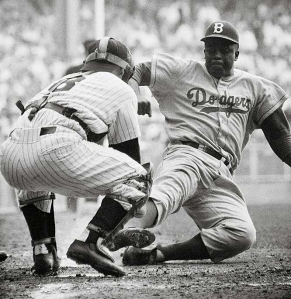
Have people forgotten Jesse Owens and Jackie Robinson?

How quickly they forget

Posted in SESSIUNCULA |
42 Comments