With Diaz nomination, Obama passes major Catholic test [Passes a… what? "Catholic" test? We must discover what this strange claim might mean.]
By John L Allen Jr
Created May 28, 2009
By extending an olive branch to pro-lifers during his commencement address at Notre Dame, President Barack Obama seemed to pass his first major Catholic test. This week, by naming an envoy to the Vatican who doesn’t have a public track record of challenging the bishops on abortion, he’s in effect passed his second. [Hang on. I cannot pass over a claim that what Pres. Obama did at Notre Dame was "extend an olive branch" unless the wood of that branch was part of a Trojan Horse. That was nothing less than subversion. What "test" was he passing? Does anyone think the President’s little suggestion of a "sensible conscience clause" was truly an irenic gesture? See Novak and my own comments elsewhere.]
For extra credit, he demonstrated a good grasp of the changing demographics of American Catholicism by appointing a Hispanic. [Pres. Obama knows a voting block when he sees it.] Measured against what one might have expected from a pro-choice Democrat [VP Biden] and a non-Catholic, Obama’s Catholic report card so far appears to look pretty good.
On Wednesday, the White House announced the appointment of Miguel Diaz, 45, an associate professor of theology at the College of St. Benedict and St. John’s University, as the ambassador of the United States to the Holy See. Born in Cuba, Diaz and his family left when he was eight, eventually settling in Miami. He has working-class roots; his father was a waiter and his mother a seamstress. Assuming Diaz is confirmed by the Senate, [And this is the wind driving the many gears of the mill these days…] his first major task ought to be arranging a meeting between Obama and Pope Benedict XVI around the time of the G-8 meeting in Italy this July.
Early Vatican reaction seems positive. Archbishop Pietro Sambi, the pope’s ambassador to the United States, called the Diaz appointment “an excellent choice of a representative who knows both the United States and the Catholic Church very well,” in an interview on Thursday with Italy’s ANSA news service.
Sambi added that as a Cuban-America immigrant, Diaz also “is a good representative of Spanish-speaking Catholics” in America.
That’s not to say, of course, that the choice is utterly uncontroversial. [Safe to say.] Diaz served on a Catholic advisory board for Obama during the 2008 campaign, and recently signed a letter in support of the nomination of Kathleen Sebelius as Health and Human Services Secretary despite her record of favoring abortion rights. One conservative Catholic media outlet thus styled the Diaz appointment “the first payback of the Obama administration to Catholics who have been unconditionally supporting his policies and appointments.” The fact that the usual Catholic suspects in the pro-Obama camp immediately hailed the appointment has also stoked concern in more conservative circles. [True. If they are in favor of the appointment, something must be wrong.]
Yet Diaz is described by colleagues as broadly pro-life, and in any event he has never been among the most prominent Catholic apologists for a “soft” position on abortion. ["Broadly" pro-life. Is that the right position for a Catholic? "Broadly" could mean just about anything.] In that sense, no one in the Vatican is likely to style the appointment as provocative. [And even if it was not seen in a good light, some in the Secretariat of State would set theological concerns aside for the sake of a meeting in July.] (Rome may have other concerns, chief among them the extent to which a fairly obscure theology professor from Minnesota is likely to carry serious political weight inside the Obama administration. That remains to be seen.) [Why is that, Mr. Allen, because fly-over Minnesota doesn’t count for anything important?]
Some Catholics may also be alarmed by Diaz’s fondness for Latin American liberation theology, [D’ya think?] which became a bête noir of the Catholic right during the 1970s and ’80s due to its affinities with Marxism and class struggle. References to figures such as Gustavo Gutíerrez and Ignacio Ellacuría run through Diaz’s writings, and one news outlet referred to Diaz as a “Cuban liberation theologian” in its headline. [I wonder if that is fair.] For the record, that’s not really accurate. In his writings, Diaz distinguishes between the “preferential option for the poor” in Latin America and the “preferential option for culture” in Hispanic theology in the United States, focused on the survival of Latino/a identity. [Hmmm. I must observe that Joseph Ratzinger uses some principles of Liberation Theology as starting points for a liturgial theology in his A New Song For The Lord. Think about it: Christ is Lord and Liberator. This is what Christ, the true Actor, is also in liturgy. So, a citation of a liberation theologian doesn’t deserve an automatic censure.]
Anyway, Diaz is nobody’s idea of a radical. [Well… Mr. Allen needs to read the views of some of the people who comment here…. but I digress…] He’s never defended armed revolution, or celebrated a “church from below” in opposition to the hierarchy. His accent has been largely on the importance of community, especially in light of the struggles of immigrant families. In one paper he coined the phrase, “outside the survival of community there is no salvation,” a play on the traditional theological maxim extra ecclesiam nulla salus (“outside the church there is no salvation”).
Looking down the line, the key question is how Diaz’s term in Rome might shape up. [Indeed… inter alia many people become more Catholic after spending some time in Rome…] In that light, the distinctive thing about being the Ambassador to the Holy See is that it’s very much an “ideas” job, which means that it’s better suited for an academic than many other diplomatic assignments one could imagine. The ambassador doesn’t have to worry about trade relationships, security questions, visa policies, and so on — the nuts-and-bolts matters that loom large in most diplomatic postings. The embassy also doesn’t have a large staff or internal bureaucracy. As a result, the ambassador has considerable scope to think outside the box, at least by the normal standards of overseas diplomacy.
The Diaz appointment would seem to open the door to partnerships with the Vatican in at least four areas.
…


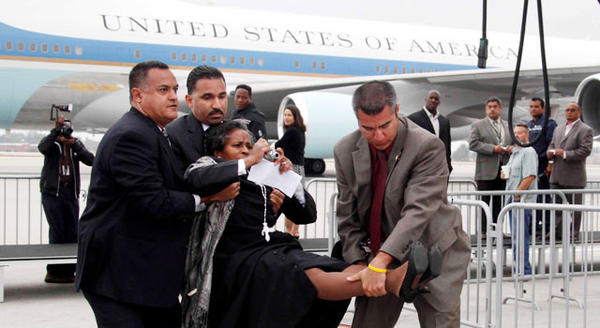 Kicking & Screaming: Journo Dragged From Near Air Force One











 Fr. John Zuhlsdorf on Pope Leo XIV airplane interview: remarks about relaxing Traditional Latin Mass restrictions: “NB: Some of you might have a tendency immediately to get frothy about this. Keep in mind that we’ve been…”




























