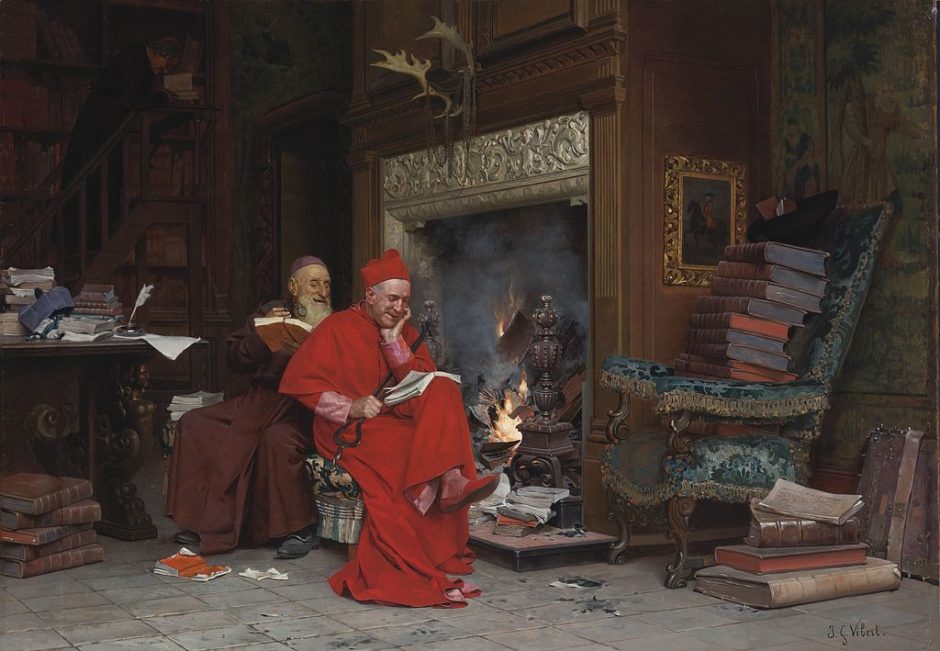
A study in how “nuance” is used to enervate

From the ultra-lefty National Catholic Reporter we have this piece.
A study in how "nuance" is used to enervate
A Georgetown prof is trying…. [btw… nice tie, Father] … to offer a very nuanced position.  The bottom line is that Catholics, especially bishops, are not sophisticated or wise unless they stop stressing abortion.

My emphases and comments.

Bishops urged to restore civility in pro-life efforts
May. 11, 2009
By JERRY FILTEAU

WASHINGTON

Calling the Obama presidency a new moment in U.S. history, Jesuit Fr. John P. Langan of Georgetown University [Where officials of the University covered up for the Holy Name of Jesus when the White House asked them to…] warned April 27 of a current “three-way impasse” on abortion. He urged U.S. bishops seeking real change to act with caution, pastoral care and “civil respect for those with whom they disagree.”  [Guess which bishops are the culprits.   Read on for the answer!]

“The bishops are certainly right to condemn the moral evil of abortion and to warn us against the individualism, selfishness and greed which have had such a devastating effect on American culture and family life as well as on our financial institutions,” he said.

“But [here it comes] if they think they make their witness more credible and more effective by developing a quasi-excommunication of the Democratic Party  [I bet you were waiting for him to politicize this, right?   If you criticize Pres. Obama’s position, or what Notre Dame did, or disagree with the Kmiec Catholics, then you are the one who is being political!  Read on…] and by aligning themselves with politicians who think that combining pro-life slogans with American chauvinism and exercising American military power [HUH?  Is there a nuclear sub I can lay down in front of somewhere?] without regard to international criticism constitutes an adequate response to evil in the world, they are sadly mistaken,” he added.

[And here is the core of this "nuanced" message.] Bishops who try to make abortion the sole or overriding political issue for Catholics are “marginalizing the church’s political influence,” he said.  [Remember to look for their starting points.  He is making an emphasis on the right to be born as a fundamental right into a political issue.  Bishops objecting to the Notre Dame invitation whom I have read are not so narrow as to consider abortion the "sole" issue.  There are many social issues.  But the fact is that while people can disagree on various strategies to confront many social issues, we cannot turn a blind eye on the right to be born.  It is a fundamental right.  If we cannot defend that right, we cannot defend any other human right.]

Langan is Georgetown’s [get this] Cardinal Joseph Bernardin professor of Catholic social thought and rector of the university’s Jesuit community. He delivered a carefully nuanced analysis ["nuanced" is the key here.  Keep in mind that people who do not think along the lines of Langan and the editors of America (a Jesuit magazine) and Reese are not "nuanced".  As a matter of fact, America thinks they are stupid bigots and sectarians.  Is this a Jesuit thing?  Wait… all three of those examples were American Jesuits, right?] of the Catholic social teaching challenges facing the new Obama administration and the 111th U.S. Congress at a seminar on Capitol Hill, held at the Dirksen Senate Office Building and sponsored by The Catholic University of America’s Life Cycle Institute.

[Okay… now we shift gears…] Langan pulled no punches on Catholic politicians who do not embrace the church’s teachings against abortion. “Catholic Democrats in political and civil life will need to show that they are ready to criticize the practice of abortion and that they do not regard it as the unquestionable exercise of an inherent right or as a morally trivial private choice,” he said.[Okay… he politicized the issue, but he at least didn’t shy away from mentioning a problem that tends to be more prevalent among Catholic Dems.]  “The teaching of the church needs to make some difference in their political behavior and should not be relegated to a purely private realm.”  [True.]

But at the same time he excoriated ["excoriate" literally means to peal off the skin, flay.] those bishops — and single-issue pro-life advocates they directly or indirectly support — who put all supporters of legal abortion in a single camp as proponents of the “culture of death,” and who advocate systematic resistance to Obama and his administration on absolutist grounds of opposition to his abortion policies.  [So… he wants something less that absolute opposition to abortion?]

“Even for those who believe that it is seriously wrong to vote for Obama or for other pro-choice candidates, it would be a mistake to think that this point justifies a comprehensive rejection of his programs and policies,” Langan said. [Okay… fine.  But I don’t hear that any bishops would oppose everything Pres. Obama proposed simply because of the President’s appalling view and record and expressed intentions about abortion.  Did I miss something in the news?  Is there a bishop who is saying that Catholics should simply oppose Pres. Obama on everything?]  “In fact, it seems clear that Catholics, even those with significant church offices and responsibilities, will need to cooperate with the Obama administration on topics such as immigration reform, financial regulation and foreign aid programs.”  [And….?]

“It would also be a serious extension of a pro-life position beyond its original moral premises to hold that pro-life people should work for the failure of Obama’s presidency,” he added. [Hmmmm…. I wonder then…. is he saying that Catholics should not resist President Obama’s reelection?]  “Failure of a presidency in a time of war and economic crisis is not a prospect that anyone should regard lightly, [True.  But one could say that about any presidency.  And where was the writer during the Bush Administration?  Did he deliver such a nuanced statement also during the Bush Administration?] whether the president’s name is Bush or Obama. National politics in the United States has an inescapably adversarial character, [all politics, everywhere, always] but this is a tendency which thoughtful religious people should look at critically and should try to mitigate rather than reinforce with one-sided demands for righteousness, demands which often turn out to be narrowly focused and rigidly exclusive.”  [Even though there are various "nuances" in this, the bottom line is, as I read this, that abortion can be pushed under the carpet in favor of other issues.  Am I wrong?  Is he not saying that?]

Langan said that while particulars may be debated, the overall thrust of Obama’s plans for energy, the environment, financial recovery and health care reform is “inclusive, egalitarian, communitarian, solidaristic and internationalist” and thus “broadly compatible with Catholic social values.”  [But… that pesky abortion issue…. You see how important it is to be nuanced?]

“There seems to be a fairly strong prima facie case for Catholics to support the Obama administration and its agenda as an effort to move American society somewhat closer to the ideals of Catholic social thought and to move our society forward from the pit which it has dug for itself,” he said.  [So…. we tolerate his projects concerning abortion (about which the Church admits no compromise) for the sake of these other projects (about which people are free to agree or disagree).]

At the same time, he said, Catholic Democrats face a core problem: [Okay… back to Catholic Dems.]  “Even when they do not favor the legal prohibition of abortion, they believe that abortion is a grave moral evil. They would not want to put the Catholic health care system in jeopardy, much less out of business. … So they are between the rock of Peter and the hard place of the post-McGovern Democratic Party, which has been less than welcoming over the years.” [Are we really in the age of a post-McGovern Democratic Party?  I don’t think so.]

He said the proposed path out of that impasse for many Catholic Democrats – not criminalizing abortion, [?  If abortion really is the killing of an innocent human being, should it be protected by law?] but implementing a social and economic agenda that aims to reduce the number of abortions  – “does not satisfy the followers and teachers of the straight and narrow path which leads to the absolute prohibition of abortion, a path which actually leads over some very rough territory and which may well be blocked by insurmountable constitutional and political obstacles.”  [Interpretation: We have lost on the abortion issue.  We must not be rigid on that issue (which we have lost).  We must seek to make progress on those other social issues.  NB: I will repeat what he calls the "proposed plan for Catholic Democrats": "not criminalizing abortion, implementing a social and economic agenda that aims to reduce the number of abortions".]

That proposed path “also fails to satisfy the demand of many pro-choice politicians, activists and experts who favor the full legitimization of abortion as an assertion of reproductive freedom, a choice to be made by women with public funding and support and without public scrutiny,” he said.  [Could be a reference to the "privacy" argument that is the underpinning of Roe v Wade and previous court decisions.]

Such pro-choice leaders, influential in the party and strengthened by the November election results, “feel no need to appeal to pro-life Democrats or to show respect for Catholic teaching on these matters. Their ideological rigidity has the effect of convincing many of the religious that there can be no compromise with what they call ‘the culture of death,’ ” he said.

“What we are looking at,” he said, “is a three-way impasse”:

    * “Pro-life Democrats — and some pro-life Republicans as well — are looking for the Obama administration to offer reassurances with regard to conscience clauses [protecting health care workers who conscientiously oppose abortion] and some signs that it is prepared to take seriously the goal of making abortion rare as well as safe and legal.  [Remember, we have "lost" on this issue, right?  So we have to settle for what we can get.] So far there are not many signs that the administration thinks it necessary or worthwhile to make such concessions” and a continued divide on such issues could fracture the religious and secular wings of the current liberal coalition.
    * “The bishops, meanwhile, have been discovering that the pace of their political involvement is determined by three groups: 1) a minority of bishops who take positions which capture media attention, [Slithery.  First…. John Fisher was in a minority, but he was right.  Is he really suggesting that those bishops do this for media attention?] such as the denial of Communion to pro-choice politicians; [They would do this because it is the right thing to do, and not for reasons of polling, or popularity or attention in the media.]  2) a noisy movement of activists and populists, ["populists"… again… he seems to be veering away from the idea that this is the right thing to do.] which includes many sincerely devout people [but perhaps not nuanced] but also far too many members who use scurrilous and vicious language to attack those who deviate from the antiabortion line which they identify with Catholic orthodoxy; and 3) rationalistic moral theorists [in other words, people who are not nuanced] who hold that all other considerations pale into insignificance in comparison with the intrinsic evil of abortion. In this situation the political influence of the church is likely to be enfeebled and marginalized beyond the dreams of our enemies.”
    * “To an increasing extent, the pro-life movement within the church shows a desire to act in ways which break amicable and civil relations with those both inside and outside our church who favor abortion or who support compromise on this issue. … They lump together both those who deny that abortion is a moral evil and those who believe that even while it is indeed a moral evil, it cannot be effectively forbidden by law in the contemporary United States.”   [Hmmm… is there effectively a different result?  If you are for abortion both from conviction and by action or if you are personally against abortion but you still vote for what favors it… is there is a difference in the end?]

“The bishops need to think carefully,” [they need to be nuanced] Langan commented, “about whether they are showing a heroic resistance to absolute evil or whether they are being used by selfish and dishonest political interests and by zealots who show more passion than judgment when they stubbornly refuse to recognize the limits of what is politically possible in a pluralistic and individualistic society.”

[His recommendation…] He said that the need in the U.S. church today “is for a group of bishops to teach in a way which shows that they are sensitive to the wounded condition of American Catholicism and to the complexities of the life issues in a very imperfect world.”  [I think that means "Stop talking about abortion.  Or if you insist, then don’t impose consequences."  Am I wrong?]

“They will need to show civil respect for those with whom they disagree, pastoral concern for Catholics who may question their teaching and caution in scrutinizing those who offer to fight their battles for them,” he said. 

Jerry Filteau is NCR Washington correspondent.

Posted in SESSIUNCULA, What are they REALLY saying? | Tagged , , , , , , ,
61 Comments

Blog is slllllooooowwwww todayyyyyyy

Sorry, folks.   Don’t know why.

Posted in SESSIUNCULA |
2 Comments

Chief Islamic Judge of Palestinian Authority attacks Israel & Benedict XVI walks out

I imagined something would happen to create tension.

No surprise that something controversial would happen during the Pope’s trip to the Holy Land, right?

This is in from the Jerusalem Post.

Sheikh attacks Israel, pope walks out

Chief Islamic Judge of the Palestinian Authority, Sheikh Tayseer Rajab Tamimi, launched a poisonous verbal attack at Israel at a Monday night gathering attended by Pope Benedict XVI.

In a meeting with organizations involved in inter-religious dialogue at the Notre Dame Jerusalem Center, Tamimi called upon Muslims and Christians to unite against what he said were the murderous Israelis. 

Taking the podium after the pope without being on the original list of speakers scheduled for the evening, Tamimi, speaking at length in Arabic, accused Israel of murdering women and children in Gaza and making Palestinians refugees, and declared Jerusalem the eternal Palestinian capital.  [Yah… that’s irenic.  What a slimy thing to do… take advantage of the Pope’s presence like that.]

Following the diatribe and before the meeting was officially over, the pope exited the premises. Army Radio reported that the pope shook Tamimi’s hand before walking out.

Minutes after the embarrassing occurrence, Father Federico Lombardi, director of the Holy See press office, released a response to the incident.

"The intervention of Sheikh Tayseer Tamimi was not previewed by the organizers of the interreligious meeting that took place at Notre Dame Centre in Jerusalem," the message read. "In a meeting dedicated to dialogue, this intervention was a direct negation of what [it] should be," it continued.

"We hope that such an incident will not damage the mission of the Holy Father aiming at promoting peace and interreligious dialogue, as he has clearly affirmed in many occasions in this pilgrimage," Father Lombardi added.

"We hope also that interreligious dialogue in the holy land will not be damaged by this incident," the message concluded.

Nine years ago, Tamimi caused a similar scandal when at an interfaith meeting attended by then-Pope John Paul II at the Notre Dame Jerusalem Center, the Palestinian religious leader condemned Israel for a long list of offenses.  [Why. Was. He. There. … ?]

Never referring to Israel by name, Tamimi had called on ‘the occupier’ to stop ‘strangling Jerusalem and oppressing its residents.‘

Singling out land confiscations, house demolitions, settlements and the Baruch Goldstein shooting in 1994, Tamimi had said Israel has a long record of ‘genocide’ and ‘shooting and wounding Palestinian children.’

Gil Hoffman contributed to this report.

Posted in SESSIUNCULA |
36 Comments

A nice response to a call for your good news

Someone sent a photo of her son receiving 1st Holy Communion.

Nice!

A nice response to a call for your good news

The world keeps turning and we must keep turning toward the Lord.

Posted in Brick by Brick, Lighter fare |
13 Comments

“Revisiting the Novus Ordo”

On his blog Musings of a Pertinacious Papist, Philip Blosser offers the following interesting commentary.   You should definitely go over there and read the comments that follow, but this is worthy of discussion here. 

My emphases and comments.

Revisiting the Novus Ordo

After more than a year of assisting exclusively at Extraordinary Form Masses on Sundays, a Mass I have come to love, I had two occasions last summer to revisit the Roman Rite in its Ordinary Form in a large suburban Catholic parish — the same parish on both occasions. The following are my observations.

I begin with the positive. The church operates a Catholic school. Together they form a large, sprawling physical plant. The Masses are well attended. When you walk into the church, you are greeted by holy water fonts at the entrance, a prominently displayed crucifix above the altar, candles, an identifiable Tabernacle, baptismal font, and pews with kneelers. [Sadly kneelers are not always found in large suburban parishes, especially of newer construction.] The pews quickly fill as the opening hymn begins. There are families and individuals of all ages, and many children, from toddlers to teens. The choir is large and reasonably well-trained, and lodged in a loft at the rear of the church. [Very good!  Get them the heck away from the sanctuary!] The priest processes in behind a crucifer, two servers, and a lector, kisses the altar and begins Mass straightaway with the Sign of the Cross. There are no clowns. There are no bongos, no electric guitars. There is no dancing in the aisles. The homily is recognizably Christian and notably earnest and sincere in tone; and the people visibly like their priest.  [Sounds pretty good!  I think many people would be delighted to have what has been described.]

I proceed, next, not to the negative, but to the ambiguous. [I like his distinction.] One question that keeps recurring to me is this: What about this religious rite and ritual would be recognizably Catholic to someone who didn’t know what it was beforehand?  [Excellent!] There is no question about its being Christian. Yet many of these things — the crucifix, the procession, the altar, the candles, the Nicene Creed, the kneeling, the filing up to receive communion — I have seen in Episcopal, Lutheran, and even Presbyterian churches.  [Aha… we are getting at what makes it Catholic.  We are back to asking questions about the connection of Catholic worship and Catholic identity.]

First of all, the acts of genuflecting and overt references to "sacrifice" ("Pray, my brothers and sisters, that our sacrifice …") [the new translation will help make this clearler] would narrow it down to either a Catholic or Episcopal (Anglican) liturgy, since the Episcopalians also genuflect and the Episcopal liturgy also refers obliquely to "sacrifice" ("… a full, perfect, and sufficient sacrifice, oblation, and satisfaction, for the sins of the whole world"), and there is no way this spartan rite could possibly be Eastern Orthodox.

Second, the only external signs by which this event could be decisively identified as Catholic, apart from the overt references to things Catholic in the homily, it seems to me, are the references to the Pope and local bishop in the Eucharistic Prayers, and the visible presence of the Tabernacle with the reserved Sacrament. These one would not generally find anywhere but in a Catholic church.

I proceed, finally, to the negative. If nothing else identified this place and this event as recognizably Catholic to someone already familiar with contemporary American Catholicism, all doubt would be banished by the withering ugliness of the architecture, the sloppiness of dress, the sheer shabbiness of the half-improvised liturgical form, the hideous banality of hymns, the utter lack of decorum and unmistakable note of tawdry casual chumminess struck throughout the event. For better or worse, this is what the vast majority of contemporary Catholics call home.  [ouch]

During the entrance procession, the priest stops to shake hands and talk with people along the aisle several times en route to the altar, patting a couple of backs.  [We are getting into the ars celebrandi.  I refer everyone to Pope Benedict’s Sacramentum caritatis.] Crucifer and servers slouch down the aisle in sneakers and jeans, vested in what look like Halloween costume sheets wrapped around them. Some people show up in what looks like beach attire. Several little kids run around the aisles throughout the liturgy. During the hymns, the choir sings the usual hidebound Haugen and Haas offerings, but virtually no one in the congregation sings. Participation seems to mean showing up and sitting back, like a casual spectator.  [Two points.  First, the common accusation of enemies of the older Mass is that people are reduced to casual spectators.  HA!  Second, sometimes in advising people while I hear confessions I remind that that we should consider our company.  Isn’t it true that when we are in a group of people behaving in a certain way, it becomes far easier for us to do the same?  The flip side is that our behaviour makes it easier for others to behave as we do.   The role of the congregation – individuals in the congregation is very important.  As a matter of fact, the congregation and individuals in the congregation can also affect the priest and his ars celebrandi.]

During the Presentation of the Gifts, those who bring up the gifts join with the priest in saying his prayers over the gifts: "… It will become for us the bread of life. … It will become our spiritual drink," before returning to their pews. The priest seems to have an allergy against using masculine pronouns, even for God. One hears the politicized response: "Let us give God [not ‘Him’] thanks and praise." As he says, "Take this, all of you, and drink from it," the priest lifts the cup (Could this be called a "chalice"?) [It will be, in the new translation.] and gestures with it, holding it out to each side of the congregation expressively, punctuating his words with dramatic pauses and modulating his voice for emphasis. We see him looking out over the congregation. He looks at us. We look at him. The focus is clearly on we who are gathered here and what he is doing for us. If there is any doubt about this, it vanishes in the forest of joined sweaty palms during the Our Father, and cacophony that erupts, recess-like, during the Rite of Peace, the presider himself walking down the aisle, presiding over the shaking of hands all around.  [UGH]

Momentarily, the priest is surrounded by no less than eleven Extraordinary Ministers of Holy Communion, looking for all the world like an out-of-place gentleman in a kitchen full of women. People soon begin shuffling forward (or to the back of the church, depending on where they are seated), to receive Communion. How does one receive here? Of course we have been reminded by Rome that we have the liturgical right to kneel; but where does one kneel here, amidst this confusion of milling people and Eucharistic Ministers? Nobody kneels, and neither do I. What’s the point? Do I want to call attention to myself or make a political statement? I just want to receive Jesus. I already feel compromised by being here. I feel disappointed in myself and by the whole experience.  [Note my comments, above, on the effect of being in a group!   I wrote them as I read.  O my prophetic soul.]

About one fourth of the congregation leaves for the parking lot right after Communion. [Why not.] Maybe half remain until the last verse of the recessional hymn. The words of "Revisiting the Novus Ordo"Martin Mosebach come to mind: "I go to church to see God and come away like a theater critic." [That is what must happen with the whole point of worship falls away from the real goal: an encounter with that alluring and fearsome Mystery which transforms us.]  Throughout the Mass I find that my focus is constantly diverted. Like Mosebach, I just want to "see God." I want to witness the Sacrifice of Christ, and to receive Him. Yet in countless ways, the elements of the Mass conspire to divert my attention away from Him, and towards incidentals – towards those who walk into their pews without genuflecting, towards those wearing what looks like beach attire, toward the chummy bonhomie of the pastor, toward his unusual gestures and voice modulations, towards the politicized gender-bending of words, toward the Eucharistic Minister who doesn’t seem to know what to do with my mouth open and tongue stuck out at her, toward the unseemly distasteful clutteredness of it all.

Yes, I know, Jesus is here too, just as he was in the stable surrounded by the braying of asses and smelly droppings of cows and goats. Yet I wonder: would it have been harder to find Him and worship Him there than here? Is this the best we can do? For the Lord of Heaven, our Maker and Redeemer?

This is a very good reflection.  I particularly appreciate how he added observations about his own interior struggle.

I have sometimes opined in these electric pages as well as on pulpy newsprint that we we may be at a point where the older form of Mass stands as the form of the Church’s worship for those who are ready for more serious spiritual nourishment.  This is not to say that we cannot be spiritual nourished by the newer forms.   Depending on how they are celebrated, they certainly can be very nourishing.  And of course the Most Holy Eucharist is beyond any sort of judgment in this regard.  Nevertheless we are creatures of body and soul.  The rites truly matter.

I myself note each time I say Holy Mass with he Novus Ordo how very different the experience is from saying the older form.  I conform myself and what I do to the continuity of the Roman Rite, but the newer form remains different in many important respects.

This is a very good topic for thoughtful reflection and conversation among the level-headed.

Thus, if you are going to post, think.  

Don’t simply post a litany of abuses you see in your parish. 

Don’t whine.  That is meaningless for the conversation here.

Posted in SESSIUNCULA |
125 Comments

John Allen on the Pope in Israel

My friend John L. Allen, Jr, the nearly ubiquitous fair-minded correspondent for the dissenting National Catholic Reporter has a report with reflections on the Pope’s visit to the Holy Land.

My emphases and comments.

Tel Aviv/Jerusalem, Israel

Especially in light of the recent uproar about Benedict XVI’s rehabilitation of a Holocaust-denying bishop, [We must never forget that all Pope Benedict did was give those SSPX bishops the ability to go to confession.] a key drama heading into his visit to Israel was whether the pontiff’s need to mend fences with Jews would blunt his message about a just resolution to the Israeli/Palestinian conflict, especially the "two-state solution."

Another way of putting that question is whether Benedict would emphasize the past or the future, the memory of the Holocaust or the present reality of the Middle East. Today the pope seemed to provide an answer, which was: He’ll do both. [An interesting way to frame the question… past and future.]

Shortly after his arrival at Tel Aviv’s Ben Gurion Airport, Benedict honored the memory of the "six million Jewish victims of the Shoah" and insisted that "every effort must be made to fight anti-Semitism wherever it is found."

Later, Benedict paid tribute to the victims again within a visit to Yad Vashem, Israel’s main Holocaust memorial, insisting that their suffering "never be denied, belittled or forgotten" – the closest he came to a reference, however indirect, to the controversy surrounding traditionalist Bishop Richard Williamson, who has claimed that the Nazis didn’t use gas chambers and that six million Jews didn’t die during the Holocaust.  [I wonder if this is reading too much?  Maybe… maybe not.]

"May the names of these victims never perish!" the pope said. "May all people of goodwill remain vigilant in rooting out from the heart of man anything that could lead to tragedies such as this!"  [The flip side of this is, "May the names of those who truly helped the Jews in WWII never perish!"]

Back at the airport, however, the pope also offered a fairly direct endorsement of the two-state solution to the Israeli-Palestinian conflict, wading directly into the political crisis of the Middle East.  [Benedict XVI has not made strong geo-political statements, as did his predecessor.]

With Israeli President Shimon Peres and Prime Minister Benjamin Netanyahu looking on, Benedict XVI prayed that "both peoples may live in peace in a homeland of their own, within secure and internationally recognized borders."

That comment comes at a time when Netanyahu’s new government is sending mixed signals about its commitment to Palestinian statehood.

Echoing another long-standing article of the Vatican’s diplomatic position, Benedict said he hoped that "all pilgrims to the holy places will be able to access them freely and without restraint, to take part in religious ceremonies and to promote the worthy upkeep of places of worship on sacred sites."

The traditional Vatican formula for the holy sites has been the desire for an "internationally guaranteed special status."

Later in the day, in a meeting with Peres at the Presidential Palace in Tel Aviv, Benedict argued that security depends upon justice, invoking the Hebrew term batah, meaning not just the absence of threat but a sensation of "calmness and confidence."  [This is in perfect harmony with what the Pope wrote in his 1st Letter for the World Day for Peace, 1 Jan 2006.  The Pope spoke of the conditions for true peace as being more than the absence of war.]

"Security, integrity, justice and peace: In God’s design for the world, these are inseparable," the pope said. Benedict warned against the influence of "particular interests or piecemeal politics," urging the peoples of the region to recognize one another as "my equal, my brother, my sister."

The pope also said he wanted to address the ordinary families of Israel.

"What parents would ever want violence, insecurity, or disunity for their son or daughter?" he asked. "What humane end can ever be served through conflict and violence?"

"I hear the cry of those who live in this land for justice, for peace, for respect for their dignity, for lasting security, a daily life free from the fear of outside threats and senseless violence," the pope said.

All in all, it seemed Benedict XVI was determined today to hit the ground running – outlining what will be the main themes of his four-day visit to Israel and the Palestinian Territories, after wrapping up three days in Jordan.

The pope’s language on the Holocaust was forceful.

"It is right and fitting that, during my stay in Israel, I will have the opportunity to honor the memory of the six million Jewish victims of the Shoah, and to pray that humanity will never again witness a crime of such magnitude."

Similarly, the pope’s commitment to fight anti-Semitism, and all forms of intolerance, seemed unambiguous.

"The church is committed to praying and working tirelessly to ensure that hatred will never reign in the hearts of men again," he said during his visit to Yad Vashem. In reflecting on the importance of remembering the victims by name, Benedict said they fell prey to a "horrific tragedy" based upon an "insidious web of lies."

To what extent Benedict’s comments on the Holocaust, and on anti-Semitism, will satisfy Jewish sensitivities, is not yet clear. On the eve of his arrival, Jewish reaction to Benedict’s visit appeared divided.

Rabbi Abraham Cooper, from the U.S.-based Simon Wiesenthal Center, said on the "Huffington Post" web site that Benedict’s pilgrimage "presents an opportunity for Jews to acknowledge that today, this church, once a main source of anti-Semitism, openly recognizes our people’s right to pursue its unique historic and spiritual destiny."  [In other words that there is no need for Jews to covert and that the Church should never make claims about its own unique role in the salvation of all people.]

Yet a Israel-based group called the "Task Force to Save the Nation and Land," headed by Rabbis Yaakov Yosef and Shalom Dov Wolpe, sent a telegram to Israel’s two Chief Rabbis protesting their plans to meet the pope.

"This involves a desecration of God’s Name… The very meeting and recognition of him is related to idol worship, if not outright idol worship, and involves a sin that one must die for and not violate," the protesting rabbis wrote.  [These folks would stone the Pope, all Christians, and any who deal with them?  Is that what this says?]

Later this evening, Benedict was scheduled to take part in an inter-faith meeting at Jerusalem’s Notre Dame Center, a pilgrimage and ecumenical center which was entrusted by the late Pope John Paul II to the Legionaries of Christ in 2004.

Tomorrow, Benedict XVI will visit both the Dome of the Rock and the Western Wall, holding meetings with the Grand Mufti and the two Grand Rabbis of Jerusalem, and celebrate a Mass near the Mount of Olives.


Mr. Allen is a pretty good analyst.

Posted in SESSIUNCULA |
17 Comments

Prominent rabbi urges Pope to say Jews need not convert

Here is an interesting piece from Catholic Culture.

My emphases.

Prominent rabbi urges Pope to say Jews need not convert
May 11, 2009

The co-chairman of the Bilateral Commission of the Chief Rabbinate of Israel and the Holy See is urging Pope Benedict to state publicly that Jews need not convert to Catholicism.  Rabbi Shear Yashuv Cohen, who addressed the Synod of Bishops last October, writes:

    In the Second Vatican Council and the Nostra Aetate document, it was made clear that no efforts would be made by the Catholic Church to convert Jews. Rather, the Jewish people should continue the faith of its forefathers as expressed in the Bible and rabbinic literature. The Jewish people remain a people of God’s covenant, a people chosen by God to give the world the Bible. Put simply, the Catholic Church accepted the theological principle that Jews need not change their religion to merit redemption. I hope you will take the opportunity during your visit in Israel to reiterate this fact … I do hope now to get your help as a religious leader– as well as the help of the entire free world– to protect, defend and save Israel, the one and only sovereign state of the "People of the Book" from the hands of its enemies.

…

There is more.  You can go there and read it yourself.

Posted in SESSIUNCULA |
Comments Off on Prominent rabbi urges Pope to say Jews need not convert

The struggle over the Secretary

The fine Italian language blog Rinascimento Sacro has an interesting post (my translation).

Canizares: either Ranjith or a Benedictine
Andrea Tornielli

The illness of the Prefect of the Congregation for Divine Worship, Card. Canizares, now well overcome, caused the delay of the publication of the appointment of the Secretary of the same Congregation, Sri Lankan Archbishop Malcom Ranjith Patabendige Don as Archbishop of Colombo, now decided for some time.  There are those who speak of days or weeks, even some months.  Certainly there is an arm wrestling context about the appointment of the new Secretary, given the key role which this dicastery has in advancing the reconciliation on the "battlefield" of the liturgy and in seeking to implement the "reform of the reform" long desired for many years ago by then-Cardinal Ratzinger.  Canizares, the ex-Archbishop of Toledo, nicknamed "little Ratzinger", would want Ranjith to still remain in Rome.  In the probable case that he is not able to keep him, he would want as his number two a collaborator which continues along the same line.  The only certainty is that he would be an anglophone.  But at the moment it is useless to forward names (and there are some), because the situation is in continuous evolution.

I have been in contact with a few of my spies.

I think what is going on here is that Archbp. Ranjith’s enemies have really started pushing to get rid of him by promoting him to the see of Colombo.  However, Card. Canizares very much intends to advance the liturgical and ecclesiological vision of Pope Benedict.  For that he needs to have the right Secretary, who will not fight him.  Ranjith’s enemies want someone who will balance Card. Canizares (read: thwart).

I remember once in the office I worked in long ago, the Cardinal President, His Eminence Card. Mayer (now our oldest living Cardinal) was having a bit of a dispute with the Secretariat of State over an important point.  Eventually it came to the point where Card. Mayer suggested that if it was his own person which was the obstacle, he would be happy to step down and let his position be filled by someone else.  They really didn’t want that, for it would put the Holy Father is a tough position: he would have to fill that highly controversial chair at a difficult time.

It strikes me that something of that same struggle is going on here.  The enemies of the Pope’s agenda have a strong hand, but so does Card. Canizares.  However, choosing a new Secretary of the CDWDS is far less problematic for the Holy Father than choosing a new Prefect to replace someone who has just been in office for a few months.

The thing which makes me pause a little is that opening to an alternative, a "benedettiano"… a "Benedictine", not in the sense of a Benedictine monk, but someone who is in on Pope Benedict’s team.

It is too early to forward names.

I could make some suggestions!

Should it come to pass that Archbp. Ranjith is moved to Colombo, I will wager that the new man would also be not only sympathetic the older liturgy.  

My random thoughts:

The Pontifical Commission "Ecclesia Dei" is going to be more closely associate with the Congregation for the Doctrine of the Faith.  The reason for this is clear: there will need to be doctrinal talks with the SSPX and the PCED is still the competent dicastery.  However, the liturgical oversight exercised by the PCED will have to go to the CDWDS someday.  There will have to be desk at the Congregation which resolves liturgical questions.  There must be some folks in the Congregation competent to handle these questions (…actually, there are now!).  Archbp. Ranjith fills that bill at this time.  If he moves, the new man will have to have some liturgical competence.

So… an anglophone, an English speaker… in harmony with Benedict XVI’s liturgy and ecclesiological vision for the Church… of good reputation and/or record of scholarship… friendly to (if not also versed in) the older form of Mass….

Too early for names, but we should keep watching for small signs.

Posted in SESSIUNCULA |
33 Comments

How many bishops have publicly objected to Notre Dame?

Here is a list, thanks to Sober Inebriation

70 Bishops so far

1. Bishop John D’Arcy, Fort Wayne-South Bend
2. Cardinal Francis George, Chicago
3. Cardinal Daniel DiNardo, Galveston-Houston
4. Archbishop Timothy Dolan, Milwaukee (–> NYC)
5. Archbishop John Nienstedt, St. Paul-Minneapolis
6. Archbishop Eusebius Beltran, Oklahoma City
7. Bishop Edward Slattery, Tulsa
8. Archbishop John Myers, Newark
9. Archbishop Alfred Hughs, New Orleans
10. Bishop Joseph Martino, Scranton
11. Auxiliary Bishop John Dougherty, Scranton
12. Bishop Thomas Doran, Rockford, Ill.
13. Bishop Thomas Olmsted, Phoenix
14. Bishop Gregory Aymond, Austin
15. Bishop Robert Lynch, St. Petersburg
16. Bishop R. Walker Nickless, Sioux City
17. Bishop Kevin Rhoades, Harrisburg, Pa.
18. Bishop William E. Lori, Bridgeport, CT
19. Bishop Robert Morlino, Madison WI
20. Bishop George Murry, S.J., Youngstown, OH
21. Bishop William Higi, Lafayette, IN
22. Bishop Anthony Taylor of Little Rock, AR
23. Archbishop Jose Gomez, San Antonio, TX
24. Auxiliary Bishop Oscar Cantu
25. Bishiop Jerome Listecki, La Crosse, WI
26. Archbishop Edwin O’Brien, Baltimore MD
27. Bishop Alex Sample, Marquette MI
28. Archbishop Daniel Buechlein, Indianapolis
29. Bishop Robert Baker, Birmingham AL
30. Bishop Samuel Aquila, Fargo ND
31. Bishop Gerald Barbarito, Palm Beach FL
32. Bishop Fabian Brukeswitz, Lincoln NE
33. Bishop Richard Stika, Knoxville TN
34. Bishop Robert Finn, Kansas City
35. Bishop Joseph Latino, Jackson MS
36. Bishop Leonard Blair, Toledo OH
37. Bishop Gerald Gettelfinger, Evansville IN
38. Bishop George Lucas, Springfield IL
39. Archbishop Daniel Pilarczyk, Cincinnati OH
40. Bishop Thomas Wenski, Orlando FL
41. Bishop Robert Vasa, Baker OR
42. Bishop Paul Coakley, Salina KS
43. Bishop John Le Voir, New Ulm MN
44. Bishop Victor Galeone, St. Augustine FL
45. Bishop David Zubik, Pittsburgh PA
46. Bishop Paul Loverde, Arlington VA
47. Archbishop Joseph Naumann, Kansas City, KS
48. Bishop Peter Jugis of Charlotte, NC
49. Bishop William Murphy of Rockville Center, NY
50. Archbishop Charles Chaput of Denver, CO
51. Bishop Glen Provost of Lake Charles LA
52. Bishop Joseph Galante of Camden, NJ
53. Cardinal Rigali of Philadelphia, PA
54. Bishop John McCormack of Manchester, NH
55. Archbishop Doland Wuerl of Washington, DC (somewhat)
56. Bishop Bernard Harrington of Winona, MN
57. Bishop Michael Warfel of Great Falls-Billings, MT
58. Bishop Michael Jackels of Wichita, KS
59. Bishop James Johnson of Springfield – Cape Girardeau, MO
60. Bishop Edward Cullen of Allentown, PA (diocesan newspaper)
61. (Aux.) Bishop Roger Gries of Cleveland, OH (highschool address)
62. Bishop Robert Hermann, apostolic administrator of St. Louis, MO
63. Bishop David Ricken of Green Bay, WI
64. Bishop Remundo Pena of Brownsville, TX
65. Bishop George Thomas of Helena, MT
66. Cardinal Sean O’Malley of Boston, MA at Boston College Law School
67. Bishop John Gaydos of Jefferson City (in the Catholic Missourian)
68. Bishop Lawrence Brandt of Greensburg, PA
69. Bishop Nicholas DiMarzio of Brooklyn, NY
70. Bishop Joseph of Altoona-Johnstown, PA

Posted in SESSIUNCULA |
57 Comments

CNA: English-speaking conference in Rome for ‘Year for Priests’

From CNA:

English-speaking priests called to Rome for ‘Year for the Priests’ seminar

Harrisburg, Pa., May 10, 2009 / 08:41 pm (CNA).- In honor of the 223rd birthday of St. John Vianney, two of the largest English-speaking associations for parish priests and deacons have announced a joint conference in Rome to encourage the ongoing formation of clergy.

Pope Benedict has designated 2010 as the Year of Priests and has invoked the patronage of the Curé of Ars, St. John Vianney. Vianney, the patron saint of parish priests, who was born on May 8, 1786 and ministered in France. He became so well-known for his spiritual direction that pilgrims would come from distant places to speak with him.

The Australian Confraternity of Catholic Clergy and the American Confraternity of Catholic Clergy have responded to the Year of Priests and organized a special seminar in Rome to “promote ongoing formation of the clergy in a fraternal setting.” The seminar is in response to the call of the Second Vatican Council and supported by Cannon Law.

Speakers will be selected based upon their “orthodoxy and loyalty to the Magisterium.” All priests and deacons from English speaking countries are invited to attend the event regardless of their membership to either the ACCC or CCC.

National Chairman, Rev. Michael Kennedy, PP, (Australia) and President, Rev. John Trigilio, Jr, PhD, (U.S.A.) have urged their members to “honor Pope Benedict’s Year for the Priests by coming to Rome in January 2010 to spend time in prayer, study, and sacerdotal fraternity.”

Posted in SESSIUNCULA |
4 Comments























