QUAERITUR: substituting for a subdeacon

QUAERITUR: substituting for a subdeaconFrom a seminarian reader, rewritten for anonymity:

I was told that having a layman (including a seminarian/acolyte) serve as a sub-deacon constitutes an abuse. Sed contra, the FSSP regularly has seminarian sub-deacons. Do you know of any official documents which address this question?

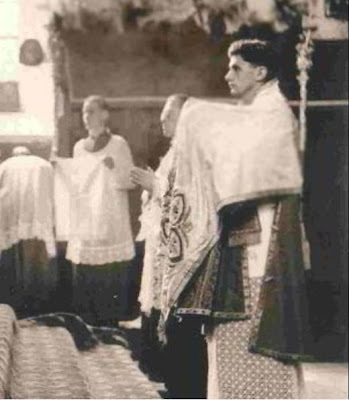
The points of the argument you need to know are these.  First, it was in the past always possible for a cleric in minor orders or a man who was at least tonsured to substitute for a subdeacon.  In that case the rubrics changed a bit, for there were things he couldn’t do.

Also, when Pope Paul VI abolished the minor orders with Ministeria quaedam, he said that the role of the subdeacon was assumed by the new version of lector and acolyte.  He also said that the newer acolyte could be called "subdeacon".  The idea being that the new version of the acolyte was to aid the deacon.  That sounds like a sub-deacon to me.

In the past, even though the rubrics assumed that those serving in all roles in the sanctuary were tonsured clerics, the non-tonsured, non-cleric substituted for altar servers in the natural course of things.  So it is today.  So it is that non-acolytes and non-lectors substitute for those installed ministries now. 

It seems to me that what could be done in the past is reasonable to do now. 

Moreover, the Pontifical Commission "Ecclesia Dei" once responded to a question posed by the Australian Ecclesia Dei Society in the early nineties about this very issued.  The PCED said then that, yes, an officially installed acolyte could take the role of the subdeacon in a Solemn Mass if a cleric wasn’t there to take the role.  I am sure that the PCED would reiterate that now were a dubium offered at that office.  He would have to be an installed acolyte.  He would not wear a maniple.  He would not wipe the chalice after the ablusions, etc.  The reference for this PCED letter is 7 June 1993, Prot. 24/92 to the Australian Ecclesia Dei Society.

An officially installed acolyte can substitute for the subdeacon… especially because there really aren’t any true subdeacons around anymore.  The clerical state begins with diaconate now, no matter what is done in the traditional groups.QUAERITUR: substituting for a subdeacon

Based on the above, I think it is wrong to say that a non-cleric substituting for an absent subdeacon in a solemn TLM is an "abuse".  It is not the ideal, but it wasn’t an abuse in the past.  It is not an abuse now.  Someone who says it is an abuse should produce his own documentation saying that it is. 

In the meantime, the PCED had and has competence in this matter.

In a seminary setting, however, there ought to be quite a few available installed acolytes and, better yet, ordained deacons.  Priests and deacons can take those roles.  Why not have a deacon take that role if this is a problem for the faculty?  Get some work out the deacons for a change!  o{];¬)

For notes and documentation, you need to 1983 Code, Ministeria quaedam, and you can get help from the new (and older) edition of Fortescue-O’Connell edited by Reid.

Posted in "How To..." - Practical Notes, ASK FATHER Question Box, Classic Posts, SESSIUNCULA | Tagged , ,
41 Comments

QUAERITUR: I was supposed to love the TLM, but I hated it!

From a reader with my emphases and comments:

I’ve been following your blog quite attentively for a few months now and all my reading convinced me that I needed to give the Extraordinary Form of the Mass a try ASAP. This Sunday I attended a High Mass at the EF here in ____. I loved the sense of reverence, mystery, and sacred space that filled the church. I really appreciated the symbolism of ad orientem posture. Praying in Latin is something I always enjoy since I studied that language from age 11 into my college years.

Still, the Mass was overall a very frustrating experience for me. I thought I was prepared – I had researched the order of the Mass beforehand, I knew my participation would be mostly interior. [very good] Even following along in my little Latin-English booklet, though, I often had no clue what was going on before me. This was mostly due to the fact that I could not hear anything the priest said for most of the Mass. I understand that some prayers are "secret" or whispered, but I honestly heard about 5 sentences after the homily. Is this normal for an EF Mass, or was I just stuck in a back pew with poor acoustics?  [I obviously can’t answer that!  o{]:¬) ] By the end I was so frustrated that I began to understand the attraction of Vatican II reforms and even Protestant tent revival services.

Anyway, here is my question. Afterwards I discussed my impressions with my roommate, who has her master’s in sacred music but is much more liberal than I. I told her about the attack of Catholic guilt I was experiencing – "I’m supposed to love this [the EF] because it’s all sublime and profound, but mostly I hated it!" She told me that she opposes the EF – not a big surprise. Her reasoning is that we believe the Holy Spirit is at work in Church councils. If the Church ultimately rejects the Novus Ordo and goes back to the  older form of the Mass, doesn’t that claim the Holy Spirit was somehow absent at Vatican II?

How would you answer her?

There are several things to address here.

First, I wonder if you didn’t experience Catholic growing-pains?  You might have made an important step in your own liturgical/spiritual growth.  On the one hand you were tuned in to all the right things (reverence, the sacred, mystery)!  On the other you were frustrated because you were being called upon to participate in a way different from your previous and habitual experience.  You are young and have not had this older, traditional experience yet.  You are used to sensory things being fed to you in easy to swallow form.  You are used to the chattier nature of the newer form of Holy Mass.  It is understandable that, not being familiar with the higher form of the older Mass you might have been a little overwhelmed.   The next time you go, it may be a very different experience for you.. or the time after that.

About your roommate’s comments I must say that while we of course believe that the Holy Spirit is at work in the Church’s Councils, the documents of the Councils were not written by automatic writing while the Spirit guided the pen.  They are the work of men aided by grace.  Pope Benedict in the past described the work of a Council or conclave in healthy terms saying that the role of the Holy Spirit was to make sure that we, in our own efforts, didn’t bring about a mortal disaster for the Church. 

Secondly, the Church gets to decide how we pray as a Church.  Changes are necessary at times.  Even abrogation of the Novus Ordo would not mean that the Holy Spirit wasn’t involved in the Council.  It would only mean that the proper authority recognized that our times require something else.

Thirdly, the Council Fathers mandated that some changes be made to reform the Church’s prayerlife.  However, the changes we actually got went far far beyond what the Council Fathers ordered.  The history of this is pretty complicated but those who were put in charge of the reform had their own agenda.  The central characters involved, in their own subsequent books describing what they hoped to do, expose their motives, their goals and their methods. 

In short, the reform the Council mandated is not the reform we got!

Pope Benedict is working to help the Church return to a better understanding of liturgy and liturgical reform.  He is trying to bring our liturgical life into continuity with our millennial tradition of prayer.  He is trying to heal the rupture that took place as a result of the distortion of the Council’s mandates.

You are fortunate to be the age you are, for you missed the truly bitter years.  That doesn’t not mean that their won’t be challenges.  You experienced some growing pains, as we all must.

Finally, I have posted here a couple entries whereunder people gave their own accounts of their first impressions of the older form of Mass.  I don’t have the links handy at the moment.  Perhaps a reader can dig them up.  There were many responses and some of them might be helpful.  I’ll add the link here when I get it.

Posted in "How To..." - Practical Notes, ASK FATHER Question Box, Brick by Brick, Classic Posts, Linking Back, SUMMORUM PONTIFICUM | Tagged , ,
138 Comments

Prayer request

Please stop now and pray for Fr. "J", who is in need.

Posted in SESSIUNCULA |
22 Comments

WDTPRS congratulates Amb. Glendon

I congratulate former the US Ambassador to the Holy See Mary Ann Glendon for her decision to decline Notre Dame’s Laetare medal.

She has set a good example at a serious moment of decision for Catholics in the United States.

As the cultural war becomes more closely fought in the public square, we need strong examples of how to live faithfully our public Catholic identity.

Amb. Glendon might have chosen to receive the award and probably could have done so with a good conscience.  She could have chosen to speak.  However, this gesture on her part was probably the very best she could have made. 

She refused to be objectified by the administration of Notre Dame, instrumentalized as "balance" to President Obama. 

She refused to be a Catholic token on the podium of a "Catholic" University.

WDTPRS sends out regards to Mary Ann Glendon and thanks her for her witness to our Catholic identity in the public square.

Posted in SESSIUNCULA |
19 Comments

QUAERITUR: a proper genuflection

From a reader:

I happened to note in O’Connell, II, 1940, p. 23: "… the Celebrant, when genuflecting at the foot of the altar (especially when genuflecting on the step), must not turn sideways, but directly face the tabernacle."
 
There seems to become a "rule" in many places for a priest to genuflect turning toward the North-East. Not a very attractive view from pews. And not all that reverent. Could you consider writing about it ? 

This came with the subject line "Important".   I am not sure I agree.

My first comment is that this O’Connell’s opinion.  It is a good one, but it is an opinion.  Sometimes people mistake opinions of sound authorities for the discipline legislated by the Church.  In a similar way, various Pope’s had to issue clarifications over the centuries that St. Augustine’s writings, though venerable in a degree hard to parallel, were not the same as the Magisterium of the Church.

Second, I was not able to find this description of the genuflection in the new edition of Fortescue-O’Connell-Reid, which I reviewed HERE. If I missed it, I hope someone will let me know.

Third, O’Connell presents an ideal.  In reality, some days it is easier to genuflect that others.  Age and injury can make it harder to genuflect in the perfect manner described.  That is certainly my situation.  I have had some bad knee injuries from sports and my knees aren’t happy every day.

It is possible that the young who are in the sanctuary might be learning to genuflect to the "north-east" as you put it, from watching older men doing their best to continue to genuflect at all.   Also, it is a little easier to shift to the "north-east" when genuflecting on steps or where there is a kneeler. 

Yes… I think that sacred ministers and those who serve, as well as the faithful, should pay attention to how they genuflect, lest their signs of due reverence become sloppy through the distraction.  This can become habitual.  We should take care to teach children good habits.

Therefore, it is good to be reminded that an authoritative source offers such an idea.

At the same time, this is really not something I would fume about or pick on.  For example, I can imagine a scene in which a priest has been striving to implement Summorum Pontificum, perhaps taking a lot of flack for it.  I can imagine him trying to calm certain factions in the parish, train servers, get singers, struggle with the Latin every week, etc., only to be confronted in the sacristy be some indignant know-it-all who starts in on the priest’s taking off his biretta as he rises rather than before he rises, or genuflecting at the altar step slightly turned to the liturgical "north-east", or not having buckles on his shoes, or having some unpicked nits on the hem of his cassock…. which by the way is too short.

I can imagine it very well, because I have been the recipient of such comments in years past and I can assure you that they are not always as welcome as you might imagine.

Posted in "How To..." - Practical Notes, ASK FATHER Question Box, SESSIUNCULA, SUMMORUM PONTIFICUM | Tagged , ,
14 Comments

Dies non

Sometimes you need a calm day.

Posted in SESSIUNCULA |
19 Comments

Springfield, IL: TLM comeback

From the Springfield Journal Record with my emphases and comments.

Mass trend: Latin making a comeback locally

By STEVEN SPEARIE
Correspondent
Posted Apr 26, 2009 @ 12:00 AM
SPRINGFIELD —

Early on a Saturday morning under the watchful gaze of archangels and the Gospel writers in a darkened church, a voice intones Hail Marys and Our Fathers with measured responses from a smattering across the church.

Worshipers cross themselves with holy water and gather missals while some women pluck mantillas — lace head scarves — from a box sitting on a radiator. Altar servers, dressed in black cassocks and white surplices, ready the altar, pausing to genuflect ramrod-straight each time they pass in front of the tabernacle.   [All these elements would be a marked contrast to most parish across the US…. not all, but most.  I especially like the observation about the care of the altar boys.]

At precisely 7 a.m., the lights burst on at Blessed Sacrament, the bells chime and the Rev. Arnaud Devillers, flanked by the servers, comes out and heads immediately to the back altar near the tabernacle. [There must be also a table altar.]  Kneeling, with his back toward the congregation, [No… he is facing the same direction with the people.] he begins: “In nomine Patris, et Filii et Spiritus Sancti. Amen.”

When Pope Benedict XVI issued an apostolic decree in July 2007 calling for wider implementation of the Traditional Latin Mass — also known as the Tridentine Mass or the Extraordinary Rite — he noted that it isn’t “a museum piece, but a living expression of Catholic worship.”

Largely hidden from Roman Catholics since the late 1960s as a result of Vatican II — a period of sweeping reforms in the Catholic church — the Latin Mass has slowly crept back onto the scene.

Not your everyday Mass [Well… it was and it is.]

Blessed Sacrament Catholic Church in Springfield has been the setting for weekly Latin Mass since Jan. 31; the Church of St. Rose of Lima Chapel in Quincy, where Devillers is chaplain, has offered Latin Masses since November.

Latin Masses in Springfield and Quincy have attracted moderately sized but fervent followings, ranging from those who preferred the pre-Vatican II rituals to those simply curious about the Mass. A 7 a.m. Saturday Mass recently drew about 50 people, [Not bad for that day and time.] where attendance has leveled off.

Like Eastern Catholic and Eastern Orthodox rites, the priest mostly has his back to the congregation [Noooo…]  during the Latin Mass. Masses are punctuated with long silences and — unlike the Masses in English familiar to most area Catholics — an absence of congregational participation. [WRONG!  They are participating actively, alright.  But their participation is more along of the lines of interior active receptivity, than mere outward expression.]  Springfield’s Latin Mass has no music, while a full choir performs at Quincy’s weekly Mass.

Rosanne Wiatroliak, 48, of Springfield says she went to the Latin Mass at Blessed Sacrament “to see what I remembered (from my childhood.)

“I don’t remember being as separated from the Eucharistic celebration (as I did before),” [she isn’t] she says. “I felt like a spectator this time around. [Many do feel that way, at first.  Then they learn what is really going on.] It was harder to follow. I’ve gotten closer to understanding (the Latin) and following along. You really have to stay on your toes unless you’re fluent in it.”  [Yes… people should focus and pay attention… at Mass!]

“It’s a lot more contemplative,” says Jim Dodge, like Wiatroliak a Blessed Sacrament parishioner who lives in Springfield. The 41-year-old took some Latin in high school, but says he leans on a Latin-English missal to follow along.

An eye on the past

Under Pope Benedict’s personal decree, Summorum Pontificum, groups requesting the Latin Mass may approach a pastor who knows how to say one directly, bypassing the bishop. [Well… that is a negative way to put it.  It is better to see this as not burdening the bishop with extra duties.]

While the rite has the enthusiastic support of Springfield Bishop George Lucas, it has created some controversy nationally, with some experts citing Pope Benedict’s aversion to modernism. [I think the Catholic Church has an aversion to modernism (at least on paper!).  But I think the writer doesn’t intend Modernism.  I think he is implying that Pope Benedict has an aversion to anything "modern".  Which isn’t the case.]  There is speculation that it may pave the way for other conservative advances.  [Notice how "conservative" and "modernism" are juxtaposed.]

Devillers is a member of the Priestly Fraternity of St. Peter, a society founded with the endorsement of then-Pope John Paul II with the purpose of celebrating Mass “according to the traditional Roman Rite.”

Before that, Devillers was allied with excommunicated French archbishop Marcel Lefebvre in the Society of St. Pius X. Lefebvre founded the society that opposes some of the modernizing reforms of Vatican II. But Devillers left that society in 1989, citing Lefebvre’s increasingly extremist views.

Lefebrve, who ordained Devillers, broke with the Vatican in 1988 when he illicitly consecrated four bishops, including Bishop Richard Williamson. Williamson has said the numbers of Jewish casualties in World War II were inflated. (Earlier this year, the Vatican lifted the ex-communications on all four bishops, though they are not in full communion with Rome.)

There is also the matter of practicality.

Few Springfield priests feel comfortable with the rite’s arcane rituals, or rubrics, with few having been trained in them.  [A couple things.  The writer uses "arcane" here.  In a sense that rite is good, in that the rites of Mass are about mystery.  However, they are not arcane if he means they are very hard to learn. Any puzzle is easy once you know the answer.  It is simply a matter of learning.  Through the centuries very many priests who weren’t very bright managed to say Mass with the older form.  If they could do it, priests can do it today. ]

The demand of other pastoral services, including Spanish-speaking Masses, may prevent already overworked priests from widely implementing the Latin Mass.  [Not to mention the lack of will.]

Bishop Lucas has periodically granted permission for Latin Masses. But they have been celebrated infrequently over the past decade in the Springfield diocese, which stretches from the Mississippi River towns of Quincy and Alton east to the Indiana border.

Devillers says Pope Benedict’s motivation in part was to reach out to conservative elements, [That is certainly one motive.  But the far more important motive doesn’t have anything to do with them.] such as the late Archbishop Lefebvre’s group, which still does not have normalized relations with Rome.

The misperception is that there is only “one rite,” or Mass in the local language, when there are in fact 22 “main rites,” Devillers says. More importantly, he adds, Vatican II never abolished the Latin Rite.

“What Pope Benedict is saying is if people are still interested in the Extraordinary Form, why not keep it?” Devillers says. 

Liturgy expert Dennis Martin of Loyola University Chicago says the familiar Ordinary Rite, or Novus Ordo, was crafted by a liturgical commission [Liturgy cobbled together by committee.] after Vatican II. The idea, Martin says, was “a limited call for (liturgical) reform,” and Vatican II made no mention about totally eliminating the Latin Mass and replacing it with the locally spoken language. [Exactly.]

A rare skill

Wearing his preferred long black cassock, Devillers says he has a two-pronged mission during his one-year trial run at Quincy: build the community at St. Rose of Lima Chapel and serve as a resource for priests from around the diocese who also might be interested in learning the Extraordinary Rite.

Devillers says a handful of priests — mostly younger ones [No surprise.] — have approached him for instruction.

“The main difficulty is not the rubrics, it’s the Latin,” says Devillers, the former superior general of the Priestly Fraternity of St. Peter.

But adding Latin Masses — against the backdrop of overextended priests and other initiatives — is “always a concern,” Lucas admits, adding that it has to be judged “in terms of personnel and time.”

Even the Rev. David Hoefler, parochial administrator at Blessed Sacrament, says time hasn’t allowed him to follow through on Latin Mass instructions.  [A couple of generations of priests have been cheated.]

Blessed Sacrament did not add any Masses to accommodate the Latin Mass. The parish was already offering the Saturday morning service in English, so Devillers says Mass at a time when Catholics already were gathering to worship. Hoefler says for now the parish can’t add any more Masses, in Latin or English.

Diocesan personnel and others deny that the Latin Mass is dividing congregations or that groups are using their muscle to advance further causes.  [And what would those causes be?]

“I hope that’s not the case (here),” says Rosanne Wiatroliak. “I don’t know and I can’t judge. It would be sad if someone used it that way.”

Devillers further denies that a sort of “ghetto Catholicism” is being built at St. Rose of Lima, [The second time we see "denies".]  which offers a wider range of Latin Masses and pre-Vatican II church. He points out that many people who come to the refurbished chapel — it is a former diocesan church but doesn’t have standing as a parish — belong to other parishes around Quincy, a largely Catholic town 115 miles west of Springfield.

“It’s the same faith, the same sacraments and the same sacrifice of the Mass,” Devillers says.

Jim Dodge says he doesn’t see any problem with the two forms of the Masses co-existing.

“To me, it’s the genius of the Catholic Church,” Dodge says. “It’s a ‘both and.’ It’s like the church’s view of celibacy and marriage. Both are positive goods.”

Steven Spearie can be reached at spearie@hotmail.com or 622-1788.


Not a bad article.  The writer took the time to speak with and quote people who were informed.

Good news.

Brick by brick.

Posted in Brick by Brick, SESSIUNCULA | Tagged , , ,
56 Comments

A CALL TO PRIESTS who implemented ad orientem worship

Here is a call to priests who have implemented ad orientem worship in their parishes.

The renowned liturgical scholar Fr. Klaus Gamber – who influenced also the liturgical theology of Joseph Ratzinger – thought that perhaps more than any other change after the Council, the turned around versus populum Mass did the greatest damage.

His Holiness Pope Benedict has for years developed a liturgical theological view of Holy Mass ad orientem versus, turned to the liturgical (not necessarily geographical) East.  WDTPRS has presented his thought many times in entries and PODCAzTs (for example here and here and here).

I found this interesting "pastor’s page" on the site Printed As Preached, by a Fr. Cávana Wallace in San Diego.  Also, I was recently at a parish where ad orientem worship has been gently implemented on occasion in what was a real "AmChurch" style parish.  It seems to be working well!

Brick by brick.

This got me thinking.

From time to time I have reported on WDTPRS about priests who have implemented ad orientem worship in their parishes.  They have generally started some catechesis beforehand.  They have had successes.  They have had problems. 

There are always bound to be people who don’t like something, no matter what it is that is done in a parish.  They complain to the bishop or try to rouse people up against the priest (perhaps forgetting to be grateful that their parish has a priest).

I suggest that ONLY PRIESTS who have implemented ad orientem worship in their parishes, occasional or frequent or exclusive, share here their experiences… the obstacles and positives, the complaints and the kudos, together with the practical details of what they have done and what happened afterward.

A CALL TO PRIESTS who implemented ad orientem worshipI hesitate to leave the combox open on this. No matter how many times I say that I want to hear from priests, the whole world will start posting.  Thus, I ask the Reverend Fathers to e-mail me with their comments, which I was post for them.  You can request anonymity, of course. 

I would like to get some meaty, focused information here, including practical tips and strategies for implementing ad orientem worship.

Once I get some offerings from priests, then I can open the combox for priests to discuss what the priests posted… if you get my drift.

Posted in "How To..." - Practical Notes, Brick by Brick, Mail from priests, SUMMORUM PONTIFICUM | Tagged , , ,
9 Comments

A great image

Archbishop Burke in Lourdes

A great image

Posted in Brick by Brick, SUMMORUM PONTIFICUM | Tagged ,
59 Comments

His Hermeneuticalness reviews a review

His Hermeneuticalness reviews a review.  Let’s have a look at the great Fr. Tim Fingan’s latest interesting entry.

A recent book by John Baldovin SJ, "Reforming the Liturgy: A Response to the Critics", published by the Liturgical Press of Collegeville, Minnesota, is reviewed in this week’s Catholic Herald by Alcuin Reid. (See: At last, the liturgical establishment is taking on its critics. Let the debate begin. Dr Reid pertinently quotes the saying of Mahatma Ghandi:

    "First they ignore you, then they ridicule you, then they fight you, then you win."

He notes that in Baldovin’s critique of Klaus Gamber, he does not dispute Gamber’s claim that there has been "a radical reform of the liturgy" which represents a "radical shift in Catholic theology and piety". For Baldovin, such a radical discontinuity is not an issue.

Baldovin also offered a critique of the work of Dr Reid, stating that he denies many of the principles of Sacrosanctum Concilium. He has apparently since accepted that this was inaccurate and that Dr Reid nowhere denies the principles of Sacrosanctum Concilium. This exchange is significant: as Dr Reid points out, it is important to be able to study the Constitution on the Sacred Liturgy critically if there is to be any dialogue about the post-conciliar liturgical reform. [Exactly!] I would add that Dr Reid’s contribution to the study of the Sacred Liturgy goes a considerable way to furthering a correct and organic interpretation of the second Vatican Council in accordance with the hermeneutic of reform and continuity.

Dr Reid is right to point out the significance of Baldovin’s new book: that the "mainstream agenda" should now include the "question of the liturgy" without ignoring the rehabilitation of the traditional form of the Roman rite is very much to be welcomed. To invoke another of the themes of Pope Benedict’s pontificate, we are engaged in a common search for the truth. ["cooperatores veritatis"]

I love that quote by Gandhi!


"First they ignore you, then they ridicule you, then they fight you, then you win."


Posted in SESSIUNCULA | Tagged , , , , , ,
29 Comments