Card. Castrillon interview: “we are moving forward … the Pope has stopped a schism”

Our friends at Rorate found and interview with Card. Castrillon, President of the Pont. Comm. Ecclesia Dei, on a Colombian radio network RCN. 

The story on RCN.

There is an interesting quote.

    "I have always had truth as a rule. The Holy Father knows this. We are moving forward, ensuring that this unity of the Church be rebuilt, and that this schism be completely ended." ["…y termine totalmente este cisma…"]

    "[W]hat is important at this moment is that the Pope has stopped a schism. ["… el Papa ha parado un cisma… "] The charity that Christ wanted to exist in the Church has been remarkably reestablished, and paths of hope are opened."

In the first quote, it seems as if there was a state of schism.  In the second, it seems as if the schism was prevented before it happened.

In an interview, a person can speak somewhat imprecisely.

I think the intent is clear.  The point is that the Pope acted to avert a real schism, a profound schism too hard to heal.

The clock is ticking on the Pope (precisely the correct man at this time to heal this rift), on Card. Castrillon (the first president of the PCED in a while actually to have gotten anything done), on the bishops of the SSPX (they aren’t getting younger), the followers of the SSPX (a whole generation has grown up among their followers who have never known unity with Rome).

The Pope’s enemies understand the clock.

There is an old phrase… cunctando regitur mundus.

They will try to block him,… just slow him down.

They must wait him out and try to get their man in next time.  Watch whom they groom.

Action was required.  

Did the Vatican bungle this?   Sure.

Why did that happen? 

There are bunglers there.

On the other hand, every Pope is at some point confronted with the reality that not everyone around him wants to implement his visions. They find ways to block or complicate his efforts.  This Pope, as all Popes have been, is beset by enemies.  Not only enemies, but bunglers.. bunglers with that unbeatable fusion of ignorance and arrogance.

I think if I were being contained in that way, I might also resort to the fait accompli to get things done.

Posted in SESSIUNCULA |
24 Comments

Something interesting about Archbp. Lefebvre

You might be interested in this story from Inside The Vatican.  A reader sent the link.

Did you know that the late Archbishop Marcel Lefebvre’s father died in a Nazi concentration camp?

Read about it.

This is interesting to think about in the context of accusations that the SSPX is anti-semitic, or in favor of clearly anti-Jewish things.

Posted in SESSIUNCULA |
29 Comments

I implore you

Folks.. I implore you…

If you send me things by e-mail you think are good for posting or writing about, or even just reviewing…

… send usable texts and working LINKS.

Posted in SESSIUNCULA |
Comments Off on I implore you

QUAERITUR: The A Word after Septuagesima

From a reader:

The A word was uttered today at the local (n.o.) Mass this morning.

Is the A only buried by traditional Catholics on Septuagesima Sunday?  
(Or can I answer my own question – there is no more Septuagesima in the New Order?)

You have answered your own question.

Tragically, there is no pre-Lent in the newer calendar.

So, in the older use we do not use that Hebrew A word until it once again is ready to rise at the Resurrection.

In the meantime, to prevent yourselves from hearing the A Word, I suggest stuffing the ends of your necktie into your ears and humming loudly during Mass, just to annoy … or amuse… the crying babies whom oblivious parents have parked near you.  You can, alternatively, mutter "not listening not listening not listening do dee do dee do not listening not listening" with your fingers in your ears.


You can read the A Word, however… so keep reading WDTPRS’s archives.  


Posted in ASK FATHER Question Box |
32 Comments

Kudos to His Hermeneuticalness

The clerical garb issue is getting interestinger all the time.

It started when Fr. Longenecker offered contumacious snark in the direction of all WDTPRSers.

But when WDTPRS mentioned ferraiuolo, Fr. L went silent.  I think we all know why.

Support for WDTPRS has come from a familiar, friendly and brilliantly enlightened quarter.

No sooner does WDTPRS mention the ferraiuolo, but His Hermeneuticalness Himself has appeared on his excellent website in the same useful item of proper clerical attire.

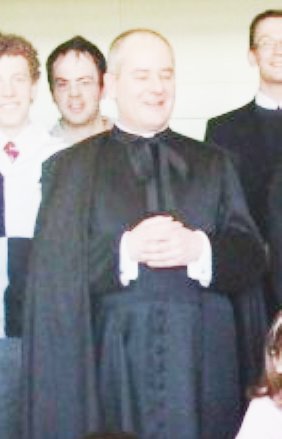
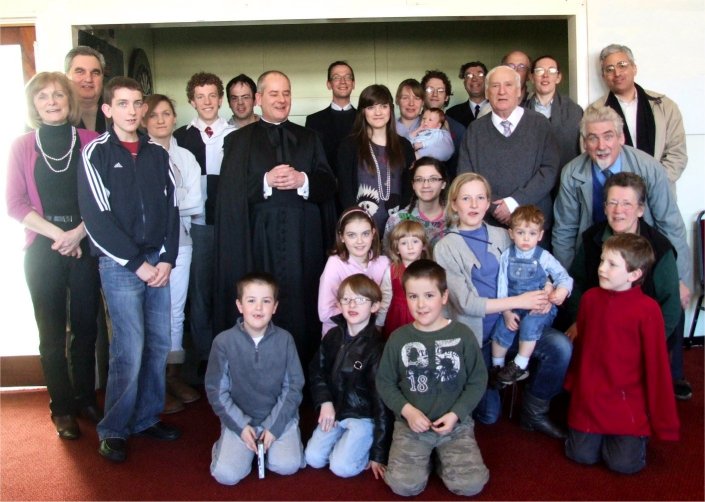
Fr. Finigan appears here, during his Million Visitor Celebration, pastorally surrounded by children and adults as befits a true shepherd of Christ’s flocks, in his ferraiuolo. 

Their joy indicates that they are all illuminated by the correctly continuous hermeneutic.

Kudos to His Hermeneuticalness

The photo doesn’t help you see His Hermeneuticalness’s sartorial splendor, so here is a detail I tweeked.

Kudos to His Hermeneuticalness

Well done.

And… by the way… vote for WDTPRS in the Bloggers Choice Awards.

Posted in SESSIUNCULA |
15 Comments

Another indulgence thing…

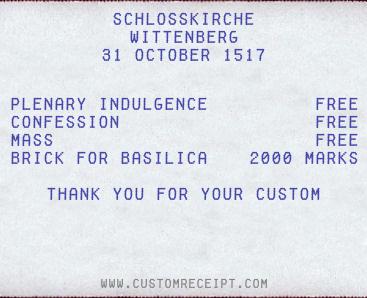
Regarding the entry on indulgences, a reader sent this.

It is reputed to by Martin Luther’s very own receipt he received at Wittenberg.  He wanted evidence against the Church selling plenary indulgences, and all he got was this.

Now.. I wouldn’t want to go out on a limb for that, but that is what I am told.

Another indulgence thing...

Sorry… I don’t know where it is from, originally.  People send things without links and I just don’t have time to dig for the sources.

Still… this is fun.

Posted in SESSIUNCULA |
8 Comments

Der Spiegel: SSPX Bp. Williamson’s interesting points to a hostile interviewer

In Der Spiegel, a German weekly, Bp. Williamson, the former rector of the SSPX seminary in Argentina, was interviewed.

Go to the link to read the whole thing, but here are some of the more interesting points.

My emphases and comments.   We jump into the middle…

….

SPIEGEL: Are you actually aware that you are dividing the Church with your extreme views?

Williamson: Only violation of the dogmas, that is, the infallible principles, destroys faith. The Second Vatican Council declared that it would proclaim no new dogmas. Today the liberal bishops act as though it were some sort of all-encompassing super-dogma, [sound like a familiar phrase?  This is exactly the term I have been using to warn against an improper exaltation of the Council and its "fruits", whatever they may be.] and they use it as justification for a dictatorship of relativism. This contradicts the texts of the Council.

SPIEGEL: Your position on Judaism is consistently anti-Semitic. [There’s a between-your-eyes statement!]

Williamson: St. Paul put it this way: The Jews are beloved for the sake of Our Father, but our enemies for the sake of the gospel.

SPIEGEL: Do you seriously intend to use Catholic tradition and the Bible to justify your anti-Semitism?  [Does this sound like an objective interviewer?]

Williamson: Anti-Semitism means many things today, for instance, when one criticizes the Israeli actions in the Gaza Strip. The Church has always understood the definition of anti-Semitism to be the rejection of Jews because of their Jewish roots. This is condemned by the Church. Incidentally, this is self-evident in a religion whose founders and all important individuals in its early history were Jews. But it was also clear, because of the large number of Jewish Christians in early Christianity, that all men need Christ for their salvation — all men, including the Jews.

…

SPIEGEL: Your statements have caused great injury and outrage in the Jewish world. Why don’t you apologize?

Williamson: If I realize that I have made an error, I will apologize. I ask every human being to believe me when I say that I did not deliberately say anything untrue. I was convinced that my comments were accurate, based on my research in the 1980s. Now I must review everything again and look at the evidence.

SPIEGEL: Do you at least recognize universal human rights?  [get that "at least"?]

Williamson: When human rights were declared in France, hundreds of thousands were killed throughout France. Where human rights are considered an objective order for the state to implement, there are constantly anti-Christian policies. [Remember: concern among SSPXers is especially focused on Church-state relations in a pluri-religious environment.] When it comes to preserving the individual’s freedom of conscience against the democratic state, then human rights perform an important function. The individual needs these rights against a country that behaves like a Leviathan. But the Christian concept of the state is a different one, so that the Christian theories of human rights emphasize that freedom is not an end in itself. The point is not freedom from something, but freedom for something. For good.  [There are limits to human freedom.  People are not simply "free" to do as they please and states have the duty to restrain that sort of freedom for the sake of the common good.]

SPIEGEL: Your statements and the lifting of your excommunication have triggered protests worldwide. Can you understand this?  [Does he think W. is stupid?]

Williamson: A single interview on Swedish television has dominated the news for weeks in Germany. Yes, it does surprise me. Is this the case with all violations of the law in Germany? Hardly. [Watch this… perhaps the best point in the interview…] No, I am only the tool here, so that action can be taken against the SSPX and the pope. Apparently Germany’s leftist Catholicism has not yet forgiven Ratzinger for becoming pope.  [There is it.]

Interview conducted by Peter Wensierski and Steffen Winter

Interview conducted in German and translated into English by Christopher Sultan

Williamson makes an excellent point and I completely agree.

Williamson’s screwy statements are just an excuse to hammer the Pope and to block the reintegration of the SSPX into the fabric of the mainstream Church.

What is at stake is the approach of rupture with the past promoted by the progressivists and the recovery of a proper Catholic identity as promoted by Pope Benedict in what I call his "Marshall Plan".

The leftists understand with virulent desperation that they must keep the ideas represented by the healthy sector of the SSPX out of the Church, even out of discussion.

Posted in SESSIUNCULA |
71 Comments

The other part of food prep

I often post photos of food prep and presentation.

There is another really important part of the process.

Cleaning your cutting board…. indeed all surfaces.

The other part of food prep

I was handling some chicken recently.  After handling raw meat wash wash wash, hands and surfaces.

I am not a complete fanatic about the kitchen, but some things I never fool with.

The FIRST thing I do after cutting up meat, especially poultry, is immediately to wash the knife, my hands and the board.

Then I usually change boards.

Ever had salmonellosis?  You don’t want it.

People debate about the advantages or disadvantages of wooden or plastic boards.

I use both.  But I wash them.  Also I keep the water pretty hot here. 

Your water temp should be at least 120F (49C)

The other part of food prep

And occasionally I spray them down with a little mixture of bleach and water.  My plastic board first gets scrubbed and then goes into the dishwasher, which gets very hot.

I don’t put my wood or bamboo boards in the dishwater, because they crack or warp.  I already have a crack starting in one of my favorites.

Other surfaces, like the sink or counter, get other treatments when I have dealt with meat.

The point is, you and your friends don’t want the consequences of not taking a moment to clean after handling meat.

Posted in Fr. Z's Kitchen |
32 Comments

NYT article on indulgences

From Hell’s Bible… the floundering New York Times comes this.

My emphases and comments.

For Catholics, Heaven Moves a Step Closer

By PAUL VITELLO
Published: February 9, 2009

The announcement in church bulletins and on Web sites has been greeted with enthusiasm by some and wariness by others. But mainly, it has gone over the heads of a vast generation of Roman Catholics who have no idea what it means: “Bishop Announces Plenary Indulgences.”  [And whose, pray tell, fault is that?]

In recent months, dioceses around the world have been offering Catholics a spiritual benefit that fell out of favor decades ago — the indulgence, a sort of amnesty from punishment in the afterlife [hmmm… we are talking about the remission of temporal punishment, for purification, in the state called Purgatory, not about the unremittable eternal punishment of Hell.] — and reminding them of the church’s clout in mitigating the wages of sin.

The fact that many Catholics under 50 have never sought one, and never heard of indulgences except in high school European history [if then] (where Martin Luther denounces the selling of them in 1517 and ignites the Protestant Reformation) [don’t forget… the CHURCH denounces the sale of indulgences!] simply makes their reintroduction more urgent among church leaders bent on restoring fading traditions of penance in what they see as a self-satisfied world.  ["fading traditions of penance"]

“Why are we bringing it back?” asked Bishop Nicholas A. DiMarzio of Brooklyn, who has embraced the move. “Because there is sin in the world.”

Like the Latin Mass and meatless Fridays, the indulgence was one of the traditions decoupled from mainstream Catholic practice in the 1960s by the Second Vatican Council, [Vatican II "decoupled" indulgences?  Or was it the false implementation of the Council and the dissent or laziness of clergy and religious?] the gathering of bishops that set a new tone of simplicity and informality for the church.  [Vatican II set a tone of "informality"?] Its revival has been viewed as part of a conservative resurgence that has brought some quiet changes and some highly controversial ones, like Pope Benedict XVI’s recent decision to lift the excommunications of four schismatic bishops who reject the council’s reforms.  [So… let’s tie the idea of indulgences to the screwy ideas of Williamson.  Is that what is going on here?]

The indulgence is among the less-noticed, less-disputed traditions to be restored. But with a thousand-year history and volumes of church law devoted to its intricacies, it is one of the most complicated to explain. [I never had problems explaining indulgences… because I believe what the Church teaches about them!]

According to church teaching, even after sinners are absolved in the confessional and say their Our Fathers or Hail Marys as penance, they still face punishment after death, in Purgatory before they can enter heaven. [IF, that is, they die in God’s friendship.  But what the writer offered here is a distortion.  The idea is that we sinners must do penance in life for our sins.  We must make reparation.  If we have not done that adequately in life, but we neverthless die in the state of grace, we are still to be admitted to heaven, but only when we have been purified of attachment to our sins or we have been readied by penance we must do out justice.] In exchange for certain prayers, devotions or pilgrimages in special years, a Catholic can receive an indulgence, which reduces or erases that punishment instantly, with no formal ceremony or sacrament.

There are partial indulgences, which reduce purgatorial time by a certain number of days or years, [The writer hasn’t taken the time to get up to speed on what the Church teaches on this matter.  The Church no longer speaks in terms of days or years.] and plenary indulgences, which eliminate all of it. You can get one for yourself, or for someone else, living or dead. You cannot buy one — the church outlawed the sale of indulgences in 1857 — but charitable contributions, combined with other acts, can help you earn one. There is a limit of one plenary indulgence per sinner per day.  [I think we have to be careful with language like "earn".  This is a matter of God’s mercy.]

It has no currency in the bad place.

“It’s what?” asked Marta de Alvarado, 34, a bank cashier in Manhattan, when told that indulgences were available this year at several churches in New York City. “I just don’t know anything about it,” she said, leaving St. Patrick’s Cathedral at lunchtime. “I’m going to look into it, though.” [See?  If pastors of souls would preach about indulgences, people will pay attention.]

The return of indulgences began with Pope John Paul II, [HUH?  They never went away!] who authorized bishops to offer them in 2000 as part of the celebration of the church’s third millennium. But the offers [Again, mercantile language.] have increased markedly under his successor, Pope Benedict, [This is silly.  The writer should have looked back at the years before Pope Benedict.] who has made plenary indulgences part of church anniversary celebrations nine times in the last three years. The current offer is tied to the yearlong celebration of St. Paul, which continues through June.

Dioceses in the United States have responded with varying degrees of enthusiasm. This year’s offer has been energetically promoted in places like Washington, Pittsburgh, Portland, Ore., and Tulsa, Okla. It appeared prominently on the Web site of the Diocese of Brooklyn, which announced that any Catholic could receive an indulgence at any of six churches on any day, or at dozens more on specific days, by fulfilling the basic requirements: going to confession, receiving holy communion, saying a prayer for the pope and achieving “complete detachment from any inclination to sin.” [for a plenary indulgence]

But just a few miles west, in the Archdiocese of New York, indulgences are available at only one church, and the archdiocesan Web site makes no mention of them. [Not really true.  Indulgences may be gained in many ways and in many venues.] (Cardinal Edward M. Egan “encourages all people to receive the blessings of indulgences,” said his spokesman, Joseph Zwilling, who added that he was unaware that the offer was missing from the Web site, but would soon have it posted.)  [Great use of modern media, guys.  Great job!  Sheesh!]

The indulgences, experts said, tend to be advertised more openly in dioceses where the bishop is more traditionalist, or in places with fewer tensions between liberal and conservative Catholics.  [grrr  What a gross simplification.]

“In our diocese, folks are just glad for any opportunity to do something Catholic,” said Mary Woodward, director of evangelization for the Diocese of Jackson, Miss., where only 3 percent of the population is Catholic. At church recently, she said, parishioners flocked to her for information about indulgences. “What all do I have to do again to get one of those?” she said they asked.

Even some priests admit that the rules are hard to grasp. [embarassing, but probably true, given the formation of the last decades]

“It’s not that easy to explain to people who have never heard of it,” [Not really.  Not if you take the time.] said the Rev. Gilbert Martinez, pastor of St. Paul the Apostle Church in Manhattan, the designated site in the New York archdiocese for obtaining indulgences. “But it was interesting: I had a number of people come in and say, ‘Father, I haven’t been to confession in 20 years, but this’ ” — the availability of an indulgence — “ ‘made me think maybe it wasn’t too late.’ ”  [HOPE!]

Getting Catholics back into the confession booth, in fact, was one of the underlying motivations for reintroducing the indulgence. In a 2001 speech, Pope John Paul II described the newly reborn tradition as “a happy incentive” for confession.

“Confessions have been down for years and the church is very worried about it,” said the Rev. Tom Reese, [why do they still call these jokers?  Will they ever change their Rolodex?] a Jesuit and former editor of the weekly Catholic magazine America. In a secularized culture of pop psychology and self-help, he said, [to which he contributed greatly] “the church wants the idea of ‘personal sin’ back in the equation. Indulgences are a way of reminding people of the importance of penance.

“The good news is we’re not selling them anymore,” he added.  [rim-shot – wink nudge]

To remain in good standing, Catholics are required to confess their sins at least once a year. But in a survey last year by a research group at Georgetown University, three-quarters of Catholics said they went to confession less often or not at all.

Under the rules in the “Manual of Indulgences,” published by the Vatican, confession is a prerequisite for getting an indulgence.

Among liberal Catholic theologians, the return of the indulgence seems to be more of a curiosity than a cause for alarm. “Personally, I think we’re beyond the time when indulgences mean very much,” said the Rev. Richard P. McBrien, [another one] a professor of theology at the University of Notre Dame who supports the ordination of women and the right of priests to marry. “It’s like trying to put the toothpaste back in the tube of original thought. [but not like trying to avoid plagiarism] Most Catholics in this country, if you tell them they can get a plenary indulgence, will shrug their shoulders.”  [There’s a note of hope for you, folks!]

One recent afternoon outside Our Lady Queen of Martyrs Church in Forest Hills, Queens, two church volunteers disagreed on the relevance of indulgences for modern Catholics.

Octavia Andrade, 64, a retired secretary, laughed as she recalled a time when children would race through the rosary repeatedly to get as many indulgences as they could — usually in increments of 5 or 10 years — “as if we needed them, then.”

Still, she supports their reintroduction. “Anything old coming back, I’m in favor of it,” she said. “More fervor is a good thing.”  [Silliness eventually gave way to a Catholic sense about this.]

Karen Nassauer, 61, a retired hospital social worker who meets Mrs. Andrade almost daily for Mass, said she was baffled by the return to a practice she never quite understood to begin with.  [And so her opinion is helpful for… what?]

“I mean, I’m not saying it is necessarily wrong,” [remeber… she doesn’t understand it] she said. “But I had always figured they were going to let this fade into the background, to be honest. What does it mean to get ‘time off’ in Purgatory? What is ‘five years’ in terms of eternity?”  [How many errors were made here?]

The latest indulgence offers de-emphasize the years-in-Purgatory [No… not "demphasize"… eliminates!] formulations of old in favor of a less specific accounting, [again… the writer can’t get these categories out of his head] with more focus on ways in which people can help themselves — and one another — come to terms with sin.  [?]

“It’s more about praying for the benefit of others, doing good deeds, acts of charity,” said the Rev. Kieran Harrington, spokesman for the Brooklyn diocese.

After Catholics, the people most expert on the topic are probably Lutherans, [?] whose church was born from the schism over indulgences and whose leaders have met regularly with Vatican officials since the 1960s in an effort to mend their differences.

“It has been something of a mystery to us as to why now,” said the Rev. Dr. Michael Root, dean of the Lutheran Theological Southern Seminary in Columbia, S.C., who has participated in those meetings. The renewal of indulgences, he said, has “not advanced” the dialogue. [So what.]

“Our main problem has always been the question of quantifying God’s blessing,” Dr. Root said. Lutherans believe that divine forgiveness is a given, but not something people can influence.  [That’s why we speak in terms of partial and plenary.]

But for Catholic leaders, most prominently the pope, the focus in recent years has been less on what Catholics have in common with other religious groups than on what sets them apart — including the half-forgotten mystery of the indulgence.

“It faded away with a lot of things in the church,” said Bishop DiMarzio of Brooklyn. “But it was never given up. It was always there. We just want to people to return to the ideas they used to know.” 

Lot’s of problems in this article but the bottom line is this: if it can get people to ask question, let them know that indulgences are part of our Catholic life, and perhaps force clerics to preach about indulgence, then this article is helpful.
How often do you see articles in diocesan newspapers on indulgences?

I’m just askin’


Posted in I'm just askin'... |
42 Comments

Peoria: Bp. Jenky stands up to anti-Catholic courts and media

A really interesting story came to my e-mail.

H.E. Most Rev. Daniel Jenky, Bishop of Peoria, ordered that a letter of his composition be read in all churches on Sunday.  Some parishes did not comply.

The issue?  His concern over anti-Catholicism.

Background: A court recently reinstated lawsuits that were previously dismissed because the statute of limitations had passed.  Article on the reinstatement is found here.    Executive summary:  Illinois law required lawsuits to be filed by the time the (alleged) minor victim was 30 years old, with the statute of limitations expiring afterwards.  The reinstatement has revolved around the rediscovery of repressed memories.

Here is a story from the Quad City Times

Let’s see the story and then Bishop Jenky’s letter with my emphases and comments.

Illinois bishop’s letter: Media has ‘intense hatred’ of Catholics

By Edith Brady-Lunny | Sunday, February 8, 2009 10:03 PM CST

PEORIA, Ill. — Catholic Bishop Daniel Jenky is lashing out [Interesting word choice.  Don’t only extremists or right-wingers "lash out"?] at the news media and Illinois courts over the handling of sexual abuse allegations made against priests.

In a letter dated for distribution over the weekend to Catholic parishes throughout the Peoria Diocese, Jenky expresses concern over media coverage and court rulings he thinks have been unfair to the diocese. At least two parishes [!  out of how many?] in the Ilinois Quad-Cities published the letter in its bulletin.

Barbara Roedel, pastoral associate at St. Pius X in Rock Island, said the letter was not read aloud during St. Pius services, which observed World Marriage Sunday and Scout Sunday.

“In our parish at Saint Pius, we printed in our bulletin the full text from Bishop Jenky,” she said. Likewise, Sacred Heart Catholic Church in Moline also printed the letter, said the Rev. Dale Wellman.

The Illinois Quad-City parishes are part of the Peoria Diocese.

“Amid all the tensions of our nation’s culture wars and in the face of the media’s intense hatred for our Catholic faith, I am increasingly concerned that our Church in effect no longer enjoys equal justice under the law,” Jenky wrote.

The diocese did not respond Friday to a request for comment on the letter. [Isn’t the letter then comment?]

Jenky defended the church’s policies and track record for dealing with abuse cases, saying credible claims have been settled while allegations unsupported by facts are rejected. He thinks measures put in place in recent years have made the church a safe environment for children.

The Catholic Diocese of Peoria has not allowed abusive priests to move from parish to parish, said Jenky, who also vowed not to be intimidated by “choreographed demonstrations or the abuse that is sometimes personally directed against me” by victims’ support groups.

The bishop questioned the motives of attorneys representing some victims and groups supporting them, saying, “Obviously (they) have a significant financial stake in trying to overturn our Diocesan policies.”

Jeff Jones, Peoria leader of the Survivors Network for those Abused by Priests, responded Friday to a copy of the letter provided to the organization.

“It’s a sad day when the bishop has to use these kinds of tactics to make sure innocent victims receive no reparations. He will stop at nothing,” said Jones.

In his letter, Jenky also assures area Catholics that he will be a “prudent steward of the money you offer for the work of Christ” and warned that difficult days may lie ahead as the diocese faces the potential of more than a dozen abuse lawsuits.

A recent ruling from the 3rd District Appellate Court could reinstate cases dismissed in June 2007 on the grounds that the alleged victims waited too long to file charges. Among the priests named in the civil actions are former Monsignor Norman Goodman and former priest Louis Condon, both of whom served in Lincoln.

Barbara Dorris, SNAP’s outreach director from St. Louis, also took issue with the letter.

“At least 18 current or former Peoria priests are admitted, proven or credibly accused predators. Is Jenky actually claiming the church handled every one of these cases promptly, openly and honorably? That defies common sense and painful history,” she said.  [Note how this story ends?  Bp. Jenky’s case is made in this story!]

(The Bloomington Pantagraph is a Lee Enterprises newspaper.)

The following letter was supposed to be read in churches throughout the Peoria Diocese over the weekend:

MOST REV. DANIEL R. JENKY, C.S.C.
OFFICE OF THE BISHOP
DIOCESE OF PEORIA OFFICE OF THE BISHOP
607 N.E. MADISON AVENUE
PEORIA, ILLINOIS 61603
PHONE: 309-671-1564
FAX: 309-671-5079

February 7-8, 2009

Dear Priests, Deacons, Religious and Faithful of the Diocese of Peoria,

My greatest responsibility as your bishop is to preach the Gospel, celebrate the Sacraments, and to try my best to be a good shepherd for this local church. The saddest part of my ministry has been to deal with our part of the immense societal issue of sexual misconduct with minors. Where there have been credible accusations made against individuals and with the advice of my Review Commission, I have not hesitated to remove them from all active ministry. I have also tried to attentively follow the charter adopted by the American bishops that deals in a comprehensive manner with this painful subject. I have not discovered any evidence in this Diocese that priests guilty of misconduct were ever moved from assignment to assignment. Our Diocese normally offers counseling to victims rather than paying out large cash settlements. Not every allegation has been found to be credible by our Review Commission, and so our Diocese resists supporting those claims that simply cannot be sustained by the facts. I take very seriously my responsibility to protect all the children entrusted to our care, and I am absolutely convinced that today the programs of our Church now provide the safest possible environment in America for your children.

In these perilous economic times, I will work to be a prudent steward of the money you offer for the work of Christ. Attorneys representing some claimants and some "victims groups" obviously have a significant financial stake in trying to overturn our Diocesan policies. Recent decisions in the Illinois courts may make our legal situation even more difficult in the future. It should be noted that the sexual abuse of minors cuts across all socio-economic lines, ethnicities, ministries, and religions. It is important to remember that the State basically exempts its own institutions from civil litigation. Amid all the tensions of our nation’s culture wars and in the face of the media’s intense hatred for our Catholic Faith, I am increasingly concerned that our Church in effect no longer enjoys equal justice under the law. I will not be intimidated by choreographed demonstrations or the abuse that is sometimes personally directed against me. I remain immensely proud of the zealous and holy priesthood of our Diocese. May God guide and protect his Holy Church and bless us all in his service. Sincerely yours in Christ,

Most Reverend Daniel R. Jenky, C.S.C. BISHOP OF PEORIA


Well done, Bishop Jenky.

Posted in SESSIUNCULA |
25 Comments