Ed Peters: Why the original SSPX excommunications were valid

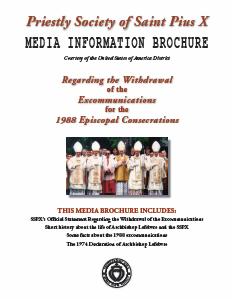
In another entry I posted some material taken from a media brochure issued by the SSPX with their claims about why the excommunications of the SSPX bishops in 1998 were never validly incurred/imposed.

Here is the relevant section:

According to the 1983 edition of the Code of Canon Law:
1. A person who violates a law out of necessity is not subject to a penalty (Canon 1323 §4).
But even if no state of necessity existed:
if one inculpably thought there was, • he would not incur the penalty (Canon 1323 §7),
and if one culpably thought there was, • he would still incur no automatic penalties (canon 1324 §3; §1, 80).
2. No penalty is ever incurred without committing a subjective mortal sin (canons 1321 §1, 1323 §7).
Archbishop Lefebvre made it clear that it was his duty before God as a bishop to perform the episcopal consecrations to ensure the continuance of the Catholic priesthood. Even if he had been wrong, there would still have been no subjective sin.
Consequently, the accusations of excommunication were illegitimate and thereby always null and void.

This is an argument.  I would like to know if this is what was determined in the study done by the Holy See before the Holy Father lifted the censures.

Ed Peters, on his excellent blog In The Light of the Law, tackles this thorny bush of claims and canons and claims.

He has a different take

Why the original SSPX excommunications were valid

While we await the L’Osservatore Romano article that is to offer an account of how Pope Benedict XVI arrived at the decision to lift the excommunication imposed on the four priests who received episcopal orders illicitly (c. 1382) from Abp. Marcel Lefebvre in 1988, the materials now coming from the Society of St. Pius X continue, in my opinion, to add to the burden such an article must carry if the remission is to make sense to otherwise well-disposed outside observers.  [Exactly.  As I have been writing for days, I would like to know what went on with the "study" of the question on the part of the Holy See.  Did they come to the conclusion that the excomm’s weren’t every really incurred?  If so, I would say "justice delayed is justice denied".  If they were validly incurred, then the gesture of the Holy Father is that much more generous and purposeful.]

In the meantime, for the benefit of those who would like to see some responses to the canonical arguments by which the SSPX claims that the 1988 excommunications were never incurred in first place, let me very briefly note the following:

[This is great stuff… read slowly.]

SSPX Arg. 1. A person who violates a law out of necessity is not subject to a penalty (Canon 1323.4). Correct, but [but!] in asserting what amounts to an affirmative defense, the burden is on the SSPX to prove that it was objectively [not subjectively… "we really feel it is necessary" isn’t a good enough argument] necessary for them to ordain four bishops in violation of universal canon law and the specific prohibitions of the Holy See. Of course, most people who break the law think they are justified in breaking it. But it’s not the offender’s opinion of "necessity" that counts, it’s lawful authority’s determination of "necessity" that matters. And Rome is the lawful authority here, not the SSPX.  [But what about "emergency powers"?  Rome gets to make that judgment also.]

SSPX Arg. 2. Even if no state of necessity existed, if one inculpably [the key here] thought there was, he would not incur the penalty (Canon 1323.7). Correct, but [but!] the burden is, as above, on the SSPX to prove that they were "without fault" in thinking that it was necessary for them to ordain four bishops against universal canon law and the specific prohibitions of the Holy See. Now, if the SSPX bishops could show that, by late June of 1988, after all that had transpired to that point, they were "without fault" in still thinking it was necessary for them to violate canon law and papal prohibitions, then I don’t know who could not show themselves to be "without fault" for breaking just about any law and disregarding just about any papal directive.  [True.  Another point here is that some people raise the question of if, in his advanced years, the late Archbishop wasn’t perhaps less sharp than he should have been.  No matter: the other bishop was involved and the four men who were consecrated were involved and made their choices.]

SSPX Arg. 3. If one culpably [the key word] thought there was [necessity], he would still incur no automatic penalties (Canon 1324.3; [other citations garbled]). Correct, but [but!] this argument avoids the crucial point that the excommunications which were lifted last week were not automatic excommunications, they were imposed excommunications (see c. 1331), that is, ones formally declared, by the Holy See no less. [The SSPXers incurred the excommunication automatically, that is true.  BUT… this was confirmed by the proper authority, the Cong. for Bishops, under the direction of the Roman Pontiff.]  Whatever was the canonical status of the SSPX bishops on June 30, 1988, by July 1 [when the Congregation issued the confirmation decree] they labored under declared excommunications, not automatic ones.

SSPX Arg. 4. No penalty is ever incurred without committing a subjective mortal sin [the key here is "subjective"] (Canons 1321.1, 1323.7). Incorrect. [!] Canon law does not attempt to read the souls of Catholics and does not require proof of them having committed "subjective mortal sin" before visiting penalties on offenders among them. [Remember that we look at sin in a couple ways.  First, an act can be objectively sinful.  Killing someone, for example, is objectively sinful because it is against the Decalogue.  But there are circumstances which lessens a person’s actual guilt for that objectively sinful act.  There is the state of mind, the reason, the attendent circumstances such as external pressure, duty, etc.  So, there is the objective dimension and the subjective dimension of human acts.]  Canon law does require that the underlying act be one that is objectively gravely sinful, [objectively] but [but!] who doubts that ordaining Catholic priests to the episcopate against the norm of canon law and the express prohibition of the pope is objectively sinful? The "culpa" mentioned in these two norms refers to legal responsibility in the external forum, [objective] not to moral responsibility in the internal forum.[objective considered in the light of the subjective]  The Holy See reasonably concluded that the external, observable actions of the SSPX bishops were in violation of canon law. That’s all that was necessary.

In sum, while I think that Canon 124 suffices to put the burden on the SSPX bishops to prove the alleged invalidity of the excommunciaitons they incurred in 1988, to the degree they think that their arguments above accomplish that goal, I disagree. I would only add that, if anyone still wants to claim that the SSPX excommunications were invalid, please read John Paul II’s m. p. Ecclesia Dei adflicta (2 July 1988), esp. para. 1-3, and show us where the pope missed the point. PS: Good luck.

+ + +

Some other quick points, if only for the record:

The SSPX censures were incurred in the context of Canon 1382 (illicit episcopal ordinations). What various SSPXers said before and since about the Church, Vatican II, "Modernist Rome", the Holocaust, and so on, might well be offensive, but it must be distinguished from assessment of the canonical crimes they committed in June of 1988. The pope’s action last week, however it will be explained, is focused, I expect, only on their illicit ordinations. [Exactly.]

The age-old question "Are popes above canon law?" admits of no easy answer, but this much should be said: first, don’t confuse actions which are only praeter legem (outside, or beyond the law) with actions that might seem to be contra legem (against the law); second, it is easier for popes to act praeter legem than it is for others to so act (c. 331).  [Right.]

I, in company with many others, hold that latae sentenitae penalties have outlived their usefulness in canon law and are today simply a source of neuralgic and distracting debates. They should be abandoned.  [I don’t agree.  There are some crimes which are not public which incurr latae sententiae excommunications.  In that case the person who did something without public knowledge would at least feel the burden of knowing he incurred the censure and may feel compelled to reconcile in the internal forum.  I have as a confessor helped a few people along this lines.  Their knowledge that they had incurred a censure, though virtually no one else knew, drove them to seek the lifting of the excommunication/irregularity.]

I, in company with many others, hold the Book VI of the 1983 Code needs to be revised to make it clearer how ecclesiastical leadership has the canonical authority to impose sanctions on offenders in accord with law (c. 221) but without becoming embroiled in an at-times hopeless tangle of affirmative defenses and "pastorally-inspired" mitigations and exceptions.

Excellent analysis.  I hope this clear up some questions.
Posted in SESSIUNCULA |
42 Comments

Wiegel on the SSPX excommunications

UPDATED: 1751 GMT

I found this in Newsweek:

My emphases and comments.

Rome’s Reconciliation

Did the Pope heal, or deepen, the Lefebvrist schism? 
By George Weigel | Newsweek Web Exclusive
Jan 26, 2009

[He starts with a question that I have tried to get through to the various reporters and news outlets who have called me in the last few days: There are burning political overtones to what the SSPX desires, especially in France, which complicate the issue enormously.  Watch!]

What do the Cardinal Richelieu and King Louis XVI, the Bastille and the Reign of Terror, the Bourbons and Robespierre, the revolutionary depredations in the Vendée, the Dreyfus Affair, the anti-clericalism of the French Third Republic, and the World War II Vichy regime have to do with the schismatic movement [Many, including the Holy See, say that it is not technically "schismatic"… though it is hard to see how it isn’t sometimes.] that the late Archbishop Marcel Lefebvre led out of the Roman Catholic Church in 1988—a movement that Pope Benedict XVI is now trying to move toward reconciliation by lifting the excommunications of its four illegally ordained bishops on Jan. 21?

In a word: everything.

There are, of course, many different kinds of people in the Lefebvrist movement; the great majority of them are men and women who find the older forms of Catholic piety—especially the Latin Mass celebrated in the Tridentine form—more spiritually beneficial than the reformed liturgy that followed the Vatican Council II (1962-1965). And it is also true that Archbishop Lefebvre, one of the leaders of the anti-reformist faction at Vatican Council II, was very unhappy with what was done to the Church’s liturgy after the council.

But Lefebvre was also a man formed by the bitter hatreds that defined the battle lines in French society and culture from the French Revolution to the Vichy regime. Thus his deepest animosities at the council were reserved for another of Vatican Council II’s reforms: the council’s declaration that "the human person has a right to religious freedom," which implied that coercive state power ought not be put behind the truth—claims of the Catholic Church or any other religious body. This, to Lefebvre, bordered on heresy. For it cast into serious question (indeed, for all practical purposes it rejected) the altar-and-throne arrangements Lefebvre believed ought to prevail—as they had in France before being overthrown in 1789, with what Lefebvre regarded as disastrous consequences for both church and society.

Marcel Lefebvre’s war, in other words, was not simply, or even primarily, against modern liturgy. [Right.] It was against modernity, period. For modernity, in Lefebvre’s mind, necessarily involved aggressive secularism, anti-clericalism, and the persecution of the church by godless men. That was the modernity he knew, or thought he knew (Lefebvre seems not to have read a fellow Frenchman’s reflections on a very different kind of modernity, Alexis de Tocqueville’s "Democracy in America"); it was certainly the modernity he loathed. And to treat with this modernity—by, for example, affirming the right of religious freedom and the institutional separation of church and state—was to treat with the devil.  [At a certain point the reps of the SSPX and those of the Holy See will have to deal with how Pope Benedict XVI parsed this, especially during his visit to the USA.]

The conviction that the Catholic Church had in fact entered into such a devil’s bargain by preemptively surrendering to the modern world at Vatican Council II became the ideological keystone of Lefebvre’s movement. And the result was dramatic: Lefebvrists came to understand themselves as the beleaguered repository of authentic Catholicism—or, as the movement is wont to put it, the Tradition (always with a capital "T"). For 10 years, Pope John Paul II tried to convince the recalcitrant Archbishop Lefebvre otherwise; he got nowhere. Cardinal Joseph Ratzinger then tried to mediate. But at the end of the day, Marcel Lefebvre hated modernity more than he loved Rome. [Good phrase.] So in 1988, rejecting the personal pleas of John Paul II and Ratzinger (men who could hardly be accused, reasonably, of preemptive concessions to modernity), [Ho1 Ho!  That is exactly what the SSPX leadership does!] an aging Lefebvre ordained four bishops to carry on his work, without the requisite authorization from Rome. Those four bishops (whose orders, while illegally conferred under church law, are nonetheless valid sacraments in the church’s eyes) automatically incurred excommunication by participating in a schismatic act—an act in conscious defiance of church authority that cuts one off from the full communion of the church. It is those excommunications that have now been lifted by Benedict XVI, in an effort to move the Lefebvrist movement toward reconciliation with Rome and toward the restoration of full communion.

That one of the Lefebvrist bishops, Richard Williamson, is a Holocaust denier and a promoter of the "Protocols of the Elders of Zion" has drawn considerable attention and commentary, particularly from Jewish scholars and religious leaders who have made large investments in Jewish-Catholic dialogue since Vatican Council II. Their concern is entirely understandable, although it has to be said that the lifting of Williamson’s excommunication in no way constitutes a papal endorsement of Williamson’s lunatic view of history, [RIGHT!  Everyone should keep that in mind.] or a retraction of John Paul II’s 1998 statement deploring the Holocaust, or a revocation of Vatican Council II’s teaching on the sin of anti-Semitism. At the same time, it ought to be recognized that Williamson’s Holocaust denial and his embrace of a crude anti-Semitic canard like the "Protocols" is not all that surprising, given that Lefebvrist political ideology grew out of the same French fever swamps [nicely done!] that produced the anti-Dreyfusards. (Even as it ought to be recognized that the hypersecularists of the Third French Republic hated Catholics as much as some anti-Dreyfusards hated Jews.)  [Let us not forget that lots of secularists really hate committed Catholics… more than any other group.]

Williamson’s inanities, while deplorable and disgusting, are something of a sideshow, however. For the highest stakes in this drama hove into view when Bishop Bernard Fellay, the current head of the Lefebvrist movement, issued a Jan. 24 letter on the lifting of the excommunications to the movement’s faithful. It is an astonishing document, declaring as it does that "Catholic Tradition is no longer excommunicated" [I tackled that here.  The SSPX bishops are not the embodiment of "Catholic Tradition".] and that the Lefebvrists constitute those "Catholics attached to Tradition throughout the world." The letter goes on to affirm "all the councils up to the Second Vatican Council about which we express some reservations." And it implies that the talks that will now commence between the Vatican and the Lefebvrists, now that the excommunications have been lifted, will focus on those "reservations."

Responsible canon lawyers have raised questions about whether this arrogance on the part of Bishop Fellay does not cast into question his fulfillment of the canonical requirements for a lawful lifting of his excommunication. [NEWSFLASH: The excommunications were lifted.] In any event, non-canonists will read his letter as Fellay’s unilateral declaration of victory: the Lefebrvists have been right all along; the Holy See has finally recognized the error of its ways; the only things left to discuss are the terms of surrender. [The SSPX leadership has a based they have to placate.  At this point, it would be better to try to bring in as many en masse as possible, rather than reconcile them piece meal.  So, let’s not get overly worked up about some… some.. of their rhetorical flourishes.  I think the best way to deal with them is simply to shrug, perhaps with a discreet roll of the eyes when no one is looking.] Ironically, but hardly coincidentally, the Catholic left (which has been clever enough to avoid formal schism while living in intellectual and psychological schism [right!] since Pope Paul VI’s 1968 encyclical on family planning, Humanae Vitae) has welcomed Benedict XVI’s canonical rescue of the Lefebvrist bishops, with numerous left-leaning Catholic dissidents now saying, in effect, "Where’s my bailout?" [LOL!  Good one.]

Benedict XVI undoubtedly intended this lifting of excommunications as a step toward healing a wound in the church. Bishop Fellay’s letter, in response to the pope’s gesture, suggests that the healing has not taken place. [Wellllll…. that might be overstating it.  Healing is a long process.  I still have twinges from old injuries, after all.] Moreover, Fellay’s letter raises the stakes for everyone, and to the highest level. For what is at issue, now, is the integrity of the Church’s self-understanding, which must include the authenticity of the teaching of Vatican Council II.  [On the other hand, there are some really hard things to understand with clarity in some of the the documents of the Council.  Theologican Joseph Ratzinger wrote with concern about Gaudium et spes for example.  Let’s not turn the "teaching of Vatican Council II", whatever that means, into a super-dogma.  People of good will can hold differing opinions on how to accomplish ecumenism or how religious liberty is to be worked out beween Church and states.  We should avoid reducing hard issues in the documents to a sort of "spirit of Vatican II" which no one is permitted to drill into.]

Father Federico Lombardi, SJ, the pope’s spokesman, emphasized to reporters on Jan. 24 that the lifting of the excommunications did not mean that "full communion" had been restored with the Lefebvrists. The terms of such reconciliation are, presumably, the subject of the "talks" to which Bishop Fellay referred in his letter. Those talks should be interesting indeed. For it is not easy to see how the unity of the Catholic Church will be advanced if the Lefebvrist faction does not publicly and unambiguously affirm Vatican Council II’s teaching on the nature of the church, on religious freedom, and on the sin of anti-Semitism. Absent such an affirmation, pick-and-choose cafeteria Catholicism will be reborn on the far fringes of the Catholic right, just when it was fading into insignificance on the dwindling Catholic left, its longtime home.  [Again… on very hard questions which are not spelled out with perfect clarity, people should be able to have differing opinions.]

GEORGE WEIGEL, a NEWSWEEK contributor, is Distinguished Senior Fellow of Washington’s Ethics and Public Policy Center, where he holds the William E. Simon Chair in Catholic Studies.


Good article.  I was thinking about attacking this French poltical angle myself, but hadn’t gotten to it yet.

I wonder if Weigel hasn’t slid into a sort of "spirit of Vatican II" position here. 

Posted in SESSIUNCULA |
98 Comments

SSPX media brochure about the lifting of the excommunications

SSPX media brochure about the lifting of the excommunicationsHave you see the media brochure released by the SSPX about the lifting of the excommunications?

Here are some lines, but you can see it yourself.

  • Some facts about the 1988 excommunications
  • In this new atmosphere, we have the firm hope to obtain soon the recognition of the rights of Catholic Tradition
  • On June 30, 1988, he consecrates four SSPX priests as bishops to ensure the survival of Catholic Tradition. Contrary to canon law, he is subsequently declared to have excommunicated himself by this action.  [No mention of the fact that he had met with Card. Ratzinger in 1988, signed an agreement, and then went back on it that same night.  Instead, this is described as…]
  • Discussions with a Modernist Rome having failed,
  • On June 30, 1988, he consecrates four SSPX priests as bishops to ensure the survival of Catholic Tradition. Contrary to canon law, he is subsequently declared to have excommunicated himself by this action.  [Contrary to Canon Law? They defy the Roman Pontiff’s wishes in this matter and they are in the right?]
  • 2000 – to the present
    The Superior General, Bishop Bernard Fellay, prudently maintains contacts with Rome while insisting on the doctrinal balance which Archbishop Lefebvre himself demonstrated.
  • The Excommunications: Why They Never Existed [So… just what is their real attitude about the lifting of the excommunications?  Is this just a matter of saying, for them, "we were right all along"?  Is is any sense that there was a wrong involved?  I would like to know more about the "study" done in the Vatican about lifting the censures.]
  • Pope John Paul II simply repeated the accusations of schism and excommunication citing Canon Law. But did a state of schism or the penalty of excommunication actually ever exist?   [What sort of attitude is this?]


[Here is the really interesting part….]

According to the 1983 edition of the Code of Canon Law:
1. A person who violates a law out of necessity is not subject to a penalty (Canon 1323 §4).
But even if no state of necessity existed:
if one inculpably thought there was, • he would not incur the penalty (Canon 1323 §7),
and if one culpably thought there was, • he would still incur no automatic penalties (canon 1324 §3; §1, 80).
2. No penalty is ever incurred without committing a subjective mortal sin (canons 1321 §1, 1323 §7).
Archbishop Lefebvre made it clear that it was his duty before God as a bishop to perform the episcopal consecrations to ensure the continuance of the Catholic priesthood. Even if he had been wrong, there would still have been no subjective sin.
Consequently, the accusations of excommunication were illegitimate and thereby always null and void.

This is an argument.  I would like to know if this is what was determined in the study done by the Holy See before the Holy Father lifted the censures.

  • Going on…
  • Was the SSPX ever in a State of Schism?
  • Disobedience does not amount to schism.   [That’s something, at least.]
  • THE 1974 DECLARATION OF ARCHBISHOP LEFEBVRE – Made on November 21, 1974


Posted in SESSIUNCULA |
124 Comments

Fr. Finigan makes some observations

His Hermeneuticalness has a good post on the anti-Pope reaction after the lifting of the excommunication of SSPX Bishop Williamson, who has made galactically imprudent statements about the killing of Jews in WWII.

Clearly not everyone at the Vatican is happy. No surprise there, then. Pope Benedict has certainly made a risky move. He knew about Bishop Williamson’s utterly reprehensible views (which the official Vatican press spokesman has unambiguously repudiated) but presumably also knew that there was no prospect of eradicating such tendencies within the SSPX before the move to effect reconciliation. He has perhaps judged it better to get the Fraternity on board and take the media flak, hoping that the extremist elements will fall away, not wishing to be associated with a Pope and a "Conciliar Rome" that they have railed against. Meanwhile, the more sensible elements of the SSPX will see that regular jurisdiction is a pressing and urgent need.

Astute. 

Yes… the clock is ticking.

There is already a whole generation of followers of the SSPX who have never known unity with Rome.

Posted in SESSIUNCULA |
37 Comments

Philadelphia: Conversion of Paul at St. Paul’s

In the Brick by Brick Department today, a reader sent that…

Father Gerald P. Carey, pastor of St. Paul Parish, celebrated a Missa Cantata yesterday, January 25th in St. Paul Church.  It was for the Feast of the Conversion of St. Paul during this year of St. Paul.  The church was filled to capacity to hear Palestrina’s Missa Brevis performed by a schola commissioned for the event.  Rober Hall directed the schola and Robert Ridgell was the organist.

Philadelphia: Conversion of Paul at St. Paul's

Posted in SESSIUNCULA |
13 Comments

QUAERITUR: How long must we fast before Communion in a TLM?

From a reader:

When [receiving Holy Communion] in the Extraordinary Form Mass is one required to observe the older fast (as opposed to the 1 hour fast required for the OF)? 

If so, how many hours of fasting is required?


No.  You are not required to keep a Communion fast according to the old laws.  You are required to observe it according to the law presently in force.

The law at present, for Latins at least, says one hour before the reception of Communion.  That is, not before the beginning of Mass, but before Communion.

Of course you are free to do more than that.  In the old days, three hours became the length of time for the Eucharistic fast.  Before that, it was from midnight.  All this was changed.  The 1983 Code is in force now.

We must be properly disposed to receive. 

We are creatures of both soul and body.  Both need their disposition.

The spiritual disposition is being in the state of grace.

The physical disposition is fasting beforehand for the length of time determined necessary by the Church.

Holy Church would do well to return us to a three hour fast. 

Making it just a little harder might help people understand that what they are doing is important, and it has consequences.

A longer fast (i.e., making things just a little harder) would help to increase both our sense of the importance of the Eucharist and also our own need to be properly disposed, spiritually and physically, to receive. 

But no one has asked my input about that.

Posted in ASK FATHER Question Box |
35 Comments

Fr. Z agrees with Bishop Fellay’s comments in an interview

Our Johnny-On-The-Spot friends at Rorate have an English version of an interview with SSPX Bishop and Superior Bernard Fellay.  Here is a part. 

Fr. Z agrees with Bishop Fellay's comments in an interviewThe Swiss daily Le Temps published today the first interview granted to journalist Patricia Briel by Bishop Bernard Fellay, Superior General of the Priestly Fraternity of Saint Pius X (FSSPX / SSPX), after the remission of excommunications made public last Saturday.

The full text:

– Do you condemn the negationist declarations of Bishop Williamson?

– [Fellay:] It does not belong to me to condemn them. I do not have the competence for his. But I deplore that a Bishop may have given the impression of involving the Fraternity with a view that is not ours.

…

– In your letter to the faithful of January 24 [PDF], you display your desire to examine, with Rome, the deeper causes of the "unprecedented crisis which afflicts the Church today". What are these causes?

– [Fellay:] In the essence, this crisis is caused by a new approach to the world, a new view of man, that is, an anthropocentrism which consists of an exaltation of man and a forgetfulness of God. The arrival of modern philosophies, with their less precise language, has led to confusion in theology.

…

– Ecumenism and religious liberty are at the center of the criticisms you make of Vatican II

– [Fellay:] The quest for unity of all in the Mystical Body of the Church is our dearest desire. Nonetheless, the method that is used is not appropriate. Today, there is such a focus on the points which unite us to other Christian confessions that those which separate us are forgotten. We believe that those who have left the Catholic Church, that is, the Orthodox and the Protestants, should come back to it. We conceive ecumenism as a return to the unity of Truth.

Regarding religious liberty, it is necessary to distinguish two situations: the religious liberty of the person, and the relations between Church and State. Religious liberty implies liberty of conscience. We agree with the fact that there is not a right to force anyone to accept a religion. As for our reflection on the relations between Church and State, it is based on the principle of tolerance. It seems clear to us that there where there are multiple religions, the State should be watchful of their good coexistence and peace. Nevertheless, there is but one religion that is true, and the others are not. But we tolerate this situation for the good of all.

…

I agree with what he said. 

Don’t you?


Go read the rest at Rorate and spike their stats a bit!  Tell ‘m Fr. Z sent ya!

Posted in Brick by Brick, SESSIUNCULA |
62 Comments

Ironic, yes, but significant

I don’t have the Italian yet, but it seems that the editor of the Holy See’s L’Osservatore Romano,  believes that the Holy Father lifted the excommunications of the SSPX bishops not just because of the context of the Week for Christian Unity, but because of the 50th anniversary of John XXIII’s calling for the Second Vatican Council.

Here is the money in a French translation of Vian’s editorial in L’Osservatore Romano:

Un geste qui aurait plu à Jean XXIII et à ses à successeurs, et une offre claire que Benoît XVI, pape de paix, a voulu publier en coïncidence avec l’anniversaire de l’ annonce de Vatican II, avec l’intention claire de voir bientôt assainie une fracture douloureuse.

Think about the irony.

The lifting of the excommunications seen as a fruit of the Council.

In the meantime, His Eminence Walter Card. Walter Kasper, President of the Pontifical Council for Inter-Religious Dialogue (therefore dealings with non-Christians, for example Jews) made a comment about SSPX Bp. Williamson’s opinions about the extent of the massacre of Jews during WWII.  He didn’t seem very happy about the whole thing.

"They are unacceptable words, stupid words.  To deny the Holocaust is stupid and it is a position that has nothing to do with the Catholic Church"

Hard to disagree.

About the lifting of the excommunications:

"It was a gesture to favor the reconstitution of the unity of the Church.  It is only a first step, because a series of themes must still be discussed.  It is necessary to see in what way they accept the Council.  It remains to be seem what will be the status of the SSPX.  … Benedict XVI expressed himself about this problems with extreme clarity.  I understand that the opinions of Williamson can cast a shadow on relations with Judaism, but I am convinced that the dialogue will continue.  We have good relations with them."

One of the things we must pray pray pray about is that in the discussions, the reps of the Holy See will not insist unreasonably that the reps of the SSPX accept points rising from the Council’s documents (and also their misapplication) over which people of good will can sincerely disagree.  If the the SSPX reps express concern over what they see as ambiguities in the Council’s documents, and they make their case, then in fairness the ambiguities, and therefore out freedom in their regard, ought to be taken into due consideration.

Posted in SESSIUNCULA |
30 Comments

A priest writes: “let’s hang up the ‘old Mass'”

When bishops, priests pr seminarians write I will always do my best to hide their identity, unless they specifically say it is okay to use their name.

From a priest:

Greetings from ___. I just thought I’d drop a note about my Mass experience on Sunday. I frequently get loaned out when there is a need. Such was the case this past Sunday….

To give some personal context, I grew up in the 70’s and 80’s, am nearing my 3rd anniversary of ordination, and am learning to celebrate the Mass according to the 62 Missal. [W]here I am stationed is by no means high church, but pretty "by the book" (we’re working on it). In addition, my confreres have charge of a parish where things are done along fairly traditional lines ….
 
All of this serves as a setup for the following: I realized this weekend that while I have been rediscovering the tradition, I have lost touch with the old Mass. Do not confuse this "old Mass" with the Traditional Latin Mass which for me is an ageless timeless discovery. The "old Mass" to which I refer is the Mass of my youth. It is the Mass of pianos and guitars, the Mass of loquacious commentators and "greet the people around you." It is the Mass of audience participation and interior dullness. It is the Mass of primping cantresses and now-dated pop styled music about us. [nice phrase] It is the Mass of candy jar ciboria and pewter chalices handled by an excessive number of extraneous ministers (who must process in and out of course). [Of course!  that’s "participation", you know, "empowering the laity"!]

It hit me after the first Mass Sunday morning that, as a child born in the 70’s, all of this has become terribly old and tired and compared to the timeless tradition of the Church and is just worn out.

Mark me down in favor of the Mass of the ages and please let’s hang up the "old Mass."

 
Nicely done.

Consider yourself "marked down", with a WDTPRS kudo by your name!

I think you see, Father, why some people have fought so hard to repress the older Mass.  They knew that when a TLM and a messy Novus Ordo Mass were able to be experienced and then compared in concrete ways, then the jig would definitely be on the upswing.

They had theological, doctrinal and ecclesiological, reasons to repress the older Mass. 

And priests like you, Father, are their worst nightmare.

As I have been writing tirelessly, Summorum Pontificum was mainly a gift for priests. 

The Holy Father’s document did not only for the most part take the decisions about the older form of Mass out of the hands of local bishops.  It also presented a new "hermeneutic" through which priests, especially younger priests, would begin to read Holy Mass and understand themselves at the Lord’s altar. 

What Summorum Pontificum did was opening the possibility of hundreds of humble instances of the "gravitational pull" which the older form of Mass, through these priests, would have both on the way they celebrate the newer form and, subsequently, on the participation of people in Holy Mass.

Posted in Brick by Brick, Mail from priests, SESSIUNCULA, SUMMORUM PONTIFICUM |
49 Comments

More anti-baby talk from Speaker Pelosi (D-CA)

The Speaker of the House, Nancy Pelosi (D-CA) is pro-abortion and she says she is Catholic. 

Archbishop Niederauer of San Francisco, where her district is, was going to have a chat with her about that, but we haven’t heard much about what happened.

I picked this up from the Drudge Report:

PELOSI SAYS BIRTH CONTROL WILL HELP ECONOMY
Sun Jan 25 2009 22:13:43 ET

Speaker of the House Nancy Pelosi boldly defended a move to add birth control funding to the new economic "stimulus" package, claiming "contraception will reduce costs to the states and to the federal government."

Pelosi, the mother of 5 children and 6 grandchildren, who once said, "Nothing in my life will ever, ever compare to being a mom," seemed to imply babies are somehow a burden on the treasury.

The revelation came during an exchange Sunday morning on ABC’s THIS WEEK.

STEPHANOPOULOS: Hundreds of millions of dollars to expand family planning services. How is that stimulus?  [I suppose there is an amusing way to answer that…. but…]

PELOSI: Well, the family planning services reduce cost. They reduce cost. The states are in terrible fiscal budget crises now and part of what we do for children’s health, education and some of those elements are to help the states meet their financial needs. One of those – one of the initiatives you mentioned, the contraception, will reduce costs to the states and to the federal government.  [So!  Let’s get rid of the babies!]

STEPHANOPOULOS: So no apologies for that?

PELOSI: No apologies. No. we have to deal with the consequences of the downturn in our economy.

I wonder if in those first 10 seconds in hell, the eternally lost soul in a moment of stark realization considers the consequences of his own "downturn".

The Social Security system will probably collapse because, as the population ages, not enough people pay into it to support those who will draw from it. 

How many abortions have there been since Roe v Wade?  

How’s that for a strain on the nation’s budget?

The United States will one day probably be involved again is a serious conflict, which will truly have to engage the whole populace.

How many abortions have there been since Roe v Wade?  

Who will bear arms and be productive when the crunch comes?

Explain to me again how thwarting God’s will results in blessings for individuals, families, communities and nations?

Sometimes the way these pols speak, when talking off the cuff, truly reveals their mindset.  Remember the "I don’t want my daughter punished with a baby" comment?  Perhaps Speaker Pelosi’s comments above reveal something of the same mindset. 

Posted in SESSIUNCULA |
56 Comments























