 Vatican II reforms set in motion 50 years ago with Pope John XXIII’s edict
Michael O’Malley The Plain Dealer
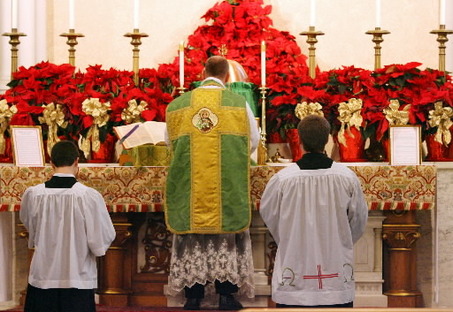
Before Vatican II, a priest celebrated Mass in Latin, facing the altar with his back to the congregation. [So, the writer either didn’t do any homework at all about this point or he chose to distort was is really going on. The priest doesn’t have his back to the people any more than a leader of troops has his back to them when he leads them toward their goal.] Here, the Rev. Bede Kotlinski celebrates the old-style Latin Mass at Immaculate Conception Church in Cleveland last Sunday.
Picture a man heaving a stone into a placid pond, the splash setting off an ever-widening chain of waves. [I think I have used that image. Perhaps he do some homework.]
Fifty years ago today, Pope John XXIII unleashed such a wave of change in the still — some would say stagnant [and some wouldn’t] — waters of the Roman Catholic Church when he called for a worldwide council of bishops to reform their ancient institution.
On Sunday, Jan. 25, 1959, John — less than three months after becoming pope — proclaimed it was time to drag the church out of the Dark Ages [HUH? At what point did he say that? Was that when he also revived the camauro?] and into the modern world. It was time, he said, to open the stained-glass windows and let in some fresh air. [cliche upon cliche. But remember what Pope Benedict said about stained-glass windows when he was at St. Patrick’s in NYC.]
The proclamation shocked Catholics, unused to seeing change in a more than 1,900-year-old patriarchy steeped in tradition. Some were skeptical. Others embraced it.
"I remember being very excited that the bishops were going to meet," said Sister Christine Schenk of Cleveland, a St. Joseph nun who was in the seventh grade when John put out the call. "We were wondering what it was all going to mean."
The council, known as Vatican II, convened in Rome in October 1962.
The convention of nearly 3,000 bishops, under the guiding hand of John, went to work on revolutionary changes that would give more freedom to the laity, [They were always free.] reach out to non-Catholics ["reach out" means…. what?] and allow congregants to celebrate Mass [congregants don’t celebrate Mass in any way like the priest] in their own language, [Which means that the Council’s requirement that Latin be preserved was disobeyed] with the priest facing them. [Something else not prescribed by the Council and already permitted when the circumstances required.]
Before Vatican II, the priest faced away from the congregation and said Mass only in Latin. [Except when he was a Maronite, for example. And the priest was facing TOWARD something, not "away" from the congregation.]
"You went from a guy with his back to you, [3rd time this cliche has come up. Like a broken record. ARe they really that hung up about this?] speaking in a language you didn’t understand, [So… what were they saying in the translation we got? Try doing a quiz on the way out the door after Mass sometime.] to where you were one of the celebrants," said Schenk. [This sister is goofed up about the terms here. But you get a sense of her ecclesiology from a comment like that.] "You went from a spectator to a player. It was all very exciting and new." [Also wrong. People were "spectators" before, anymore than they are now. Doing stuff doesn’t make you liturgically "active".]
John died in 1963, but Vatican II continued in four sessions through his successor, Pope Paul VI, until it adjourned in 1965, launching more changes over the next 10 years than in the church’s previous 100 years.
"I have very vivid memories of how poorly prepared people were for the changes," said Bishop Richard Lennon of the Cleveland Catholic Diocese. "Priests were not prepared at all, and as a result it was a pretty haphazard event, a bit unsettling until you got used to it."
Vatican II opened the gates of social activism, [You’ve got to be kidding. The Church supported ALL social institutions for the poor and needy for centuries!] freedom of expression [Had a look in a museum lately? A library" Concert hall?] and conscience, [What does that mean?] and a respect for all religions, [respect for people’s rights, that is] proclaiming to put an end to centuries-old prejudices and bad blood toward other Christian denominations. [Wow! The Church must have really been bad back then!]
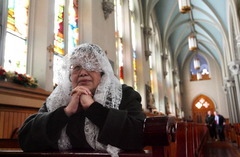
In Africa, Masses were celebrated with drums; in America, with guitars. [And that has worked so well.] Women no longer had to cover their heads in church. And nuns all over the world began shedding their medieval robes and veils. One nun told a documentary filmmaker that it was strange to feel wind on her forehead and in her hair. (John’s fresh air?) [And how are your vocations doing in your institute there, sister? Pretty good are they?]
Bigger role for lay people
Vatican II eventually put an end to meatless Fridays [Well… not entirely] and long hours of fasting before receiving Communion. [Which lowered respect for the Eucharist.] It restored the stature of the Bible, [?!?] which had taken a back seat to church teachings, and allowed lay people to hand out consecrated Communion wafers, a job only a priest had been allowed to do. [Because no one believe that a consecrating a priest’s hands means anything anymore. Big improvement that!]
"The fundamental change is the role it gave to lay people," said the Rev. Lou Trivison, 84, retired pastor of Resurrection Church in Solon. "It called on the laity to put their faith into action — to work for peace and unity among ourselves and all Christian churches. [This is ridiculous. People did that for centuries before the Council. Notice when most parishes and schools were build, hosiptals, etc.]
"There’s more to being a Christian than just baking cookies and making coffee after Mass," said Trivison. [How insulting to our forebears in the faith.] "The laity can now be more-active members of the church through involvement in parish ministries.
"Prior to Vatican II, the laity’s role was to pray, fast and obey. In other words, ‘Shut up.’ " [Another insult.]
But the newly empowered laity would speak up, [Not a problem if their shepherds would and lead them and formed them. But they DIDN’T.] unleashing a host of hot-button issues that today remain subjects of fierce debate: Ordination of women, marriage for priests, gay sexual intercourse and the use of contraception — all, to various degrees, not approved by the church hierarchy. [This phrase makes it sound as if the "hierarchy" can simply approve things, as if there is no role for the Church’s tradition, or of reflection on natural law or Scripture.]
"I believe those things need to be addressed," said Marilyn Cunin, 78, of Cleveland Heights, a lifelong practicing Catholic. "We have educated people in the congregations today who don’t just say, ‘Yes sir, yes sir.’ [Again… see the pernicious nature of the implication that the hierarchy can just "change things" if they were finally to come to their senses and follow the sheep instead of shepherd them?]
"I can’t imagine why Rome would object to ordaining women. Women are perfectly equal." [No. Not "perfectly equal" in the sense that roles of men and women are identitical. Men and women are equal in dignity as images of God. They are not "equal" in the sense of "interchangable" as far as vocations, etc. are concerned.]
Cunin said the church in pre-Vatican II days was preoccupied with the trappings of ritual — rosaries, candles, incense, icons, novenas — which, today, she said, have little meaning for her. [Neither did the schools, libraries, colleges, hospital, parishes, orphanages, convents….]
"If you forgot your chapel veil, you had to put a Kleenex on top of your head," she said. "That’s just ridiculous. It’s laughable. [Second time this is brought up. The writer is trying to make the Church before the Council seem stupid in the eyes of the oh so grown up and knowing modern reader.]
"I can appreciate the rituals, but sometimes there are people down the street going hungry while you’re saying the rosary. [Another insult. When were the Little Sisters of the Poor founded? The Missionaries of Charity? Catholic hospitals which did not turn away the sick. When was the Vincent de Paul Society formed. Does this person honestly think that the Church was not involved with the poor and hungry before Vatican II. Really?] I believe faith should be more about addressing the problems of world hunger, AIDS and injustices." [Mushy thought. It all sounds so very high minded and smug. How are "injustices" to be tackled? People of good will can disagree about the ways "injustices" can be approached. But to suggest that the Church wasn’t interested in "injustices" before the Council is just a lie.]
Small group of Catholics rejects reforms as heresy [Sloppy use of that term]
Most Catholics, both liberal and conservative, support Vatican II, although they may differ in their interpretations of it. [Is it legitimate to "interpret" it in a way other than that which this writer is trying to convey?] And most believe Pope John Paul II slowed the Vatican II movement by issuing conservative decrees and reaffirming Rome’s authority, which to some is a blessing and to others a disappointment.
"Pope John called them prophets of doom," said the Rev. Allan Laubenthal, 74, who was in Rome during Vatican II and now teaches theology part time at St. Mary’s Seminary in Wickliffe. "There are a few still around. They crop up now and then."
The Society of Pius X, based near Kansas City, Mo., is a breakaway group flatly opposed to Vatican II. It is represented here by the Rev. Markus Heggenberger, who celebrates Mass in the old Latin rite at St. Peregrine Chapel in Westlake.
Heggenberger opposes Mass in English, the new roles of the laity and efforts to reach out to other religions. [Perhaps it would be fairer to say opposes misinterpretations of new roles of the laity and false ecumenism?]
"Who wants to make common cause with Muslims?" he said. "The Catholic Church, I think, is a new religion, a religion of sentimentality as opposed to a religion of the Ten Commandments. Pope John XXIII was a liberal, not consistent with the Catholic faith."
But it was John’s messages in a time of cultural changes throughout the Western world that attracted millions of Catholics, including the Rev. Donald Cozzens, [You knew that if this was from Cleveland they would have to trot out this guy.] who teaches religious studies at John Carroll University.
"Vatican II asked, ‘What is religion all about? Is it about control or about liberation?’ " Cozzens said. "Religion is meant to liberate the soul so an individual sees his or her dignity as a child of God.
"You should follow your conscience. But you should form your conscience in light of truth and Christian teaching. The commandments are really in your heart. They’re not imposed arbitrarily by a church."

 Vatican II reforms set in motion 50 years ago with Pope John XXIII’s edict
 On Sunday, Jan. 25, 1959, John — less than three months after becoming pope — proclaimed it was time to drag the church out of the Dark Ages [HUH? At what point did he say that? Was that when he also revived the camauro?] and into the modern world. It was time, he said, to open the stained-glass windows and let in some fresh air. [cliche upon cliche. But remember what Pope Benedict said about stained-glass windows when he was at St. Patrick’s in NYC.]




 mibethda on Pope Leo XIV airplane interview: remarks about relaxing Traditional Latin Mass restrictions: “The prime rationale underlying Traditionis Custodes and the restriction of the Vetus Ordo Missae as declared by Pope Francis, Cardinal…”




























