With a biretta tip to The Papist o{]:¬)
The Holy Father seems to be having some … Fanta!

It will come as no surprise to anyone who has followed WDTPRS for a while that I am no great lover of squirrels.
Yes… I know this might lose me some votes in the 2008 Weblog Awards election… (VOTE FOR ME!) … but I do admit it.
I don’t like them.
So I was quite amused when a reader sent me a link to this article in Hell’s Bible… er um… the New York Times.
January 7, 2009
Saving a Squirrel by Eating One
By MARLENA SPIELERRARE roast beef splashed with meaty jus, pork enrobed in luscious crackling fat, perhaps a juicy, plump chicken … [so far so good] these are feasts that come to mind when one thinks of quintessential British food. Lately, however, a new meat is gracing the British table: squirrel.
Though squirrel has appeared occasionally in British cookery, history doesn’t deem it a dining favorite. Even during World War II and the period of austerity that followed, the Ministry of Food valiantly promoted the joys of squirrel soup and pie. British carnivores replied, “No, thank you.” [No!]
These days, however, in farmers’ markets, butcher shops, village pubs and elegant restaurants, squirrel is selling as fast as gamekeepers and hunters can bring it in. [I am on board so far.]
“Part of the interest is curiosity and novelty,” said Barry Shaw of Shaw Meats, who sells squirrel meat at the Wirral Farmers Market near Liverpool. “It’s a great conversation starter for dinner parties.” [Yes… I suspect it is.]
While some have difficulty with the cuteness versus deliciousness ratio — that adorable little face, those itty-bitty claws [blech] — many feel that eating squirrel is a way to do something good for the environment while enjoying a unique gastronomical experience. [Yes! Offing a squirrel helps everyone!]
With literally millions of squirrels rampaging throughout England, Scotland and Wales at any given time, squirrels need to be controlled by culls. [euphemism] This means that hunters, gamekeepers, trappers and the Forestry Commission (the British equivalent of forest rangers) provide a regular supply of the meat to British butchers, restaurants, pâté [!] and pasty makers and so forth.
The situation is more than simply a matter of having too many squirrels. [a relative concept] In fact, there is a war raging in Squirreltown: invading interlopers (gray squirrels introduced from North America over the past century or more) are crowding out a British icon, the indigenous red squirrel immortalized by Beatrix Potter and cherished by generations since. The grays take over the reds’ habitat, eat voraciously and harbor a virus named squirrel parapox (harmless to humans) that does not harm grays but can devastate reds. (Reports indicate, though, that the reds are developing resistance.) [Death to them, say!]
“When the grays show up, it puts the reds out of business,” said Rufus Carter, managing director of the Patchwork Traditional Food Company, a company based in Wales that plans to offer squirrel and hazelnut pâté [hmmm] on its British Web site, patchwork-pate.co.uk.
Enter the “Save Our Squirrels” campaign begun in 2006 to rescue Britain’s red squirrels by piquing the nation’s appetite for their marauding North American cousins. [good idea!] With a rallying motto of “Save a red, eat a gray!” the campaign created a market for culled squirrel meat. [I wonder if this… could it have been inspired by "Say the Black…" … no… ]
British bon vivants suddenly couldn’t get enough squirrel. Television chefs [I wonder about internet streaming priests who cook!] were preparing it, cookbooks were extolling it, farmers’ markets were selling out of it and restaurants in many places were offering it on the menu.
Meanwhile gamekeepers, hunters and trappers were happy to know that the meat was being eaten, not wasted. “My lads don’t like to kill an animal if it’s not going to be eaten,” [well…] Mr. Shaw said of the hunters who bring him game.
Many enjoy squirrel, however, simply because they like its taste. Mr. Carter said he didn’t know what he was eating when he tried it. But, he said, “at first bite, I thought it delicious.” Patchwork will send squirrel pâté, by the way, in return for a donation to “Save Our Squirrels” — but only within Britain.
…
If you want to grab your shotgun, make sure you have very good aim — squirrels must be shot in the head; a body shot renders them impossible to skin or eat. (You want to get rid of the head in any event, as squirrel brains have been linked to variant Creutzfeldt-Jakob disease, the human form of mad cow disease.)
Skinning a squirrel is “difficult and unpleasant,” the food writer Leslie Mackley said, adding, “You have to fight to rip the skin from the flesh.”
….
There is more, and you can go find the article. This the essence.
I am getting, finally, to a back log of interesting e-mail form readers:
Thought you’d be interested in some snaps taking during today’s celebration of the Feast of the Holy Name at the Archdiocese of San Francisco’s only weekly scheduled Mass in the Extraordinary Form. Fr. William Young is the celebrant.
We normally get 200-300 people in the pews. The schola is growing.
The Mass is held in the chapel (Most Holy Rosary) of St. Vincent’s boys home in Marin County, California just north of San Francisco.

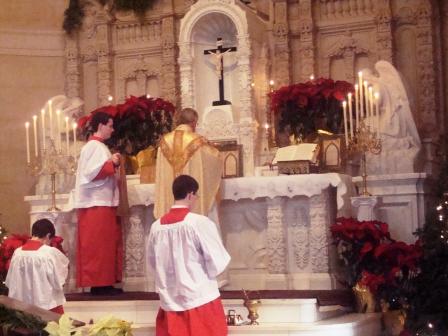
Our church architecture in every age reveals what our Catholic identity was at the time, how we prayed, what we believed in.
Imagine… this is a chapel for a home for boys back in the day.
How were children valued?
What did Mass mean to those who built this building?
What was sacred then, is sacred now.
We are recovering ourselves and our senses.
We received the news of the death of Fr. Richard John Neuhaus, convert, priest of the Archdiocese of New York, author and editor of First Things. With wit and good humor, Father Neuhaus was a strong and intelligent voice of sound teaching and defense of the Catholic faith in the public square for many years.
The Christian presence and voice in the “public square” was a constant theme of his. He penned a book called The Naked Public Square and provided a marvelous anecdotal commentary in the monthly First Things called “The “Public Square”. He underscored that we must not allow the expression of religion to be marginalized from public discourse. People of faith have a right to express themselves in the great debate about the burning issues of our time. We have the right, as much as anyone, to shape the discourse.
In these WDTPRS columns I have picked up the theme of the “public square” especially in light of what I believe His Holiness Pope Benedict XVI has been trying to accomplish in his pontificate. Pope Benedict has been trying to revitalize our Catholic identity precisely so that we can contribute something vital, and often missing, from “the public square”, where policies, laws and mores are forged under the heat and hammering of debate. Catholics must have a voice in government, the arts, the academy, the press, every human endeavor. But for our voice and actions to have a good effect, according to our vocations to shape the world around us, we must know who we are as Catholics, know what we believe, and be able to express the same cogently and with conviction. If we don’t know who we are, then we won’t have anything to offer.
Liturgy is a key element what I call the Pope’s “Marshall Plan”, to revive our identity and energize our Church, both within and also for the sake of our role in the public square. As we pray as Catholics, so shall we believe and behave. If we have fuzzy prayers, nebulous and ever-shifting worship, we will be vague and ineffective as Catholic Christians with nothing firm to stand on in our own lives and nothing worth of attention from others.
When Pope Benedict through his document Summorum Pontificum released the older form of Mass and the sacraments from exile, he put into the hands of parish priests a powerful tool for the redirection of our public worship and the revitalization of our Catholic identity. What was sacred for our ancestors in the Faith, is sacred for us today. What shaped our forebears and nourished the lives of saints, shaped cultures, guided the arts and thought about life’s deepest questions for over a millennium is part of who we are as Catholics. What served as a bulwark against religious and secularist error, what provided the rich and the poor together, the young and old, high born and lowly alike the possibility of a daily encounter with transforming mystery will be a mighty source of strength and grace now, as we struggle to be faithful to Christ’s commands in a ever more relativist dominated world.
I mourn the loss of Fr. Neuhaus. His example and words in the public square will be missed. In his life he helped to shape awareness of what is at stake. In your charity, say a prayer for him.
Eternal rest grant unto him, O Lord.
And let perpetual light shine upon him.
May he rest in peace.
May his soul, and all the souls of the faithful departed
through the mercy of God, rest in peace.
Read Fr. Neuhaus’s insight about death and dying…

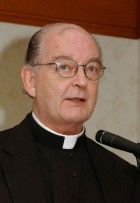 Please pray for Fr. Richard John Neuhaus, who is close to death.
Fr. Neuhaus, a priest of the Archdiocese of New York, is a convert from Lutheranism, an author of great insight and edition of First Things.
Father has developed an infection while battling cancer. He received last rites from Fr. George Ruttler.
In your kindness pray for him. The Enemy attacks priests.
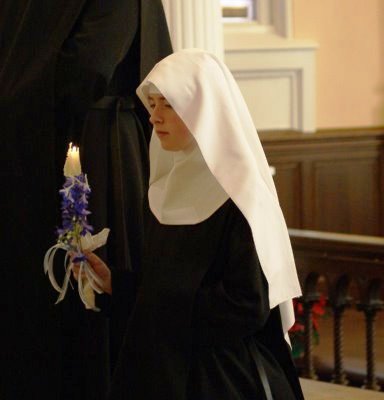
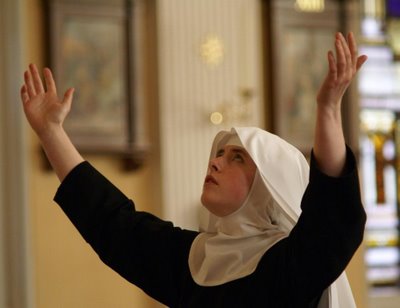
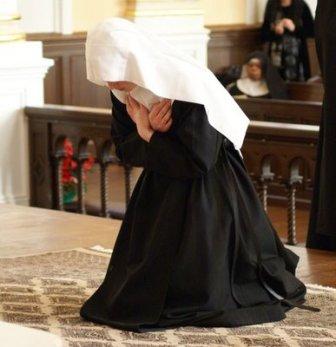
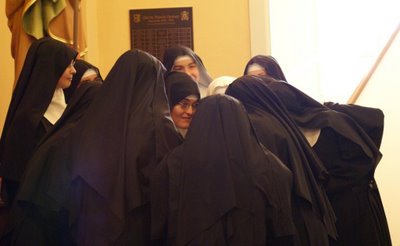
Kansas Catholic has beautiful photos of the investiture of some novices for what is rapidly becoming one of my favorite communities of women religious.
On Tuesday, January 6, 2009, the Feast of the Epiphany, the Benedictines of Mary, Queen of Apostles, a traditional community in the Diocese of Kansas City-Saint Joseph (MO), had a novice make her first profession of vows and also had the investiture in the Benedictine Habit of four postulants. This happened at the Oratory of Old Saint Patrick in Kansas City, MO.
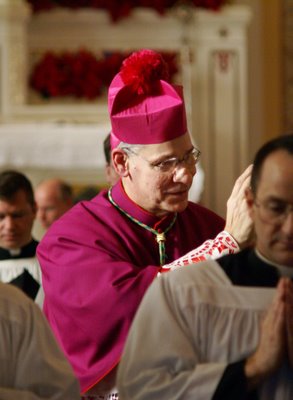
Here are photographs of the Holy Mass, celebrated by His Excellency Robert W. Finn, as well as the profession of Sister Grace of the Merciful Face of Jesus and the investiture of the four postulants. Congratulations to the Benedictines of Mary for their phenomenal growth. Their website is here, and details, among other things, their making of traditional vestments.
Here are a few. Go to Kansas Catholic for more!
And the great Bp. Finn!
From a reader:
Having received the approval of the Archbishop, Timothy M. Dolan, an apostolate for the celebration of Holy Mass in the Extraordinary Form (TLM), under the care of the Pontifical Institute of Christ the King Sovereign Priest with Reverend Canon Olivier Meney, ICRSP, is being established in Sheboygan, Wisconsin, Archdiocese of Milwaukee.
Fr. James Connell has generously opened the use of his church, Holy Name of Jesus Catholic Church, 818 Huron, Sheboygan, to the Institute. Mass will be celebrated on the 4th Sunday of each month at 3:00PM.
The first Mass of this new apostolate will be celebrated on Sunday, January 25th, the Feast of the Conversion of Saint Paul. Mass will be preceded by the Rosary at 2:40PM. A reception with refreshments follow immediately after Mass.
Brick by brick, folks!
From a reader:
The Living Tradition: The Dominican Rite in the Twenty-First Century
Dates:
August 5-9, 2009
Place:
St. Albert the Great Priory
House of Studies of the Western Dominican Province 5890 Birch Court Oakland CA 94618As a response to the spirit of Summorum Pontificum, a number of priests experienced in the use of the Rite have volunteered to assist other Dominicans who would like to learn to celebrate the traditional Dominican Mass. The conference will include workshops, not only for the ordained ministers and celebrants of Mass, but also for training for servers and other ministers, including musicians. As many people besides Dominican priests might spiritually benefit from this program, the conference is open to all interested: non-Dominican priests, nuns and sisters, or lay people who would like to attend.
Plenary Lecturers:
Fr. Aidan Nichols, O.P., of the English Province, the well-known author of books on spirituality, theology, and culture
Prof. William Mahrt of Stanford University, President of the Church Music Association of American and editor of Sacred Music, whose own experience of medieval chant began with the Dominican liturgy at the University of Washington.
Fr. Giles Dimock, O.P., of the Eastern Province, former professor of liturgy at the Franciscan University of Steubenville, and prior of Immaculate Conception Priory in Washington D.C.
Fr. Augustine Thompson, O.P., of the Western Province, professor at the University of Virginia, and author of books and articles on medieval religion, theology, and liturgy.
Conference Liturgies:
Daily Dominican Rite Low Mass
Dominican Rite Solemn Mass of St. Dominic and a Solemn Requiem
Dominican Rite Missa Cantata
Compline in the Dominican Rite will be sung each evening
There will be time off on Saturday to visit the Bay Area. For more see the program.Registration forms, the program and a poster may be down-loaded for printing at The Living Tradition. Registration forms and fees should be sent to: The Living Tradition, Holy Rosary Church, 375 N.E. Clackamas Street, Portland, OR 97232. You may also request a copy of the registration forms by writing to the same address. Fee options and room and board reservations for St. Albert the Great Priory, Oakland CA, are explained on the forms.
Dominican friars may begin registering immediately. Dominican nuns, sisters, laity, and non-Dominicans may begin registering on April 1, 2009. Friars who wait till after that date to register will not get priority.
I have absolutely torn my office apart and reconfiguring everything, computers, network, cams, layout of the stuff… untangling wires, consolidating and removing…
whew!
In the meantime, don’t forget to vote for WDTPRS everyday until the polls close.
You can vote once during a 24 hour period.


Coat of Arms by D Burkart
 waalaw on Daily Rome Shot 1118 – Paddywhack!: “1. R-h1+ . . . B×h1 2. R×h1× If . . . . . . . . . K-g2 3.…”
 on Pope Leo XIV airplane interview: remarks about relaxing Traditional Latin Mass restrictions: “! TC was Francis’s decision and we will continue that. ! SP was Benedict’s decision and we will not continue…”
 on Pope Leo XIV airplane interview: remarks about relaxing Traditional Latin Mass restrictions: “~mibethda You are assuming that there isn’t a contingent among the powers that be that has just as much of…”
 on NB: Desktop and Posting – Zuhlsdorf’s Law kicks in: “We have all tried to enter thru that “narrow gate”. Just last night I installed new computer drafting software for…”
 on Pope Leo XIV airplane interview: remarks about relaxing Traditional Latin Mass restrictions: “WVC: You are exactly correct. The problem is that under TC we the faithful who have a desire to attend…”
 on Your Sunday Sermon Notes – 6th Sunday after Epiphany Resumed (N.O.: 33rd Ordinary): “Last Sunday we had just gotten off of a cruise ship in Fort Lauderdale and rented a car for the…” on Pope Leo XIV airplane interview: remarks about relaxing Traditional Latin Mass restrictions: “I don’t think the problem is the liturgy itself; that is why the Eastern Rite is not seen as a…”
 on Pope Leo XIV airplane interview: remarks about relaxing Traditional Latin Mass restrictions: “Is there not a unity within the Catholic Church, of the liturgical rites within the the 24 churches in the…”

A Daily Prayer for Priests








They find you a pro-life agent in your area who commits to giving a portion of the fee to a pro-life group!

PLEASE subscribe via PayPal if it is useful. Zelle and Wise are better, but PayPal is convenient.
A monthly subscription donation means I have steady income I can plan on. I put you my list of benefactors for whom I pray and for whom I often say Holy Mass.
In view of the rapidly changing challenges I now face, I would like to add more $10/month subscribers. Will you please help?
For a one time donation...



Help Monks in Wyoming (coffee – UPDATED LINK) and Norcia (beer) and the wonderful "Soap Sisters" of Summit, NJ!


Please follow me on Twitter!










Visits tracked by Statcounter
since Sat., 25 Nov. 2006:

