WDTPRS – Sunday in the Octave of Christmas – Holy Family – (2002MR)

In the Novus Ordo, today is the Feast of the Holy Family.  We are also observing Sunday in the Octave of Christmas.

A liturgical “octave” is an eight day period following and including the feast. In a way, the Church suspends time so that we can “rest” within the mystery we have celebrated while contemplating it from different angles.

Perhaps you have gone to a museum and seen a magnificent statue, such as Michelangelo’s David in Florence.

Glancing at it for a moment is not enough; you want to spend some time.

Looking at it from one direction is inadequate; you walk around it to see it from various points of view.

Considering our human weakness, a single day per year does not suffice to gather in the different dimensions of the mystery of a great feast. An octave, however, allows us to reflect on a feast in different ways.

For example, Pius Parsch, a prominent figure of the Liturgical Movement during the 20th c., wrote in The Church’s Year of Grace that the feasts of Sts. Stephen, John the Evangelist, and the Holy Innocents permit us to approach Christ, the new born King, first as martyrs, then as virgins, then as virgin-martyrs.

Theologically speaking, an octave anticipates the eternal bliss of heaven in which we will consider God in His glory. Think of it this way. God created the world in six days and on the seventh, the Sabbath, He rested. This cycle of seven repeats itself while the world endures. The eighth day is therefore beyond the cycle of seven. It symbolizes an eternal state, the perfect unending Sabbath of heaven. As a Church, during the octave – perceived as a single continuous day – we imitate the hosts of heaven in their abiding contemplation. Advent prepared us for the coming of the Lamb, both at Bethlehem and the end of time. Christmas too marks both comings. After Christmas we gather around the manger of Bethlehem and contemplate Jesus who is also the Lamb of the book of Revelation. We are like the Magi who adore Him, but we are also like the heavenly multitude of 144,000 who “follow the Lamb wherever he goes” (Rev 14:4). In both ways we remain in the Lord’s presence.

On 1 January we celebrate the solemn feast of Mary, Mother of God, once called in the traditional Roman calendar (and still so by those using the 1962 Missale Romanum) the Feast of the Circumcision, when Christ shed His Blood for us for the first time. Thus, at Christmas the wooden Crib already points to the wooden Cross, and beyond to the goal of heaven made possible now for the children of a common Father. Mary stood at the foot of both. Consequently, it is fitting to celebrate her with great solemnity in the Christmas octave. By her participation in the salvific shedding of her Son’s Blood Mary gives us an important example of sacrificial love.

The place God Incarnate chose to begin manifesting this sacrificial love, which reached its culmination on the Cross, was the family home. Together with Mary and His earthly father Joseph, Christ began to reveal something of the unity of love within the most perfect of communions, the Holy Trinity. It is fitting to celebrate the Holy Family within the Octave of Christmas when we contemplate the coming of the Lord in imitation of that final, perfect communion with God to be enjoyed only by the blessed in heaven. The family is a paradigm of all other human relationships. The Holy Family teaches us, who are still in this world but moving inexorably toward our judgment and final goal, how to live – together – in this present state of “already, but not yet”.

COLLECT – LATIN TEXT (2002MR):
Deus, qui praeclara nobis sanctae Familiae
dignatus es exempla praebere,
concede propitius,
ut domesticis virtutibus caritatisque vinculis illam sectantes,
in laetitia domus tuae praemiis fruamur aeternis.

ICEL (1973 translation of the 1970MR):
Father, help us to live as the holy family,
united in respect and love.
Bring us to the joy and peace of your eternal home.

According to the fine Lewis & Short Dictionary the noun exemplum means, “a sample for imitation, instruction, proof, a pattern, model, original, example….” For the Fathers, exemplum could mean many things. including man as God’s image, Christ as a Teacher, and the content of prophecy. In Greek and Roman rhetoric and philosophy, which so deeply influenced the Fathers, exemplum could have auctoritas, “authority”, which means among other things the moral persuasive force of an argument. When we hear this prayer with Patristic ears, exemplum is not merely an “example” to be followed: it indicates a past event as a reason for hope and an incitement to the spiritual life that leads to being raised up after the perfect exemplum, the Risen Christ.

The deponent verb sector (you know the word “sect”) is, “to follow continuously or eagerly… to strive after.” The playwright Publius Terentius Afer (Terence + 158 BC) uses it for followers of a philosopher (Eunuchus 2.2.31). These disciples would take their name from their philosophical master just as we ‘Christians have ours.

In the ancient Church there was a gossamer thin distinction between religion and philosophy. In a sense, Christ, the teacher offering His disciples perfect exempla is the verus philosophus for He Himself is Wisdom and Truth, and our faith is vera philosophia.

That illam (singular) goes back, necessarily to familia (singular feminine, not the neuter plural exempla). Exemplum is also laden with import in the writings of the Fathers of the Church.

Praeclarus, a, um, the adjective paired with exempla, signifies basically, “very bright, very clear” and then by extension, “very beautiful (physically or morally), magnificent, honorable, splendid, noble, remarkable, distinguished, excellent, famous, celebrated.” Praeclara …exempla is so packed with information that it is really impossible to render it into English completely without a long excursus, like, “authoritative models for imitation very beautiful in instructive clarity”. Also, the combination of praebere exempla is very common in the writings of the Fathers often for “offering examples for imitation” of virtues or good works.

This prayer is laden with philosophical vocabulary revolving around instruction of and conformity of life to wisdom through virtues. This prayer is a new composition for the Novus Ordo based somewhat on the Collect for the Feast of the Holy Family in the 1962MR.

Whoever wrote this knew more than his prayers, I can tell you.

The term domestica virtus, is used by ancient authors of philosophical works (e.g., Cicero (+43 BC) and Seneca (+AD 65)) and thereafter by the doctor of the Church St. Ambrose of Milan (+397) in his own works on virginity and on virtues and duties.

This word pairing brings to mind the Second Vatican Council’s description of the family as the “domestic Church”, reprised in the Catechism of the Catholic Church 1656 citing Lumen gentium 11:

In our own time, in a world often alien and even hostile to faith, believing families are of primary importance as centers of living radiant faith. For this reason the Second Vatican Council, using an ancient expression, calls the family the domestic Church (Ecclesia domestica). It is in the bosom of the family that parents are “by word and example…the first heralds of the faith with regard to their children. They should encourage them in the vocation which is proper to each child, fostering with special care any religious vocation.”

LITERAL TRANSLATION:
O God, who deigned to provide us
with the very beautiful models of the Holy Family,
grant propitiously
that we who are eagerly imitating them in domestic virtues and the bonds of charity,
may enjoy eternal rewards in the joy of Your house.

The England & Wales Novus Ordo Liturgy of Hours:
God, our Father,
in the Holy Family of Nazareth,
you have given us the true model of a Christian home.
Grant that by following Jesus, Mary and Joseph
in their love for each other and in the example of their family life
we may come to your home of peace and joy.

We are asking God implicitly to enable us through grace, building in us the supernatural virtues of faith, hope and especially charity, to imitate the clear examples (praeclara exempla) of Jesus, Mary and Joseph in the communion of their earthly household. We are to build communion among ourselves, on their authoritative model, which in turn exemplifies the communion of the Church and of the Persons of the Trinity. Thereafter, our examples, our own families, serve as the building block of a society oriented to God, the “city of God”, not the “city of man”. The reward for doing this faithfully is participation in the heavenly household of God the Father in the new family of the Church triumphant.

What the Holy Family offers us is a real exemplum, authoritative model, of freedom.

This is not the false freedom of self-interested satisfaction of appetites, or the freedom to “choose” divorced from consideration of objective truths. This is freedom within, not from the bonds of charity. The more we are implicated or “bound up” in the love of God, giving Him our freedom, the freer we truly are. Vinculum literally means “that with which any thing is bound”, a “fetter”, like a chain. Here it describes effect of real charity, vincula caritatis, the kind of sacrificial love based on obedience to God’s will that the Holy Family had for one another and Christ showed forth perfectly while fixed and bound to the Cross. The “bonds of charity” require sacrifices and the abandoning, or better, transformation of selfish desires. The bonds of the family, and any authentic relationship based on something other than mutual use of each other, seem to modern eyes often to restrict personal freedom. But this is not the case. God’s love and God-like love, charity, makes us freer than we could ever hope to be without it.

The bonds of love and virtues of the Holy Family are foreshadows of the harmony of heaven which we are eagerly striving after. The family, nourished in the faith and sacraments of the Church, is an image of the Holy Family, itself an image of the communion of persons of the Church in heaven and of the Persons of the Trinity. Today’s Collect points to the importance of the “domestic Church.” The family is the first “church” children know. Parents are the first examples of God children experience. Your children first learn who God is by experiencing you.

Can anyone wonder why the forces of hell are bending relentless attacks upon the family and the virtues which must be practiced in the home? Through the media, especially cinema, TV, and the internet, there pour into our homes a constant assault on virtue. And it is precisely virtue (not diversity, not tolerance, not inclusivity, not politically correct sensitivity, not freedom of choice unfettered from charity) that makes possible a family and therefore a society.

This prayer is a contradiction of worldly ways and an affirmation of the God’s true image in us.
Posted in Christmas and Epiphany, WDTPRS |
Comments Off on WDTPRS – Sunday in the Octave of Christmas – Holy Family – (2002MR)

TV dinner

I received a gift card for a good grocery store in the Twin Cities and as I left town I got a few things I would not ordinarily have bought.

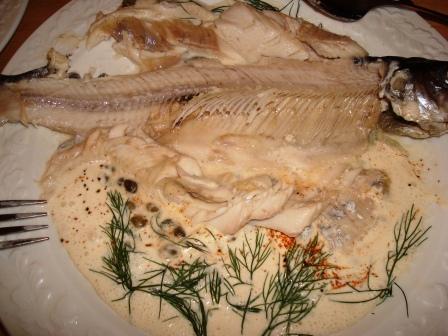
Tonight for supper I made a little rainbow trout!

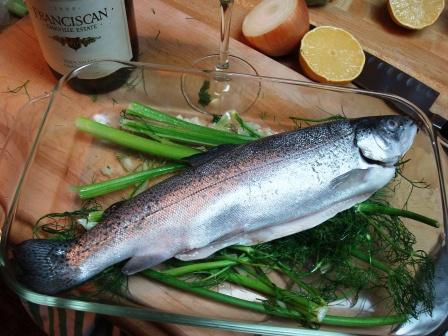
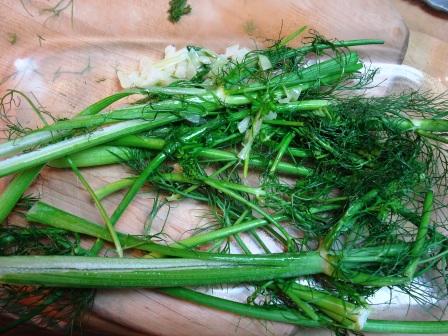
I started with a bit of chopped onion, butter and olive oil, some ginger oil, and put the critter on a bed of stalks of fennel all in a glass pan.. dish… thing.  For moisture, I used some fish base I keep around, half a glass the white wine I was sipping (Franciscan Chardonnay) and the juice of a lemon.  No salt because of the fish base.  No pepper.

TV dinner

TV dinner

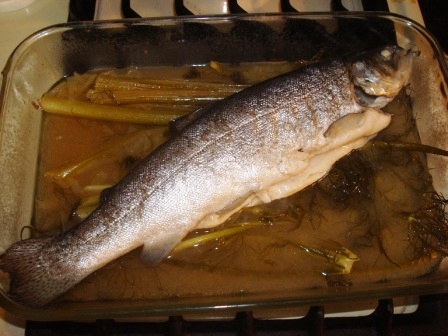
The glass pan went into the oven, covered at 325F for 30 minutes.

TV dinner

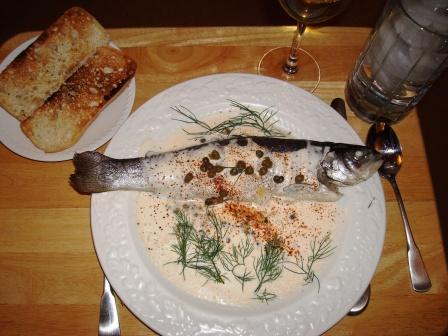
I drained off the liquid and reduced it for a couple minutes. I then added a some crème fraîche, beat it up with a whisk.

I finished the plate with capers, little fronds from the fennel I saved and some black pepper and cayenne pepper.

Had there been guest I would have dressed out the fish after presenting them.   But I just did it all on the plate, since I am pretty deft at this.

So…. TV dinner is served!

TV dinner

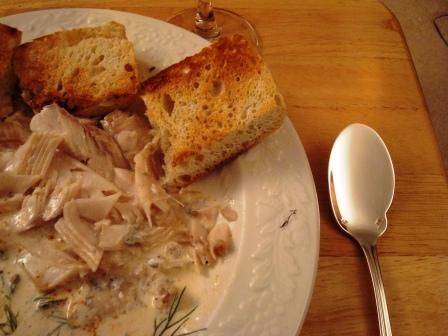
The bread is toasted ciabatta.

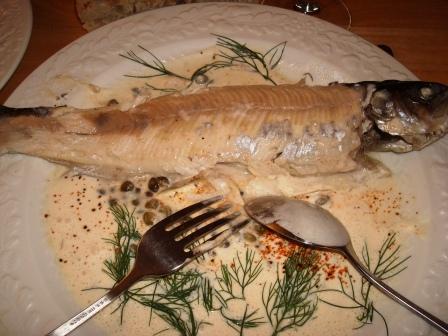
So, we begin to dressit out.  First the skin on the top.  I always work with at least one spoon… often two.

TV dinner

The flesh slides right off.  Again, had this been for guests, I would have shifted it all to a different plate.  I was lazy.

TV dinner

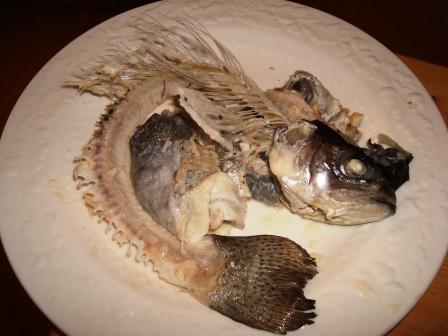
You can lift the whole back bone, tail and head out as one piece and put it aside.  Just think of the old cartoon garbage can accessories when cats were involved.

TV dinner

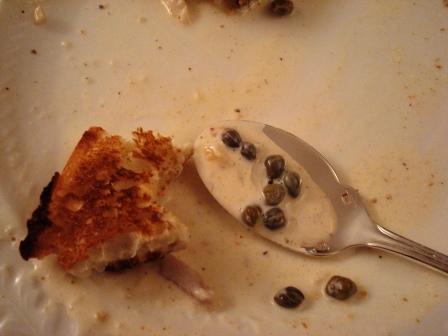
The sauce was so good that I got out one of my precious sauce spoons just for fun!

TV dinner

You don’t want to miss a drop of this stuff.  I would lick the plate… but that is why on the eighth day (or during the Octave) God created the cuillère à sauce individuelle!

TV dinner

Yep.  Not bad.  

It’s a nice change from ramen.

I am very grateful for to my dear friend who gave me the grocery gift card. 

It was a nice supper for my name day…well… one of my name days.

It is good to stay in practice!

Posted in Fr. Z's Kitchen, My View |
30 Comments

A Minnesota priest asks people not to fight FOCA and to thwart the US bishops effort

In the Archdiocese of St. Paul & Minneapolis, His Excellency Most Rev. John Nienstedt, the Archbishop, has spoken very firmly about the need to defend the right to life and the urgent need to resist FOCA.

FOCA would remove all restrictions to abortion and would make the position of Catholic physicians and health-care givers very difficult.

This is what Archbp. Nienstedt wrote – and said – about FOCA.

A least one of the priests openly opposes the Archbishop’s position about FOCA.

Here is what Fr. Michael Tegeder, pastor of St. Edward’s in Bloomington, MN, offered to the world in the Minneapolis Star/Tribune, arguably one the worst newspapers in the United States.

My emphases and comments.

Michael Tegeder: Church plans for mass mailing on abortion bill are ill-advised

By MICHAEL TEGEDER

December 22, 2008

When I signed up 35 years ago to be a priest, little did I realize that postcards would be an essential tool of ministry in the Catholic Church. It began a few years ago, when the Catholic bishops of Minnesota, led by then-Bishop John Nienstedt, pushed a postcard campaign in all Minnesota Catholic parishes that promoted a constitutional amendment to limit marriage to one man and one woman. Preprinted postcards were to be signed and sent to legislators.

We never got a report from the bishops on what was accomplished. To someone who did not see this as necessary, it seemed a waste of time and money. It also generated some unnecessary ill will.  [Since it is clear that the institution of marriage as being between one man and one woman is under attack in the public square, it seems Fr. Tegeder is not interested in defending marriage described in the traditional Christian way.]

Now the bishops of the United States are conducting a national postcard campaign to oppose the Freedom of Choice Act (FOCA). [Don’t be distracted.  Tegeder is not really interested in the use of postcards.  He is taking a position against what the postcard campaigns are all about.  He was against defending marriage as between one man and one woman.  Let’s see what else he is against.] This is to take place in all Catholic parishes the weekend of Jan. 24-25, which happens to be during the annual Week of Prayer for Christian Unity and just a few days after the historic inauguration of the first African-American president, Barack Obama. This should indeed be a time to focus on what unites us.   [So… his position is that voicing opposition to FOCA will interfere with Christian Unity?  His position is that we shouldn’t voice opposition to FOCA because the man who promised to sign it is going to be inaugurated?]

Our nation and new president will be challenged by ongoing wars, an economy in severe recession, ballooning deficits, high unemployment and an environment and health care system in crisis. Yet at this very moment the Catholic bishops have declared that they have this more pressing need.  [Yes… because if you cannot say that a human being has the right to be born, then no other rights can be defended.  What is going on here is that Tegeder has fallen into the "we shouldn’t be single issue Catholics" crowd.  The the "seamless garment" approach is still rending the Church.]

A national postcard campaign against FOCA is a huge undertaking. In the letter from our archdiocese to me as pastor, I was told, "Our Archdiocese is responsible for securing a point person in each parish who will be responsible for the January 2009 massive postcard campaign materials in your parish." Actually, they intend for the pastors to do this. Postcards are to be sent to our representatives in Congress.

Obviously church leaders have every right to promote their concerns in the public arena. [Ehem… so long as their concerns are in keeping with the teachings of the Church.]  But FOCA is a phantom threat. [FOCA is a "phantom threat"?] It is meant to limit legislation by Congress on abortion. It will not be passed. [?!?]  Why would Congress pass a law to limit its own power? One well-placed Catholic commentator stated, "FOCA has as much chance of passage as the [now 0-15] Detroit Lions have of winning the next Super Bowl."  [Okay folks… how many things are wrong with this paragraph?]

A Catholic journalist, David Gibson, has a good perspective for Catholics concerned about abortion: "The problem of course is that these straw men and red herrings divert us all from the hard work to be done on this issue both within the church and in the public square. Opposition to FOCA should be part of that, to keep pressure on and pols honest. But using a phantom FOCA as a single-issue means of demonizing one’s political opponents does no good to one’s cause, or the wider society." 

We can do many positive things. Indeed, Obama has stated that he wants to reduce the number of abortions. We should work with him on doing this.

In the Christmas spirit, [HUH? This is just snide.] may I offer this suggestion to my fellow Catholics: With your Christmas offering, include a note saying that we do not need to send FOCA postcards.  [Look what he just did.  He publicly, in the local secular newpaper, asked people to defy the bishops of the USA in their attempt to fight FOCA.  He asked people to thwart the local Archbishop’s initiative.] During this season of goodwill, let us offer our new president some and hold back on the confrontation. And to the bishops: Your Graces, remember grace.

Michael Tegeder is a priest in Bloomington.

This is an example of contumacy offered to the person of the Archbishop of St. Paul and Minneapolis, in my opinion. 

Posted in SESSIUNCULA |
70 Comments

Parish church decorations

How about some photos of your parish church’s decorations?

Posted in SESSIUNCULA |
28 Comments

Adjusted

I adjusted the view of the Z-Cam.  While I was gone it had shifted a bit. 

I have it sort of jury-rigged in a window with a little tape.

Posted in SESSIUNCULA |
Comments Off on Adjusted

Hot Dumpling

Yum!

Hot Dumpling

Posted in SESSIUNCULA |
18 Comments

Z-Cam and Radio Sabina

<!–ustream feed–>

Posted in SESSIUNCULA |
23 Comments

WSJ review of a book on Vatican II and rupture

I was alerted this morning, over breakfast with one of the most erudite priests of my acquaintance of a book review in the Wall Street Journal.

Let’s have a look with my emphases and comments.

What Happened at Vatican II
By John W. O’Malley
(Harvard/Belknap, 380 pages, $29.95)

 DECEMBER 25, 2008, 9:37 P.M. ET

Bookshelf
Chronicle of a Council
The debates, controversies and effects of one of the 20th century’s most significant religious events.

By EDWARD T. OAKES, S.J.

Contrary to popular wisdom, the highest authority of the Catholic Church is not the pope acting alone, reigning like some Jacobean absolute monarch. [hmmm] No, the Catholic buck stops when the pope teaches in communion with his fellow bishops. [I think the "buck stopping" and exercise of teaching authority are different concepts.]  True, the pope can act alone, and when he does his writ is universal and without appeal. Nonetheless, when he convokes a solemn assembly of bishops — technically called an ecumenical council ("ecumenical" meaning here world-wide, not local) — the church witnesses the highest instance of its teaching authority. As the church’s own "Code of Canon Law" of 1917 says: "An ecumenical council enjoys supreme power over the universal Church."
[Bookshelf]  [The 1983 is the Code now in force for the Latin Church.  I found this paragraph confusing. Lumen gentium is pretty clear about the Supreme Pontiff’s ability to teach entirely apart from a Council or the body of bishops in union with him. ]

The 21st of such councils, which met each fall from 1962 to 1965, is known as the Second Vatican Council — usually abbreviated as Vatican II. It was, most competent observers would agree, one of the most significant religious events of the 20th century. [Man bites dog!] But there agreement stops. Did Vatican II mean a rupture or a continuation with the church’s past?  [Sooo… Pope Benedict’s 2005 Christmas address to the Curia continues to shape the conversation!]

John O’Malley, a Jesuit professor at Georgetown University, [the author of the book in question] is a prominent exponent of the view that Vatican II represents discontinuity. (Another Jesuit, Cardinal Avery Dulles, who died on Dec. 12, 2008, led those scholars who insist on Vatican II’s continuity. [With all due respect to the late Cardinal, I think Joseph Ratzinger was the leader in this area.  But this is a Jesuit writing about a Jesuit commenting about a late Jesuit.]) At least superficially, Father O’Malley has a point: The Mass is now celebrated in the language of the people instead of in Latin;[That is just a fact… it is not the Church’s law.  The same Vatican II we are talking about here required that Latin be maintained.  It was definitely an application of a hermeneutic of discontinuity and rupture which removed Latin from our worship, to the great detrimment of the whole Church.] liturgical translations avoid Renaissance cadences in favor of staccato syntax; [They do.  They also favor incredibly banal language nearly bereft of theological or linguistic fidelity to the Latin originals.  The new translation will be better.] thundering condemnations of the modern world (and of Protestants) have been replaced with openness and dialogue — and vocations to the priesthood and convent life have plummeted.  [A tree is known from its fruits.]

Of course, no major event in history can escape the law of unintended consequences; and Vatican II is no exception. The assembled bishops hardly intended to empty rectories and convents, but that is what happened. Which forces the question: How much of this disruption was predictable and how much was due to the unexpected winds of history, such as the student rebellions of 1968 and the rise of the so-called counterculture? And if predictable, should Vatican II, at least to some extent, be faulted — for the sin of imprudence if not of untruth?  [How much was… planned … ?]

Not according to Father O’Malley, who sees Vatican II as an unalloyed good, precisely because it marked a break with the past. [This fellow is in the same theological morass as was (Jesuit) Karl Rahner and especially Hans Kung, who still thinks that the break of continuity didn’t go nearly deep enough.]  As he puts it in "What Happened at Vatican II": "At stake were almost two different visions of Catholicism: from commands to invitations, from laws to ideals, from definition to mystery, from threats to persuasion, from coercion to conscience, from monologue to dialogue, from ruling to serving, from withdrawn to integrated, from vertical to horizontal, from exclusion to inclusion, from hostility to friendship, from rivalry to partnership, from suspicion to trust, from static to ongoing, from passive acceptance to active engagement, from fault-finding to appreciation, from prescriptive to principled, from behavior modification to inner appropriation."  [blech]

This passage nicely exemplifies the standard ploy of Whig and liberal historiography: Take the high road of monopolizing all the virtue and consign "conservatives" to a hidebound redoubt of obscurantism. [Good observation.] How much such rhetorical sleight of hand can itself be regarded as an example of dialogue over monologue might be questioned. But it has to be said in Father O’Malley’s favor that his liberal advocacy never impairs his acutely observed history of the Council, now the go-to work on "what happened at Vatican II." He is particularly illuminating when he gives the background and context to the debates (often very heated) that gave birth to its decrees. The narrative might be Whig, but the history is fair – and rivetingly told.

Ironically, Father O’Malley’s dedication to his craft often undercuts his discontinuity thesis. He openly admits that, without the advances made in church teaching during Pius XII‘s pontificate (1939-58), Vatican II would have been inconceivable. Not only did Pius call on Catholic biblical scholars in 1943 to study the Bible as a set of variable documents conditioned by their respective cultural settings (thereby undercutting a budding Catholic quasi-fundamentalism), he also urged Catholics to promote democracy. In an important radio address on Christmas Eve 1944, he almost sounded like Woodrow Wilson: "Taught by bitter experience, people today more and more oppose monopolies of power that are dictatorial, accountable to no one, and impossible to reject. They want a system of government more compatible with the dignity and liberty due to citizens." In that same address the pope even said that "the future belongs to democracy." Pope John XXIII (who convoked the Second Vatican Council in 1959) could not have said it better.

Nor was Vatican II, as Father O’Malley admits, quite as noncondemnatory as it is often taken to be, for it roundly denounced both abortion and the wholesale destruction of cities in war. Even on birth control it did no more than repeat past teaching. The author also concedes that the assembled bishops were not just divided along conservative/progressive lines but that deep divisions ran through both camps. For example, Cardinal Francis Spellman of New York (Eleanor Roosevelt’s bête noire) strongly defended the Decree on Religious Liberty against the worries of many bishops from Spain and Italy that such a concession represented the heresy of "Americanism."

In other words, in "What Happened at Vatican II," the historian is at war with the editorialist. Fortunately, the historian wins almost every time.

Father Oakes teaches theology at the University of St. Mary of the Lake in Mundelein, Ill., the seminary for the archdiocese of Chicago.

I won’t be rushing on the strength of this review to get the book, but I will look at it if it comes my way and I don’t have to buy it.

I think we have had enough of the "discontinuity" camp.

We need far better history of the Council than hitherto has been published.  Some scholars are beginning to move in this direction, opposite the Alberigo camp, the School of Bologna, etc.  I have in mind, for example, Archbp. Marchetto’s work in Italian.

Posted in SESSIUNCULA |
82 Comments

Roast

Which an’ I’m carving a rib roast, ain’t I.

Roast

Roast

Posted in SESSIUNCULA |
23 Comments

Tree

Here is a tree. An 11′ Frasier Fir.

Tree

Posted in SESSIUNCULA |
9 Comments