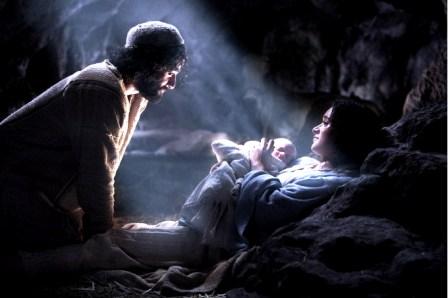
 Christmas has three Masses, at night, at dawn and in the day. Let us use the Mass in nocte or “Midnight Mass”.
Using the texts of the orations, let’s drill into our “Midnight Mass” in the Extraordinary Use of the Roman Rite.
This is the Mass which, I think, captures our attention and our hearts.
COLLECT (1962MR – ad primam Missam in Nocte)
Deus, qui hanc sacratissimam noctem
veri luminis fecisti illustratione clarescere:
da, quaesumus;
ut, cuius lucis mysteria in terra cognovimus,
eius quoque gaudiis in caelo perfruamur.
This survived the ministrations of the Consilium with slight changes to live on in the same spot in the Novus Ordo. It was shifted around for style.
This prayer is full of words dealing with light, beauty, fame, clarity. Lumen means “light” in the sense of “a source of light, a lamp, torch” and thereby, “light of the eye, the eye”. It can be the hole through which light penetrates, such as the pupil of the eye, and also “beauty” and “ornament”. Remember that Christ is called “lumen” in the Creed. Lux is “light” of the sun, moon and also stars, as well as “the eye” which receives the light, and by extension “encouragement, help, succor” and even “ornament”. We wish lux perpetua for those who die. Illustratio is a technical word from rhetoric, a “vivid representation” and it comes from illustro which means “to illuminate” and also “make clear, explain”, even “render famous” – “illustrious”. Christ Himself is the illustratio in Whom we see the perfect (now) visible image of the invisible Father. Claresco signifies “to become or grow bright or clear” that – sc – adding a progressive element. It stands for “to become illustrious, famous, renowned.” In the subtle contrast of the different kinds of light in lumen (like the light of a torch) and lux (like the light of the heavenly bodies) I cannot help but hear a distinction of what man can produce and what God alone creates. Christmas, of course, acknowledges the taking up of our human nature by the Lumen de lumine, illuminating what we are and do by what He is and does.
Remember that the next Mass for Christmas begins with the chant Lux fulgebit… and the theme of light flashes throughout its prayers as well. There is a climax to the Masses. In the first, in the dark of night, there the anticipation of light as a promise. In the second, it glimers and flashes and we wonder at its newness. In the third, the promises is reveal as the Babe who has been born, Puer natus est nobis. The Gospel of the Third Mass is the Prologue of John… a summary of the mystery and our Mass and this Prologue is not said at the end as the Last Gospel of the Mass in the Day. In a sense, Mass remains open ended as we look into the Octave.
LITERAL VERSION:
O God, who made this most sacred night
to grow ever brighter by the vivid representational illumination of the true light,
grant, we beg Thee, that we may enjoy completely in heaven also the joys of Him
whose sacramental mysteries of light we perceive on earth.
We are to enjoy the content of this feast “fully” (perfruor), which of course means an adequate preparation beforehand (fasting, penance, works of mercy) and proper disposition (state of grace and both remote and proximate prayer and study with meditation about the feast).
The vocabulary of light, excellence, clarity brings into clear focus what a dark and wretched world we would be in were it not for the gift of Christ’s first appearance in His birth at Bethlehem. Into a dark world mired in sin came Light Itself. He is the one also through Whom light and grace can enter into our souls: in baptism Christ, with the Father and Spirit, abides in our souls. They share something of their divine life with us in grace and interior illuminations. They bring graces which ornament and adorn our souls, making them beautiful, clear, and resplendent mirrors, images of the Trinity’s glory.
Christ is the incarnate perfect visible image of the invisible Father. As the God made Man illustratio, Christ also reveals us more fully to ourselves (cf. Gaudium et spes 22). This is why I use the adjective “representational”.
SECRET:
Accepta tibi sit, Domine, quaesumus,
hodiernae festivitatis oblatio:
ut, tua gratia largiente,
per haec sacrosancta commercia,
in illius inveniamur forma,
in quo tecum est nostra substantia.
This also survived into the Novus Ordo with variations.
The Lewis & Short Dictionary says that commercium means “trade, traffic, commerce” but also “intercourse, communication, correspondence, fellowship.” Every student of Latin knows that epistolarum commercium is an exchange of letters, correspondence back and forth. Perhaps you will recall the phrase O admirabile commercium – “O wonderous exchange!”, the famous antiphon of Vespers and Lauds of the octave day of Christmas which has been set to glorious sacred music by composers of every age.
This commercium is an Old Testament reference to the way in which man entered with God into a covenant, a contract and exchange (though between unequal partners). Our new covenant with God is a commercium, the mysterious participation of the divine Second Person of the Trinity in our humanity, the way that the Son of God became the Son of Man so that we might be made the sons of God.
There is a strong juridical/legal overtone to the word commercium. Ancient Romans classified people in roughly three different categories, cives (citizens), latini (those closely tied to Rome but without full status), and peregrini (foreign residents). A civis had the rights, among other things, of connubium et commercium, the right to contract legal marriage and to conduct business and commerce (Latini had commercium and the peregrini had neither). This also included inheritance rights. Eventually in the dissolution of the Republic into the Empire these were the only truly valuable rights in the civitas (the body-politic, the body of the citizens united in a community including all the integrated cities, etc. – think of St. Augustine’s City of God…De civitate Dei).
Returning to commercium Eamon Duffy gives us some food for thought (emphasis mine):
In marked contrast to many of the longer and more discursive prayers of other rites, especially those of the East, these crisp and often tightly structured prayers (read: Collect, “secret”, post-Communion) offer a unique glimpse of Roman tradition at its most profound and most memorable. Fidelity to the tradition would demand faithfulness in transmitting something at least of the quality of these prayers into the vernacular. In discussing the distinctive theological merits of the Roman liturgy, Cipriano Vagaggini, one of the key figures in the production of the Post-Conciliar Mass, singled out the notion of a “sacrum commercium“, a holy exchange, in the eucharistic offering, which is so central in the Roman canon. Bread and wine, he wrote, “are chosen from among the gifts God has given us and are offered to him as a symbol of the offering of ourselves, of what we possess and of the whole of material creation. In this offering we pray God to accept them, to bless them and to transform them through his Spirit into the Body and Blood of Christ, asking him to give them back to us transformed in such a way that through them we may, in the Spirit, be united to Christ and to one another, sharing in fact in the divine nature.” Vagaggini was discussing the theological focus of the Roman Canon, but this notion of a “holy exchange” in fact underlies many of the most characteristic prayers of the Roman Rite, and could even be claimed, I think, as one of its defining features…. In the Missal its characteristic form is binary: prayers over the offerings or after Communion repeatedly explore the paradox that earthly and temporal things become, by the power of God, vehicles of eternal life. The Missal is never tired of this dialectic, and prayer after prayer rings the changes on it (cf. The Tablet of 6 July 1996, pp. 882-3).
The translation in preparation is of critical importance. However, as I have repeatedly reminded you faithful WDTPRSers, a campaign is being waged against the norms established by the Holy See. The norms found in Liturgiam authenticam from the Congregation for Divine Worship and Discipline of the Sacraments uphold precisely what Fr. Duffy spoke to above. However, there are Catilines resisting these norms and working to usurp the process. They want a style of liturgical language reflecting how people actually talk today, which is ever shifting and which tends to the lower denominators rather than the higher. In contrast, the norms foresee a sacral style rooted in the structure of the prayers and the deeper traditions of English literature.
I want for you and for me a translation which will give us our inheritance, deep and beautiful prayers which sprang forth from the early Church and were written even in the blood of martyrs. Even the newly composed Latin prayers are rooted in this living tradition. They too echo with our forbears’ deepest aspirations.
LITERAL TRANSLATION
Let the sacrificial offering of today’s feast,
we implore, O Lord, be pleasing to Thee,
so that, Thy grace bestowing,
by means of this most sacred exchange,
we may be found to be in the form of Him,
in Whom our substance is presently with Thee.
Commercium in Old Testament language is how man entered with God into a covenant, a sort of business contract and asymmetrical exchange (between unequal partners).
In our new covenant with God there is a new commercium in which divine Second Person of the Trinity participates in our humanity so that, as the Fathers of the Church would say, the Son of God became the Son of Man so that we might be made the sons of God.
That word forma is also a technical word, which alas space prevents us from examining at length. Suffice to say God will share with us, His images, His own glory, which will form and reform us for eternity, making us ever more beautiful images after His own “form”. In the Incarnation, God took our humanity, our substance (substantia) into an indestructible bond with His divinity. So, we can truly say that our humanity is at this very moment seated at the right hand of the Father. In this prayer, there is simultaneously the admission that we are not yet in the state for which God made us (in heaven), already present with Him in the Person of the Risen Christ, and a deep sense of intertwined gratitude for this reality with longing for what is to come. All of this is embodied at this precise moment in the simple hosts and chalice of wine with its tiny symbolic drop of water, our humanity in its multitude of persons being taken up in Christ and transformed in communion in God.
POSTCOMMUNIO:
Da nobis, quaesumus, Domine Deus noster:
ut, qui Nativitatem Domini nostri Iesu Christi
mysteriis nos frequentare gaudemus;
dignis conversationibus
ad eius mereamur pervenire consortium.
This prayer also survived, but with a subtle edit: the scissor wielding experts of the Consilium removed the word mysteriis as well as the Name of the Lord. You who have read this blog and my articles know what I think about MYSTERY in worship.
Frequento means “to visit or resort to frequently, to frequent; to do or make use of frequently, to repeat” and also “to celebrate or keep in great numbers” as in the observance of public festivals. We have seen conversatio before. This is a deep word in Christian contexts, indicating a manner or way of living one’s life in a “converted way” (cf. 1 Tim 3:14-15 ) and, especially in monastic settings, according to a rule of life.
A real “conversation” always involves (or involved before telephones and e-mail) a “turning around” toward a person and then an exchange, a back and forth. In the Christian “way of life” we have always a turning to God in a marvelous exchange. Certainly this echoes the theme of commercium from our Secret and therefore emphasizes the critical role of Holy Communion both in our loving dealings with God, in whom we have a New Covenant in Christ, and with our neighbor, whom we are commanded to love with charity, sacrificial love.
Consortium comes from the preposition cvm (“with”) and sors (“any thing used to determine chances”). Sors is “fate, destiny, chance, fortune, condition, share, part.” It thus means also a “community of goods” and by extension “fellowship, participation, society.” A consortium is a situation in which you have “cast your lot” with a group and with whom you are sharing a common outcome or fate. We hear the word consortium near the end of the Roman Canon when we are praying to have a share in the lot, the reward, of the great martyrs named therein.
LITERAL TRANSLATION:
Grant to us, O Lord our God,
that we who rejoice to throng together in mysteries
for the Nativity of our Our Lord Jesus Christ,
may by worthy manners of Christian living
merit to attain to a sharing in His destiny.
What are the 1973 ICEL versions of these prayers? I don’t know and I am not going to look.
The phrase mysteria lucis …“mysteries of light” in our collect recalls me to our Holy Father’s letter Rosarium Virginis Mariae (RVM) in which he presented at the beginning of a special year dedicated to the Most Holy Rosary a new set of mysteries, the mysteries of light. In that letter, Pope John Paul wrote that we should learn to “(sit) at the school of Mary” and “contemplate the beauty on the face of Christ and to experience the depths of his love” (RVM 1; 3; passim). We must learn more and more to contemplate with Mary the face of Christ.
In the face of our Blessed Lord we see the Father, the loving Father, revealed.
We also see ourselves revealed. He teaches us who we really are. From His little face in Bethlehem we see His love and tender humility.
Already in the Holy Infant, however, in the wood of the crib foreshadowing the wood of the Cross, in the first shedding of His Blood in His circumcision, we see His Passion anticipated. We see in the adult face of the Son of Man the suffering of all men, brought onto ourselves by our sins. We see His terrible humility in the face of the suffering Messiah. We see His face scarred, battered “beyond human semblance and his form beyond that of mortals” (Is 52:14)… our sole contribution to His “beauty”.
In His Risen face, we see man’s tarnished beauty made clean again and awaiting final transformation, our tears and bruises washed away and healed in His splendor. We see His generous humility. We see in His every word and every deed during His earthly life how we are to live and thus be saved. We see His exemplary humility. His is the face we must contemplate.
No one has ever contemplated the face of Christ with the love, attention, and gaze of Mary. She can teach us, at Christmastide, to look at Him anew, and in looking at Him, see our neighbor in a new light.
May Christ, Light from Light born in Bethlehem and who is yet to come, bless you and yours for a Holy and Happy Christmas.


 Christmas has three Masses, at night, at dawn and in the day. Let us use the Mass in nocte or “Midnight Mass”.


 waalaw on Daily Rome Shot 1118 – Paddywhack!: “1. R-h1+ . . . B×h1 2. R×h1× If . . . . . . . . . K-g2 3.…”




























