
From a reader:
Dear Fr. Z,
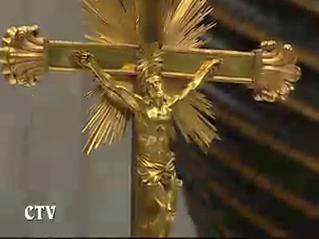
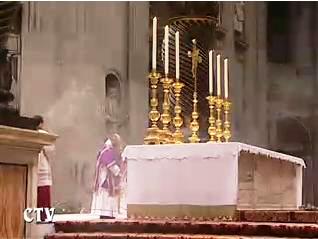
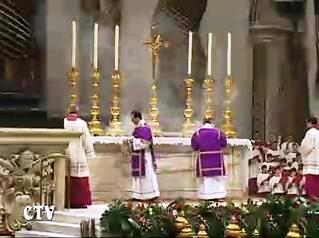
At St. Margaret’s Church in Oceanside, CA, our pastor, Fr. Cavanna Wallace has been using the "Benedictine arrangement" of candles and crucifix since August (when it was introduced with a catechetical homily).This morning, we walked into church to find the arrangement at the far side of the altar, facing us. Father’s homily spoke of Advent as "looking towards the east" to the new day of Christ’s birth, explaining that this was expressed in the direction of our prayer. He then prayed the Roman Canon ad orientem (well, "liturgical" east, anyway, since our apse is actually to the west!).
To wit (excerpt):
…
This watching and waiting, anticipating the Lord’s return, has historically been articulated throughout the Christian centuries in the language of sacred architecture. Since the fourth century which initiated Christian building projects all across the Roman Empire, churches were built so that, when Christians assembled in prayer, both priest and people prayed together facing the common direction of east. The priest and people did not look towards each other (except during a sermon or homily), but when they prayed, they did so with the priest, like a shepherd, leading his flock in the direction of the rising sun, turning around to assure his flock that they were on the right path and the Lord was with them.
The connection between the light of the rising sun and the glory of the returning Lord are themes which run through the whole season of Advent as well as instinctively during our early morning prayers throughout the whole year.
(Scriptural mediations of the importance of “looking East” can be found in Wisdom 16:28, Zechariah 14:4, Malachi 3:2, Matthew 24:27 and 30, Luke 1:78, and Revelation 7:2). St Justin Martyr reflected about the manner of Christian worship in beginning of the second century and wrote, “For the word of His truth and wisdom is more ardent and more light-giving than the rays of the sun, and sinks down into the depths of heart and mind. Hence also the Scripture said, ‘His name shall rise up above the sun.’ And again, Zechariah says, ‘His name is the East.’” St. Clement of Alexandria contrasts pagan temples which faced west with the attitude of Christian prayer which looked towards the east, writing, “And since the dawn is an image of the day of birth, and from that point the light which has shone forth at first from the darkness increases, there has also dawned on those involved in darkness a day of the knowledge of truth. In correspondence with the manner of the sun’s rising, prayers are made looking towards the sunrise in the east. Whence also the most ancient temples looked towards the west, that people might be taught to turn to the east when facing the images.” Stromata Book iv)
And even though our local geography does not allow us literally to face east together in prayer, we use the Cross as our compass, restoring this ancient practice of the priest, like a shepherd, leading his people in the direction of the glory of heaven – which is, of course our common goal, our prayers directed to God.
Of course, this must be translated into our lives every day in order that we might be compatible with Christ so that we can see him, when he returns, face to face. When will that day come? We do not know. Will it come? Yes – for Christ has said he will return. “We watch in joyful hope for the coming of our Savior, Jesus Christ”.
CCC 1040 El Juicio final sucederá cuando vuelva Cristo glorioso. Sólo el Padre conoce el día y la hora en que tendrá lugar; sólo El decidirá su advenimiento. Entonces, El pronunciará por medio de su Hijo Jesucristo, su palabra definitiva sobre toda la historia. Nosotros conoceremos el sentido último de toda la obra de la creación y de toda la economía de la salvación, y comprenderemos los caminos admirables por los que Su Providencia habrá conducido todas las cosas a su fin último. El juicio final revelará que la justicia de Dios triunfa de todas las injusticias cometidas por sus criaturas y que su amor es más fuerte que la muerte (cf. Ct 8, 6).
When we entered through the doors of this church, the narthex pointed us through the darkness, in the direction of where we first encountered Christ, in baptism. Before this Altar we will turn to face the Lord together, and through Holy Communion we will literally “put on Christ”. At the end of Mass, with the dismissal, we will journey onward from here and pass under the “gallery”, depicting above us on the way out, the Lord’s Second Coming and the Final Judgment. And this we should not be afraid of. Our Advent journey does not take us into the night, but towards the morning. As St. Paul has reminded us in the Epistle, “The night is far gone; the day is drawing near. Let us cast aside deeds of darkness and put on the armor of light”. Ven Senor Jesus!




 ex seaxe on Pope Leo XIV airplane interview: remarks about relaxing Traditional Latin Mass restrictions: “Asked whether he would reconsider his priorities after his surgery and the long trip, Leo replied, “I don’t feel like…”




























