We have all heard of C & E Catholics. There are those Catholics who think about going to church twice a year, Christmas and Easter. Many more feel the impulse to make a confession before the Masses of these great feasts.
However, with the larger numbers of people coming for confession or "penance services", some priests over the last few decades have – sometimes from good motives and sometimes from laziness – held "form 3" services, which we call "general absolution".
General absolution does not include individual confession of all mortal sins in number and kind.
General absolution is permitted by the Church in certain emergency circumstances, such as when an airplane is going to crash, troops are going into battle, a person is dying in an emergency ward and many people are around, a missionary finds a thousand people waiting, etc.
However, for the sacramental absolution to be valid, there must be an intention to confess your sins and it may not be received more than once without individual auricular confession when there is no danger of death.
Pastors of souls, bishops, should remind their flocks, and their priests, about the importance of confession and the conditions for a valid sacramental absolution of sins.
To this end, His Excellency Most Reverend John Nienstedt, Archbishop of St. Paul and Minneapolis, has a letter in the newly revamped Catholic Spirit, the paper of the archdiocese.
This was for the 5 November issue. I don’t know how I missed this. Be sure to spike their stats by clicking here.
His Excellency will over the next weeks use his platform to present a catechesis on the sacrament of penance. He taught seminarians about this sacrament for many years.
Let’s have a look with my emphases and comments.
Penance and the gift of forgiveness
By Archbishop John C. Nienstedt
Wednesday, 05 November 2008
“A regular use of general absolution is bound to have a negative effect on the spiritual well-being of the penitent because general absolution involves a depersonalized experience of the sacramental grace of forgiveness.
Without the one-on-one encounter and an explicit confession of guilt, penitents also risk developing a superficial understanding of their willing participation in the personal evil that is sin.”
FROM: The Catholic Spirit Com.
Official Newspapar of the Archdiocese of Saint Paul, Mineapolis
THE WHOLE TEXT:
Within the first verses of St. Mark’s Gospel, Jesus appears in Galilee, proclaiming God’s Good News: This is the time of fulfillment. The reign of God is at hand! Reform your lives and believe in the Gospel!” (Mark 1:15).
From the very beginning of his public ministry, then, Jesus calls all men and women to conversion from sin. But, one might ask, what is sin? Why are we called to conversion? What kind of reform is being asked of us?
Understanding sin
The Catechism of the Catholic Church indicates the answer:
“To try to understand what sin is, one must first recognize the profound relationship of man to God, for only in this relationship is the evil of sin unmasked in its true identity as humanity’s rejection of God and opposition to him. . . .
“Without the knowledge Revelation gives of God we cannot recognize sin clearly and are tempted to explain it as merely a developmental flaw, a psychological weakness, a mistake, or the necessary consequence of an inadequate social structure, etc. [All of which reduce to almost nothing an individual’s personal responsibility.] Only in the knowledge of God’s plan for man can we grasp that sin is an abuse of the freedom that God gives to created persons so that they are capable of loving him and loving one another” (CCC. 386-387).
Who has sinned? St. John gives us the answer in his first letter:
“If we say, ‘We are free of the guilt of sin,’ we deceive ourselves; the truth is not to be found in us” (1 John 1:8).
Therefore, to be truthful, we must all admit that we have sinned. Sin affects both our relationship with God and with our neighbor. But the truly good news is that Jesus came to save us from sin and that he has entrusted the power to absolve sin to his apostles. That power of forgiveness is offered to us in the sacrament of penance, otherwise known as reconciliation.
The ordinary, and therefore most appropriate, way of celebrating this sacrament calls for a verbal confession of our sins to a priest. Why? Allow me to give three reasons for this.
Jesus as model
The first reason is that, during his earthly ministry, [1] Jesus himself always forgave sins in a one-on-one encounter with the penitent. While other miracles in the Gospels may have involved groups of persons, the gift of forgiveness is always given to an individual, who hears Jesus speak the words, “Go, your sins have been forgiven.”
Second, as human beings, one of the most difficult things we ever have to say is, “I’m sorry.” Yet, [2] once we have said it, we are freed to accept our guilt and then to begin the process of reconciliation. We can inevitably find all kinds of self-justifying reasons for what we have done or failed to do. Yet, once we have spoken out loud the reality of our guilt, it is often only then that we accept responsibility for what we have done, and only then can we begin to reform our ways. [Remember that Christ, in His words and deeds, reveals man more fully to himself (cf. GS 22). In our encounter with Christ and our own submission of our words and deeds, and omissions, to Him in the person of His minister, we are also revealed more fully to ourselves. When we confess our sins after a good examination of conscience, we learn about ourselves.]
Finally, the actions that we call “sins” very often betray an attitude or an inner disposition that ultimately led us to commit a particular sin. [Our "particular fault" as spiritual writers call it. Identifying a particular fault is a major step in our spiritual lives.]
Over the next weeks, I plan to share with you some thoughts as to how we can move forward with a total re-catechesis for the sacrament of penance [This is very welcome!] Having taught a penance practicum to seminarians for 13 years, I have learned that there is an art on the part of the confessor in hearing a confession. The priest has to listen closely to what is being said “between the lines.” It is one thing to know that one has been uncharitable, hurtful or unfaithful, but that doesn’t necessarily lead one to know why he or she committed the particular act, i.e., what prompted this action in the mind or heart.
Only by getting “behind” the objective sinful act, can one begin to change one’s life with a firm purpose of amendment. The assistance of a confessor can be invaluable in this process.
Pastoral concerns
Historically, the Second Vatican Council, contrary to what some may think, never envisioned the use of Form III with General Absolution as the ordinary way to experience the sacrament of penance. The church has never approved its use, even though it has been widely practiced in some places. [Many dioceses have this problem. And it is amazing that some priests have simply defied the efforts of their bishops to change this.]
In response to a question regarding this very point, Archbishop Harry Flynn wrote clearly in his pastoral letter of Feb. 20, 1996, that general absolution is not acceptable as a normal practice. This is also the position of the last two popes, a synod of bishops as well as the U.S. Conference of Catholic Bishops’ general assembly. It is now codified into law.
But my concern here is much more a pastoral one than a legal one.
A regular use of general absolution is bound to have a negative effect on the spiritual well-being of the penitent because general absolution involves a depersonalized experience of the sacramental grace of forgiveness.
Without the one-on-one encounter and an explicit confession of guilt, penitents also risk developing a superficial understanding of their willing participation in the personal evil that is sin.
I am pleased to be receiving requests these days from pastors who are planning penance services using Forms I or II during the upcoming Advent season. I encourage all pastors in the archdiocese to do the same. To be clear: The use of general absolution is simply not allowed.
I appeal to all of our priests to be obedient to the promises they made on their ordination day and offer our Catholic people the sacrament as it is meant to be celebrated. I likewise appeal to our faithful laity not to participate in celebrations prohibited by church norms. [This is excellent. In 1990 Pope John Paul II, in the revised rites for ordination, made this more explict in the part of the ordination where the candidates are queried about their intentions. They are asked if they desire to be ordained in order to forgive sins.]
It is my sincere hope that the clergy, religious and laity in this local church may reflect in practice the unity that Jesus himself desired as we join in a common celebration of the sacrament of penance.
A ‘re-catechesis’
Over the next weeks, I plan to share with you some thoughts as to how we can move forward in this archdiocese with a total re-catechesis for the sacrament of penance so that it may be the powerful help in our growth toward holiness that it is meant to be.
Until then, let us pray again and again for the grace of that conversion from sin that Jesus announced so long ago: “This is the time of fulfillment. The reign of God is at hand! Reform your lives and believe in the Gospel!”
God love you!
What a welcome initiative this is.
The sacrament of penance has been so neglected for so long. I would hazard to say that very many of our Catholic people have no real sense of the Church’s teaching about sin, justification, sanctification, forgiveness. I would say very few really think about the Four Last Things. I suspect that a large majority never think about confession, which is the ordinary means by which CHRIST desired that we be reconciled to God, the Church and each other.
In a first article, Archbishop Nienstedt couldn’t say everything that could be said about the sacrament of penance. But this is but the first, not the last or only.
Please go give that page a hit, by clicking this link. That will send a message to the editor and the Archbishop. At the time of this writing the column on that site has only 170 hits! Make it spike!
I look forward to reading the others and making sure that a wider readership picks them up.
This is a matter of life and death.
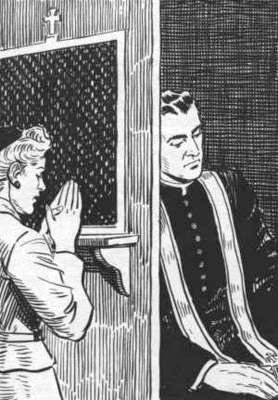 Fr. Z’s 20 Tips For Making A Good Confession o{]:¬)

 The intrepid




 ex seaxe on Pope Leo XIV airplane interview: remarks about relaxing Traditional Latin Mass restrictions: “Asked whether he would reconsider his priorities after his surgery and the long trip, Leo replied, “I don’t feel like…”




























