UK: Masses for Card. Reginald Pole

A friend in England wrote with news:

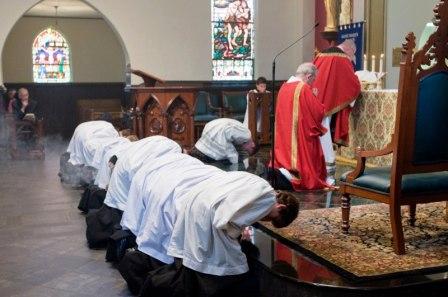
A week Monday, 17th November, there are a number of Requiem Masses in the usus antiquior in England for the repose of the soul of the last Archbishop of Canterbury, Reginald Cardinal Pole, who died on 17th November 1558 (several hours after Queen Mary I).  

I shall be in choro at that to offered in the Chapel of Magdalen College, Oxford, where Pole had studied.


I wish I could be there! 

Posted in SESSIUNCULA |
36 Comments

Fr. Z asks a favor on behalf of a fellow blogger

Everyone… please consider giving American Papist a lift today.

He is trying to win a college scholarship for bloggers, to pay his loans.

I think WDTPRSers could give him a boost.

This will cost you nothing but a few seconds of your time.

Go HERE and vote for Thomas Peters, who runs the American Papist site.

He is a good kid trying to do good work.

We Catholic bloggers have to stick together and not just play in our own little sandboxes.

Working together, linking and helping each other, makes us a more effective force in shaping the conversation.

Posted in SESSIUNCULA |
38 Comments

“O ye lightnings and clouds, bless the Lord: praise and exalt him above all for ever”

"O ye lightnings and clouds, bless the Lord: praise and exalt him above all for ever"A moment for some perspective.

Carefully consider the photo to the right, from Astronomy Picture of the Day.

Explanation: What’s happening at the center of active galaxy 3C 75?

The two bright sources at the center of this composite x-ray (blue)/ radio (pink) image are co-orbiting supermassive black holes powering the giant radio source 3C 75.

Surrounded by multimillion degree x-ray emitting gas, and blasting out jets of relativistic particles the supermassive black holes are separated by 25,000 light-years. At the cores of two merging galaxies in the Abell 400 galaxy cluster they are some 300 million light-years away.

Astronomers conclude that these two supermassive black holes are bound together by gravity in a binary system in part because the jets’ consistent swept back appearance is most likely due to their common motion as they speed through the hot cluster gas at 1200 kilometers per second. [PER SECOND]

Such spectacular cosmic mergers are thought to be common in crowded galaxy cluster environments in the distant universe.

In their final stages the mergers are expected to be intense sources of gravitational waves.


Given this explanation, one wonder at what "intense" might imply.

Read Daniel 3.

Blessed art thou in the firmament of heaven: and worthy of praise, and glorious for ever….      O ye heavens, bless the Lord: praise and exalt him above all for ever…. O ye sun and moon, bless the Lord: praise and exalt him above all for ever…. O ye stars of heaven, bless the Lord: praise and exalt him above all for ever….     O ye fire and heat, bless the Lord: praise and exalt him above all for ever…. O ye cold and heat, bless the Lord, praise and exalt him above all for ever…. O ye light and darkness, bless the Lord: praise and exalt him above all for ever…. O ye lightnings and clouds, bless the Lord: praise and exalt him above all for ever…. O ye servants of the Lord, bless the Lord: praise and exalt him above all for ever…. O ye holy and humble of heart, bless the Lord: praise and exalt him above all for ever.

Posted in SESSIUNCULA |
8 Comments

Ad orientem in Greenville, SC

From a well-known priest reader:

Dear Father,

I have posted on my website some photographs of a Sunday Mass celebrated Ad Deum. I thought you mind find these photos of interest, since they show the practical consequences of our re-orientation. You can find them at www.jayscottnewman.net by going to the page called "Photos" and clicking on the photo album labeled "Exaltation of the Holy Cross."

May the LORD bless the work of your hands.

Shall we have a look at a few of the photos? 

There are from 14 September 2008 which was, of course, the anniversary of Summorum Pontificum going into effect.

This is Novus Ordo.

Ad orientem in Greenville, SC

Ad orientem in Greenville, SC

Ad orientem in Greenville, SC 

I probably don’t need to remind long time readers of WDTPRS that Fr. Newman took some time to inform his parish about the history and advantages of ad orientem worship along with the news that that was what would happen.  He used the bulletin for the Sundays during Lent to present the whole picture.

Folks… it can.. and should… be done.


Posted in Mail from priests, SESSIUNCULA |
26 Comments

Saturday errands in the big city

I am “in town” and therefore doing important things such as getting a haircut from one of the better barbers here, still inexpensive and blessedly fast while being very good. “Mike” does a good job. Many seminarians and priests have come here for years, and a few archbishops.

Saturday errands in the big city

Then it was off to the excellent religious and church goods store Leaflet Missal. This store has it all and you can find it online.

They have been very good to seminarians over the years and friendly to clergy. On a wall near the door there us a bit of a gallery of men to whom they perhaps gave summer jobs or who were associated with better things before the tide began to turn.

Saturday errands in the big city

Saturday errands in the big city

Saturday errands in the big city

Saturday errands in the big city

I wish they had a wish list. The fellow who runs the church goods area has good taste and is quite involved with the TLM at St. Augustine’s in S. St. Paul. Here are a couple things which would grace the Sabine Chapel. The angels (below) would also be wonderful.

Saturday errands in the big city

Saturday errands in the big city

I found that they have reliquaries in silver in the same style as the gold ones in the chapel. Nice. You would not make a mistake to check them out.

Saturday errands in the big city

Saturday errands in the big city

Saturday errands in the big city

Posted in My View |
19 Comments

Sacramento, CA: “Chants of a Lifetime” (and black vestment alert)

A kind reader sent the following:

Father, if you go to Sacramento Bee newspaper for Nov. 7, there is a video called "Chants of a Lifetime." The paper did an article on the schola, choir, choristers at St. Stephen’s in Sacramento. The video has interviews, music and part of the All Souls’ Day Solemn High Requiem Mass. Bishop Soto (briefly seen) attended. Our priests are in beautiful black vestments with purple embroidered embellishment. Fr. Novokowsky also conducted the blessings and incensings of the "bier," draped in black, which was surrounded by six lighted candles.   Gloria Thiele, Grass Valley, CA

Here is the piece.

Chants of a lifetime
An age-old form of vocal worship enhances the liturgy at St. Stephen’s Catholic Church
By Carlos Alcala
calcala@sacbee.com
Published: Friday, Nov. 07, 2008 | Page 2H

Gregorian chant holds a place in popular imagination as the province of hooded monks intoning monotonous melodies along dim stone corridors.

It’s not like that.

At St. Stephen’s Catholic Church in Sacramento, the ancient musical form is sung by children and young men and women, a multiethnic choir of multicolored voices.

Teens sing wearing Vans or boots poking out from beneath cassocks. They sing at Masses where toddlers babble and babies wail and adults walk in and out during services.  [In other words, it’s normal.]

Rehearsal is in a classroom furnished with old pews, the ceiling covered in dull acoustic tiles.

The setting is mundane, but the music is ethereal. It’s ear- pleasing and eye-opening, but difficult to describe.

It resonates when the men’s deeper voices are breathing the Latin phrases.

When the higher voices come in, the music undulates; it flows out like unrhythmic acoustic heat: radiant music.  [I agree that chant by women is ethereal.  I am not much for mixing the voices, however.]

A rarity in modern church

St. Stephen the First Martyr Church – off Fruitridge Road in unincorporated Sacramento – is one of the few parishes in Northern California to incorporate traditional Gregorian chant into Mass.

To hear some tell it, that is very odd. To them, chant and Mass are nearly synonymous.

Gregorian chant ebbed in the decades after the Roman Catholic Mass was opened to vernacular – non-Latin – languages, even though chant was still officially supported.  [not just "supported"]

"Gregorian chant should have the first place in musical liturgy," said William Mahrt, a professor at Stanford and president of the Church Music Association of America.

"(It’s) the fundamental music," Mahrt said, "the basic music."

In the fourth century, it was how people learned the psalms, said Peter Jeffery, Scheide Professor of Music History at Princeton. [This reporter did some homework!]

Much as popular songs are memorized today, the music of chant conveyed religious precepts to largely illiterate societies.

"The chant is the servant of the text," [YES!]  said Jeffrey Morse, St. Stephen’s choir leader for six years.

Chant is fundamental to more than the church.

A link to modern music

"There wouldn’t have been Elvis Presley if there hadn’t been Gregorian chant," Morse said.

That may be an exaggeration, but musical notation itself was created by monks in the 800s specifically to record chant melodies.

It’s essentially the same notation – the system for writing music – that is used for chant today, though not for other music.

What Morse’s choir sings during St. Stephen’s Masses is largely prescribed by centuries of tradition.

"Choristers were singing the exact same text to the exact same melody in 800 on the same Sunday," Morse said. "It grounds you in history."

Few parishes are grounded like St. Stephen’s.

The parish was set up by Bishop William K. Wiegand to conduct a traditional Latin Mass. The priest who hired Morse recognized the place of chant and Morse’s wealth of knowledge and experience.  [Excellent priest.]

When asked about the name "Gregorian," he readily recites the dates and nature of Gregory the Great’s papacy . Gregory’s name was appended to the chants that existed before he was made pope in 590.

The music was practically dead in the United States in the late 1980s and early ’90s. Morse had to go to England to study Gregorian music. "No one wanted it, basically," he said.

Things are changing, though.

There’s something of a self-help movement, experts like Mahrt and Jeffery say.

A summer chant gathering four years ago had 40 participants – mostly refugees from failing choirs. This year it had 260 – some from growing choirs, some who seek to seed new ones.

In some cases, politics is behind the growth of chant.  [Watch how the reporter now ruins the article.]

Many Catholics associate Latin Mass and traditional music with conservative politics, said Princeton’s Jeffery.

Indeed, at St. Stephen’s during a recent Mass, political stickers on cars in the parking lot were all in support of the McCain-Palin ticket or initiatives aligned with a conservative social agenda.  [grrrr]

Embracing tradition

Many may seek tradition, but few have the experience of Morse and his choir. Even some teens in his group have been in it for six years – six times around the prescribed cycle of the liturgy.

They know the chants. They know the music. Though it’s in Latin, "We definitely try to understand what we’re singing," said Ellen Presley, 20, a music major at California State University, Sacramento.

When the choir takes a break in August, Presley said, "everyone complains about us not being here. The music adds a lot."

In fact, it is choir participation that draws 21-year-old Jonathan Crane to drive two hours from Corning to St. Stephen’s. "It was the sound" that thrilled him, he said.

Crane and Presley are also impressed by the voices of the 8- and 9-year-old choristers who sing with them.  [Of course!  It’s chant, not brain surgery.]

The music is a major part of the service, but not everything. During Mass, the chant’s beauty competes with the rustle of life in the congregation.

It is not like a visit to the symphony, where every cough is frowned upon and babies are unwelcome.

The choir is not the focus. In fact, they sing from a loft, heard but not seen.  [Contrast that with how many parishes put their "pop group" up front.]

Chant’s most ardent supporters seem to like it that way.

Background, not a concert

"I think that’s very much what music in a sacred context should be," Morse said. "It shouldn’t be a concert at all."  [Back to that point.  You can tell what caught the reporter’s attention.   This was a foreign experience.]

"The object of one’s attention," said Mahrt, "is worship."  [Which perhaps the reporter hadn’t experienced too often.]

Still, the music augments the worship, said Father Robert Novokowsky, the parish’s pastor.  [I think this needs to be adjusted.  Music such as chant isn’t really an "add on". It is the liturgical prayer.]

"During the liturgy, the chant is meditative," he said. It’s one thing to have a short psalm read. It’s quite another to experience it sung.

"It takes four minutes to sing that one line," Novokowsky said.

"It’s a way of experiencing the mystery of God."   [Well said.   If music (and everything else in church) doesn’t bring you to an experience of mystery, then the liturgical "experience" has failed.   Listening to chant well sung is like peering through the cleft in the rock with Moses (Exodus 33).]

Call The Bee’s Carlos Alcalá, (916) 321-1987.
Posted in SESSIUNCULA |
38 Comments

Crispy Fish!

Tonight… I am out for a belated birthday supper with one of my best peeps.

Crispy fish!

Crispy Fish!

Posted in My View |
22 Comments

John Allen’s open letter to Pres.-Elect Obama

My friend Mr. John L Allen, Jr., the nearly ubiquitous former Rome correspondent for the National Catholic Reporter and nearly the only reasonable writer for that ultra-lefty dissenting publication has an interesting open letter to President-Elect Obama.

It is worth your time to read.  My emphases and comments.

For the record, nobody from the Obama transition team has solicited my [John Allen is speaking] advice about relations with the Vatican, and I would frankly be surprised if the question were yet on their radar screen. Others, however, are already speculating about how things might shake out; on Wednesday, for example, Reuters moved a story predicting a “tricky” relationship between Rome and the Obama White House because of the abortion issue. As a thought exercise, I decided to pen an open letter to the president-elect about U.S.-Vatican ties over the next four years.

Mr. President-elect:

This letter is a plea to make U.S.-Vatican relations under your administration a priority, because of the enormous good in the world that could be accomplished by exploiting natural areas of common concern.

I’m aware that the stars may not seem especially well-aligned for such collaboration. A small number of Catholic bishops in the United States made statements during the campaign that favored your opponent, which may have left a bitter aftertaste among some of your supporters and advisors. It’s also clear to everyone that, barring a dramatic change of heart on your part, the White House and the Vatican will have deep differences during your term over “life issues” such as abortion and embryonic stem cell research.

I would urge you, however, not to allow those points to obscure four basic political realities.  [Mr. Allen often breaks things down into lists, which can be helpful in getting your head around issues.]

[1] First, the Vatican and the United States need each other, whatever their differences may be in a given historical moment. What the United States is in the realm of “hard power,” meaning coercive military and economic might, the Vatican is in terms of “soft power,” meaning the capacity to stir action on the basis of ideas. Religion is a powerful motivating force in human affairs, and the pope has the biggest bully pulpit of any religious leader. It’s simply bad for everyone if these two forces are not on good speaking terms.  ["hard power" and "soft power" … interesting]

[2] Second, it’s smart politics for you not to neglect the Vatican. As you know better than anyone, in some ways your reelection campaign in 2012 has already begun. You won the Catholic vote overall this time, but narrowly lost white Catholics; working cooperatively and respectfully with the Vatican could help you and your party with that group.

[3] Third, the Vatican has a centuries-old diplomatic tradition of dealing with governments that, in one way or another, don’t follow the church’s line on certain matters. Despite those disagreements, Vatican diplomacy typically strives to keep lines of communication open and to seek common ground. In other words, they’ll want to do business with you where they can.

[4] Fourth, the Vatican is eager for good relations with the United States in particular, regardless of which party happens to be in power. The Vatican deeply admires the robust religiosity of America, in contrast with the pervasive secularism of much of Europe. The Vatican also believes that the United States is its most natural ally in promoting religious freedom and human dignity around the world.  [This is undoubtedly the case.]

The potential for collaboration is very real, because there are numerous areas where your policy positions dovetail with the social teaching of the Catholic church and the diplomatic interests of the Vatican. Among the most obvious examples are immigration, economic justice, peace, and environmental protection. In a statement this week congratulating you, Vatican spokesperson Fr. Federico Lombardi also expressed the Vatican’s desire to work together on Iraq, the Holy Land, Christian minorities in the Middle East and Asia, and the fight against poverty and social inequality.

In each area, you will find a clear track record of teaching from recent popes and a strong determination on the part of the Vatican’s diplomatic apparatus to move the ball. [These are concrete points which can be verified.] In fact, many of these topics represent areas in which the Vatican was at odds with the Bush administration and has longed for new American leadership.

Pope Benedict XVI himself has clearly opened the door to a positive working relationship.

The pope sent a telegram on Wednesday calling your election “a historic occasion,” and offering his prayer that God will “support you and the American people, so that through the good will of all, a world of peace, solidarity and justice can be built.” Lombardi likewise expressed hope that you “will be able to match the expectations and the hopes directed towards the new president, effectively serving justice and rights, finding the best ways to promote peace in the world, favoring the growth and dignity of persons with respect for essential human and spiritual values.”  [So… the Vatican has already extended a hand.  What will an Obama White House do?]

You’ll notice that neither the pope nor his spokesperson explicitly mentioned abortion or other areas of disagreement, and certainly their tone suggests that concern for the “life issues” will not exclude cooperation in other areas. On the contrary, the Vatican seems to be doing everything it can to invite it.

May I suggest one more possibility for U.S.-Vatican partnership? I believe there is a historic opportunity for your administration and the Holy See to work together to move the international community, at long last, toward serious engagement on behalf of peace and development in Africa.

You are a hero to much of Africa, giving you a degree of political capital on the continent that no other Western leader could rival. At the same time, 2009 is shaping up as a “Year of Africa” in global Catholicism. [Which many Catholics don’t know, much less American politicians.  Good for Allen for mentioning it.] Over the next 12 months, Pope Benedict XVI will visit Cameroon and Angola; the African bishops will hold their plenary assembly in Rome; and bishops from all over the world will converge on Rome for a “Synod for Africa.” All this suggests the possibility of synergy between the world’s most important political and spiritual leaders — i.e., you and the pope — to promote peace and development for Africa, where the world’s most impoverished and abandoned people are today found.

If you’re interested in forging such a partnership, the first important choice to make is who to send to the Vatican as your ambassador. Ideally, you will turn to someone known to have your ear, who will have real political influence in your administration, and who also knows the Catholic world. What you’re looking for, in other words, is a Democratic equivalent of James Nicholson, President Bush’s first Vatican ambassador. Nicholson had served as the chair of the Republican National Committee, and helped to steer the party’s outreach to Catholic voters. Bush sent a clear signal with that nomination that he was interested in the Vatican, and this is one case where it would behoove you to follow his lead.

Finally, one last piece of unsolicited advice: Mr. President-Elect, whatever else you do, please try to avoid repeating the mistakes of the last Democratic administration with regard to the Vatican.  [Read this next part closely.]

In his memoirs, former Vatican Ambassador Raymond Flynn tells a depressing story from 1994 illustrating what I mean. During the lead-up to the U.N. conference on population in Cairo in 1994, Pope John Paul II called Flynn to the Vatican on a Saturday morning to personally request a telephone conversation with President Clinton. Flynn relayed the request urgently to the White House that afternoon, and got no response. He called again on Sunday and on Monday, both times with no results. Frustrated, Flynn then got on a plane to Washington on Tuesday. He cooled his heels outside the president’s office that night and most of Wednesday. Finally, he was admitted to the White House’s pre-Cairo war room, where he was told by Assistant Secretary of State Timothy Wirth that “nobody is getting a chance to lobby the president on this one.” Dumbfounded, Flynn explained that the Bishop of Rome is not a lobbyist, and that it would be seen as a profound act of disrespect if the president wouldn’t even get on the phone. After almost a week, Clinton finally agreed to take the pope’s call.

The episode was symptomatic of a basic disinterest within the Clinton team about the Vatican, which at times shaded off into hostility. The result was that the U.S.-Vatican relationship during the Clinton years was more often defined by predictable differences than by imaginative areas of common purpose.  [Well expressed.]

For what it’s worth, Mr. President-Elect, my advice is to get on the phone if the pope calls. Better yet, initiate the conversation yourself. You might be surprised about where it goes.


Very well written thought exercise. 

I think it is worthwhile making this visible.

Posted in SESSIUNCULA |
126 Comments

WARNING: blog maintenance

Very soon I will be doing things to the blog’s domain.

If you can’t access the blog at some point in the near future, keep trying.  It’ll be back soon. 

UPDATE 6 Nov 18:04 GMT

I initiated a change of registrar for the domain from the old company I once had, with so many disasters, with to a new and competent company.

The old company is so bad that when I put in my request for the unlocking codes, it took them over three days to reply.  I have the codes and it is full speed ahead.

Hopefully the transfer will be without interruption, since the servers won’t be changing.


UPDATE 7 NOV 11:21 GMT

I am working with the previous registrar and running into problems.  They are really dragging their feet, telling me that all sorts of things have to be done, that they are waiting for me to do things, that they can’t do anything… blah blah. 

I think I am being stonewalled.  So… there are problems.

This is starting to feel like B’rer Rabbit and the Tar Baby.

Posted in SESSIUNCULA |
2 Comments

Reminder: First Friday

Just in case you didn’t notice… today is First Friday

Posted in SESSIUNCULA |
12 Comments