ASK FATHER: We can eat halal meat?

For some reason the issue of idols keeps coming up.

Pope Francis had a meal catered for 1500 poor people.  He served them lasagne alla bolognese, lasagne in the style of Bologna.  Sort of.

By the way… it’s lasagne, plural, just as it’s spaghetti, plural.  Lasagna is from Latin laganum or Greek laganon, for rectangular sheets of pasta. There is a 14th c cookbook, Liber de coquina which has a recipe that is moving in the direction of more modern lasagne.  I digress.

Italians have their traditional recipes which have come even to be codified by commissions. The Accademia Italiana della Cucina informed the Camera di Commercio di Bologna that they identified the traditional recipe. The sauce for the dish, ragù, includes both beef and pancetta, that is, salt cured pork belly.

Il Messaggero reports that Francis served lasagne alla bolognese made without pancetta!    HERE

Oh the humanity! 

Okay.  Perhaps the world won’t fall apart if something that is not lasagne alla bolognese is called lasagne alla bolognese.  

The point is that the recipe, the meal – according to the report – was “rigorosamente halal” so that Muslims could eat it.   That obviously requires the omission of pork.

However, it also includes halal meat in the lasagne!

(One of my correspondents quipped to me that the only religious prescriptions he seems to respect are the non-Catholic ones.  Also, we must leave aside that Francis had served tortellini made with – I can hardly bring myself to write – chicken.  The newish Archbp. of Bologna, Zuppi, thought this was a good idea for the annual feast of San Petroniothus sparking polemics and even comments from politicians about undermining tradition for the sake of illegal immigrants.  Yes, tortellini are important.)

This brings up another question.  Many people over the last few years have asked me if it is okay for us to eat halal meat.  

This is complicated.   And, again, we are into a discussion of the worship of idols and the possible involvement of demons.

Halal meat. What is it?

I am not an expert on Islam, nor do I play one on TV.  What follows is a sketch.  There are variations according to the Islamic group, but the framework seems to be the same across the board.

Interpreters within Islam are themselves divided over how animals for food are to be ritually slaughtered (dhabihah). Suffice to say that there are Islamic certifications for meat slaughtered in a way they deem acceptable.

Regardless of the method, there is always a prayer pronounced over the animal while killing it.  The prayer to be recited is “Bismillah allahu akbar… In the name of allah; allah is the greatest.”  If the name “allah” is accidentally omitted the meat might permissible. If purposely omitted it is haram, forbidden.  Slaughtering in the name of any other god is forbidden.  Different communities differ on the admissibility of meat ritually slaughtered by Jews (shechita) or slaughtered by Christians in whatever manner.

Muslims are obliged to eat only halal meat.  (Therefore the papal lasagne had halal beef.  If it didn’t they massively offended the Muslims to whom they were catering.)

Many groceries are caving into this and provide only halal meat.  Some tell their customers and some, apparently, don’t readily admit it.

Paul said in 1 Corinthians 10:

Therefore, my beloved, shun the worship of idols. I speak as to sensible men; judge for yourselves what I say. The cup of blessing which we bless, is it not a participation in the blood of Christ? The bread which we break, is it not a participation in the body of Christ? Because there is one bread, we who are many are one body, for we all partake of the one bread. Consider the people of Israel; are not those who eat the sacrifices partners in the altar? What do I imply then? That food offered to idols is anything, or that an idol is anything? No, I imply that what pagans sacrifice they offer to demons and not to God. I do not want you to be partners with demons. You cannot drink the cup of the Lord and the cup of demons. You cannot partake of the table of the Lord and the table of demons.

Is halal meat the same as the meat offered to idols against which St. Paul inveighs?  I’ll get to that.  Are Christians permitted or forbidden from eating halal meat?

Going on.let’s consider what else Paul says in 1 Cor 10:

“All things are lawful,” but not all things are helpful. “All things are lawful,” but not all things build up. Let no one seek his own good, but the good of his neighbor. Eat whatever is sold in the meat market [including meat sacrificed to false idols] without raising any question on the ground of conscience. For “the earth is the Lord’s, and everything in it.”  If one of the unbelievers invites you to dinner and you are disposed to go, eat whatever is set before you without raising any question on the ground of conscience.  (But if some one says to you, “This has been offered in sacrifice,” then out of consideration for the man who informed you, and for conscience’ sake— I mean his conscience, not yours—do not eat it.) For why should my liberty be determined by another man’s scruples? If I partake with thankfulness, why am I denounced because of that for which I give thanks?

One can argue that the animal slaughtered in the Islamic way, is a kind of sacrifice to a false god.

Must Catholics automatically accept that the God of Jews and Christians and the god of Islam are the same?  LG 16 and CCC 841 pretty much say so.  According to Islam – again, I am not an expert on Islam – Mohammed was visited by an angel, supposedly Gabriel.  However, what Gabriel told Mohammed contradicts what we know the Archangel Gabriel told Mary.  Hence, we must conclude that a false “gabriel”, a fallen angel visited Mohammed.  In that case is “allah” the same as a the Christian/Jewish God?

The 1st Commandment of the Decalogue forbids us to partake in false religions.  As a Christian, I contend that Islam is a false religion.

So, if “allah” really is a false god and not, in fact, the same God of the Jews and Christians, then eating halal meat, ritually slaughtered in the name of a false god, violates what Paul said in 1 Corinthians.

In the case Paul brings up, the person tells the other explicitly that the meat was sacrificed to an idol, hence, its eating is intended to be an extension of participation in the worship of the false god/idol.   If the idol meat is simply meat that was once sacrificed to an idol but now who cares?  That distances the consumer from the act of worship.   Nitpicking?  No.  That’s making distinctions.  As Paul did.

Many places serve halal meat without obviously notifying the customer.

Peter, in Acts 10, receives a vision of all sort of animals including those forbidden in the Law. He hears God’s voice to “Get up, Peter. Kill and eat.” God explains, “Do not call anything impure that God has made clean.”  This is repeated three times, just in case Peter doesn’t get it. Three seems to be Peter’s thing.  There are no animals which are, by their nature, impure.  However, as Paul said, food should be avoided if eating it would be a participation in false worship.

Apparently food sacrificed to idols is still a thing.

Does the prayer to “allah” pronounced in dhabihah ritual slaughter tantamount to sacrificing the animal to an idol?

Frankly, the manner in which the animal is slaughtered and the prayer which is pronounced, make it seem very much like a sacrifice to rather than just a invocation of blessing.

So, the slaughter is one thing.  Let’s say for the sake of this post that halal slaughter is the same as sacrifice to a false god.  That’s debatable, but let’s say that it is.

I have in mind a scenario of a barbecue.  Lots of stuff on the grill.  Some of the meat is halal.  The grillmaster says, “Come and get it!”  A prayer is said, “Bless us, O Lord, and these Thy gifts…”.  Everyone digs in.  Acceptable?   I am leaning towards ‘yes’.

Alternatively, the grillmaster says, “This is halal meat, which was killed in the name of Allah.”   Nope. Sorry.  That seems to me to be, by intention, an extension of participation in a false religion.

To be on the strict side, avoid halal meat if possible.

NO MATTER WHAT, always ask God’s blessing on anything you purchase and what you cook and what you eat.  As Paul says, “whether you eat or drink, or whatever you do, do all to the glory of God.”

There is nothing wrong and everything right with asking God to bless foodstuffs

  • after you buy them,
  • while you are preparing and cooking them, and
  • before you eat them.

Pious Jews say their blessing prayers – beautiful prayers – even for different categories of foods as they eat.

Again, I am not an expert on how Muslims kill animals for food or how they pray.  I am happy to be corrected if I have put my foot wrong.   However, I suspect that I am on the right track.

I close this post with a reminder of the nice little booklets published by a monastic community in France, Èditions Pax Inter Spinas, that is, Benedictiones Mensae, or “table/meal blessings” with Gregorian chant notation.  These are the traditional meal blessings used in the Roman Rite, especially in communities like seminaries and monasteries.  I think it would be great for even families to have these booklets and learn how, as a family, to sing these prayers.

I posted a podcast about this.  HERE

https://zuhlsdorf.computer/2019/08/podcazt-176-how-to-sing-table-prayers-in-latin/

Posted in "How To..." - Practical Notes, ASK FATHER Question Box, Liturgy Science Theatre 3000, PODCAzT | Tagged , ,
27 Comments

ASK FATHER: Why didn’t the Assistant Deacons wear surplices during the Pontifical Mass at the Shrine? #MassoftheAmericas Wherein Fr. Z analyzes and then rants.

The other day, His Excellency Most Rev. Salvatore Cordilone of San Francisco celebrated a Pontifical Mass at the Throne at the National Shrine of the Immaculate Conception.  It was televised.  A new musical Mass setting was used and new vestments were designed.  All in all it was wonderful and all involved are to be thanked and congratulated.

That said, under the post in which I wrote about the Mass (HERE – VIDEO!) some one asked…

QUAERITUR:

Father, why are the two “deacons” with him not wearing surplices?

Yes, I found that a little puzzling.

What is this about?  At these Pontifical Masses, the bishop can be accompanied by two Assistant Deacons, who help put the miter on and off, etc.  They wear dalmatics, as deacons, though they can be ordained priests.  They wear their choir dress with the dalmatic over.  Thus, you expect them to wear also the surplice under the dalmatic.  When that is done, they were also the amice over the surplice before putting on the dalmatic.

What happened at this last Mass?

A little strange.

Let’s check out what happened at other televised Pontifical Masses at the same Shrine.

When Bp. Slattery celebrated…

When Archbishop Sample celebrated.

Elsewhere, here in Madison, the Extraordinary Ordinary of happy memory (almost one year ago…), often celebrated these Masses.   Here’s a shot.   Yes.  Surplices.  In this small space we did what I’ve seen done in narrow spaces in Rome and I, as MC, put the sacred ministers on the altar steps.

Card. Burke in Minneapolis.  Yup.  Surplices on the Assistant Deacons.

What do manuals say?

Stehle says that, before Mass, the Assistant Deacons wear their choir dress – cassock, surplice and biretta – to accompany the bishop to visit the Blessed Sacrament and then take him to where the bishop will vest. Then they go apart and put on the amice and dalmatic. They are not instructed to remove their surplice. Instead, it seems as if they are to put the amice on over the surplice and then the dalmatic over all. However, Stehle says that, at the end of Mass, the Assistant Deacons accompany the bishop to the throne and then “go to resume their surplices”. That sounds like they might remove their dalmatics and amices and then put on surplices that they had previously removed. Otherwise, it could be interpreted as simply removing their dalmatics and amices and then going back to the bishop in the surplices they were wearing beneath the amices. In other words, they resumed the dress in which they began, “resume” not necessarily meaning putting on something removed.  The Assistant Priest is described by Stehle at the beginning of Mass wearing “amice and cope over his surplice”.

In processions with the Blessed Sacrament, priests and deacons wear their proper vestment over the surplice and amice.

In one commentary I saw – contra Trimeloni – in some places Assistant Deacons could wear albs.  If albs, then surely surplices.

Collins says that the Assistant Deacons vest in the amice and dalmatic over the surplice (Vol 2, p. 53).

Reworking Fortescue O’Connell (silent on Pontifical Masses), Reid says that the Assistant Deacons put the amice and dalmatic on over the surplice (p. 200).

Trimeloni says that, for a Pontifical Mass, there is prepared in the sacristy (or wherever the bishop vests), surplices, amices and dalmatics for two Assistant Deacons.  That means that they put them on (p. 756).  Also, after the recitation of Terce, Trimeloni says that the Assistant Deacons, “go to put on over the surplice (sopra la cotta), the amice and dalmatic” (p. 771).  Not much doubt there.

So, is this a case of auctores scinduntur?  No.  I don’t think so.  I am going with an interpretation of Stehle that is consistent with the others.   “Resume” means returning to being only in cassock and surplice.

It seems to me that the Assistant Deacons ought to have been vested in the surplice, with the amice and then dalmatic over all.   I won’t hazard a guess as to why this choice was made other than, perhaps, a strict reading of Stehle was chosen without checking other sources.

We had better go back to the Shrine and do the whole thing over again with surplices on those Assistant Deacons!  Let’s repeat it often!

Lastly, a note about these ceremonial manuals.

There is interplay between the manualists, each pinging off the others.  However, each manual seeks to describe what is done to follow the written rubrics and solve the problems of what is not written within their spaces and with their personnel available.   Some MCs solve their particular problems with a little creativity, but also within the “genius” of the rubrics, of the rite.  For example, a Pontifical Mass in a cramped space might require that we place sacred ministers on the altar steps rather than with a chair for the Assistant Priest and sedilia for the Deacon and Subdeacon.  This isn’t wrong.  It’s a variation that is well founded within the rites.   Hence, in Madison, where we have had probably more Masses at the Throne in recent years than anywhere else, we made choices according to which church we are in (there is no cathedral).

The Roman Rite has strong bones and structures and strictures.  It is also flexible.  We mustn’t be inflexible when it comes to the rites.  One manual doesn’t solve all issues.  One manual is not the be all and end all for our rites.   Reading widely and then doing it slowly but surely teaches those doing it how it is to be done.  Fabricando fabri fimus!  You become a carpenter by doing carpentry.  By immersing in the rites, reading the experiences of those in the past, you get a sense of the “genius” of the rite.  “Genius” is a Roman concept which I am borrowing and baptizing.  The ancient Roman “genius” was a tutelary spirit that accompanied a person from birth to death, fate-like, or spirits that went with offices.  I don’t mean that pagan thing, which was demonic and to which Christians were forced to sacrifice or suffer.  I mean something more like Romanitas when it comes to the Roman Rite.  I mean something more like Gesamtkunstwerk, a vision that integrates all the elements of texts, music, architecture, movement, ornament, etc.  This isn’t something that springs Athena-like from forth a single head.  It is rooted in generation upon generation of shared experience around a singular purpose.  And in liturgical worship that focus rests in the virtue of Religion, giving to God what is His due and doing so, incarnationally, in the Roman way.

We are our rites.  To know ourselves – which is necessary – we have to know our rites.   And the way the rites are known and used has a simultaneous interplay with our environment and exigencies.

Enough for now.

Suffice to say that Roman Catholic priests really ought to know their Roman Rite.  Really know it, be in it, resound with it.

UPDATE:

Some have asked about liturgical sources.

Stehle

US HERE – UK HERE

Trimeloni

US HERE – UK HERE

Fortescu-O’Connell/Reid

US HERE – UK HERE

Collins

HERE

Posted in "How To..." - Practical Notes, ASK FATHER Question Box, Liturgy Science Theatre 3000, Wherein Fr. Z Rants | Tagged , , , ,
10 Comments

ACTION ITEM! Seminarians are waiting for BIRETTAS! Priests are waiting for SATURNOS!

I had a note from John in Church Goods at Leaflet Missal in St. Paul.  John is at the action center of the Birettas for Seminarians Project and the Saturnos for Priests Project.
John reports:

Update:

Priests waiting for Saturnos – 23

Seminarians waiting for birettas – 31

Okay, folks… do you thing!

For more information click

HERE

And let’s not forget those saturnos for priests.  The more, the merrier.

Posted in ACTION ITEM!, Priests and Priesthood, Seminarians and Seminaries | Tagged ,
1 Comment

Ultra-dissident “Voice of the Faithful” to host an online meeting about deaconettes. Anyone can register!

This is interesting.

Voice of the Faithful – which is neither – is sponsoring an online meeting about the ordination of woman to the diaconate.   It is hosted through the super-liberal Hofstra University.

Anyone can register!  HERE

Women Deacons Now [That‘s objective!]

Women Deacons Now that the Synod is Over

Dec 4, 2019 07:30 PM in Eastern Time (US and Canada)

To learn more about Voice of the Faithful try HERE.  This group is the very paradigm of dissident.

There are real problems with the suggestion that women can be ordained.

First, we don’t know enough about what female deacons were in the ancient Church.

Second, the Sacrament of Orders is one sacrament, not three.  The one sacrament confers three orders, diaconate, priesthood, episcopate – that is, deacons, priests and bishops.   Only men can be ordained as priests and bishops.  It is by divine appointment that men only can be ordained with this sacrament as bishops and priests.  Hence, women cannot be ordained as deacons with Sacrament of Orders.  Cf. Lumen gentium 20 ff.


Posted in Deaconettes, You must be joking! | Tagged ,
11 Comments

For some lighter reading

If you are looking for some lighter reading today, zip over the Sandro Magister’s page.   He has a post about how the semi-official journal of the Holy See La Civiltà Cattolica (edited by Jesuits, ), promotes Francis as a master of eloquence.   It’s director is the great fan of  Pier Vittorio Tondelli, Fr Antonio (“2+2=5”) Spadaro, SJ.

I promise you that this is not from The Onion.  It is from the other “Onion”, La Civiltà Cattolica (edited by Jesuits).


Posted in Lighter fare | Tagged
5 Comments

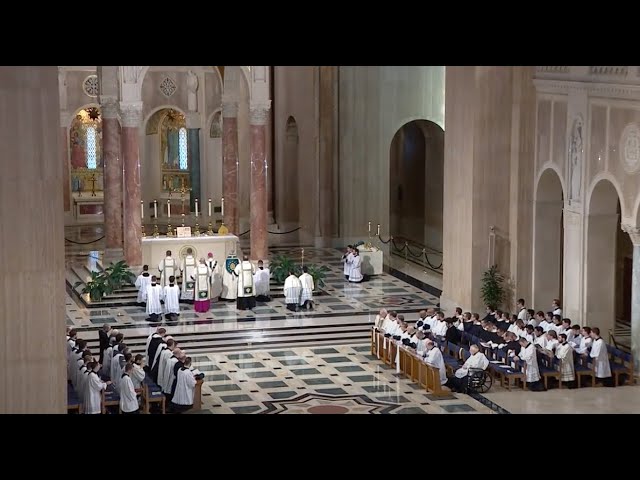
VIDEO – Pontifical Mass at the Shrine of the Immaculate Conception

Here is the video of the Pontifical Mass at the Shrine of the Immaculate Conception which I attended last Saturday. There was a new composition for the Mass. Archbishop Salvatore Cordileone of San Francisco was the celebrant.  Check out in particular 2:16:55, toward the end at the Salve Regina.

YouTube thumbnailYouTube icon

Liturgically, they did a good job. However, at some point we have to make choices about what “solemn” means. It doesn’t necessarily have to mean “slow”. Also, one of the great aspects of the traditional Rite is that things can happen at the same time, rather than the CHUNK (pause) CHUNK (pause) CHUNK (pause) CHUNK (pause) of the Novus Ordo.

One of the musical pieces I liked was the new Ave Maria which was in the indigenous language of Juan Diego.   This is the language in which Our Lady would have spoken with Juan Diego!   Surely with divine assistance for those words. Here’s a shot of the text.  In the video, start at about 2:06:30.

The vestments were by Altarworthy.  After the Mass I spoke with the gal who made them.  Very nice.   They had interesting elements you can’t easily see.  On dalmatics, etc., on both sides there are shields surrounded by golden roses and on each are titles of Mary from the Litany of Loreto.   I’d like to work with them.

It is important that we support these large scale and highly visible Pontifical Masses.  It is important that we support also composition of new liturgical music.

What we are doing is NOT locked in amber.

Remember:  WE ARE OUR RITES.  If that is true, then there is a dynamic between us and the rites that is simultaneous and continuous.   Inculturation.  There is an authentic inculturation.  It is authentic when what the Church has to give has logical priority over what the world has to offer.   We are our rites and our rites are us.  If we are not locked on amber, then neither are they.  They have been in continual development since the Church’s beginning.  Very slow.  Organic.  This is what was so violently interdicted in the 60s and 70s through the sudden imposition of an artificially composed rite.    But we are our rites!   Consider the damage that has been done to our Catholic identity because of that rupture of continuity.   We must reestablish continuity and we must also maintain dynamism.   The rites must be stable.  However, music can be new and renewing.  Music is pars integrans in our rites, an integrating part.  So, we should foster truly sacred music.   Music for sacred liturgical music must be 1) sacred and 2) artistic.   It must be in a sacred idiom or an idiom at least that is not in conflict with the sacred and it must be of high quality composition and performance.  I like the distinction made by Ratzinger about music that is for the People and music that comes from the People.  The first is more entertainment which the later conveys something deeply united to their culture, their “who”.   This is important in considering inculturation as well.

But I am running long.

Posted in Liturgy Science Theatre 3000 | Tagged , ,
23 Comments

My View For Awhile: Domum

My time in the District has been great. I pretty much unplugged from the mass of email and did some recreational reading. I met friends, and enjoyed the Mass today.

If you are near DC go to the Verrocchio exhibit at the National Gallery.  It isn’t huge but it is very good, worth the effort.

There is also an exhibit of a Spanish sculptor and maker of retablos, Alonso Berruguete.   This guy’s got game.

Today I was at the chapel at the chancery of the Archdiocese for Military Services.   Who can name this saint chaplain, depicted in the painting?

Dominicans on the way to Mass.   It reminds me of an old Roman joke which I won’t tell now.

One of the symbols of the basilica.

Still some colorful leaves.  I missed all the color in Wisconsin.

Speaking of color, which drink is mine?

Time to head home.

Many thanks to the wonderful people who stopped me after Mass to chat for a bit.

UPDATE:

Someone sent this.

“On the way out!”

Meanwhile, I also got this. Ever have problems with autocorrect?

Lorenzo de Medici thought that was hilarious.

He got it too.

That’s by Moroni, by the way. Innovative composition for a portrait. Way ahead of time!

Here’s a fascinating offering by Paolo Veronese. The Martyrdom and Last Communion of St Lucy. Her martyrdom is underway. Look at how she looks at the Host. Remember what they do to her eyes? And her’s is an important feast in December.

Really interesting painting.

And a jaunt into mannerism and Raphael Sanzio. I think he is playing with earlier Italian Madonna and Child, wherein Jesus grasps was he Virgins veil or robe, which I take to be a symbol of Him taking from her our humanity.

His tomb in Rome where I was a couple weeks ago.

I think I’ve written about the Latin on his tomb elsewhere. ILLE HIC EST RAPHAEL…

But wait… they are closing the aircraft doors.

Hurry!

TIMUIT QUO SOSPITE VINCI RERUM MAGNA PARENS ET MORIENTE MORI.

This here guy is Raphael. While he was alive Mother Nature was afraid that she would be defeated (by him painting nature more beautifully than she could) and while he was dying (she was afraid) that she would die (because he wouldn’t be around to paint her so beautifully anymore)!

There’s a lot in those words, but that’s Latin, friends. That’s Latin.

The flight attendants on this flight probably don’t know Latin but they are funny. “That’s Brittany in the back. Wave Brittany. She is Delta’s Worst Attendant of the Year and we’re glad to have her with us tonight.”

UPDATE:

From the last flight. I’d have to agree. All in all.

I was just asked if I was a Jesuit. If she only knew.

Posted in On the road, What Fr. Z is up to |
42 Comments

They pretend it’s about language, but in reality it’s about content.

My good friend of many years, Msgr. Hans Feichtinger, has an excellent piece today at Crisis.   He puts his finger directly on the problems flowing from Germany and on the whole environment that spawned the Amazon Synod (“walking together”).

Many of the problems we face today have their tendrils back into the notions of Karl Rahner, SJ.

Here is a salient slice:

The paradigm of adapting faith and the language of faith to conform with the ways in which people already speak, think, and live can easily become misleading. It is true that we need to speak the language that people speak “where they are”; otherwise, there cannot be any communication at all. But as the process of evangelization unfolds, it must be turned around—which is another aspect of “conversion”: we need to change and adapt our lives and language to the Faith, and not vice versa.

As a theoretical distinction this may seem obvious. In reality, however, this distinction has not been maintained. Rahner left us a theology with internal tensions that often cannot be reconciled, and with a fundamental ambivalence when it comes to how the faith relates to modernity. The “balance of Rahner’s vision,” as Patrick Burke notes, has not been maintained by his heirs and followers. As a consequence, the Church in Germany today is in adaptation mode. Its bishops are convinced that, in order to be “relevant,” they need to reform her doctrines and practices so that they are less removed from “the reality of people’s lives”. Many theological discussions today are deceptive: they pretend to be about language, whereas they are about content. They claim to call for development, whereas they demand a revolution.

This is exactly right.   They pretend it’s about language, but in reality it’s about content.

You can also see the immediate results of this in our sacred liturgical worship since the Council and the disastrous reforms perpetrated under the Rahnerian “spirit” of the Council.

You must read the whole thing.


Posted in Synod, The Drill | Tagged ,
24 Comments

Some reading for the road

As I prepare to make a trip, I find good reading is available.

First, from The Catholic Thing:

Drawing Bright Lines
by David Carlin

I’m an old man, and though I hope, and on certain days even go so far as to expect, that the Catholic Church in America will eventually recover from the very bad slump it has been in for the past few decades, I fear that I won’t live long enough to see this recovery.

When I’m on my deathbed (a piece of furniture I hope to avoid for at least a few more years), in order that I may die with a smile on my face, I will ask my grandchildren to bring me news of any signs of Catholic recovery. “Report to me,” I’ll ask them, “any bishop who has been brave enough to excommunicate a Catholic pro-abortion politician. And tell me about any diocese in which it has been discovered that there is not a single example of a homosexual priest.”

[…]

Next, something sent by a friend. At Church Life Journal:

When a Pope Writes and the Church Rebels
by Richard Yoder

A papal document seems to change Church teaching, dividing the Catholic world. Much of the controversy depends upon divergent disciplines around the reception of Holy Communion and different ideas of sin and grace. What seemed pious and holy yesterday is now condemned as heresy. Much confusion ensues. When asked to clarify what he means, the Pope refuses. Resistant bishops are threatened and punished. Invoking the Tradition of the Church, four bishops mount an ecclesiastical challenge of the document, with others soon joining. They become popular heroes, especially after their leader is publicly humiliated and demoted by Church authorities. Their partisans think of themselves as a remnant of the faithful, holding carefully to the Truth of Christ in a time of general darkness. They find their own positions foreshadowed in prophecy. They blame the Jesuits and the hierarchy for this period of widespread apostasy and confusion. They claim to discover the Jesuits teaching idolatry and compromising with paganism in their missionary efforts. They circulate their ideas through samizdat, popular polemics, and oppositional journalism. They become increasingly skeptical of Papal power.

Is this the Church of today, under Pope Francis? No, it is the Church of the early 18th century, in the tumultuous years after the Papal Bull Unigenitus. This landmark document of 1713 wrought a major trauma in the life of the Church when it first emerged. Unigenitus, like the wider Jansenist crisis to which it contributed, is mostly forgotten among the faithful today.

[…]

I am reminded of my own reminder that Popes come and go. Some are good. Some are bad. Some are significant and some aren’t. The same is to be said for Councils and for the decades we live in.

Whatever our situation is, this is the time that God wanted us to be here. Hence, it is an honor to serve in in this set of circumstances, no matter what they may bring. This is our time to make a difference.

Also, my friend Fr. Lang of the London Oratory has a good offering at Adoremus Bulletin. Fr James Bradley of the UK Ordinariate commented on Twitter that this helps fend off the reification of sacraments. His argument might be a touch subtle. However, this caught my eye. Remember… We Are Our Rites.

Newman’s love for the Divine Office illumined his path towards the Catholic Church. When in spring 1842, beset by doubts in the theory of the Via Media, he retired to Littlemore for a period of prayer and study, joined by a number of like-minded friends, the daily recitation of the Roman Breviary (with some omissions, such as the Marian antiphons) became a staple of their community life. After Newman and two of his companions were received into the Catholic Church on October 9, 1845 by Blessed Dominic Barberi (1792-1849), a small but significant change occurred in the community’s daily prayer. While they had recited the Latin text in the Anglicizing manner familiar from school and university, after that momentous day they adopted the Italianate pronunciation known as “Church Latin.”

Posted in The Drill | Tagged , , ,
8 Comments

The demonic Pachamama idol mess isn’t going to go away

The constant veneration and display of the demon Pachamama during the Amazon Synod must not be simply waved aside.



Two things for the record.

Card. Cupich of Chicago has defended the veneration of this demon idol, though that is not what he thinks it is.  Lifesite HERE  Chicago Catholic HERE on 6 November. He writes with anger about how “statues” were taken from Santa Maria in Traspontina and thrown into the river.  He write:

The artwork from the Amazon region depicted a pregnant woman, a symbol of motherhood and the sacredness of life, that represents for indigenous peoples the bond humanity has with our “mother earth,” much as St. Francis of Assisi portrayed in his Canticle of the Creatures.

He then admits that the statues were from a “pagan” culture.   But he then defends the … respect?… they were shown threw his understanding of inculturation.   The argument is… remarkable.  It’s not convincing, however.

Moving overseas, we find a defense of Pachamama veneration the Bishop Emeritus of San Cristóbal de las Casas, Felipe Arizmendi Esquivel in, of all places, the Vatican’s daily L’Osservatore Romano of 12 November!

?È una divinità la Pachamama?

Is Pachama a diety?

You won’t be surprised to learn that, NO!, indeed not. She is really a manifestation of our respect for the love of God through our respect for “mother nature” which God created. See?

Anni fa, durante un incontro del Celam che ho coordinato a Cochabamba, in Bolivia, sui diversi nomi di Dio nelle culture originarie del Cono Sud, ho chiesto a un indigeno aymara se, per la sua gente, la pachamama (la madre terra) e l’inti (il padre sole) erano dei e lui mi ha risposto: «Chi non ha ricevuto l’evangelizzazione li considera dei; per noi che siamo stati evangelizzati, non sono dei, ma i doni migliori di Dio». Risposta stupenda! Questo sono! Sono manifestazioni dell’amore di Dio, non dei.

Years ago, during a meeting of the CELAM which I coordinated in Cochabamba, Bolivia, on the different names of God in the original cultures of the Southern Cone, I asked an indigenous Aymara if, for his people, pachamama (mother earth) and the inti (the sun father) were gods and he replied: ‘Those who have not received evangelization consider them gods; for us who have been evangelized, they are not gods, but God’s best gifts ». Wonderful answer! This is it! They are manifestations of God’s love, not gods.

So there it is.

I guess that if it walks like a duck, swims like a duck, and quacks like a duck, then its a prairie dog.

UPDATE:

Meanwhile, the woman who was the “priestess” in the Vatican Gardens idol fiasco at the beginning of October, said what it was all about.  HERE

The female indigenous leader who planted a tree alongside Pope Francis in the Vatican Gardens ahead of the Amazon Synod was clear from the beginning about the syncretistic and pagan meaning of the act which, she explains, was intended to “satisfy the hunger of Mother Earth” and reconnect with “the divinity present in the Amazonian soil.”

In an October 4 statement that went under the radar during the Synod itself, Ednamar de Oliveira Viana, of the Maués region in Brazil, says of the Vatican Garden tree-planting ceremony: “To plant … is believing in a growing and fruitful life to satisfy the hunger of Mother Earth’s creation. This brings us to our origin by reconnecting divine energy and teaching us the way back to the Creator Father.”

I dunno.  That doesn’t sound good to me.

There are a lot of kabuki dances going on to explain away what sure looked like demonic idol veneration.

No… correction… kabuki is quite beautiful.  Nothing about the idol or the explanations is beautiful.  It is more like Three Card Monte with all the teamwork.  We got a dealer (also called a “tosser”… ya, I know…) and some shills in the crowd who place bets to give punters the idea they could win.  And their muscle will eventually manifest, who takes out some of the naysayers.

Posted in You must be joking! | Tagged
27 Comments





















